AI Agents in Operational Decisions: 2026 Guide
<p>Discover the vital role of AI agents in operational decisions. This 2026 guide equips executives with frameworks for successful deployment.</p>


AI agents are defined as autonomous coordinators of specialized analytical tools that decompose complex operational requests, route sub-problems to purpose-built models, and assemble governance-compliant recommendations at machine speed. The role of AI agents in operational decisions has moved from experimental to mission-critical in 2026, with organizations like KPMG, BCG, and MIT Sloan documenting concrete frameworks for deployment. This guide gives executives a direct map of the architecture, governance requirements, resource trade-offs, and real-world applications that determine whether an AI agent deployment succeeds or stalls.
How do AI agents orchestrate complex operational decisions?
AI agents orchestrate decision ecosystems by decomposing a single operational request into discrete sub-problems, each handled by a specialized agent built for that task. One agent may run supply optimization. Another runs simulation. A third handles analytics. An orchestrator coordinates all three, resolves conflicts between their outputs, and enforces policy precedence before assembling a final recommendation.
This decentralized architecture is what separates modern AI agent systems from older monolithic models. A monolithic model tries to solve everything with one large system. A multi-agent architecture assigns the right tool to the right problem, which produces faster, more accurate outputs with clearer audit trails.
The orchestrator’s job is not just coordination. It also enforces governance rules in real time, deciding which agent outputs are admissible and which require escalation. Without that layer, you get fast answers that may violate compliance requirements or contradict each other.
- Decomposition: The orchestrator breaks a complex request (e.g., “optimize our Q3 procurement plan”) into sub-tasks: demand forecasting, supplier scoring, budget constraint modeling.
- Routing: Each sub-task goes to the agent best equipped to handle it, whether that is an optimization engine, a generative model, or a simulation tool.
- Conflict resolution: When two agents produce contradictory outputs, the orchestrator applies policy precedence rules to determine which recommendation takes priority.
- Assembly: Final outputs are combined into a ranked set of recommendations with rationales, ready for executive review.
Pro Tip: Map your existing decision workflows before deploying a multi-agent system. Agents can only decompose problems that are clearly defined. Ambiguous workflows produce ambiguous agent outputs.
Narrow vs. wide decisions: how should AI agents be calibrated?
Not every operational decision benefits from the same type of AI support. MIT Sloan recommends calibrating AI use to decision complexity, applying analytical optimization to narrow tasks and generative AI to wide decisions. Executives who overgeneralize AI across all decision types waste resources and introduce unnecessary risk.

The table below clarifies the distinction and guides deployment choices.
| Decision Type | Characteristics | Best AI Approach | Example |
|---|---|---|---|
| Narrow | Structured, bounded, measurable | Optimization models, analytical AI | Inventory reorder point calculation |
| Wide | Ambiguous, exploratory, multi-stakeholder | Generative AI, synthesis agents | Strategic supplier diversification |
| Hybrid | Structured core with exploratory elements | Combined orchestration | Disruption response planning |
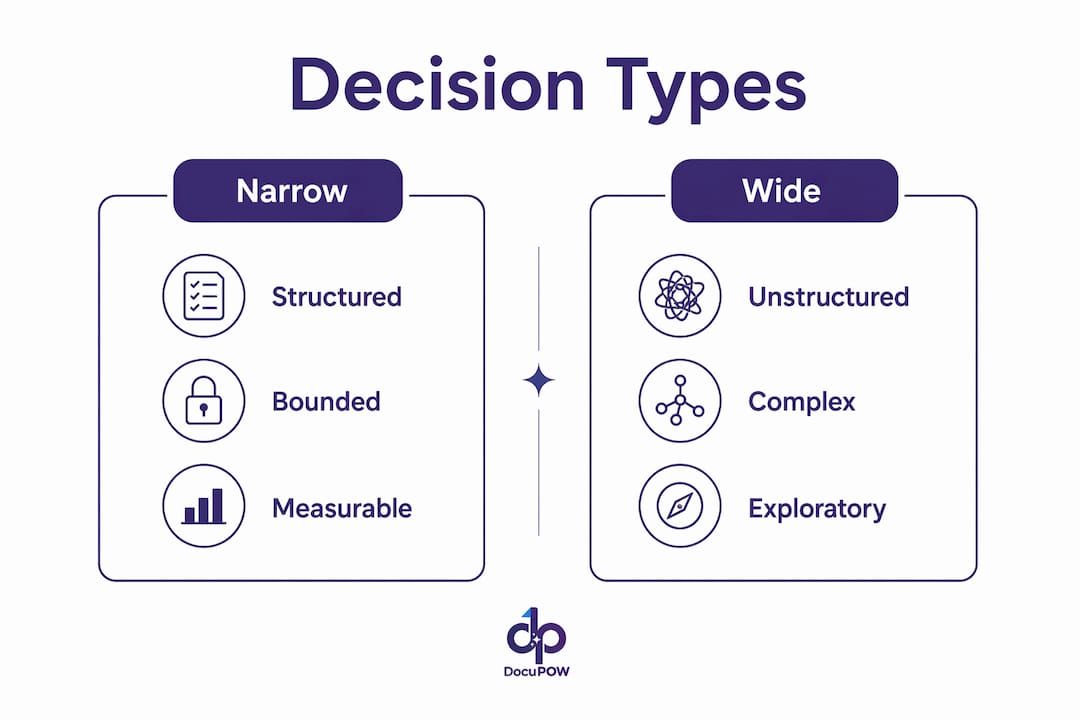
Narrow decisions have clear inputs, defined constraints, and measurable outcomes. Analytical AI and optimization models handle these well because the solution space is bounded. Wide decisions involve ambiguity, competing priorities, and judgment calls that require synthesis across many data sources. Generative AI agents excel here as exploration and synthesis tools, not as autonomous decision-makers.
Hybrid decisions are the most common in practice. A procurement disruption, for example, has a structured cost component (narrow) and a strategic supplier relationship component (wide). The right architecture combines both agent types under a single orchestrator.
Pro Tip: Before classifying a decision as narrow or wide, ask one question: “Can I write down every constraint that defines a correct answer?” If yes, it is narrow. If not, it is wide or hybrid.
What governance requirements make AI agent deployment work?
Enterprise AI agent deployment requires organizational readiness that goes well beyond technology capability. KPMG’s framework identifies three non-negotiable pillars: an updated IT operating model, clearly defined decision rights, and centralized monitoring for autonomous execution. Without all three, agents operate in a governance vacuum.
The most common mistake executives make is treating human oversight as a one-time approval step. Human-in-the-loop supervision must be runtime and continuous. Approving an agent’s initial plan does not protect you from the emergent behaviors that arise as agents interact with live data and other agents at scale.
Effective governance for AI agent systems requires the following:
- Embed governance as a pipeline operator. Controlled Agentic AI Systems that project actions into admissible space before execution provide auditability and replayability that approval gates cannot match.
- Define decision rights explicitly. Specify which decisions agents can execute autonomously, which require human confirmation, and which are always escalated to senior leadership.
- Implement centralized monitoring. A single observability layer across all agents lets you detect anomalies, track policy compliance, and intervene before errors compound.
- Design legible oversight moments. Plan-based oversight strategies reduce problematic agent actions by surfacing decision-critical moments to human reviewers in context, not after the fact.
- Avoid approval fatigue. Runtime governance that filters inadmissible actions automatically reduces the volume of human reviews to only the highest-stakes decisions.
The goal is not to eliminate human judgment. The goal is to focus human judgment where it matters most, while agents handle the structured execution work that does not require it.
What are the resource costs of multi-agent AI operations?
Multi-agent AI systems consume significantly more compute than single-model deployments. Agentic AI workloads can involve up to 1,000 times more tokens and approximately 90 tool calls per scenario compared to standard model queries. That scale translates directly into higher cloud spend and longer latency if left unmanaged.
The table below shows how key resource metrics shift between standard AI queries and agentic workloads.
| Metric | Standard AI Query | Agentic AI Workload |
|---|---|---|
| Token volume | Baseline | Up to 1,000x higher |
| Tool calls per scenario | 1–3 | ~90 |
| Latency | Low | Moderate to high |
| Cost per decision | Low | Significantly higher |
These numbers are not a reason to avoid agentic AI. They are a reason to architect it carefully. Cost-aware orchestration means setting token budgets per sub-task, implementing stopping rules when utility checks show diminishing returns, and routing low-complexity sub-problems to smaller, cheaper models.
Executives should treat token volume and tool call counts as primary performance budgets, the same way they treat compute costs in cloud infrastructure. An agent that runs 90 tool calls to answer a question that needed 10 is not more thorough. It is poorly designed. For a deeper look at agentic AI ROI benchmarks, the 2026 data shows clear patterns in where efficiency gains materialize and where overhead dominates.
How do AI agents improve supply chain and procurement decisions?
Supply chain and procurement are the two operational functions where the impact of AI agents is most documented and most measurable. BCG reports that AI agents assessed partial shipment options and production change scenarios in under an hour for senior management during a supply disruption. A human team performing the same analysis would typically need days.
The mechanism behind that speed is agent-driven supply chain scenario evaluation: multiple specialized agents simultaneously model different response options, score them against cost, risk, and service-level constraints, and return a ranked list with rationales. Executives receive a structured decision brief, not raw data.
Key applications where AI agents expand decision capacity in these functions include:
- Disruption response: Agents evaluate dozens of rerouting, substitution, and production adjustment scenarios simultaneously, delivering ranked options within minutes.
- Supplier risk scoring: Agents continuously monitor supplier financial health, geopolitical signals, and delivery performance to flag risks before they become disruptions.
- Procurement negotiation support: Agents synthesize market pricing data, historical contract terms, and demand forecasts to recommend negotiation positions.
- Demand-supply balancing: Agents coordinate across inventory, logistics, and production planning agents to recommend allocation decisions that minimize cost and stockouts simultaneously.
The common thread across all four applications is speed and scope. AI agents do not just answer faster. They evaluate a wider range of options than any human team can process in the same time window. That expanded decision space is where the real operational value lives. Executives who want to understand how AI agent orchestration integrates with existing enterprise systems will find the technical architecture matters as much as the use case selection.
Key takeaways
AI agents deliver operational value only when governance, resource management, and decision-type calibration are built into the architecture from the start, not added after deployment.
| Point | Details |
|---|---|
| Orchestration architecture matters | Decentralized multi-agent systems outperform monolithic models by routing sub-problems to specialized agents. |
| Calibrate by decision type | Apply optimization AI to narrow decisions and generative agents to wide or exploratory decisions. |
| Runtime governance is non-negotiable | One-time approval is insufficient; embed governance as a continuous pipeline operator with centralized monitoring. |
| Resource costs require active management | Token budgets and stopping rules prevent agentic workloads from generating excessive cost and latency. |
| Supply chain delivers the clearest ROI | BCG documents sub-hour scenario analysis that replaces multi-day human processes in procurement and logistics. |
Where most executives get AI agent deployment wrong
I have watched organizations invest heavily in AI agent technology and then underperform expectations because they treated deployment as a technology project rather than an organizational change. The agents worked. The organization was not ready for them.
The most consistent failure pattern is governance designed for the demo, not for production. A system that looks controlled in a sandbox behaves very differently when it is processing live procurement data, interacting with three other agents, and operating under time pressure. Emergent risks from large-scale agent interactions are not theoretical. Google DeepMind has flagged this as a serious concern for 2026 deployments. Executives need to take it seriously before they scale, not after.
The second failure pattern is approval fatigue. Teams design human-in-the-loop oversight that requires sign-off on too many decisions. Reviewers start rubber-stamping. The oversight becomes theater. The fix is runtime governance that filters inadmissible actions automatically, so human reviewers only see decisions that genuinely require judgment. That requires investment in continuous human oversight design, not just a checkbox in the deployment plan.
My honest recommendation: spend as much time on your governance model and IT operating model as you spend on selecting the AI technology itself. The technology is the easier problem.
— Sameer
How DocuPOW connects document intelligence to operational AI
Operational AI agents are only as good as the data they work with. When critical information is locked in purchase orders, invoices, shipping documents, and contracts, even the best agent architecture produces decisions based on incomplete inputs.
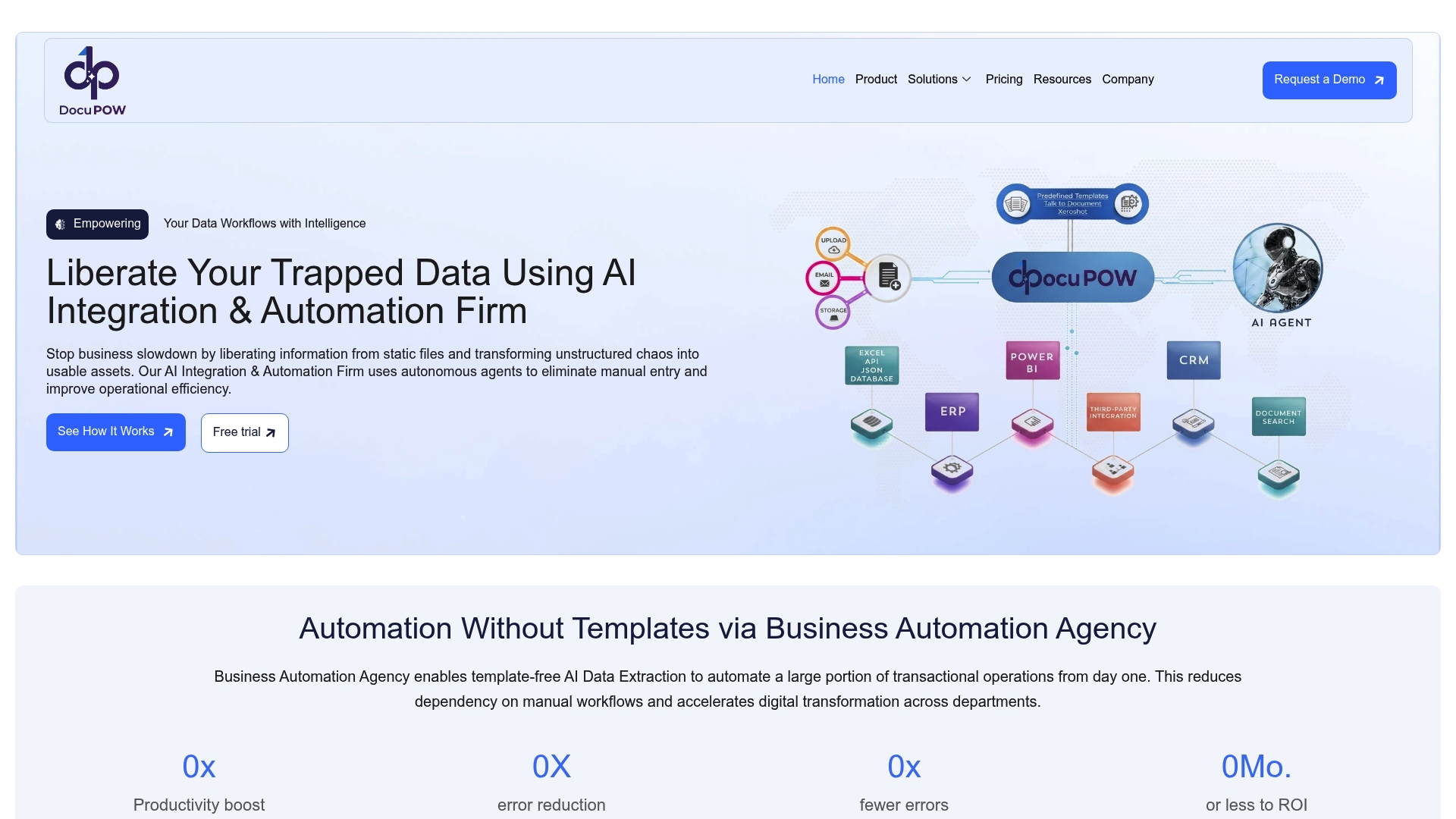
DocuPOW solves that problem directly. Its autonomous agents extract structured data from unstructured documents without rigid templates, feeding clean, context-aware data into your operational decision pipelines. For executives building AI-driven operations, DocuPOW provides the document intelligence layer that makes agent recommendations reliable. Explore the full range of document process automation benefits and see how DocuPOW integrates with enterprise AI workflows to improve both decision quality and operational efficiency.
FAQ
What is the role of AI agents in operational decisions?
AI agents autonomously coordinate specialized analytical tools to decompose complex operational requests, enforce governance rules, and deliver ranked recommendations. Their core function is expanding decision speed and scope beyond what human teams can process manually.
How do AI agents differ from traditional decision support tools?
Traditional tools present data for humans to analyze. AI agents act on that data by routing sub-problems to specialized models, resolving conflicts between outputs, and assembling governance-compliant recommendations without waiting for human direction at each step.
What governance model works best for AI agent deployments?
KPMG’s framework recommends embedding controls directly into the action-execution pipeline, defining explicit decision rights, and maintaining centralized monitoring. Runtime governance outperforms approval-gate models because it filters inadmissible actions before they execute.
How should executives measure AI agent performance?
Track token volume, tool call counts, decision latency, and compliance rate as primary operational metrics. BCG’s supply chain examples show that speed of scenario evaluation and quality of ranked recommendations are the most meaningful business-level indicators.
Are multi-agent AI systems too expensive for mid-size operations?
Cost depends on architecture design, not system size. Implementing token budgets, stopping rules, and cost-aware routing keeps agentic workloads within budget. The Green Software Foundation documents that unmanaged agentic workloads can consume up to 1,000 times more tokens than standard queries, making deliberate resource design mandatory regardless of organization size.
Recommended
See DocuPOW on your documents.
Stop building templates. Start extracting data.