Automate Manufacturing Document Processing in 2026
<p>Discover how to automate manufacturing document processing in 2026. Save costs, reduce manual efforts, and transform your operations today!</p>


Automated manufacturing document processing is the AI-powered extraction, classification, and routing of production data from documents like bills of materials (BOMs), request for quotations (RFQs), datasheets, and invoices without manual entry. The industry term for this technology is intelligent document processing (IDP). Manufacturers that implement it reduce procurement cost-per-transaction by 62% and save 14 hours of manual coordinator time per production line each week. That is not a marginal efficiency gain. It is a structural shift in how manufacturing operations handle information. Tools like Microsoft Power Automate, AI-powered IDP platforms, and agentic AI workflows from companies like NVIDIA now make this shift achievable for mid-size and enterprise manufacturers alike.
What does it take to automate manufacturing document processing?
Before you deploy any AI tool, you need three things in place: a classified document backlog, defined use cases, and a mapped workflow. Skipping any one of these is the most common reason automation projects stall after the pilot phase.
The core technology stack
The foundation of any manufacturing IDP deployment is an AI-powered extraction engine that reads documents without relying on fixed templates. Traditional optical character recognition (OCR) tools break when a supplier changes their datasheet layout. Modern IDP platforms use machine learning models trained on document context, not position, so they adapt to format variation automatically.

Beyond extraction, you need integration. Automating document workflows that connect to your Manufacturing Execution System (MES) and Enterprise Resource Planning (ERP) platform ensures data flows directly into production without redundant re-entry. Siemens demonstrates this with pre-configured integrations that combine Manufacturing Operations Management (MOM) and process automation to reduce costs and accelerate digital transformation.
The most advanced layer is agentic AI. NVIDIA’s Factory Operations Blueprint uses a centralized “factory manager” AI agent to coordinate specialized sub-agents for tasks like quality control and material transport. That same architecture applies to document workflows, where one orchestrating agent routes extracted data to the right downstream system.
Document types and automation readiness
| Document Type | Complexity | Automation Maturity | Best Approach |
|---|---|---|---|
| Datasheet spec extraction | Low | High | Fully automated IDP |
| Invoice processing | Low–Medium | High | IDP with ERP integration |
| BOM comparison | Medium | High | AI language model automation |
| RFQ processing | Medium–High | Moderate | IDP with human review |
| Complex quoting | High | Low | Human-in-the-loop required |
- Map your current document volumes by type before selecting a platform
- Prioritize document types with high volume and low structural complexity first
- Define exception thresholds: what confidence score triggers human review?
- Confirm your MES and ERP systems have accessible APIs before committing to a platform
Pro Tip: Audit your top three highest-volume document types and calculate the hours spent on manual handling per week. That number becomes your baseline ROI target before you write a single procurement request.
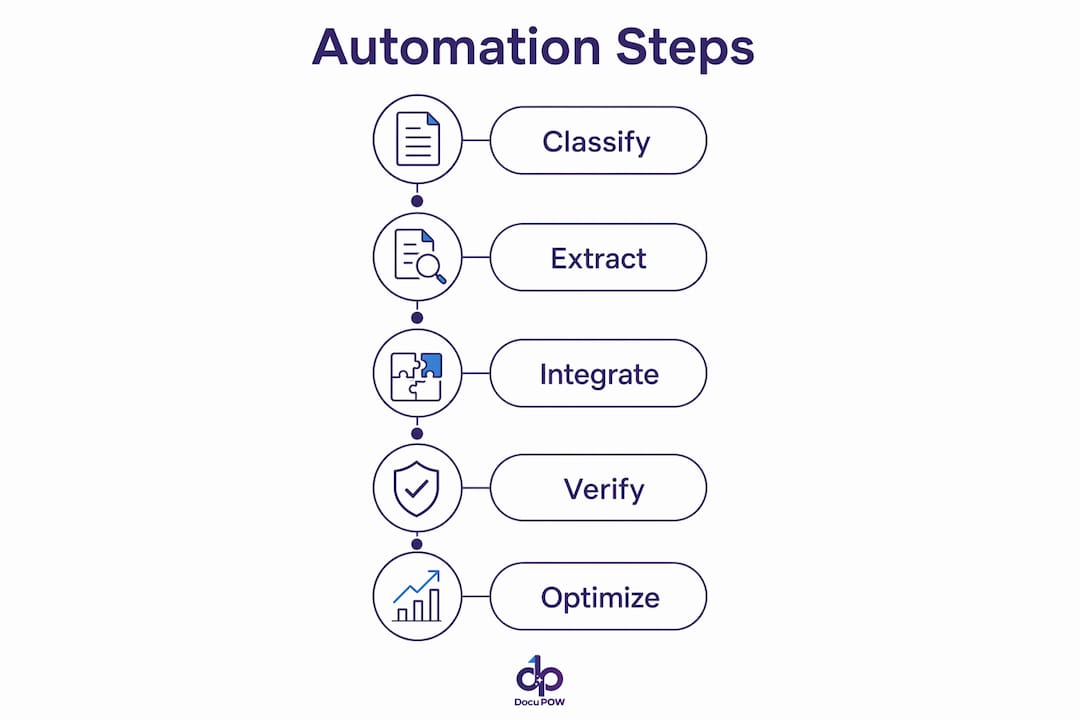
How to implement automated document processing step by step
A phased implementation reduces risk and builds internal confidence. The following six steps reflect how successful manufacturing teams deploy IDP without disrupting live production.
-
Prioritize high-volume, low-complexity documents first. BOM comparison is the best starting point for most manufacturers. AI-powered BOM automation saves 4–8 hours per comparison and delivers 60–80% faster processing at 90–95% accuracy. That ROI is fast enough to justify the next phase of investment.
-
Classify and clean your existing document backlog. This step is the most critical and the most skipped. Classifying and cleaning documents before deployment significantly reduces AI errors during processing. Garbage in, garbage out applies directly to IDP. Spend time here before touching any automation software.
-
Pilot with real documents, not synthetic ones. Testing IDP tools with actual BOMs, RFQs, and datasheets is non-negotiable because real documents contain formatting inconsistencies and data quality issues that synthetic test sets never reveal. Run your pilot on 200–500 real documents across at least three document types.
-
Integrate with MES, ERP, and workflow tools. Microsoft Power Automate is a common integration layer for mid-market manufacturers. For enterprise deployments, direct API connections to SAP, Oracle, or similar ERP platforms give you tighter data governance. Connecting document automation to existing systems is where most of the long-term efficiency gains are locked.
-
Deploy with human-in-the-loop exception handling. Full autonomy is not the goal at launch. Configure your IDP platform to flag low-confidence extractions for human validation. This keeps error rates low while the model learns your specific document formats. Accuracy improves with each validated exception.
-
Measure ROI and scale gradually. Track cost-per-transaction, processing time, and error rate weekly for the first 90 days. Use those numbers to build the business case for the next document type. Scaling too fast before the first use case is stable is a common and costly mistake.
Pro Tip: Do not start your pilot with your most complex document type. Start with the one your team processes most often. Early wins build the organizational trust that funds the harder automation work later.
How do you troubleshoot common pitfalls in document workflow automation?
Most automation failures trace back to the same root causes. Knowing them in advance saves months of rework.
Data quality problems are the leading cause of poor IDP accuracy. If your scanned documents are low resolution, inconsistently named, or stored across disconnected file systems, the AI model has no reliable input to work from. The remediation phase, classifying and cleaning existing documents, is the most overlooked step in the entire process.
Siloed automation projects create a second major failure mode. Manufacturers that automate document extraction without connecting it to MOM and ERP systems end up with accurate data sitting in a separate tool that nobody queries. Treating process automation and MOM as one integrated project rather than separate initiatives is the approach that produces lasting results.
Overconfidence in full autonomy is the third pitfall. Human-in-the-loop workflows where AI flags exceptions for human validation consistently outperform fully autonomous deployments in accuracy and reliability. Any vendor claiming 100% autonomous accuracy on complex manufacturing documents is overstating what current technology delivers.
The manufacturers who succeed with document automation are not the ones who deploy the most AI. They are the ones who define the clearest exception-handling rules before they go live.
Additional pitfalls to watch:
- Skipping linked systems testing before go-live, which causes silent data errors in ERP
- Underestimating user training time for the exception review interface
- Setting confidence thresholds too high, which routes too many documents to human review and defeats the efficiency gain
- Treating automation as a one-time project rather than a continuous improvement program
Classic OCR vs. IDP vs. agentic AI: which approach fits your operation?
The right technology depends on your document complexity, integration requirements, and internal technical capacity. These three approaches represent distinct levels of capability.
| Approach | Accuracy on Variable Formats | Integration Ease | Scalability | Best For |
|---|---|---|---|---|
| Classic OCR | Low | Moderate | Low | Fixed-format, high-volume forms |
| Template-based extraction | Medium | Moderate | Low | Consistent supplier documents |
| AI-powered IDP | High | High | High | Mixed document types, variable formats |
| Agentic AI workflows | Very High | Requires API expertise | Very High | Complex multi-step manufacturing operations |
| Rule-based automation | Medium | High | Medium | Predictable, structured workflows |
Classic OCR tools like ABBYY FineReader work well for fixed-format documents where layout never changes. The moment a supplier updates their datasheet template, accuracy drops sharply. Template-based extraction tools add a layer of structure but still require manual template updates for each new document variant.
AI-powered IDP platforms read document context rather than position. They handle format variation without manual reconfiguration. For manufacturers dealing with dozens of suppliers and hundreds of document variants, this is the practical choice. AI in manufacturing documentation has matured to the point where zero-shot extraction, meaning the model processes a new document type without prior training examples, is now production-ready.
The shift in 2026 is toward centralized agentic AI workflows that coordinate specialized AI agents for complex tasks. For document processing, this means one orchestrating agent that routes extracted data, triggers validation steps, and escalates exceptions automatically. Cloud-based solutions offer faster deployment and lower upfront cost. On-premise solutions give you tighter data control, which matters for manufacturers handling export-controlled technical documents.
Key takeaways
Manufacturers that automate document processing with AI-powered IDP, proper data remediation, and human-in-the-loop exception handling achieve the fastest and most durable efficiency gains.
| Point | Details |
|---|---|
| Start with high-volume, simple documents | BOM comparison and datasheet extraction deliver the fastest ROI with 60–80% faster processing. |
| Clean data before automation | Classifying and remediating your document backlog is the most critical step for reliable AI accuracy. |
| Human oversight is not optional | Human-in-the-loop exception handling outperforms fully autonomous AI on complex manufacturing documents. |
| Integrate with MES and ERP | Document automation only delivers full value when extracted data flows directly into production systems. |
| Treat automation as a phased program | Scale gradually from proven use cases rather than deploying broadly before accuracy is validated. |
Why most manufacturers are still thinking about this wrong
I have watched manufacturers spend six months selecting an IDP platform and two weeks on data preparation. That ratio is backwards. The technology decision matters far less than the quality of the documents you feed into it.
The teams that get the best results treat the remediation phase, the classification and cleaning of existing documents, as a dedicated project with its own timeline and owner. They do not bolt it onto the tail end of vendor selection. They do it first.
There is also a tendency to frame document automation as a cost-cutting exercise. That framing limits ambition. The real opportunity is speed. When a BOM comparison that took a senior engineer four hours now takes twelve minutes, that engineer is available for the work that actually requires judgment. That is a capability gain, not just a cost reduction.
I am also skeptical of any deployment roadmap that promises full autonomy within the first year on complex document types like RFQs or technical quoting packages. The agentic AI workflows coming out of NVIDIA and similar organizations are genuinely impressive. But production-scale reliability on high-stakes manufacturing documents still requires human validation at the exception layer. Build that into your architecture from day one, not as a workaround, but as a feature.
The manufacturers who will lead in the next three years are not waiting for perfect AI. They are building the data infrastructure and exception-handling discipline now so that when the next generation of models arrives, they can absorb it immediately.
— Sameer
How DocuPOW accelerates manufacturing document automation
DocuPOW is built specifically for the document complexity manufacturers deal with every day. Its zero-shot extraction technology processes new document formats without requiring template configuration, which means your team is not rebuilding rules every time a supplier changes their layout. DocuPOW’s AI agents understand document context, not just position, so accuracy holds across BOMs, RFQs, datasheets, and invoices at scale.
For manufacturing teams ready to move from manual coordination to automated data flows, DocuPOW connects directly to MES and ERP systems and delivers real-time data extraction with built-in exception handling. Explore the DocuPOW manufacturing solution to see how global manufacturers are cutting manual document handling and improving data accuracy across their operations.
FAQ
What is intelligent document processing in manufacturing?
Intelligent document processing (IDP) is AI-powered technology that extracts, classifies, and routes data from manufacturing documents like BOMs, invoices, and datasheets without manual entry. Unlike classic OCR, IDP adapts to variable document formats using machine learning models trained on document context.
How long does it take to implement document automation in manufacturing?
A focused pilot on one document type, such as BOM comparison or invoice processing, typically takes 6–12 weeks from data preparation to live deployment. Full-scale rollout across multiple document types and ERP integration generally takes 6–12 months depending on data quality and system complexity.
What documents should manufacturers automate first?
Start with high-volume, low-complexity documents. Datasheet spec extraction and standard invoice processing offer the fastest accuracy gains. BOM comparison automation saves 4–8 hours per comparison and is a strong second priority once invoice processing is stable.
Is fully autonomous document processing reliable for manufacturing?
Not yet for complex document types. Human-in-the-loop verification remains the standard for production-scale accuracy, where AI flags low-confidence extractions for human review rather than processing them autonomously. Full autonomy is reliable for simple, structured documents like standard purchase orders.
How does document automation integrate with ERP and MES systems?
Most modern IDP platforms connect to ERP systems like SAP and Oracle via API, pushing extracted data directly into production workflows. MES and ERP integration eliminates redundant data entry and reduces compliance risk by maintaining a single source of truth across manufacturing operations.
Recommended
See DocuPOW on your documents.
Stop building templates. Start extracting data.