Enterprise Search in 2026: The IT Leader’s Buying Guide
Unlock the future of Enterprise Search with our 2026 guide. Learn how AI-driven solutions enhance knowledge retrieval and streamline workflows.

TL;DR:
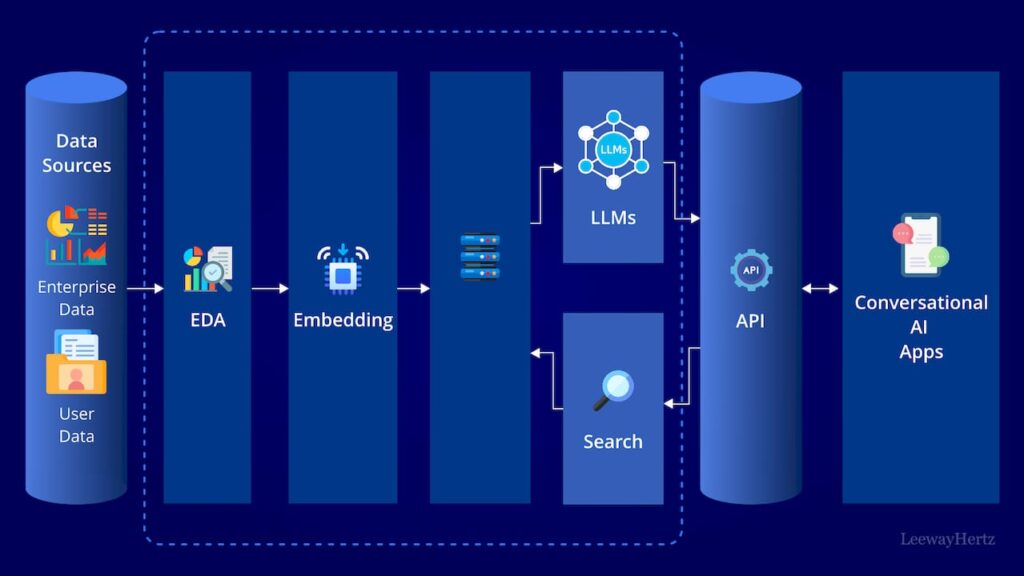
Modern enterprise search combines AI-driven semantic retrieval, grounding, and actions to surface accurate answers from organizational data.
A successful deployment requires validating retrieval quality, grounding accuracy, and governed workflows through a scoped pilot in four to six weeks.
Modern enterprise search is a permission-aware, AI-driven knowledge layer that combines semantic retrieval, Retrieval-Augmented Generation (RAG), and optional agentic actions to surface accurate answers from your organization’s documents and systems. The short version for procurement teams: evaluate any platform as long-lived infrastructure, not a point solution, and validate retrieval quality, grounding, and governed action triggers in a scoped pilot before committing to full rollout.
Key facts to anchor your evaluation:
Many digital workers say they waste too much time hunting for information or chasing updates. IDC estimates that a knowledge workforce can lose significant salary costs annually from failed search and content recreation.
-
Enterprise search remains primarily a data governance challenge — models alone cannot fix ambiguous, duplicated, or stale documents.
-
Trust anchors to require from any vendor: SOC 2 certification, RAG with explicit grounding and citations, and a connector catalog that covers your live systems. DocuPOW meets all three.
Table of Contents
-
What architecture and data work does reliable search actually require?
-
DocuPOW runs pilots that prove retrieval and automation outcomes
What does enterprise search actually mean in 2026?
The term has outgrown its original definition. Legacy keyword search matched terms to documents. Modern AI-powered enterprise search interprets intent, enforces role-based context, and in mature implementations, triggers governed actions across connected systems.
The technical stack underneath that experience has three layers working together:
-
Retrieval: Hybrid retrievers combine BM25 (exact-match keyword) with dense vector embeddings for conceptual matching. A strong reranker sits on top to balance precision and recall before any answer is generated.
-
Grounding: RAG feeds retrieved passages into a large language model (LLM) to generate a cited, verifiable answer. Without reliable retrieval, RAG produces confidently wrong answers — a failure mode worse than a blank result.
-
Agentic layer: Multi-hop reasoning, workflow triggers, and human-in-the-loop checkpoints let the system move from answering a question to initiating an approved action (submitting a request, routing a ticket, flagging a discrepancy).
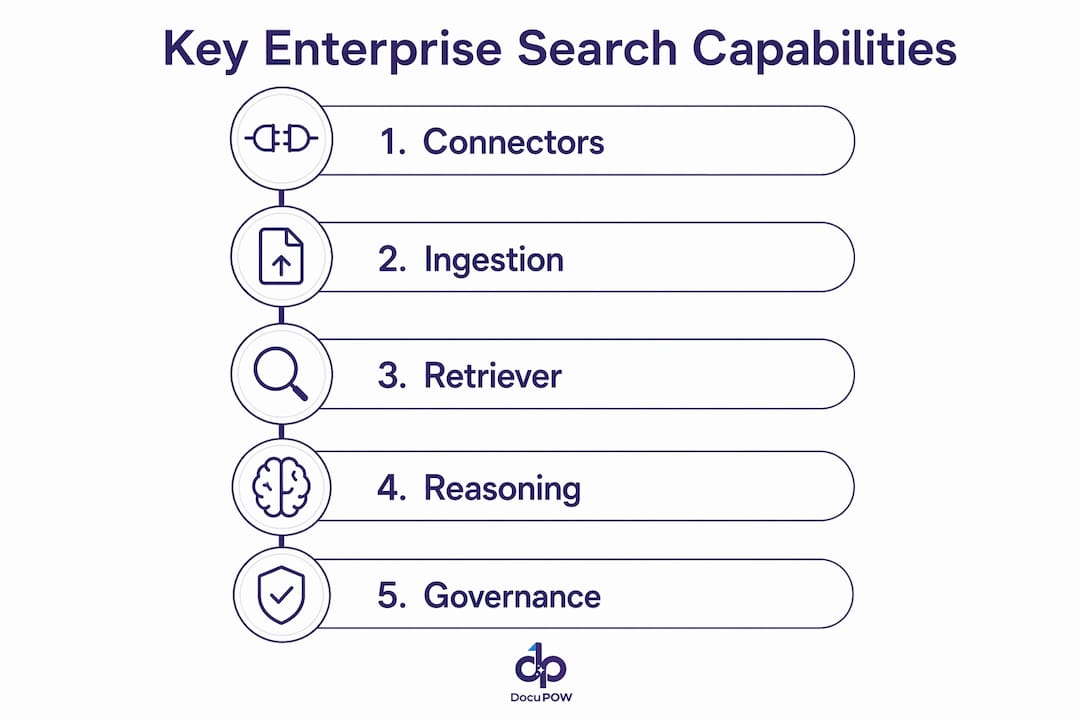
A useful mental model for the architecture: connectors → ingestion/metadata/permissions → retriever/ranker → reasoning/agent layer → actions and audit log. Every layer must be designed; skipping permissions at ingestion creates expensive remediation later.
Traditional keyword-based search cannot handle this level of context or access enforcement. That gap is why most organizations treating search as a solved problem are quietly losing productivity and compliance ground.

What capabilities should you require from any platform?
Start with three non-negotiables: permission-aware retrieval, semantic ranking, and explicit grounding with citations. Everything else is a tier-two requirement.
Retrieval and ranking:
-
Hybrid retrieval (BM25 + dense vectors) with a configurable reranker
-
Knowledge-graph support for entity relationships across documents
-
Multimodal inputs: text, tables, PDFs, scanned images via OCR
Grounding and reasoning:
-
RAG with provenance: every generated answer cites its source document and passage
-
Agentic orchestration with multi-hop reasoning and configurable action triggers
-
Explicit “I don’t know” policy when retrieval confidence falls below threshold
Security and compliance:
-
SOC 2 Type II and ISO 27001 certification
-
TLS encryption in transit, AES-256 at rest
-
RBAC/ABAC at the document level, SSO via SAML/OIDC
-
Audit logging for every query, retrieval event, and action taken
Operations:
-
Pre-built connector catalog (HRIS, ITSM, ERP, CRM, SharePoint, Confluence, Slack)
-
Incremental indexing with delta detection per source
-
Monitoring and observability dashboards; throttling and partition awareness
Pro Tip: Map each capability to a specific document-automation use case before vendor demos. Contracts need field-level security and version provenance. Invoices need structured extraction plus semantic search. HR policies need role-scoped answers. A generic demo will not surface these gaps — your test dataset will.
What architecture and data work does reliable search actually require?
The biggest costs in any enterprise search project are integration and permissions, not licenses. Integration effort dominates total implementation cost, and teams that underestimate it pay for it in scope changes.
Connector strategy:
-
Decide live (API-federated, real-time) vs. indexed (crawled, scheduled) per source based on freshness requirements and API rate limits.
-
Prioritize connectors by value: identity directory and HRIS first (they anchor permissions), then ITSM and ticketing, then ERP/CRM, then shared drives and collaboration logs.
-
Each enterprise data source connector adds roughly 2–4 weeks of engineering time.
Ingestion pipeline:
-
Use layout-aware parsing and OCR quality controls; raw text dumps materially degrade RAG reliability compared to document intelligence with section hierarchy.
-
Tag provenance at ingestion: source system, document version, authoritative owner, and last-verified date.
-
Deduplicate aggressively. Duplicate content is one of the top causes of conflicting answers.
Document preparation:
-
Canonicalize authoritative sources before indexing (one HR policy, not five versions across three drives).
-
Build curated answer banks for high-risk query intents (benefits, compliance, legal) before exposing broad corpora.
Pro Tip: Run a permissions audit before writing any ingestion code. Map every Active Directory or LDAP group, including nested groups, and validate late-binding vs. early-binding security patterns. Teams that skip this step routinely absorb $30,000–$60,000 in unplanned remediation.
How do you run a pilot that actually proves value?
A scoped pilot must validate three things: retrieval relevance on your corpus, ground-truth accuracy of generated answers, and safe execution of governed action flows. A scoped pilot validating retrieval quality, grounding accuracy, and governed action flows typically runs four to six weeks, including data preparation and connector configuration.
| Phase | Duration | Key Activities |
|---|---|---|
| Discovery and scoping | Week 1 | Define target domain, query intents, success KPIs |
| Data prep and connectors | Weeks 1–2 | Permissions audit, ingestion pipeline, source canonicalization |
| Baseline testing | Week 3 | Precision@k, recall, hallucination rate on labeled query set |
| Closed-user testing | Weeks 4–5 | 20–50 internal users, time-to-answer, ticket deflection tracking |
| KPI validation and go/no-go | Weeks 4 and 5 | Compare results to acceptance criteria; document gaps |
Metric definitions to use:
-
Precision@k: share of top-k results that are relevant to the query intent
-
Hallucination rate: percentage of generated answers containing unsupported claims
-
Time-to-answer: median seconds from query submission to answer rendered
-
Ticket deflection rate: queries resolved without human escalation
-
Automation completion rate: governed action flows completed without error
Go/no-go checklist: permissions validated end-to-end; acceptable precision on target intents; audit trail and explainability in place; latency within SLA at expected query load.
For procurement, prioritize platforms with a platform-plus-services model — vendors who provide professional services for connector integration and permissions work, not just software licenses. Evaluate their connector catalog, SLA commitments, pricing model (usage vs. seat), and integration roadmap before signing.
From pilot to production: what does the rollout look like?
Treat the search layer as an owned platform with SRE ownership, data stewardship, and product governance. A one-time deployment without ongoing ownership degrades within months.
Rollout milestones:
-
Pilot on one high-value domain (IT or HR) — narrow, curated answer engines are more reliable than broad general-purpose search over uncontrolled corpora.
-
Limited production with a defined user group and monitored KPIs.
-
Domain answer engines for two or three additional business units.
-
Enterprise rollout with federated governance.
-
Continuous evaluation: model refresh cadence, connector health checks, permission drift audits.
| Role | Responsibility |
|---|---|
| Platform owner | Roadmap, vendor relationship, SLO ownership |
| Data steward | Source canonicalization, provenance tagging, content governance |
| SRE | Uptime, latency monitoring, connector health |
| Security/compliance | Permission audits, access-control testing, audit log review |
| Business owner | Domain KPIs, user adoption, curated answer bank maintenance |
For adoption, phase rollout by domain, train power users first, and publish adoption KPIs alongside technical ones. Teams that see their own deflection rates tend to self-reinforce the behavior.
How do you calculate and present ROI?
Measure time saved, ticket deflection, automation completed, and error reduction tied to high-value document workflows. Forbes guidance on AI enterprise search recommends presenting a clear example calculation to finance stakeholders.
A simple formula: (average minutes saved per query × daily queries × working days × average hourly labor cost) + (deflected tickets × average handle-time cost) = annual productivity value.
| KPI | What it measures |
|---|---|
| Time-to-answer | Median seconds from query to answer; baseline vs. post-deployment |
| Ticket deflection rate | Queries resolved without escalation as a share of total queries |
| Automation success rate | Governed action flows completed without human correction |
| Cost per automated transaction | Total platform cost ÷ completed automation actions |
| Compliance incident reduction | Audit findings tied to stale or inaccessible policy documents |
Vendor case studies typically highlight pilot deflection percentages, average handle-time reduction, and headcount redeployment. Require vendors to show these metrics from a deployment comparable in size and document complexity to yours, not just a marquee logo.
Where do enterprise search projects fail?
The biggest failure modes are garbage-in data, permissions mismatch, and brittle answer generation. Each is preventable with upfront governance work.
-
Stale or duplicated content: Index only canonicalized, versioned sources. Stale documents produce confidently wrong answers that erode user trust faster than a blank result.
-
Permissions drift: Access controls that were correct at deployment drift as org structures change. Schedule quarterly permission audits and automate group-membership sync where possible.
-
Hallucination without guardrails: Require an explicit “I don’t know” policy and multi-retriever pipelines. A single retriever that misses relevant passages sends the generator off-track.
-
Hidden platform limits: Cloud-managed search platforms carry field/attribute caps and partition limits that cause production incidents if not tracked in the architecture roadmap. Document these constraints before go-live.
-
No human review gate for actions: Any agentic action that touches a system of record needs a human-in-the-loop checkpoint until the automation completion rate is proven over at least 90 days.
An enterprise AI strategy that skips governance planning typically stalls at the pilot stage — not because the technology fails, but because the organization cannot agree on who owns the answer.
Why DocuPOW fits this architecture
DocuPOW is built for exactly the use case this guide describes: agent-based, template-free document extraction combined with AI-powered semantic search and multi-step workflow orchestration. It does not require rigid templates, which means it handles the messy, heterogeneous document types that break rules-based systems — contracts, invoices, HR forms, compliance filings.
Key capabilities relevant to the buyer criteria above:
-
Template-free extraction from any document type (PDFs, scanned images, structured forms)
-
Agentic orchestration with configurable workflow triggers and back-office automation
-
AI-powered semantic search and query across extracted document data
-
Pre-built enterprise connectors for ERP and CRM via API
-
Human-in-the-loop audit review at configurable checkpoints
-
Real-time analytics and predictive insights dashboards
-
SOC 2 compliance and enterprise-grade security controls
Sample pilot outline aligned to the checklist above: Scope to one document-heavy domain (procurement or AP). Connect two to three source systems via DocuPOW’s API connectors. Define five to ten target query intents with labeled ground-truth answers. Run baseline precision and hallucination tests in week three. Measure ticket deflection and time-to-answer over a closed user group in weeks four and five. Go/no-go at week six based on agreed KPIs.
Pro Tip: Use DocuPOW’s AI data extraction guide to pre-define the extraction fields and provenance tags for your pilot corpus before ingestion. Clean metadata at the source cuts reranker errors significantly.
Key Takeaways
AI-driven enterprise search requires treating retrieval, grounding, and governance as infrastructure — not a one-time software purchase — and validating all three in a scoped pilot before full rollout.
| Point | Details |
|---|---|
| Search is infrastructure | Budget for ongoing SRE ownership, permission audits, and model refresh — not just a license fee. |
| Pilot narrow first | Start with one curated domain (IT or HR) before expanding to broad corpora to keep accuracy predictable. |
| Permissions dominate cost | Active Directory complexity is the top cost driver; audit nested groups before writing any ingestion code. |
| Require grounding and citations | RAG without reliable retrieval produces confidently wrong answers; insist on provenance in every vendor demo. |
| DocuPOW for document automation | DocuPOW’s template-free extraction, agentic orchestration, and SOC 2 compliance align directly with the pilot criteria above. |
The case for treating search like a product, not a project
The conventional wisdom in enterprise IT is to treat search as a feature — something you bolt onto an intranet or a service desk and tune once. That framing is what causes most implementations to quietly degrade over 18 months.
What actually works in the field: assign a platform owner with an SLO and a quarterly roadmap review. The search layer is a product with users, a backlog, and a release cadence. The moment you stop treating it that way, permission drift accumulates, connector health degrades, and users revert to emailing colleagues.
Three practical tips worth acting on immediately: First, start with canonical sources only. Indexing everything is tempting and almost always wrong. Second, isolate high-risk query intents (benefits eligibility, compliance deadlines, contract terms) into curated answer banks before exposing them to the general retriever. Third, assign a permissions auditor as a named role before the pilot starts. Not a committee — one person who owns the AD/LDAP mapping and signs off on it.
The long-term stewardship point is the one most procurement teams skip in the RFP. Ask every vendor: what does your professional services team do after go-live? The answer tells you more about real TCO than any pricing sheet.
DocuPOW runs pilots that prove retrieval and automation outcomes
Faster answers and fewer escalations are measurable within six weeks when the pilot is scoped correctly. DocuPOW’s pilot engagements are designed to validate retrieval relevance, grounding accuracy, and governed automation flows against your actual documents and query intents — not a generic demo dataset.
What a DocuPOW pilot delivers: a scoped connector configuration for two to three of your live systems, a labeled test corpus with ground-truth answers for your target intents, baseline and post-deployment KPI measurements (time-to-answer, deflection rate, automation completion), and a go/no-go report your team can present to finance and security stakeholders.
The timeline is four to six weeks. The deliverables are yours to keep regardless of the procurement outcome. If your team is evaluating AI workflow automation for document-heavy operations, the pilot is the right first step. Request a scoped pilot engagement at docupow.ai.
Useful sources and further reading
Annotated resources for procurement and technical teams building internal business cases:
-
The Enterprise Search Reality Check (Gradient Flow) — The most direct analysis of why data governance, not model capability, determines enterprise search outcomes. Essential reading before any RFP.
-
The Fundamentals of AI Enterprise Search (Forbes) — Covers hybrid retrieval architecture and KPI frameworks; useful for technical sections of a business case.
-
Enterprise Search Software Development Cost (Raft Labs) — Detailed cost breakdown by build tier; the permissions-complexity analysis is the most accurate TCO framing available.
-
When Search Becomes Infrastructure (Aaxis.ai) — Covers platform limits and operational monitoring requirements at enterprise scale.
-
DocuPOW Intelligent Document Automation Platform — Primary resource for DocuPOW’s agent-based extraction, semantic search, and enterprise security posture.
-
Enterprise AI API Integration Examples (DocuPOW) — Practical connector and API integration patterns for enterprise deployments.
“Cognitive search platforms will become the brains of accurate agentic AI.” — Forrester, as cited by Kore.ai’s enterprise search analysis
FAQ
What is enterprise search in simple terms?
Enterprise search is a single interface that lets employees find information across all of an organization’s internal systems — documents, databases, chat, and applications — while respecting each user’s access permissions.
How does AI improve enterprise search over keyword search?
AI-powered search interprets the intent behind a query, not just the words, and uses RAG to generate cited answers from retrieved content rather than returning a list of links.
What security certifications should an enterprise search vendor have?
At minimum, require SOC 2 Type II and ISO 27001, plus document-level RBAC, SSO via SAML/OIDC, TLS encryption in transit, and full audit logging for every query and action.
A scoped pilot validating retrieval quality, grounding accuracy, and governed action flows typically runs four to six weeks, including data preparation and connector configuration.
Can DocuPOW handle unstructured documents like contracts and invoices?
Yes. DocuPOW uses template-free, agent-based extraction that understands document context without predefined rules, making it suited for contracts, invoices, HR forms, and compliance filings across enterprise workflows.
Recommended
See DocuPOW on your documents.
Stop building templates. Start extracting data.