Compliance Documentation: Your Audit-Ready Enterprise Guide
Elevate your Compliance Documentation strategy with AI orchestration. Streamline audits, reduce compliance debt, and ensure audit-ready operations!


TL;DR:
- Implement agentic AI orchestration for compliance documentation by conducting an obligation inventory and piloting workflows. This approach automates evidence generation and ensures immutable, audit-ready logs, reducing retrieval times and regulatory risk. Starting with high-impact document flows enhances efficiency, aided by flexible AI agents, workflow automation, and verified security controls.
Adopt agentic AI orchestration for compliance documentation now. That is the direct recommendation. Start by running a legal and regulatory obligation inventory across your enterprise, stand up a two-to-six-week pilot on one or two high-risk document flows, and enable immutable audit logging from day one. DocuPOW’s agent-based platform handles template-free extraction, multi-step workflow orchestration, and human-in-the-loop review gates, making it the practical choice for IT, finance, operations, and compliance teams that need defensible evidence without manual assembly.
Quick wins you can expect:
- Faster audit response times because evidence is generated as a byproduct of normal operations, not assembled after the fact
- Lower compliance debt through automated change propagation when regulations shift
- Auditable records by design, with time-stamped, immutable logs that satisfy SOC 2, ISO 27001, and sector-specific regulators
Pro Tip: Before your pilot, map which document flows currently require the most manual retrieval time during audits. Those are your highest-ROI starting points.
Table of Contents
- Why does fragmented compliance data create audit risk?
- What documents does your enterprise actually need to capture?
- What technical architecture makes compliance documentation audit-ready?
- How do you run a pilot-to-scale compliance automation program?
- How do you automate controls without losing human oversight?
- What security and regulatory requirements should you validate with vendors?
- How do you measure the ROI of compliance documentation automation?
- How does DocuPOW address these compliance documentation challenges?
- What are the biggest risks in AI-based compliance automation, and how do you mitigate them?
- How do you trial and integrate DocuPOW in your existing compliance workflows?
- Key Takeaways
- Why agentic automation changes the compliance documentation equation
- Ready to run your compliance documentation pilot with DocuPOW?
- Useful sources
- FAQ
Why does fragmented compliance data create audit risk?
Compliance debt accumulates when documentation is siloed, inconsistently maintained, or stored in ways that make retrieval slow. Examiners treat slow evidence retrieval as a red flag, not a minor inconvenience. Three failure modes drive most audit exposure: hidden obligation gaps (requirements that were never logged), change propagation failures (a regulation updates but downstream controls do not), and slow retrieval during a live regulatory review.
The scale of the problem is measurable. AscentAI’s RegTech Benchmark Survey found 39% of respondents cited fragmented data as a top compliance challenge; among Tier 1 banks the figure rose to 67%. Poor document management alone can drain over 20% of productivity across teams. When regulatory updates land in shared inboxes and obligation records are not tied to source requirements, a change in guidance does not automatically flag which controls it affects.
Pro Tip: Measure your current mean time to retrieve a specific piece of evidence during an unannounced internal audit drill. Anything over 30 minutes signals a systemic documentation problem worth prioritizing.
What documents does your enterprise actually need to capture?
Regulatory compliance files span more functions than most teams initially scope. The core evidence types, with their typical owners:
| Document Type | Primary Owner | Retention Hint | Audit-Readiness Test |
|---|---|---|---|
| Policies and SOPs | Compliance / Legal | Review annually or on regulatory change | Version-controlled, dated, and approved |
| System configurations | IT / Security | Retain for audit cycle duration | Linked to change records |
| Audit trails and system logs | IT / Operations | Retain according to relevant audit cycle requirements, with financial logs typically subject to multi-year retention mandates | Immutable, time-stamped, tamper-evident |
| Training records and attestations | HR / Compliance | Retain for periods in line with employment record retention policies | Signed acknowledgments with dates |
| Contracts and third-party agreements | Legal / Procurement | Term plus regulatory hold period | Mapped to obligation register |
| Risk assessments and audit reports | Compliance / Risk | Retain per regulator guidance | Tied to remediation evidence |
| Change records | IT / Change Management | Audit cycle plus buffer | Linked to affected controls |
| Data lineage records | IT / Data Governance | Per data regulation requirements | Traceable from source to output |
OSHA logs have a specific retention requirement per regulatory rules. Sensitive records containing PHI or PII require permanent redaction before sharing with third parties, not just visual masking. Ownership clarity matters here: IT must produce immutable logs as part of the control evidence chain, not as an afterthought.
What technical architecture makes compliance documentation audit-ready?
Evidence should be a byproduct of normal business processes, not something assembled manually before a review. That principle drives the architecture.
The core components:
- Ingestion layer: Connectors to source systems (ERP, CRM, GRC platforms, cloud storage) that pull documents and structured data automatically
- Template-free extraction: AI agents that read context, not rigid field positions, so they handle varied document formats without breaking
- Obligations register: A structured data model mapping each regulatory requirement to its source text, owner, and downstream controls
- Workflow orchestration: Multi-step, rule-based and AI-driven workflows that route documents, trigger approvals, and flag missing evidence
- Immutable audit logs: Append-only, cryptographically linked log entries capturing the event, triggering action, user identity, and permissions at the time of action
- Role-based access control: Least-privilege access enforced at the workflow level, with access to log archives itself logged
- Human-in-the-loop review gates: Gated approval steps for sensitive certifications and high-risk extractions before records are finalized
- API integrations: Bidirectional connectors to GRC, ERP, and HR systems so the platform participates in the compliance in IT outsourcing chain, not just stores outputs
Treating document automation as orchestration, not storage, is what separates a defensible system from a glorified file cabinet.
Pro Tip: Validate AI-produced audit evidence by confirming each record carries an immutable log entry with a verification hash. If your vendor cannot show you that chain of custody on demand, the evidence will not hold up under examiner scrutiny.

How do you run a pilot-to-scale compliance automation program?
A four-phase approach keeps scope manageable and produces measurable results before you commit to full deployment.
Phase 1: Assess (weeks 1–2). Inventory all legal and regulatory obligations by source text. Identify the three to five document flows with the highest manual retrieval burden or the most audit exceptions. Gap-analyze current retention schedules against U.S. regulatory requirements.
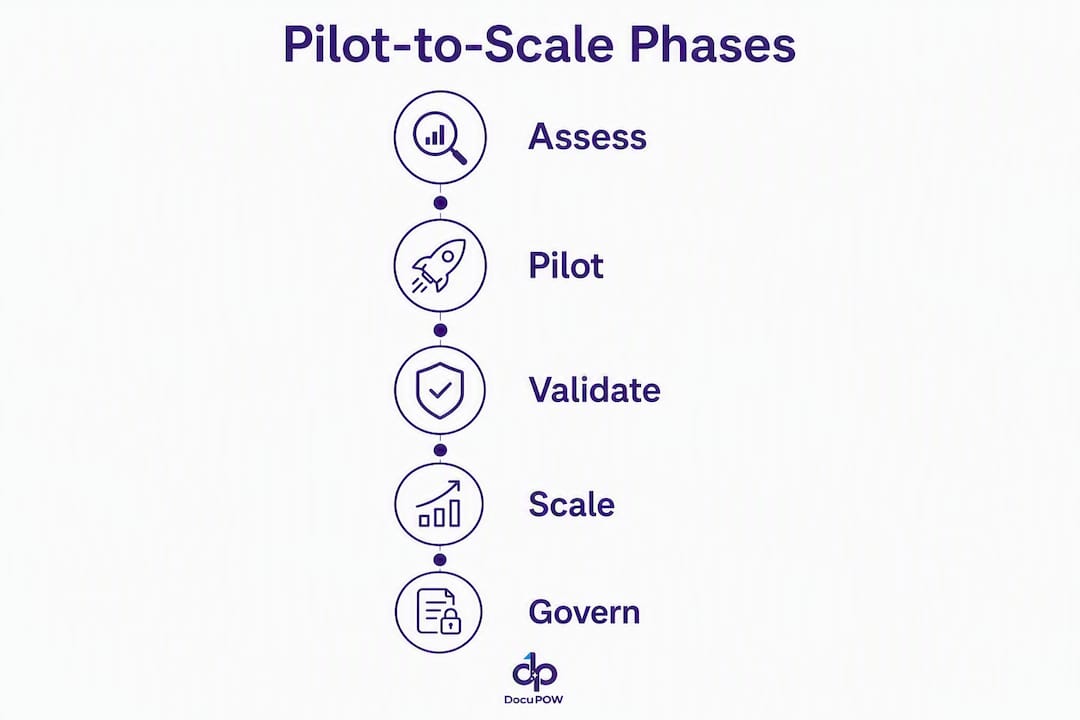
Phase 2: Pilot (weeks 3–8). Scope one or two critical flows, for example financial transaction records or third-party ICT provider assessments. Define success criteria upfront: target retrieval time, false-positive threshold for AI extraction, and evidence completeness rate. Stakeholders to include: compliance lead, IT architect, data privacy officer, and a business-unit control owner.
Phase 3: Validate (weeks 9–12). Run an internal audit simulation against the pilot flows. Measure KPI baselines. Test change propagation by simulating a regulatory update and confirming downstream controls flag automatically. Compliance documentation should be reviewed at least annually or whenever regulations change, so build that cadence into the validation phase.
Phase 4: Scale and govern. Expand integrations, onboard additional document flows, and establish a governance calendar. Common cost drivers at this stage: connector build for legacy systems, data clean-up for historical records, and human-review capacity planning.
How do you automate controls without losing human oversight?
Not every control is safe to automate end-to-end. The distinction matters to examiners.
Controls safe for full automation: log collection, retention enforcement, expiration alerts, change-record creation, and evidence tagging to framework identifiers. Controls requiring human sign-off: risk classification decisions, obligation-impact assessments when guidance changes, and sensitive-data redaction approvals.
Design patterns that work:
- Gated approvals: Workflow pauses at defined checkpoints and routes to a named control owner before the record is finalized
- Sampled review: A configurable percentage of AI-extracted records routes to human review, with results feeding back to improve confidence thresholds
- Escalation rules: Records below a confidence threshold or flagged by anomaly detection route automatically to a senior reviewer
- Immutable control evidence: Every approval, rejection, and override is logged with user identity and timestamp, creating a defensible decision trail
Pro Tip: A minimal gating strategy: automate evidence collection and tagging, but require a named human sign-off for any record that will be cited directly in a regulator response. That single gate covers most examiner concerns without slowing routine operations.
What security and regulatory requirements should you validate with vendors?
U.S. enterprises automating compliance documentation need to verify specific security controls before signing a contract.
Security certifications to request: SOC 2 Type II attestation, ISO 27001 certification, encryption at rest and in transit (AES-256 minimum), customer-managed key options, and access logging for all administrative actions including log archive access.
Privacy and data handling: Confirm permanent redaction capability (not just visual masking) for PHI and PII. Validate that retention policies can be configured per document type to match U.S. rules, including OSHA, financial, and employment record requirements. Ask how the vendor handles data residency for regulated data.
AI-specific controls: Request documentation of model provenance and training-data constraints. Confirm the platform has output validation with configurable confidence thresholds and a defined fallback process when AI extraction fails or scores below threshold.
Pro Tip: During procurement, request a sample audit trail from the vendor’s own platform showing how a document was processed, who accessed it, and what the extraction confidence score was. If they cannot produce that in under 24 hours, that is your answer about their audit readiness.
How do you measure the ROI of compliance documentation automation?
| KPI | Measurement Method | Target Benchmark |
|---|---|---|
| Audit response time | Time from examiner request to evidence delivery | Pilot benchmarks show a substantial reduction in evidence retrieval time compared to manual processes. |
| Evidence auto-produced | Percent of audit evidence generated without manual assembly | In mature deployments, most audit evidence is generated without manual assembly. |
| Exceptions per audit cycle | Count of audit findings related to missing or late evidence | Trending toward zero |
| Manual hours saved | Hours per month previously spent on evidence collection | Quantified in pilot phase |
| Mean time to propagate a regulatory change | Hours from regulation update to downstream control update | Critical obligations typically see regulatory change propagated within a short timeframe. |
Secondary metrics worth tracking: cost per document processed, time to produce evidence for a specific regulator request, and percent of records carrying immutable audit trails.
ROI levers to look for: reduced external audit preparation fees, fewer regulatory penalties, lower staff hours on evidence assembly, and faster onboarding of new regulatory frameworks through the obligations register.
How does DocuPOW address these compliance documentation challenges?
DocuPOW maps directly to the architecture requirements above. Its autonomous agents extract structured data from any document format without templates, so varied regulatory filings, contracts, and system exports all feed the same obligations register. Workflow automation for operations handles multi-step orchestration, routing documents through configurable approval gates with full human-in-the-loop review capability.
For a financial-services team managing third-party ICT provider assessments, DocuPOW’s API integrations pull contract data from existing ERP and GRC systems, extract obligation-relevant fields, and log every extraction event immutably. The result: evidence is ready before the examiner asks, not assembled in a scramble after the request lands.
For customs clearance and cross-border compliance, DocuPOW’s document automation capabilities extract classification codes, certificates of origin, and regulatory declarations from high-volume document flows, tagging each record to the relevant regulatory identifier.
DocuPOW’s agentic approach means the platform understands document context rather than matching fixed field positions. When a new document format arrives, the agents adapt. That flexibility is what makes it viable for the full range of regulatory compliance files an enterprise actually encounters, not just the clean, structured ones.
Real-time analytics and predictive insights let compliance leads see which obligations are approaching expiration or have evidence gaps before an audit cycle opens, shifting the team from reactive scrambling to proactive oversight.
What are the biggest risks in AI-based compliance automation, and how do you mitigate them?
AI automation introduces specific failure modes that manual processes do not. Knowing them in advance lets you design around them.
Extraction inaccuracy: AI agents can misread ambiguous document layouts or low-quality scans. Mitigation: set confidence thresholds that route low-scoring extractions to human review automatically. Never let an unreviewed low-confidence record enter the obligations register.
Model drift: An AI model trained on one document population may degrade as document formats evolve. Mitigation: schedule quarterly accuracy audits against a held-out sample of known-correct records. Track false-positive and false-negative rates as standing KPIs.
Integration failure: A broken API connector can silently stop evidence collection. Mitigation: build alerting for connector health and missed ingestion windows. Treat a silent connector failure as a compliance event, not just an IT ticket.
Over-reliance on automation: Teams that stop reviewing AI outputs entirely create a new kind of compliance debt. Mitigation: maintain sampled human review even after the system matures, and document that review process as part of your control evidence.
Vendor lock-in and data portability: If your vendor cannot export your obligations register and audit logs in a standard format, you lose continuity if you switch platforms. Mitigation: require data portability and export capabilities in the contract before signing.
How do you trial and integrate DocuPOW in your existing compliance workflows?
Step 1: Request a scoped demo. Bring two or three real document samples from your highest-burden compliance flow. Ask DocuPOW to demonstrate extraction accuracy and show the audit log entry produced for each document.
Step 2: Define pilot scope. Select one document flow, name a control owner, and set three measurable success criteria: extraction accuracy rate, retrieval time target, and evidence completeness percentage.
Step 3: Connect source systems. Work with DocuPOW’s integration layer to connect your existing ERP, GRC, or document repository via API. Confirm immutable logging is active from the first document processed.
Step 4: Run the pilot for four to six weeks. Process real documents, route exceptions to human review, and log every approval. At week four, run an internal audit drill against the pilot flow.
Step 5: Validate and expand. Review pilot KPIs against your baselines. If extraction accuracy and retrieval time meet targets, expand to the next document flow. Use the AI workflow automation guide to plan the scale phase with your IT and compliance leads.
Key Takeaways
Agentic AI orchestration makes compliance documentation audit-ready by generating defensible evidence as a byproduct of normal operations, not as a manual assembly task.
| Point | Details |
|---|---|
| Start with an obligations inventory | Map every regulatory requirement to a source text and owner before touching technology. |
| Automate evidence generation, not just storage | Extract structured fields and connect them to workflows so evidence is created at control execution. |
| Immutable logs are non-optional | Every record needs a time-stamped, tamper-evident audit trail to satisfy SOC 2, ISO 27001, and sector regulators. |
| Measure audit response time first | Reducing evidence retrieval time significantly is a realistic pilot benchmark and the clearest ROI signal. |
| DocuPOW as your pilot platform | DocuPOW’s template-free agents, human-in-the-loop gates, and API integrations cover the full architecture described here. |
Why agentic automation changes the compliance documentation equation
The conventional view treats compliance documentation as a records management problem: store the right files, label them correctly, and retrieve them on demand. That framing is wrong, and it is why so many programs fail under examiner scrutiny. The real problem is orchestration. When a regulation changes, every downstream control, procedure, and evidence artifact that depends on it must update automatically. Storage cannot do that. Only a system that understands the relationship between obligations, controls, and evidence can propagate a change without human intervention at every step.
DocuPOW was built around that principle. Autonomous agents extract context, not just fields. Workflows orchestrate the full chain from ingestion to approval to immutable logging. Human reviewers stay in the loop for decisions that require judgment, while the system handles everything that does not. The design goal is defensible evidence by default, with integration-first architecture so the platform works with the systems your teams already use, not instead of them.
Ready to run your compliance documentation pilot with DocuPOW?
Audit preparation costs enterprises weeks of manual effort per cycle. DocuPOW cuts that by making evidence a continuous output of your existing workflows, not a project that starts when the examiner calls. Bring your sample documents, define your pilot scope, and set your success criteria. The platform connects to your ERP and GRC systems via API, extracts structured compliance data without templates, and logs every action immutably from the first document processed.
To start your pilot, visit the enterprise AI workflow guide or explore the full DocuPOW platform to review architecture, security certifications, and integration options. Prepare three things before your first call: a list of your highest-burden document flows, your current audit response time baseline, and your top two regulatory frameworks. That is enough to scope a meaningful pilot in the first conversation.
Useful sources
These references back the regulatory and technical claims in this article. Save them as part of your obligations inventory or knowledge base.
- Compliance debt and audit exposure: Global Relay on compliance debt — consult for definitions and examiner behavior patterns
- Fragmented data benchmarks: FinTech Global / AscentAI RegTech Benchmark Survey — use for quantifying the business case internally
- Automated workflow architecture: Compliance and Risks architect’s guide — reference for evidence-by-design patterns
- Document collection and orchestration: SuperDocu compliance automation guide — use for extraction vs. storage distinctions
- Retention requirements by document type: Redactable compliance documentation guide — consult for OSHA, financial, and employment retention periods
- Review cadence and templates: SafetyCulture compliance documentation overview — use for annual review triggers and standardized templates
- Auditable workflow design (SOC 2, GDPR, ISO 27001): Tines compliance workflow automation guide — reference for immutable log architecture and multi-framework evidence tagging
- Centralized documentation best practices: MetricStream compliance documentation process — use for RBAC, version control, and retention policy design
FAQ
What is compliance documentation?
Compliance documentation is any record that proves your organization follows applicable laws, regulations, and internal policies. It includes policies, SOPs, audit trails, training records, contracts, and risk assessments, each tied to a specific control or regulatory requirement.
How often should compliance documents be reviewed?
At minimum annually, and immediately whenever a relevant regulation changes. Automated review reminders tied to your obligations register prevent gaps from opening between scheduled cycles.
What makes compliance documentation audit-ready?
Evidence must be generated at the point of control execution, stored in immutable logs with time-stamps and user identifiers, and retrievable on demand without manual assembly. Systems that store files without extracting structured data rarely meet that standard under examiner scrutiny.
How does DocuPOW improve audit response time?
DocuPOW’s agentic workflows generate evidence as a byproduct of normal operations, so records are already compiled and logged before an examiner requests them. Human-in-the-loop review gates keep a named approver in the chain for sensitive records, satisfying both speed and defensibility requirements.
What security certifications should you require from a compliance automation vendor?
Request SOC 2 Type II attestation and ISO 27001 certification at minimum, plus confirmation of encryption at rest and in transit, role-based access controls, and immutable access logging for all administrative actions including log archive access.
Recommended
See DocuPOW on your documents.
Stop building templates. Start extracting data.