Cost Reduction for Managers: Strategic Steps & KPIs
Unlock effective cost reduction strategies to lower expenses, improve performance, and invest smartly in growth. Discover how today!


Cost reduction is the disciplined effort to lower what it costs to run your business while protecting the capabilities that generate revenue and freeing the capital you need to grow. The standard approach: target low-value spend first, then adjust working-capital levers like Days Sales Outstanding (DSO) and Days Payable Outstanding (DPO), and reinvest the savings into higher-return activities rather than simply pocketing them.
Three signals tell you a program is overdue:
- DSO climbing above your industry benchmark, or DPO shrinking without a strategic reason
- Subscription and SaaS spend that no one has audited in 18 months
- Invoice-processing costs above a typical threshold where automation often pays back within a year
Gartner frames this as cost optimization, not cost cutting: a continuous, multidimensional discipline with three core dimensions — reduce low-value spend, improve enterprise performance, and reinvest in future value. That framing matters because it shifts the conversation from “what can we slash?” to “what should we fund?” DocuPOW’s document automation platform is built around exactly that logic: convert manual processing cost into measurable savings, then redirect the freed capacity toward higher-value work.
Table of Contents
- What’s the difference between cost reduction and cost optimization?
- Where should you target cost reduction first?
- How do you run a cost reduction process step by step?
- How do you measure cost reduction impact?
- What do real cost reduction examples look like?
- How does document automation convert to measurable cost savings?
- What does a realistic implementation timeline and cost look like?
- What change management strategies make cost reduction programs succeed?
- How should you communicate with stakeholders during a cost reduction effort?
- How do sustainability considerations fit into cost reduction?
- Key Takeaways
- The case for treating cost as a continuous discipline
- Cut invoice processing costs with DocuPOW
- Useful sources and further reading
- FAQ
What’s the difference between cost reduction and cost optimization?
The terms get used interchangeably, and that confusion causes real damage.
Cost cutting is tactical and often one-time: freeze hiring, cut travel, reduce headcount by 10% across the board. It produces fast results on a P&L but frequently erodes the capabilities that generate future revenue. Harvard Business Review calls this the core risk: deep, indiscriminate cuts make organizations weaker, not stronger, because they eliminate the people and processes that differentiate the business.
Cost optimization is continuous and value-aligned. You ask not “what can we cut?” but “what does this spend actually produce, and is there a cheaper way to produce the same or better outcome?” Gartner’s framework requires all three dimensions to be active simultaneously: reducing waste, improving performance, and reinvesting. Drop any one of them and you have cost cutting dressed up in better language.
The practical difference shows up in examples:
- Cutting the entire training budget saves money this quarter and raises attrition next year. That is a cut.
- Shifting instructor-led training to a blended digital model at 40% of the cost while maintaining completion rates. That is optimization.
- Eliminating a product SKU that generates 2% of revenue but consumes 15% of supply-chain complexity. That is optimization.
Deloitte warns specifically against “death by a thousand cuts” — siloed, short-term decisions that collectively hollow out the organization’s ability to compete.
Pro Tip: Set up a cross-functional cost governance board with representatives from finance, operations, HR, and technology. Any proposed cut above a defined threshold (say, $250,000 annualized) requires board sign-off. This single governance step prevents the siloed decisions that Deloitte identifies as the most common source of long-term capability loss.
Where should you target cost reduction first?
The highest-impact categories for most mid-size and enterprise organizations fall into five areas. Each has proven levers and common traps.
Procurement and supplier management
- Renegotiate contracts at renewal using market benchmarks, not last year’s price.
- Consolidate suppliers to increase volume leverage and reduce administrative overhead.
- Use contract analytics to identify auto-renewals, price escalation clauses, and duplicate vendor relationships.
Trap: Cutting supplier count too aggressively creates single-source risk. Maintain at least two qualified suppliers for critical inputs.
Working capital
- Shorten DSO by tightening credit terms, automating invoice delivery, and offering early-payment discounts selectively.
- Extend DPO strategically by negotiating payment terms with suppliers who have pricing power, not by simply paying late.
- Reduce days inventory outstanding (DIO) through demand-signal integration and safety-stock rationalization.
Grant Thornton’s guidance makes the case clearly: adjusting working-capital levers often unlocks more liquidity than traditional OPEX cuts, with less organizational disruption.
Technology and software
Applying focused software rationalization — auditing licenses, eliminating shelfware, and rightsizing cloud instances — can produce substantial savings. Gartner research on software-cost best practices documents cases where three targeted practices have significantly reduced software spend. For a practical framework on cloud rightsizing, the IT cost reduction guide for CIOs covers the specific levers in detail.

Trap: Cutting tools that shadow IT depends on creates workarounds that cost more than the license.
Labor and operating model
- Redeploy people from manual, repetitive tasks to higher-value roles before considering headcount reductions.
- Consolidate back-office functions into shared services where transaction volumes justify it.
- Upskill selectively: targeted training on high-demand skills costs less than replacing the person who leaves.
BLS data shows a significant share of workers in management and professional occupations teleworked as of late 2023. For many organizations, that shift has already reduced facilities costs; the question now is whether the real-estate footprint has been adjusted to match.
Overhead and facilities
- Renegotiate leases at renewal, particularly in markets where office vacancy rates remain elevated.
- Audit subscriptions quarterly: software, media, professional memberships, and data services accumulate fast.
- Consolidate office locations where hybrid work patterns make partial occupancy the norm.
Pro Tip: Run a “subscription census” every quarter. Assign one person in finance to pull every recurring charge from corporate cards and AP, map each to an active user count, and flag anything with utilization below 50%. Most organizations find 15–25% of subscription spend is either unused or duplicated.
Early design decisions also matter more than most managers realize. Aston University research finds that design choices lock in a large majority of a product’s lifecycle cost, which means SKU rationalization and design-for-cost reviews belong in any serious cost program, not just procurement.
How do you run a cost reduction process step by step?
A repeatable five-step process keeps the program from becoming a one-time event.
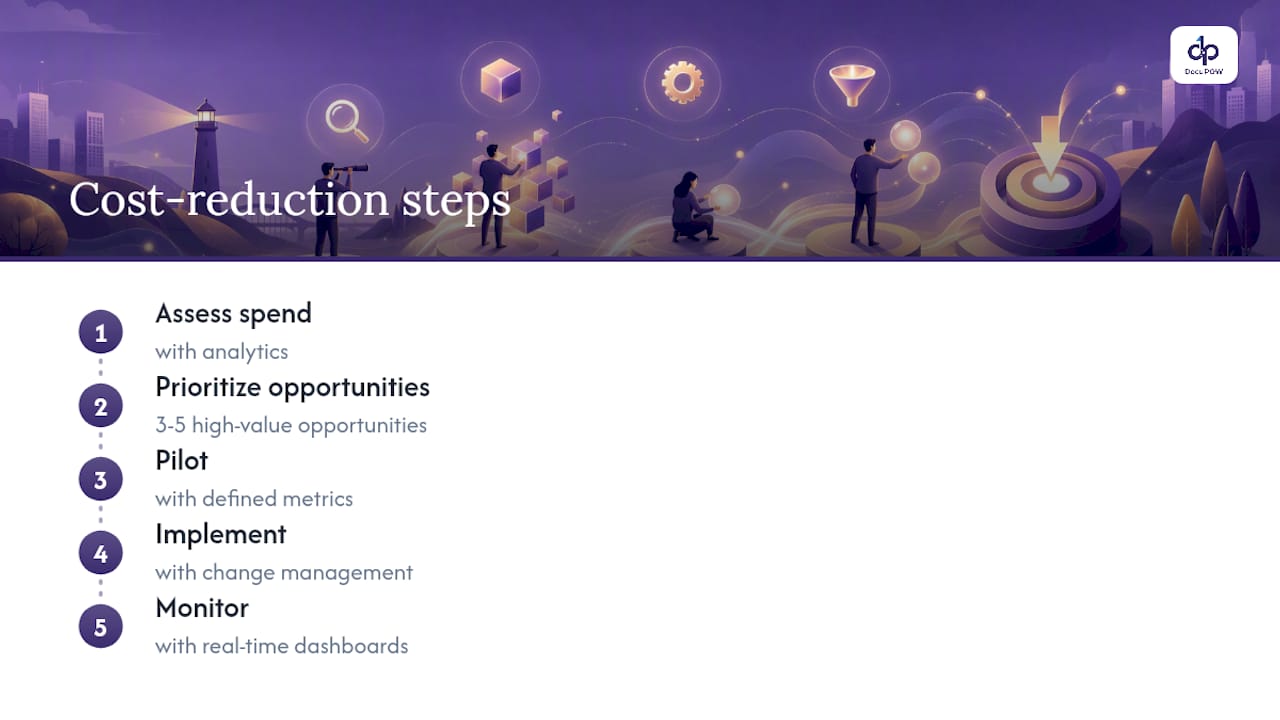
- Assess. Pull spend analytics across all categories. Map activities to costs using activity-based costing or a simplified driver-based model. Benchmark against industry peers where data is available. The goal is a ranked list of cost pools by size and addressability.
- Prioritize. Score each opportunity on three dimensions: value at stake, risk to strategic capability, and payback timeline. Select 3–5 pilot actions that score well on all three. Avoid the temptation to tackle everything at once.
- Pilot. Define scope, objectives, success metrics, and a minimum viable implementation for each pilot. Set a 60–90 day window with a clear go/no-go decision point.
- Implement. Execute change management, process redesign, technology integration, and supplier negotiation in parallel. Deloitte’s CFO guidance recommends driver-based budgeting and rolling forecasts to keep targets precise and current throughout implementation.
- Monitor. Build real-time dashboards for each KPI. Set trigger thresholds: if savings fall below 80% of target at the 90-day mark, escalate for review. If they exceed target, evaluate scaling.
A practical how-to guide from ABusinessManager.com reinforces this sequence: audit everything, prioritize top opportunities, pilot with defined metrics, measure rigorously, and iterate.
Recommended timeline:
- Days 1–30: Spend audit complete, baseline KPIs set, pilot actions selected
- Days 31–60: Pilots launched, governance board active, first progress review
- Days 61–90: Pilot results assessed, go/no-go decisions made, scaling plan drafted
- Months 4–6: Full implementation of approved initiatives, change management underway
- Months 7–12: Run-rate savings tracked, reinvestment decisions made, next cycle initiated
How do you measure cost reduction impact?
Measurement is where most programs fail. Savings get claimed before they are realized, double-counted across departments, or reported without a clear baseline.
| KPI | Formula | Reasonable Target |
|---|---|---|
| Total realized savings | Baseline spend minus actual spend | Varies by category; 10–20% in first year is typical for a structured program |
| Run-rate savings | Annualized savings from completed initiatives | Should exceed program investment cost within 12 months |
| ROI | (Savings minus program cost) / program cost | Minimum 3:1 for technology-enabled initiatives |
| Payback period | Program cost / monthly savings | 6–18 months for most automation investments |
| DSO | Accounts receivable / (revenue / day) | Benchmark against your industry; a 5-day reduction often equals millions in freed cash |
| DPO | Accounts payable / (COGS / day) | Extend strategically; 30 days is common in manufacturing |
| Invoice cost per transaction | Total AP processing cost / invoice volume | Best-in-class is under $3; many organizations run $10–$15 |
| FTEs freed | Headcount equivalent hours saved / standard hours | Track redeployment, not just elimination |
Three rules for clean measurement:
- Set the baseline before the initiative starts, using at least 12 months of historical data.
- Attribute savings to a single initiative owner. When two programs affect the same cost line, split the attribution explicitly.
- Report net savings: gross savings minus the cost of the program, the technology, and any transition costs.
Working-capital KPIs deserve special attention. Grant Thornton’s analysis shows that CFOs increasingly treat DSO, DPO, and DIO as more powerful levers than simple OPEX cuts, because they unlock cash without reducing headcount or capability.
What do real cost reduction examples look like?
Commercial: procurement renegotiation and SKU rationalization
A mid-size consumer goods manufacturer ran a structured spend analysis and found that its top 20 suppliers accounted for 78% of direct material spend, but only 12 of those 20 had been renegotiated in the past three years. After a six-month renegotiation program using market benchmarks and competitive bids, the company reduced direct material costs by 11% on the renegotiated contracts. Simultaneously, a SKU rationalization review eliminated 23% of product variants that collectively generated under 4% of revenue but consumed a disproportionate share of production scheduling, warehousing, and logistics complexity. The combined program delivered margin improvement within the first fiscal year. These results are representative of structured programs; outcomes vary by industry, supplier concentration, and negotiating leverage.
Public sector: process automation and shared services
A state agency consolidated three separate back-office functions (accounts payable, HR administration, and procurement processing) into a single shared-services center and introduced process automation for high-volume, rule-based transactions. Administrative FTE requirements dropped without service degradation, because automation absorbed the transaction volume while staff shifted to exception handling and vendor management. The payback on the shared-services investment came within 18 months. Public-sector results depend heavily on union agreements, procurement rules, and change management quality.
How does document automation convert to measurable cost savings?
Manual document processing is one of the most consistently underestimated cost lines in mid-size and enterprise organizations. Invoice processing alone typically costs $10–$15 per transaction at organizations relying on manual entry, compared to under $3 at best-in-class automated operations. The gap is not marginal; at 10,000 invoices per month, it represents $840,000 to $1.44 million in annual processing cost.
DocuPOW addresses this with template-free document extraction: autonomous AI agents that read any document format, understand context, and extract structured data without requiring rigid templates or manual field mapping. The practical impact shows up in three places:
- Invoice-processing cost. Automated extraction and three-way matching reduce manual touchpoints per invoice, cutting cost per transaction and exception rates simultaneously. DocuPOW’s AP automation solution handles this end-to-end.
Statistic callout: Organizations running manual AP processes typically spend $10–$15 per invoice. Automation-first operations benchmark under $3, according to industry benchmarks cited across Gartner and Deloitte research.
Pro Tip: Pilot document automation on a single, high-volume document type first: supplier invoices, purchase orders, or remittance advices. A 90-day pilot on one document type gives you clean before-and-after data on cost per transaction, exception rate, and cycle time. That data becomes the business case for scaling.
Implementation success depends on three factors: a clean data model that maps extracted fields to your ERP’s chart of accounts, an ERP integration that pushes data without manual re-entry, and a human-in-the-loop QA layer for exceptions above a defined confidence threshold. DocuPOW’s platform covers all three, with API-based ERP integration and real-time analytics that track extraction accuracy and processing volume. For a broader view of automation’s role in reducing operational costs, DocuPOW’s resource library covers the ROI mechanics in detail.
What does a realistic implementation timeline and cost look like?
Cost reduction programs vary enormously by scope, but a structured initiative typically follows a predictable cost and payback curve.
A working-capital program (DSO/DPO/inventory) requires minimal technology investment and can show cash impact within 30–60 days of implementation. The primary cost is management time and, in some cases, a short-term consulting engagement to run the spend analysis.
A procurement renegotiation program costs more in management time and may require external benchmarking data or a sourcing consultant. Payback typically comes within 6–9 months on the first round of renegotiated contracts.
A technology-enabled automation program (AP automation, document processing, workflow orchestration) carries a higher upfront cost: software subscription, integration work, and change management. Payback horizons of 6–18 months are realistic for well-scoped pilots. Programs that try to automate too many document types simultaneously tend to run long and over budget.
The most common cost mistake is underestimating change management. Technology works; adoption is the variable. Budget 20–30% of total program cost for training, communication, and process redesign.
What change management strategies make cost reduction programs succeed?
The technical work is the easy part. The harder problem is getting people to change how they work, especially when the change is associated with cost pressure.
Three strategies consistently separate successful programs from failed ones.
Visible executive sponsorship. The CFO or COO needs to be the named sponsor, not just a signatory on the approval memo. Employees read organizational signals carefully; a program that lives in a PMO without C-suite visibility gets deprioritized at the first competing demand.
Early wins, communicated loudly. Identify one or two initiatives that can show measurable results within 60 days and publicize the outcome internally. Early wins build credibility for the harder changes that follow.
Role clarity during transition. When automation or shared services change job responsibilities, people need to know specifically what their new role looks like, not just that their old tasks are being automated. Ambiguity drives attrition; specificity drives engagement.
How should you communicate with stakeholders during a cost reduction effort?
Stakeholder communication is not a soft skill in this context. Poor communication is a direct cause of program failure: it drives attrition, creates resistance, and generates the rumor cycles that make implementation harder.
The communication framework that works is simple: what, why, when, and what it means for you. Every stakeholder group (employees, suppliers, investors, customers) needs a version of that message tailored to their concerns.
For employees: explain the business rationale, the scope of the program, and what reinvestment looks like. If the program involves redeployment rather than elimination, say so explicitly and early.
For suppliers: communicate changes to payment terms or sourcing strategy before they take effect. Suppliers who feel blindsided become unreliable partners; suppliers who are brought into the conversation often propose savings themselves.
For investors and board members: frame cost reduction as a capability-building investment, not a distress signal. Show the reinvestment plan alongside the savings target.
How do sustainability considerations fit into cost reduction?
Sustainability and cost reduction align more often than managers expect, and the alignment is growing as energy costs and regulatory pressure increase.
Energy efficiency investments (LED lighting, HVAC upgrades, building management systems) typically pay back within 2–5 years and reduce both operating costs and carbon emissions. Waste reduction programs in manufacturing lower disposal costs and material consumption simultaneously. Supplier consolidation, done well, reduces logistics miles and packaging waste alongside procurement cost.
The risk is the reverse: cost cuts that increase environmental cost. Switching to cheaper materials that require more frequent replacement, or cutting maintenance budgets that lead to equipment failures, can produce short-term savings and long-term cost and compliance problems. Any cost initiative that touches physical operations should include a sustainability impact screen as part of the prioritization step.
Key Takeaways
Sustainable cost reduction requires targeting low-value spend, optimizing working-capital levers like DSO and DPO, measuring realized savings against a clean baseline, and reinvesting the freed capital into capabilities that drive future growth.
| Point | Details |
|---|---|
| Optimize, don’t just cut | Gartner’s three-dimension framework (reduce waste, improve performance, reinvest) prevents capability loss that one-off cuts cause. |
| Working capital first | Grant Thornton’s guidance shows DSO/DPO/inventory adjustments often unlock more liquidity than OPEX cuts with less disruption. |
| Measure with a clean baseline | Set baseline KPIs before any initiative starts; report net savings after program costs to avoid overstating impact. |
| Pilot before scaling | A 90-day pilot on one document type or cost category gives you the data to justify full-scale investment. |
| DocuPOW for document costs | DocuPOW’s template-free AP automation reduces invoice-processing cost from the $10–$15 manual range toward the sub-$3 best-in-class benchmark. |
The case for treating cost as a continuous discipline
Most cost programs are launched in response to a crisis: a margin miss, a budget shortfall, a board directive. That reactive posture is understandable, but it is also why so many programs produce one-time savings and then stall. The organizations that sustain cost advantage treat it the way they treat quality or safety: as a continuous discipline with governance, metrics, and accountability built into the operating model.
The hardest part of that shift is not analytical. It is cultural. Leaders have to be willing to make the reinvestment argument in the same breath as the savings argument, or the program becomes an extraction exercise that hollows out the business over time. The evidence from Gartner, Deloitte, and HBR consistently points the same direction: capability-preserving cost moves compound. Blunt cuts do not.
Cross-functional governance is the mechanism that makes the discipline stick. When finance, operations, HR, and technology all have a seat at the cost governance table, the siloed decisions that produce “death by a thousand cuts” become structurally harder to make. That is not a soft organizational principle. It is the single most reliable predictor of whether a cost program delivers sustained results or a one-time P&L improvement that reverses within 18 months.
Cut invoice processing costs with DocuPOW
The range between $10–$15 per invoice for manual processing and under $3 per invoice for automated operations is not a technology problem. It is a decision problem. DocuPOW’s enterprise automation platform gives AP, finance, and operations teams the infrastructure to close that gap: template-free extraction that reads any document format, multi-step workflow orchestration, automated three-way matching, and real-time analytics that track cost per transaction from day one.
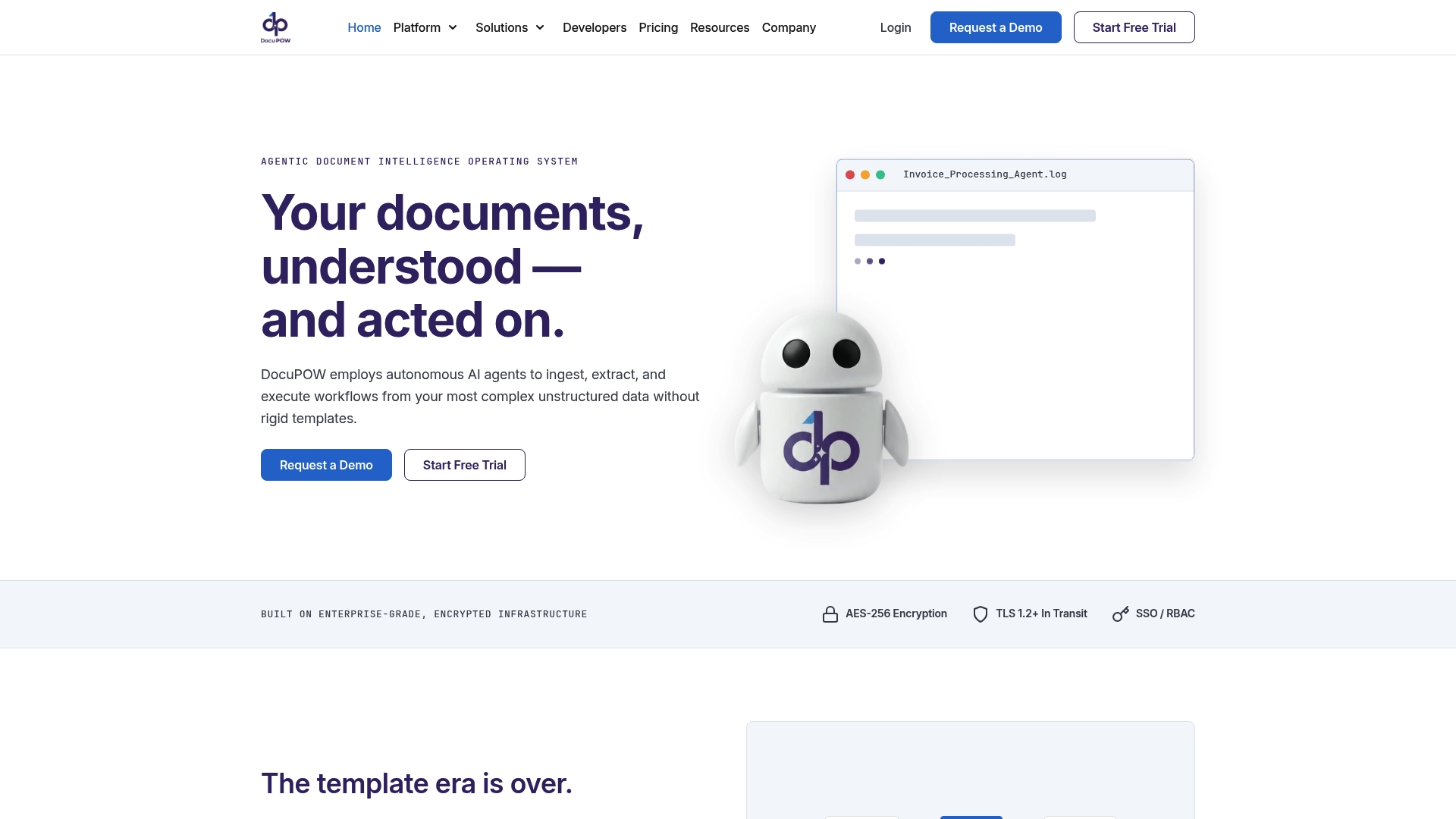
A practical pilot scope for a cost reduction program: start with supplier invoice processing and automated three-way matching across PO, invoice, and receipt. That single workflow typically covers the highest transaction volume and the highest manual-processing cost in any AP function. DocuPOW’s human-in-the-loop review layer keeps your team in control of exceptions without requiring them to touch every document. For a full picture of the operational savings from document automation, the resource covers ROI mechanics, integration requirements, and payback benchmarks. Request a demo or ROI assessment at docupow.ai to see what the numbers look like for your transaction volume.
Useful sources and further reading
- Cost Optimization That Funds the Future | Gartner
- Cost Cutting That Makes You Stronger
- BLS: Telework prevalence in management and professional occupations
- Design determines 70% of cost — Aston Research
FAQ
What does cost reduction mean in business?
Cost reduction is the disciplined effort to lower the total cost of running a business while protecting strategic capabilities and freeing capital for reinvestment. It differs from cost cutting in that it targets waste and inefficiency rather than capability.
How do you reduce costs effectively?
The most effective approach follows five steps: assess spend with analytics, prioritize 3–5 high-value opportunities, pilot with defined metrics, implement with change management, and monitor with real-time dashboards. Working-capital levers like DSO and DPO often produce faster results than OPEX cuts.
What’s another term for cost reduction?
Cost optimization is the closest industry-standard term, though it implies a continuous and strategic discipline rather than a one-time reduction exercise. Gartner uses cost optimization to describe the three-dimension framework of reducing waste, improving performance, and reinvesting savings.
What is a practical example of cost reduction?
A manufacturer renegotiating supplier contracts using market benchmarks and eliminating low-revenue SKUs that consume disproportionate supply-chain complexity is a common example. In AP functions, automating invoice processing with a platform like DocuPOW reduces cost per transaction from the $10–$15 manual range. Automated operations benchmark under $3 per invoice.
What KPIs should you track for cost reduction?
Primary KPIs include total realized savings, run-rate savings, ROI, and payback period. Working-capital KPIs (DSO, DPO, DIO) and operational KPIs (invoice cost per transaction, FTEs freed, cycle time) round out a complete measurement framework.
Recommended
See DocuPOW on your documents.
Stop building templates. Start extracting data.