Proof of Delivery Processing: From Driver Scan to Billing
How carriers capture, validate and route proof of delivery data, from signatures and photos to billing, with exception handling and US record retention.

Proof of delivery processing is the work of turning a delivery confirmation (a signature, a photo, a scan, a timestamp) into clean, validated data that reaches billing, claims and customer systems without anyone retyping it. For a carrier, the goal is simple: the moment a driver hands over freight, the evidence is captured, checked against the order, and attached to the right record. Carriers that still rely on paper receipts, emailed photos and manual keying wait longer to invoice and scramble when a customer disputes a delivery.
This guide walks through what a POD record contains, how the data moves from the driver to storage, where automation fits, how to handle missing or disputed evidence, and what to ask when you evaluate tools.
TL;DR
- A POD record confirms the right goods reached the right recipient. It usually combines a signature or recipient name, a timestamp and often photos, scans or GPS coordinates.
- Processing means four steps: capture, extract and validate, route to your TMS, ERP or accounting system, and store with an audit trail.
- Most delays come from the messy middle: blurry photos, handwritten receipts, mismatched order numbers. Exception queues with human review keep these from stalling billing.
- A signed bill of lading is a commonly accepted form of POD, but it does not replace the final delivery record.
- Template-free extraction matters for carriers because every consignee, shipper and driver app produces a different layout.
Table of Contents
- What a proof of delivery record contains
- How PODs travel from the dock to a database
- Where manual POD processing breaks down
- Automating capture, validation and routing
- Handling missing, unclear or disputed delivery records
- Does a bill of lading prove delivery?
- Retention, security and audit readiness in the US
- What to look for in POD processing software
- A practical rollout plan
- Our perspective
- See it on your own delivery documents
- FAQ
- Sources
What a proof of delivery record contains
Proof of delivery is a receipt or document showing that a package was handed to the intended recipient at the correct address, as ShipBob’s guide to POD puts it. EasyPost adds that it also records the condition of the goods at the moment of handoff. That condition note is what makes POD so valuable when freight arrives damaged or short.
What it holds depends on the carrier and the mode. The U.S. Postal Service gives a clear public example: its Proof of Delivery response is an emailed letter with the delivery information, recipient name, tracking number, an image of the recipient’s signature, and the printed name and address. It can also show the delivery location, product of mail, extra services and package weight.
For trucking and last-mile fleets, the evidence set is often broader. EasyPost lists recipient signatures or identity, photographs, GPS coordinates, timestamps and barcode scans. Fleet software documentation describes the same toolkit: barcode or QR scans, digital signatures and photographs, with a timestamp on every proof record.
In practice, a useful POD for a carrier carries these fields:
| Field | Why it matters downstream |
|---|---|
| Shipment or PRO number | Links the evidence to the order and invoice |
| Consignee name and address | Confirms the right recipient and location |
| Delivery date and time | Starts the clock for billing and claims |
| Signature and printed name | Shows who accepted the freight |
| Piece count and condition notes | Supports or defeats shortage and damage claims |
| Exceptions (refused, damaged, short) | Triggers a different billing and claims path |
| Photos, GPS, scans | Backs up the signature when it is disputed |
How PODs travel from the dock to a database
The path is easiest to see in a large operation that has to do it at scale. The U.S. Postal Service’s signature capture procedure (PO-610) says employees scan mailpiece barcodes and capture signatures, names and addresses on handheld devices, and the scanners then transmit the electronic record to a central tracking and reporting database.
Most carriers follow the same logic at a smaller scale:
- Capture. The driver scans a barcode, collects a signature on a phone or handheld, and takes photos. Some fleets still collect a paper delivery receipt or signed bill of lading.
- Transmit. The driver app, telematics system or an emailed scan sends the evidence to the office.
- Read and validate. Someone, or something, reads the shipment number, consignee, quantities and signature, then compares them with the order.
- Route. The validated record updates the transportation management system, triggers an invoice, and notifies the customer.
- Store. The image and data are kept, indexed and retrievable for as long as claims or regulations require.
Steps 3 and 4 are where the hours disappear. Driver apps handle capture well. Paper receipts, faxed scans, photos of clipboards and PDFs from consignee portals do not arrive as neat data.
Where manual POD processing breaks down
Anyone who has worked a billing desk recognizes the pattern. A driver photographs a receipt at an angle. A consignee stamps their own form instead of yours. The shipment number is handwritten and a 5 looks like an S. A clerk opens the image, types the details into the TMS, and attaches the file. Multiply that by hundreds of deliveries a day and three problems appear:
- Slow billing. Invoices wait for evidence that is sitting in an inbox.
- Typing errors. A wrong digit sends the POD to the wrong order, and the right order looks undelivered.
- Weak claim files. When a customer says freight was never received, nobody can find the signed copy quickly.
Old-style optical character recognition makes this only partly better. Template-based tools need a configured layout for each form, so a new consignee or a redesigned receipt means rebuilding the template. Carriers deal with thousands of formats, so the maintenance never ends.
Automating capture, validation and routing
Automation works best when you treat POD as a flow of business events rather than a pile of files. Integration specialists describe the proof-of-delivery pipeline as a controlled flow of events that lets billing eligibility and customer notifications be decided independently. That idea is practical: a delivery can be confirmed while the invoice is still waiting on a missing signature, and the two should not block each other.
A working automated flow has these parts.
Read any document, without templates
The extraction layer has to read a signed receipt, a photographed bill of lading or a consignee’s own form and return structured fields: shipment number, consignee, date, piece count, signature present, exception notes. Template-free, zero-shot extraction does this without a setup project for each layout. That is the approach behind DocuPOW’s extraction platform, which is designed to adapt to layouts it has not seen before.
Validate against the order
Extraction is only useful if the result is checked. Validation compares the extracted values with the order in your TMS: does the shipment number exist, does the consignee match, does the piece count agree, is the delivery date plausible? Strict schema validation catches the record that looks complete but fails a rule, such as a signature field with no printed name.
Push to the systems that act on it
One integration example shows the destination. Stacksync describes moving POD images and signatures from driver apps and telematics into a TMS order record, then triggering invoicing in an ERP within seconds of delivery. Whatever tools you use, the principle is the same: the validated record should write itself into the TMS, accounting and document store through an API, not wait for a person to copy it.
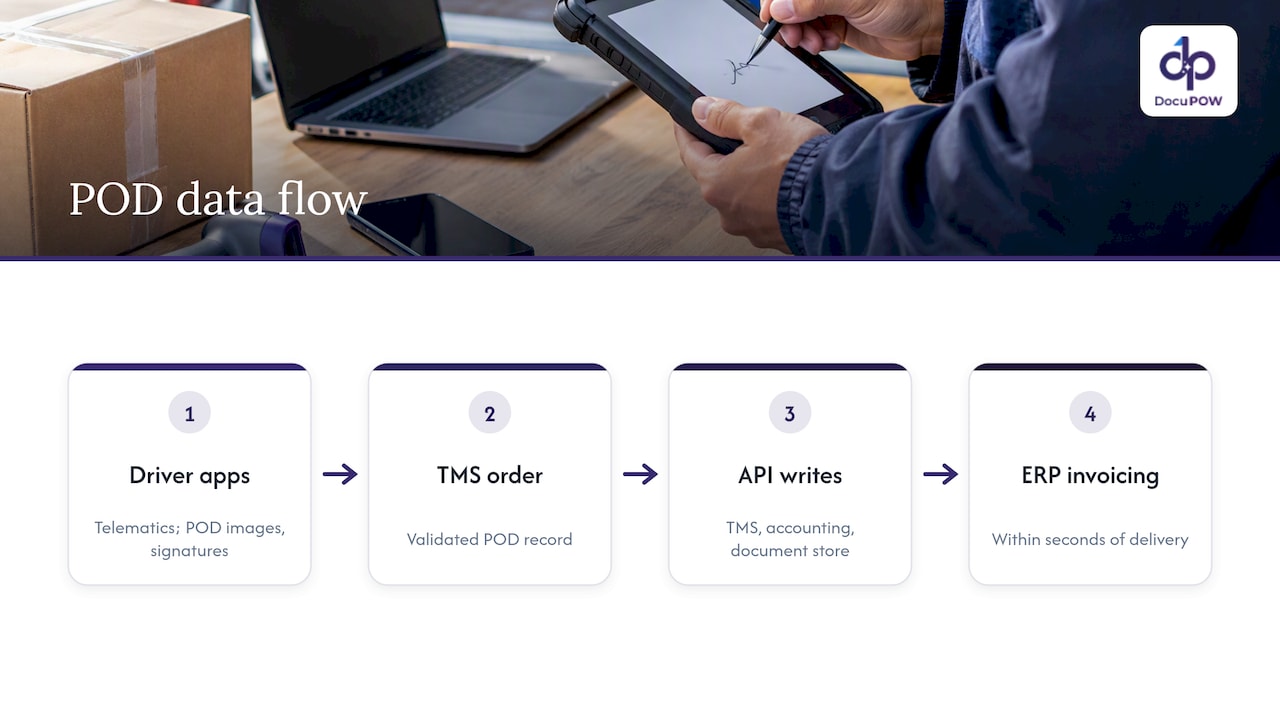
For multi-system setups, sync design guidance for logistics recommends middleware that carries delivery milestones across TMS, WMS and ERP, with stable correlation IDs so a shipment can be traced from booking to finance. If you are mapping this, start with the correlation ID: one identifier that follows the shipment everywhere.
DocuPOW’s own write-up on proof of delivery automation for claims-ready evidence covers how we approach this for logistics operations.
Handling missing, unclear or disputed delivery records
No flow is clean all the time. The test of a POD process is what happens to the record that does not pass validation.
Well-designed systems send mismatches and missing data to dedicated ownership queues where a person reviews, corrects or resolves them, and they keep an audit log of every action so the record can be reprocessed once the missing evidence arrives. That is the human-in-the-loop pattern, and it matters for three reasons:
- Speed. The 90 percent of clean records go straight through, and staff spend time only on the exceptions.
- Accountability. Each exception has an owner, a status and a history.
- Defensibility. If a customer disputes a delivery, you can show who reviewed what and when.
Typical exception rules a carrier might set:
| Exception | Suggested route |
|---|---|
| No signature or unreadable signature | Billing review queue; request driver photo or GPS evidence |
| Piece count differs from the order | Claims queue; hold invoice adjustments |
| Shipment number not found | Data-entry queue; match by consignee and date |
| Consignee refused delivery | Customer service queue; trigger return or reschedule flow |
| Duplicate document | Auto-merge, flag for spot check |
A good review screen shows the original image beside the extracted fields, so the reviewer fixes a value in seconds rather than hunting through a file. Our guide to document approval workflow design covers how to structure those review steps and controls.
Does a bill of lading prove delivery?
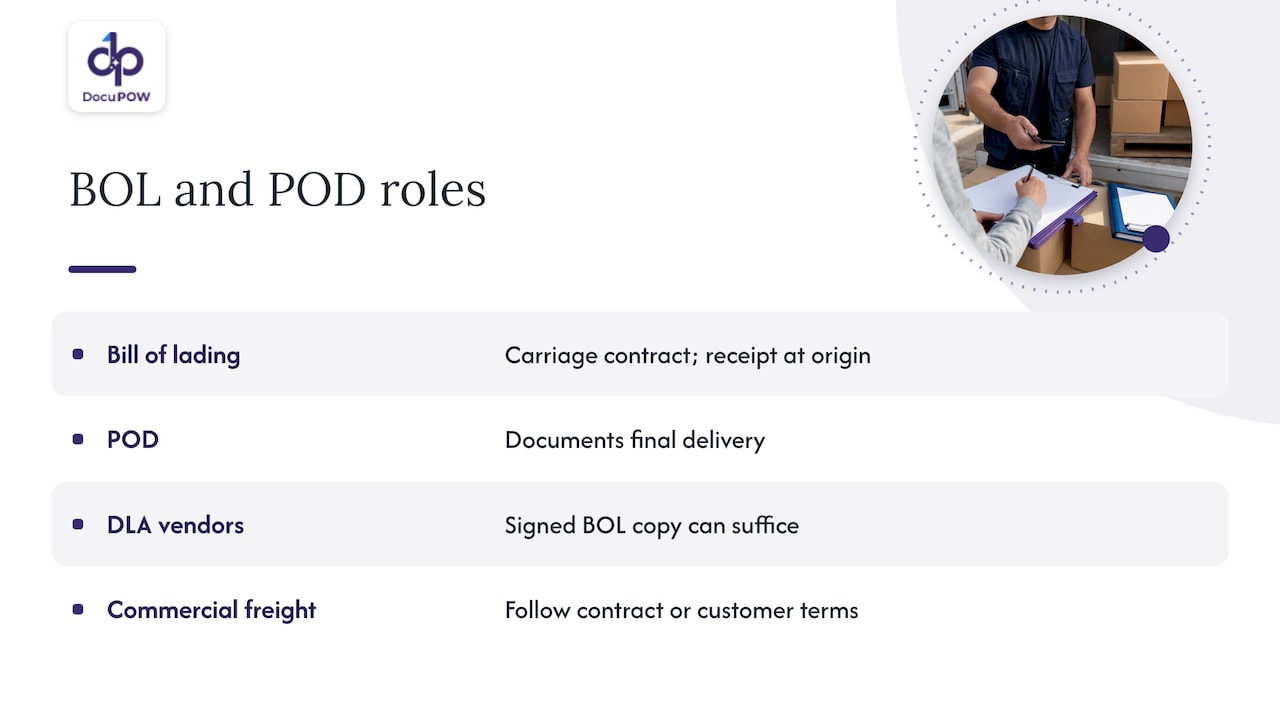
A signed bill of lading often counts, but the two documents do different jobs. The bill of lading is the contract of carriage and the receipt for goods at origin, while the POD documents the final delivery. Together they establish the chain of custody for legal and claims purposes.
For federal contracting, the Defense Logistics Agency is explicit. Its guidance lists a screenshot of shipper tracking details, a signed POD from the shipper, and a copy of a signed bill of lading as commonly accepted forms of POD. So for a DLA vendor, a signed BOL copy can be enough. For commercial freight, what counts is what your contract or the customer’s terms require, so confirm that with the customer before you decide that a signed BOL alone is your standard.
Retention, security and audit readiness in the US
How long you keep POD records depends on who you are and who you serve.
- Federal contract work. DLA vendors must keep POD documentation for at least four years.
- Regulated motor carriers. Federal rules in 49 CFR Part 379 set retention periods by record type, including shipping documents such as bills of lading. The schedule in Part 379, Appendix A lists the periods, and the same part says records of a company going out of business may not be destroyed until dissolution is final and all pending claims are completed. Check the current eCFR text and ask your counsel which category your records fall in.
- Your own contracts. Customer agreements and insurers often require longer periods than the regulation.
Whatever the period, design retention in from the start: store the image and the extracted data together, index them by shipment number and consignee, restrict access by role, encrypt at rest and in transit, and log every view and edit. Signatures and names are personal data, so treat the archive as sensitive.
What to look for in POD processing software
Because the other question readers ask is who offers automated proof of delivery data capture for carriers, it helps to sort the market by type rather than by brand:
- Driver app and TMS modules capture signatures and photos well, but usually do not read paper or third-party documents that arrive by email or scan.
- Integration and sync platforms move records between systems, but need clean structured data to move.
- Template-based OCR reads fixed forms, and needs rework for every new layout.
- Agentic document intelligence platforms read varied documents without templates, validate the output, route exceptions to people and write results into your systems.
Use this checklist when you evaluate any option:
- Does it read documents it has never seen, without a template build?
- Does it validate against your order data, not just extract text?
- Can a reviewer see the source image next to every extracted field?
- Are exceptions routed to owners, with an audit log?
- Does it integrate with your TMS, ERP and accounting system through an API?
- How is data encrypted, and who can see what?
- Can you start with one lane, one customer or one document type?
A phased start is sensible. Our logistics data entry pilot is built around a 4 to 8 week scope on a defined set of documents, and the logistics solutions page shows the wider workflow. If your delivery documents arrive alongside customs and shipping paperwork, the shipping document automation approach handles those on the same platform.
A practical rollout plan
- Pick the document set. Start with the PODs that cause the most billing delay or the most disputes.
- Define the fields and rules. Agree what a complete POD must contain and what counts as an exception.
- Connect the destination. Decide where the validated record writes: TMS, ERP, document store.
- Run in parallel. Process documents automatically while your team checks results, and track the share that passes untouched.
- Assign exception owners. Name a person or team for every queue.
- Measure. Track days from delivery to invoice, exception rate and time to resolve a dispute. Our note on data accuracy standards explains how to set meaningful accuracy targets.
- Expand. Add consignee types, regions and document formats once the first set is stable.
Our perspective
Proof of delivery is the document that turns a shipment into revenue, and it is also the document most likely to arrive as a crooked photo or a stamped scrap of paper. We built DocuPOW because we think that gap should not be closed by people retyping fields.
Our view is that carriers need three things together. First, extraction that does not depend on templates, because the consignee decides what the receipt looks like, not you. Second, validation that enforces a schema against the order, so a record is either right or clearly flagged. Third, human review where it counts, with source citations and an audit trail, so a disputed delivery can be answered with evidence rather than memory.
That is why we describe DocuPOW as more than OCR. The system is designed to read documents the way an expert would, check them, and carry the result into the databases and workflows that act on it. For carriers, that means a delivery can move toward billing and claim-ready evidence without waiting for a person to open an attachment.
Syed Naveed Abbas
See it on your own delivery documents
DocuPOW offers a Starter plan at $99 per month and a Professional plan at $499 per month, with Enterprise available for larger operations. Bring a batch of real delivery receipts and bills of lading, and see how template-free extraction and validation handle them.
Review the plans on our pricing page, or see how supply chain document extraction fits your operation.
FAQ
What is proof of delivery processing?
It is the set of steps that turn delivery evidence into usable records: capturing signatures, photos and scans, extracting and validating the data, routing it to billing, TMS and claims systems, and storing it with an audit trail. Automation reduces the manual typing and matching in the middle.
What information should a POD contain?
At minimum: the shipment identifier, recipient name and address, delivery date and time, and a signature or other proof of receipt. Many carriers add photos, GPS coordinates, barcode scans and condition notes. The USPS example shows tracking number, signature image, and printed name and address.
Does a bill of lading prove delivery?
Not by itself in every case. The bill of lading is the contract and origin receipt, and the POD records the final handoff. For Defense Logistics Agency vendors, a copy of a signed bill of lading is a commonly accepted form of POD. For commercial freight, follow your customer contract.
How should carriers handle a POD with a missing or unreadable signature?
Route it to an exception queue with a named owner rather than letting it block other records. The reviewer can use photos, GPS data or scan timestamps as supporting evidence, and the action is logged so the record can be reprocessed once the evidence arrives.
How long should a carrier keep POD records?
It depends on your category. DLA vendors must keep them at least four years, and motor carrier shipping documents fall under the retention schedule in 49 CFR Part 379. Confirm the current rules and your contract terms with counsel or your compliance lead.
Sources
- What is Proof of Delivery? (USPS)
- What Is Proof of Delivery in Logistics? (EasyPost)
- What is Proof of Delivery? (ShipBob)
- Proof of Delivery (Fleetbase)
- PO-610 Signature Capture and Electronic Record Management (USPS, via NALC)
- Proof-of-delivery capture to billing in seconds (Stacksync)
- Proof of Delivery Integration (Mol-Tech)
- Logistics ERP Sync Design Across TMS, WMS and Finance (SysGenPro)
- What is Proof of Delivery (POD)? (Defense Logistics Agency)
- Proof of Delivery: Legal and Commercial Standards (Legal Clarity)
- 49 CFR Part 379, Appendix A (govinfo)
Recommended
See DocuPOW on your documents.
Stop building templates. Start extracting data.