AI Data Extraction for Business Professionals: 2026 Guide
<p>Discover how AI Data Extraction transforms document processing for business professionals. Learn efficient techniques for managing high volumes and…</p>


TL;DR:
- AI data extraction automates the retrieval of structured information from unstructured documents using schema-driven methods. It outperforms traditional template-based approaches by offering higher accuracy, faster processing speeds, and preservation of document layout across diverse formats. These benefits improve efficiency in industries like finance, healthcare, and real estate by enabling scalable, high-quality data automation.
AI data extraction is the process of using artificial intelligence to pull structured information from unstructured documents automatically. The industry term for this broader discipline is intelligent document processing (IDP), and AI data extraction is its core function. Modern systems combine natural language processing (NLP), machine learning, and schema-driven processing to convert PDFs, invoices, contracts, and images into clean, usable data. DocuPOW applies this approach through autonomous agents that read document context rather than matching fixed templates. For business professionals managing high document volumes, the difference between template-based and AI-driven extraction is the difference between a brittle process and one that scales.
How does AI data extraction work?
AI data extraction operates through a pipeline of coordinated technologies. The process starts with document ingestion, where the system accepts files across formats. Then OCR (optical character recognition) converts scanned images into machine-readable text. NLP models interpret meaning, and a schema layer defines exactly which fields to extract.

The most significant shift in recent years is the move from template-based extraction to declarative schema definitions. Declarative schemas let business professionals specify the fields they need using a JSON structure, without any prior training data or template configuration. The AI reads the schema, locates the relevant data in the document, and returns structured output. This means you can point the system at a new document type on Monday and have clean data by Tuesday, with no model retraining required.
Modern extraction pipelines also handle format diversity at scale. Advanced AI extraction can process over 100 document formats, including PDFs, DOCX files, spreadsheets, images, and websites, through a single API call. That breadth matters for operations teams dealing with supplier invoices, scanned receipts, and web-sourced data all in the same workflow.
Key components in a production-grade AI extraction pipeline include:
- OCR layer: Converts scanned pages and images into text while preserving spatial layout
- NLP engine: Interprets field labels, sentence structure, and contextual meaning
- Schema definition: Declares target fields in JSON format without model retraining
- Confidence scoring: Assigns a reliability score to each extracted field
- Citation metadata: Records the source location of each extracted value for audit trails
Pro Tip: Always review per-field confidence scores before sending extracted data downstream. A field with a low confidence score signals ambiguity in the source document, not a system failure. Flag those fields for human review rather than letting errors propagate into your ERP or CRM.
What performance benchmarks does AI extraction offer vs. traditional methods?
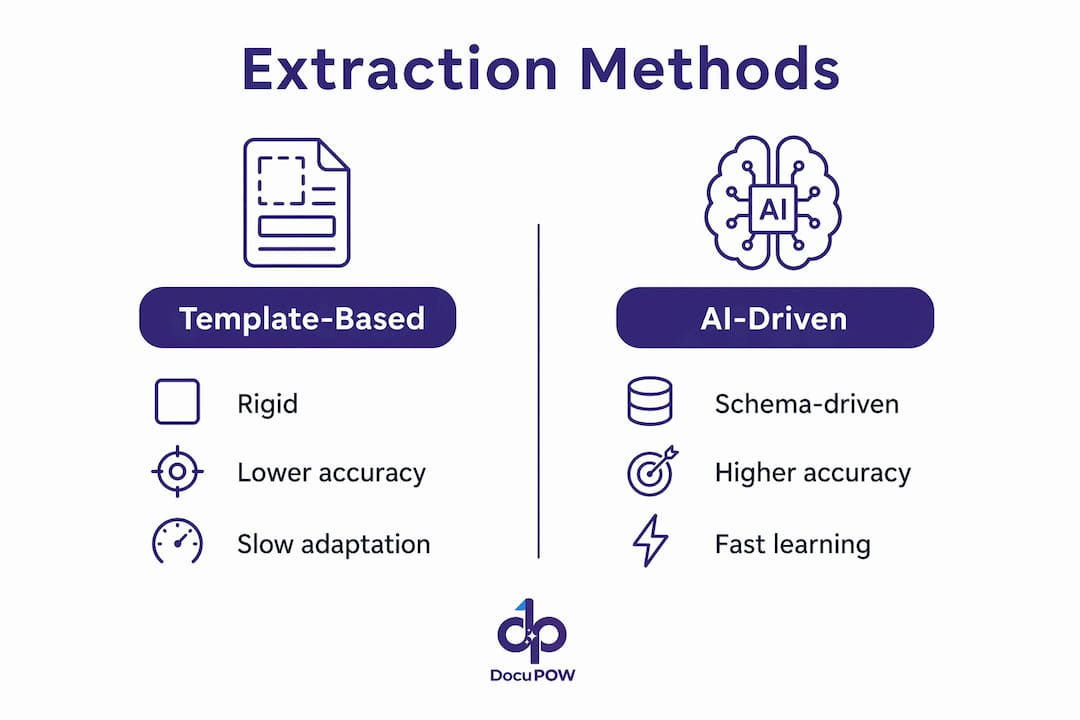
The accuracy gap between template-based and AI-driven extraction is measurable and significant. Template-based extraction typically suffers a 12–28 point F1 score drop when processing new document formats. F1 score measures the balance between precision and recall, so a 20-point drop means roughly one in five extracted values is wrong or missing. That error rate is unacceptable at scale.
LLM-based intelligent extraction methods drop only 2–6 F1 points when encountering new formats. That gap closes because the model understands language and context rather than relying on fixed field positions. A supplier invoice from a new vendor no longer breaks the extraction job.
Speed is the second dimension where modern AI extraction separates itself. Specialized extraction engines with Rust cores achieve processing speeds 15–40 times faster than equivalent open-source libraries across common formats like PDF, DOCX, and XLSX. Faster throughput means finance teams can close books faster and operations teams can process inbound shipment documents in near real time.
Spatial fidelity is a less-discussed but critical factor. Modern extraction engines preserve table structures and document layout, which are essential for accurate downstream analysis. Older flattening techniques collapse tables into unstructured text, destroying the row-column relationships that give the data meaning.
| Dimension | Template-based extraction | LLM-based AI extraction |
|---|---|---|
| F1 score drop on new formats | 12–28 points | 2–6 points |
| Processing speed | Baseline | 15–40x faster (Rust-core engines) |
| New document type setup | Manual template rebuild | Schema definition only |
| Table and layout preservation | Often lost | Maintained (spatial fidelity) |
| Retraining required | Yes, per new format | No |
What are the real-world applications of AI data extraction?
Intelligent document processing platforms extend well beyond simple text extraction. IDP platforms connect extracted data directly to business process automation, linking field values to workflows for tasks like policy administration, claim resolution, and purchase order matching. The data does not just get extracted. It gets routed, validated, and acted on.
The industries seeing the clearest returns include:
- Finance and accounting: Automated retrieval from invoices, bank statements, and expense receipts feeds directly into ERP systems, cutting manual entry and accelerating month-end close. Teams using automated financial data extraction report fewer reconciliation errors and faster audit cycles.
- Healthcare: Medical forms, prior authorization documents, and clinical records contain dense, variable data. AI extraction pulls structured fields from these documents and routes them to patient management systems without manual transcription.
- Real estate: Lease agreements, title documents, and property disclosures contain dozens of critical fields. Real estate document workflows benefit from AI extraction that reads variable clause structures rather than fixed field positions.
- Manufacturing and supply chain: Bills of lading, quality certificates, and supplier invoices arrive in hundreds of formats. Automated extraction in manufacturing reduces receiving errors and speeds up supplier payment cycles.
- Insurance: IDP accelerates claim resolution and supports early fraud detection by automating extraction from FNOLs, medical records, and supporting documents.
Document types that benefit most from AI-driven automated data retrieval include invoices, contracts, purchase orders, shipping manifests, medical intake forms, research papers, and regulatory filings. The common thread is high volume combined with structural variability. When no two documents look exactly alike, template-based tools fail and AI-driven tools thrive.
Pro Tip: Start your IDP rollout with the document type that causes the most downstream errors in your current process. Fixing one high-impact extraction point delivers faster ROI than spreading effort across every document type at once.
How can businesses implement AI data extraction effectively?
The starting point for any implementation is schema design. Define the fields your business needs from each document type in a structured format. JSON schema definitions steer the AI toward exactly the right fields without requiring custom model training. This approach cuts setup time from weeks to hours for most document types.
A practical implementation follows these steps:
- Audit your document inventory. List every document type entering your workflows, their formats, and the fields your teams extract manually today.
- Define schemas per document type. Write JSON schemas specifying field names, data types, and any validation rules. Start with your highest-volume document type.
- Connect via API. Most production-grade AI extraction platforms expose a REST API. Send documents to the endpoint and receive structured JSON in return.
- Validate with confidence scores. Set a confidence threshold for each field. Route low-confidence extractions to a human review queue rather than passing them downstream automatically.
- Integrate with downstream systems. Map extracted fields to your ERP, CRM, or workflow platform. Use the citation metadata to maintain a full audit trail from source document to database record.
- Monitor and refine. Track field-level accuracy over time. When accuracy drops on a specific field, review the source documents for structural changes and update the schema accordingly.
Common challenges include OCR quality on low-resolution scans and document variability across vendors. For OCR issues, pre-processing steps like image deskewing and contrast normalization improve text quality before extraction begins. For variability, schema-driven AI extraction handles the differences automatically because it reads meaning rather than position.
DocuPOW’s platform applies this schema-driven approach through autonomous agents, making it well-suited for back-office automation scenarios where document formats change frequently and manual setup time is a bottleneck.
Key Takeaways
AI data extraction delivers the greatest value when schema-driven methods replace rigid templates, enabling accurate, high-speed processing across variable document formats at scale.
| Point | Details |
|---|---|
| Schema-driven extraction wins | JSON schemas extract target fields without model retraining, cutting setup from weeks to hours. |
| Accuracy gap is measurable | LLM-based tools drop only 2–6 F1 points on new formats versus 12–28 points for template-based systems. |
| Speed advantage is real | Rust-core extraction engines process documents 15–40 times faster than standard open-source libraries. |
| Confidence scores are mandatory | Per-field confidence scores identify ambiguous extractions before errors reach downstream systems. |
| Industry applications are broad | Finance, healthcare, real estate, manufacturing, and insurance all benefit from AI-driven automated data retrieval. |
Why I think most businesses are still thinking about this the wrong way
The conversation I hear most often goes like this: a team evaluates AI extraction tools, picks one based on a demo with clean sample documents, and then hits a wall three months later when real-world documents break the system. The problem is not the tool. The problem is that teams treat document extraction as a one-time configuration project rather than an ongoing data quality discipline.
The shift to declarative schemas changes this dynamic fundamentally. When your extraction logic lives in a JSON schema rather than a hand-built template, updating it takes minutes. That means your extraction system can evolve as fast as your document landscape does. I have seen operations teams cut their document exception rate by focusing obsessively on schema maintenance rather than chasing a perfect initial setup.
The other thing most articles skip is the importance of spatial fidelity. A lot of teams evaluate extraction tools by testing on simple text fields and miss the fact that their most valuable data lives inside tables. A tool that flattens a financial statement into unstructured text has destroyed the data before you even start analyzing it. Always test with your most complex document type, not your simplest.
My practical advice: pick a platform that exposes confidence scores at the field level, supports schema updates without retraining, and preserves document layout. Those three criteria eliminate most of the failure modes I have seen in production deployments. Vendor selection based on demo performance on clean documents is the single most common mistake in this space.
— Sameer
DocuPOW’s AI-powered platform for document extraction
DocuPOW is an intelligent document automation platform built on schema-driven AI extraction and autonomous agents that read document context rather than matching templates.
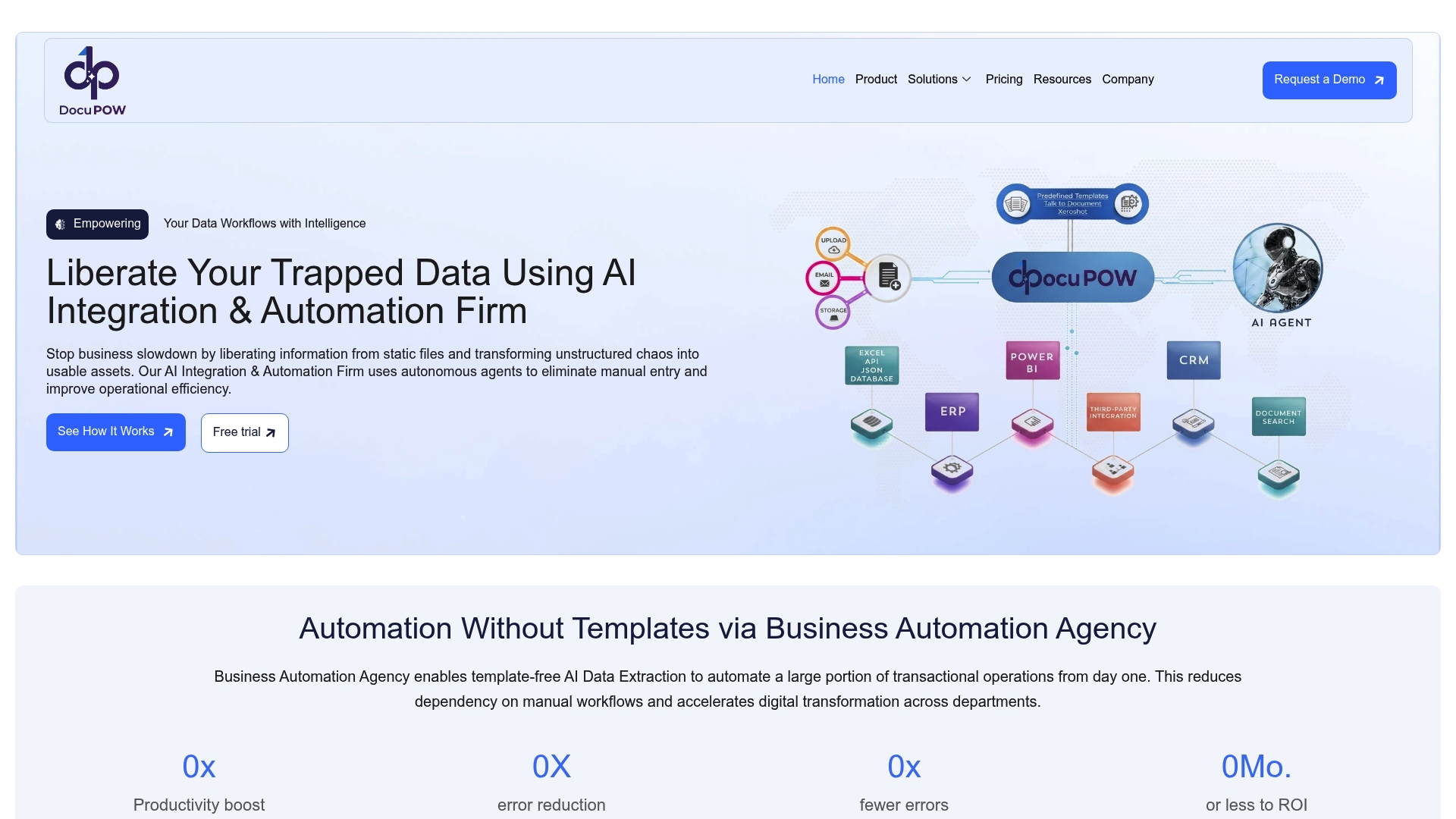
Teams across manufacturing, real estate, supply chain, and finance use DocuPOW to process high volumes of variable documents with accuracy that template-based tools cannot match. The platform supports high-volume document workflows with real-time analytics and full audit trails from source document to structured output. For teams managing property documents, DocuPOW’s real estate extraction solutions handle lease agreements, title documents, and disclosures without manual field mapping. Visit DocuPOW to see how the platform fits your document processing needs.
FAQ
What is AI data extraction?
AI data extraction is the automated process of pulling structured fields from unstructured documents using NLP, machine learning, and schema-driven processing. It replaces manual data entry with accurate, high-speed retrieval across formats like PDFs, images, and DOCX files.
How does AI extraction differ from traditional OCR?
Traditional OCR converts images to text but does not interpret meaning or structure. AI extraction adds NLP and schema logic on top of OCR output, identifying specific fields and their values regardless of where they appear in the document.
What is an F1 score in the context of data extraction?
An F1 score measures the balance between precision and recall in extraction accuracy. Template-based tools drop 12–28 F1 points on new document formats, while LLM-based tools drop only 2–6 points, making AI methods significantly more reliable across variable documents.
Do AI extraction tools require training data for new document types?
Schema-driven AI extraction requires no training data for new document types. Defining a JSON schema with the target fields is sufficient for the system to extract accurately from documents it has never seen before.
What industries benefit most from intelligent data extraction?
Finance, healthcare, real estate, manufacturing, insurance, and supply chain operations all benefit from intelligent data extraction. Any industry processing high volumes of variable documents, such as invoices, contracts, or medical forms, sees measurable gains in speed and accuracy.
Recommended
See DocuPOW on your documents.
Stop building templates. Start extracting data.