Audit Preparation for Accounting Teams: Checklist & Timeline
Prepare your accounting team for audits with effective checklists and timelines. Ensure a clean opinion with efficient documentation and controls.


Audit preparation is the coordinated, year-round set of controls, documentation, and workflows that lets your organization support auditor testing and obtain a clean (unqualified) opinion. Per PCAOB auditing standards, auditors scope and design testing based on risk assessment — which means your readiness directly shapes how deep they go. Corporate Finance Institute frames the practical goal simply: resolve uncertainties and document complex transactions early enough that auditors can test without excessive rework. Tools like DocuPOW can accelerate the evidence assembly side of that goal, but the discipline starts with ownership and timing.
Your 48-hour stabilization checklist — run this before anything else:
- Assign a single point of contact (controller or senior manager) who owns all auditor communications
- Pull the latest trial balance snapshot and confirm it ties to the general ledger
- Locate and date-stamp your top five schedules: bank reconciliations, A/R aging, A/P aging, fixed asset schedule, and board minutes
- Confirm who owns external confirmation requests (bank, legal, investment custodian)
- Verify access to passworded systems auditors will need: ERP, document management, payroll
This emergency checklist is a triage tool for immediate stabilization and does not substitute for the full audit preparation process described in the seven-phase audit timeline below, which should commence 3–6 months before fieldwork per standard guidance. If any item is missing, that gap is your first remediation priority.
Key Takeaways
Year-round audit readiness, built on named ownership, current reconciliations, and documented technical positions, is the single most effective way to reduce audit delays, minimize findings, and lower fees.
| Point | Details |
|---|---|
| Start 3–6 months early | Begin reconciliations, owner assignments, and remediation well before fieldwork per NowCFO guidance. |
| Assign a single point of contact | Every audit request needs one named owner; gaps in ownership are the leading cause of delays. |
| Map evidence to FS assertions | Organize documents by existence, completeness, and valuation to anticipate auditor follow-up questions. |
| Fix control gaps before fieldwork | Remediate design gaps early; use compensating controls for late-discovered issues and document them formally. |
| DocuPOW for evidence assembly | DocuPOW’s template-free extraction and human-in-the-loop review reduce document turnaround time across the audit cycle. |
Table of Contents
- What types of audits expect from you
- How to build your audit preparation timeline
- What documents auditors will ask you to provide
- How to assess and fix control gaps before fieldwork
- Common pitfalls that cause audit delays
- What to expect during fieldwork and how to manage it
- How automation speeds evidence assembly without replacing judgment
- Why audit readiness is a governance signal, not just a compliance task
- Cut evidence assembly time with DocuPOW
- Sources
- FAQ
What types of audits expect from you
Not every audit is the same, and over-preparing for the wrong scope wastes time. Here are the four types most U.S. organizations encounter:
Financial statement audit. The most common engagement. Auditors test whether financial statements are fairly presented under FASB standards. Evidence focus: trial balance, reconciliations, journal entry support, and disclosures. External auditors follow PCAOB standards for public companies and AICPA standards for private entities.
Internal audit. Conducted by your own internal audit function or a co-sourced provider. Objective is control effectiveness, not financial statement opinion. Evidence focus: process documentation, control evidence, exception reports, and remediation tracking.
Compliance and regulatory audits. Cover specific regulatory requirements — HIPAA, SOX Section 404, state licensing. Evidence is narrower but must be precise. Expect auditors to test specific controls tied to the regulation, not the full financial close.
SOC audits (SOC 1 / SOC 2). Conducted by a CPA firm assessing service organization controls. SOC 1 covers controls relevant to user entities’ financial reporting; SOC 2 covers security, availability, and related trust service criteria. IT general controls and access management evidence are central.
Single audits. Required for federal award recipients spending $750,000 or more in federal funds in a fiscal year. Governed by the Uniform Guidance (2 CFR Part 200). Expect auditors to test compliance with specific federal program requirements alongside the financial statements.
- Engage a tax specialist early when tax items are material — the IRS conducts its own tax audits with separate documentation requirements
- Bring in a valuation specialist for goodwill, intangibles, or complex financial instruments before fieldwork starts
- For SOC and IT audits, loop in your IT security team at the planning stage, not after the opening meeting.
Pro Tip: For SOC 2 and compliance audits, map your control inventory to the specific criteria before the auditor arrives. A control matrix with evidence owners already assigned cuts opening-meeting time in half.
How to build your audit preparation timeline
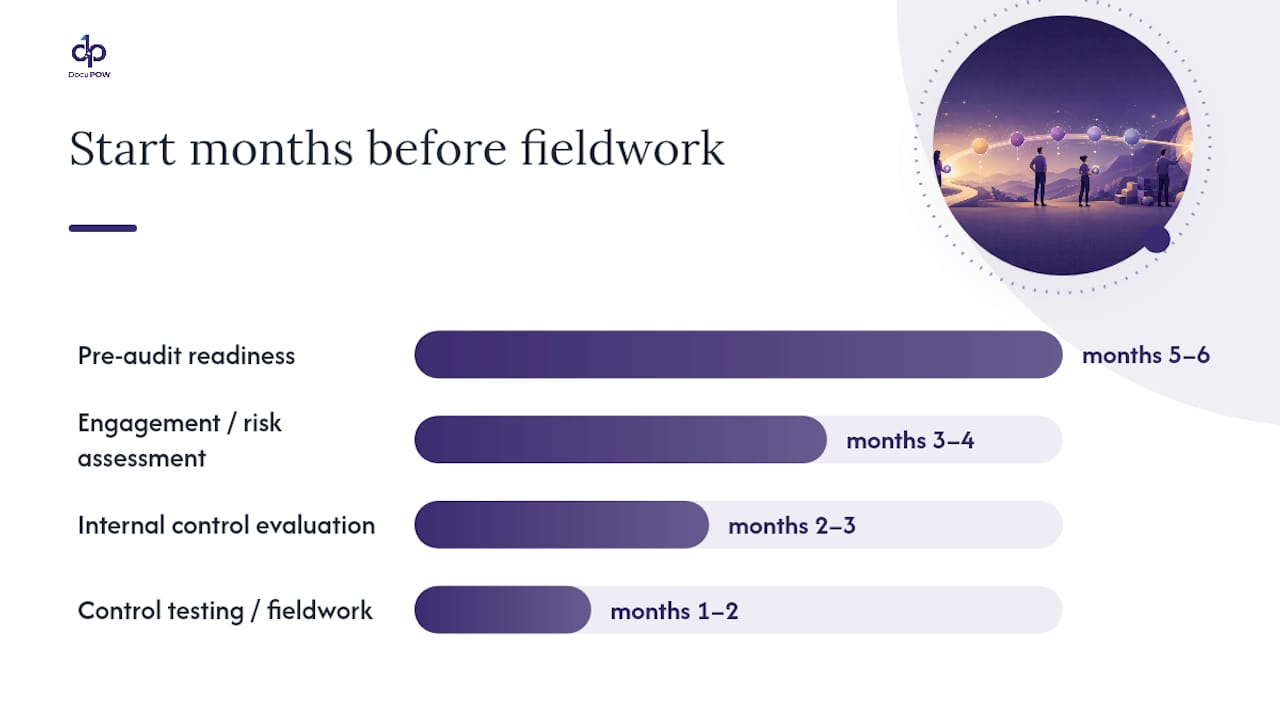
FieldGuide’s seven-phase audit process maps directly to what your team needs to prepare. NowCFO recommends starting 3–6 months before fieldwork to allow time for reconciliations, technical position papers, and remediation. Here is how to translate that into a working timeline with owners.
-
Pre-audit readiness (months 5–6 before fieldwork). Controller and CFO assign owners to every major account and schedule. Close prior-year open items: outstanding reconciling differences, unadjusted audit differences from the prior year, and any open management letter points. This is also when you pull prior-year auditor recommendations and build a remediation tracker.
-
Engagement and risk assessment (months 3–4). Auditors send a preliminary document request list (PBC — Prepared by Client). Your single point of contact logs every item into a request tracker and assigns due dates. RSM recommends that every audit request have a named accountable owner to avoid delays and duplication.
-
Internal control evaluation (months 2–3). Finance and IT walk through entity-level controls, IT general controls, and key transaction-level controls. Document walkthroughs and collect control evidence (approvals, system logs, reconciliation sign-offs). Identify gaps and begin remediation.
-
Control testing and substantive procedures (fieldwork, months 1–2). Auditors arrive and begin sample testing. Your team responds to evidence requests within agreed SLAs. Interim fieldwork (often Q3 for calendar-year entities) covers controls; year-end fieldwork covers substantive procedures on balances.
-
Evaluation of findings (weeks 2–4 post-fieldwork). Auditors draft findings and communicate proposed adjustments. Management reviews, responds, and provides additional support where needed.
-
Report delivery (weeks 4–6 post-fieldwork). Auditors issue the draft report. Management reviews the opinion, footnotes, and any management letter comments.
-
Remediation and follow-up (ongoing). Assign owners to every management letter point. Track remediation to completion before the next cycle begins.
Owner assignment reference:
| Phase | Typical Owner | Key Deliverable |
|---|---|---|
| Pre-audit readiness | Controller | Prior-year open items closed, schedule owners assigned |
| Engagement / risk assessment | Controller + CFO | PBC tracker populated, SLAs confirmed |
| Internal control evaluation | Finance + IT | Walkthrough documentation, gap list |
| Control testing / fieldwork | All schedule owners | Evidence responses within SLA |
| Findings evaluation | Controller + legal | Management response letters |
| Report delivery | CFO + audit committee | Final opinion review |
| Remediation follow-up | Controller | Management letter tracker updated |
What documents auditors will ask you to provide
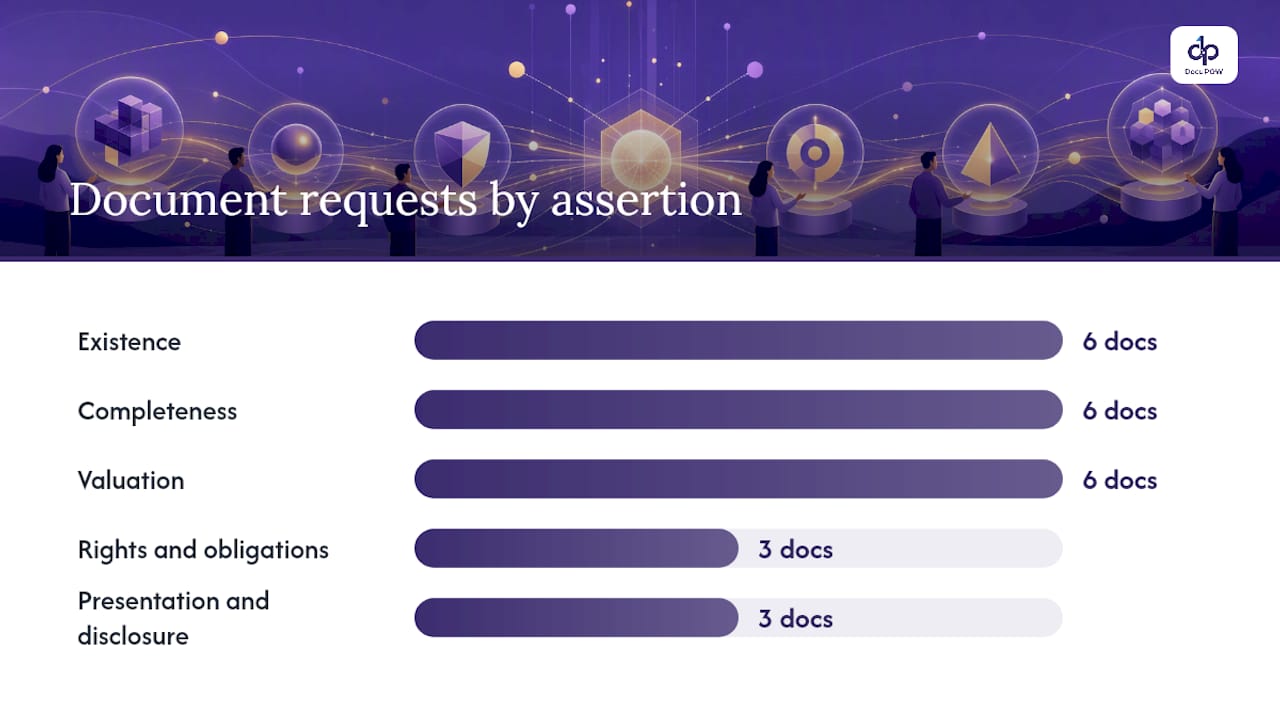
Every auditor request ties back to a financial statement assertion: existence, completeness, valuation, rights and obligations, or presentation and disclosure. Organizing your evidence around those assertions — not just by account — helps your team anticipate follow-up questions before they arrive.
Core document list:
- Trial balance and general ledger detail (existence, completeness)
- Bank reconciliations and bank statements for all accounts (existence, valuation)
- A/R aging schedule and customer confirmations (existence, valuation)
- A/P aging schedule and vendor confirmations (completeness, rights/obligations)
- Fixed asset schedule with additions, disposals, and depreciation detail (existence, valuation)
- Lease schedules (right-of-use assets and liabilities under relevant lease accounting standards) (completeness, valuation)
- Contract summaries for significant agreements (rights/obligations, presentation)
- Board and audit committee minutes (completeness, presentation/disclosure)
- Payroll registers and benefit accruals (completeness, valuation)
- Inventory count sheets and cut-off documentation (existence, completeness)
- Tax filings and tax provision workpapers (valuation, presentation)
- External confirmations: legal representation letters, investment custodian statements (existence, rights/obligations)
Document-to-assertion mapping:
| Document | Typical Owner | Primary FS Assertion |
|---|---|---|
| Bank reconciliations | Treasury | Existence, valuation |
| A/R aging + confirmations | AR manager | Existence, valuation |
| Fixed asset schedule | Fixed assets / controller | Existence, valuation |
| Board minutes | Corporate secretary | Completeness, disclosure |
| Lease schedules (ASC 842) | Lease administrator | Completeness, valuation |
| Payroll registers | HR / payroll | Completeness, valuation |
| Inventory count sheets | Operations / warehouse | Existence, completeness |
| Tax provision workpapers | Tax director | Valuation, presentation |
RSM South Africa’s guidance on month-end close discipline and organized documentation confirms that teams with structured evidence repositories see materially fewer audit delays. Build your folder structure before fieldwork starts, not during it.
Electronic vs. physical evidence. Most auditors now accept electronic evidence via secure portals. Redact personally identifiable information (PII) from payroll and HR documents before uploading. Use version-controlled folders with clear naming conventions (account_period_version). For physical originals — signed contracts, original board minutes — maintain a log of what was scanned and where the original is stored. Secure file transfer is non-negotiable; email attachments for sensitive financial data are not acceptable.
Pro Tip: Build your compliance documentation folder structure to mirror the auditor’s PBC list. When auditors send their request, you map each item to an existing folder rather than hunting for files.
How to assess and fix control gaps before fieldwork
Auditors evaluate controls at four levels: entity-level controls (tone at the top, risk assessment, monitoring), period-end controls (close process, journal entry review), IT general controls (access management, change management, operations), and transaction-level controls (authorization, three-way match, reconciliation). Gaps at any level affect how much substantive testing auditors perform — and how long fieldwork takes.
Steps to test controls internally before auditors arrive:
- Select a sample of transactions for each key control (authorization, reconciliation, system access review) and verify evidence exists
- Conduct walkthroughs: follow one transaction from initiation to recording and confirm each control operated as designed
- Collect control owner sign-offs on the walkthrough documentation
- Compare results to the prior-year control matrix and flag any new gaps or changed processes
When you find a gap, the response depends on timing. A gap discovered four months out can often be remediated through a policy update, a new approval workflow, or a system configuration change. A gap found two weeks before fieldwork needs a compensating control: a manual review layer that achieves the same objective while the permanent fix is implemented. Document the compensating control formally — auditors will ask for it.
FASB standards govern the recognition and disclosure requirements auditors check. When a control gap touches a complex accounting area (revenue recognition, lease accounting, business combinations), prepare a short technical position paper that documents your accounting policy, the standard applied, and the judgment made. Write it before fieldwork, not in response to an auditor question.
Pro Tip: Document technical accounting positions contemporaneously — the day you make the judgment, not the day auditors ask. A position paper written after the fact reads as a rationalization; one written at decision time reads as governance.
Common pitfalls that cause audit delays
Most audit delays trace back to a handful of predictable problems. Knowing them in advance is most of the fix.
Missing or stale reconciliations. A bank reconciliation that hasn’t been prepared since Q2 is a red flag for both control quality and balance accuracy. Rolling reconciliations — prepared and reviewed monthly — eliminate this entirely. RSM’s audit readiness guidance points to month-end close discipline as one of the highest-impact practices for reducing delays.
Undocumented journal entries. Auditors sample journal entries, particularly large, unusual, or late entries. Every journal entry needs a preparer, a reviewer, a business purpose, and supporting documentation. Entries posted without support are an immediate finding.
Weak evidence for estimates. Allowance for doubtful accounts, warranty reserves, and fair value measurements all require documented assumptions. If your estimate methodology lives only in someone’s head, it will not survive auditor scrutiny.
Poor access management. Auditors test whether only authorized users can post transactions, approve payments, or modify master data. Segregation of duties violations — one person who can both create and approve a vendor — are among the most common IT findings.
Staffing gaps during fieldwork. Key staff on vacation during the two weeks auditors are on-site is a predictable problem that teams still walk into every year. Block fieldwork dates on the calendar of every schedule owner at the start of the engagement.
Last-minute system freezes. Freezing the ERP for year-end close while auditors need live access creates friction. Coordinate the freeze window with your IT team and communicate it to auditors in advance.
Quick triage if auditors raise a concern during fieldwork:
- Acknowledge the request immediately; do not let it sit
- Identify the schedule owner and set a same-day or next-day response target
- If the support doesn’t exist, prepare a narrative explanation and escalate to the controller
- Never provide partial or inconsistent support — auditors will expand their sample
What to expect during fieldwork and how to manage it
The opening meeting sets the tone for the entire engagement. Use it to confirm the request tracker format, agree on the communication channel (portal, email, or shared drive), set SLA targets for responses (typically within 24–48 hours for standard requests), and introduce all schedule owners by name. Grant Thornton recommends early auditor engagement, agreed request channels, and designated project management to avoid overload and reduce extra fees.
Fieldwork phases:
- Opening meeting. Confirm scope, timeline, key contacts, and communication protocols.
- Interim fieldwork (if applicable). Auditors test controls and perform preliminary substantive procedures, often in Q3 for calendar-year entities.
- Year-end fieldwork. Auditors complete substantive testing on year-end balances, confirmations, and disclosures.
- Closing meeting. Auditors communicate proposed adjustments, open items, and preliminary findings before issuing the draft report.
Request tracker — columns your team needs:
- Request ID (sequential number for tracking)
- Description of the request
- Schedule owner (named individual)
- Due date (agreed with auditor)
- Status (open / in progress / provided / closed)
- Auditor contact (who raised the request)
- Notes (any clarification or partial response)
Agreeing communication protocols up front dramatically reduces duplicated requests and confusion during fieldwork. When a request is unclear, ask for clarification before preparing the response — a misunderstood request that gets answered wrong costs more time than the clarifying question.
Escalation. If an auditor raises a finding you believe is factually incorrect, escalate to the engagement partner, not the staff auditor. If the disagreement is material and unresolved, the audit committee should be informed. Document every escalation in writing.
PCAOB auditing standards govern how auditors plan and scope their work. Understanding that auditors are required to respond to assessed risk helps you anticipate where they will focus — high-risk accounts get more testing, not less.
How automation speeds evidence assembly without replacing judgment
The highest-value automation targets in audit preparation are repetitive, high-volume tasks: extracting data from invoices, leases, and contracts; running automated reconciliations; routing confirmation requests; and maintaining versioned evidence storage with secure sharing. These are exactly the tasks where manual effort creates bottlenecks and errors.
What to automate:
- Data extraction from invoices, purchase orders, lease agreements, and contracts (template-free extraction handles non-standard formats)
- Automated bank and balance sheet reconciliations with exception flagging
- Confirmation workflow routing (send, track, receive, file)
- Versioned evidence storage with audit trail and access controls
- API-based pulls from ERP and CRM to populate schedules automatically
What to keep manual:
- Judgmental position papers and technical accounting memos
- Valuation assumptions and model inputs
- Legal opinions and attorney representations
- Management’s assessment of going concern or significant estimates
DocuPOW’s agent-based extraction works without rigid templates, which matters for audit evidence because contracts, leases, and vendor agreements rarely follow a standard format. The platform’s human-in-the-loop review layer keeps a compliance professional in the decision chain for anything that requires judgment, while the AI workflow automation handles the extraction and routing automatically. Integration with ERP systems via API means reconciliation schedules can be populated from live data rather than manual exports.
For teams evaluating financial document automation tools, the practical question is not whether to automate but where to start. Organizational readiness for AI-assisted workflows is a real factor — AI readiness varies by team maturity and data quality, and both affect how quickly automation delivers value.
Pro Tip: Pilot automation on one cycle — A/P or fixed assets — and measure the reduction in request turnaround time and rework before expanding. A single cycle pilot gives you defensible data for the next budget conversation.
Why audit readiness is a governance signal, not just a compliance task
Most finance teams treat audit preparation as a year-end sprint. That framing is the root cause of most audit delays, most findings, and most extra fees. RSM’s year-round readiness framework is right: the discipline of timely reconciliations, documented positions, and clear ownership is not audit prep — it is financial reporting governance.
Boards and audit committees read audit outcomes as signals about management quality. A clean opinion delivered on schedule, with no material weaknesses and a short management letter, tells the audit committee that the finance function is in control. A delayed audit with multiple findings tells a different story, regardless of the technical explanation.
Management ownership is the variable that matters most. Auditors can only test what you give them. When every schedule has a named owner, every reconciliation is current, and every technical position is documented before fieldwork starts, the audit becomes a verification exercise rather than an investigation. That shift changes the tone of every auditor conversation.
Use the evidence checklist and timeline in this guide as your control register for the audit cycle. Review it quarterly, not just in the month before fieldwork.
Cut evidence assembly time with DocuPOW
Finance teams that spend fieldwork weeks hunting for documents, reformatting exports, and chasing schedule owners are paying for a problem that automation solves directly. DocuPOW’s agent-based platform extracts data from contracts, leases, invoices, and any other document type without templates, routes evidence to the right owner automatically, and maintains a versioned, access-controlled repository that auditors can review securely.
The practical payoff: fewer last-minute requests, faster response times, and an evidence trail that holds up to auditor scrutiny. For teams not ready to automate immediately, the manual best practices in this guide — rolling reconciliations, named owners, a request tracker, and a pre-built folder structure — deliver the same discipline without a platform. When you are ready to move faster, explore DocuPOW’s document process automation capabilities and request a demo to see how the platform fits your audit cycle.
Sources
The recommendations in this guide draw on the following authoritative sources. Each aligns to specific sections of the guide:
- PCAOB auditing standards | PCAOB
- FASB standards | FASB
- How to prepare your annual financial audit | RSM Australia
- Financial audit process steps | FieldGuide
- Audit preparation | Corporate Finance Institute
- Audit readiness checklist for lean finance teams | Grant Thornton
- What Is Audit Preparation? A Comprehensive Guide | NowCFO
- IRS home page | IRS
FAQ
What does audit preparation mean?
Audit preparation is the coordinated set of controls, documentation, and workflows an organization maintains so auditors can test financial statements and issue an opinion efficiently. The practical goal, per Corporate Finance Institute, is to resolve uncertainties and document complex transactions before fieldwork begins.
What are the seven steps in the audit process?
FieldGuide maps the standard audit process to seven phases: pre-audit readiness, engagement and risk assessment, internal control evaluation, control testing, substantive procedures, evaluation of findings, and report delivery. Each phase has corresponding preparation activities your team should complete before auditors begin that phase.
How far in advance should you start preparing for an audit?
NowCFO recommends beginning audit preparation 3–6 months before auditors commence fieldwork. That window allows time to close prior-year open items, complete reconciliations, document technical positions, and remediate control gaps before the opening meeting.
What are the 5 C’s of audit?
The 5 C’s is not a universally standardized framework in U.S. auditing standards; definitions vary by firm and training context. A common version covers Criteria (the standard being measured against), Condition (what was found), Cause (why the gap exists), Consequence (the risk or impact), and Corrective action (the recommended fix). These are most often used in internal audit findings, not external financial statement audits.
How can automation help with audit preparation?
Automation handles high-volume, repetitive tasks — data extraction from contracts and invoices, reconciliation population, confirmation routing, and versioned evidence storage. DocuPOW’s agent-based platform performs template-free extraction and integrates with ERP systems via API, reducing manual document assembly time across the audit cycle while keeping human reviewers in the loop for judgment-dependent tasks.
Recommended
See DocuPOW on your documents.
Stop building templates. Start extracting data.