Information Retrieval: A Technical Guide for Practitioners
Unlock the power of Information Retrieval with this comprehensive guide. Explore techniques, metrics, and systems to enhance your document retrieval!

Information retrieval (IR) is the set of techniques and systems that find, rank, and present the documents or passages most relevant to a user’s information need. Unlike a database query that returns exact matches, an IR system assigns a retrieval status value (RSV) to every candidate document and returns a ranked list ordered by predicted relevance. The canonical measures for judging that list are precision and recall, extended by metrics like MAP and nDCG for ranked output. Benchmark suites such as TREC and MS MARCO provide the shared test collections that let researchers compare systems fairly. Ranking functions range from classical BM25 to transformer-based neural models, and production stacks today almost always combine both.
This guide covers:
-
Core components and the IR pipeline (indexing, representation, retrieval, ranking, serving)
-
Model families: Boolean, vector-space/tf–idf, probabilistic/BM25, language models, and neural embeddings
-
Evaluation metrics and benchmark suites
-
Libraries and tools: Apache Lucene, Elasticsearch, Apache Solr, FAISS, Annoy, and Milvus
-
Modern hybrid retrieval, RAG pipelines, and multi-modal search
-
Enterprise deployment patterns, challenges, and ethical considerations
Table of Contents
-
What is information retrieval, and how does it differ from data retrieval?
-
How did information retrieval evolve from Boolean logic to neural models?
-
Which tools and libraries should you use for building IR systems?
-
What makes modern hybrid retrieval and RAG different from classical IR?
-
What operational challenges should you expect when deploying IR systems?
-
DocuPOW brings IR techniques to enterprise document workflows
What is information retrieval, and how does it differ from data retrieval?
IR returns a ranked list of items ordered by predicted relevance to an information need. That single distinction separates it from almost every other data-access paradigm.
A SQL query against a relational database returns every row that satisfies a Boolean predicate, nothing more and nothing less. The query is precise, the schema is fixed, and “relevance” is not a concept the engine cares about. IR inverts that contract: the user expresses a fuzzy, often ambiguous need (“papers on transformer-based ranking”), and the system must translate that expression into a retrieval operation, score candidates, and decide what order to present them in.
The concept of an information need is central here. A user rarely knows exactly what they want before they search. They have a gap in knowledge, and the query is an imperfect proxy for that gap. IR systems model the gap, not just the literal query string. That modeling step, called query understanding or query translation, is where most of the interesting engineering happens.
Typical IR tasks include:
- Retrieval-augmented generation (RAG): — fetching the passages a language model needs to answer a question accurately
Pro Tip: Use IR-style ranking whenever the user’s need is fuzzy or exploratory. Use exact-match retrieval (SQL, key-value lookup) when you know the precise identifier and need a deterministic answer. Mixing the two in a hybrid stack covers most real-world cases.
How did information retrieval evolve from Boolean logic to neural models?
The arc runs from symbolic rule-following to statistical weighting to learned representations, and each shift was driven by a failure mode of the previous approach.
-
1950s–1960s: Early library science and document retrieval systems used Boolean logic. Queries were AND/OR/NOT combinations of terms. Precision was controllable, but recall was brittle and ranking was impossible.
-
1970s–1980s: Gerard Salton’s vector-space model introduced tf–idf weighting and cosine similarity, letting systems score documents by term frequency relative to how rare a term is across the corpus. Ranking became possible.
-
1980s–1990s: The probabilistic retrieval framework, culminating in BM25 (Robertson and Sparck Jones), added term frequency saturation and document length normalization. BM25 remains the default lexical scorer in Elasticsearch and OpenSearch today.
-
1992–present: TREC (Text REtrieval Conference) launched, giving the field shared test collections and relevance judgments. Evaluation practices matured alongside model development.
-
2000s: Language model approaches to IR (query likelihood models) offered a probabilistic alternative to BM25 and opened the door to smoothing techniques.
-
2013–2018: Word2Vec, GloVe, and then ELMo introduced dense vector representations. Semantic similarity became computable without exact term overlap.
-
2018–present: BERT and subsequent transformer models enabled deep contextual representations. Bi-encoder architectures (dense retrieval) and cross-encoder re-rankers became practical at scale. MS MARCO provided the large-scale passage ranking benchmark that drove this generation of research.
Evaluation practices evolved in parallel. Early systems were judged on precision and recall over unranked sets. As ranked retrieval became standard, MAP and nDCG replaced or supplemented those measures. Online A/B testing joined offline test collections as a required validation step for production changes.
What are the core components of an IR system?
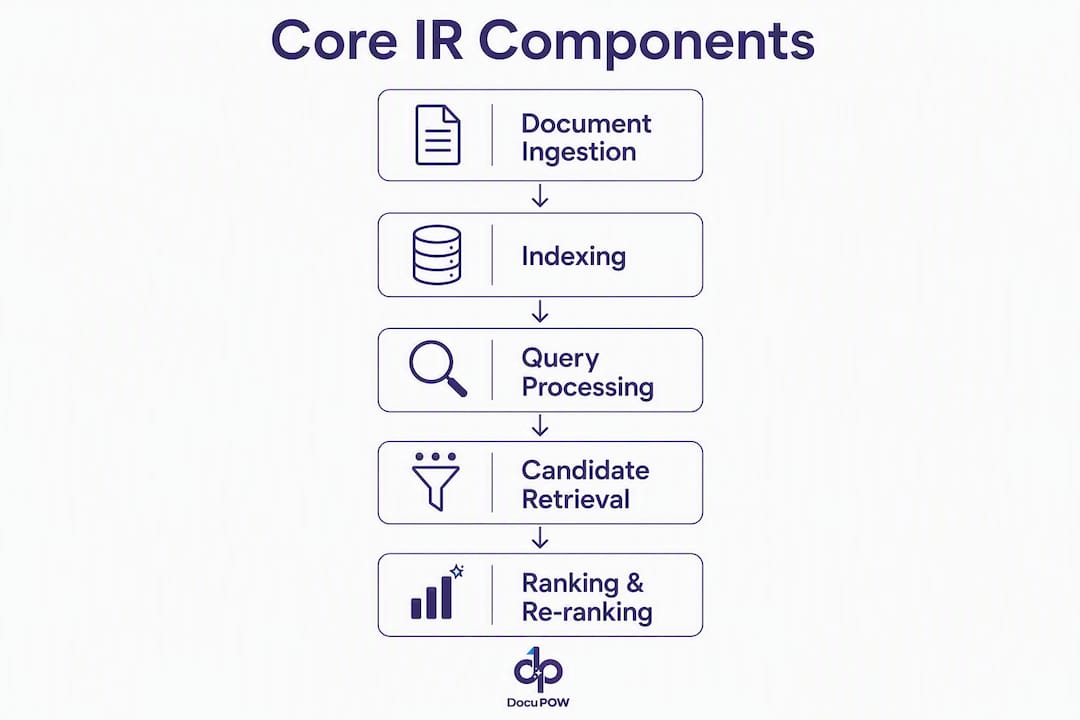
Every IR system, from a simple search box to a production RAG pipeline, runs the same logical pipeline: document ingestion → preprocessing → indexing → candidate retrieval → ranking/re-ranking → serving.
Indexing: inverted indexes and positional postings
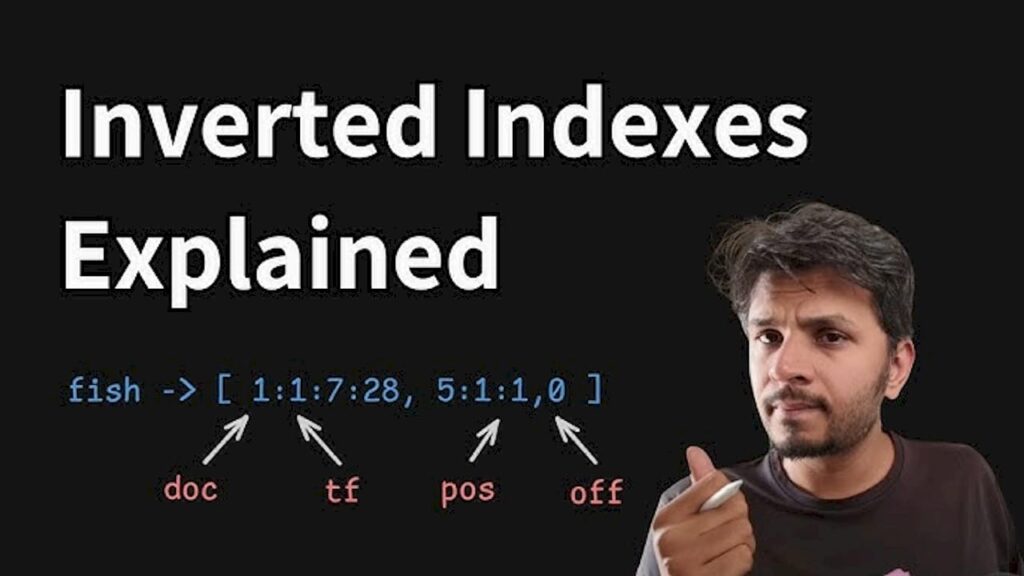
The inverted index is the data structure that makes fast retrieval possible. For each term in the vocabulary, the index stores a posting list: the set of document IDs that contain that term, along with term frequency and, in a positional index, the positions of each occurrence. Positional postings enable phrase queries (“machine learning”) and proximity scoring.

A term dictionary maps each term to its posting list offset on disk. At query time, the engine looks up each query term in the dictionary, fetches the posting lists, and merges them. That merge is where Boolean AND/OR logic and BM25 scoring happen.
Representation: from bags of words to dense embeddings
Bag-of-words treats a document as an unordered set of term counts. tf–idf weights those counts by inverse document frequency, downweighting common terms. Dense embeddings encode the full semantic meaning of a passage into a fixed-length vector, typically 768 or 1,024 dimensions for transformer-based encoders. The right choice depends on the query type: exact entity matching favors sparse representations; conceptual similarity favors dense ones.
Retrieval vs. ranking
Candidate retrieval is fast and approximate. The goal is to reduce a corpus of millions to a few hundred candidates with high recall. Ranking is slower and more precise: a scoring function (BM25, a neural model, or a cross-encoder) assigns a final score to each candidate and sorts the list.
Serving concerns
Latency, freshness, and scale are the three levers that determine whether a theoretically good system works in production. Sharding splits the index across machines so queries can run in parallel. Freshness requires incremental indexing strategies that add new documents without full rebuilds. Latency budgets dictate how expensive a re-ranker you can afford.
Pro Tip: Set a latency budget before choosing a re-ranker. A cross-encoder running on CPU adds hundreds of milliseconds per query. If your SLA is under 200ms end-to-end, you need a bi-encoder or a very small cross-encoder on GPU.
Which IR model families should you know?
The main families are Boolean, vector-space/tf–idf, probabilistic/BM25, language models, and neural embedding-based models. Each has a distinct use case and a distinct failure mode.
Boolean models treat retrieval as set membership. A document either matches a query or it does not. They are fast and deterministic, which makes them useful for structured filtering (faceted search, access control), but they cannot rank results and they are sensitive to query formulation.
Vector-space models and tf–idf represent documents and queries as vectors in a high-dimensional term space. The similarity score between a document d and query q is typically cosine similarity:
score(d, q) = (d · q) / (|d| × |q|)
The tf–idf weight for term t in document d is:
tf-idf(t, d) = tf(t, d) × log(N / df(t))
where tf(t, d) is the raw term count, N is the corpus size, and df(t) is the number of documents containing t. High idf means the term is rare and therefore informative.
BM25 extends the probabilistic framework by adding two critical corrections to raw tf–idf. Term frequency saturation prevents a term appearing 100 times from scoring 100× better than one appearing once. Length normalization prevents long documents from dominating simply because they contain more terms. The BM25 score for a query Q with terms q₁…qₙ against document d is:
score(d, Q) = Σ IDF(qᵢ) × [tf(qᵢ,d) × (k₁+1)] / [tf(qᵢ,d) + k₁ × (1 − b + b × |d|/avgdl)]
where k₁ (typically 1.2–2.0) controls saturation and b (typically 0.75) controls length normalization. BM25 remains the default lexical scorer in Elasticsearch and OpenSearch because it generalizes well across domains without tuning.
Language model approaches frame retrieval as: what is the probability that document d generated query Q? Query likelihood models with Dirichlet or Jelinek-Mercer smoothing often match or beat BM25 on standard benchmarks, and they connect naturally to neural language models.
Neural and embedding-based models split into two architectures. Bi-encoders encode the query and document independently into dense vectors; retrieval is a nearest-neighbor search over those vectors. Cross-encoders take the query and document together as input and produce a single relevance score; they are more accurate but far slower because they cannot precompute document representations. Hybrid retrieval combining BM25 and vector search is the production standard for RAG systems precisely because vector embeddings excel at semantic similarity but fail on exact entity matching, while BM25 compensates with IDF and length normalization.
-
Boolean: structured filtering, access control, legacy systems
-
tf–idf / vector-space: baseline ranking, lightweight deployments
-
BM25: general-purpose lexical ranking, default for most production stacks
-
Language models: probabilistic retrieval, neural LM fine-tuning
-
Bi-encoders: semantic search, dense retrieval at scale
-
Cross-encoders: re-ranking top-K candidates for maximum accuracy
Pro Tip: Add a cross-encoder re-ranker only on the top 50–100 candidates from your bi-encoder or BM25 pass. Running a cross-encoder over thousands of documents is prohibitively slow; running it over a small shortlist is where it earns its keep.
How does text preprocessing and indexing work in practice?
Preprocessing determines what the index actually contains. Get it wrong and your retrieval quality suffers regardless of how good your ranking model is.
The pipeline runs in this order:
-
Tokenization: split raw text into tokens. Whitespace tokenization is simple but misses compound words and subword units. WordPiece and BPE (byte-pair encoding) tokenizers, used by BERT-family models, handle out-of-vocabulary terms by splitting them into known subword pieces.
-
Normalization: lowercase all tokens, strip punctuation, apply Unicode normalization (NFC or NFKC), and decide on a stopword strategy. Removing stopwords reduces index size and speeds up retrieval, but it breaks phrase queries that include them (“to be or not to be”).
-
Stemming vs. lemmatization: stemming (Porter, Snowball) chops word endings heuristically and is fast but imprecise (“running” → “run”, “better” → “better”). Lemmatization uses morphological analysis to return the dictionary form (“better” → “good”) and is more accurate but slower. For most English-language production systems, stemming is sufficient; lemmatization pays off in morphologically rich languages.
-
Index construction: build the inverted index by iterating over preprocessed tokens, recording (term, doc_id, position) triples, and sorting by term. The resulting posting lists are stored on disk with compression (variable-byte or PForDelta encoding).
-
Chunking for RAG and passage retrieval: splitting long documents into passages before indexing. Chunk size is a genuine trade-off. Smaller chunks (128–256 tokens) improve precision for specific queries; larger chunks (512–1,024 tokens) preserve more context for conceptual questions. Query-adaptive retrieval selects chunk size dynamically based on query specificity, using coarse-grained vectors for broad questions and fine-grained lexical retrieval for entity-specific ones.
Implementation notes worth knowing:
-
Incremental indexing: add new documents to a separate in-memory segment and merge periodically. Lucene’s segment architecture does this automatically.
-
Document deletion: mark documents as deleted in a deletion bitmap; they are physically removed during segment merges.
-
Update strategies: updates are deletes followed by inserts. Frequent small updates fragment the index; batch updates are more efficient.
How are IR systems evaluated?
Precision and recall are the foundation. Precision is the fraction of retrieved documents that are relevant; recall is the fraction of relevant documents that are retrieved. They trade off against each other: retrieving everything maximizes recall but collapses precision; retrieving only the single most confident result maximizes precision but misses most relevant documents.
F1 is the harmonic mean of precision and recall, useful when you want a single number that penalizes extreme imbalance between the two.
For ranked retrieval, set-based measures are not enough. Precision-recall curves and ranked metrics capture position sensitivity:
-
Precision@k (P@k): precision among the top k results. P@10 is the standard for web search evaluation because users rarely look past the first page.
-
Mean Average Precision (MAP): the mean of average precision scores across queries. Average precision rewards systems that rank relevant documents early.
-
nDCG (Normalized Discounted Cumulative Gain): accounts for graded relevance (a document can be “highly relevant,” “relevant,” or “not relevant”) and discounts gains logarithmically by rank position. nDCG is the standard metric for MS MARCO and most modern IR benchmarks.
-
Reciprocal Rank (MRR): the mean of 1/rank of the first relevant result, useful for question-answering tasks where one correct answer exists.
Metric spotlight: nDCG@10 is the single most widely reported metric in modern IR research. It rewards placing highly relevant documents at rank 1 more than at rank 5, and it handles graded relevance labels, which makes it more informative than binary precision/recall for real-world search quality.
Benchmark suites provide the shared test collections that make comparison meaningful:
-
TREC (Text REtrieval Conference): the oldest and most influential benchmark program, running since 1992. TREC tracks cover web search, clinical trials, news, and more. Each track provides a document corpus, a set of topics (queries), and human relevance judgments (qrels).
-
MS MARCO: a large-scale passage and document ranking dataset derived from Bing search logs, with sparse relevance labels. It drove the neural IR wave of the 2010s and remains the standard pre-training and fine-tuning resource for dense retrieval models.
Evaluation practice distinguishes offline evaluation (fixed test collections, reproducible) from online A/B testing (real users, real behavior, but noisy and expensive). Both are necessary: offline evaluation catches regressions before deployment; A/B testing validates that metric improvements translate to user satisfaction.
Practical pitfalls:
-
Skewed relevance distributions inflate precision metrics; always report the percentage of relevant documents in the collection.
-
Human relevance labels are noisy and annotator-dependent; inter-annotator agreement (Cohen’s kappa) should be reported.
-
Evaluation choices must match the user task: web search optimizes P@10; legal discovery optimizes recall; tune thresholds to user tolerance for false positives versus false negatives.
Which tools and libraries should you use for building IR systems?
The core toolkit spans two categories: lexical search engines and vector indexes. Most production systems use at least one from each.
Apache Lucene is the foundational Java library underlying most open-source search infrastructure. It handles tokenization, inverted index construction, BM25 scoring, and query parsing. Lucene is not a server; it is a library you embed in your application. Everything else in this list either wraps Lucene or solves a different problem entirely.

Elasticsearch wraps Lucene in a distributed, REST-accessible server with JSON APIs, horizontal sharding, and built-in support for dense vector fields (kNN search via HNSW). It is the most widely deployed search engine in enterprise environments and supports hybrid BM25 + vector search natively as of recent versions. BM25 is its default lexical scorer.
Apache Solr is the other major Lucene-based search server, older than Elasticsearch and historically stronger in enterprise document management and faceted search. Solr’s SolrCloud mode provides distributed search. It has added vector search support, though Elasticsearch’s ecosystem for hybrid retrieval is currently more mature.
FAISS (Facebook AI Similarity Search) is a C++ library with Python bindings for efficient nearest-neighbor search over dense vectors. It supports flat (exact) indexes for small corpora and approximate indexes (IVF, HNSW, PQ) for billion-scale retrieval. FAISS is the standard choice when you need maximum control over the vector index and are comfortable with lower-level APIs.
Annoy (Approximate Nearest Neighbors Oh Yeah) is a lightweight C++ library with Python bindings, originally built at Spotify for music recommendation. It uses random projection trees to build a static, memory-mappable index. Annoy is fast at query time and memory-efficient, but the index is read-only after construction, which limits it to use cases where the corpus changes infrequently.
Milvus is a purpose-built vector database designed for production-scale similarity search. It supports multiple index types (IVF_FLAT, HNSW, DiskANN), multi-tenancy, and hybrid scalar-vector filtering. Milvus is the right choice when you need a managed vector store with operational features (replication, backup, access control) rather than a library you manage yourself.
| Category | Lucene | Elasticsearch | Solr | FAISS | Annoy | Milvus |
|---|---|---|---|---|---|---|
| Primary use | Lexical search library | Distributed lexical + vector search | Distributed lexical search | Vector similarity library | Lightweight ANN library | Vector database |
| Hybrid search | No (library only) | Native (BM25 + kNN) | Partial | No (vector only) | No (vector only) | Scalar + vector filter |
| Index mutability | Yes | Yes | Yes | Flat/IVF yes; HNSW append-only | Read-only after build | Yes |
| Operational features | None | High (sharding, HA, REST) | High (SolrCloud, REST) | None | None | High (replication, multi-tenancy) |
| Language bindings | Java | REST / many clients | REST / many clients | C++, Python, Java | C++, Python | Python, Java, Go, Node |
| Best fit | Embedded Java apps | Enterprise search, RAG backends | Enterprise document search | Research, custom pipelines | Static corpus, low ops overhead | Production vector store |
Integration pattern: the standard production architecture pairs a lexical engine (Elasticsearch or Solr) with a vector index (FAISS for custom pipelines, Milvus for managed deployments) and fuses their result lists with Reciprocal Rank Fusion before a cross-encoder re-ranker. For teams that want to reduce operational complexity, unified data layers like PostgreSQL with pgvector consolidate lexical and vector search in a single store, reducing synchronization overhead and mitigating cross-tenant leakage.
Pro Tip: For content freshness and ranking signals, the indexing pipeline needs to account for document age and update frequency. Content freshness affects how search engines weight documents in their rankings, and the same principle applies to enterprise IR: stale index segments degrade retrieval quality for time-sensitive queries.
Where is information retrieval applied in the real world?
IR techniques power a wider range of applications than most practitioners realize when they first encounter the field.
-
Web search: the most visible application. Systems like Google and Bing index hundreds of billions of documents, run multi-stage ranking pipelines (BM25 candidate retrieval, neural re-ranking, diversity re-ranking), and must return results in under 200ms. The primary success criterion is P@10 and user engagement signals (click-through rate, dwell time).
-
Enterprise search: employees searching internal knowledge bases, SharePoint repositories, Confluence wikis, and email archives. The corpus is smaller but heterogeneous (PDFs, spreadsheets, scanned documents, emails). Multi-modal ingestion and access control are the dominant engineering challenges. Enterprise document intelligence at scale requires IR pipelines that handle structured and unstructured content in the same retrieval pass.
-
eDiscovery: legal teams searching millions of documents for evidence relevant to litigation. Recall is the primary metric because missing a relevant document can have legal consequences. Technology-assisted review (TAR) combines IR with active learning to prioritize human review of the most likely-relevant documents.
-
Recommender systems: collaborative filtering and content-based recommendation both use IR-style retrieval. Item-to-item similarity search over dense embeddings is a standard component of modern recommendation pipelines.
-
Retrieval-augmented generation (RAG): a language model answers questions by first retrieving relevant passages from a corpus, then conditioning its generation on those passages. Hybrid retrieval (BM25 + dense) with cross-encoder re-ranking is the standard RAG retrieval stack. Real-world document automation factories use RAG-style pipelines to answer queries over invoice archives, contract repositories, and compliance document sets.
-
Semantic search over documents: invoice processing, contract search, and helpdesk ticket routing all benefit from semantic search that matches intent rather than exact keywords. A query for “payment terms” should surface clauses about “net 30” and “due upon receipt” even when those exact words do not appear in the query.
What makes modern hybrid retrieval and RAG different from classical IR?
Hybrid retrieval combining BM25 and vector search is the production standard for RAG systems. The reason is straightforward: neither approach alone is sufficient.
Dense vector search excels at semantic similarity. A query for “how do I cancel my subscription” will retrieve passages about “account termination” and “ending your plan” even without term overlap. But vector embeddings cluster semantically similar phrases and fail to distinguish exact entities like error codes, version numbers, and product SKUs. BM25 handles those cases precisely because its IDF weighting gives high scores to rare, specific terms.
Reciprocal Rank Fusion (RRF) solves the score normalization problem when fusing two ranked lists. Instead of trying to normalize BM25 scores (which are unbounded) against cosine similarity scores (which are bounded between -1 and 1), RRF converts each list to rank positions and combines them:
RRF_score(d) = Σ 1 / (k + rank_i(d))
where k is a constant (typically 60) and rank_i(d) is the rank of document d in list i. Documents that rank highly in both lists score well; documents that rank highly in only one list score moderately. No score normalization required.
Semantic granularity matters operationally. Advanced systems adapt chunk size and retrieval depth to query specificity: coarse-grained vectors for broad conceptual questions, fine-grained lexical retrieval for entity-specific queries. A fixed chunk size is a compromise that works adequately for average queries but fails at the extremes.
Multi-modal retrieval extends the pipeline beyond text. Tables, images, charts, and structured data fields all carry information that text-only indexes miss. Encoding tables as structured text (markdown or CSV) before indexing is a pragmatic first step; dedicated table encoders and vision-language models handle more complex cases.
Limitations to keep in mind:
-
Dense retrievers struggle with out-of-distribution queries and rare entities not well-represented in training data.
-
RAG systems can hallucinate when retrieved passages are ambiguous or contradictory.
-
Data staleness: a vector index built on a corpus snapshot degrades as the corpus changes; incremental updates are harder for HNSW than for inverted indexes.
-
Scale: billion-scale vector indexes require significant infrastructure (GPU memory, distributed HNSW, or product quantization).
-
Vector search alone is not safe for compliance-sensitive applications; hybrid stacks and human-in-the-loop validation are the safer choice.
Pro Tip: The recommended production architecture is: hybrid retrieve (BM25 + bi-encoder) → RRF fusion → cross-encoder re-rank on top 50 → LLM consume. Each stage filters aggressively so the expensive stages see only a small, high-quality candidate set.
How do you build a simple IR pipeline from scratch?
The minimal path from raw data to a working retrieval system has five stages. Each one is a checkpoint where you can measure quality and decide whether to add complexity.
-
Prepare your data. Choose a dataset. MS MARCO Passage Ranking is the standard starting point: it has 8.8 million passages, 1 million training queries, and sparse relevance labels. TREC collections (TREC-COVID, TREC Deep Learning) provide smaller, more carefully judged alternatives. For domain-specific prototyping, a Common Crawl subset filtered to your domain works well.
-
Preprocess and index. Tokenize, lowercase, and stem (or lemmatize) your corpus. Build an inverted index using Apache Lucene directly or via the Python
whooshlibrary for small corpora. For dense retrieval, encode passages with a bi-encoder (e.g.,sentence-transformerswith themsmarco-distilbert-base-v3model) and index the resulting vectors in FAISS with an IVF index. -
Candidate retrieval. Run BM25 retrieval to get the top 100 candidates per query. Separately run ANN search over the dense index for the top 100 dense candidates. Fuse the two lists with RRF.
-
Re-rank. Pass the top 50 fused candidates through a cross-encoder (e.g.,
cross-encoder/ms-marco-MiniLM-L-6-v2from thesentence-transformerslibrary). This step typically adds 3–5 nDCG points on MS MARCO. -
Evaluate and iterate. Compute nDCG@10, MAP, and recall@100 using
pytrec_evalagainst the MS MARCO qrels. Recall@100 after the retrieval stage is the most important number: if relevant documents are not in your candidate set, no re-ranker can fix that.
Practical tips:
-
Start with BM25 alone. It is a strong baseline and fast to implement. Add dense retrieval only when BM25 plateaus.
-
Tune chunk size before tuning model hyperparameters. Chunking decisions affect recall more than most model choices.
-
Use
beir(Benchmarking IR) to evaluate your pipeline across multiple domains without writing custom evaluation code. -
Log query latency at each pipeline stage from day one. Latency regressions are hard to diagnose retroactively.
What operational challenges should you expect when deploying IR systems?
The top challenges in production IR are precision-recall trade-offs, data freshness, cross-tenant leakage, latency and cost, fairness and bias, and relevance drift. None of them are solved once; they require ongoing monitoring.
- Precision vs. recall:) — every threshold decision shifts the balance. Raising the retrieval cutoff improves recall but increases the load on the re-ranker. Lowering it improves precision but risks missing relevant documents. Set thresholds based on the user task, not on what looks good in offline evaluation.
Ethical and privacy considerations deserve explicit attention. Storing query logs creates privacy risk; anonymization and retention limits are standard practice. Differential privacy techniques can protect individual queries in aggregate analytics. Transparency about how results are ranked builds user trust, particularly in high-stakes applications like legal discovery and medical information retrieval.
Enterprise deployments require multi-modal ingestion and scale-aware design; tools that work for single-user prototypes often fail at organizational scale. Human-in-the-loop validation, sandboxed test environments, and audit trails are not optional extras for compliance-sensitive deployments.
Pro Tip: Build a “canary query set” of 50–100 queries with known correct answers and run it against every index update. A regression on canary queries before a deployment catches freshness and leakage issues before users do.
How does IR power enterprise document automation?
Semantic search, hybrid retrieval, and multi-modal ingestion are not just research concepts. They are the technical foundation of modern enterprise document automation, and the gap between a prototype and a production deployment is almost entirely an IR engineering problem.
Consider three concrete workflows:
-
Invoice processing: a finance team needs to extract payment terms, vendor names, and line-item totals from thousands of PDFs monthly. A text-only keyword search misses invoices where “net 30” appears as “thirty days net” or in a scanned image. Multi-modal ingestion (OCR + table extraction + semantic search) retrieves the right passages regardless of surface form.
-
Contract search: a legal team needs to find every contract containing a specific indemnification clause. High recall is mandatory. A hybrid BM25 + dense retrieval pipeline with a cross-encoder re-ranker achieves recall levels that keyword search alone cannot match, and an audit trail documents every retrieval decision for compliance review.
-
Compliance workflows: a compliance officer needs to verify that all vendor agreements meet updated regulatory requirements. Semantic search surfaces agreements that are conceptually relevant even when they use different terminology, and human-in-the-loop review flags edge cases for manual inspection.
Early-stage retrieval tools frequently fail in enterprise deployments because they lack multi-modal ingestion and the scalability required for heterogeneous document processing. The engineering requirements are specific: the system must handle PDFs, Word documents, spreadsheets, and scanned images in the same retrieval pass, maintain access control at the document level, and produce an audit trail that satisfies legal and regulatory review.
DocuPOW addresses these requirements directly. Its autonomous agents perform template-free data extraction across document types, combining semantic search with structured data extraction and real-time analytics. The platform’s human-in-the-loop audit review integrates the kind of oversight that compliance-sensitive IR deployments require, and its API integrations with ERP and CRM systems close the loop between retrieval and action.
Pro Tip: For enterprise deployments, prioritize data governance and access control before optimizing ranking. A system that leaks documents across tenants or fails an audit is worse than a system with slightly lower nDCG. Build the governance layer first, then tune retrieval quality.
Key Takeaways
Hybrid retrieval combining BM25 and dense vector search, fused with RRF and re-ranked by a cross-encoder, is the production standard for modern IR systems and RAG pipelines.
| Point | Details |
|---|---|
| Hybrid retrieval is the production norm | Combine BM25 and bi-encoder retrieval, fuse with RRF, and re-rank with a cross-encoder for best results. |
| Evaluation metrics must match the task | Use nDCG@10 for ranked search quality, recall@100 for RAG candidate generation, and MAP for multi-query benchmarking. |
| Preprocessing determines index quality | Tokenization, normalization, and chunk size decisions affect recall more than most model choices. |
| Tooling choice depends on operational needs | Elasticsearch for managed hybrid search; FAISS for custom pipelines; Milvus for production vector stores; pgvector for unified data layers. |
| DocuPOW applies IR to document automation | DocuPOW uses semantic search, multi-modal ingestion, and human-in-the-loop review to deliver enterprise-grade document extraction and compliance workflows. |
The gap between IR theory and what actually ships
Most IR courses teach you to optimize nDCG on MS MARCO. That is useful. But the problems that actually consume engineering time in production are almost never about the ranking model.
The real bottlenecks are ingestion fidelity (can the system parse the document formats your users actually have?), access control (does the multi-tenant isolation hold under adversarial queries?), and relevance drift (is the model still good six months after deployment when query patterns have shifted?). These are operational and data engineering problems, not model problems. The field’s obsession with benchmark leaderboards has produced genuinely impressive ranking models, but it has also created a generation of practitioners who underestimate how much of production IR quality is determined before the ranking function ever runs.
The other underappreciated insight: human-in-the-loop review is not a crutch for a weak model. It is a data flywheel. Every correction a human reviewer makes is a training signal. Systems that treat human review as a cost to be minimized are leaving their best source of domain-specific relevance signal on the table.
The practical advice: if you are building an IR system for a new domain, spend twice as long on your evaluation setup as you think you need. A bad evaluation harness will lead you to optimize the wrong thing, and you will not discover the mistake until users complain.
DocuPOW brings IR techniques to enterprise document workflows
Faster document extraction without the retrieval failures that plague template-based systems: that is the concrete difference DocuPOW delivers. Where classical document processing tools rely on rigid field mappings that break when a vendor changes their invoice layout, DocuPOW’s autonomous agents apply semantic search and multi-modal ingestion to extract data from any document structure, the same hybrid retrieval logic that powers modern RAG pipelines applied directly to your document workflows.

The platform handles the full pipeline: ingestion of PDFs, scanned images, spreadsheets, and structured data; template-free extraction using contextual AI agents; human-in-the-loop audit review for compliance-sensitive workflows; and real-time analytics that surface extraction quality metrics before errors reach downstream systems. For finance, legal, and operations teams processing high document volumes, that means fewer manual corrections, faster cycle times, and an audit trail that holds up to regulatory scrutiny.
If you want to see how IR-driven document automation performs on your actual document types, explore DocuPOW’s enterprise automation examples or review the financial data extraction guide to understand what the pipeline looks like for your use case. Request a demo at docupow.ai to see the platform against your own documents.
FAQ
What does “information retrieval” mean?
Information retrieval is the process of finding documents or passages that are relevant to a user’s information need, typically from a large unstructured collection, and returning them in ranked order by predicted relevance.
What are the three main types of information retrieval models?
The three main families are Boolean models (exact-match set retrieval), vector-space models (tf–idf and cosine similarity), and probabilistic models (BM25 and language model approaches). Neural embedding-based models are a fourth, increasingly dominant family.
What is a practical example of information retrieval?
A legal team using eDiscovery software to find every contract containing an indemnification clause is a direct example: the system retrieves and ranks documents by relevance to the query, prioritizing recall to avoid missing legally significant documents.
What does it mean to “retrieve” information in an IR context?
Retrieval means generating a ranked list of candidate documents from a corpus by comparing a query representation against indexed document representations, using a scoring function (such as BM25 or cosine similarity over dense vectors) to assign each document a relevance score.
How is information retrieval different from a database query?
A database query returns every record that exactly matches a structured predicate. An IR system returns a ranked list ordered by predicted relevance to a fuzzy, natural-language information need, tolerating ambiguity and surface-form variation that would cause a SQL query to return zero results.
Recommended further reading and resources
The resources below are the authoritative starting points for deeper study, organized by type.
Textbooks and surveys:
-
Introduction to Information Retrieval by Christopher D. Manning, Prabhakar Raghavan, and Hinrich Schütze (Cambridge University Press, 2008). The standard graduate-level textbook. Freely available online. Covers Boolean retrieval, tf–idf, BM25, language models, evaluation, and query expansion.
-
Modern Information Retrieval by Ricardo Baeza-Yates and Berthier Ribeiro-Neto. The other canonical textbook, stronger on probabilistic models and user interaction.
Evaluation and metrics:
-
Stanford IR Book: Evaluation of unranked retrieval sets: precision, recall, F-measure definitions and intuition.
-
Stanford IR Book: Evaluation of ranked retrieval results: MAP, nDCG, precision-recall curves.
-
Metrics, Statistics, Tests (Northeastern/Khoury): lecture notes covering IR effectiveness metrics and test collection methodology.
-
UNSW IR Evaluation lecture notes: TREC, MS MARCO, and A/B testing in context.
Benchmark datasets:
| Dataset | Type | Scale | Primary metric |
|---|---|---|---|
| MS MARCO Passage | Passage ranking | 8.8M passages, 1M train queries | MRR@10, nDCG@10 |
| TREC Deep Learning | Document + passage ranking | MSMARCO-based, careful qrels | nDCG@10 |
| TREC-COVID | Biomedical retrieval | — | nDCG@10, MAP |
| BEIR | Multi-domain zero-shot | — | nDCG@10 |
| Common Crawl | Web-scale pretraining | Petabyte-scale | N/A (pretraining) |
Tools and libraries:
-
Apache Lucene: foundational Java search library.
-
Elasticsearch: distributed search server with hybrid BM25 + kNN support.
-
FAISS: Facebook AI Similarity Search library for dense vector indexes.
-
Milvus: production vector database with multi-tenancy and replication.
-
sentence-transformers: Python library for bi-encoder and cross-encoder models.
-
pytrec_eval: Python bindings for the standard TREC evaluation tool. -
beir: multi-dataset IR benchmarking framework.
Research papers and reports:
-
Why Vector Search Alone Isn’t Enough: Hybrid Retrieval for RAG: practical guide to hybrid stacks and RRF.
-
Semantic granularity and query-adaptive retrieval (arXiv): adaptive chunk size and retrieval depth.
-
Unified data layers and production retrieval architectures (arXiv): pgvector and synchronization patterns.
-
Knowledge engine development challenges (arXiv): enterprise multi-modal ingestion requirements.
Recommended
See DocuPOW on your documents.
Stop building templates. Start extracting data.