Top 6 Most Reliable Data Extraction Service Alternatives 2026
Compare the top 6 Most Reliable Data Extraction Service alternatives. Make an informed decision on the best fit for your organization.

Processing high volumes of mixed business documents without losing accuracy or traceability is time consuming and prone to errors. Many data extraction services require manual template setup, complex rules, or hidden pricing that limits scale and transparency. This comparison measures accuracy, deployment choices, and integration features so teams can select the right service for their document workflow needs.
Table of Contents
DocuPOW
At a Glance
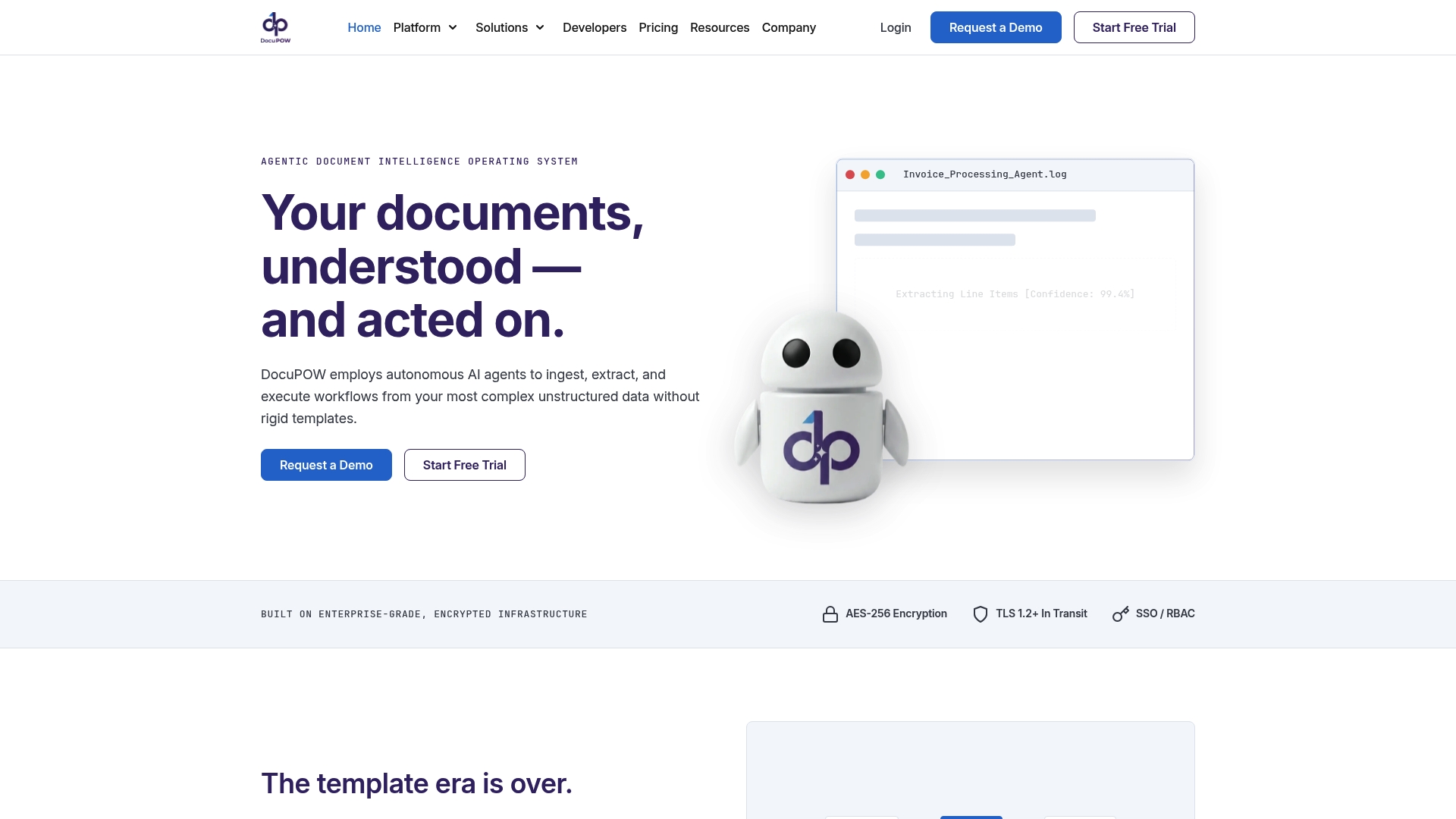
Zero shot extraction of 100+ fields from unseen document types works without training data. Autonomous AI agents read, understand, and route unstructured business documents into workflows and system updates. The platform removes template requirements and reduces manual data entry while preserving source citations for audit trails.
Core Features
DocuPOW uses natural language schema definitions and AI that adapts to varied document layouts and document types. The visual builder, DocuPOW Flow, orchestrates end to end document processes with human in the loop controls. Every extracted data point ties back to a verifiable source through Infinity, so teams retain traceable evidence for audits. The system also handles complex tables and nested line items so accounting fields map correctly.
Key Differentiator
The platform relies on advanced zero shot AI models that adapt instantly to new document formats without templates or retraining. That approach removes long training cycles and cuts the overhead of maintaining many extraction rules. For organizations processing mixed document types at scale, this changes how quickly data becomes system ready for ERPs and CRMs.
Pros
No templates or rigid rules are required, and the system adapts to irregular layouts while reporting confidence scores and source citations. The platform runs process automation that can validate totals, match purchase orders, and write results directly to ERPs via API or direct writes. Real time analytics and predictive insights help teams detect exceptions earlier and improve financial visibility and accuracy. Transparency with verifiable citations makes audits faster and reduces dispute resolution time.
Cons
- High initial setup complexity for some enterprise configurations and custom workflows.
Notable Integrations
- API
- ERP systems via direct write or API
- MCP compatible AI assistants such as Claude
Who It’s For
Enterprises and large teams that process complex unstructured documents at scale will benefit most. Global manufacturers, financial institutions, and logistics operators with heavy invoice and order flows gain faster financial visibility. Organizations that require audit trails and human in the loop oversight will find DocuPOW fits operational controls.
Unique Value Proposition
Autonomous agents run end to end document workflows with human in the loop controls. That capability turns unstructured files into system ready records and lets teams update ERPs and CRMs automatically. The result is faster financial visibility and earlier intervention on predicted exceptions, reducing manual reconciliation work.
Real World Use Case
A financial institution uses DocuPOW to extract thousands of supplier invoice fields and validate totals. The system matches invoices to purchase orders and writes reconciled records into the ERP while preserving audit citations. This reduced manual effort and lowered reconciliation errors while keeping traceable evidence for compliance.
Pricing
Starts at $99/month for 400 credits for the Starter tier, with higher tiers for professional and enterprise levels. Enterprise features such as custom SLAs and dedicated support require direct engagement and may affect pricing. Smaller teams should evaluate credit consumption against expected document volumes.
Website: https://docupow.ai
ABBYY FineReader Engine

At a Glance
The vendor advertises a pretrained recognition accuracy of 90%+. That claim is the most concrete technical metric ABBYY highlights for automated text capture and extraction.
ABBYY pairs that recognition claim with enterprise tooling aimed at large-scale document projects. The marketing emphasizes uses across finance, healthcare, and manufacturing.
Core Features
ABBYY combines AI-powered document understanding with a low code platform that teams can configure without extensive developer work. The product set includes pretrained recognition models, tools for process mining and optimization, and connectors designed for enterprise deployment.
These capabilities target capture from scanned images, PDFs, and unstructured documents while supporting many languages and file types. The platform scope ranges from single workflows to broad automation across back office systems.
Key Differentiator
ABBYY’s single most distinct claim is the pairing of high pretrained recognition accuracy with a low code deployment path. That combination aims to reduce the time between pilot and production for complex document projects.
This accuracy claim sits behind product options that let organizations scale recognition and add process mining to analyze how documents move through operations.
Pros
ABBYY reports it is trusted by over 10,000 organizations, including Fortune 500 firms. That scale shows in vendor investments in enterprise features such as language support and broad document type coverage.
The vendor reports 95% recognition accuracy out of the box, which vendors cite to shorten model training for common document classes. ABBYY also offers tools for process analysis so teams can find bottlenecks and tune capture rules.
These strengths suit programs that need centralized management, language breadth, and enterprise integrations for downstream systems.
Cons
- Website pages report some 404 errors, which limits public access to detailed technical documentation and integration guides.
- The product suite can be complex to deploy. Buyers often need dedicated professional services or internal implementation resources.
- Third party reviewers advise careful product selection among ABBYY offerings to avoid buying a module that does not match a specific workflow.
When It May Not Fit
Small teams that need a lightweight plug and play capture tool will likely find ABBYY more than they need. Organizations without implementation support may struggle to configure advanced process mining and enterprise connectors. Buyers wanting full public documentation before engagement may be delayed by missing pages.
Who It’s For
Large enterprises seeking scalable, AI driven document processing and automation will get the most value. The product targets centralized IT teams, shared services centers, and operations groups managing high document volumes across multiple business units.
Real World Use Case
ABBYY cites customers such as FinTrU, Vinmar, and Carlsberg using the platform to automate regulatory compliance, invoice processing, and order management. Those deployments reduced manual data entry and supported faster handoff to ERP and compliance systems.
Pricing
Pricing is not published on the public site. The product is sold for enterprise projects and typically requires a sales conversation to get a quote and deployment options. Licensing models and support levels vary by deployment scope and scale.
Website: https://abbyy.com
UiPath
At a Glance
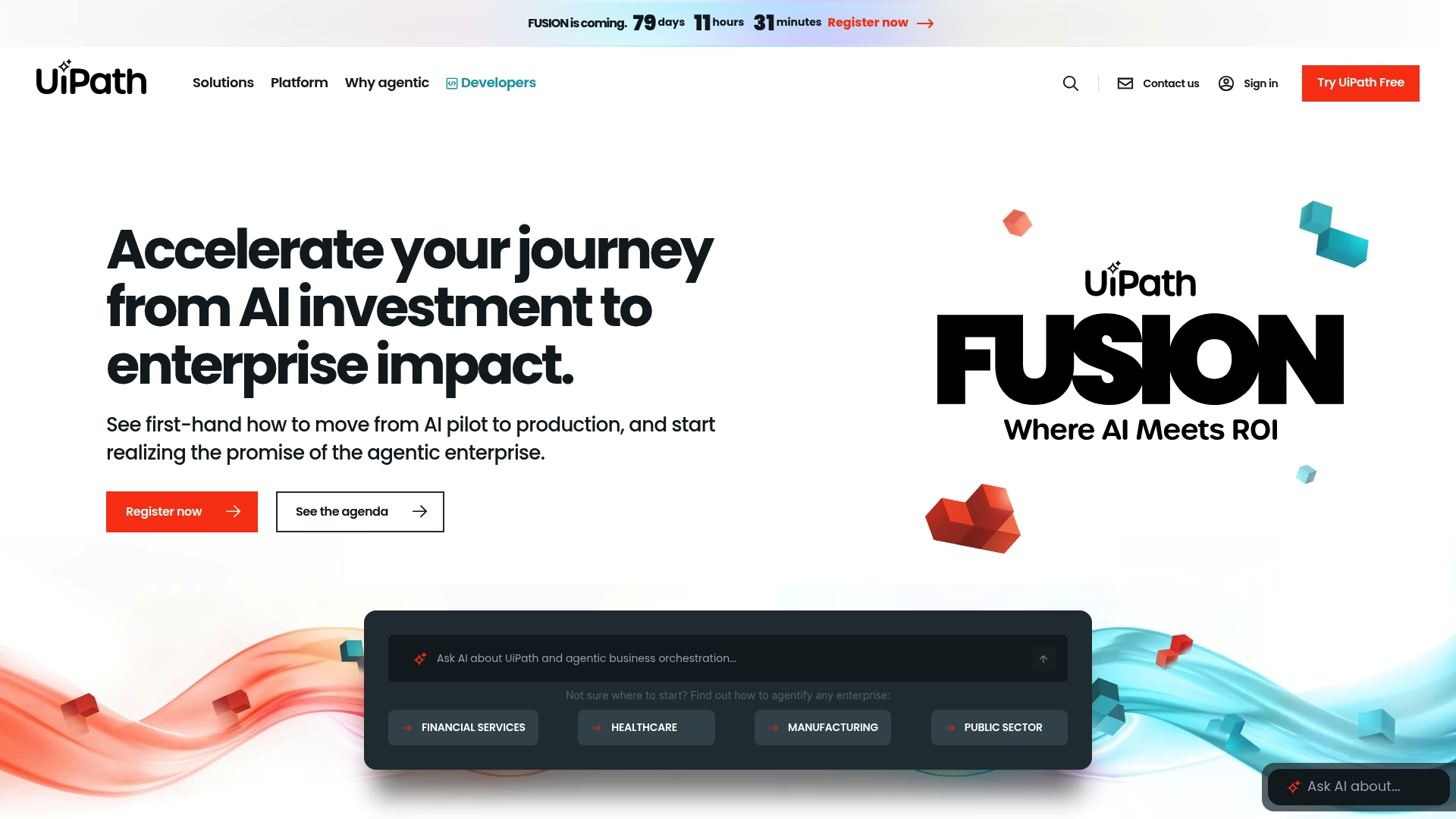
Agentic AI that links human, robotic, and AI agents drives UiPath’s enterprise automation ambitions. The platform emphasizes orchestration across people, attended bots, and unattended robots to handle repeatable and decisioned work. That design targets large-scale rollouts with governance and control.
Core Features
UiPath offers tools to build, orchestrate, and govern automation workflows and to deploy both attended and unattended robots. The platform includes prebuilt solutions for industry and department use and connects to AI models, APIs, and third-party systems. End to end process automation and orchestration is supported with management and monitoring capabilities.
Key Differentiator
UiPath centers on agentic AI that coordinates human, robotic, and AI agents to run complex enterprise processes. That focus fits organizations aiming for broad automation coverage and strict governance. It differs from DocuPOW by prioritizing agent orchestration and enterprise governance rather than autonomous document-first extraction.
Pros
UiPath’s agentic approach lets teams combine human judgment with automated actors for tasks that require exceptions or approvals. The platform ships industry and department solution templates that reduce build time for common processes. Governance, security controls, and a developer community with certifications support large IT teams and center of excellence models. The vendor also wins recognition for document mining and analytics as part of its automation suite.
Cons
- Complexity can be high for teams without automation architects. Large deployments need planning and governance resources.
- Enterprise features raise the learning curve. Smaller IT teams may struggle to run a full automation lifecycle.
- Pricing specifics are not listed in the product brief. Smaller organizations should budget for potential cost and implementation effort.
When It May Not Fit
Organizations that need a light, single-purpose document extractor will likely find UiPath more than they need. Small businesses with limited automation staff may prefer simpler tools with lower setup overhead. Projects with tight budgets and no dedicated automation governance may face long timelines and higher total cost of ownership.
Notable Integrations
- Microsoft
- SAP
- Peak.ai
- Coded agents
- API automation
Who It’s For
Large enterprises and government agencies that need scalable, AI-enabled automation across multiple departments will match UiPath’s strengths. Teams that require governance, audit trails, and certification pathways will gain from the platform. Organizations planning broad process transformation and allocating dedicated automation resources will extract the most value.
Real World Use Case
UiPath’s marketing materials state that Omega Healthcare increased productivity by 100%, Johnson Controls saved $18M, and Uber achieved $22M in savings after automating processes. Those vendor-reported results illustrate how broad automation programs can cut manual effort and reduce cycle times when implemented at scale.
Pricing
Plans and pricing are listed on the vendor site. Specific tier details and cost examples are not provided in the product summary, so procurement should request enterprise quotes and total cost estimates for licensing, implementation, and governance services.
Website: https://uipath.com
Ephesoft
At a Glance
Ephesoft reports a patented machine learning classification that adapts to diverse document types with high accuracy. The product supports cloud, on-premises, and hybrid deployment models to match enterprise constraints. Organizations use it for invoice processing, mailroom intake, and records digitization.
Core Features
Ephesoft captures data from both digital files and scanned paper, and it applies machine learning for document classification and extraction. The platform offers APIs and out of the box connectors so it integrates with ERP, RPA, BPM, and ECM systems. Deployment flexibility covers cloud, on premises, and hybrid setups for teams with varying compliance and infrastructure needs.
Key Differentiator
The platform centers on a patented machine learning based classification engine that learns from examples to improve extraction accuracy over time. That approach helps when documents arrive in many formats and templates. The vendor highlights industry recognition from third party reports for its intelligent document processing capabilities.
Pros
Ephesoft shows strong machine learning capabilities that reduce manual sorting and improve classification after initial training. Its flexible deployment choices let IT teams place processing where compliance or latency requirements demand. The product integrates with common enterprise tools and offers APIs for custom workflows, which helps connect capture to downstream ERP and automation systems.
Cons
-
Limited public pricing: detailed costs are not listed and typically require a custom quote, which makes budget planning harder.
-
Complex initial setup: some customers report that installation and tuning need technical expertise or professional services for peak accuracy.
-
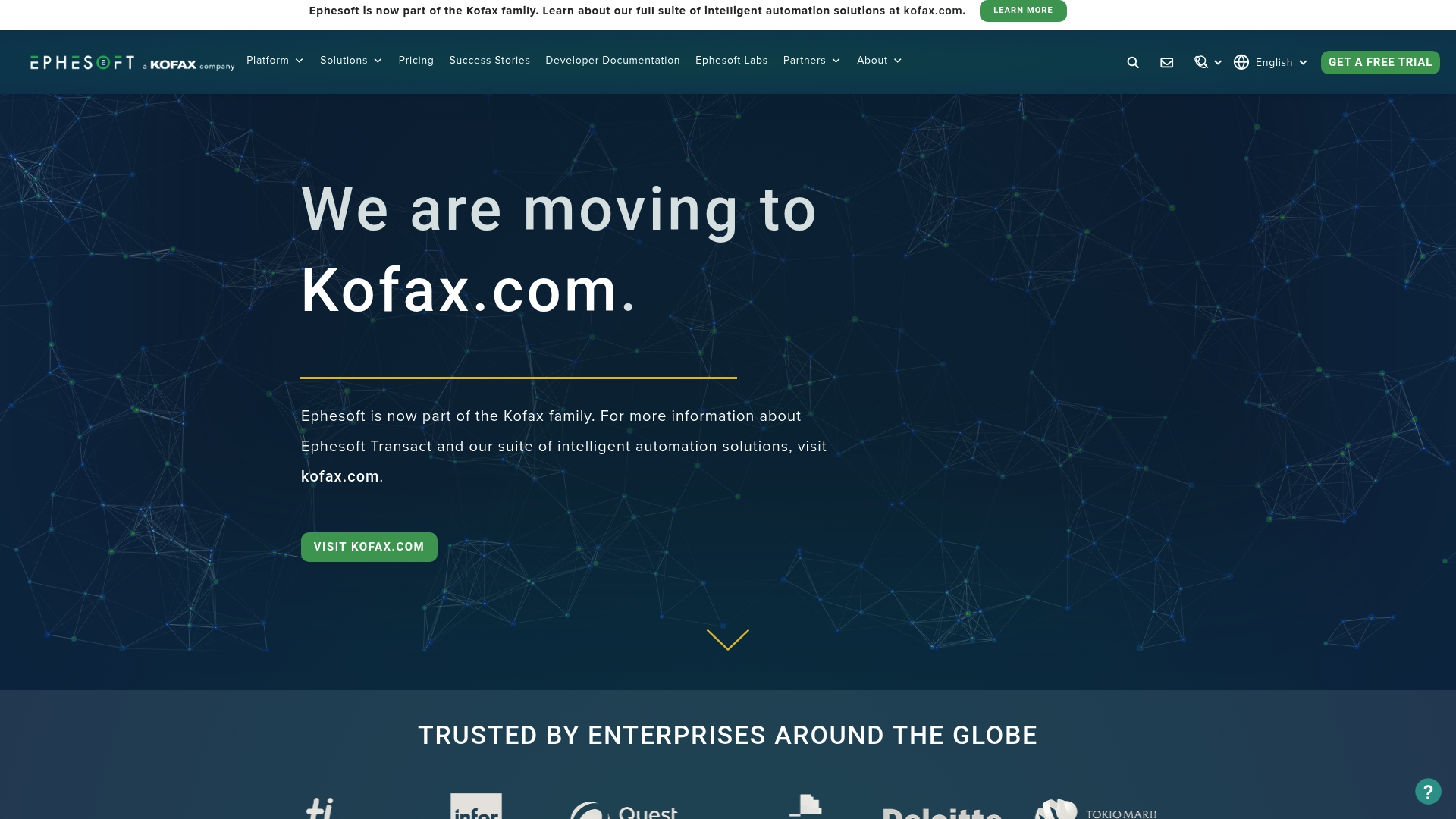
Migration friction: moving into the Kofax environment can require retraining and configuration changes for existing customers.
When It May Not Fit
If your team lacks technical staff or access to professional services, the initial setup could slow adoption. Organizations with small document volumes may find the implementation effort disproportionate to gains. If you need transparent list pricing for fast evaluation, Ephesoft will likely require contact with sales for a quote.
Notable Integrations
- ERP systems
- RPA tools such as UiPath and Blue Prism
- Content management systems like Alfresco and Nuxeo
- Microsoft SharePoint and Power BI
- APIs and connectors for custom integrations
Who It’s For
Enterprises and government agencies with high volume document intake will get the most from Ephesoft. Teams that must keep processing on premises for compliance will value the hybrid and on premises options. Organizations that already run RPA or ERP platforms will appreciate the connector set.
Real World Use Case
A large financial institution uses Ephesoft Transact to automate invoice and accounts payable processing. The system extracts vendor, date, and totals from varied invoice layouts and passes data into the ERP. That setup reduced manual keying and improved visibility into cash flow.
Pricing
Pricing is not explicitly listed. Costs are typically customized based on deployment model, volume, and desired modules. Expect to contact sales for a tailored quote and implementation estimate.
Website: https://ephesoft.com
Parseur
At a Glance
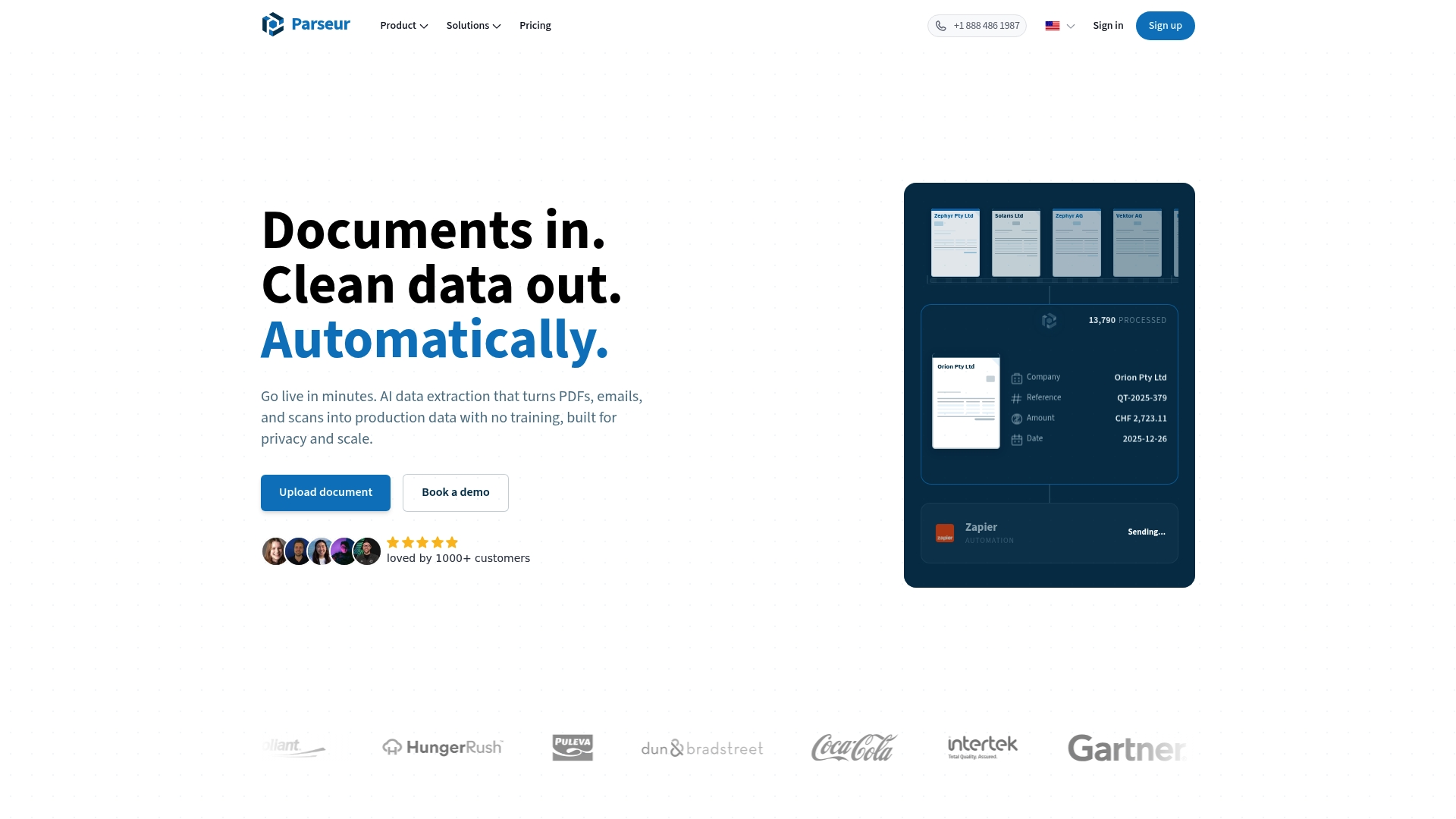
Parseur’s marketing materials claim AI driven instant extraction that needs no training or templates and handles multiple layouts out of the box. The vendor advertises high uptime and auto scaling. The company also states GDPR and SOC 2 compliance and that HIPAA is in progress, and it claims connectors to thousands of apps.
Core Features
Parseur accepts documents via email, API, and direct upload, then runs parsing with Vision AI, Text AI, or template rules. Extracted fields are normalized and validated before real time exports to downstream systems. The product also includes fast OCR and connectors for common automation workflows.
Key Differentiator
The main distinction is the emphasis on instant, template free extraction for multi layout documents. That approach favors teams that must get reliable outputs the same day they begin. It fits buyers who prioritize rapid deployment over deep context aware document agents.
Pros
Setup requires no model training, so teams can parse common documents quickly and start routing data to other systems. Parseur supports invoices, receipts, bank statements, resumes, and varied PDF layouts, which suits companies with mixed document fleets. That uptime and scaling claim makes it practical for high volume ingestion, and the vendor’s compliance statements back a privacy focused posture. Native connectors and automation platform links reduce custom integration work.
Cons
- Pricing details and usage limits are not specified; the site says free to start but does not list tier limits or cost per document.
- The marketing material does not detail how it handles highly complex layouts or deeply nested tables, so edge case performance is unclear.
- No on premises deployment option is described, so organizations that require isolated infrastructure will need a different solution.
When It May Not Fit
If your workflows require on premises processing, Parseur is not a match because it operates as a cloud only solution. Organizations that need heavy customization of parsing logic or advanced context reasoning may find the product too focused on rapid, template free extraction. Teams expecting explicit published SLAs or transparent per document pricing will need more detail than the vendor provides.
Notable Integrations
Excel, Google Sheets, Zapier, Webhooks, Power Automate, Airtable, and Slack are listed as direct connectors. These integrations let you move parsed fields into spreadsheets, automation flows, or messaging channels without building custom middleware.
Who It’s For
Teams and businesses that need automated, scalable document extraction without investing in model training or heavy development will get the most value. Small to mid sized operations that process invoices, orders, resumes, or shipping documents will appreciate the quick setup. Enterprises that accept cloud based services and want connectors to existing automation platforms will also find this useful.
Real World Use Case
A finance team used Parseur to capture invoice line items from mixed supplier PDFs and emailed receipts. The company cut manual data entry hours and reduced posting errors by routing validated fields directly into accounts payable. That workflow sped approvals and kept parsed records tied to compliance controls.
Pricing
Parseur advertises a free starting tier followed by usage based pricing described as pay as you grow. Specific tier limits and per document rates are not listed publicly in the product copy.
Website: https://parseur.com
super.AI
At a Glance
super.AI reports Bureau Veritas cut processing time by 75% for data capture tasks. That customer result highlights handling of high-volume extraction across mixed document types. The platform pairs automated extraction with human review to reduce error rates in production workflows.
Core Features
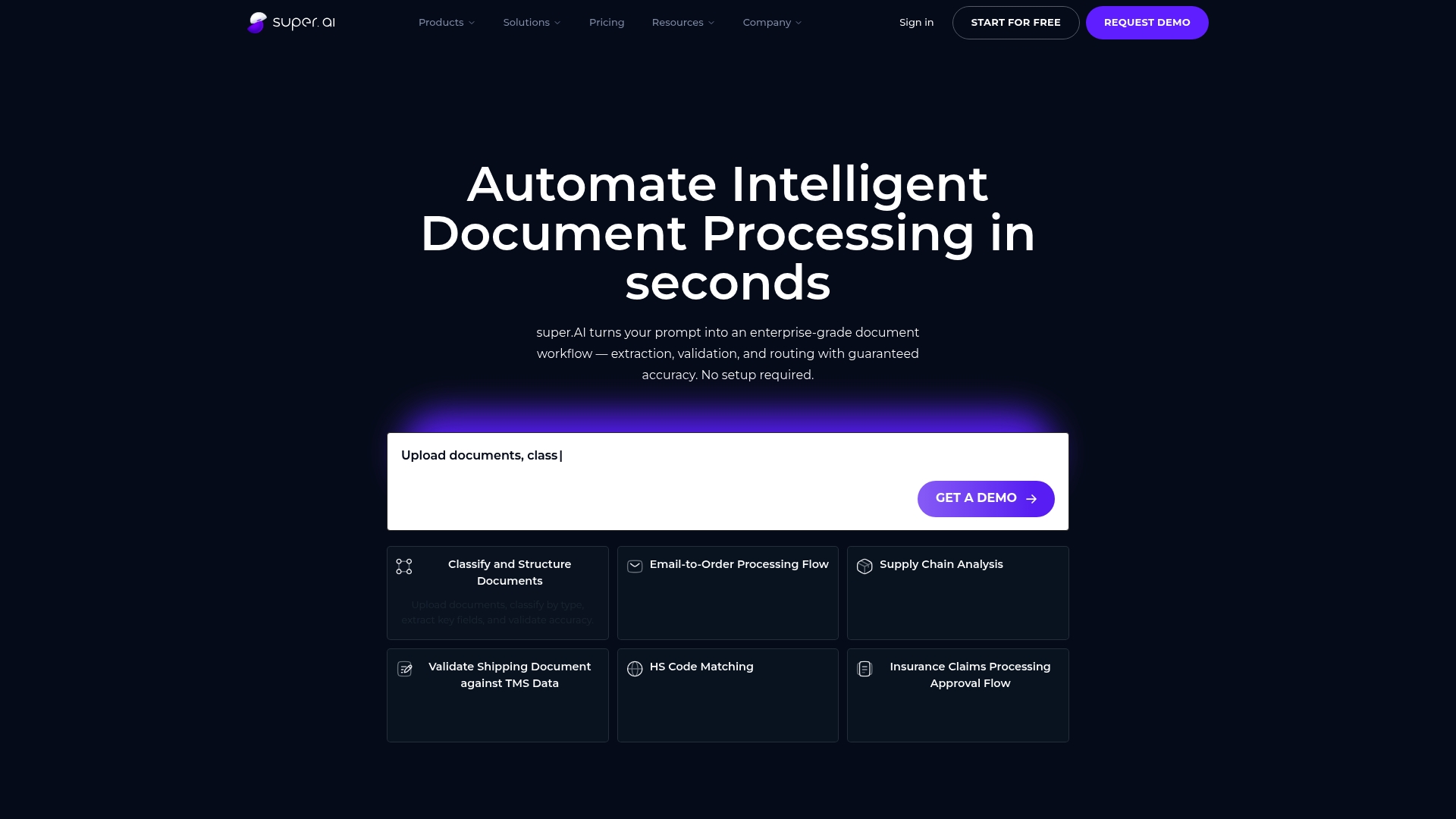
The product can classify and structure documents automatically and extract key fields from invoices, bills, customs forms, and other formats. It validates extracted data in real time against enterprise systems and supports human in the loop review to catch edge cases. Pre-built connectors and APIs allow routing to ERP, CRM, and cloud systems while letting teams select different AI models per workflow.
Key Differentiator
The vendor says built in human in the loop review delivers guaranteed accuracy at scale without complex setup. That human review sits inside configurable workflows and elevates machine output before final routing. The combination reduces error volume while preserving automation throughput. Teams keep control of edge decisions through a review queue and policy controls.
Pros
According to the vendor, super.AI offers guaranteed service level agreements and human review to support accuracy requirements. It supports many document types and languages, which helps multinational operations. Deployment options include enterprise installations and a self service entry point, so teams can pilot before scaling. The product integrates with major enterprise systems and can run with multiple AI models to balance speed and precision.
Cons
-
Setup complexity grows for very large enterprise deployments and may require dedicated technical resources.
-
Customizing workflows for highly specialized document types can be time consuming for internal teams.
-
The system depends on external AI models, and performance can vary with model selection.
When It May Not Fit
If you lack engineering capacity to build and maintain custom extractors, this product may require more internal work than a plug and play tool. If your documents are extremely novel or highly experimental, the vendor notes performance can vary on those file types. Small teams with low monthly volumes may find the enterprise options heavier than their needs.
Notable Integrations
- Salesforce
- SAP
- IBM
- Oracle
- SAS
- ServiceNow
- Snowflake
- UiPath
Who It’s For
Large enterprises in logistics, finance, insurance, and supply chain will get the most from this product. Teams that must process high volumes of mixed-format documents and meet strict accuracy targets will benefit. Organizations that already operate ERP or data platforms will find the connector set useful.
Real World Use Case
Bureau Veritas saw a large time reduction in data capture tasks using the product, and that reduction demonstrates how automation plus human review can cut manual hours. Risk teams used the review queue to handle exceptions without stopping the main workflow. Finance groups routed validated fields directly into accounting systems to reduce reconciliation time.
Pricing
The vendor does not publish standard list pricing and appears to use custom enterprise contracts for large deployments. The vendor advertises a free self service option that includes 25,000 credits for testing and light use. Expect negotiated rates for volume processing and enterprise controls.
Website: https://super.ai
Comparison of alternatives
Organizations processing unstructured document formats for data extraction will find compelling differences among the evaluated platforms. The following analysis explores how these platforms excel in unique dimensions and their use cases.
Adaptive capability versus pretrained accuracy
DocuPOW stands out by providing zero-shot AI models for handling undefined document formats, ensuring operational flexibility and reducing configuration overhead. Conversely, ABBYY FineReader Engine emphasizes high-accuracy OCR with pretrained models, beneficial for applications with repetitively standardized documents requiring recognition performance without further algorithm refinement. Enterprise-level clients focusing on adaptive versatility would benefit from DocuPOW’s flexibility, whereas predetermined accuracy under uniform workflows positions ABBYY favorably.
Scalability and strategic implementation
UiPath’s integration of attended and unattended robotic process automation caters to organizations implementing workflows requiring structured governance and multitiered agent orchestration. DocuPOW, while excelling in document-specific handling, does not prioritize multitier collaborations. Enterprises envisioning diverse operational strategies might prefer UiPath, which scales with tailored human-automated agent allocations allowing intricate governance models.
Best fit
- Enterprises seeking adaptive, autonomous capabilities for mixed-format document extraction and auditability should evaluate DocuPOW.
- Teams prioritizing OCR with language support and process mining within centralized management will find ABBYY FineReader Engine beneficial.
- Small to medium organizations requiring no-code deployment and straightforward document parsing favor Parseur.
- Multinational corporations preferring human-in-the-loop capabilities for complex policy controls can consider super.AI.
Our pick
DocuPOW distinguishes itself through its advanced zero-shot extraction models, enabling dynamic adjustment to varied, unstructured documents without retraining. This makes it an solution for enterprises requiring adaptation. However, organizations requiring specialized centralized workflows with high initial pretrained accuracy,~ such as ABBYY FineReader Engine offers, might consider alternatives.
When evaluating intelligent document processing tools, key features such as adaptability, deployment options, and pricing become crucial factors.
| Product Name | Key Differentiator | Best For | Pricing | Notable Limitation |
| DocuPOW | Zero-shot AI for mixed document types | Enterprises handling large-scale complex documents | Starts at $99/month | High initial setup complexity for enterprise configurations |
| ABBYY FineReader Engine | High pretrained accuracy with low-code integration | Large organizations with multilingual needs | Price not published | Some online documentation missing |
| UiPath | Agentic AI combining humans and bots | Governments and large-scale enterprises | Price not published | High complexity for small IT teams |
| Ephesoft | Machine learning classification engine | Entities needing on-premises and hybrid deployments | Price not published | Complex setup requiring technical expertise |
| Parseur | Rapid template-free extraction | Mid-sized businesses needing quick implementation | Pay-as-you-grow model | No on-premises deployment offered |
| super.AI | Human review for guaranteed accuracy | Logistics and finance enterprises with strict accuracy targets | Free start with 25,000 credits | Setup complexity for large deployments |
What Challenges Do Most Reliable Data Extraction Services Solve?
Organizations handling large volumes of unstructured documents need a solution that adapts quickly without relying on rigid templates. DocuPOW meets this need with autonomous AI agents that read and extract data from multiple document types instantly. This approach reduces manual data entry, delivers real-time analytics, and preserves audit trails to improve financial clarity for global manufacturers and large teams.
Explore how DocuPOW’s AI-driven workflows can accelerate your document processing and cut reconciliation errors. Learn more about our solution in the AI Archives – DocuPOW and related insights in the research Archives – DocuPOW.
See the impact firsthand by visiting https://docupow.ai and start importing your documents to extract complex fields without templates.
FAQ
How does DocuPOW handle complex tables in document processing?
DocuPOW efficiently processes complex tables and nested line items, ensuring that accounting fields map correctly. The system excels in extracting data from various document layouts without rigid templates. Organizations can expect accurate data extraction, which simplifies financial document management.
What is the difference between DocuPOW and ABBYY FineReader Engine?
ABBYY FineReader Engine excels with a pretrained recognition accuracy of over 90%, making it suitable for companies needing reliable text capture from various document types. In contrast, DocuPOW’s zero shot AI adaptation allows it to quickly respond to new document formats without lengthy training cycles, making it more efficient for businesses frequently handling diverse documents.
Which platform is best for high-volume invoice processing and audit trails?
DocuPOW is ideal for organizations requiring audit trails, as it preserves verifiable citations for compliance and oversight. The platform’s design targets enterprises involved in high-volume invoice processing while retaining necessary audit capabilities for transparency and accountability.
Can I use super.AI for document workflows that involve human review?
Yes, super.AI emphasizes human in the loop review for enhanced accuracy in document workflows. This feature allows users to ensure correct outputs before finalization, making it suitable for high-volume processing where quality assurance is crucial. DocuPOW, while also focusing on automated workflows, may be better for teams prioritizing rapid data extraction.
How does pricing for DocuPOW compare to other services like Parseur?
DocuPOW starts at $99 per month for 400 credits, providing a clear pricing tier for organizations. In contrast, Parseur offers a free starting tier but does not specify usage limits or costs per document, making budgeting more complex for potential users.
See DocuPOW on your documents.
Stop building templates. Start extracting data.