90 Days to Healthcare Information Governance With Agentic Automation
Regulation aware playbook for healthcare: get audit ready information governance in 90 days and safely deploy agentic document automation.

Information governance is the organization-wide framework of policies, processes, and assigned responsibilities that keep information accurate, accessible, and compliant. Done right, it cuts legal exposure, shrinks eDiscovery costs, and gives leaders trusted data the moment they need it. The rest of this guide breaks down the frameworks, the roadmap, and the sector-specific rules that make that happen.
TL;DR:
- Effective information governance relies on broad organizational scope, clear ownership, and enforcement of policies across both structured data and unstructured content.
- Building a cross-functional governance committee with decision-making authority enhances coordination between legal, IT, compliance, and business units, reducing conflicting rules.
- Regular audits, role-based training, and pilot automation demonstrate progress and help scale governance efforts without overextending resources.
- Automation tools with classification, lifecycle enforcement, and audit trail capabilities are essential to scale IG beyond manual processes and ensure compliance.
- In healthcare and regulated sectors, strong controls over access, retention, and breach response are vital, with documentation proving compliance and supporting multijurisdictional requirements.
Table of Contents
- What Does Information Governance Actually Cover?
- Why Information Governance Matters More Than Most Budgets Admit
- Core Principles and Frameworks Behind Information Governance
- The Operational Building Blocks: Lifecycle, Retention, and eDiscovery
- How to Implement an Information Governance Program
- Information Governance in Regulated Sectors: What Healthcare Requires
- What Technology Needs to Do to Operationalize Governance
- Operationalizing IG With Agentic Document Automation
- A Realistic Roadmap and the KPIs That Prove It’s Working
- Data Privacy Laws Beyond Healthcare: Where IG and Regulation Meet
- How AI and Cloud Computing Are Reshaping Information Governance
- Where Information Governance and Cybersecurity Overlap
- Who Actually Owns Information Governance Day to Day
- Common Pitfalls That Derail Information Governance Programs
- Publisher Perspective: What IG Investment Actually Requires
- Where to Read More on Information Governance
- Sources
- FAQ
What Does Information Governance Actually Cover?
Information governance is bigger than most people assume. It spans structured data sitting in a database and unstructured content like PDFs, emails, contracts, and scanned intake forms. It also spans the humans who create, touch, and eventually delete that information. If a policy exists but nobody enforces it, that’s not governance. It’s a document.
The confusion usually starts with three overlapping terms that get treated as synonyms when they’re not.
- Information governance (IG) is the umbrella: policies, processes, and accountability structures across the whole organization, covering both structured and unstructured content.
- Data governance is narrower. It focuses on structured data quality, definitions, and stewardship, typically inside databases and analytics platforms.
- Records management is narrower still. It handles retention schedules and disposition for records specifically, often as one operational arm under the IG umbrella.
Think of IG as the constitution and data governance and records management as statutes written underneath it. A healthcare system might have a data governance council that owns patient-record data quality in its electronic health record system, while a separate records management function handles retention for paper intake forms and referral faxes. Both report into the same IG charter, which is exactly the point. Without that shared charter, the two groups build conflicting rules, and nobody notices until an auditor does.
Setting scope early matters more than picking the perfect org chart. Decide upfront which content types, systems, and business units fall under the IG program’s authority, and which stay outside it for now. A narrower first scope that actually gets enforced beats an enterprise-wide mandate that exists only on paper.
Why Information Governance Matters More Than Most Budgets Admit
The case for information governance is rarely made in the boardroom, and that’s a mistake. When litigation hits or a regulator sends a records request, the organizations that already know where their information lives respond quickly. The ones that don’t spend weeks reconstructing custodial chains from memory and inbox searches.
Poor information governance shows up as measurable cost, not abstract risk.
- Legal teams pay outside counsel to manually review data that should have been disposed of years earlier under a defensible retention schedule.
- Compliance teams miss regulatory deadlines because nobody can locate the record that proves a control was followed.
- IT teams store duplicate copies of the same contract in four systems, inflating storage costs and creating four different “correct” answers to the same question.
The strongest argument for executive buy-in is time-to-response. Pro Tip: When you pitch IG to the CFO, frame it around one number: how many business days it currently takes to produce a specific record for a legal hold or a HIPAA access request. That number is usually embarrassing, and it’s the easiest ROI story to tell.
Effective data stewardship also compounds. A retention schedule that gets enforced today means less data to search, tag, and protect next year. The Sedona Conference frames defensible disposition as one of the core payoffs of a mature IG program, not a side benefit. Fewer records in scope means lower legal hold costs, smaller breach surfaces, and faster answers when leadership asks a simple question: “Can we find that?”
Core Principles and Frameworks Behind Information Governance
Two frameworks dominate serious IG programs, and they solve different halves of the problem.
The Sedona Conference’s Commentary on Information Governance lays out eleven principles built for legal defensibility. Independence from any single department sits at the center of that list. IG can’t live entirely inside legal or entirely inside IT, because either placement biases decisions toward that function’s priorities over the organization’s.
Information governance works best as a top-down, organization-wide program, with principles built around stakeholder representation, defensible disposition of information no longer needed, and periodic review to keep policies current as the organization and its risks change.
AHIMA’s Information Governance Adoption Model, built with the American Hospital Association, takes the operational side. IGAM breaks IG into competencies like organizational structure, strategic alignment, data governance, and records and information management, then scores a health system’s maturity in each one. It’s less about legal theory and more about the practical checklist: who owns what, and how far along is each function.
Cross-cutting principles show up in both frameworks and in an AHIMA effective data stewardship toolkit, regardless of industry:
- Accountability: every policy needs a named owner, not a department.
- Transparency: stakeholders should be able to see how information decisions get made.
- Lifecycle orientation: governance applies from creation through disposition, not just at the retention deadline.
- Proportionality: controls should match actual risk, not apply uniformly regardless of sensitivity.
The Operational Building Blocks: Lifecycle, Retention, and eDiscovery
Information governance becomes real at the process level, where lifecycle stages, classification rules, and legal holds intersect.
- Creation and capture. Information gets classified at the point of intake whenever possible. A loan application, a patient intake form, and a vendor invoice should each carry a classification tag before they ever hit a shared drive.
- Use and access. Access controls should mirror classification, not organizational hierarchy. A finance director doesn’t automatically need access to protected health information just because they outrank the records clerk.
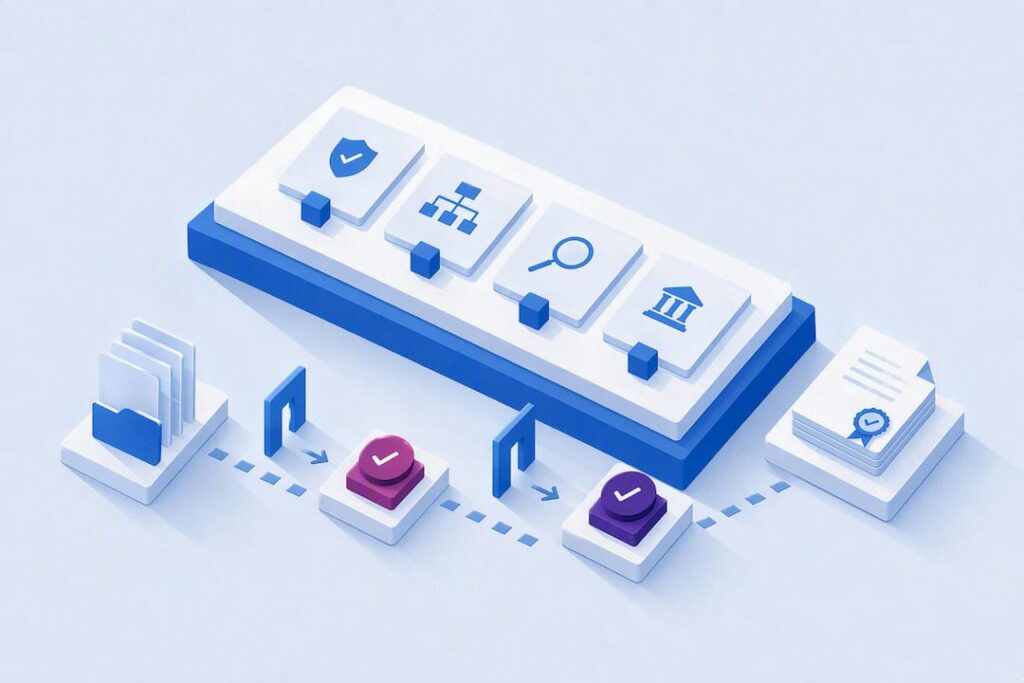
- Retention and disposition. A defensible retention schedule needs three components working together: a published schedule stating how long each record type lives, a deletion process enforced by tooling rather than manual follow-through, and an audit trail proving both the decision and the execution actually happened.
- Legal hold and eDiscovery readiness. When litigation is reasonably anticipated, a legal hold suspends normal disposition for affected records. Chain-of-custody documentation matters here as much as the hold itself. An auditor or opposing counsel will ask not just “did you preserve it” but “can you prove nothing changed.”
- High-risk processing review. Data Protection Impact Assessments document accountability whenever a process introduces meaningful privacy risk, whether that’s a new analytics tool touching patient data or a vendor integration pulling personal information across systems.
DPIAs work best when they’re not a one-time compliance exercise. Building DPIA outputs into procurement contracts and technical requirements for any vendor touching high-risk personal data keeps the assessment relevant instead of shelved.
How to Implement an Information Governance Program
Most IG programs fail for a boring reason: they get treated as an IT initiative instead of an organizational one. Practitioner accounts point to siloed ownership and missing executive sponsorship as the most common failure pattern, and it shows up almost identically across industries.
Here’s a sequence that avoids that trap.
- Secure executive sponsorship and name measurable objectives. A vague mandate to “improve governance” won’t survive budget season. Tie the program to specific numbers: days to fulfill a data request, percentage of legacy data classified, or reduction in duplicate storage.
- Form a cross-functional governance committee. Legal, IT, compliance, records, and business unit leaders each need a seat, and the committee needs actual decision rights, not advisory status. This is the single most cited fix in industry best-practice guidance on IG for turning committees from talk shops into working bodies.
- Conduct a current-state audit. Map where information actually lives, who has access, and where retention rules are being ignored in practice. This step surfaces the gap between written policy and daily behavior, which is usually wide.
- Write or reconcile policies, then train by role. A generic annual training video doesn’t change behavior. Role-based training scenarios that show a records clerk exactly how to classify an intake form, or show a claims adjuster exactly when a legal hold applies, do.
- Pilot automation before scaling it. Pick one document type or one business unit and test automated classification and retention tagging there before rolling it out enterprise wide. IT teams that manage document automation directly tend to catch integration gaps early, before they become enterprise-wide headaches.
- Set a monitoring and reporting cadence. Quarterly reviews of policy exceptions, classification coverage, and access anomalies keep the program from going stale the moment the initial launch excitement fades.
Pro Tip: Skip the temptation to write a perfect policy manual before piloting anything. A rough retention rule tested on one document type for 30 days teaches you more than three months of committee debate about edge cases that may never occur.
Information Governance in Regulated Sectors: What Healthcare Requires
Healthcare organizations carry an extra layer that generic IG frameworks don’t fully address: HIPAA and the specific handling requirements around protected health information. A 2024 scoping review of health information governance literature analyzed 37 documents and identified six core categories, including goals, principles, components, and roles, that together form a workable framework specifically for health systems.
Regulatory frameworks generally require organizations to demonstrate, not just claim, that certain controls exist.
- Access controls must be role-based and auditable, so a nurse’s access to a chart and a billing clerk’s access to the same chart look different and get logged differently.
- Audit logs need to capture who accessed what PHI, when, and why, in a format that survives an investigation months later.
- Breach readiness means a documented response plan, not an assumption that “we’d figure it out” if something went wrong.
- Retention obligations for medical records vary by record type and by state, and a defensible schedule has to reconcile both layers rather than defaulting to one blanket rule.
DPIAs earn their keep here too. Documenting accountability for any new data-sharing arrangement, whether it’s a referral network integration or a research partnership, gives compliance teams a paper trail before regulators ask for one. When federal, state, and international obligations conflict, such as a multistate health system managing different retention minimums, the safer move is documenting the reasoning behind the choice made, not just the choice itself. An IT ethics certification focused on governance principles can also help staff internalize why these controls exist, not just how to follow them mechanically.
What Technology Needs to Do to Operationalize Governance
Manual enforcement of information governance policy doesn’t scale past a handful of file cabinets. The technology layer needs to do four things well: classify content automatically as it enters the organization, enforce lifecycle rules without waiting on a human to remember a deadline, orchestrate legal holds so preservation happens the moment litigation becomes reasonably anticipated, and generate audit trails that prove the process actually happened.
Automated classification and lifecycle enforcement reduces the manual burden that causes policy drift in the first place, but only when paired with clear written policy behind it. Automation without policy just moves the chaos faster.
When evaluating any tool against these needs, confirm a few things during due diligence rather than after signing:
- Does the platform log access and changes in a way that survives audit scrutiny, not just internal review?
- Can retention rules be configured per document type rather than applied as one blanket setting?
- Does the vendor’s security architecture meet your organization’s specific contractual and regulatory obligations, not just generic industry claims?
Operationalizing IG With Agentic Document Automation
Template-free extraction changes the classification bottleneck that stalls most IG programs. Traditional systems rely on rigid templates, which break the moment a vendor changes an invoice layout or a hospital switches intake vendors. Autonomous agents that understand document context instead of memorized layouts can classify and tag content without that fragility.
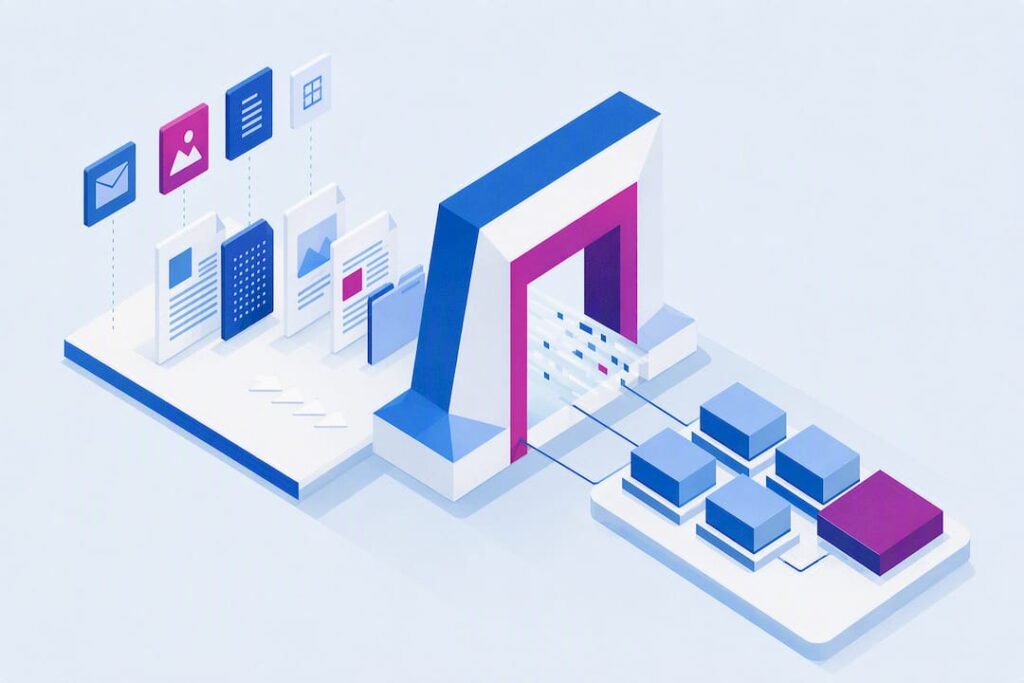
A practical workflow looks like this: a document is ingested, an agent classifies it and assigns retention metadata based on content rather than filename, the extracted data routes into the relevant system, and an audit log records the entire chain automatically. That sequence replaces what used to be several manual handoffs.
- Fewer manual classification errors, since agents interpret document content rather than matching a rigid template.
- Faster response to discovery and access requests, since retention tags exist from the moment of ingestion rather than being applied retroactively.
- A cleaner audit trail, since every action gets logged as part of the workflow rather than reconstructed after the fact.
Pro Tip: Before adopting any automation platform for IG, verify its specific security certifications and contractual data-handling commitments directly with the vendor rather than assuming coverage based on industry reputation.
A Realistic Roadmap and the KPIs That Prove It’s Working
IG programs that survive their first year tend to follow a similar cadence: small, provable wins early, followed by scaled automation once the pilot proves out.
In the first 90 days, the priority is a signed governance charter, one pilot scope (a single document type or business unit), and a handful of simple, enforceable retention rules. Between six and twelve months, the focus shifts to scaling the automation pilot, running role-based training across departments, publishing a full retention schedule, and standing up a reporting dashboard.
Executive sponsors keep funding programs that show numbers, not narratives. Baseline KPIs tied to executive reporting are what keep the sponsorship alive past the first budget cycle.
| KPI | What it measures |
|---|---|
| Time to fulfill data requests | Days between a legal hold or access request and delivery of the responsive records |
| Percentage of records classified | Share of enterprise content tagged with a governance classification |
| Reduction in discoverable data | Volume of data eliminated through defensible disposition over a defined period |
| Policy violation rate | Frequency of access or retention exceptions flagged during monitoring |
Data Privacy Laws Beyond Healthcare: Where IG and Regulation Meet
HIPAA gets the spotlight in healthcare IG conversations, but it’s far from the only regulation shaping how organizations govern information. The General Data Protection Regulation in the European Union and the California Consumer Privacy Act in the United States both impose specific rights and obligations that ripple into IG program design, even for organizations that don’t consider themselves “healthcare” companies.
These frameworks share a common thread with HIPAA even though they cover different populations: individuals get rights over their own data, and organizations have to prove they can honor those rights on a deadline. A CCPA deletion request and a HIPAA right-of-access request both test the same underlying capability: can the organization actually locate and act on a specific person’s information across every system it lives in?
This is where information governance stops being a compliance checkbox and starts being infrastructure. An organization with strong classification and lifecycle management can answer a CCPA request in days. One without it spends weeks searching file shares and email archives, often missing the statutory deadline entirely.
Multistate and multinational organizations face a harder version of this problem: reconciling retention minimums, deletion rights, and consent requirements that don’t always align across jurisdictions. The practical answer isn’t picking one rule and hoping it satisfies every regulator. It’s documenting, for each data category, which jurisdiction’s rule applies and why, so the reasoning survives an audit even when the underlying law is genuinely ambiguous.
How AI and Cloud Computing Are Reshaping Information Governance
Cloud migration solved a storage problem and created a governance one. When records lived in a single on-premises server, classification was hard but at least contained. Now the same contract might exist in a cloud document store, an email archive, a collaboration platform, and a vendor’s SaaS system, all governed by different default retention settings that nobody centrally configured.
Artificial intelligence adds a second layer of complexity, and it cuts both ways. AI-powered classification and extraction tools can tag and organize unstructured content at a speed no manual review team could match, which is exactly the capability IG programs have needed for years. But AI systems trained on organizational data also create new governance questions: where does training data get stored, how long is it retained, and who’s accountable if a model surfaces sensitive information it shouldn’t have had access to.

The practical response is treating AI tools and cloud platforms as governed systems from day one, not bolt-on exceptions. That means classification rules apply the same way whether a document sits in a cloud repository or a legacy file server, and any AI system touching sensitive data goes through the same DPIA process as a traditional vendor integration. Organizations that have already built strong lifecycle management find this transition easier, because the classification and retention logic doesn’t need to be rebuilt. It just needs to be extended to new systems.
Where Information Governance and Cybersecurity Overlap
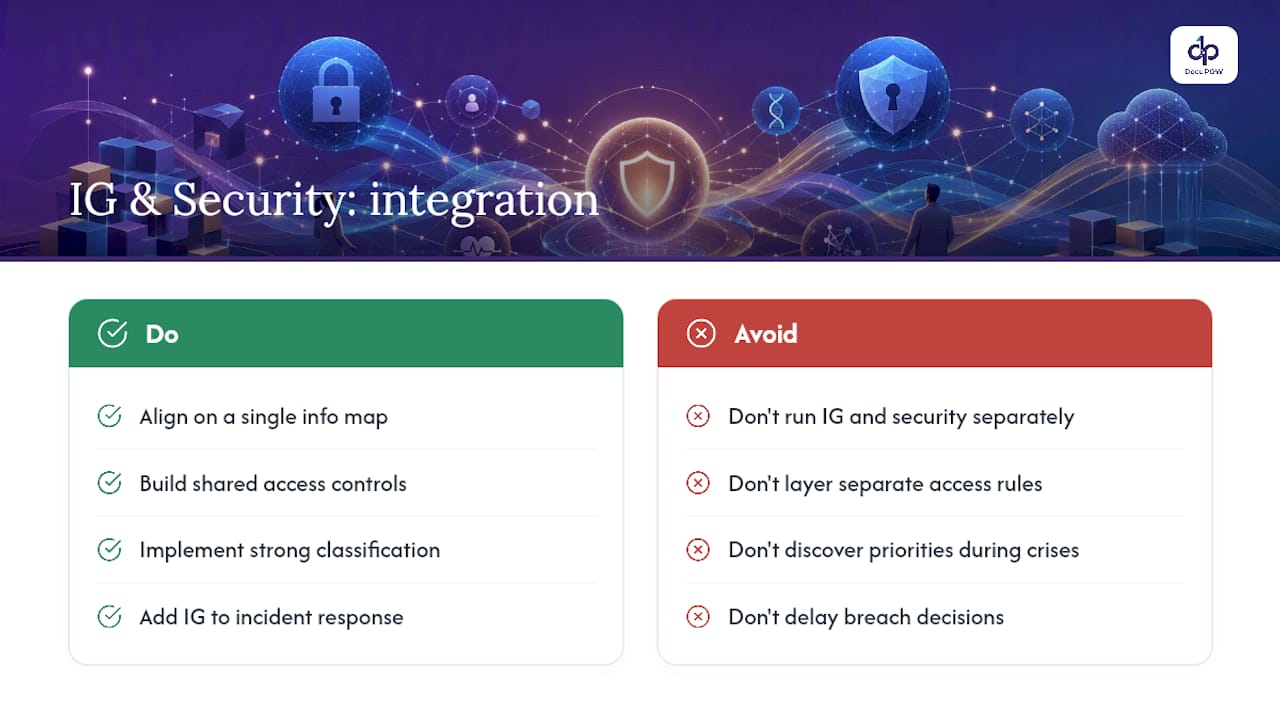
IG and cybersecurity get run as separate programs in a lot of organizations, and that separation causes real gaps. Cybersecurity teams focus on keeping unauthorized actors out. IG teams focus on making sure the right people can find the right information and that the wrong information gets deleted on schedule. Both goals depend on the same underlying map: what information exists, where it lives, and who’s supposed to have access to it.
A breach response illustrates the overlap well. When a security incident happens, the first questions are usually about scope: what data was exposed, how sensitive was it, and how long had it been sitting there. An organization with strong classification can answer that in hours. One without it spends days just figuring out what was even in the affected system, which delays every subsequent decision, including the legally mandated breach notification.
Access controls sit at the exact intersection of both disciplines. Role-based access, audit logging, and least-privilege design serve cybersecurity’s goal of limiting attack surface and IG’s goal of enforcing classification-based permissions simultaneously. Building these controls once, jointly, rather than layering separate cybersecurity and IG access rules on top of each other, reduces both the administrative burden and the odds of conflicting permissions creating a security gap.
The organizations that get this right typically fold IG representation into the security incident response team and fold security representation into the IG governance committee, so neither group is discovering the other’s priorities for the first time during a crisis.
Who Actually Owns Information Governance Day to Day
Executive sponsorship gets the headline attention, but the daily work of information governance runs through a wider cast of roles, each with distinct accountability.
Records managers own retention schedules and disposition execution, translating legal and compliance requirements into concrete rules applied to specific record types. Data stewards, often embedded in individual business units, handle day-to-day classification decisions and flag exceptions the written policy didn’t anticipate. IT teams build and maintain the technical infrastructure that enforces access controls and automates lifecycle rules, working from requirements the governance committee sets rather than making policy decisions unilaterally.
Legal and compliance teams define the regulatory boundaries the program has to operate within and manage legal holds when litigation arises. Business unit leaders, often the most overlooked stakeholders, own the practical reality of how information actually flows through their teams, and their buy-in determines whether frontline staff follow the policy or route around it.
The governance committee itself needs a charter that spells out decision rights explicitly: who can approve a new retention rule, who can grant a classification exception, and who escalates disputes between departments. Without that clarity, the committee becomes a discussion forum instead of a body that actually governs anything.
Common Pitfalls That Derail Information Governance Programs
Most IG programs don’t fail because the framework was wrong. They fail because of a handful of predictable operational mistakes.
Treating IG as a one-time project rather than an ongoing program is the most common one. A policy written once and never revisited drifts out of sync with how the organization actually operates within a year or two. Assigning ownership to IT alone, without legal, compliance, and business unit representation, produces rules that solve technical problems but miss legal and operational risk.
Skipping the current-state audit is another frequent shortcut. Writing new policy without first understanding where information actually lives and how people actually use it means the policy addresses an organization that doesn’t exist. Underinvesting in training compounds this: policies that never translate into daily action get quietly bypassed the moment they create friction for someone trying to finish their job.
Scaling automation before piloting it is a subtler trap. Rolling out an enterprise-wide classification system without testing it on one document type first means any misconfiguration multiplies across the entire organization instead of staying contained. And measuring nothing, or measuring the wrong things, leaves the program vulnerable the first time budget gets tight, because there’s no data proving it’s working.
Publisher Perspective: What IG Investment Actually Requires
Most organizations still treat information governance as a project with an end date. It isn’t. It’s closer to a maintenance discipline, one that needs the same sustained attention as a security program, because information keeps getting created faster than most policies get revised.
The technology question matters, but it’s secondary to the sponsorship question. Automation should reduce human effort and produce a cleaner, more defensible record of what happened, not just move the same manual work into a dashboard. Agent-based extraction and classification, done well, does that. Done as a bolt-on to a program with no clear ownership, it just automates the chaos faster.
Anyone building or reviving an IG program should read the primary frameworks directly rather than relying on secondhand summaries, and should look at how peer organizations, particularly in regulated sectors, have actually structured their committees and pilots.
— Syed Naveed Abbas
Where to Read More on Information Governance
The Sedona Conference Commentary on Information Governance remains the clearest statement of legal-defensibility principles for any IG program. The AHIMA Information Governance Toolkit gives healthcare organizations competency-based worksheets built around the IGAM model. For the academic grounding behind health-sector frameworks, the scoping review on health information governance analyzes 37 documents to map the field’s core categories and roles.
Organizations exploring how automation fits into an IG program can also look at how agentic workflow orchestration supports classification and audit-trail generation at scale, and how document intelligence platforms handle template-free extraction across varied document types.
Sources
- The Sedona Conference Commentary on Information Governance, Second Edition (April 2019)
- A framework for health information governance: a scoping review
- AHIMA Information Governance Toolkit
FAQ
What is meant by information governance?
Information governance is the organization-wide framework of policies, processes, and assigned responsibilities that ensures information stays accurate, accessible, and compliant across its entire lifecycle, from creation through disposition.
What are the key components of an information governance program?
Most programs are built around classification, retention and disposition, access controls, audit logging, and legal-hold management, all tied together by a cross-functional governance committee with clear decision rights.
What are the core principles behind information governance?
The Sedona Conference’s commentary lists eleven principles, with independence from any single department, stakeholder representation, defensible disposition, and periodic review among the most frequently cited in practice.
What are the main pillars of data governance within IG?
Data governance, as a subset of the broader IG umbrella, typically centers on data quality, clear ownership through data stewardship, defined data definitions, and accountability for how structured data is used and maintained.
How is information governance different from records management?
Records management focuses specifically on retention schedules and disposition for records, while information governance is the broader umbrella covering policy, process, and accountability across all information types, structured and unstructured.
Recommended
See DocuPOW on your documents.
Stop building templates. Start extracting data.