AI Agent Development Company: 2026 Evaluation Guide
Discover how to choose the right AI Agent Development Company in 2026. Evaluate capabilities, pricing, and integration for optimal results.


TL;DR:
- The best AI agent development companies deliver production-ready systems with deep API integration, transparency, and monitoring. They design scalable workflows, avoid vendor lock-in, and conduct thorough scoping phases like Agent Design Sprints to prevent costly failures. Choosing a partner requires verifying live deployments, open architecture, and ongoing support to ensure reliable, maintainable solutions.
An AI agent development company builds autonomous software agents that observe environments, make decisions, take actions, and improve workflows without constant human input. Unlike a basic chatbot, a production AI agent integrates with live systems, manages state across multi-step tasks, and escalates to humans when it hits the edge of its defined autonomy. Choosing the right AI agent development company requires evaluating production experience, integration depth, and systems engineering discipline. This guide covers the key capabilities, frameworks, pricing, and selection criteria that business leaders need to make a confident decision in 2026.
1. What capabilities distinguish a top-tier AI agent development company?
The best AI agent development firms deliver more than a working demo. They build agents that hold up in production, under real data, real edge cases, and real compliance requirements.

Tool use architecture and API integration depth separate production builders from prototype shops. A capable firm designs agents that call external APIs, query databases, and retrieve documents in a coordinated sequence. This API integration depth is what makes an agent genuinely useful rather than a glorified search box.
Planning and reasoning transparency is non-negotiable for regulated industries. Production AI agents log decision reasoning chains to provide full traceability for audit and compliance needs. That means every action the agent takes is traceable, which matters enormously in finance, healthcare, and manufacturing.
Human escalation mechanisms define the boundary between automation and risk. AI agents require human escalation pathways for situations beyond their defined autonomy boundaries. A firm that skips this design step is building an agent that will eventually make a costly unsupervised mistake.
Production monitoring and drift detection keep agents reliable after launch. Models degrade as data patterns shift, and a firm without observability tooling will leave you managing failures reactively.
Multi-agent orchestration and state management matter for complex workflows. Coordinating multiple specialized agents, each handling a distinct task, requires architectural discipline that only experienced firms possess.
Pro Tip: Ask any prospective firm to show you a production monitoring dashboard from a live client deployment. If they cannot, they are selling you a prototype capability, not a production one.
2. What are the main AI agent development frameworks?
Framework choice shapes everything from how an agent reasons to how easy it is to maintain. Multi-agent orchestration frameworks differ significantly: LangGraph handles stateful workflows, LangChain supports general-purpose agents, and AutoGen coordinates multi-agent systems.
| Framework | Architecture | Best use case | Key limitation |
|---|---|---|---|
| LangChain | Chain-based | General agents, RAG pipelines | Limited native state management |
| LangGraph | Graph-based | Stateful, multi-step workflows | Steeper learning curve |
| AutoGen | Multi-agent coordination | Parallel agent collaboration | Higher orchestration complexity |
| Custom frameworks | Proprietary | Highly specialized workflows | Vendor lock-in risk |
The choice between open-source and proprietary frameworks carries real business consequences. Vendor lock-in is a critical risk, and best practices include using open-source frameworks with client ownership of prompt logic and orchestration code. That means if you ever switch vendors, you keep your intellectual property and your architecture.
For most enterprise document automation workflows, LangGraph is the strongest choice because it natively handles the conditional branching and state persistence that document processing requires. AutoGen fits scenarios where parallel agents need to collaborate, such as a research agent feeding outputs to a summarization agent. LangChain works well for simpler retrieval-augmented generation tasks where state management is minimal.
The right firm will recommend a framework based on your workflow complexity, not on what they already know. A firm that defaults to one framework for every client is optimizing for their own efficiency, not yours.
3. What does a typical AI agent development project cost and how long does it take?
Enterprise-grade AI agent projects are not cheap or fast. Production cutover typically takes 4–14 weeks and costs about $47,000 per single agent engagement. That figure reflects the real engineering effort involved, not a sales estimate.
Pricing breaks down by project phase and complexity:
| Phase | Typical cost | Timeframe |
|---|---|---|
| Agent Design Sprint | $3,500–$5,000 | 5–7 days |
| Discovery and scoping | $5,000–$15,000 | 1–2 weeks |
| Simple agent build | $15,000–$50,000 | 3–6 weeks |
| Complex agent build | $50,000–$150,000 | 6–12 weeks |
| Multi-agent system | $100,000–$500,000 | 10–20 weeks |
| Ongoing support | $2,000–$10,000/month | Continuous |
The most underestimated cost driver is integration engineering. Most engineering effort focuses on integration plumbing, including APIs and databases, taking 2–4 weeks. That is often more time than the AI modeling itself. Teams that budget only for the model miss the bulk of the real work.
Industry best practice avoids direct-to-production deployment. Standard practice includes two weeks of shadow mode where the agent runs alongside humans for review before operating autonomously. That shadow period is not optional overhead. It is the difference between a controlled rollout and a production incident.
Pro Tip: Never skip the Agent Design Sprint. A $3,500–$5,000 sprint that produces a technical specification prevents the ambiguity that causes six-figure project failures.
4. How to evaluate and choose the right AI agent development partner
Choosing among AI agent development companies requires more than reviewing a portfolio. You need evidence of production deployments, not polished demos.
Start with these questions in your first vendor conversation:
- Can you show a live production deployment with monitoring dashboards?
- Who owns the prompt logic, orchestration code, and agent architecture after delivery?
- How do you handle tool call failures, API timeouts, and unexpected data formats?
- What does your human escalation design look like for edge cases?
- How do you detect and respond to model drift after launch?
Red flags are easy to spot if you know what to look for. A vendor that cannot describe their failure mode planning in specific terms is not ready for production work. A vendor that retains ownership of your orchestration code is building dependency, not capability.
Vendors that prioritize workflow scoping with detailed definitions of users, triggers, and data before writing a single line of code consistently deliver better ROI and operational reliability. Skipping this step is the single most common cause of AI agent project failures.
The Agent Design Sprint is the clearest signal of a mature vendor. It costs $3,500–$5,000 and produces an implementable technical specification. Any firm that wants to jump straight to development without a scoping phase is optimizing for billing hours, not your outcome.
Post-launch support is where most vendors fall short. Ignoring post-launch monitoring leads to costly failures. Continuous tuning is not optional for agents in production. Confirm that your contract includes monitoring, retraining triggers, and a defined escalation path for production issues.
Knowledge transfer is the final test. A good partner leaves your team able to maintain, extend, and audit the agent without calling them for every change. If a vendor resists documenting their architecture, they are building a dependency, not a solution.
Key takeaways
The most effective AI agent development partner combines production-proven integration depth, open-source architecture, and a systems engineering approach to deliver agents that hold up in real business environments.
| Point | Details |
|---|---|
| Prioritize production proof | Ask for live monitoring dashboards, not demos, before signing any contract. |
| Budget for integration work | API and database plumbing takes 2–4 weeks and drives most project costs. |
| Start with a Design Sprint | A $3,500–$5,000 sprint produces the technical spec that prevents costly failures. |
| Demand open-source architecture | Client ownership of prompt logic and orchestration code prevents vendor lock-in. |
| Plan for post-launch monitoring | Continuous tuning and drift detection are required for agents to stay reliable in production. |
What I’ve learned from watching AI agent projects succeed and fail
I’ve watched organizations spend six figures on AI agent projects that never made it to production. The pattern is almost always the same. A vendor sells a compelling demo, skips the scoping phase, and delivers something that works perfectly on clean sample data and breaks immediately on the messy, inconsistent documents that real businesses actually use.
The uncomfortable truth is that 40% of failure modes emerge during scenario stress testing against real-world noisy data. That number should change how you evaluate vendors. It means the majority of production failures are predictable and preventable, but only if the vendor runs rigorous stress tests before deployment.
The firms that consistently deliver treat AI agent projects as systems engineering challenges, not software features. They think about infrastructure, governance, and observability from day one. They design for failure before they design for success.
My strongest advice: insist on an Agent Design Sprint before any development begins. The specification it produces is not just a planning document. It is the clearest signal you will get about whether a vendor actually understands your workflow or is just pattern-matching to their last project.
Open architecture is not a technical preference. It is a business requirement. The moment you accept proprietary orchestration code you cannot read or own, you have handed a vendor permanent leverage over your operations. That is a risk no operations leader should accept.
— Sameer
DocuPOW’s approach to AI-driven document automation
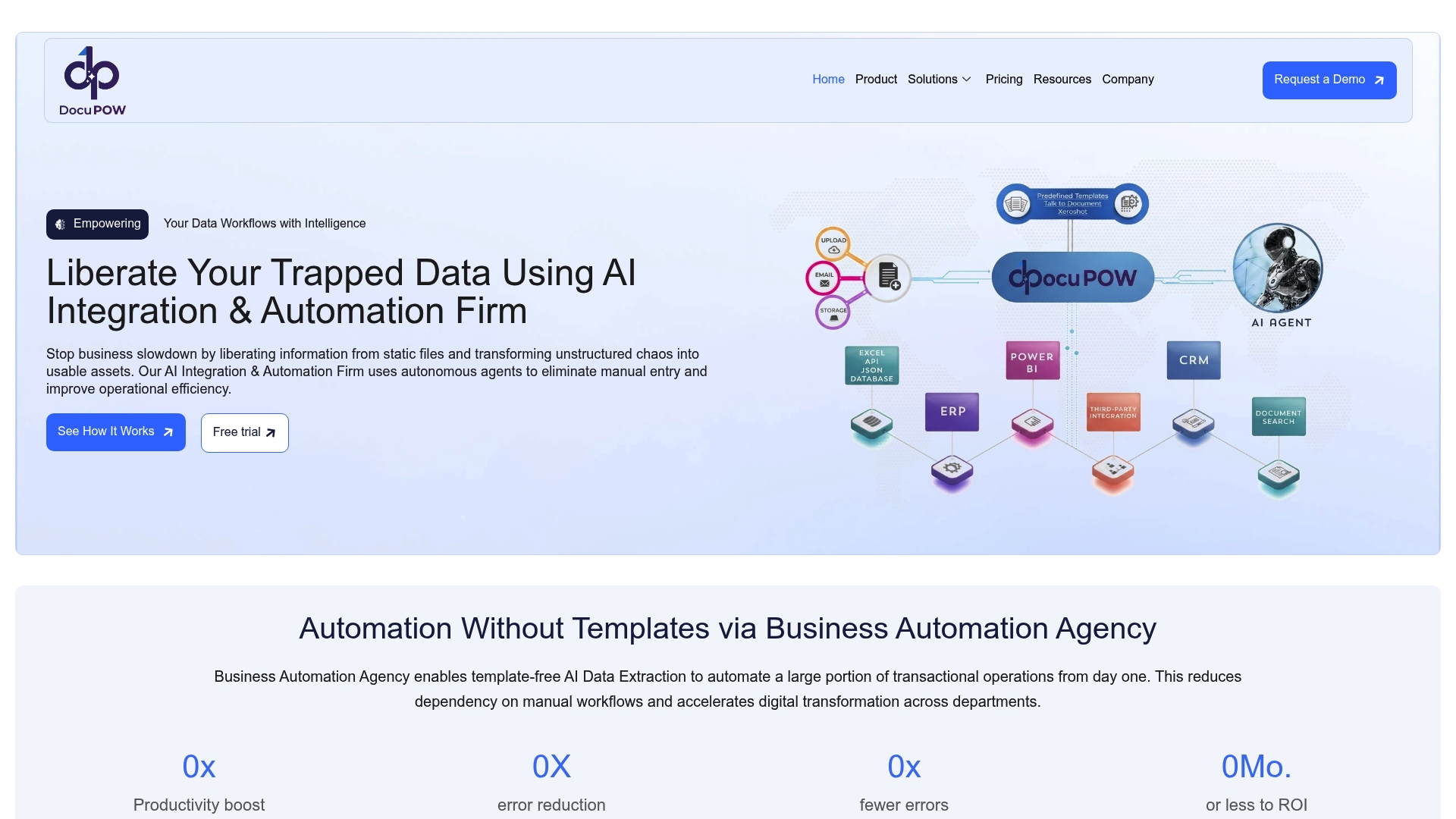
DocuPOW applies the same production-first principles covered in this guide to document automation for enterprise teams. Its autonomous agents extract data from unstructured documents without rigid templates, integrate directly with existing business systems, and provide real-time analytics that shift teams from reactive to proactive decision-making. For operations leaders dealing with high document volumes, DocuPOW’s AI workflow automation services cover the full stack: integration engineering, agent orchestration, monitoring, and continuous improvement. Teams in real estate, construction, and back-office operations can also explore purpose-built solutions for document process automation that reduce manual entry and improve financial visibility at scale.
FAQ
What does an AI agent development company actually build?
An AI agent development company builds autonomous software agents that connect to business systems, execute multi-step tasks, and make decisions without constant human oversight. These agents differ from chatbots because they take actions, not just generate responses.
How long does it take to build a production AI agent?
Enterprise AI agent projects typically take 4–14 weeks from kickoff to production cutover, with integration engineering alone requiring 2–4 weeks. Complex or multi-agent systems take longer.
What is an Agent Design Sprint?
An Agent Design Sprint is a 5–7 day scoping engagement that produces a detailed technical specification for an AI agent project. It costs $3,500–$5,000 and is the most reliable way to prevent scope failures before development begins.
How do I avoid vendor lock-in with an AI agent partner?
Require that all prompt logic, orchestration code, and agent architecture be delivered to you as client-owned assets. Insist on open-source frameworks like LangChain, LangGraph, or AutoGen rather than proprietary platforms.
What should AI agent development services cost in 2026?
Pricing ranges from $15,000–$50,000 for simple agents to $100,000–$500,000 for multi-agent systems, with ongoing support running $2,000–$10,000 per month. Discovery and scoping add $5,000–$15,000 before development begins.
Recommended
See DocuPOW on your documents.
Stop building templates. Start extracting data.