Contract Intelligence for Enterprise Teams: A Buyer’s Guide
<p>Unlock faster, informed decisions with contract intelligence. Transform static contracts into actionable insights that enhance business efficiency.</p>


Contract intelligence turns static contract text into structured, queryable data that feeds directly into business decisions, workflows, and automations. Instead of a signed PDF sitting in a shared drive, you get parties, clauses, dates, and obligations pulled out, tagged, and connected to the systems that act on them.
The payoff shows up fast. Workday’s 2026 Contract Intelligence Index found that a large majority of professionals say only a few people in their organization know who owns a given contract, and many organizations already report measurable value from contract intelligence within weeks or months of adoption, with a high proportion seeing returns inside a year. That gap between “contracts as buried paperwork” and “contracts as live business data” is exactly what this technology closes.
- Faster first-pass reviews because clauses and obligations are pre-tagged, not manually re-read
- Fewer missed renewals, auto-renewals, and compliance deadlines
- Recovered value from unclaimed discounts, rebates, and entitlements sitting in old agreements
Platforms like DocuPOW approach this with template-free extraction, meaning the system reads contracts by understanding their structure and language rather than matching them to a rigid form. That matters more than it sounds. Most enterprise contract portfolios contain dozens of formats, redlines, and one-off addenda that break template-based tools on day one.
Key Takeaways
Contract intelligence works because it converts unstructured contract text into structured data that other systems and people can act on immediately.
| Point | Details |
|---|---|
| Definition first | Contract intelligence extracts clauses, obligations, and dates into structured, searchable data. |
| Value shows up fast | Workday reports most organizations see returns within a year, many within months. |
| Complements, not replaces, CLM | CLM handles workflow and signature; contract intelligence handles understanding and analytics. |
| Pilot before scaling | Start narrow, on renewals or NDAs, with metrics defined before the pilot begins. |
| DocuPOW fits the checklist | Template-free extraction, agentic workflows, and human-in-the-loop review cover the core capabilities buyers need. |
Table of Contents
- How Does Contract Intelligence Actually Work?
- What Capabilities Should You Expect From a Contract Intelligence Platform?
- Is Contract Intelligence the Same as Contract Lifecycle Management?
- Where Should Contract Data Live, and How Is It Protected?
- Which Enterprise Use Cases Deliver the Most Value?
- What Does a Contract Intelligence Rollout Actually Look Like?
- How Do You Evaluate Contract Intelligence Vendors?
- Why DocuPOW Fits the Contract Intelligence Checklist
- Ready to Pilot Contract Intelligence on Your Own Documents?
- Sources
- FAQ
How Does Contract Intelligence Actually Work?
Under the hood, contract intelligence is a pipeline, not a single feature. Documents come in from wherever they already live: scanned PDFs, email attachments, e-signature exports, shared drives. From there, the system has to make sense of pages that were never designed to be read by a machine.
The typical flow looks like this:
- Ingestion: pulling documents from repositories, inboxes, or upload portals in whatever format they arrive
- OCR and layout analysis: converting scans and images into machine-readable text while preserving structure like tables and signature blocks
- Clause and field extraction: identifying parties, effective dates, payment terms, termination clauses, and other defined fields using natural language processing
- Normalization: mapping extracted terms to a consistent internal vocabulary, or ontology, so “termination for convenience” and “termination without cause” resolve to the same concept
- Indexing: storing the structured output in a searchable format
- Downstream integration: feeding that structured data into CLM systems, ERP platforms, alerting tools, or autonomous agents that act on it
Deployment can run in the cloud, in a private environment, or as a hybrid setup, with API endpoints connecting the extraction layer to whatever systems already run the business. The honest caveat: extraction quality depends heavily on document quality and template diversity. Handwritten amendments, low-resolution scans, and contracts in less common languages remain harder to process accurately.
Pro Tip: Before a full rollout, run a sample of your messiest, oldest contracts through any system you’re evaluating, not just your cleanest templates. That’s where extraction accuracy actually gets tested.
What Capabilities Should You Expect From a Contract Intelligence Platform?
Enterprise buyers should treat contract intelligence like any other mission-critical system: with a checklist, not a sales pitch. Microsoft’s Document Intelligence prebuilt contract model illustrates the baseline technical bar: it extracts parties, jurisdictions, contract IDs, titles, key-value pairs, and line items from PDFs, scans, and Office files, returning structured JSON. A serious enterprise platform needs to go well beyond that baseline.
Core extraction and analysis features:
- OCR plus support for multiple file formats (PDF, scanned images, Word, email)
- Clause classification that recognizes indemnification, limitation of liability, auto-renewal, and similar clause types
- Entity and obligation extraction tied to specific parties and dates
- Deadline and renewal tracking with automated alerting
- Semantic, natural-language search across the full contract portfolio, not just keyword matching
- Cross-portfolio analytics that surface risk concentrations or non-standard terms at scale
- Risk scoring and playbook comparison against approved clause language
Integration and governance features:
- APIs and pre-built connectors for CLM, ERP, and CRM systems
- Webhook or event-based support so a flagged obligation triggers an alert somewhere a human will see it
- Human-in-the-loop review for low-confidence extractions
- Audit logs tracking who reviewed, edited, or approved extracted data
- Configurable extraction models and role-based governance controls
Vendors and product pages, including Icertis’s own explainer, frame contract intelligence as the layer that turns agreement text into operational rules, alerts, and automated actions. That framing is useful: if a platform can’t turn a clause into a trigger somewhere downstream, it’s an extraction tool, not an intelligence platform.
Is Contract Intelligence the Same as Contract Lifecycle Management?
No, and confusing the two leads to wasted budget. Contract Lifecycle Management (CLM) handles the administrative side of a contract’s life: drafting, routing for approval, e-signature, and storage. Contract intelligence handles understanding: what the contract actually says, what it obligates you to do, and how it compares across a portfolio of thousands of similar documents.
- CLM answers: Where is this contract in the approval process? Who needs to sign next?
- Contract intelligence answers: What are our total indemnification exposures across all vendor contracts? Which agreements auto-renew in the next 90 days?
The decision rule is straightforward. If your pain point is workflow and routing, prioritize CLM. If you’re sitting on a large, complex portfolio and need How to Improve Contract Intelligence-style visibility across it, prioritize an intelligence layer. Independent guidance suggests the tipping point often lands around 500 or more active contracts, past which manual clause-by-clause analysis simply stops scaling. The strongest setups don’t force a choice. Look for platforms that either integrate cleanly with your existing CLM or offer both capabilities natively, rather than locking you into a single point solution.
Where Should Contract Data Live, and How Is It Protected?
Deployment architecture is usually the first question security and IT teams ask, and it should be. Three models dominate:
- Cloud SaaS: fastest to deploy, easiest to scale, and typically the most cost-effective for mid-size portfolios
- Private cloud: keeps data within a dedicated environment, often required by regulated industries with strict data residency rules
- On-premise or hybrid: maximum control over where documents physically sit, at the cost of slower deployment and higher maintenance overhead
Whichever model you choose, verify the fundamentals directly rather than taking a sales deck’s word for it: encryption at rest and in transit, role-based access controls that limit who can view sensitive clauses, and detailed audit logging. Ask specifically about SOC 2 and ISO 27001 attestations, and ask to see the actual certificates rather than a logo on a webpage. Cloud platform pages, including Microsoft Azure’s compliance documentation, are a useful benchmark for what “enterprise-grade” should actually include.
On integration, expect bi-directional APIs that sync with your CLM, ERP, and CRM systems, plus event-driven webhooks that fire alerts when a contract hits a renewal window or a flagged clause. Connector patterns for existing document stores and email archives matter too. Contracts rarely live in one clean place.

Pro Tip: Ask any vendor to run a proof-of-value on a sample of your own contracts before you sign anything. Accuracy claims on a vendor’s demo dataset tell you almost nothing about how the system performs on your actual paperwork.
Which Enterprise Use Cases Deliver the Most Value?
Contract intelligence pays for itself fastest in a handful of specific, repeatable scenarios rather than as a vague portfolio-wide upgrade.
- Inbound NDA and vendor intake triage: automatically flagging non-standard terms before they reach a lawyer’s desk
- Obligation tracking and renewal management: catching auto-renewals and termination windows before they pass unnoticed
- Entitlement recovery: surfacing rebates, discounts, and credits buried in vendor agreements that finance never claimed
- M&A due diligence: rapidly analyzing an acquired company’s full contract portfolio for risk exposure
- SLA and compliance monitoring: tracking whether vendors are actually meeting the service levels they agreed to
Industry commentary from Ironclad points to meaningful post-signature value leakage in large organizations, much of it tied to unclaimed entitlements and missed renewal windows that nobody was tracking. That leakage compounds across procurement, finance, and sales, not just legal. Procurement teams use contract intelligence to benchmark vendor terms; finance teams use it to catch billing discrepancies against contracted rates; sales teams use it to speed up quote-to-contract cycles when reviewing customer paper.
What Does a Contract Intelligence Rollout Actually Look Like?
A pilot-to-scale approach beats a big-bang rollout almost every time. EY’s guidance on GenAI adoption in contract management recommends starting with a narrow, high-impact use case, defining success metrics before you begin, and investing in change management from day one rather than treating it as an afterthought.
- Select a high-value scope: renewals, NDAs, or a specific vendor category, not the entire portfolio
- Ingest a representative sample, including your messiest documents, not just clean templates
- Validate extraction accuracy against manual review on that sample
- Measure outcomes against metrics defined before the pilot started
- Iterate on extraction models and workflows based on pilot findings
- Scale to the broader portfolio once accuracy and adoption both clear your bar
| Metric | What it tells you |
|---|---|
| Extraction accuracy | Percentage of key fields correctly identified without manual correction |
| Time saved per review | Reduction in hours spent per contract during first-pass review |
| Obligations tracked | Share of total portfolio obligations now monitored automatically |
| Recovered value | Dollar value of entitlements or renewals caught that would have been missed |
| Stakeholder adoption | Percentage of target users actively using the system after 90 days |
Governance can’t be an afterthought either. Assign named contract owners for each category, not a vague team. Define a clause playbook with preferred and fallback language. Set clear escalation rules for what happens when the system flags something high-risk, and schedule periodic audits of the extraction models themselves, since accuracy can drift as contract language evolves.

How Do You Evaluate Contract Intelligence Vendors?
Run a structured evaluation rather than a features comparison based on marketing pages. Check these first:
- Accuracy benchmarks tested on your own sample documents, not the vendor’s demo set
- Supported file types and language coverage matching your actual contract portfolio
- API depth and existing connectors for your CLM, ERP, or CRM stack
- Security attestations, SLA terms, and published uptime history
- Pricing model that fits your portfolio size, not a flat enterprise rate designed for a much larger company
Bring these questions to every demo:
- Can we test this on 50 of our own contracts before committing?
- How does the system handle low-confidence extractions, and who reviews them?
- Can extraction models be retrained on our specific contract language?
- Where does our data physically reside, and can we get that in writing?
Watch for red flags: vague accuracy claims with no sample test offered, no visible audit trail for extracted data, resistance to running a proof-of-value on your documents, or contract terms that make it hard to export your own data later.
Why DocuPOW Fits the Contract Intelligence Checklist
DocuPOW was built around the exact gap most legacy tools struggle with: rigid templates that break the moment a contract deviates from the expected format. Its agent-based approach reads documents by understanding context and structure, not by matching against a fixed layout, which covers the template-free extraction capability enterprise buyers should be checking for.
- Template-free extraction across contract types, formats, and languages without manual template setup
- Agentic, multi-step workflow orchestration that routes extracted obligations into downstream systems automatically
- Human-in-the-loop audit review for low-confidence extractions, with full audit logging
- Real-time analytics and predictive insights that surface portfolio-wide risk instead of one contract at a time
- API-based integration with ERP and CRM systems, plus developer tools for custom connectors
- Enterprise-grade security and compliance controls built for regulated industries
That combination directly maps to the capability checklist covered earlier: extraction, analytics, integration, and governance, in one platform rather than three stitched together.
What Most Contract Intelligence Rollouts Get Wrong
The recurring failure pattern isn’t technical. It’s ownership. Teams launch a pilot without naming who actually owns contract data going forward, so the initiative stalls the moment the project sponsor moves to a different priority. Poor source data compounds the problem: feeding a system your worst, oldest scans without cleanup expectations sets accuracy targets that were never realistic to begin with. Scope creep kills momentum too, when a focused pilot on renewals quietly expands to “the entire portfolio” before anyone has validated the approach works.
The fix is almost boring in its simplicity. Centralize contracts in one place before you extract anything. Pilot on a narrow, high-value slice like renewals or NDAs. Pick two measurable metrics before you start, and don’t add a third until those two are tracked reliably.
Ready to Pilot Contract Intelligence on Your Own Documents?
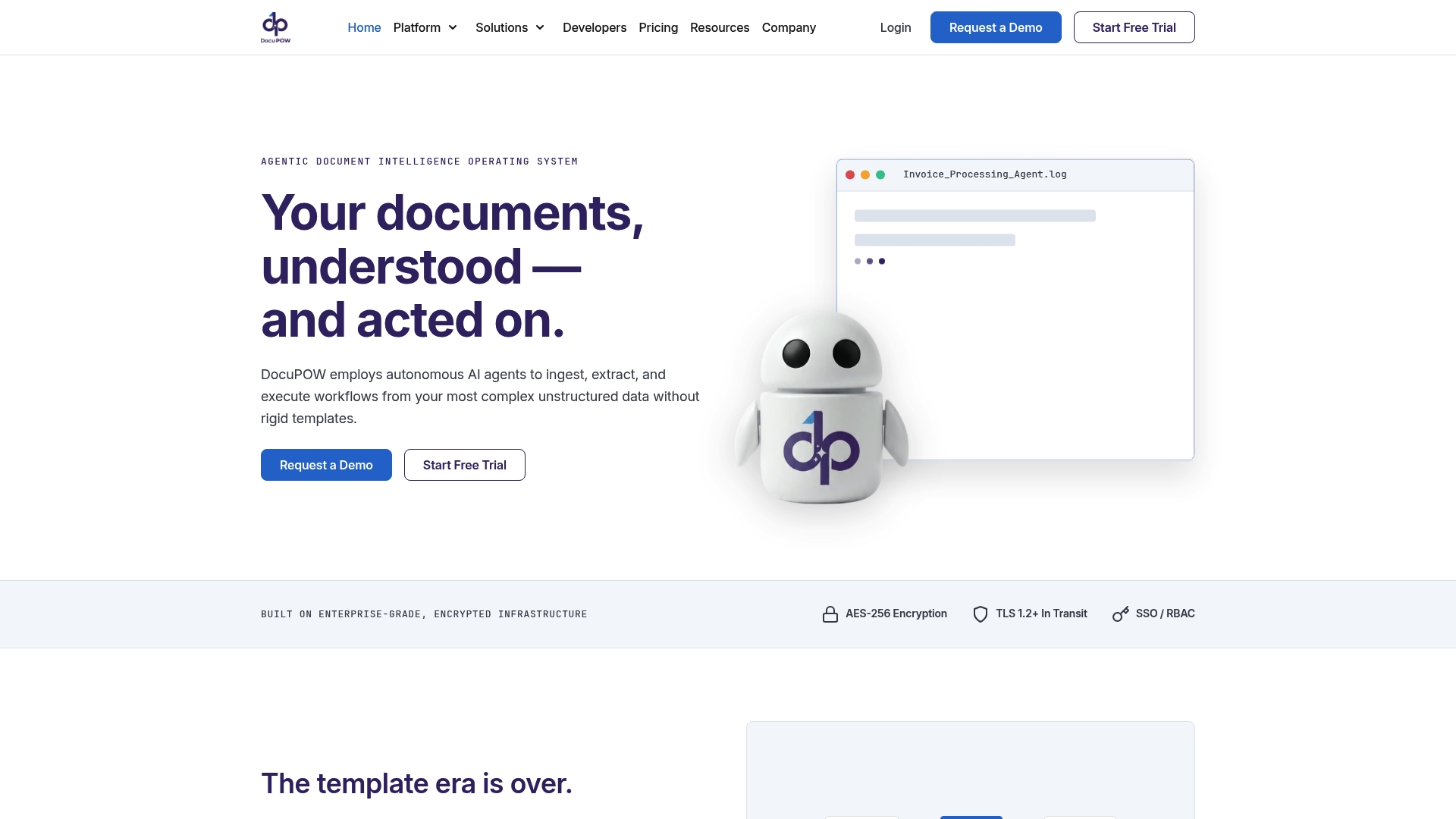
Reading about extraction accuracy is one thing. Watching it work on your actual, messy, decade-old contract portfolio is another. DocuPOW’s template-free approach means a pilot doesn’t require weeks of template configuration before you see real output.
If your team manages high contract volume, whether that’s vendor agreements, leases, or supply chain paperwork, DocuPOW’s guidance on scaling document processing for large portfolios walks through what a proof-of-value should measure before you commit budget. Sector-specific flows exist too. Property teams managing lease renewals and tenant obligations can see how the same extraction engine applies to their own real estate contracts.
The most useful next step is the simplest one: run a proof-of-value on a sample of your own contracts, not a vendor demo set, and measure accuracy against your actual paperwork before scaling anything.
Sources
- How GenAI can drive innovation in contract management and deliver value | EY
- Contract data extraction – Document Intelligence – Foundry Tools | Microsoft Learn
- What Is a Contract Intelligence Platform? (2026 Guide)
FAQ
What degree do you need to be a contract analyst?
Most contract analyst roles look for a bachelor’s degree in business, paralegal studies, or a related field, though some senior positions prefer a legal background or paralegal certification.
What is Icertis contract intelligence?
Icertis is one enterprise vendor offering a contract intelligence platform that uses generative AI to extract terms and automate contract workflows, illustrating a broader category that includes template-free platforms like DocuPOW.
Can ChatGPT analyze a contract?
General-purpose AI chat tools can summarize or answer questions about a single contract you paste in, but they lack the audit trails, portfolio-wide analytics, and governance controls that dedicated contract intelligence platforms provide.
How much is Icertis worth?
Icertis’s private valuation isn’t publicly listed with a current, verifiable figure, and valuations for privately held vendors change frequently based on funding rounds.
Do I need contract intelligence if I already use a CLM?
If your CLM handles routing and signatures but you still can’t answer questions like “which contracts auto-renew next quarter,” you likely need an intelligence layer on top, whether that’s a dedicated platform or one that combines both functions like DocuPOW aims to.
Recommended
See DocuPOW on your documents.
Stop building templates. Start extracting data.