Make Contract Risk Analysis an Operational Control With 1 to 5 Scoring
Treat contract risk as an operational control: score high value contracts on a 1 to 5 likelihood and impact grid, pilot agentic automation, and embed...

Contract risk analysis is the process of identifying which clauses in a contract could cause financial, operational, legal, or reputational damage, then scoring each one by likelihood and impact. The immediate move is to stop reviewing every contract equally: pick your highest-value and highest-dependency agreements, score each risk on a 1 to 5 scale for both likelihood and impact, and fix anything that lands above your threshold before you sign. ISO frameworks offer a solid structure for this, and automation platforms can compress the review timeline considerably.
TL;DR:
- Priority should be given to high-value contracts involving revenue, sensitive data, or long-term dependencies, with ongoing monitoring throughout the contract lifecycle.
- Risks should be categorized into liability, financial, operational, regulatory, and reputational, to enable targeted review and efficient triage.
- Use a simple 1 to 5 scoring scale for likelihood and impact to evaluate risks, avoiding complex formulas that lack real trust or clarity.
- Critical clauses like liability caps, auto-renewal terms, and data export rights require negotiation and preventative measures before signing.
- Deploy automation tools for bulk clause detection, score transparency, renewal alerts, and cross-functional review to make contract risk analysis scalable and effective.
Table of Contents
- Defining the Scope: What Belongs in a Contract Risk Review
- The Five Risk Categories Every Reviewer Should Tag
- A Step-by-Step Process for Analyzing Contract Risks
- The Pre-Sign Checklist and Scoring Rubric
- High-Risk Clauses and How to Negotiate Them
- Where Automation Helps and Where Humans Still Have to Sign Off
- Piloting Contract Risk Analysis With Agentic Automation
- Legal Implications and Compliance Requirements Tied to Contract Risk
- What Contract Risk Failures and Successes Actually Look Like
- Getting Legal, Finance, IT, and Procurement in the Same Room
- Beyond AI: Other Tools Supporting Contract Risk Management
- Fitting Contract Risk Into Enterprise Risk Management
- Turning Contract Review Into an Automated, Governed Workflow
- A Governance-First Take on Contract Risk
- Sources
- FAQ
Defining the Scope: What Belongs in a Contract Risk Review
Contract risk analysis is not proofreading. A lawyer checking for typos and inconsistent defined terms is doing something different from a team asking, “If this vendor disappears, what happens to our operations in 90 days?” The second question is the actual job. It requires looking past grammar into business consequence: revenue exposure, data dependency, and what breaks downstream if a clause gets triggered.
Not every contract deserves the same scrutiny. Prioritize agreements that touch revenue directly, involve sensitive data handling, lock you into multi-year commitments, or create technical integration dependencies you can’t easily unwind. A one-page NDA with a low-risk vendor doesn’t need the same treatment as a five-year platform agreement your finance team depends on for reporting.
The review also has to span the full lifecycle, not just the signing moment. Pre-signature is where you catch problems cheaply. Renewal and amendment windows are where risk quietly compounds if nobody’s watching. Ongoing monitoring and eventual exit planning matter just as much, since the clauses that hurt most (data lock-in, termination penalties) tend to surface only when you’re trying to leave.
The Five Risk Categories Every Reviewer Should Tag
Sorting contract risks into categories speeds up bulk review because you can triage by type instead of reading every clause with the same generic lens.
- Liability risk: uncapped or poorly capped exposure, indemnity obligations that outweigh the deal’s value, and limitation-of-liability clauses that carve out too little for your side.
- Financial risk: price escalators tied to vague indices, hidden renewal fee jumps, and payment terms that create cash flow strain.
- Operational risk: dependencies on a vendor’s uptime, API stability, or support responsiveness. This is where a single deprecation clause can trigger months of unplanned engineering work.
- Regulatory risk: data residency requirements, industry-specific compliance obligations, and clauses that shift compliance burden onto you without adequate support.
- Reputational risk: publicity rights, co-marketing obligations, or breach notification terms that could expose your brand if the vendor stumbles.
Tagging clauses this way during first-pass review lets a legal or procurement team scan a hundred contracts and immediately see which ones cluster around liability exposure versus operational fragility, rather than treating each document as a fresh mystery.
A Step-by-Step Process for Analyzing Contract Risks
Most failed reviews skip straight from reading to gut-feel judgment. A repeatable process fixes that. Here’s the sequence that holds up under volume:
-
Identify. Build a clause inventory using metadata tags (contract type, value, counterparty, renewal date) and flag business-context risks like data volume or integration depth.
-
Assess. Score each identified risk on two axes: likelihood (1 to 5) and impact (1 to 5). Multiply them for a composite score.
-
Prioritize. Set a threshold. Anything scoring above it goes into active mitigation; anything below gets logged and monitored.
-
Mitigate. Choose your response: negotiate different language, add an operational control (like a backup vendor), or accept the risk with a documented compensating control.
-
Monitor. Track renewal windows, SLA breach counts, and operational red flags on a set cadence, not just when something breaks.
The scoring step is where most teams overcomplicate things. Risk-scoring practice favors simple 1 to 5 scales over elaborate weighted formulas, because complexity creates a false sense of precision without improving the decision.
Pro Tip: Resist the urge to build a 20-variable risk formula in a spreadsheet. A clean 1 to 5 by 1 to 5 grid, applied consistently, beats a complicated model nobody trusts enough to act on.
The Pre-Sign Checklist and Scoring Rubric
Before any contract gets a signature, run it against a fixed checklist rather than relying on memory. The items that matter most, in practice: data access and export rights, liability cap size, indemnity scope, SLA definitions and exclusions, auto-renewal terms, price escalation triggers, termination rights, assignment restrictions, and audit rights.
Score each flagged issue using the same impact times likelihood grid from the process above:
- Score 1 to 8: low priority. Log it and move on.
- Score 9 to 15: moderate. Flag for negotiation if time allows, but not a blocker.
- Score 16 to 19: high. Requires a specific mitigation plan before signing.
- Score 20 to 25: immediate mitigation required. Do not sign until this is resolved or formally accepted by someone with authority to accept that level of exposure.
Recording the outcome matters as much as the scoring itself. Every flagged risk needs an owner: legal typically negotiates clause language, IT or operations implements technical controls, and procurement tracks remediation deadlines. Without a named owner, a “high risk, flagged for follow-up” note in a shared document tends to die there.
Pro Tip: Keep the rubric visible to everyone reviewing contracts, not just legal. When finance and procurement use the same scoring language, escalation conversations get a lot shorter.
High-Risk Clauses and How to Negotiate Them
A handful of clauses account for most of the damage in vendor agreements. Practitioner triage repeatedly points to liability caps, termination for convenience, most-favored-customer terms, IP assignment, and weakened auto-renewal provisions as the ones worth fighting for.
- Auto-renewal: push for a defined notice window (60 to 90 days) and put a calendar reminder process in place internally, since missing the window is often the actual failure, not the clause itself.
- Limitation of liability: negotiate cap size relative to contract value, and insist on carve-outs for data breaches and IP infringement that are separate from the general cap.
- Data access and export: minimum 60 to 90 day post-termination export windows in machine-readable formats, not a vague promise of “reasonable assistance.”
- SLA credits: define exactly how uptime is measured and make sure credits aren’t your only remedy for repeated failures.
- API deprecation: attach a technical addendum specifying notice periods and migration support, since unplanned re-engineering from a deprecated integration can cost more than the contract’s entire value.
Common Paper’s 2026 benchmark data shows liability supercaps and AI-specific contract language becoming standard inclusions, which means the clauses worth scrutinizing keep shifting even in agreements that look boilerplate.
Where Automation Helps and Where Humans Still Have to Sign Off
Automation earns its place in contract risk analysis by handling volume: detecting clause types across thousands of documents, applying consistent scoring, flagging renewal deadlines, and generating dashboards that show risk concentration by category or counterparty. None of that replaces judgment on the close calls.
- Clause detection and bulk scoring across a full contract portfolio in far less time than manual review.
- Renewal alerts tied to actual dates pulled from document text, not a shared calendar someone forgot to update.
- Audit logs and evidence export, so a compliance reviewer can see exactly why a contract was scored the way it was.
- Human-in-the-loop review on anything flagged high risk, since explainability and auditability remain essential for compliance use even when detection is automated.
- Integration with CLM, procurement, and ERP or CRM systems, so risk data doesn’t sit isolated from the workflows that act on it.
Any platform you evaluate should support these integration points and produce transparent, exportable scoring, not a black-box number nobody can defend to an auditor.
Piloting Contract Risk Analysis With Agentic Automation
DocuPOW’s template-free extraction reads contract structure without preset templates, which matters because contract formats vary constantly across vendors and regions. Its human-in-the-loop audit review and real-time analytics give teams the explainability that compliance officers need.
A practical pilot: pick one high-risk contract class (say, data-processing agreements), run it through automated scoring, and measure three things:
- Time-per-contract, comparing manual review hours to automated throughput.
- Percentage of flagged high-risk contracts actually remediated within 30 days.
- Reduction in total manual review hours across the batch.
If those numbers move in the right direction on one contract class, the case for scaling writes itself.
Legal Implications and Compliance Requirements Tied to Contract Risk
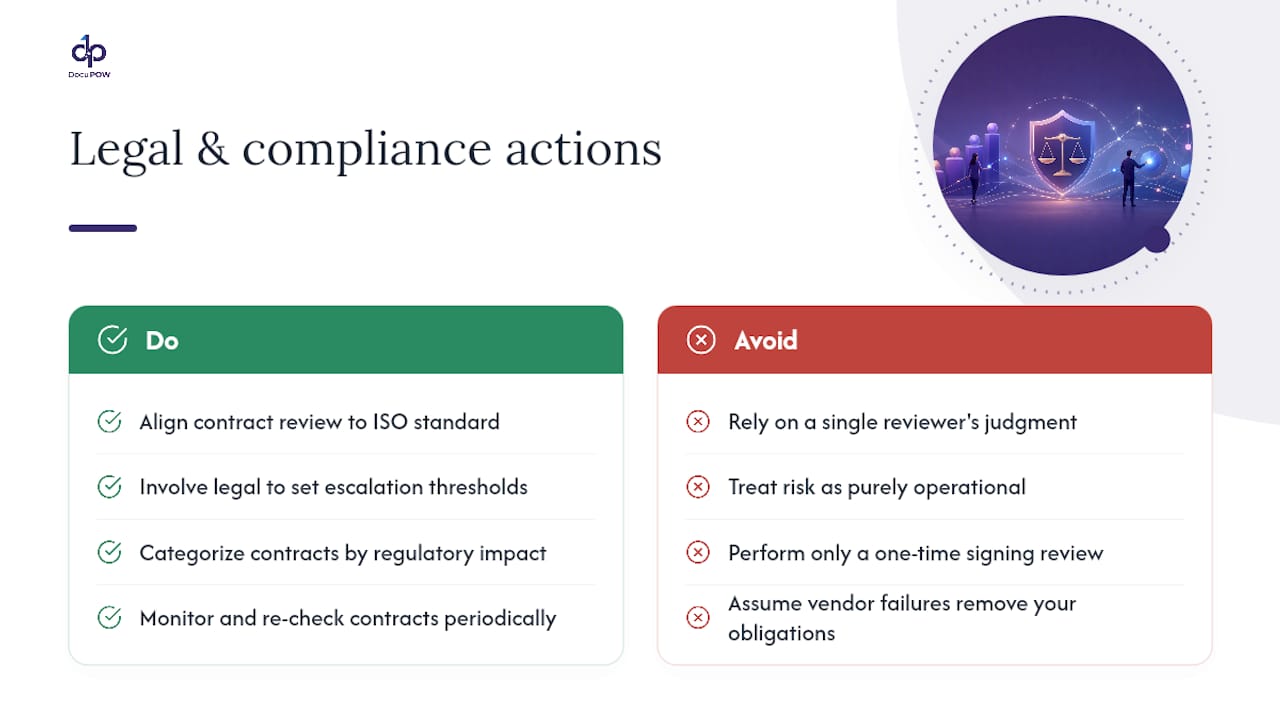
Unmanaged contract risk isn’t just a business problem. It can create direct legal exposure. Regulatory frameworks in data protection, financial services, and healthcare increasingly hold organizations accountable for the terms they accept from vendors, not just their own internal practices. A data-processing agreement with weak breach notification language can leave your company non-compliant with obligations you owe to your own customers, even though the failure originated with a third party.
Aligning contract review to a recognized standard gives you a defensible process if a regulator or auditor ever asks how risk decisions got made. ISO’s risk management frameworks provide language and structure that many compliance teams map their internal contract review policies against, which matters when you need to demonstrate consistency across hundreds of agreements rather than relying on one reviewer’s judgment call.
Compliance requirements also change based on contract category. A vendor agreement touching personal data carries different obligations than a straightforward equipment lease. Regulatory risk in a contract isn’t static either. A clause that was compliant last year can become a liability after a rule change, which is why monitoring has to include a periodic re-check against current regulatory requirements, not just a one-time signing review.
Legal counsel should be involved specifically in setting the risk thresholds that trigger escalation, since the line between “acceptable risk” and “unacceptable exposure” often depends on regulatory context that a purely operational reviewer might miss.
What Contract Risk Failures and Successes Actually Look Like
The clearest failures share a pattern: a clause everyone assumed was standard turns out to have teeth. A company relying on a vendor’s API discovers a deprecation clause allowing 30 days’ notice for a shutdown, then spends months on emergency re-engineering because no technical addendum specified a longer transition period. Another common failure: an auto-renewal clause with a narrow cancellation window locks a company into another full year at a price increase nobody budgeted for, because the notice deadline passed while the contract sat in a shared drive nobody was monitoring.
The successes tend to look less dramatic, which is part of why they don’t get talked about. A procurement team that catches an uncapped indemnity clause during pre-signature review and negotiates a cap tied to contract value avoids a lawsuit that never happens, and nobody writes a case study about the disaster that didn’t occur. A legal team that insists on a 90-day data export window before signing a new platform contract saves itself an operational crisis two years later when the vendor relationship sours and migration becomes urgent.
The pattern across both outcomes is the same: risk that gets identified and scored before signing is a negotiation. Risk that surfaces after signing is a crisis. The gap between those two states is almost always the presence or absence of a structured review at the point of signature, not the sophistication of the tools used to run it.
Getting Legal, Finance, IT, and Procurement in the Same Room
Contract risk analysis fails most often not from bad scoring methodology but from siloed review. Legal catches liability language nobody else understands. IT sees the API dependency that legal has no way to evaluate. Finance knows the price escalator will hurt in year three, but the contract never crosses their desk until it’s signed. Procurement holds the counterparty relationship history that could have predicted the vendor’s slow support response.
Structuring risk analysis as a cross-functional process, even a lightweight one, catches problems that any single department misses on its own. This doesn’t require a standing committee for every contract. A high-value, high-dependency agreement warrants a 30-minute review with representatives from each affected function before signature. Lower-risk contracts can run through a single reviewer with a checklist, escalating only if something crosses the threshold.
Communication after signing matters just as much. A monitoring cadence is only useful if the person who spots a warning sign (a missed SLA, a renewal date approaching) actually tells someone who can act on it. Building that escalation path into the process, rather than assuming it will happen organically, is what separates teams that catch problems early from teams that discover them during a crisis.
Beyond AI: Other Tools Supporting Contract Risk Management
Automation and AI get most of the attention, but several other tool categories play a real role in contract risk management. Contract lifecycle management (CLM) systems provide the repository and workflow backbone: version control, approval routing, and a single source of truth for which version of a contract is actually in effect. Without a CLM system, even a good risk analysis process degenerates into people negotiating against outdated drafts.
Clause libraries and playbooks, whether built internally or licensed, give reviewers pre-approved language to fall back on during negotiation instead of drafting from scratch under time pressure. Risk registers, the kind used in broader enterprise risk management, give contract-specific findings a home alongside other organizational risks, so a contract risk doesn’t live in isolation from operational or financial risk tracking elsewhere in the business.
Project and procurement templates also matter more than they get credit for. Adapting a structured project management contract template for technical addenda, or using targeted procurement question sets to gather vendor information before negotiation starts, closes gaps that pure document review often misses. Manufacturing teams assessing vendor operational dependencies can draw on frameworks used in predictive maintenance planning to think through what happens if a critical supplier contract fails unexpectedly.
None of these tools replace scoring and prioritization. They support the infrastructure around it.
Fitting Contract Risk Into Enterprise Risk Management
Contract risk analysis works best when it isn’t a standalone exercise sitting in legal’s corner of the business. Enterprise risk management (ERM) frameworks treat contract exposure as one input among several: operational risk, financial risk, cybersecurity risk, and strategic risk all feed into the same governance structure. A contract risk that scores high on the 1 to 5 rubric should surface in the same reporting that an enterprise risk committee already reviews, not sit in a separate spreadsheet only legal ever opens.
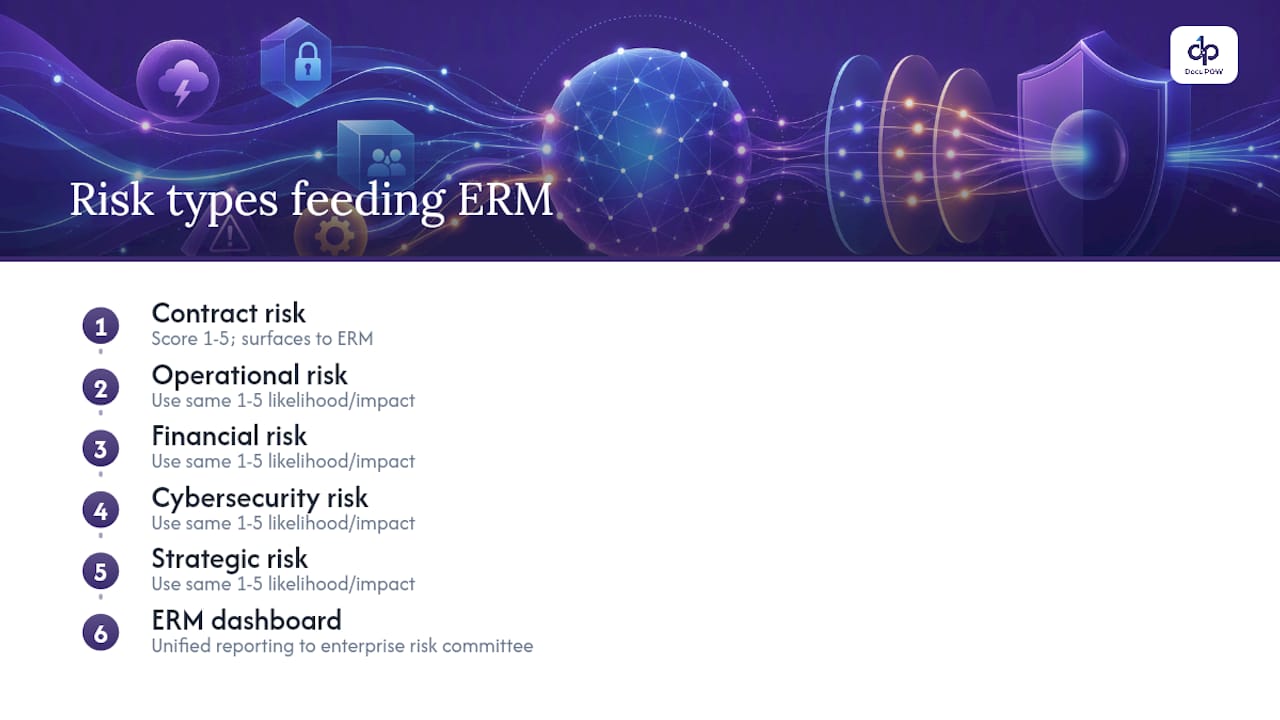
This integration matters practically because contract risks rarely stay contained to contracts. A vendor concentration risk (too many critical functions depending on one supplier) is a contract issue and an operational resilience issue simultaneously. A data processing agreement with weak breach terms is a contract issue and a cybersecurity governance issue at the same time. Treating them as separate silos means the same underlying exposure gets evaluated twice, inconsistently, by two different teams that don’t talk to each other.
Aligning contract risk scoring language with the broader ERM framework, using the same likelihood and impact scales across risk types, lets an executive team see contract exposure next to every other category of organizational risk on one dashboard. That’s the difference between contract risk analysis as a compliance checkbox and contract risk analysis as an actual input into how the business makes decisions about vendors, growth, and where to invest in operational resilience.
Turning Contract Review Into an Automated, Governed Workflow
Running this process consistently across hundreds of contracts is where most teams stall, not because the methodology is unclear but because manual review doesn’t scale. DocuPOW’s contract analysis platform applies agentic, template-free extraction to pull risk-relevant clauses out of any document format, then feeds that into scoring and analytics dashboards your legal, finance, and procurement teams can actually use together. Pricing starts from an affordable monthly fee for the Starter plan, with higher tiers available for additional features (https://docupow.ai/pricing), with Enterprise pricing available on request for organizations running high contract volumes across multiple business units. If you’re managing a contract portfolio that’s outgrown spreadsheet tracking, a pilot on your highest-risk contract class is the fastest way to see whether automated scoring actually moves your remediation numbers.
A Governance-First Take on Contract Risk
Scoring a contract means nothing without a governance structure that acts on the score. The organizations that get real value from contract risk analysis treat it as an operational control tied to measurable outcomes, not a legal exercise that ends when the document gets signed. Pilot one high-risk contract class, score it consistently, integrate the findings into your existing risk reporting, and put legal, finance, IT, and procurement in the same review loop from the start. Skip any one of those and the process quietly reverts to spreadsheet theater.
— Syed Naveed Abbas
Sources
- Iso
- Gartner report on contract operational dependencies
- SaaS agreement red flags — ReviewMyContract
- SaaS contract negotiation: what not to concede — Causo Hub
FAQ
What Is Contract Risk Analysis?
Contract risk analysis is the process of identifying, scoring, and prioritizing clauses in an agreement that could create financial, operational, legal, or reputational exposure. It goes beyond legal proofreading to focus on business impact, using a structured method like a 1 to 5 likelihood and impact scale to decide which risks need negotiation before signing.
What Are Some Examples of Contract Risk?
Common examples include uncapped liability clauses, auto-renewal terms with narrow cancellation windows, vague SLA credit remedies, and API deprecation rights that can trigger unplanned re-engineering work. Data access restrictions and short post-termination export windows also rank among the most frequently flagged risks in practitioner reviews.
What Are the Three C’s of a Contract?
Definitions vary across sources, but a common framing centers on clarity, consideration, and consent, referring to unambiguous terms, fair value exchanged, and mutual agreement without coercion. This framing is more of a general contract-law heuristic than a formal legal standard.
What Is an Example of Risk Analysis in a Contract Review?
A practical example is scoring a vendor’s limitation-of-liability clause: if a data breach is moderately likely (a 3 out of 5) and the potential financial impact is severe (a 5 out of 5), that clause scores 15, landing in the moderate-to-high range that typically requires negotiation before signature. Applying the same scale consistently across every contract is what turns individual judgment calls into a defensible, repeatable process.
Recommended
See DocuPOW on your documents.
Stop building templates. Start extracting data.