Document Summarization for Enterprise Teams: A Pilot-First Guide
Unlock the power of Document Summarization for your enterprise. Learn to pilot workflows for accurate, auditable results and efficiency.


TL;DR:
- Effective enterprise document summarization requires structure-aware parsing and a pilot-based approach to ensure accuracy and workflow integration. Hybrid extraction strategies and comprehensive pipeline design help prevent errors and facilitate scaling. Running focused pilots with clear metrics and governance establishes readiness for full-scale deployment.
Enterprise document summarization must deliver structure-aware, auditable, and workflow-ready data — not just a readable paragraph. Before you evaluate any platform, define what success actually looks like:
- Human-review rate below 15% on standard document types
- Precision and recall above 0.90 on your labeled ground truth set
- Cycle-time reduction of at least 30% on the target workflow
- Integration-ready output that posts directly to your ERP, CRM, or DMS without manual reformatting
The short version: pilot one workflow, measure against qualitative thresholds, then scale. Everything below tells you how.
Table of Contents
- Why document summarization fails without structural parsing
- Which summarization approach fits your workflow?
- How to design an end-to-end summarization pipeline
- How do you run a pilot and measure success?
- What does production readiness actually require?
- How DocuPOW applies these principles in practice
- Key Takeaways
- What most pilots get wrong
- DocuPOW turns a pilot into a production workflow
- Useful sources for architects and ops leaders
- FAQ
Why document summarization fails without structural parsing
Feeding raw extracted text to a large language model produces what ThoughtWorks calls a “bag of words” failure: the model loses the spatial and relational context that gives enterprise documents their meaning. A procurement contract is not a wall of prose. It is a hierarchy of clauses, a table of payment milestones, and embedded figures that only make sense in relation to each other.
ThoughtWorks testing identified three distinct parsing problems that must be solved separately:
- Text and layout extraction: preserving heading hierarchy, paragraph order, and page flow
- Table structure recognition: identifying row/column relationships, merged cells, and multi-level headers
- Image and diagram interpretation: extracting meaning from figures, charts, and embedded visuals using vision-capable models
Flattened or misattributed table data and fragmented diagram extraction produced inaccurate summaries and citations in ThoughtWorks’ own document-processing experiments — errors that propagated silently into downstream automation.
A concrete failure pattern: a vendor invoice with a nested payment-terms table gets flattened to a single text string. The summarization model reads “Net 30 2% discount 10 days” as a sentence fragment and posts the wrong payment terms to the ERP. The AP team catches it three weeks later during reconciliation. That is not a model problem. It is a parsing problem, and no amount of prompt engineering fixes it after the fact.
For diagrams and figures, ThoughtWorks used a vision-capable LLM alongside polygon-based figure extraction (Docling) to preserve figure boundaries and metadata — a pattern worth replicating in any pipeline that processes technical or financial documents.
Which summarization approach fits your workflow?
Hybrid approaches are the right default for enterprise use. Extract structure first, then apply abstractive summarization selectively where paraphrase genuinely improves clarity. Here is how the three modalities break down:
- Extractive summarization selects verbatim sentences from the source. High auditability, zero hallucination risk, but can produce choppy output when source sentences lack context on their own. Best for invoices, purchase orders, and any document where exact field values matter.
- Abstractive summarization paraphrases and synthesizes. Reads naturally, but carries hallucination risk — especially on long documents where chunking without entity tracking can cause the model to drop or invent clauses. Best for executive summaries and narrative sections of contracts.
- Hybrid approaches combine both: extract structured fields and table data first, then apply abstractive summarization to free-text clauses. This is the pattern that hits 94% factual accuracy on legal contracts when paired with entity tracking.
Recommended use cases by document type:
- Invoices and POs: extractive only
- Legal clause summaries: hybrid (extract clause text, abstractive for plain-language summary)
- Diagrams and figures: vision model plus LLM reasoning
- Board books and earnings transcripts: abstractive with structured output parser
Pro Tip: Keep an auditable anchor for every summarized claim: store the source sentence, page number, and bounding box coordinates alongside the extracted value. Without that trace, a reviewer cannot verify the output, and your audit trail is worthless. Avoiding common prompt mistakes during model configuration also reduces the rate of structurally malformed outputs.
How to design an end-to-end summarization pipeline
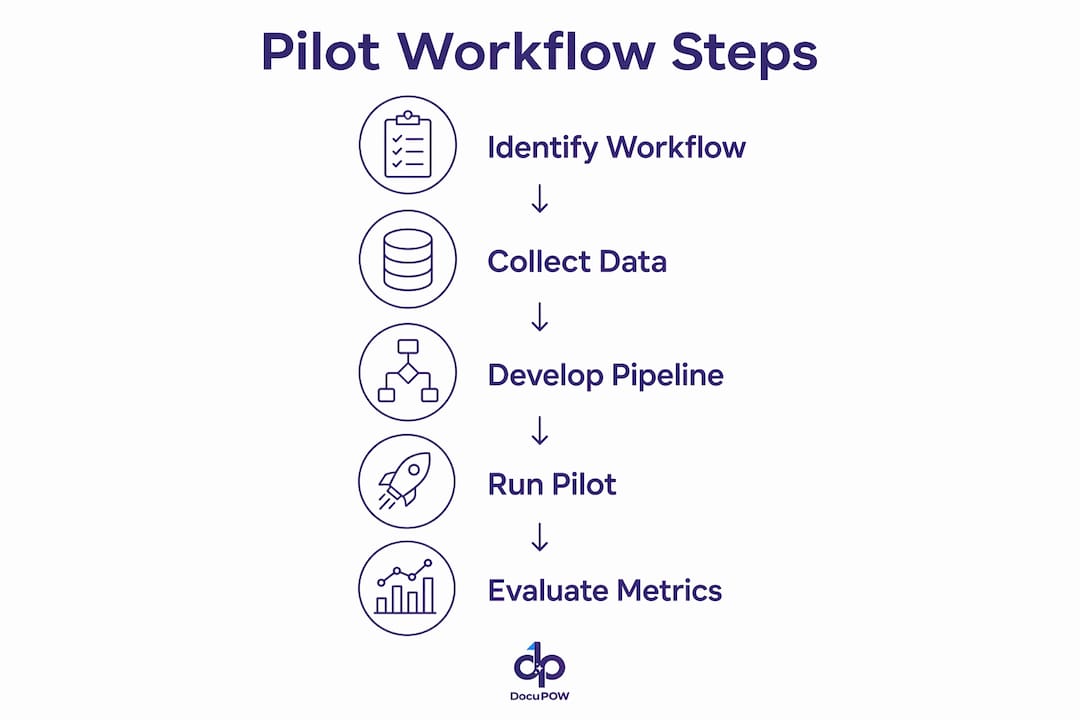
Pick one high-value, document-heavy workflow and design the full pipeline before touching a second use case. FluidLabs recommends procurement or contract management as the anchor workflow because both have visible cycle-time pain and clear success metrics.
The pipeline components, in order:
- Intake and ingest: email inbox monitor, shared drive watcher, or API webhook
- Format conversion: PDF normalization, OCR for scanned documents, image extraction
- Layout-aware parsing: separate passes for text/layout, table structure, and figures
- LLM reasoning layer: chunked summarization with entity tracking and structured output schema
- Validation layer: schema conformance check, numeric field regex, hallucination flags
- Human-in-the-loop review: confidence threshold routing to exception queue
- Orchestration and event bus: job queue with idempotency keys and append-only event log
- Downstream connectors: ERP, CRM, DMS via API with transactional idempotency
On pipeline orchestration: event-driven architectures offer error isolation and partial replay, which matters at scale. A failed table-extraction stage does not block the entire document batch. Linear pipelines are simpler to stand up for a pilot but will block on failed stages as volume grows. For most enterprise pilots, start linear and migrate to event-driven when throughput exceeds a few hundred documents per day.
Operationally, idempotency keys per job and append-only event sourcing prevent duplicate downstream records when a stage retries. Stage-level observability lets you replay from the exact failure point without reprocessing the entire document.

Pro Tip: Build the human review UI so the reviewer sees the extracted value and the source evidence side by side. A reviewer who cannot see the original text cannot make a confident decision, and your exception queue becomes a bottleneck instead of a safety net.
How do you run a pilot and measure success?
Run a pilot on a single workflow before committing to a broader rollout. FluidLabs suggests a timeline of several weeks for a single high-volume workflow; multi-workflow programs typically take several months.
| Metric | Target threshold | Business impact |
|---|---|---|
| Precision | ≥ 0.90 | Low false-positive rate in downstream systems |
| Recall | ≥ 0.90 | Missed obligations and values stay below acceptable risk |
| F1 score | ≥ 0.90 | Balanced accuracy across both error types |
| Human-review rate | < 15% | Sustainable reviewer workload at scale |
| Cycle-time reduction | ≥ 30% | Measurable throughput gain vs. baseline |
| False-negative cost | Quantified per document type | Grounds ROI calculation in real dollar exposure |
Pilot readiness checklist:
- Label a ground truth set of representative documents per document type
- Define labeling rules for ambiguous fields before annotation begins
- Confirm integration endpoints (ERP/CRM sandbox) are accessible
- Document the rollback plan if the pilot fails validation
- Set reviewer SLAs and escalation paths for the exception queue
- Complete a compliance review covering data residency and access controls
Run an A/B comparison against the existing manual process, and shadow the production system before cutover. The contract value at risk from missed obligations averages 11% post-signature — that figure alone justifies the ROI case for most procurement teams.
What does production readiness actually require?
Production requires hardened integrations, full observability, secure data handling, and clear governance before you scale beyond the pilot workflow.
Integration best practices:
- Define API contracts with versioned schemas before connecting downstream systems
- Use webhook reliability patterns: retry with exponential backoff, dead-letter queues for failed deliveries
- Normalize payloads at the connector layer so downstream systems receive consistent field names regardless of source document format
Security and compliance checklist for U.S. enterprises:
- SOC 2 Type II certification for the platform and any third-party parsing APIs
- HIPAA considerations where documents contain protected health information; confirm Business Associate Agreements are in place
- Data residency: verify documents do not leave designated cloud regions during processing
- Encryption at rest and in transit for all document storage and API calls
- Role-based access controls with audit logging on every extraction and review action
Azure Document Intelligence and public LLM APIs enforce throttling; design backoff strategies, batching, and parallelization into the pipeline from day one. Model selection is also a cost lever: use smaller, faster models for classification and routing, and reserve larger models for complex clause summarization.
Human-in-the-loop governance requires confidence thresholds that route low-confidence outputs to exception queues automatically, audit trails that store source evidence next to each extracted value, and clear reviewer accountability so every human decision is logged with a timestamp and user ID.
How DocuPOW applies these principles in practice
DocuPOW’s template-free extraction platform uses autonomous agents that understand document context without relying on rigid templates, which means it handles format variation across vendors, jurisdictions, and document generations without manual reconfiguration.
Key platform capabilities:
- Template-free, agent-based extraction across any document type or format
- Agentic orchestration for multi-step workflows from intake through archival
- Real-time analytics and predictive insights to shift teams from reactive to proactive
- Native ERP and CRM connectors via API for direct downstream integration
- Human-in-the-loop review UI with source evidence displayed alongside extracted values
- Enterprise-grade security including SOC 2 compliance and data residency controls
DocuPOW transforms document workflows for organizations, improving financial visibility and supporting faster data-driven decision-making with real-time analytics and predictive insights.
The single-workflow pilot model maps directly to DocuPOW’s deployment approach: scope one high-value workflow, validate against precision/recall thresholds, then extend the same pipeline architecture to additional document types. See real-world implementation examples for how this pattern scales across industries.
Key Takeaways
Accurate enterprise document summarization requires structural parsing, a hybrid extraction approach, and a measurable pilot before any scaling decision.
| Point | Details |
|---|---|
| Structural parsing is non-negotiable | Separate passes for text, tables, and figures prevent the “bag of words” failures that break downstream automation. |
| Hybrid approaches reduce hallucination | Extract structured fields first, then apply abstractive summarization to narrative sections for best accuracy. |
| Pilot one workflow for 8–16 weeks | Set precision, recall, and F1 thresholds at high levels and keep a low human-review rate before scaling. |
| Event-driven pipelines scale better | Idempotency keys and event sourcing prevent duplicate records and enable partial replay at production volume. |
| DocuPOW as your pilot platform | DocuPOW’s template-free, agent-based extraction and native ERP/CRM connectors are built for measurable enterprise pilots. |
What most pilots get wrong
The teams that struggle with document summarization rollouts almost always make the same mistake: they treat the LLM as the hard part and treat parsing as a solved problem. It is the other way around. A well-configured GPT-4 chain on poorly parsed input will hallucinate with confidence, and no evaluation metric will catch it until a missed contract obligation or a mis-posted invoice value surfaces downstream.
Two other pitfalls worth naming: first, skipping the labeled ground truth set because it feels slow. Without it, you have no baseline and no way to prove the pilot worked. Second, building the human review UI as an afterthought. Reviewers who cannot see source evidence next to extracted values will either rubber-stamp everything or reject the system entirely. Neither outcome builds organizational trust.
The team that should own the pilot is not IT alone. Operations owns the workflow, finance owns the ROI case, and legal or compliance owns the governance requirements. A cross-functional pilot owner group is the difference between a proof of concept that stalls and one that scales.
DocuPOW turns a pilot into a production workflow
Faster cycle times on document-heavy workflows are achievable in 8–16 weeks when the pipeline is built right from the start. DocuPOW’s enterprise workflow automation platform gives IT and operations teams template-free extraction, agentic orchestration, and native ERP/CRM connectors in a single platform with SOC 2 compliance built in.
A DocuPOW pilot is scoped to one workflow, runs 8–16 weeks, and delivers measurable KPIs: precision, recall, and F1 scores above 0.90, human-review rate below 15%, and a documented cycle-time reduction. The platform overview covers architecture, developer tools, and integration options in detail. For operations-specific use cases, the document process automation benefits page maps platform capabilities directly to operational outcomes.
Request a demo or start your pilot scoping at docupow.ai.
Useful sources for architects and ops leaders
- ThoughtWorks: Document processing is three distinct problems — foundational reading on parsing architecture and the bag-of-words failure mode
- FluidLabs: Document Workflow Automation Complete Guide — pilot timelines, workflow anchoring, and contract value loss data
- DEV Community: API-Driven Document Pipeline Architecture — idempotency keys, event sourcing, and pipeline observability patterns
- KeepSolid Automations: Document Workflow Intake and Review — human-in-the-loop review UX and confidence threshold routing
- Markaicode: AI for Document Summarization Enterprise — LangChain + GPT-4 production benchmarks, entity tracking, and hallucination rates
- ExtractBench: Benchmark and Evaluation Methodology — schema-driven evaluation framework distinguishing omission from hallucination
- Frontier Enterprise: The new bottleneck in enterprise AI — executive-level framing of document intelligence as an operational and financial risk
- Context Windows: Nasdaq Document Summarization Case Study — real-world outcomes including reading time reduction and pilot prep metrics
FAQ
What is the difference between extractive and abstractive summarization?
Extractive summarization selects verbatim sentences from the source document; abstractive summarization paraphrases and synthesizes content. Hybrid approaches combine both and are the recommended pattern for enterprise documents where accuracy and readability both matter.
How long does an enterprise document summarization pilot take?
A single-workflow pilot typically runs 8–16 weeks; multi-workflow programs take 6–12 months when done properly, according to FluidLabs.
What precision and recall thresholds should I target?
Target precision, recall, and F1 scores above 0.90 on your labeled ground truth set, with a human-review rate below 15%, before scaling beyond the pilot workflow.
Why does structural parsing matter more than model selection?
Parsing preserves the table structures, nested headers, and figure relationships that give enterprise documents their meaning. Feeding unparsed text to any LLM produces a bag-of-words output where spatial and relational context is lost, regardless of model capability.
How does DocuPOW handle template-free extraction at scale?
DocuPOW uses autonomous agents that understand document context without rigid templates, enabling extraction across varying formats and document types with native ERP/CRM connectors and SOC 2 compliance for U.S. enterprise deployments.
Recommended
See DocuPOW on your documents.
Stop building templates. Start extracting data.