Author: Naveed Abbas

  • Business Process Digitization: A Playbook for Leaders

    Business Process Digitization: A Playbook for Leaders

    Business process digitization means converting manual workflows and paper-based documents into digital, instrumented processes that can be tracked, automated, and improved over time. If you’re deciding where to start, don’t start with your most complex process. Start with the one that already hurts.

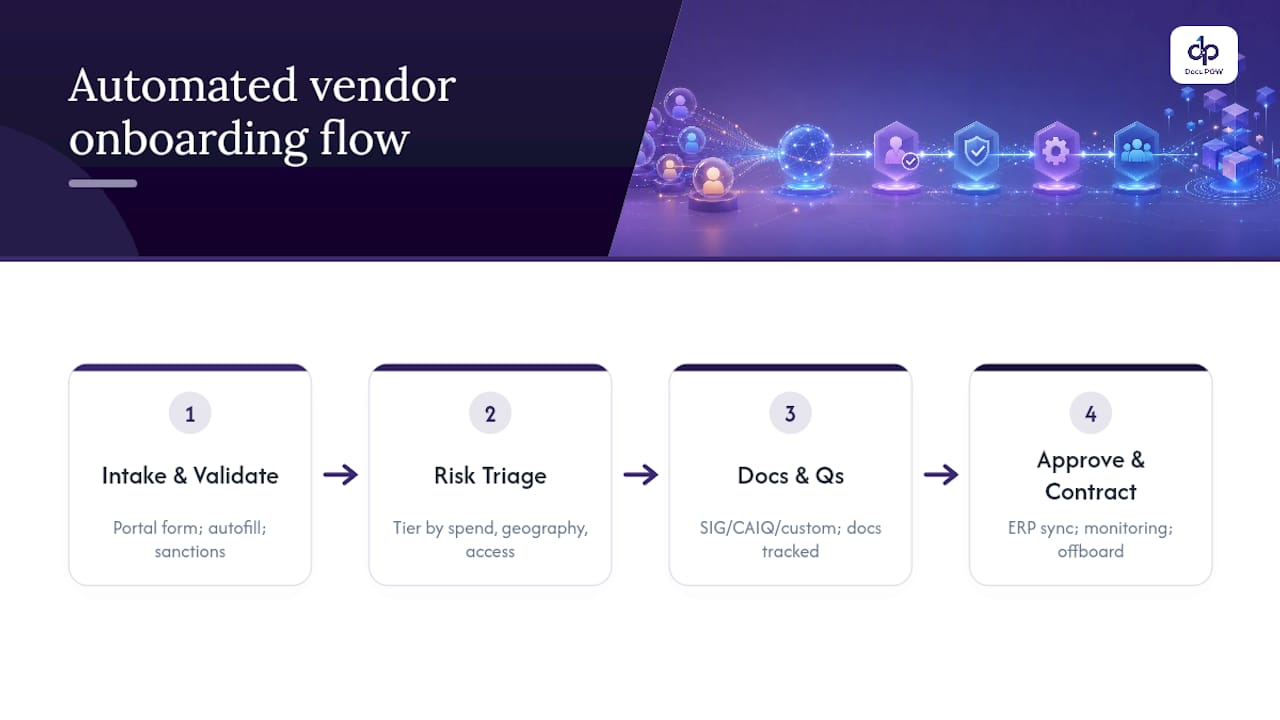
    Target processes that are high-volume, repetitive, and prone to error, especially ones that involve documents crossing between systems: invoice processing, procurement approvals, vendor onboarding. These are the workflows where digitization pays for itself fastest.

    Look for these signals before you pick a pilot:

    • Transaction volume high enough that small time savings compound quickly
    • Cost-per-transaction that finance already flags as too high
    • Error rates that trigger rework, disputes, or compliance exposure
    • Audit or regulatory pain from missing or inconsistent paper trails

    Key Takeaways

    Business process digitization succeeds when leaders pilot one high-volume, document-heavy process with predefined KPIs before scaling automation across the organization.

    Point Details
    Start narrow Pilot one high-volume, high-error process like invoicing or onboarding before scaling.
    Separate the stages Treat digitization, digitalization, and digital transformation as distinct goals with distinct metrics.
    Simplify before automating Fix broken process steps first; automation only speeds up whatever you feed it.
    Set KPIs before launch Lock in cycle time, error rate, and cost-per-transaction targets before the pilot begins.
    Match tools to complexity Use template-free extraction for variable documents; DocuPOW’s agent-based approach fits high-volume, inconsistent-format workflows.

    Table of Contents

    What Is Business Process Digitization, Exactly?

    Confusion here costs companies real money, because teams set the wrong goals for the wrong stage of maturity. Digitization is narrow and technical: it’s the act of converting analog information (a paper invoice, a signed contract, a fax) into digital form. Digitalization is what happens next, when you use that newly digital data to change how a process actually runs, routing approvals automatically instead of walking a folder around the office. Digital transformation is bigger still: a strategic shift in operating model, culture, and business logic that digitalized processes make possible.

    SAP frames the distinction simply: digitization creates the digital asset, digitalization uses that asset to change workflows and business models. A systematic review in the Journal of Product Innovation Management found so many overlapping, inconsistent definitions across academic and industry literature that the authors recommended organizations adopt precise, parsimonious definitions and stick to them, specifically to avoid the confusion that derails cross-functional projects.

    Stage Purpose Typical technology Short-term outcome
    Digitization Convert analog records to digital format Scanners, OCR, document capture Searchable, storable digital files
    Digitalization Use digital data to change how work flows Workflow engines, BPM, RPA Faster cycle times, fewer manual handoffs
    Digital transformation Rethink strategy and operating model around digital capability AI/ML, analytics platforms, integrated ecosystems New business models, competitive repositioning

    Precise, separate definitions of digitization and digitalization aren’t academic nitpicking. When a CFO says “digitize AP” and means one thing while IT hears another, budgets and timelines both slip.

    Getting this vocabulary straight before you scope a project saves you from measuring a digitization pilot against digital-transformation-sized expectations.

    What Are the Benefits of Digitizing Business Processes?

    The business case writes itself once you can see it in numbers. Digitized processes cut cycle times because work no longer waits in a physical inbox or a shared drive folder nobody checks. Error rates drop because data gets captured once, correctly, instead of being retyped at every handoff. Operating costs fall as headcount previously spent on manual entry and reconciliation shifts toward exception handling and analysis.

    Beyond cost, digitization delivers benefits that are harder to put a dollar figure on but matter just as much:

    • Faster cycle times across approvals, onboarding, and fulfillment
    • Lower error rates from eliminating repeated manual data entry
    • Reduced cost per transaction as manual labor shrinks
    • Stronger auditability with a digital trail for every action and approval
    • Better customer and employee experience through faster turnaround
    • Sharper decision-making, since instrumented processes generate the data leaders need in real time

    Research on BPM implementation reports productivity gains up to roughly 50% for administrative processes and up to 30% for knowledge-worker tasks when automation is applied well, though results vary widely by sector and process complexity. Operational efficiency also functions as a mediator for financial performance: firms that integrate digital processes report better resource use and fewer errors, and those gains tend to show up on the P&L within a few quarters.

    Pro Tip: Don’t promise the board your full ROI range on day one. Set a modest benefit horizon for the pilot (cycle time and error rate only), then expand your KPI set once you scale, so early wins build credibility instead of setting up a letdown.

    How Do I Digitize My Business Step by Step?

    A digitization project fails less often from bad technology than from bad sequencing. Here’s the order that actually works.

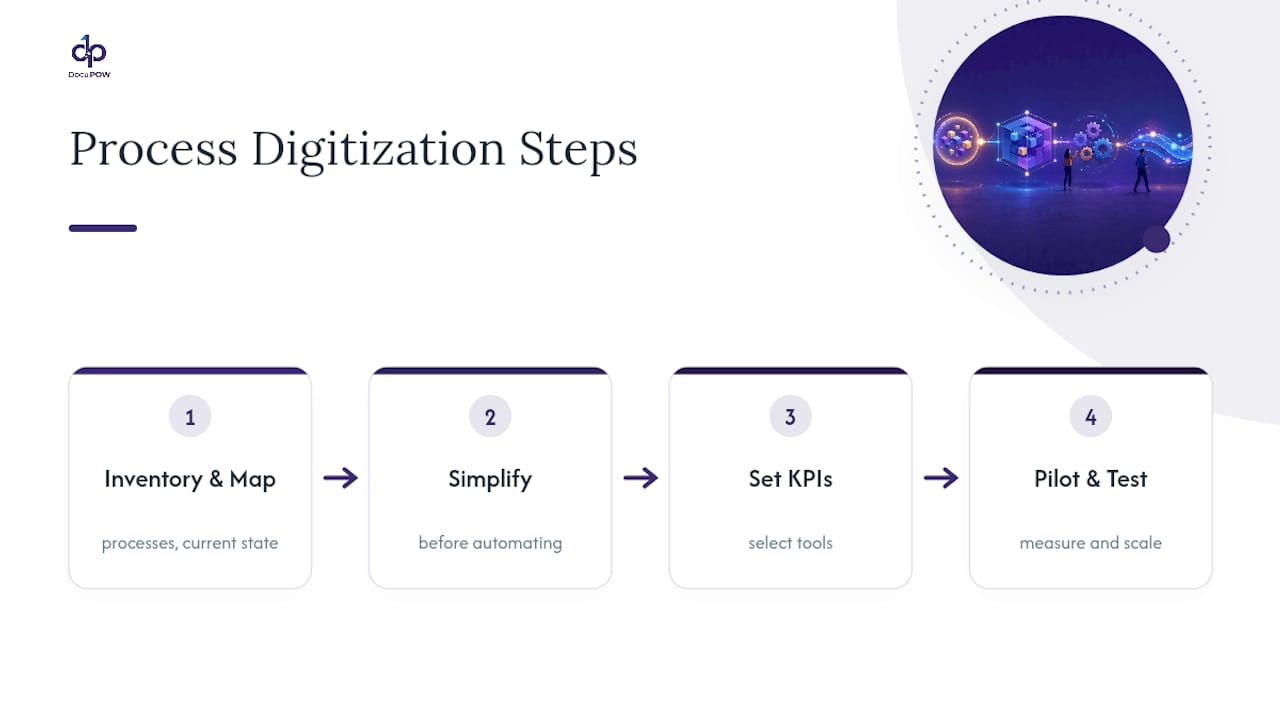
    1. Inventory your processes. List every workflow that touches documents or crosses departments. Rank by volume, cost, and error frequency.
    2. Map the current state. Document every step, handoff, and decision point in your target process, including the informal workarounds nobody put in the manual.
    3. Simplify before you automate. Cut redundant approvals and dead steps first. Automating a broken process just makes it fail faster.
    4. Set acceptance criteria and KPIs. Define cycle time, error rate, labor hours, SLA compliance, and cost per transaction targets before you build anything.
    5. Select your tools. Match technology to the process complexity (more on this below) and prioritize API-friendly platforms over rigid, template-locked systems.
    6. Build and pilot. Scope the pilot to one process, one team, one region if possible. Keep it small enough to fix quickly.
    7. Run user acceptance testing. Validate against your predefined KPIs, not just “does it technically work.”
    8. Go live, measure, and scale. Expand to adjacent processes once the pilot clears its acceptance gates.

    Timeline expectations matter for setting stakeholder patience correctly. Discovery and mapping typically take one to two weeks for a single process. Pilot build and testing run four to eight weeks depending on integration complexity. Most organizations should expect measurable ROI within three to six months of go-live, a timeline consistent with BPM implementation case data showing pilots reaching ROI payback in roughly six months and scaling to ten or fifteen processes within a year.

    Budget across three categories: licensing (the platform itself), integration (connecting to ERP, CRM, or accounting systems), and change management (training, champions, and communication). Underfunding the third category is the most common reason pilots stall after a promising start.

    Build go/iterate/stop gates into your plan:

    • Go if the pilot hits at least 80% of its KPI targets within the test window
    • Iterate if results are directionally right but short of targets, and the gap traces to a fixable configuration issue
    • Stop if the underlying process itself is still broken after simplification, meaning the problem isn’t technology at all

    Pro Tip: Freeze your KPI definitions before the pilot starts. Teams that redefine “success” mid-project almost always do it to avoid admitting the pilot underperformed.

    What Do Real Business Process Digitization Examples Look Like?

    Abstract benefits convince nobody. Concrete before/after numbers do.

    • Accounts payable / invoice processing: Manual three-way matching across email and spreadsheets shrinks to automated extraction and matching, cutting invoice cycle time from days to hours and removing most manual keying errors.
    • Procurement approvals: Paper or email approval chains that stall when someone is out of office become routed digital approvals with automatic escalation, closing an entire class of bottleneck.
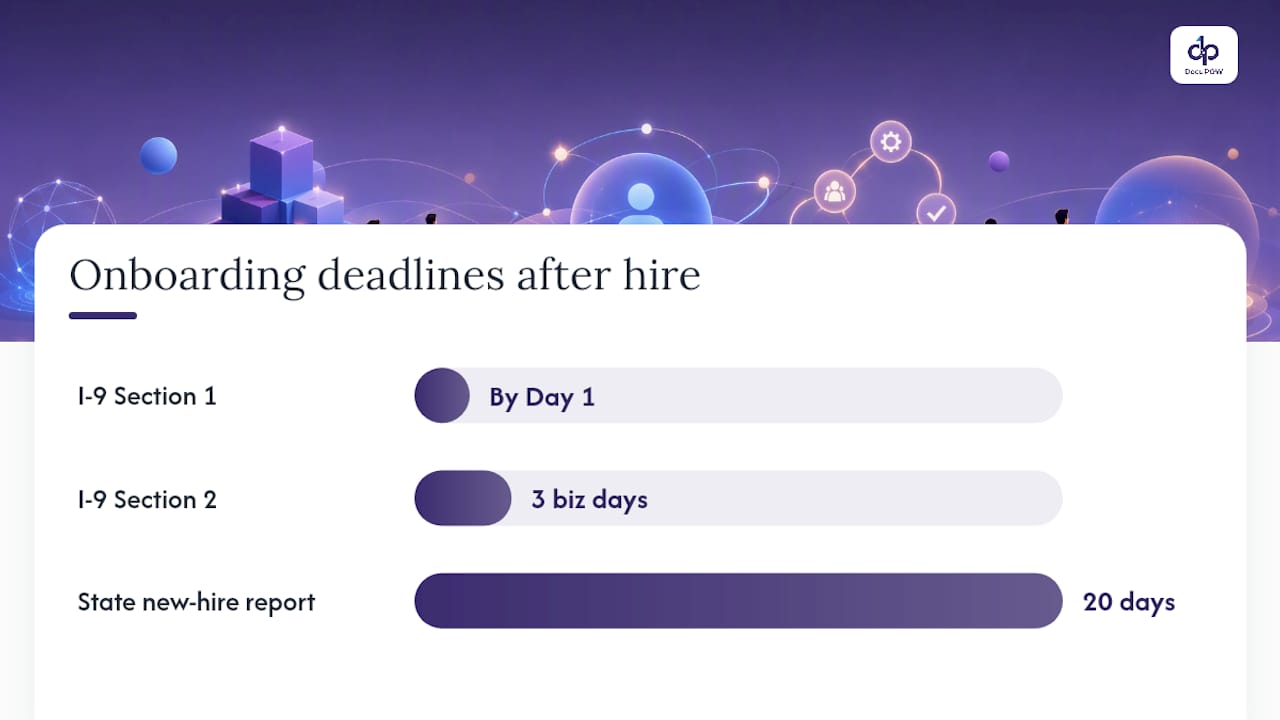
    • HR onboarding: New-hire paperwork scattered across forms and file cabinets becomes a single digital packet with e-signatures and automatic system provisioning.
    • Shipping and receiving paperwork: Bills of lading and receiving reports move from clipboard to scan-and-extract, syncing directly into inventory systems.
    • Quality and CAPA tracking in manufacturing: Corrective action reports that lived in binders become searchable digital records with automatic escalation on overdue items.

    McKinsey’s research on process digitization documents cases where a multi-day manual process, like customer onboarding, dropped to minutes once the paperwork and approval chain were digitized end to end, with pilots scoped tightly enough to show payback within months rather than years.

    The pattern repeats across industries: pick one painful process, digitize it completely rather than partially, measure the before and after honestly, then use that proof point to fund the next one.

    What Technology Do You Need to Digitize Processes?

    Six categories cover most digitization stacks, and picking the wrong one for your use case is the fastest way to build something brittle.

    • Document capture and intelligent data extraction (IDP): Pulls structured data out of invoices, contracts, and forms regardless of layout.
    • BPM or low-code workflow engines: Route tasks, approvals, and exceptions between people and systems.
    • RPA (robotic process automation): Useful for narrow, stable, rule-based tasks, but brittle when the underlying screens or data formats change.
    • Integration middleware / iPaaS: Connects your document and workflow layer to ERP, CRM, and accounting systems.
    • Analytics and BI layer: Turns process data into the dashboards leaders actually check.
    • Identity and security controls: Governs who can see, approve, or edit what, and creates the audit trail compliance teams need.
    Use case complexity Recommended technology mix
    High-volume structured documents (invoices, POs) Document capture / IDP + workflow engine
    Cross-system approvals with multiple stakeholders BPM platform + integration middleware
    Narrow, stable, repetitive data-entry tasks Targeted RPA, tightly monitored
    Unstructured or variable-format documents Template-free, AI-driven extraction

    A practical guide to intelligent document processing walks through how capture technology fits into a broader workflow stack for teams evaluating this layer first.

    Hands connecting automation cables

    Pro Tip: Prioritize API-first platforms over anything that only integrates through screen scraping. RPA-only solutions built on brittle UI automation break every time a vendor updates their portal, and you’ll spend more on maintenance than you saved on labor.

    How Do You Measure Digitization Maturity and ROI?

    Most organizations move through four recognizable stages, and knowing which one you’re in keeps expectations realistic.

    • Manual: Paper or unstructured digital files (PDFs, scanned images) with no instrumentation. Nobody can answer “how long does this actually take?”
    • Instrumented: Processes are digitized and timestamped, so you can measure cycle time and volume, even if steps are still manual.
    • Automated: Routing, matching, and approvals run without manual intervention for the majority of cases.
    • Optimized / insight-driven: Analytics and predictive signals flag exceptions before they become problems, and the process improves itself over time.

    Track these KPIs from day one: cycle time, error rate, cost per transaction, automation rate (percentage of cases requiring no human touch), SLA compliance, and user satisfaction. Baseline each one before you touch the process, or you’ll have no credible before/after story.

    A quick ROI example: if a process currently costs $12 per transaction across 10,000 transactions a month ($120,000/month) and digitization cuts that to $7 per transaction, you’re saving $50,000 monthly. Against a $150,000 implementation cost, that’s a three-month payback, in line with the three-to-six-month range BPM benchmarks report for well-scoped pilots.

    What Goes Wrong With Digitization Projects, and How Do You Fix It?

    Most failures trace back to a small set of repeat offenders.

    • Automating a broken process: Speeding up bad workflow steps just produces errors faster. Simplify first, then automate.
    • Underinvesting in change management: Technology adoption fails when people aren’t trained or bought in. Budget training and champions from the start, not as an afterthought.
    • Scope creep: Pilots that try to digitize everything at once rarely ship. Keep the first phase narrow.
    • Brittle integrations and RPA-only builds: Screen-scraping automation breaks on every UI update. Favor API-based integration where it exists.
    • Poorly defined KPIs: Vague goals like “improve efficiency” can’t be measured or defended to finance. Set specific, numeric targets before launch.
    • Lack of executive sponsorship: Without a visible sponsor, funding dries up the moment priorities shift elsewhere.

    Pro Tip: Publicize small wins loudly and early.

    When Does Agent-Based Document Automation Make Sense?

    Traditional template-based extraction tools break the moment a vendor changes their invoice layout or a new document type shows up. That’s the gap agent-based platforms like DocuPOW are built to close: autonomous agents interpret document context and structure rather than matching against a fixed template, which matters most when your document mix is genuinely varied.

    • Template-free extraction across invoices, contracts, and unstructured records without manual template maintenance
    • Human-in-the-loop audit review to catch exceptions before they hit your financial systems
    • API integrations with ERP and CRM platforms for straight-through processing
    • Real-time analytics and predictive insights that shift teams from reactive fixes to proactive monitoring

    This approach earns its keep fastest in high-volume invoice processing, cross-border document sets with inconsistent formatting, and rapid post-acquisition integration where two companies’ document systems collide overnight.

    The processes that benefit most from agent-based extraction are the ones where “just add another template” stopped working years ago.

    Whatever platform you evaluate, check its integration depth with your existing ERP or CRM and its support model before committing. A tool that extracts data brilliantly but can’t get that data into your financial system solves only half the problem.

    Why Incremental Pilots Beat Big-Bang Digitization Programs

    Big-bang digitization programs collapse under their own scope more often than they fail on technology. A tightly scoped pilot with predefined KPIs proves value in weeks and builds the internal credibility that funds everything after it. Leaders who wait for a perfect enterprise-wide plan usually wait past the point where competitors already moved.

    If you take one action from this guide, run a 60 to 90 day pilot on a single high-volume invoice or onboarding flow, with cycle time, error rate, and cost-per-transaction targets locked in before day one.

    Put Your Documents to Work Instead of Filing Them Away

    DocuPOW is built for exactly the bottleneck this guide keeps circling back to: document-heavy processes that break rigid, template-based tools the moment formats vary. Instead of maintaining a template library that falls apart with every new vendor invoice or contract format, DocuPOW’s agents read the document itself, extract what matters, and route it through your workflow with a human checkpoint for anything uncertain.
    DocuPOW

    That means faster financial close, cleaner data feeding your ERP, and fewer manual corrections down the line for finance, operations, and procurement teams juggling high volumes of varied paperwork. If your first pilot process involves invoices, contracts, or cross-border documents with inconsistent layouts, DocuPOW’s AI workflow automation services are built for exactly that starting point. Start a trial or request a demo to see how quickly your own high-volume document set can move from manual to measured.

    Sources

    FAQ

    What Are the 7 Steps of Business Process Digitization?
    Seven-step business process digitization workflow

    Most implementation playbooks follow: inventory processes, map the current state, simplify before automating, set KPIs, select tools, pilot and test, then measure and scale.

    What Are the Four Types of Digitalization?

    Digitalization commonly applies at four levels: task-level (automating one step), process-level (redesigning a workflow), function-level (transforming a department), and organization-level (changing the business model itself).

    How Do I Digitize My Business?

    Start by inventorying document-heavy, high-volume processes, simplify them, then pilot digital capture and workflow tools on the highest-cost one before expanding to others.

    What Are the Steps Involved in the Digitization Process?

    The core steps are assessing current processes, mapping workflows, selecting the right technology (document capture, workflow automation, or agent-based extraction), piloting, measuring against KPIs, and scaling what works.

    How Long Does a Digitization Pilot Take to Show ROI?

    Most well-scoped pilots reach measurable ROI within three to six months, based on BPM implementation benchmarks and McKinsey case data.

  • Business Efficiency Through AI Starts With Your Documents

    Business Efficiency Through AI Starts With Your Documents

    AI improves business efficiency reliably in one specific scenario: when it’s aimed at high-volume document workflows and measured against the P&L, not just adoption metrics. Point AI at invoice processing, contract review, or PO matching first, track the dollar impact, then reinvest the savings into the next process. That sequence is what separates companies seeing real gains from those still running pilots.

    The proof is already in: 66% of organizations report measurable productivity and efficiency gains from enterprise AI adoption. Companies that link AI to cost transformation, rather than treating it as a bolt-on tool, see roughly three times greater cost reduction and 1.6x higher EBIT margins than their peers. And document-heavy processes, still eating up more than 40% of knowledge-worker time according to the Arahi AI 2026 workflow guide, are the fastest place to prove it.

    • Enterprise AI adoption correlates with real productivity gains, not just hype.
    • Companies that redesign end-to-end processes around AI outperform those bolting AI onto old workflows.
    • Document automation (invoices, contracts, PO matching) is the highest-leverage starting point for measurable ROI.

    Pick one document workflow. Pilot it in the next 30 to 90 days. Measure the dollar impact before you scale anything further.

    Key Takeaways

    AI improves business efficiency most reliably when applied first to high-volume document workflows and measured directly against P&L outcomes rather than adoption alone.

    Point Details
    Start with documents Pilot invoice processing, contract approvals, or PO matching before broader automation efforts.
    Redesign the value flow Fix handoffs across departments, not just one team’s task, to unlock trapped value.
    Build the data foundation first Reliable ingestion, integrations, and a semantic layer prevent fragmented, error-prone automation.
    Measure against the P&L Track cycle time, cost per transaction, and EBIT impact, not just tickets automated.
    Use DocuPOW for template-free extraction Its agent-based platform pairs human-in-the-loop review with real-time analytics to prove pilot ROI fast.

    Table of Contents

    Why Document Workflow Automation Is Your Best First Move

    Every operations leader has a list of processes they’d love to automate. The mistake is starting with the flashiest one instead of the most measurable one. Document workflows win because they are high-volume, rule-based, and generate a data trail you can audit against the P&L within weeks, not quarters.

    Invoice processing, contract approvals, and PO/invoice matching are the classic starting points, and for good reason. They repeat thousands of times a month, follow predictable logic, and touch systems that already produce clean before-and-after data. Functional AI adoption for document tasks is already widespread, with 75–95% of employees and executives using some form of AI for redaction, extraction, or summarization, often outside sanctioned tools. That’s a governance risk, but it’s also a signal: your teams already know these tasks are ripe for automation.

    Look for tasks with four traits before you commit a pilot budget:

    • High volume — hundreds or thousands of instances per month, not dozens.
    • Rule-based logic — a human could explain the decision tree in five minutes.
    • Data-rich inputs — structured or semi-structured documents like invoices, POs, or contracts.
    • High cycle frequency — processes that repeat weekly or daily, so improvements compound fast.

    Done right, you should see cycle times drop from days to hours and manual touches fall dramatically, with some finance and legal teams scaling throughput 3 to 5 times on the same headcount.

    Pro Tip: Scope your first pilot to a single document type and a single approval chain. Resist the urge to automate an entire department on day one. A narrow, working pilot in production beats a broad one still stuck in testing.

    From Pilot Wins to Enterprise-Wide Value

    A successful invoice automation pilot feels great until you realize it didn’t move the needle on total operating costs. That’s the trap of functional optimization: fixing one team’s workflow without touching the process it feeds into. Real efficiency gains come from redesigning the entire value flow, not just automating a task inside it.

    EY’s analysis found that up to 70 to 75% of potential AI value stays trapped across functional silos, because procurement, finance, and operations each optimize their own slice without coordinating the handoffs between them. An invoice that processes faster in AP but still waits five days for a manager’s manual sign-off hasn’t actually gotten faster.

    Scaling past the pilot stage requires organizational moves, not just more automation licenses:

    • Executive sponsorship that owns the outcome across departments, not just within one function.
    • Cross-functional ownership of the value stream, so procurement and finance share the same success metric.
    • OKRs tied directly to P&L line items, not vanity metrics like “tickets automated.”
    • Tolerance for early failure, since the first redesign attempt rarely gets the handoffs right.

    Choose your next pilot based on which use case can fund the following one. A PO-matching project that frees up $200,000 in working capital should pay for the contract-automation rollout that comes after it.

    The Technical Foundation AI Efficiency Depends On

    None of this works without a data foundation that can actually feed AI systems clean, structured information. Rushing into automation before this groundwork exists tends to accelerate fragmentation instead of fixing it. You end up with faster processing on top of the same messy data.

    Start with the basics: reliable document ingestion through optical character recognition or intelligent document processing, direct integration into your systems of record (ERP, CRM, HRIS), robust APIs that let data move without manual re-entry, and secure storage that meets your industry’s compliance requirements.

    Above that sits the intelligence layer, the part most companies underestimate. Ontologies, semantic models, or knowledge graphs let AI agents understand that “vendor” in your ERP and “supplier” in your procurement system are the same entity. Without that layer, agents can extract data perfectly and still make context errors that a human would catch instantly.

    Stanford’s Digital Economy Lab found that most scaling failures trace back to process redesign, data quality, and change management, not model performance. Companies that invest in data products and clean integrations before scaling AI report more reliable outcomes than those chasing the newest model.

    • Confirm ingestion accuracy before you trust downstream automation.
    • Map your systems of record and their integration points early.
    • Build the semantic or ontology layer before adding more agents, not after.
    • Treat data governance and security review as a prerequisite, not an afterthought.

    Rolling Out AI Without Losing Track of the Numbers

    A staged rollout beats a big-bang launch every time, mostly because it forces you to prove value before you ask for more budget. Here’s a sequence that works across most mid-size and enterprise operations:

    1. Days 1–30: Select one high-volume document workflow, define baseline metrics (cycle time, cost per transaction, error rate), and stand up the pilot with a human-in-the-loop review.
    2. Days 30–90: Run the pilot at production volume, validate accuracy against the baseline, and calculate the realized dollar impact.
    3. Months 3–6: Present the P&L case to leadership, secure funding for a second workflow, and start redesigning the cross-functional handoffs the first pilot exposed.
    4. Months 6–12: Scale to two or three additional workflows, reinvesting savings from the first pilot to fund the rollout.

    BCG’s research on successful scaling programs shows leaders typically set 1 to 2 year timelines from pilot to full scale, and they track value at the P&L line item, not just at the functional metric level.

    Track these before you claim victory:

    • Cycle time (days to hours, measured against your original baseline).
    • Touch count (how many people handle a document before it’s resolved).
    • Cost per transaction (fully loaded, including software and review labor).
    • EBIT impact (the number your finance team actually cares about).

    Build a simple measurement checklist before launch: document your assumptions, capture a true baseline, and set a validation date 90 days out to confirm the savings are real and not just a temporary dip in volume.

    Where Agentic AI Fits and What It Requires

    Agentic AI, systems that take multi-step action rather than just extracting data, delivers the biggest jumps in productivity, but only in the right conditions. Stanford’s research found agentic implementations posting median productivity gains well above simpler automation approaches, though they depend on the intelligence layer and governance structure being in place first.

    The use cases that compound value fastest are the ones spanning multiple systems: cross-system approvals, multi-step document orchestration, and exceptions routing where an agent decides whether a case needs human review.

    Where Agentic AI Fits and What It Requires — overview diagram

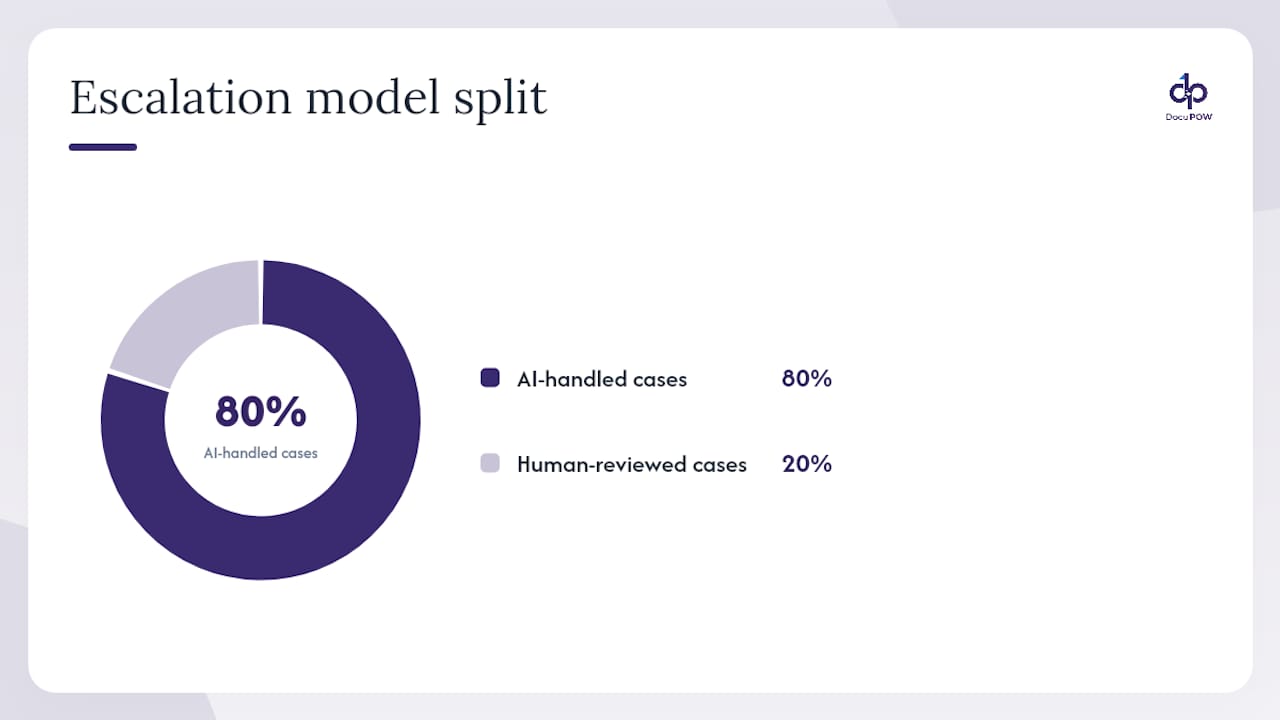
    The design pattern that works in practice is an escalation model: AI handles the routine 80% of cases, and humans review the exceptions. This keeps throughput high without sacrificing accuracy on the cases that actually carry risk.

    Before you deploy agents at scale, put a governance checklist in place:

    • Model monitoring to catch drift in accuracy over time.
    • Access controls limiting which systems an agent can act on autonomously.
    • Audit trails for every action an agent takes, especially in finance and legal workflows.
    • Periodic validation against a human-reviewed sample set.

    Pro Tip: Start every new agentic workflow with a 100% human review rate, then reduce it gradually as accuracy data builds. Jumping straight to full autonomy is how a small extraction error becomes a compliance incident.

    Evaluating a Document Automation Vendor

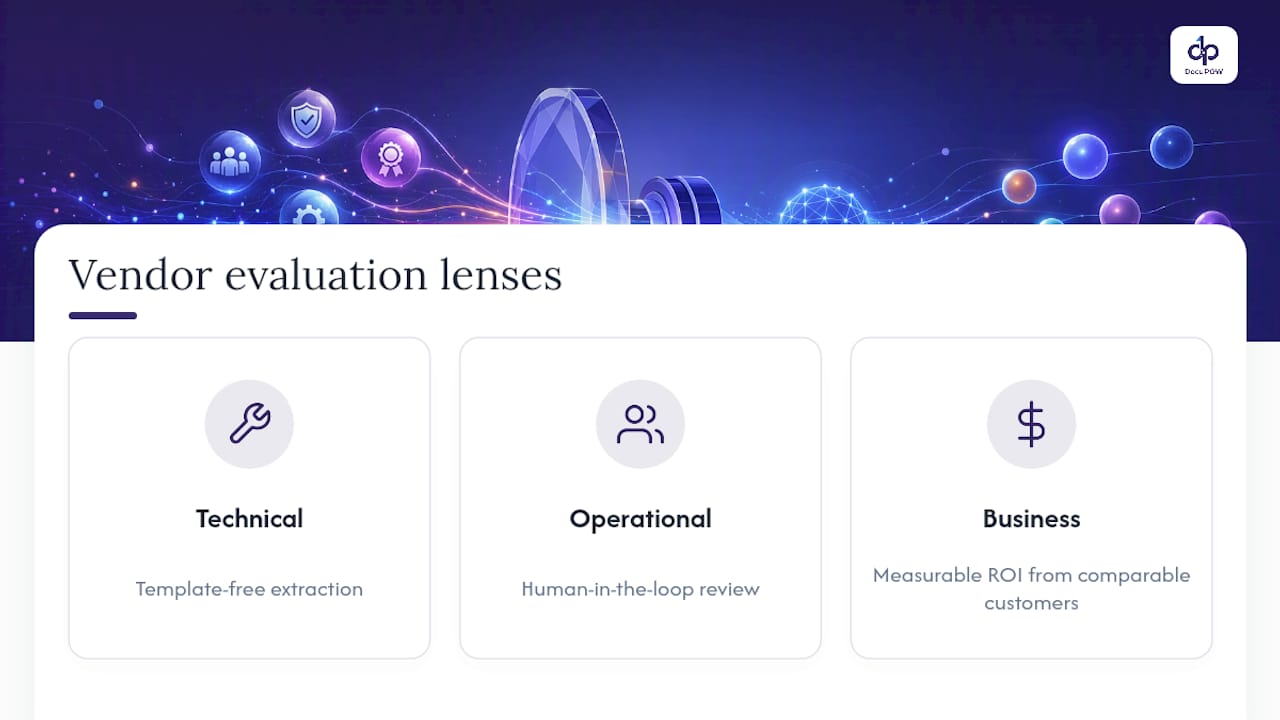
    Choosing the wrong platform costs you the ninety days you just spent proving the concept works. Run every vendor through three lenses before signing anything.

    Diagram of vendor evaluation criteria

    Technical: Does it handle template-free extraction, or does it break the moment a vendor changes their invoice layout? Check its accuracy rate, integration catalog, API depth, and how it performs at your actual document volume, not a demo sample of ten files.

    Operational: Does it support human-in-the-loop review for exceptions? What SLA and throughput guarantees back the contract, and what security and compliance certifications does it hold?

    Business: Can they show measurable ROI from comparable customers? Is pricing predictable as you scale, and what does implementation actually take, in weeks, with your team’s time included?

    Ask during the demo: “Show me how this handles a document type it’s never seen.” “What happens when extraction confidence is low?” “What’s the real timeline from contract signature to production?” A vendor that can’t answer clearly is telling you something.

    Author perspective: what successful leaders do differently

    The leaders getting real returns aren’t the ones with the most ambitious AI roadmap. They’re the ones disciplined enough to prove value on one document workflow before touching a second. Every dollar saved gets reinvested, every metric gets tied to the P&L. If you lead a team facing this decision, sponsor one document automation pilot in the next 90 days and demand the cost data before you approve anything bigger.

    How DocuPOW Fits Into This Playbook

    DocuPOW builds around the exact sequence this article lays out: start with documents, prove the P&L impact, then scale. Its agents read documents contextually rather than relying on rigid templates, so a pilot doesn’t break the moment a vendor sends an invoice in a new layout.

    DocuPOW

    The platform handles template-free extraction, multi-step workflow orchestration, and human-in-the-loop audit review in the same system, which means the escalation model described above isn’t a custom build, it’s already there. Real-time analytics and predictive insights give finance and operations leaders the P&L visibility to justify the next phase of the rollout, instead of waiting on a quarterly report to find out if the pilot worked.

    If your first move is invoice processing or PO matching, DocuPOW’s accounting workflow tools and automated three-way matching are built for exactly that starting point. Request a demo and bring one real workflow to it, ideally the same one you’d pilot in the next 90 days, and see how it handles your actual documents rather than a canned sample.

    Sources

    FAQ

    What’s the fastest way to see AI efficiency gains?

    Automate a single high-volume document workflow, like invoice processing or PO matching, and measure the dollar impact within 90 days before scaling further.

    How long does an AI pilot typically take to show ROI?

    Most staged rollouts show measurable pilot results within 30 to 90 days, with full enterprise scaling taking 1 to 2 years according to BCG’s research on scaling programs.

    What’s the difference between automation and agentic AI?

    Automation typically handles a single task, like extracting data from a form, while agentic AI takes multi-step action across systems, such as routing, matching, and escalating exceptions without manual handoffs.

    Does DocuPOW require rigid templates for document extraction?

    No. DocuPOW uses context-aware agents rather than fixed templates, so it can adapt to new document formats without requiring reconfiguration.

    What KPIs prove AI is actually improving efficiency?

    Track cycle time, touch count, cost per transaction, and EBIT impact rather than adoption metrics like the number of automated tasks alone.

  • The Practical Guide to AI-Powered Information Extraction

    The Practical Guide to AI-Powered Information Extraction

    The fastest path to reliable AI-powered information extraction for enterprise workflows is a schema-first pipeline with per-field confidence gates and hybrid routing: fast template matching for known layouts, a language model fallback for everything else. That combination gets you predictable costs on the documents you already understand and coverage on the ones you don’t.

    Here’s what that means in practice:

    • Primary benefit: you get straight-through processing on the bulk of your volume, which is the only way extraction pays for itself at scale.
    • Core risk: edge cases and data drift. New vendors, new layouts, and format changes will break template-only systems, and even LLM-based systems degrade if you don’t monitor them.
    • Next step: pull 2,000 to 5,000 sample documents from your real intake stream, define your schema with field types and enums, and run a two-to-four week pilot before you commit to any single vendor.

    The accuracy ranges worth planning around sit at roughly 85% to 95% for generative AI extraction in SAP’s Document AI reference architecture, which frames the pipeline as three layers: ingest, extraction and enrichment, and posting. DocuPOW’s agent-based approach fits into that same three-layer pattern but removes the template-maintenance burden, which matters most once your document mix gets messy.

    Key Takeaways

    Reliable AI-powered information extraction at enterprise scale comes from combining a versioned schema, per-field confidence calibration, and hybrid routing between fast template paths and model-based fallbacks.

    Point Details
    Choose architecture by variance, not preference High document variance favors MLLM or agentic platforms; low variance, high volume favors OCR+ML with templates.
    Calibrate confidence before trusting it Run a labeled batch of several thousand documents so reported confidence scores match real-world accuracy.
    Version every schema change Treat schemas as immutable and create new versions rather than editing live ones, to preserve audit history.
    Monitor for drift continuously Track per-vendor accuracy with sliding windows and alerts, since format changes break pipelines silently.
    Consider DocuPOW for high-variance portfolios Its template-free, agentic extraction with human-in-the-loop review and ERP/CRM integration targets exactly this use case.

    Table of Contents

    What Is AI-Powered Information Extraction?

    AI-powered information extraction is the use of machine learning models, primarily natural language processing and computer vision systems, to pull structured data out of unstructured or semi-structured documents without relying on a fixed template for every layout variant. That’s the core distinction from rule-based extraction: a template system needs a human to map coordinates on a specific invoice layout; it breaks the moment a vendor redesigns their invoice. An AI-driven system generalizes across layouts it has never seen, using context and language understanding instead of fixed positions.

    A few concepts recur across every serious implementation, and you’ll need this vocabulary before you can evaluate a vendor or design a pipeline:

    • Schema — the structured definition of what fields you want extracted (invoice number, line items, tax amount) and their expected types.
    • Key information extraction (KIE) — the technical term for pulling named entities and field values tied to a schema, as opposed to general-purpose text summarization.
    • OCR (optical character recognition) — converts document images into machine-readable text; still the backbone of most production pipelines even when a large language model does the reasoning.
    • MLLM (multimodal large language model) — a model that reads image and text together, sometimes skipping OCR entirely.
    • Confidence and human-in-the-loop (HITL) — the score attached to each extracted field, and the review workflow that catches low-confidence extractions before they hit a system of record.

    Microsoft’s introductory training module on information extraction frames this well for practitioners just getting oriented: it lays out learning objectives and prerequisites the same way a solution architect would scope a project, starting with what document types you’re dealing with and what output format the business actually needs.

    That output format question matters more than most teams expect going in. An invoice needs line-item tables reconciled against a purchase order. A contract needs clause-level extraction with obligations and dates. A medical claim needs coded fields validated against payer rules. Research PDFs need citation and table extraction exported to CSV or reference-manager formats. The “right” extraction architecture often changes based on which of these you’re solving first, which is exactly why the next section matters.

    Which Architecture Fits: OCR+ML, MLLM, or Agentic Systems?

    Three architecture patterns dominate production deployments today, and they trade off cost, latency, and long-tail coverage differently enough that picking the wrong one shows up in your monthly cloud bill within weeks.

    OCR plus NER/rule/ML pipelines run text recognition first, then apply named-entity recognition or classical machine learning models to identify and label fields. This is the mature, well-understood approach: cheap per document, fast, and easy to audit because you can trace every extracted value back to a bounding box on the page. Its weakness is brittleness. A layout it hasn’t seen, a rotated scan, or a handwritten annotation can break the pipeline in ways that are hard to diagnose without deep tooling.

    Multimodal LLM (MLLM) pipelines feed the document image, or image plus text, directly into a model trained to understand both visual layout and language simultaneously. These systems handle novel layouts far better than classical pipelines because they reason about context rather than fixed positions. The tradeoff is cost and latency per document, plus less transparency into why a particular value was extracted.

    Agentic, template-free platforms combine intelligent document routing, enforced schema validation, and autonomous agents that adapt extraction logic per document without a human pre-building a template. This is the category DocuPOW operates in, and it’s built specifically to solve the long-tail problem: instead of maintaining hundreds of templates for hundreds of vendor invoice formats, an agent-based system understands document structure and context well enough to extract correctly on the first document it ever sees from a new source.

    Architecture Cost per document Long-tail coverage Maintainability Best fit
    OCR + NER/ML Low Weak on new layouts High template debt over time High-volume, stable, known formats
    MLLM end-to-end Moderate to high Strong Low template debt, higher compute cost Moderate volume, high format diversity
    Agentic/template-free Moderate Strong, improves with use Low, self-adapting to new layouts High-variance enterprise portfolios

    The AWS Machine Learning blog’s evaluation of key information extraction puts this choice in concrete terms: larger foundation models generally improve accuracy, but at higher cost and latency, so the right model class depends on your specific tolerance for error against your throughput needs. If you’re processing ten thousand near-identical purchase orders a day, that math favors a lean OCR pipeline with an LLM safety net for exceptions. If your document mix changes weekly because you onboard new vendors constantly, a template-free system earns back its higher per-document cost through the maintenance hours it eliminates.

    Pro Tip: Don’t pick an architecture based on your current document mix alone. Model where your document diversity will be in eighteen months. Teams that scale by acquisition or by adding new supplier relationships almost always underestimate how fast template debt accumulates.

    Mapping the Extraction Pipeline From Intake to System of Record

    Every production-grade extraction system, regardless of which architecture powers it, moves documents through the same functional stages. Understanding these stages lets you audit a vendor’s claims or design your own pipeline with the right checkpoints.

    • Capture and ingest — documents arrive via email, upload, scanner, or API; this stage assigns a document ID and stores the raw file.
    • Pre-processing — deskewing, noise removal, and OCR run here if the architecture uses OCR, producing tokens and bounding boxes as artifacts.
    • Classification and routing — the system identifies document type (invoice, contract, claim) and routes it to the correct schema and extraction path.
    • Extraction — fields are pulled and populated against the schema, with a confidence score attached to each field.
    • Validation and enrichment — extracted values are cross-checked against business rules, master data, or a second model pass, and missing fields are flagged.
    • Human-in-the-loop review — low-confidence fields route to a human reviewer through an audit workspace rather than blocking the entire document.
    • Posting to systems of record — validated data lands in the ERP, CRM, or accounting system via API, closing the loop.

    Each stage produces specific artifacts you’ll want visibility into: token-level text with bounding boxes from pre-processing, a document-type label and schema version from classification, and a field-confidence map from extraction. That schema version tag matters more than it sounds. If you change your invoice schema six months into production without versioning it, you lose the ability to compare historical accuracy against current accuracy, which makes debugging drift nearly impossible.

    Operationally, you’re balancing batching against latency. A nightly batch job processing thousands of receipts can tolerate slower, more thorough extraction. A real-time claims intake system answering a customer inline cannot. Velocity’s rundown of production IDP patterns identifies hybrid routing, versioned schemas, and tamper-evident audit trails as the operational differentiators that separate systems that survive their first year from ones that quietly degrade.

    Pro Tip: Calibrate your confidence thresholds per field, not per document. A total-amount field on an invoice deserves a much stricter confidence gate than a vendor-address field, because the financial exposure of an error is asymmetric across fields.

    How to Run a Pilot That Actually Proves ROI

    A pilot that skips schema design or picks too small a sample will tell you nothing useful. Follow this sequence to get a defensible answer within a month.

    1. Identify your document channels. List every source documents currently arrive from: email attachments, scanned mail, EDI feeds, portal uploads. Missing a channel here means your pilot won’t represent real volume.
    2. Secure stakeholder access early. You’ll need someone from IT to grant API access to the target ERP or CRM, and someone from the business unit to validate extracted values against ground truth.
    3. Collect your sample set. Pull 2,000 to 5,000 labeled documents, and deliberately oversample the vendor formats or document variants that appear least often, since those are exactly the cases that break template systems. Microsoft’s Azure implementation module walks through this kind of hands-on setup for teams building on Azure Content Understanding specifically.
    4. Design the schema before you touch a model. Define explicit field types (string, date, currency, enum), decide how missing values get represented, and version the schema from day one so later changes don’t corrupt your accuracy history.
    5. Set your success metrics before you run the pilot, not after. Track field-level F1 score, straight-through processing (STP) rate, cost per document, and the reduction in manual review time compared to your current baseline.
    6. Run the extraction and route low-confidence results to human review. This is where you validate whether your confidence thresholds are calibrated correctly.
    7. Compare results against your baseline process. If your STP rate clears 70 to 80% on the pilot set and manual review time drops meaningfully, you have a case to scale.

    DocuPOW’s guide to AI data extraction for business professionals covers how to size this kind of pilot against real business use cases if you want a second reference point before you start.

    Measuring Accuracy and Catching Drift Before It Costs You

    Extraction systems don’t fail loudly. They fail one field at a time, quietly, until a quarterly audit turns up a pattern of tax amounts that were off by a few percentage points for months. Building a real testing protocol is what prevents that.

    Hands calibrating measurement device

    Start with the metrics that actually predict business outcomes rather than academic benchmarks alone:

    Metric What it measures Why it matters
    Field-level precision/recall/F1 Accuracy per individual field, not per document A 95% document-level accuracy can hide a critical field that’s wrong 30% of the time
    Straight-through processing (STP) rate Percentage of documents needing zero human review Direct proxy for cost savings
    Calibration reliability Whether a stated confidence score corresponds to empirical accuracy Miscalibrated confidence breaks your entire HITL routing logic
    Cost per document Compute plus review labor cost The number that determines whether the architecture is sustainable at your volume

    Error analysis needs categories, not a single “wrong” bucket. Separate text misinterpretation (the model read the wrong value entirely) from schema mismatch (the value was right but mapped to the wrong field), OCR transcription errors (character-level mistakes from poor scan quality), and multi-row or table extraction failures, which remain one of the hardest problems in the field because line-item tables vary wildly in structure across vendors.

    Your testing protocol should include a labeled holdout set that never touches training or prompt-tuning, cross-vendor evaluation so you’re not just testing on your best-behaved document sources, and regression tests that run automatically whenever you update a schema or swap a model version. In production, monitor for drift using a sliding window per document vendor, with z-score alerts when a vendor’s accuracy drops outside its historical range, backed by audit logs that let you reconstruct exactly what happened on any flagged document. Velocity’s production patterns research treats this kind of ongoing drift detection as a non-negotiable operational layer, not an optional add-on you build later.

    Where Extraction Delivers the Fastest ROI Across the Enterprise

    Not every document type is worth automating first. Prioritize based on volume, error cost, and how standardized the format already is.

    • Finance and accounts payable: invoice extraction feeding three-way match against purchase orders and receipts is usually the highest-ROI starting point because volume is high and the fields are relatively standardized. DocuPOW’s three-way match flow is built specifically around this pattern.
    • Procurement: purchase-order and inventory reconciliation benefits from extraction the moment you’re managing more than a handful of suppliers, since format variance climbs fast with supplier count.
    • Legal: contract clause extraction (termination dates, indemnification terms, renewal windows) demands higher accuracy tolerance and often requires a human review step for anything flagged as ambiguous, given the downside of missing an obligation.
    • Insurance: claims processing combines structured fields with unstructured narrative text, and regulatory hold requirements mean audit trails aren’t optional.
    • Research and analytics: extracting tables, citations, and figures from PDF reports at scale supports downstream analytics work, though data sensitivity is usually lower than in finance or legal contexts.

    Each vertical carries its own constraints on top of the extraction problem itself. Insurance and healthcare data sensitivity often triggers stricter access controls. Legal documents frequently need clause-level table complexity that off-the-shelf schemas don’t anticipate. Practical advice here is simple: pick the document type where you already have volume, a known integration target like an ERP or CRM, and a clear cost of manual error, and automate that first before expanding into harder verticals.

    Solving the Engineering Problems Around the Model

    The model is rarely the reason an extraction deployment stalls. Integration, security, and scale are.

    On the integration side, decide early whether you need batch processing (nightly runs against a document archive) or streaming (webhooks firing as documents arrive, with retry semantics for failed API calls). Most enterprise deployments end up needing both, feeding into ERP systems, S/4HANA environments, or standard accounting platforms through documented APIs rather than screen scraping or manual export.

    Security and compliance controls aren’t optional line items you add before a big customer asks. Build in PII redaction at the point of extraction, encryption at rest and in transit, role-based access controls, and tamper-evident audit logs from day one, because retrofitting compliance into a live pipeline is far more expensive than designing for it upfront.

    Secured server rack and cables

    Scale introduces its own set of decisions. Autoscaling inference capacity handles volume spikes, but hybrid routing, sending known-format documents down a cheap template path while reserving expensive LLM calls for genuinely novel documents, is usually what keeps your cost curve flat as volume grows. Caching extraction results for duplicate or near-duplicate documents saves real money at scale too.

    Monthly document volume Recommended architecture pattern
    Under 5,000 MLLM end-to-end, template-free; volume too low to justify template maintenance
    2,000 to 5,000 Hybrid: template fast path for top vendors, agentic fallback for the rest
    Over 5,000 Hybrid at scale with autoscaling inference and aggressive caching on repeat formats

    For teams working through vendor-managed or outsourced document operations, DocuPOW’s BPO solution page covers how OCR and AI extraction fit into outsourced workflow environments specifically, where document variance is often even higher because you’re processing on behalf of multiple clients.

    What New Research Reveals About MLLMs vs. OCR Pipelines

    A 2026 industry benchmarking study produced a finding that surprised a lot of practitioners who assumed OCR would remain a mandatory first step indefinitely: high-capacity multimodal LLMs given image-only inputs matched or beat OCR-plus-MLLM setups in a meaningful share of tested scenarios, according to large-scale benchmarking research on MLLMs for business-document extraction. The likely explanation is that vision encoders in these models preserve layout and typographic cues, like bold headers, column alignment, and spatial grouping, that a separate OCR step often strips away or distorts when it flattens a document into linear text.

    That doesn’t mean OCR is obsolete. The same research flags task-specific knowledge gaps and stresses that schema design and exemplar quality still drive a large share of the accuracy difference between a well-built and poorly-built pipeline, image-only or not. Failure modes cluster around unfamiliar domain vocabulary and documents where table structure is unusually dense.

    If you want to validate this in your own environment rather than take the benchmark at face value, run these experiments:

    • Image-only vs. OCR+text A/B test on your actual document sample, not a public benchmark, since layout conventions in your specific vendor mix will shift the result.
    • Per-field error breakdown rather than a single aggregate accuracy number, to see whether the gap concentrates in specific field types like tables or dates.
    • Hierarchical error analysis, categorizing failures by document type, then field type, then error class, which is the framework the benchmarking paper itself proposes for isolating root causes.

    The practical takeaway for enterprise teams: architecture decisions made two years ago based on “OCR is mandatory” assumptions deserve a fresh look, but only after you’ve tested against your own document population.

    Choosing Between OCR+ML, MLLM, and Agentic Platforms

    Run your decision through five criteria before committing to an architecture, in this order:

    • Document variance and volume. Low variance, high volume favors OCR+ML with template paths. High variance at any volume favors agentic or MLLM approaches.
    • Latency and throughput targets. Real-time customer-facing extraction needs a faster, leaner path than an overnight batch job.
    • Cost sensitivity. If you’re processing millions of near-identical documents, shaving cents per document through a lean OCR path compounds fast.
    • Audit and compliance needs. Regulated industries need traceable field-level confidence and immutable audit trails regardless of architecture.
    • Integration complexity. How many systems of record does this need to post to, and how mature are their APIs?

    The compact routing logic looks like this: if you have a small number of dominant document formats representing most of your volume, build a template fast path for those and route everything else, the long tail, to an LLM-based fallback. If your portfolio is heterogeneous from the start with no dominant formats, skip the template investment entirely and go with an end-to-end MLLM or agentic approach.

    When you evaluate vendors against this framework, look past the accuracy number in the sales deck and ask about pricing model (per-document, per-seat, or usage tiers), whether field-level confidence and calibration are exposed to you or hidden inside a black box, how schema versioning works when your fields change, what human-in-the-loop tooling actually looks like day to day, and what SLAs and integration APIs come standard.

    For high-variance enterprise document portfolios specifically, an agentic, template-free platform tends to win this comparison because it removes the ongoing template-maintenance labor that quietly eats the savings from any extraction project. DocuPOW’s approach, template-free extraction paired with multi-step workflow orchestration, an audit-ready human-in-the-loop review workspace, and real-time analytics, is built around exactly this high-variance case, which is also why it integrates directly with ERP and CRM systems rather than requiring a separate data-mapping layer on top.

    An Engineering Perspective on Where Extraction Actually Breaks

    The failure modes that matter in production rarely show up in a vendor demo. They show up six months in, when a supplier changes their invoice template without telling anyone, or when a new document type arrives that nobody trained the system on. A pipeline that only handles the documents it was built for isn’t solving the actual problem enterprises have, which is that document formats never stop changing. The systems that hold up are the ones built to treat an unfamiliar layout as a normal event to route and learn from, not an exception that breaks the pipeline.

    Schema versioning deserves more respect than it usually gets. Treat every schema as immutable once it’s live: if a field needs to change, create a new version rather than mutating the old one in place, and keep the audit trail tied to the schema version that was active when a document was processed. That single discipline is the difference between being able to explain a discrepancy from eight months ago and having no idea why a number changed.

    Pro Tip: Build your audit trail assuming someone outside your team, an auditor, a regulator, a new hire debugging a production incident, will need to reconstruct exactly what happened to a specific document a year from now. Design for that reader, not for yourself today.

    How DocuPOW Fits Into Your Extraction Strategy

    If the decision framework above pointed you toward a template-free, agentic approach, that’s precisely the gap DocuPOW closes. Instead of building and maintaining a library of templates for every vendor format you encounter, DocuPOW’s autonomous agents read document context directly, which means a new supplier invoice or an unfamiliar contract layout doesn’t require an engineer to configure anything before it can be processed correctly.

    DocuPOW

    The platform combines template-free extraction with multi-step workflow orchestration, so extracted data doesn’t just land in a database, it triggers the next step in your process automatically. A human-in-the-loop audit workspace catches low-confidence fields before they reach your systems of record, and real-time analytics give finance and operations leaders visibility into document volume, exception rates, and processing costs as they happen rather than in a monthly report. Integration runs through APIs into the ERP and CRM systems you already use, so you’re not building a parallel data layer.

    For high-volume enterprise portfolios specifically, DocuPOW’s guide to high-volume document processing best practices walks through the cost and throughput considerations that matter once you’re past the pilot stage. If you’re ready to see how template-free extraction handles your own document mix, request a demo through DocuPOW’s platform overview and bring a sample of your hardest documents, the ones your current process struggles with most, to see it in action.

    Sources

    For readers who want to go past this overview, these sources cover the technical detail a production implementation actually requires.

    FAQ

    Can AI Actually Do Data Extraction Reliably?

    Yes. Modern AI systems, particularly multimodal LLMs and agentic platforms, extract structured data from invoices, contracts, and other documents with accuracy ranges around 85% to 95% for supported enterprise scenarios, though reliability depends heavily on schema design and confidence calibration.

    What Is the 30% Rule in AI Extraction?

    Which AI Approach Is Best for Data Extraction?

    There’s no single best approach across every use case: OCR+ML pipelines work well for high-volume, low-variance documents, MLLM pipelines handle format diversity better, and agentic, template-free platforms like DocuPOW tend to win for high-variance enterprise portfolios where template maintenance would otherwise become a permanent cost.

    Does AI Extraction Just Pull Information From the Internet?

    No. AI-powered information extraction reads and interprets the specific document you feed it, whether that’s a scanned invoice, a PDF contract, or a claims form, using trained language and vision models rather than searching the web for the answer.

    How Big Should a Pilot Sample Be Before Scaling?

    Most practitioner guidance recommends 2,000 to 5,000 labeled documents for an initial pilot, with deliberate oversampling of your rarest document formats so the calibration reflects true long-tail performance rather than just your most common layouts.

  • Intelligent Records Processing: From Paper to Decisions

    Intelligent Records Processing: From Paper to Decisions

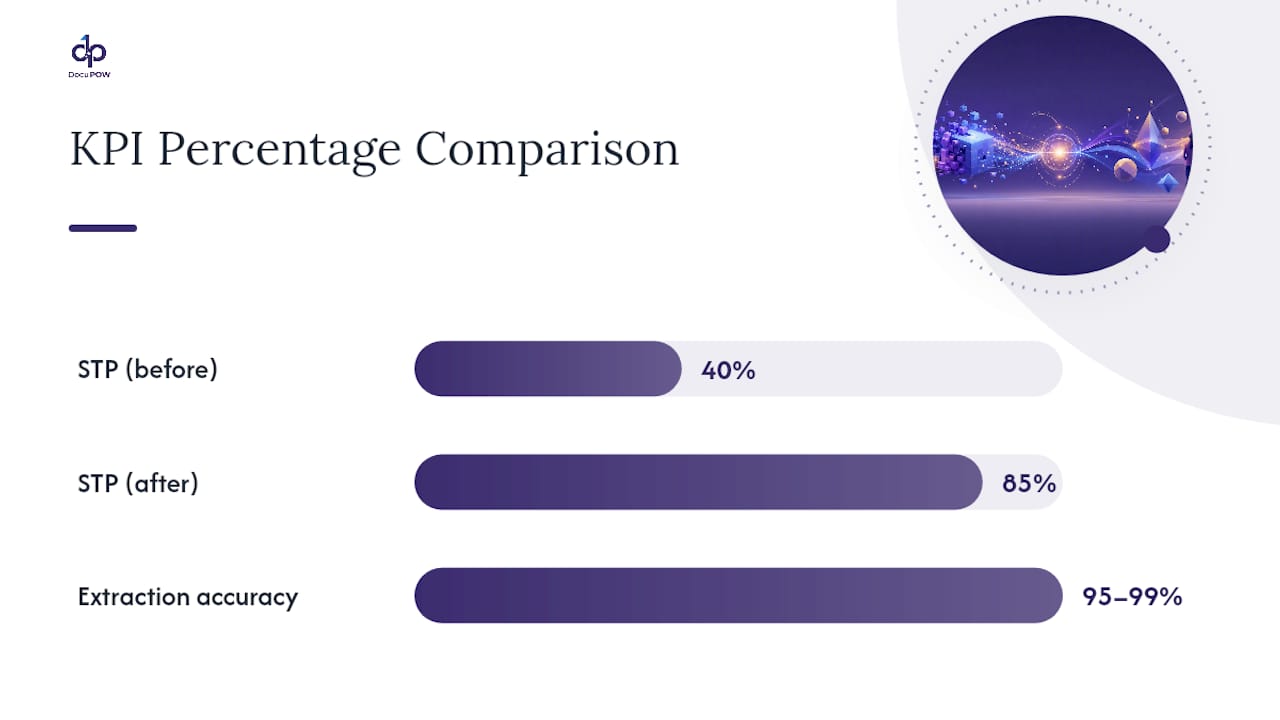
    Intelligent Records Processing turns unstructured documents into validated, structured data and routes that data straight into the business systems that run your company. It reads an invoice, a claim, or an intake form the way a trained clerk would, then delivers clean fields into your ERP, EHR, or CRM without a human retyping a single number. Modern systems hit 95 to 99% accuracy on well-defined structured documents, and when a human-in-the-loop reviewer catches the remaining edge cases, effective accuracy climbs close to 100%.

    That accuracy shows up downstream as straight-through processing, or STP: the percentage of documents that flow from ingestion to your system of record with zero human touch. By improving STP, finance teams significantly reduce the number of exceptions handled manually. The math is why operations leaders care about this technology more than almost any other automation category on the market.

    A properly built Intelligent Records Processing system produces three things for every document it touches:

    • Document classification — what type of record this is (invoice, W-2, claim form, contract)
    • Extracted fields — the specific data points pulled from the page (vendor name, claim amount, effective date)
    • Validated records — data that has been checked against business rules and, where needed, human review, before it enters your system of record

    Security posture matters just as much as accuracy for anything touching financial or patient records, which is why enterprise buyers should expect SOC 2 and, where health data is involved, HIPAA-aligned controls from any vendor they evaluate.

    Key Takeaways

    Intelligent Records Processing works because it pairs contextual understanding with confidence-based human review, turning unstructured documents into structured data your systems can act on immediately.

    Point Details
    Definition matters IRP goes beyond OCR by classifying, extracting, validating, and delivering structured data into business systems.
    Accuracy is high but not absolute Expect 95 to 99% accuracy on structured documents, with HITL review closing the remaining gap.
    Start with a pilot Scope your first pilot on the highest-volume, highest-error document type, not the easiest one.
    Track the right KPIs Monitor STP rate, extraction accuracy, throughput, error rate, and cost per document from day one.
    DocuPOW’s approach reduces maintenance Its template-free, agent-based extraction avoids the rebuild cycle that template-based systems require for every new layout.

    Table of Contents

    What Is Intelligent Records Processing, Really?

    Intelligent Records Processing is the software category that reads a document, understands its context, and outputs structured, business-ready data. It is not the same thing as optical character recognition, and confusing the two is the single most common mistake buyers make when scoping a project.

    OCR does one job: it converts pixels into text. Feed it a scanned invoice and it hands back a wall of characters with no understanding of what a “total due” field is or where the vendor’s name sits relative to the invoice number. Traditional OCR is a text-extraction layer, not a data pipeline.

    IRP builds on top of that layer. It classifies the document, maps the layout, identifies which text block is a field versus a label, extracts that field with a confidence score, and validates it against rules before handing off structured output, often as JSON with key-value pairs and table data intact. Databricks frames this well: the goal isn’t just readable text, it’s AI-ready structured data that downstream systems and analytics tools can consume immediately.

    Here’s why that distinction actually matters in practice:

    • An accounts payable team using OCR alone still has to manually map “Total Due: $4,215.00” to the right ledger field, invoice by invoice.
    • A claims team relying on OCR gets a text blob per page, with no reliable way to tell a diagnosis code from a policy number without a human reading it.
    • An IRP system extracts both fields directly, tags them with a confidence score, and routes anything below a set threshold to a reviewer instead of straight into the ledger or claims system.

    Layout-aware extraction, the kind that preserves bounding boxes and cell coordinates rather than flattening everything into raw text, is also what makes an audit trail possible months later when a compliance team needs to trace exactly where a number came from on the original page.

    How Does an Intelligent Records Processing Pipeline Work?

    An IRP pipeline moves a document through six stages, and each one exists to catch a specific type of error before it reaches your system of record. The standard pipeline runs from raw file to structured, delivered data, and understanding each stage is what separates a well-scoped pilot from a stalled one.

    1. Ingestion. Documents arrive by email, upload, scan, or API from a partner system. Common pitfall: no standard intake channel, so documents scatter across inboxes and shared drives before processing ever starts.
    2. Image pre-processing. The system straightens skewed scans, removes noise, and enhances contrast. Poor scan quality here is the single biggest driver of downstream extraction errors, which is part of why the National Archives digitization guidance puts so much weight on scanning standards and file handling before automation even enters the picture.
    3. Classification. The system identifies document type. A pitfall worth flagging: mixed-format batches (an invoice with a packing slip stapled to it) routinely trip up classifiers trained on clean, single-document samples.
    4. Extraction. Fields, tables, and key-value pairs get pulled out with a confidence score attached to each one.
    5. Validation and enrichment. Extracted data gets checked against business rules (does this vendor exist in our master list?) and enriched with lookups (does this tax ID match a known record?).
    6. Integration and delivery. Clean, structured data lands in the ERP, CRM, or case management system, typically over an API.

    Confidence scoring is the mechanism that decides what happens next. A field at 62% confidence, maybe a handwritten total or a smudged date, gets routed to a human reviewer instead of guessed at. This is human-in-the-loop, or HITL, and it’s the difference between a system that quietly makes errors and one that knows what it doesn’t know.

    A practical confidence threshold rule looks like this: route anything under 85% confidence on a financial total to a reviewer, but allow 70% confidence on a non-critical field like a customer’s middle name to pass through automatically. The threshold should track the cost of being wrong, not a single blanket number across every field.

    Pro Tip: Track your confidence score distribution weekly during the first three months of a rollout. A slow downward drift usually means new document variants are entering the pipeline that your model hasn’t seen, and it’s your earliest warning sign before error rates actually spike.

    What Technologies Power Intelligent Records Processing?

    Modern IRP systems combine seven distinct technology layers, and knowing what each contributes helps you evaluate whether a vendor’s platform actually covers your document mix or just handles the easy cases.

    • OCR/ICR — converts printed and handwritten characters into machine-readable text; the foundational layer everything else builds on.
    • Layout analysis — maps where text blocks sit relative to each other, so the system knows a number near the label “Total” is different from one near “Subtotal.”
    • NLP and entity extraction — identifies named entities (dates, amounts, party names) inside unstructured text like a contract clause or a doctor’s note.
    • ML classification — sorts documents into types using patterns learned from labeled examples.
    • LLM and zero-shot capabilities — handle previously unseen document formats without requiring a labeled training set for every new variant.
    • Computer vision models — read stamps, signatures, checkboxes, and photographic evidence like damage images in a claim.
    • Rules engines and connectors — enforce business logic and push validated data into ERP, CRM, or EHR systems via API.

    Choosing between a trained ML model and an LLM/zero-shot approach comes down to volume and variability. A high-volume, stable document type like a standard vendor invoice format justifies training a dedicated model because the accuracy payoff compounds over thousands of transactions. A low-volume, highly variable document, like a one-off legal notice or an unusual claim attachment, is a better fit for zero-shot LLM extraction since building a trained model for a handful of documents a month rarely pays for itself. A tiered extraction framework that routes easy documents to fast local OCR and only sends hard cases to a cloud vision-language model gives you the best of both: lower cost on the bulk of your volume and better accuracy where it counts.

    Semantic extraction (understanding that “amount owed” and “balance due” mean the same thing) matters as much as positional extraction (knowing where on the page a number typically sits), because vendor and partner documents rarely follow one fixed template. A system that only knows positional patterns breaks the moment a new supplier sends an invoice laid out differently.

    Hands holding stylus over blank tablet

    What Business Benefits Should You Expect From IRP?

    Well-implemented Intelligent Records Processing cuts manual data entry, shortens cycle times, and pushes extraction accuracy to a high level on structured documents, and those effects compound into real budget impact within a single fiscal year.

    Six KPIs matter more than any others when you’re building the business case or tracking a live pilot:

    KPI What It Measures
    STP rate Percentage of documents processed with zero human touch
    Extraction accuracy Percentage of fields correctly extracted and validated
    Processing throughput Pages or documents handled per hour
    Error rate Percentage of records requiring correction after delivery
    Mean time to exception resolution Average time a flagged document sits before a human resolves it
    Cost per document Total processing cost divided by document volume

    Diagram of key performance metrics for IRP

    On the accuracy side, reported ranges of 95 to 99% on structured documents are consistent across well-scoped implementations, and HITL review on the flagged remainder pushes effective accuracy close to full reliability. Production cost per document varies with complexity. Cost considerations for production IDP typically break down across classification, extraction, validation, and human review, with simpler structured forms costing less per document than dense, variable contracts.

    A rough rule of thumb for estimating payback: multiply your monthly document volume by your fully loaded labor cost per document, then multiply that by the percentage reduction in manual touches you expect. A team processing 15,000 invoices a month at $4 in labor cost per invoice, moving from 40% STP to 85% STP, is looking at labor savings on roughly 6,750 additional documents a month that no longer need manual handling. Run that math against your own volume before you scope a pilot, not after.

    Where Does Intelligent Records Processing Deliver the Most Value?

    The highest-value use cases share one trait: high document volume paired with a repetitive, rules-based decision that a human currently makes by hand. Accounts payable, claims processing, patient intake, contract ingestion, and KYC onboarding top the list for a reason.

    • Accounts payable — extracts header fields (vendor, invoice number, date, total) and line-item detail, then matches against purchase orders before posting to the general ledger.
    • Claims processing — pulls procedure codes, diagnosis codes, and claim totals, then routes anything with a coding mismatch to an adjuster.
    • Patient intake — captures demographic data, insurance details, and consent form fields from scanned or photographed documents at check-in.
    • Contract ingestion — identifies parties, effective dates, renewal terms, and key clauses like indemnification or termination language.
    • KYC and onboarding — extracts identity document fields and cross-references them against compliance databases before an account opens.

    Healthcare offers one of the clearest scale examples. A 2024 industry index on administrative transactions found continued friction in how healthcare data moves between payers and providers, much of it tied to manual document handling that automated data exchange could resolve. Integration points matter as much as the extraction itself: a claims IRP deployment is only as useful as its connection to the adjudication system on the other end, and a patient intake deployment lives or dies on how cleanly it feeds the EHR.

    IDP vs. OCR vs. RPA: What Does Each One Actually Do?

    OCR, IDP, and RPA solve three different layers of the automation stack, and most failed implementations trace back to a team picking the wrong one, not a bad vendor. OCR reads text. IDP understands and structures it. RPA acts on structured data once it exists.

    OCR alone is enough when you just need searchable text from scanned archives, no structured data, no downstream automation, just a text index for a document repository. Full IDP becomes necessary the moment you need structured fields flowing into a business system with any accuracy guarantee, which covers the vast majority of finance, healthcare, and legal document work. RPA adds value downstream of IDP, taking the clean structured data and executing the next step in a business process, like posting an approved invoice or updating a policy record, once IDP has already done the understanding.

    The most durable orchestration pattern pairs IDP for the understanding layer with RPA or direct API integration for the action layer, rather than trying to stretch either technology to cover both jobs. Treating OCR as a substitute for IDP is the most expensive mistake on this list, because it looks cheaper upfront and gets far more costly once exception volume overwhelms a manual review team.

    How Do You Roll Out Intelligent Records Processing Without Breaking Anything?

    A phased rollout, pilot, refine, scale, monitor, cuts risk more than any single technology choice you’ll make. Skipping straight to full production on your highest-volume document type is the single most common cause of stalled IDP projects.

    1. Select representative documents. Pull a sample that includes your messiest real-world cases, not your cleanest ones.
    2. Label and train. Build ground-truth labels for the fields that matter most, then train or configure the extraction models against them.
    3. Set confidence thresholds. Decide, field by field, what confidence level triggers automatic pass-through versus human review.
    4. Integrate with one downstream system. Connect to a single ERP, CRM, or case management endpoint before attempting a multi-system rollout.
    5. Run human-in-the-loop review. Have reviewers work flagged exceptions and track how often their corrections match the model’s low-confidence guess.
    6. Evaluate KPIs. Measure STP rate, accuracy, throughput, and cost per document against your baseline before deciding to scale.

    A first document type typically takes several weeks to move from pilot to stable production, with simpler structured forms like standard invoices requiring less time and highly variable documents like contracts or medical records requiring more. Budget across four categories: model inference and processing costs, human review labor during the pilot phase, integration engineering for connecting to your systems of record, and a decision on cloud versus on-premise processing driven largely by your data residency and compliance requirements.

    Scanning quality set at the ingestion stage has an outsized effect on everything downstream. The National Archives’ digitization policy on file formats and metadata capture is worth reviewing even for a private-sector rollout, since the same scanning discipline that protects long-term government records also protects extraction accuracy in a commercial pipeline.

    How Should You Evaluate an IRP Vendor?

    Prioritize extraction accuracy, integration depth, security certifications, HITL support, monitoring capability, and pricing model, in roughly that order, when scoring vendors during an RFP or demo cycle.

    • Does the platform support template-free extraction, or does every new document layout require a new template to be built and maintained?
    • What are the documented APIs and connectors for your specific ERP, CRM, or EHR?
    • Does the vendor carry SOC 2 certification, and HIPAA-aligned controls if you handle patient data?
    • What SLA governs model drift, meaning how quickly does the vendor detect and correct accuracy degradation as new document variants appear?
    • Does the platform support configurable HITL review queues, or is exception handling an afterthought bolted onto the extraction engine?
    • What analytics and confidence-trend dashboards come standard versus custom-built?

    In the actual demo, ask pointed operational questions rather than accepting a canned walkthrough: What throughput did this handle in your last production deployment? What documents were used in this demo, yours or a curated sample? What’s the actual error-handling path when a field extraction fails outright? How is model drift detected and who owns retraining?

    Pro Tip: Run every finalist vendor on your worst 20 to 30 documents, the ones with coffee stains, handwritten margins, and inconsistent layouts, not the clean samples a sales team hands you. A vendor’s real accuracy shows up on your ugliest documents, not their best case study.

    How Does DocuPOW Approach Intelligent Records Processing Differently?

    DocuPOW uses autonomous agents and template-free extraction to cut setup time and ongoing maintenance, the two costs that quietly eat most of the ROI out of traditional IDP deployments. Where template-based systems break every time a vendor changes an invoice layout, an agent-based approach reads context the way a person would, understanding that “amount due” and “balance owed” point to the same field regardless of where they sit on the page.

    That approach shows up in five practical differentiators:

    • Template-free extraction that adapts to new document layouts without a manual configuration cycle.
    • Human-in-the-loop audit review built into the workflow rather than added as a separate tool.
    • Real-time analytics and predictive insights that surface processing trends as they happen, not in a weekly report.
    • API connectors for direct integration with ERP and CRM systems already running in your stack.
    • Enterprise-grade security features built for the compliance expectations of finance, healthcare, and legal teams.

    Global manufacturers running high document volumes across accounts payable and vendor onboarding are a natural starting point, and the same template-free extraction approach extends cleanly into construction site intake documents and real estate transaction paperwork, where document variability across vendors and jurisdictions has historically made template-based systems expensive to maintain.

    The recurring failure in traditional IDP isn’t the extraction accuracy on day one, it’s the maintenance burden that builds every time a new document variant shows up and a template has to be rebuilt. An agent-based system that understands context rather than memorizing layout removes that maintenance tax entirely, which is where the real cost savings show up over a full year, not just in the pilot.

    What Do Most Teams Get Wrong When They Roll This Out?

    Treat Intelligent Records Processing as an ongoing data-engineering discipline, not a one-time software purchase, and most of the common rollout failures disappear before they start. The teams that struggle almost always installed a system, watched the initial accuracy numbers, and stopped paying attention.

    Start small on a single document type with clear boundaries, an invoice format or a standard intake form, rather than trying to automate every document category in your organization simultaneously. Instrument everything from day one: confidence score trends, exception volume, and reviewer correction patterns tell you far more about system health than a single accuracy percentage measured once at launch.

    A few do’s and don’ts worth internalizing before you scope your next phase:

    • Do treat labeling quality as seriously as you’d treat data quality in any analytics pipeline, because a sloppy label set trains sloppy extraction.
    • Do monitor for drift monthly, since new vendors, new form layouts, and seasonal document variants all erode accuracy quietly over time.
    • Don’t assume a model trained on last year’s documents will hold up against this year’s variants without periodic retraining.
    • Don’t skip change management for the human reviewers whose job shifts from data entry to exception handling. That’s a different skill set and it needs training, not just a new tool.

    Governance is the piece that gets skipped most often. Someone on your team needs explicit ownership of confidence threshold tuning, retraining schedules, and periodic bias checks on how the model handles different document formats or languages, because a “set-and-forget” system degrades in ways that are invisible until the error rate spike shows up in a monthly report.

    Ready to See What a Pilot Looks Like?

    DocuPOW runs a structured pilot program built specifically for teams that want proof before they commit to a full rollout, not a generic trial account with no clear success criteria. Unlike a template-based platform where onboarding means weeks of configuration work before you see a single processed document, DocuPOW’s agent-based extraction starts working on your actual documents from day one.

    DocuPOW

    A DocuPOW pilot typically includes:

    • Integration with one downstream system of your choice (ERP, CRM, or case management)
    • Human-in-the-loop review setup tuned to your risk tolerance
    • Real-time dashboards tracking accuracy, STP rate, and throughput from the first document processed
    • Clearly defined success criteria agreed upon before the pilot starts, not after

    If accounts payable is your highest-volume pain point, the financial data extraction guide walks through what a first 90 days typically looks like. For teams weighing the broader cost and staffing case, the document process automation benefits overview breaks down where the savings actually show up. Request a demo through DocuPOW’s platform page to scope a pilot against your own worst documents, the same ones you’d hand any vendor in an evaluation.

    Sources

    • What Is Intelligent Document Processing (IDP)? A Practical Guide for Business Leaders
    • We’ve talked previously about the risks this can create for the business, and how Intelligent Document Processing (IDP) can be a solution to that problem.
    • What is Intelligent Document Processing? | Databricks Blog

    FAQ

    What does intelligent document processing do?

    It classifies documents by type, extracts specific data fields with a confidence score, validates that data against business rules, and delivers structured output directly into systems like an ERP or CRM.

    What is the difference between OCR and intelligent document processing?

    OCR converts scanned text into machine-readable characters with no understanding of meaning, while IDP adds classification, layout awareness, semantic extraction, and validation on top of that raw text.

    What is IDP and how does it work?

    IDP is a pipeline that moves a document through ingestion, image pre-processing, classification, extraction, validation, and integration, using OCR, NLP, and machine learning at each stage to produce structured, business-ready data.

    How accurate is intelligent document processing?

    Well-scoped IDP systems typically report 95 to 99% accuracy on well-defined structured documents, with human-in-the-loop review pushing effective accuracy close to full reliability on flagged exceptions.

    How is DocuPOW different from template-based IDP platforms?

    DocuPOW uses autonomous, agent-based extraction that reads document context rather than relying on fixed templates, which reduces the setup and maintenance work required every time a new document layout appears.

  • Vendor Onboarding Automation: A Procurement Guide

    Vendor Onboarding Automation: A Procurement Guide

    Vendor onboarding automation standardizes intake, validates documents, and enforces risk-based approvals so you can cut cycle time and close compliance gaps without adding headcount. If you take one action after reading this, pick a medium-risk, high-volume supplier class and measure your current baseline cycle time. That single measurement is what separates a successful pilot from a wishful one.

    Immediate benefits you can expect:

    • Faster approvals: structured digital intake replaces email chains and chases
    • Standardized evidence capture aligned to SOC 2 and ISO 27001 controls
    • Automated risk-based routing using SIG or CAIQ questionnaire frameworks
    • Fewer data-entry errors in ERP master records
    • Continuous monitoring that catches vendor deterioration earlier than quarterly reviews

    Pro Tip: The highest-impact pilot is almost always a medium-risk, high-volume supplier class — complex enough to stress-test the workflow, common enough to generate statistically meaningful cycle-time data within six to eight weeks.

    Your immediate next step: select one supplier lane, document the current average days from request to approved status, and set a target. Without that baseline, you cannot prove ROI to the CFO.


    Key Takeaways

    Vendor onboarding automation delivers measurable cycle-time reduction, cleaner ERP master data, and a defensible TPRM posture when implemented with a clear pilot lane, a baseline measurement, and human-in-the-loop review for high-risk cases.

    Point Details
    Baseline before you automate Measure current cycle time and FTE hours per onboarding before selecting a platform.
    Pilot on medium-risk, high-volume lanes This supplier class generates enough data in 6–8 weeks to prove or disprove ROI.
    Template-free extraction is non-negotiable Platforms requiring per-layout configuration create bottlenecks every time a new document type appears.
    Continuous monitoring closes the TPRM gap Post-activation monitoring catches certificate expirations and sanctions changes that periodic reviews miss.
    DocuPOW for the full workflow DocuPOW’s agent-based platform covers intake, document extraction, ERP sync, and compliance evidence in one integrated system.

    Table of Contents

    Why manual vendor onboarding breaks down at scale

    Email threads, shared spreadsheets, and PDF attachments are not a vendor onboarding process. They are a collection of workarounds that happen to produce an approved vendor record — eventually.

    The failure modes are predictable. Approvers get CC’d inconsistently, so the same document gets reviewed twice or not at all. Data entered by a supplier into an email form gets re-keyed into the ERP by a procurement analyst, introducing errors at every transfer. Evidence like certificates of insurance or W-9s gets stored in someone’s inbox rather than a central repository, making audits painful and compliance gaps invisible until they matter.

    Standardized data collection plus real-time enrichment can cut early-stage manual verification time dramatically, yet most organizations still rely on ad hoc email requests for the same data they could collect once through a structured portal.

    The consequences compound as vendor count grows:

    • Procurement: delayed approvals block sourcing events; off-contract spend rises when preferred vendors are not yet active
    • Finance: incorrect banking or tax data causes failed payments and rework
    • Security/compliance: missing or expired certificates create audit findings and unmanaged third-party risk
    • Operations: new vendors cannot be provisioned in downstream systems until the ERP record exists, delaying time-to-revenue

    Statistic callout: Published implementation examples show that automation can reduce supplier onboarding timelines by about half compared to manual processes, with ROI timelines often landing in the six-to-twelve-month range.

    The problem scales non-linearly. A team that manages 200 vendors per year with email can just about hold it together. At 500 vendors, the same process produces a backlog, compliance gaps, and frustrated suppliers who cannot get paid.


    What automation actually delivers for procurement, security, and operations

    The business case for automating the vendor onboarding process is not abstract. It shows up in three places: time, accuracy, and risk posture.

    For procurement teams:

    • Cycle time drops because intake validation, sanctions screening, and tiered approvals run in parallel rather than sequentially
    • Supplier master data arrives pre-validated, so ERP records are cleaner from day one
    • Analysts spend time on exceptions and relationships, not data re-entry

    For security and compliance:

    • Evidence lands in a centralized, auditable repository rather than scattered inboxes
    • Continuous monitoring flags certificate expirations, adverse media, and posture changes between review cycles
    • TPRM automation speeds processes, improves scalability, and reduces hours spent on manual risk assessments, with AI and continuous monitoring as the central capabilities

    For finance and AP/AR:

    • Correct banking details and tax identifiers at the point of onboarding reduce failed payments
    • Faster vendor activation means revenue-impacting suppliers can invoice sooner
    • Fewer exceptions in the payment run translate directly to analyst time saved

    Pro Tip: Measure supplier satisfaction separately from internal cycle time. A vendor who found your portal confusing will tell you things your internal metrics never will. A short three-question survey sent at activation costs almost nothing and surfaces UX problems before they affect retention.

    The downstream benefit that procurement teams consistently underestimate is time-to-first-invoice. For a revenue-generating supplier relationship, every day the vendor is not yet active in the ERP is a day that relationship cannot generate value.


    Capabilities to require from any vendor onboarding automation platform

    Not all platforms are equal, and the gap between a capable system and a limiting one usually shows up at the document-extraction layer. Here is the full capability checklist, followed by a tiering table.

    Full capability list:

    • Self-service intake portal with branded supplier experience
    • Template-free document capture (no rigid field mapping per document type)
    • Automated field extraction and validation against master data rules
    • Questionnaire automation with conditional skip logic (SIG, CAIQ, custom)
    • Risk scoring and vendor tiering at intake
    • Sanctions and entity verification (OFAC, global watchlists)
    • Continuous monitoring with external intelligence signals
    • Configurable approvals and workflow engine with escalation rules
    • ERP, CRM, and contract lifecycle management (CLM) integrations via API
    • Secure evidence repository with role-based access
    • Full audit trail and compliance reporting
    • Human-in-the-loop review for exceptions and high-risk cases

    Why template-free extraction matters specifically: traditional OCR tools require a field map for every new document layout. When a supplier sends a certificate from a new insurer or a tax form in an unfamiliar format, a template-based system either fails or requires manual configuration. Agent-based document automation reads context rather than position, so new document types require no setup time. For procurement teams onboarding suppliers across multiple geographies and document standards, that difference is significant.

    AI frameworks applied to supplier selection extract signals from documents and external data to support both initial risk decisions and ongoing performance monitoring, which is exactly what the extraction and monitoring layers of a mature platform should do.

    Tier Capability Why it matters
    Essential Self-service intake portal Removes email as the intake channel
    Essential Automated field extraction and validation Eliminates re-keying and data errors
    Essential Sanctions and entity verification Blocks onboarding of restricted parties
    Essential ERP integration via API Creates vendor master record without manual entry
    Essential Audit trail and compliance reporting Required for SOC 2 and ISO 27001 evidence
    Important Template-free document capture Handles new document types without reconfiguration
    Important Risk scoring and tiering at intake Routes high-risk vendors to deeper review automatically
    Important Questionnaire automation with skip logic Reduces supplier burden; collects only relevant data
    Important Continuous monitoring Detects deterioration between review cycles
    Advanced Fourth-party dependency capture Maps supply chain risk beyond direct vendors
    Advanced Predictive risk signals Flags emerging issues before they become incidents
    Advanced CLM and GRC/TPRM integration Closes the loop between contract, risk, and procurement

    Integration touchpoints to confirm before you buy: ERP (SAP, Oracle, NetSuite), CLM (Ironclad, Icertis), GRC/TPRM platforms, identity and provisioning systems, and AP automation tools. Centralizing supplier master data and integrating via APIs is the single most important architectural decision — disconnected systems produce fragmented data regardless of how good the intake layer is.


    How an automated vendor onboarding workflow runs, stage by stage

    A well-designed automated workflow removes human touchpoints from the routine and routes exceptions to the right person at the right time. Here is what each stage looks like in practice.

    Diagram of eight-stage vendor onboarding workflow

    Stage 1: Intake and registration. The supplier receives a branded portal link and completes a structured intake form. Auto-fill pulls company data from public registries where available. The system captures legal entity name, tax ID, banking details, and contact information in one pass.

    Stage 2: Automated validation and enrichment. The platform validates submitted data against sanctions lists (OFAC, UN, EU), verifies the legal entity, and enriches the record with external data. Mismatches trigger an exception flag rather than a manual email.

    Stage 3: Risk tiering. Based on spend category, geography, data access, and initial screening results, the system assigns a risk tier. Low-risk vendors proceed to a lightweight approval path. Medium and high-risk vendors trigger deeper due diligence, including questionnaire dispatch.

    Stage 4: Evidence collection and questionnaire. The platform sends the appropriate questionnaire (SIG Lite, CAIQ, or a custom version) with skip logic so suppliers only answer relevant questions. Document requests (certificates of insurance, SOC 2 reports, financial statements) go out automatically, and the system tracks receipt and expiry.

    Stage 5: Approvals and contract creation. Completed packages route to the right approvers based on risk tier and spend category. Approval workflows can include procurement, legal, security, and finance in parallel or sequence. Contract templates trigger from the approval event where CLM integration exists.

    Stage 6: ERP record creation and provisioning. On final approval, validated data writes directly to the ERP vendor master. Downstream provisioning (system access, payment terms, preferred status) triggers automatically. Automated supplier onboarding with direct ERP synchronization removes the manual re-entry step that causes most master data errors.

    Stage 7: Continuous monitoring and alerts. Post-activation, the platform monitors for certificate expirations, sanctions list changes, adverse media, and financial distress signals. Alerts route to the vendor owner or risk team based on severity.

    Stage 8: Offboarding triggers. Contract end dates, inactivity thresholds, or risk escalations trigger an offboarding workflow that deactivates the vendor record, revokes system access, and archives evidence.

    Pro Tip: Build a simple flow diagram of this eight-stage process before your pilot kickoff and share it with every stakeholder. Procurement, security, legal, and finance all think they understand the process — they rarely agree on who owns stage 3. The diagram surfaces those disagreements before the tool does.

    Roles to assign at each stage: procurement owns intake and approvals; security owns risk tiering and questionnaire review; legal owns contract creation; finance owns banking validation and ERP record; the vendor manager owns continuous monitoring alerts.


    How to implement automation and choose the right solution

    The phased roadmap

    1. Assess and baseline. Document your current process end-to-end. Measure average cycle time, error rate, and FTE hours per onboarding. This is your before state.
    2. Design. Map data fields, document types, and approver logic. Assign data owners. Define risk tiers and the criteria for each.
    3. Pilot (one to two lanes). Select a medium-risk, high-volume supplier class. Run the pilot for six to twelve weeks. Measure against your baseline.
    4. Integrate. Connect the platform to your ERP and any CLM or GRC tools. Validate data flows with your IT team before scaling.
    5. Scale and improve. Roll out to additional supplier classes. Use analytics to identify remaining bottlenecks and refine risk-tiering logic quarterly.

    Selection criteria checklist

    When evaluating platforms, buyers consistently prioritize ease of configuration, document handling quality, and integration depth. Use this list to structure your evaluation:

    • Template-free or agent-based document extraction (no per-layout configuration)
    • Native API integrations with your ERP and CLM
    • SOC 2 Type II and ISO 27001 certifications
    • Configurable risk-tiering logic without professional services dependency
    • Analytics dashboard with cycle-time and exception reporting
    • Vendor support model and implementation timeline
    • Scalability to handle peak onboarding volumes without performance degradation

    TPRM automation is most effective when paired with human accountability, so look for platforms that support human-in-the-loop review rather than fully black-box decisions.

    Red flags to walk away from

    • Systems that require professional services to add a new document type
    • No audit trail or evidence repository
    • Closed APIs that cannot connect to your ERP without custom middleware
    • Vendors who quote implementation timelines longer than twelve weeks for a standard pilot

    Pro Tip: Pair your automation rollout with a RACI matrix and a written exception-handling policy before go-live. The tool will surface edge cases your process design did not anticipate. Without a documented owner for exceptions, those cases land back in email.


    Security, compliance, and TPRM specifics you cannot skip

    Vendor onboarding is a primary attack surface for supply chain risk. Automation helps, but only if the platform itself meets the security controls you are requiring of your vendors.

    Required controls in your platform:

    • Centralized evidence repository with role-based access control
    • Encrypted storage at rest and in transit
    • Chain-of-custody audit logs for every document and approval action
    • Retention policies aligned to your regulatory requirements
    • Data residency options if you operate in regulated jurisdictions

    TPRM capabilities to require:

    • Risk-based tiering at intake (not a flat due-diligence process for all vendors)
    • Continuous monitoring using external intelligence signals (adverse media, financial distress, sanctions updates)
    • Fourth-party dependency capture for critical vendors
    • Remediation tracking with SLA enforcement

    Statistic callout: Automation standardizes repeatable TPRM work across onboarding, assessments, monitoring, remediation, and offboarding — and the playbook consistently recommends tiered due diligence paired with a central vendor inventory as the foundation.

    Automation reduces human error in evidence collection by removing the discretion from the process. When a questionnaire dispatches automatically based on risk tier, every vendor in that tier gets the same questions. When document expiry triggers an alert automatically, no vendor slips through because an analyst forgot to check. For compliance documentation and audit readiness, that consistency is the point.

    Security review checklist for procurement:

    • Does the platform hold SOC 2 Type II and ISO 27001 certifications?
    • Where does supplier data reside, and can you specify region?
    • What are the role-based access controls for internal users?
    • What is the vendor’s incident response SLA and notification timeline?
    • How does the platform handle data deletion requests?

    KPIs to track and how to build your ROI case

    Primary KPIs

    1. Cycle time (days from request to approved vendor record): the single most important metric
    2. Percent of onboardings fully automated (no manual touchpoint required)
    3. FTE hours per onboarding (before and after)
    4. Number of evidence exceptions (missing or expired documents at approval)
    5. Time to ERP record creation (from final approval to live vendor master record)
    6. Compliance findings per audit cycle (open items related to vendor evidence)

    Secondary KPIs

    • Supplier satisfaction score (post-activation survey)
    • Off-contract spend rate (proxy for delayed activations)
    • Time to first invoice paid (for revenue-impacting vendors)
    KPI Baseline example Target range Notes
    Cycle time a few weeks about one week Measure from request submission to approved status
    % fully automated a minority a strong majority Excludes high-risk vendors requiring manual review
    FTE hours per onboarding several hours about one hour Includes intake, validation, and ERP entry
    Evidence exceptions at approval a substantial portion of cases a small portion Tracks missing or expired documents
    Time to ERP record creation a few days post-approval within a day Measures integration latency

    A simple ROI calculation

    If your team processes 400 vendor onboardings per year at an average of five FTE hours each, that is 2,000 hours annually. At a fully loaded cost of $75 per hour, the manual process costs $150,000 in labor alone. Reducing to 1.5 hours per onboarding cuts that to $45,000, a saving of $105,000 per year before accounting for error reduction, faster time-to-revenue, or avoided audit findings.

    For revenue-impacting suppliers, calculate separately. If a vendor activation delay costs one day of revenue, and your average revenue-impacting vendor generates $10,000 per day, cutting cycle time by ten days per vendor across twenty such vendors per year is $2,000,000 in accelerated revenue recognition. That number tends to get a CFO’s attention.

    Financial data extraction automation is one of the highest-ROI starting points because the ERP sync step alone eliminates the most error-prone manual transfer in the entire process.


    How DocuPOW addresses real vendor onboarding challenges

    The baseline challenge

    A global manufacturer was onboarding suppliers across four regions using a combination of email intake, shared drives for document storage, and manual ERP entry. Average cycle time was 22 days. Audit preparation required a full week of analyst time per quarter because documents were scattered across inboxes and folders.

    The DocuPOW intervention

    DocuPOW’s agentic document automation platform replaced the email intake with a structured supplier portal. The platform’s template-free extraction engine processed certificates of insurance, W-9s, SOC 2 reports, and financial statements without requiring a field map for each layout. Extracted data validated automatically against master data rules before routing to the approvals workflow.

    Hands using digital document capture device

    The ERP integration wrote validated vendor records directly to the supplier master on approval, eliminating manual re-entry. Human-in-the-loop review was preserved for high-risk vendors and exception cases, so the team retained oversight without handling routine cases manually.

    Technical fit summary:

    • Template-free extraction handled new document layouts without reconfiguration
    • Human-in-the-loop audit review for high-risk and exception cases
    • API integration with ERP for same-day vendor master creation
    • Analytics dashboard tracking cycle time, exception rate, and approval SLAs
    • Centralized evidence repository with role-based access and full audit trail
    • Enterprise security certifications supporting SOC 2 and ISO 27001 evidence requirements

    Implementation example

    The pilot ran on the indirect materials supplier class (medium risk, high volume) over eight weeks. Procurement, IT, and security each assigned one stakeholder. Key integration points were the ERP vendor master and the existing CLM tool.


    What I’ve learned from onboarding automation implementations

    The gap between a successful implementation and a stalled one almost never comes down to the technology. It comes down to whether procurement, IT, and security agreed on who owns the risk-tiering logic before the platform went live.

    The most common surprise: teams discover mid-pilot that their existing vendor data is far messier than anyone admitted. Duplicate records, missing tax IDs, inconsistent legal entity names. Automation surfaces this immediately because it tries to validate data that was never validated before. That is actually a feature, not a problem. But if you are not prepared for a data-cleanup sprint in weeks two and three of your pilot, it will feel like a crisis.

    A few rules of thumb that hold across implementations:

    • Start with the integration that causes the most pain, usually ERP sync, not the one that sounds most impressive
    • Test your exception-handling workflow with real edge cases before go-live, not hypothetical ones
    • Communicate the portal change to suppliers at least two weeks before launch with a clear FAQ; supplier confusion at intake is the most common cause of pilot delays
    • Do not automate a process you do not understand; map it manually first, then automate the mapped version

    Change management is underrated. The analysts who used to manage the email inbox are not obstacles to automation. They are the people who know where every exception lives. Involve them in the design phase and they will make the system better. Exclude them and they will find ways to route around it.


    DocuPOW cuts vendor onboarding cycle time from weeks to days

    Procurement teams that have spent months chasing certificates via email and re-keying data into ERP systems know exactly what the cost of that process is. DocuPOW’s agent-based platform addresses the core bottleneck directly: documents of any type, from any supplier, extracted and validated without template configuration.

    DocuPOW

    Three capabilities that matter most for vendor onboarding: template-free extraction that handles new document layouts on first submission, direct ERP and CRM integration via API for same-day vendor master creation, and enterprise-grade security with SOC 2 and ISO 27001 evidence handling built in. The KYC and onboarding automation flow is purpose-built for identity and compliance document processing, which covers the most document-intensive part of any onboarding program.

    Pilots typically run six to eight weeks on a single supplier class. To see how the platform fits your current ERP and document stack, request a demo at DocuPOW.


    Useful sources and further reading


    FAQ

    What is vendor onboarding automation?

    Vendor onboarding automation replaces manual email intake, spreadsheet tracking, and re-keying with a structured digital workflow that captures supplier data, validates documents, applies risk-based routing, and syncs approved records to your ERP automatically.

    How long does a vendor onboarding automation pilot typically take?

    Most pilots run six to twelve weeks on a single supplier class.

    What software is best for automating vendor onboarding?

    The strongest platforms combine template-free document extraction, configurable risk-tiering, native ERP integration, and SOC 2 or ISO 27001 certification. DocuPOW’s agent-based platform covers all four, with human-in-the-loop review for high-risk cases and direct API integration with major ERP systems.

    How does automated onboarding differ from employee onboarding automation?

    Vendor onboarding automation focuses on third-party risk management, document validation (certificates, tax forms, compliance questionnaires), and ERP master data creation. Employee onboarding automation centers on HR system provisioning, policy acknowledgment, and identity management. The underlying workflow logic is similar, but the compliance controls and document types differ significantly.

    How do you measure ROI for vendor onboarding automation?

    Track cycle time (days from request to approved), FTE hours per onboarding, and evidence exception rate before and after implementation. A team processing 400 vendors per year at five hours each can reduce that to 1.5 hours with automation, converting the time saved directly into FTE-equivalent cost savings and faster time-to-first-invoice for revenue-impacting suppliers.

  • Employee Onboarding Automation for HR Leaders

    Employee Onboarding Automation for HR Leaders

    Employee onboarding automation uses event-driven workflows to connect your HRIS to downstream systems, so new hires are ready by Day 1 while HR admin time and compliance risk both drop. The immediate next step: pick one high-friction task, run a one-week pilot, and measure the result before scaling anything else.

    Start here:

    • Owner: HR ops lead or HRIS administrator
    • Scope: One role type, one workflow (paperwork packet or IT provisioning)
    • Success metric: Time from offer acceptance to completed task, compared to your current baseline

    That single pilot gives you a real number to take to leadership and a tested template to copy across roles.


    Key Takeaways

    Automating onboarding paperwork and IT provisioning first, using a five-step framework anchored on your HRIS as the single source of truth, delivers the fastest compliance gains and the clearest ROI for HR teams.

    Point Details
    Start with one workflow Automate paperwork or IT provisioning first; score candidates on frequency, compliance risk, and cross-team handoffs.
    Use the five-step framework Map, pick, connect, build, and refine; run a 4–6 week pilot before scaling to other roles.
    Measure before and after Baseline HR hours per hire, pre-boarding completion rate, and Day-1 readiness before launch to prove ROI.
    Build compliance controls in Automated I-9 timing, timestamped audit logs, and exception alerts are required, not optional, for US onboarding.
    DocuPOW for document automation DocuPOW’s template-free AI extraction validates onboarding documents and routes data to HRIS and payroll automatically.

    Table of Contents

    What does employee onboarding automation actually include?

    Employee onboarding automation is trigger-based orchestration anchored on a single source of truth, typically your HRIS. When a hire record is created or a status changes (offer accepted, start date confirmed), that event fans out to every downstream system that needs to act. No one manually emails IT to create an account. No one chases a new hire for a W-4 on Day 1.

    The core components in a mature architecture:

    • HRIS (Rippling, Gusto, BambooHR): the source of truth that fires the trigger
    • Identity provider / IdP (Okta): provisions email, SSO, and app access
    • Payroll system: receives tax form data and direct deposit details
    • ITSM / procurement: creates equipment and software tickets
    • LMS: assigns role-based training paths
    • E-signature platform (DocuSign): routes offer letters, I-9s, W-4s, NDAs
    • Document automation (DocuPOW): extracts and validates data from uploaded documents without rigid templates
    • Communication tools: sends pre-boarding emails, Slack messages, calendar invites

    A simplified data flow looks like this: HRIS fires an event → an orchestration layer (Workato, n8n, or native HRIS automations) routes it → identity, payroll, IT, and LMS each receive the fields they need → the employee experience layer (portal, email, calendar) surfaces tasks to the new hire.

    Ownership typically splits across three teams. HR owns the process design, document collection, and compliance checkpoints. IT owns provisioning and equipment. Payroll owns tax form validation and direct deposit setup. The orchestration layer is the connective tissue that keeps all three in sync without manual handoffs.


    Which onboarding tasks are worth automating first?

    About 70% of administrative onboarding tasks are automatable across a typical six-phase arc. The six categories where teams consistently find the fastest wins:

    • Paperwork and e-signatures: Offer acceptance triggers a pre-boarding portal that routes I-9, W-4, direct deposit authorization, and NDA for e-signature. Fully automatable; no human checkpoint needed until a document is rejected or flagged.
    • Account and access provisioning: HRIS start date + role triggers Okta to create the account and assign app groups. Day-1 access is ready before the employee walks in. Fully automatable with a manager approval gate for elevated permissions.
    • Equipment procurement: Role and location fields trigger an ITSM ticket (ServiceNow, Jira Service Management) for laptop, phone, and peripherals. Needs a human checkpoint for custom configurations or budget exceptions.
    • Welcome communications: Offer acceptance triggers a pre-boarding email sequence: welcome message, portal login, Day-1 agenda, manager introduction. Fully automatable; personalize by role and location using merge fields.
    • Training and LMS assignment: Role field triggers automatic enrollment in required courses (compliance training, role-specific modules). Completion deadlines and reminders run automatically. Fully automatable; manager review of completion is a good human checkpoint at 30 days.
    • Scheduling and 30/60/90 check-ins: Start date triggers calendar invites for orientation, manager 1:1s, and pulse surveys at 30, 60, and 90 days. Fully automatable; the check-in conversation itself stays human.

    Pro Tip: Paperwork and IT provisioning are commonly recommended as the starting points because they tend to be high-frequency, involve cross-team coordination, and are directly visible to new hires. Automate one end-to-end before touching the others.


    How do you decide what to automate first?

    Score candidate workflows on five criteria before committing to a build. This keeps the pilot focused and gives you a defensible rationale for stakeholders.

    1. Frequency: How many hires per month does this workflow touch? Higher volume = higher ROI per hour of build time.
    2. Time per hire: How long does this task take manually? Workflows that consume 30+ minutes per hire are the obvious targets.
    3. Compliance risk: Does a missed or late step create a legal exposure (I-9 timing, state new-hire reporting)? High-risk tasks justify automation even at lower volume.
    4. Cross-team handoffs: Does the task require coordination between HR, IT, and payroll? Manual handoffs are where errors and delays concentrate.
    5. Visibility gap: Would a new hire notice if this step was late or wrong? High-visibility failures damage the new-hire experience before Day 1 ends.

    Score each candidate 1–5 on each criterion. Workflows that perform strongly across these factors are good pilot candidates, with paperwork and IT provisioning often among the top choices.

    Pilot template (4–6 weeks):

    1. Weeks 1–2: Scope the workflow, map every field and handoff, identify the integration points, and build in a sandbox environment.
    2. Week 3: Run the flow with a test record. Include edge cases: a contractor, a remote employee, a rehire.
    3. Week 4: Run with a real hire (with manual backup in place). Measure time-to-completion against your baseline.
    4. Weeks 5–6: Fix exceptions, document the runbook, and present results to stakeholders before scaling.

    Connecting HRIS to downstream systems for event-driven orchestration is the technical foundation that makes this pilot replicable across roles.


    The 5-step implementation framework: map, pick, connect, build, refine

    A five-step framework gives teams a repeatable path from “we should automate this” to a live, measured workflow.

    1. Map: Bring HR, IT, payroll, and a hiring manager into one room. Walk the current process end-to-end. Document every task, owner, handoff, and wait time. You will find delays you did not know existed. This step takes one to two weeks and is not optional.

    2. Pick: Apply the prioritization checklist from the section above. Select one workflow. Resist the urge to automate everything at once. Teams that start with a single paperwork or IT provisioning flow consistently deliver faster ROI and cleaner rollouts.

    3. Connect: Designate the HRIS as the single source of truth. Define the trigger event (offer accepted, start date set), the data fields that flow downstream, and the systems that receive them. Document the API or integration method for each connection before writing a single workflow rule.

    4. Build and test: Build in a sandbox. Use a “golden sample” hire record that covers your most common scenario, then test edge cases: a part-time employee, a remote hire, a contractor with a 1099. Include approval gates, exception routing, and automated reminders for incomplete tasks. Run a 4–6 week pilot with real hires before declaring success.

    5. Refine: Pull the KPIs (time-to-productivity, pre-boarding completion rate, HR hours per hire). Collect new-hire feedback at Day 30. Fix what broke, document what worked, and copy the template to the next role or workflow. Scale incrementally, not all at once.

    Pro Tip: Assign a single “automation owner” who is accountable for the workflow after launch. Without a named owner, exceptions pile up unresolved and the automation quietly degrades over months.

    A governance cadence that works: weekly exception review during the pilot, monthly metric review for the first quarter, quarterly process audit thereafter.


    How should you connect your systems and test the integrations?

    The integration layer is where most onboarding automation projects stall. The question is not whether to integrate, but how. Three options exist:

    • Native HRIS integrations: Rippling, Gusto, and BambooHR each offer pre-built connections to common tools. Fast to set up, limited in flexibility. Good for small teams with standard stacks.
    • iPaaS / middleware: Workato, Make, or Zapier sit between systems and orchestrate multi-step flows with conditional logic, error handling, and retry rules. Better for complex, multi-system flows.
    • Custom API integrations: Maximum flexibility, maximum maintenance burden. Reserve for cases where no pre-built connector exists.

    The data that needs to flow, and where:

    Source field (HRIS) Destination system Action triggered
    Employee ID + role Okta (IdP) Create user, assign app groups
    Start date + location ITSM (ServiceNow) Open equipment ticket
    Tax state + SSN Payroll system Initialize tax record
    Role + department LMS Enroll in required courses
    Offer letter status DocuSign Route documents for e-signature
    Uploaded documents DocuPOW Extract and validate fields, push to HRIS/payroll

    Vendor examples by category: Rippling, Gusto, and BambooHR for HRIS; Okta for identity and access; DocuSign for e-signatures; Workato for orchestration; DocuPOW for document intelligence and extraction.

    Testing playbook:

    • Create a “golden sample” hire record with all standard fields populated.
    • Run the full flow in a sandbox. Confirm every downstream system received the correct data.
    • Test edge cases: a contractor (different tax forms), a remote employee (different state tax rules), a rehire (existing records in some systems).
    • Define rollback rules before going live. If a provisioning step fails, what is the manual fallback and who is notified?

    Pro Tip: Never promote a workflow to production until it has run cleanly on at least three edge-case records in the sandbox. One bad Day-1 experience from a provisioning failure costs more goodwill than the automation saves.

    Orchestration platforms are often the practical core that lets HRIS events fan out to identity, payroll, ITSM, and LMS without fragile manual handoffs.


    Ready-to-adapt workflow templates for common onboarding scenarios

    These templates are designed to be copied into Workato, Make, Zapier, or your HRIS’s native automation builder. Each follows a trigger → actions → escalation structure.

    Template 1: Offer acceptance → pre-boarding portal

    • Trigger: Offer status changes to “accepted” in HRIS
    • Actions: Send welcome email with portal link; assign paperwork packet (I-9, W-4, direct deposit, NDA) via DocuSign; set 48-hour completion reminder
    • Escalation: If incomplete at 48 hours, notify HR coordinator and send a second reminder to the new hire

    Template 2: Offer accepted → equipment procurement

    • Trigger: Offer accepted + role and location fields confirmed
    • Actions: Open ITSM ticket with equipment spec; notify IT manager; set expected delivery date based on start date minus five business days
    • Escalation: If ticket unresolved at T-3 days, escalate to IT director and notify HR

    Template 3: Role-based learning path assignment

    • Trigger: Employee record created in LMS (synced from HRIS on start date)
    • Actions: Enroll in mandatory compliance courses; assign role-specific modules; set 30-day completion deadline; schedule reminder at Day 15
    • Escalation: If incomplete at Day 28, notify manager and HR

    Template 4: Day-1 agenda and manager welcome sequence

    • Trigger: Start date T-3 business days
    • Actions: Send new hire Day-1 schedule; send manager a “your new hire starts Monday” checklist; create calendar blocks for orientation and first 1:1
    • Escalation: None (informational sequence)

    Template 5: 30/60/90 check-in cadence

    • Trigger: Start date + 30, 60, 90 days (three separate scheduled triggers)
    • Actions: Send pulse survey to new hire; send manager a structured check-in prompt; log responses to HRIS or people analytics tool
    • Escalation: If survey not completed within 5 days, send one reminder

    Trigger rule for workflow engines: Use “offer_status = accepted AND start_date IS NOT NULL” as the root condition for all pre-boarding flows. This prevents partial records from firing actions before a start date is confirmed, which is the most common source of duplicate or premature communications.

    Well-executed automation can compress a multi-day onboarding into a one-day experience by running pre-boarding tasks before Day 1 and automating provisioning and document handling in parallel.


    What KPIs should you track to measure onboarding automation success?

    Baseline every metric before you launch. Without a pre-automation number, you cannot prove ROI or identify regressions.

    KPI Definition Data source Measurement frequency
    Time-to-productivity Days from start date to full independent contribution Manager survey / performance system 90-day mark
    Pre-boarding completion rate % of new hires completing paperwork before Day 1 HRIS / e-signature platform Weekly (pilot), monthly (post-rollout)
    HR hours per hire Total HR admin time per onboarding cycle Time tracking / HR ops log Per cohort
    Day-1 readiness score % of new hires with access, equipment, and accounts ready on Day 1 IT ticketing / provisioning log Per hire
    Onboarding NPS New hire satisfaction score at Day 30 Pulse survey Monthly
    90-day retention rate % of new hires still employed at 90 days HRIS Quarterly
    Manager task completion rate % of manager-assigned onboarding tasks completed on time HRIS / task management tool Weekly (pilot), monthly (post-rollout)

    Structured onboarding programs directly influence new-hire productivity and retention, which makes time-to-productivity and 90-day retention the two metrics most worth presenting to senior leadership.

    One resource estimates HR admin per hire dropping from roughly 26 hours to under 3 hours with automation. That is the kind of number that funds the next phase of your automation roadmap.

    Dashboard cadence: Weekly exception and completion rate reviews during the pilot. Monthly metric reviews for the first quarter post-rollout. Quarterly process audits to catch workflow drift and incorporate new role types.


    What US compliance requirements does automated onboarding need to support?

    Automation does not reduce compliance obligations. It makes them easier to meet consistently, but only if the workflow is built with the right controls from the start.

    Required US onboarding documents and timing:

    • Form I-9: Must be completed by the end of the employee’s third business day. Section 1 (employee) on or before Day 1; Section 2 (employer) within three business days. Automated reminders and timestamped completion records are non-negotiable.
    • Form W-4: Collect before or on the first paycheck. Route via e-signature; validated fields flow to payroll automatically.
    • State new-hire reporting: Most states require reporting within 20 days of hire. Automate the data submission or trigger a task for the payroll team.
    • Direct deposit authorization: Collect during pre-boarding. Validate routing and account numbers before passing to payroll.
    • Industry-specific certifications: Healthcare, finance, and construction roles may require license verification before Day 1. Build a conditional branch in the workflow for regulated roles.
    • Benefits enrollment: ERISA requires specific notice timelines. Automate the enrollment window trigger and track completion.

    Practical controls your automation must include:

    • Encrypted storage for all documents (at rest and in transit)
    • Role-based access controls so only authorized personnel can view sensitive documents
    • Immutable, timestamped audit logs for every document action (sent, viewed, signed, rejected)
    • Automated exception alerts when a required document is incomplete at T-1 day before the deadline
    • A compliance dashboard that surfaces blocked or overdue items before Day 1

    Vendor security checklist (ask every vendor):

    Question Why it matters
    SOC 2 Type II certified? Confirms independent audit of security controls
    Data residency in the US? Required for some regulated industries
    Encryption at rest and in transit? Baseline for PII protection
    Role-based access controls? Limits exposure of sensitive employee data
    Audit log immutability? Required for I-9 and tax document compliance
    Breach notification SLA? Sets expectations for incident response

    For specialized compliance scenarios, DocuPOW’s fintech and banking onboarding flows show how document automation handles regulated identity verification and audit requirements at scale.


    What US compliance requirements does automated onboarding need to support? — overview diagram

    What are the most common pitfalls in onboarding automation, and how do you avoid them?

    The failure mode that kills most onboarding automation projects is not technical. Teams automate a broken process and then wonder why the automated version is also broken, just faster.

    Best practices that actually hold up:

    • Standardize before you automate. If your current process has five different paperwork packets for five managers, pick one and enforce it before building a workflow around it.
    • Start with one role, one workflow. Scope creep is the primary reason pilots miss their deadlines.
    • Keep human touchpoints for relational moments. The manager’s first call, the team lunch, the 30-day check-in conversation. Automate the scheduling; never automate the conversation itself.
    • Personalize by role, not just by name. A sales rep and a software engineer need different training paths, different equipment, and different Day-1 agendas. Merge fields and conditional branches handle this without manual intervention.
    • Build feedback loops. Pulse surveys at Day 30 and Day 90 surface problems the workflow metrics miss.

    Pitfalls to avoid:

    • Automating without a named exception owner. Blocked hires pile up silently.
    • Ignoring mobile-first design. Mobile-first onboarding flows increase completion rates for hourly and seasonal hires. Design forms completable in 10–15 minutes on a phone.
    • Skipping manager training. Managers who do not understand the automated flow create shadow processes that undermine it.
    • Failing to monitor exceptions after launch. Set a weekly exception review for the first 90 days.

    Pro Tip: *Before launch, send every manager a one-page “what changes for you” summary.


    How DocuPOW accelerates onboarding paperwork and reduces compliance risk

    The paperwork phase of onboarding is where most compliance risk concentrates and where HR teams spend the most manual time. DocuPOW addresses this directly with template-free document extraction that uses autonomous AI agents to read and validate any document type without requiring pre-configured templates.

    A typical DocuPOW-powered paperwork workflow:

    • Candidate accepts offer → pre-boarding portal opens → new hire uploads ID documents and signs I-9, W-4, and NDA via e-signature
    • DocuPOW agents extract and validate fields from uploaded documents (government IDs, tax forms, certifications) without template dependency
    • Validated data flows automatically to the HRIS employee record and payroll system
    • Audit records with timestamps are stored immutably for compliance review
    • Exceptions (unreadable document, mismatched fields) surface in a human-in-the-loop review queue before the record is promoted

    Integration touchpoints: DocuPOW connects to HRIS platforms via API to write validated employee data directly to the record. Payroll systems receive tax data fields. Procurement systems receive equipment receipt data for asset tracking.

    Benefit summary:

    • Faster pre-boarding completion: paperwork processed in minutes rather than days
    • Lower HR hours per hire: extraction and validation happen without manual data entry
    • Automated audit trail: every document action is timestamped and stored for I-9 and tax compliance
    • Reduced error rate: AI validation catches field mismatches before they reach payroll

    [Insert Syed Naveed Abbas’s professional bio or credentials here.]
    [Insert case studies demonstrating DocuPOW’s effectiveness.]
    [Insert client testimonials validating DocuPOW’s solutions.]
    [Insert internal performance or usage data for DocuPOW.]

    For a practical look at how HR document automation connects to broader HR workflows, DocuPOW’s 2026 guide covers the integration patterns and ROI benchmarks in detail.


    Which tool categories do you need, and what does each one do?

    No single platform covers every onboarding automation need. Most organizations assemble a stack across six to seven categories. Here is what each category does and where example vendors fit:

    • HRIS (source of truth): Stores employee records and fires the trigger events that start every downstream workflow. Rippling, Gusto, and BambooHR are common choices for US teams ranging from small businesses to mid-market.
    • Orchestration / iPaaS: Routes events from the HRIS to every downstream system, handles conditional logic, retries, and exception alerts. Workato is a strong enterprise option; Make and Zapier work well for simpler stacks.
    • Identity and access management (IdP): Provisions email, SSO, and application access on the start date. Okta is the dominant enterprise choice.
    • E-signature: Routes offer letters, I-9s, W-4s, and NDAs for legally binding electronic signature. DocuSign is the standard for US compliance requirements.
    • LMS: Assigns and tracks required training. Cornerstone, Docebo, and Workday Learning are common enterprise options; TalentLMS fits smaller teams.
    • Procurement / ITSM: Manages equipment and software requests. ServiceNow and Jira Service Management handle ticket creation and tracking.
    • Document automation: Extracts and validates data from any document type without templates, routes validated fields to HRIS and payroll, and maintains an audit trail. DocuPOW handles this layer with AI-powered extraction and workflow automation that connects to the rest of the stack via API.

    Starter stack for small teams (under 50 hires per year): BambooHR or Gusto + DocuSign + a lightweight LMS + DocuPOW for document extraction. Orchestration can start with native HRIS automations or Zapier.

    Enterprise pattern (200+ hires per year): Rippling or Workday as HRIS + Workato for orchestration + Okta for identity + DocuSign for signatures + Cornerstone for LMS + ServiceNow for ITSM + DocuPOW for document intelligence. This stack handles parallel provisioning, conditional role branches, and exception escalation at scale.


    What I have learned from watching onboarding automation go live

    The gap between a clean demo and a live workflow is always wider than the project plan suggests. A few patterns show up repeatedly.

    Hands adjusting onboarding provisioning device

    Manager adoption is the first real test. The workflow runs perfectly in the sandbox, then a manager approves an equipment request three days late because they did not realize the ticket was in their queue. The fix is not a better workflow. It is a two-minute video walkthrough sent to every manager before the first real hire goes through the system.

    Data mismatches surface in week two. A preferred name field in the HRIS does not match the legal name field the IdP needs. A state tax code is formatted differently in payroll than in the HRIS. These are not edge cases. They are the norm. Build a data validation step before the trigger fires, not after.

    Contractors and rehires break almost every assumption. A contractor may already have an Okta account from a previous engagement. A rehire may have a payroll record that conflicts with the new one. Test both scenarios in the sandbox before launch, and build explicit conditional branches for each.

    The wins worth celebrating after a pilot: the first hire who completes all paperwork before Day 1 without a single HR follow-up email. The IT ticket that closes two days before the start date. The manager who says “I didn’t have to do anything.” Those moments are the proof points that fund the next phase.

    Quick rollback matters more than people think. If a provisioning step fails for a real hire, you need a manual fallback that takes under 15 minutes to execute. Document it before launch, not after the first failure.


    DocuPOW cuts onboarding paperwork time from days to minutes

    The biggest time sink in most onboarding workflows is not the process design. It is the document handling: collecting, reading, validating, and routing forms that arrive in different formats from different sources.

    DocuPOW

    DocuPOW eliminates that bottleneck. Its AI agents extract data from any document, whether it is a government-issued ID, a tax form, or a certification, without requiring a pre-built template. Validated fields flow directly to your HRIS and payroll system via API, and every action is logged with a timestamp for compliance. For HR teams running high-volume hiring, that means paperwork that used to take days of back-and-forth is processed in minutes, with an audit trail already in place.

    The integration is straightforward: DocuPOW connects to the orchestration layer you already use, whether that is Workato, native HRIS automations, or a custom API setup. It fits into the stack you are building, not the other way around.

    To see how DocuPOW handles document extraction and validation in an onboarding workflow, explore the product or request a demo directly.


    Sources


    FAQ

    What is automated onboarding?

    Automated onboarding uses trigger-based workflows, anchored on an HRIS, to complete administrative tasks like document collection, account provisioning, and training assignment without manual intervention. The goal is a new hire who is compliant, equipped, and productive by Day 1.

    How do you automate the onboarding process?

    Start by mapping your current workflow end-to-end, then apply the five-step framework: map, pick, connect, build, and refine. Pick one high-friction task (paperwork or IT provisioning), connect your HRIS to the relevant downstream systems, and run a 4–6 week pilot before scaling.

    What is the best software for employee onboarding?

    No single platform covers every need. Most teams assemble a stack: an HRIS (Rippling, Gusto, or BambooHR) as the source of truth, an orchestration tool (Workato) for multi-system flows, Okta for identity, DocuSign for e-signatures, and DocuPOW for document extraction and validation.

    What are the 5 C’s of employee onboarding?

    Definitions vary across frameworks, but a widely cited version covers Compliance, Clarification, Culture, Connection, and Confidence. Automation handles Compliance and Clarification most directly; Culture, Connection, and Confidence require human touchpoints that should be scheduled, not replaced, by automation.

    How much time does onboarding automation actually save?

    One estimate puts HR admin per hire dropping from roughly 26 hours to under 3 hours with automation. The actual savings depend on your current process, hire volume, and which workflows you automate first, which is why baselining before launch is the single most important measurement step.

  • Customer Onboarding Automation: A Manager’s 2026 Guide

    Customer Onboarding Automation: A Manager’s 2026 Guide

    Customer onboarding automation is the set of automated workflows, triggers, and integrations that move new customers from signed contract to first value faster, while freeing your team from repetitive admin. The single most useful thing you can do right now: map one complete onboarding journey, pick one customer segment to pilot, and measure your baseline KPIs before you touch a single tool.

    Three priorities to act on immediately:

    • Map one journey end-to-end before selecting any software. Identify every handoff, every waiting period, and every manual task your team performs today.

    • Choose a pilot segment with enough volume to generate signal but narrow enough to control variables. Mid-market SaaS signups or a single product line work well.

    • Baseline your KPIs now. Time-to-first-value, 90-day activation rate, and CSM hours per new account are key numbers that will help prove or disprove your pilot’s success.

    Vendor cohort data from US Tech Automations shows automated onboarding cohorts achieving an 18–35% lift in 90-day activation versus manual flows. Gartner identifies AI-driven personalization as one of the highest-value AI use cases for customer service and support, which makes onboarding a natural first investment. For document-heavy flows, DocuPOW’s agent-based extraction removes the manual bottleneck that stalls most KYC and contract verification steps.

    Key Takeaways

    Automated onboarding consistently outperforms manual processes on activation rate, time-to-first-value, and CSM capacity, but only when you map the journey first, measure a baseline, and pilot before scaling.

    Point Details
    Map before you build Document every manual step and handoff before selecting any tool or configuring any trigger.
    Pilot one segment first Run a 4–6 week pilot on one customer segment and compare activation and CSM hours against baseline.
    Track time-to-first-value This single KPI correlates most directly with 90-day retention and should anchor every pilot report.
    Keep human touchpoints Automate admin tasks; protect kickoff calls, escalations, and high-ACV relationship moments.
    DocuPOW for document-heavy flows Template-free agentic extraction removes the manual bottleneck in KYC and contract-driven onboarding.

    Table of Contents

    What customer onboarding automation actually does differently

    Manual onboarding means a CSM sends a welcome email, chases a document, schedules a kickoff call, and manually updates the CRM, all for every new account. Automated onboarding replaces those repetitive steps with event-driven workflows: a trigger fires, a task executes, a record updates, and the CSM only sees the exception.

    The practical difference shows up in two places: speed and consistency. A manual process depends on who’s working that day and how full their queue is. An automated process runs at 2 AM on a Sunday with the same accuracy as a Tuesday morning.

    Common tasks that automation handles well:

    • Account provisioning and access grants after payment confirmation

    • Welcome email sequences with personalized product guidance based on signup data

    • Document collection requests and automated follow-up reminders

    • In-app guided tours triggered by first login events

    • Health-score calculations updated when customers complete or skip key milestones

    • Internal CRM and billing system updates when a customer status changes

    • Escalation alerts to CSMs when a customer goes quiet past a defined threshold

    Where automation should step back: high-ACV enterprise accounts with custom implementation requirements, customers who flag complexity during discovery, and any moment where relationship trust is the actual deliverable. A high-value ARR account deserves a human kickoff call. Automation handles the paperwork before and after it.

    Why the business case for automated onboarding is hard to argue against

    Faster time-to-value, lower CSM overhead per account, and measurably better activation and retention are the core outcomes. The business case compounds quickly once you run the numbers on headcount leverage.

    Key benefits and the metrics they move:

    • Time-to-first-value: Automated provisioning and guided setup cut the gap between signup and first meaningful product use, often from days to hours.

    • CSM capacity: When automation handles document chasing and routine check-ins, each CSM can manage a larger book of business without service quality dropping.

    • Churn reduction: Customers who complete onboarding milestones within the first 30 days retain at higher rates. Automation makes milestone completion more consistent.

    • Net Revenue Retention (NRR): Better activation feeds expansion revenue. A customer who reaches first value in week one is more likely to expand in month six.

    • Admin cost reduction: SHRM’s guidance on automation confirms that automating repeatable administrative tasks produces measurable cost savings across onboarding-adjacent workflows.

    A rough ROI sketch: if your team spends an average of three unbilled hours on admin per new client, and OnboardMap’s analysis shows automation can reclaim roughly 70% of that time, a team onboarding a moderate volume of new accounts per month recovers substantial hours monthly. At a fully loaded CSM cost of $60–$80 per hour, that’s a meaningful return before you count activation lift or churn improvement.

    Core components every automated onboarding system needs

    An automated onboarding system has six components: a journey map, event triggers, an orchestration layer, integrations, content assets, and a monitoring setup. Every piece depends on the one before it.

    The linear pattern looks like this: milestone reached → trigger fires → action executes → internal record updates → next milestone begins. For example: payment confirmed (milestone) → provisioning webhook fires (trigger) → account created and welcome email sent (action) → CRM status updated to “active” (record update) → first-login trigger armed (next milestone).

    Required components and example triggers:

    • Journey map: A documented sequence of every milestone from contract to first value, with the owner and expected duration for each step.

    • Event triggers: Payment received, first login, document uploaded, inactivity threshold crossed, milestone skipped, support ticket opened.

    • Orchestration layer: The workflow engine that listens for triggers and routes actions. This can be a purpose-built onboarding platform, a CRM workflow builder, or an integration platform.

    • Integrations: CRM, billing system, product analytics, identity and access management, document extraction, and communication tools.

    • Content assets: Email templates, in-app tooltips, video walkthroughs, and checklist templates personalized by segment or product tier.

    • Monitoring and alerting: Dashboards that surface stuck accounts, broken triggers, and milestone completion rates in real time.

    Pro Tip: For document-heavy onboarding, sequence provisioning before welcome messages. Sending a “get started” email before a customer’s account is actually ready creates immediate friction and a support ticket. Trigger the welcome sequence only after provisioning confirms success.

    How to implement automated onboarding step by step

    The minimal viable automation pilot every team should run: automate document collection and the first three milestone nudges for one customer segment over a 4–6 week window, then measure activation and CSM hours before expanding.

    Implementation stages:

    1. Discovery (weeks 1–2): Interview CSMs and customers. Map the current journey. Identify every manual task, every waiting period, and every point where customers go quiet.

    2. Design (weeks 2–3): Define the automated flow: triggers, actions, content, and escalation rules. Decide which touchpoints stay human.

    3. Build (weeks 3–5): Configure integrations, build templates, set up triggers in your orchestration layer. For document-heavy flows, connect your document extraction tool to the workflow.

    4. Pilot (weeks 5–10): Run automation for one segment only. Keep manual processes running in parallel so you can compare outcomes.

    5. Measure and iterate (weeks 10–12): Compare activation rate, time-to-first-value, and CSM hours against baseline. Fix broken triggers, adjust reminder cadence, and refine content.

    6. Scale: Roll out to additional segments with lessons from the pilot baked in.

    Roles and responsibilities:

    For enterprise-scale rollouts, the enterprise automation services guide covers governance and change management in more depth.

    KPIs to track and how to report them to leadership

    Time-to-first-value is the single most important KPI for most onboarding programs. It measures how long it takes a new customer to complete the action that proves your product works for them, and it correlates directly with 90-day retention.

    Core onboarding KPIs:

    Metric Definition How to Calculate Sample Target
    Time-to-first-value Days from signup to first meaningful product use Date of first key action minus signup date Under 7 days for self-serve SaaS
    90-day activation rate % of new customers completing core milestones within 90 days Activated accounts ÷ total new accounts Approximately 70% depending on product complexity
    Task automation rate % of onboarding tasks completed without manual CSM intervention Automated tasks ÷ total tasks 60–80% for mid-market SaaS
    Funnel conversion rate % of customers advancing through each milestone stage Accounts at stage N ÷ accounts entering stage N Varies by stage; flag significant drops
    NPS/CSAT at day 30 Customer satisfaction score collected at the 30-day mark Standard NPS or CSAT survey NPS above 40; CSAT above 4.0/5.0
    Churn rate (90-day) % of new customers who cancel within 90 days Churned accounts ÷ new accounts Below 5% for well-designed flows

    Reporting checklist:

    • Weekly (CSM team): Stuck accounts, broken triggers, milestone completion by cohort. Source: orchestration layer dashboard.

    • Monthly (CS leadership): Activation rate trend, time-to-first-value average, CSM hours per account. Source: CRM + product analytics.

    • Quarterly (executive): NRR impact, churn rate by onboarding cohort, automation rate progress. Source: billing system + BI dashboard.

    For building the reporting layer, automating operational reporting workflows covers dashboard setup and data source connections.

    Vendor cohort benchmarks show that well-instrumented onboarding programs identify churn risk substantially earlier than programs relying on manual check-ins, giving CSMs time to intervene before a customer decides to leave.

    KPIs to track and how to report them to leadership — overview diagram

    What your tech stack needs and where compliance fits in

    Every automated onboarding system needs six integration categories: CRM, billing, product analytics, identity and access management, document extraction, and workflow orchestration. Missing any one of them creates a gap where manual work sneaks back in.

    Integration categories and why they matter:

    • CRM (Salesforce, HubSpot): The source of truth for customer data and the trigger point for many onboarding workflows. A closed-won opportunity should automatically kick off provisioning.

    • Billing system (Stripe, Zuora): Payment confirmation is the most reliable trigger for account creation. Webhook reliability here is non-negotiable.

    • Product analytics (Mixpanel, Amplitude): Tracks in-product behavior so triggers fire based on what customers actually do, not just what they say they’ll do.

    • Identity and access management: Handles user provisioning, SSO, and permission scoping. Errors here block customers from starting.

    • Document extraction: For KYC, contract review, and compliance-heavy onboarding, template-free extraction tools pull structured data from unstructured files without manual entry. See the KYC and onboarding document automation flow for a practical example.

    • Workflow orchestration: The engine that connects all of the above and routes actions based on trigger conditions.

    Security and compliance considerations:

    For U.S. customers, two regulatory requirements directly affect onboarding automation design. First, sanctions screening: any onboarding flow that involves financial transactions or regulated services must check customers against OFAC’s sanctioned party lists before account activation. This check should be automated and logged, not manual. Second, tax and identity documentation: IRS requirements govern which tax forms (W-9, W-8BEN, and others) must be collected and retained for certain customer types. Build these collection steps into the automated flow with defined retention periods.

    Compliance documents and device on industrial desk

    Additional compliance requirements for document-heavy onboarding in fintech and banking are covered in this compliance-first onboarding guide.

    Integration checklist:

    • Define required API endpoints and authentication methods for each system before build begins.

    • Design retry logic for every webhook: failed payment confirmations and document upload events must not silently drop.

    • Log every automated action with a timestamp and outcome for audit purposes.

    • Scope PII handling: define which fields are stored, where, and for how long, consistent with your privacy policy and applicable state laws.

    How DocuPOW handles document-heavy onboarding

    Agent-based, template-free document extraction reduces manual document handling and cuts verification time for onboarding flows that require KYC, contracts, or compliance documentation. The difference from template-based tools: DocuPOW’s autonomous agents read document context rather than matching fixed field positions, so they work on any document format without reconfiguration.

    A realistic pilot scenario: A mid-market financial services company onboards new business clients who must submit articles of incorporation, beneficial ownership forms, and a signed service agreement before activation. Previously, a CSM manually reviewed each document, extracted key fields, and updated the CRM, taking an average of 45–90 minutes per client. With DocuPOW integrated into the onboarding workflow:

    • Uploaded documents trigger automatic extraction of entity name, ownership structure, and signatory details.

    • Extracted data populates the CRM record directly via API, with a human-in-the-loop review queue for exceptions.

    • OFAC screening runs automatically against extracted ownership data before the account activates.

    • The CSM receives a summary notification rather than a raw document stack.

    Pilot success criteria to track:

    • Reduction in average document review time per account (target: 50%+ reduction from baseline)

    • Increase in accounts reaching “document verified” status within 48 hours of submission

    • CSM hours per new account in the pilot cohort versus the control group

    • Error rate on extracted fields versus manual entry baseline

    DocuPOW connects to CRM and billing layers via API, slots into existing orchestration tools, and places human review at the exception level rather than the default. For organizations in fintech or banking, the fintech and banking solution page shows how compliance-heavy onboarding flows are structured.

    Pro Tip: Place the human-in-the-loop review step after automated extraction, not before. Reviewers work faster when they’re confirming pre-populated fields than when they’re reading raw documents from scratch. This single sequencing change typically cuts review time by more than half.

    Best practices that keep automation from feeling robotic

    Automation should remove admin, not the human relationship. The most common failure mode is automating the wrong touchpoints, specifically the moments where a customer actually needs to feel heard.

    Do this:

    • Personalize every automated message with at minimum the customer’s name, company, and the specific product or tier they purchased. Generic templates erode trust fast.

    • Keep a visible human fallback in every automated sequence. A “reply to this email to reach your CSM” line costs nothing and prevents customers from feeling trapped in a bot loop.

    • Sequence provisioning before welcome messages. A customer who can’t log in when they click your “get started” link will open a support ticket, not explore your product.

    • Batch reminder notifications. One well-timed reminder outperforms three reminders sent across 48 hours. OnboardMap’s research on automation mistakes identifies over-notification as one of the top five reasons automated onboarding feels robotic.

    • Test every trigger with a real account before going live. Broken triggers are invisible until a customer hits them.

    Avoid this:

    • Automating the kickoff call for high-ACV accounts. The relationship value of that first human conversation outweighs any efficiency gain.

    • Sending automated check-ins that reference milestones the customer already completed. Stale data in your CRM creates embarrassing, trust-damaging messages.

    • Building flows without an escalation path. Every automated sequence needs a condition that hands off to a human when a customer goes quiet or signals frustration.

    Troubleshooting the most common failure modes:

    • Missing data causing broken personalization: Audit your CRM fields before building templates. A merge tag that pulls a blank field sends “Hi {first_name}” to your customer.

    • Broken triggers after system updates: Webhooks break silently when APIs change. Set up monitoring alerts on every trigger endpoint.

    • Over-notification complaints: Review your full sequence end-to-end from the customer’s perspective. Count every touchpoint across every channel in a 7-day window.

    For a broader view of what to automate and what to protect as human touchpoints, Flowla’s onboarding automation guidance offers a useful framework.

    Where onboarding automation is headed in the next 12–24 months

    AI-driven personalization and agentic document automation are becoming table stakes for document-heavy onboarding. Teams that pilot these capabilities now will have a measurable head start by the time the broader market catches up.

    Three trends shaping the near term:

    • Agentic AI for document processing: Autonomous agents that read, classify, and extract from any document format without templates are moving from early-adopter to mainstream. Gartner’s research on AI use cases for customer service places AI-driven personalization among the highest-priority investment areas, and document-heavy onboarding is a direct beneficiary.

    • Real-time identity verification: Biometric and document verification that returns a result in seconds rather than hours is changing what “instant activation” means for regulated industries.

    • Privacy-preserving identity checks: As state-level privacy laws expand across the U.S., onboarding flows will need to handle PII with more granular consent and data-minimization controls built into the workflow, not bolted on afterward.

    The strategic recommendation: invest in pilotable, composable automation rather than monolithic suites. A modular stack lets you swap components as the technology matures without rebuilding the entire flow. Cross-industry examples from banking and fintech, where compliance requirements force this kind of architectural discipline, are worth studying. The AI role in new client onboarding guide covers how these patterns are playing out across sectors.

    DocuPOW cuts document verification time for onboarding pilots

    Document-heavy onboarding has a specific bottleneck that generic automation tools don’t solve: unstructured files that don’t fit a template. DocuPOW’s agentic extraction reads any document format, pulls the fields your workflow needs, and routes exceptions to a human reviewer, without manual data entry as the default.

    DocuPOW

    For teams running KYC, contract review, or compliance-driven onboarding, a scoped pilot with DocuPOW typically covers one document type, one customer segment, and a 4–6 week measurement window. Success metrics are defined upfront: document verification time, CSM hours per account, and activation rate versus the control group. The platform integrates with your existing CRM and orchestration layer via API, so there’s no rip-and-replace required.

    To scope a pilot for your onboarding flow, explore DocuPOW’s AI workflow automation guide or visit Docupow to request a demo with your specific document types and volume in hand.

    Sources

    Authoritative resources for teams implementing automated onboarding in the U.S.:

    FAQ

    What is customer onboarding automation?

    Customer onboarding automation is the use of event-driven workflows, triggers, and integrations to move new customers from signup to first value without manual CSM intervention for routine tasks. It covers provisioning, document collection, welcome sequences, milestone nudges, and CRM updates.

    How long does it take to implement an automated onboarding pilot?

    A focused pilot covering one customer segment typically runs 10–12 weeks from discovery through measurement: two weeks to map and design, three to five weeks to build and integrate, and four to six weeks to run the pilot and collect data.

    Which KPI matters most for measuring onboarding automation success?

    Time-to-first-value is the most direct indicator. It measures how quickly a new customer reaches their first meaningful product outcome, and it correlates strongly with 90-day retention and expansion revenue.

    When should onboarding stay manual instead of automated?

    High-ACV enterprise accounts with custom implementation requirements, customers who signal complexity during discovery, and any touchpoint where relationship trust is the primary deliverable should stay human. Automation handles the admin around those moments, not the moments themselves.

    How does DocuPOW fit into an automated onboarding workflow?

    DocuPOW’s template-free agentic extraction handles the document verification bottleneck in KYC and contract-driven onboarding, pulling structured data from any file format and routing exceptions to a human reviewer via API integration with your existing CRM and orchestration layer.

  • Operational Efficiency: A Manager’s Guide to Measuring and Scaling It

    Operational Efficiency: A Manager’s Guide to Measuring and Scaling It

    Operational efficiency is the ratio of useful output to resources consumed — how much value your organization produces per dollar spent, hour worked, or headcount deployed. According to PepperEffect, improving it is the primary mechanism for scaling revenue without proportional headcount growth. If you have 30 days and need to move the needle now, start here:

    1. Baseline your top cost driver. Pick the single process that consumes the most labor or creates the most rework, and measure its current cycle time and error rate before touching anything.
    2. Map before you automate. Document the process end-to-end, identify the one biggest bottleneck, and eliminate or standardize it. Automating a broken process amplifies waste.
    3. Set three KPIs and a review cadence. Cycle time, cost-per-transaction, and straight-through processing (STP) rate cover most operations. Review weekly for the first 90 days.

    When efficiency improves, three benefits show up first: margin protection (same revenue, lower cost base), faster throughput per employee (more output without more headcount), and greater resilience when demand spikes or supply chains tighten.


    Key Takeaways

    Operational efficiency scales revenue without scaling headcount — and the fastest path to it runs through measurement, standardization, and targeted automation of your highest-volume processes.

    Point Details
    Measure before you change Baseline cycle time, STP rate, and exception rate before any intervention — ratios alone won’t show you where to act.
    Standardize before automating Map and fix the process first; automating a broken workflow amplifies waste instead of eliminating it.
    Pilot on highest-volume processes A single-use-case pilot can go live in weeks and deliver measurable STP and cycle-time improvements within 90 days.
    Govern the gains Assign a named KPI owner and put efficiency metrics on a recurring leadership agenda or gains erode within months.
    DocuPOW for document operations DocuPOW’s agent-based platform delivers template-free extraction, observable queues, and human-in-the-loop audit to compress document cycle times and lift STP rates.

    Table of Contents

    How do you measure operational efficiency?

    The classic starting point is the operating-efficiency ratio: (Operating Expenses + COGS) / Total Revenue. A ratio below 1.0 means the business is profitable; the lower the number, the more efficiently it converts inputs to revenue. ProjectManager’s breakdown of the formula notes that while it’s a useful financial snapshot, it tells you nothing about where inefficiency lives or which process to fix first.

    That’s why modern operations teams layer in outcome-focused metrics:

    Metric What it measures Best for
    Cycle time End-to-end time per transaction or process Any workflow with defined start/end
    STP rate % of transactions completed without human exception handling High-volume, rules-based processes
    Exception rate % of transactions requiring manual intervention Document-heavy or data-entry workflows
    Cost-per-transaction Fully loaded cost to complete one unit of work AP, claims, order processing
    OEE (Overall Equipment Effectiveness) Availability × Performance × Quality Manufacturing and capital equipment
    Revenue per employee Total revenue / headcount Org-level efficiency benchmarking
    Cost-to-serve Total cost to deliver service to one customer Customer operations, logistics

    A worked example

    Say your AP team processes 2,000 invoices per month. Operating expenses for that team total $40,000; COGS attributable to the process is $10,000; and the revenue supported is $500,000. Your operating-efficiency ratio is ($40,000 + $10,000) / $500,000 = 0.10. That looks healthy at the financial level. The ratio tells you the score; cycle time and STP rate tell you why.

    Pro Tip: Don’t try to track seven metrics at once. Pick the two or three that map directly to your biggest cost center or slowest process. For most back-office teams, cycle time and exception rate are the fastest path to a meaningful baseline.

    For continuous measurement, tools like Power BI, Tableau, and Looker Studio can automate metric collection and surface real-time dashboards, so your KPI review isn’t dependent on someone pulling a spreadsheet every Friday.

    Measurement cadence matters. Real-time dashboards work for transaction-level metrics like STP rate and exception rate. Weekly reviews suit cycle time and cost-per-transaction. Quarterly reviews are appropriate for the operating-efficiency ratio and revenue-per-employee benchmarks. Mixing cadences is fine; what kills programs is reviewing everything quarterly and missing a process degradation for 90 days.


    What are the real business benefits of improving operational efficiency?

    The business case for efficiency work is straightforward, but managers often undersell it by focusing only on cost. The full picture:

    • Margin protection. Reducing cost-per-transaction by even 15–20% on a high-volume process drops directly to operating income without requiring a single new customer.
    • Throughput per employee. Document workflow automation can compress contract approval cycles from 9 days to roughly 36 hours and let AP teams process 3–5x invoice volume with the same headcount.
    • Faster customer cycles. Shorter internal cycle times translate directly to faster quotes, faster fulfillment, and faster resolution — all of which affect retention.
    • Cash flow improvement. Faster invoice processing and order-to-cash cycles free working capital that would otherwise sit in the pipeline.
    • Resilience. A process with documented steps, clear ownership, and measured STP rates survives staff turnover and demand spikes far better than one that lives in one person’s head.

    Stat worth citing in your next leadership deck: Document-heavy workflows still consume more than 40% of knowledge-worker time. Automation that compresses a 9-day contract approval to 36 hours doesn’t just save labor — it accelerates every downstream decision that contract was blocking.

    For most mid-market operations teams, that number is large enough to justify a pilot in the first conversation.


    Which strategies actually lift operational efficiency?

    There’s no universal answer, but there is a useful decision rule: match the strategy to the nature of the problem. High-volume, repetitive work responds to automation. Variable demand and slow approvals respond to process mapping and governance. Capital-intensive operations respond to predictive maintenance. Here’s the full menu:

    Strategy Best-fit scenario Core mechanism
    Process mapping and standardization Inconsistent outputs, high exception rates, new team members Eliminates variation; creates a repeatable baseline
    Lean / Kaizen waste elimination Visible bottlenecks, excess handoffs, rework loops Removes non-value-adding steps; reduces cycle time
    Automation and agentic AI High-volume, rules-based, document-heavy workflows Replaces manual handling; scales without headcount
    Predictive maintenance / IoT Capital equipment with unplanned downtime Shifts from reactive to scheduled maintenance
    Workforce enablement and training Skill gaps causing errors or slow throughput Raises first-time-right rates; reduces rework
    Vendor consolidation / BPO Fragmented supplier base, high procurement overhead Reduces transaction costs; improves leverage
    Energy and facilities management Capital-intensive operations with high utility costs Cuts overhead; ENERGY STAR programs provide frameworks

    A few concrete illustrations of these strategies in practice:

    Removing that step cut average cycle time by four days.

    Lean waste elimination: A manufacturer applied value-stream mapping to its production line and identified three redundant inspection steps that added cost without catching defects the final QC check didn’t already catch.

    Hands inspection on factory production line

    Agentic AI for document workflows: An AP team replaced manual invoice matching with an AI agent that reads invoices, matches them to POs, and routes exceptions only.

    Unified RevOps architecture: Amaya’s research on B2B SaaS teams found that aligning sales, marketing, and customer success under a unified RevOps model produced 28% faster sales cycles and 35% higher close rates — an efficiency gain that shows up in revenue, not just cost.

    The sequencing principle that holds across all of these: map and standardize first, eliminate the biggest bottleneck second, then automate the cleaned process. Automation compounds only after standardization. A clean process automated grows throughput without adding headcount; automating a broken process simply amplifies waste.


    How to build an operational efficiency roadmap that actually scales

    Most efficiency programs fail not because the strategy is wrong but because the rollout is too broad too fast. A phased approach keeps scope manageable and gives you proof points to secure continued investment.

    Phase 1: Diagnose and map (weeks 1–4)

    1. Identify the top 2–3 processes by cost, volume, or complaint frequency.
    2. Map each end-to-end: inputs, steps, handoffs, decision points, outputs.
    3. Measure baseline KPIs: cycle time, exception rate, cost-per-transaction, STP rate.
    4. Produce a process map, a KPI baseline document, and a ranked list of bottlenecks.

    Phase 2: Stabilize and pilot (weeks 5–12)

    1. Select one process for the pilot — highest volume or highest exception rate is usually the right call.
    2. Standardize the process: document the correct path, assign ownership, remove redundant steps.
    3. Deploy the improvement (automation, workflow change, or training) in a controlled environment.
    4. Produce: SLAs for the pilot process, automation acceptance tests, a change-management communication plan.

    Phase 3: Measure and govern (months 3–6)

    1. Compare pilot KPIs against baseline weekly.
    2. Establish a governance rhythm: who reviews metrics, who owns exceptions, who approves changes.
    3. Identify the next two processes for the pipeline.
    4. Produce: a governance charter, updated KPI dashboard, and a lessons-learned document.

    Phase 4: Scale and embed (months 6–12)

    1. Roll the proven approach to the next process cohort.
    2. Embed efficiency metrics into team scorecards and leadership reviews.
    3. Train process owners to run future improvements without central program management.
    Phase Duration Key artifact
    Diagnose and map Weeks 1–4 Process maps, KPI baseline
    Stabilize and pilot Weeks 5–12 SLAs, acceptance tests, change plan
    Measure and govern Months 3–6 Governance charter, KPI dashboard
    Scale and embed Months 6–12 Team scorecards, training materials

    Payback framing for finance: For document automation pilots, Arahi AI’s implementation guide notes that a single-use-case deployment can be live in weeks, with department-wide rollouts taking 6–12 weeks when the stack integrates cleanly to systems of record. That timeline makes a 90-day payback realistic for high-volume processes.

    Kickoff questions every program leader should surface: Who owns the cost of this process today? Who owns the data? Who is the directly responsible individual (DRI) for the pilot outcome? What does success look like in numbers, not adjectives?


    Does operational efficiency mean layoffs? Common pitfalls and misconceptions

    The short answer: no, not by design. The goal of efficiency work is to produce more output with the same resources, not to reduce headcount. In practice, most organizations redeploy freed capacity to higher-value work — faster customer response, more complex problem-solving, or growth initiatives that were previously backlogged. Harvard Business Review’s research on burnout makes the point clearly: when employees are overloaded with low-value manual work, engagement and quality both suffer. Removing that work tends to improve morale, not threaten it.

    That said, efficiency programs do fail, and usually for one of these reasons:

    • Automating before standardizing. If the process has high variation and unclear ownership, automation locks in the chaos.
    • Measuring activity instead of outcomes. Tracking documents processed per day instead of STP rate or cycle time rewards busyness, not efficiency.
    • Ignoring quality and customer experience. Cutting steps that customers notice — or that catch errors — destroys the gains.
    • Missing data governance. Efficiency tools generate data. Without ownership rules and access controls, that data becomes a liability.

    Pro Tip: Before launching any efficiency initiative, publish a one-page statement of intent that answers three questions: What problem are we solving? What happens to the time we free up? How will we measure success? Teams that see this document trust the program. Teams that don’t, resist it.

    Red flags that a program is hurting culture: voluntary turnover rises in the affected team, exception rates increase after go-live (people gaming the metric), or process owners stop reporting problems. Any of these signals a governance or communication failure, not a technology failure.


    Industry examples: what efficiency gains actually look like

    These are representative outcomes based on published research and documented automation results, not guarantees.

    Industry Process Before After Primary lever
    Manufacturing Contract approval 9 days ~36 hours Document automation
    Finance / AP Invoice throughput Baseline volume 3–5x same headcount Agentic AI + STP
    B2B SaaS / RevOps Sales cycle length Baseline 28% faster Unified RevOps architecture
    B2B SaaS / RevOps Deal close rate Baseline 35% higher Aligned sales + marketing
    Retail / Fulfillment Order processing Manual matching High STP rate Workflow automation

    Manufacturing teams using predictive maintenance and IoT sensors typically shift from reactive repair schedules to planned maintenance windows, reducing unplanned downtime. The OEE improvement from eliminating unplanned stops often exceeds what any single process change achieves.

    For AP teams, the 3–5x invoice throughput figure from Arahi AI’s research reflects what happens when exception handling drops from 55–60% of invoices to under 25%. The same two people process far more volume because they spend their time on genuine exceptions, not routine matching.

    In professional services, the efficiency lever is utilization rate and first-time-right delivery. Firms that standardize proposal and contract templates, automate intake, and use workflow tools to track deliverable status typically see utilization improvements within one quarter of rollout.


    Why document operations and agentic AI are now core efficiency levers

    HFS Research’s analysis of operational workflows draws a sharp distinction between document processing (counting how many files you handled) and document operations (measuring whether the right decision happened at the right time). The shift matters because most efficiency losses in knowledge-work environments don’t happen during extraction — they happen in the routing, approval, and exception-handling steps that follow.

    The practical implication: systems that parse documents and dump data into a spreadsheet solve only the first problem. The real cycle-time loss is in what happens next. DocuPOW’s Flow orchestration addresses this by placing parsed documents into observable queues that feed downstream approvals and decisions, rather than treating extraction as the endpoint.

    What to look for in any document operations platform:

    • Reusable parsing stage. The extraction logic should be callable by multiple downstream workflows, not rebuilt for each use case.
    • Observable queues. Every document in flight should have a visible status: extracted, pending review, approved, routed, completed. Invisible queues are where cycle time disappears.
    • Human-in-the-loop audit. High-confidence extractions should flow straight through; low-confidence ones should surface to a reviewer with context, not just a flag.
    • End-to-end orchestration. The platform should own the handoff from extraction to decision to system-of-record update, not leave that integration to a separate tool.

    The AI role in business efficiency extends beyond document handling. AI agents can monitor queue depth, flag SLA breaches before they happen, and recommend routing changes based on historical exception patterns. That’s the shift from reactive to proactive operations that most efficiency programs aim for but rarely achieve with rule-based automation alone.

    For procurement and operations leaders evaluating platforms, require these artifacts from any vendor during a pilot: a baseline STP rate before go-live, a target STP rate at 90 days, an exception-rate reduction figure, and a cycle-time comparison for the piloted process. Any vendor that can’t commit to those four numbers in writing is not ready for production.


    What actually determines whether an efficiency program succeeds

    The programs that produce durable results share a pattern that’s easy to describe and surprisingly hard to execute: diagnose first, standardize second, automate third. Most teams skip the middle step.

    Here’s what that looks like in practice. The temptation is to automate immediately. The better move is to standardize the carrier data requirements first, get those three carriers to submit structured data, and then automate.

    The governance piece is where most programs quietly die. A pilot succeeds, the team celebrates, and then the DRI moves to a new project. Six months later, exception rates have crept back up because no one owns the metric anymore. The fix is simple: before you scale, assign a named owner to each KPI and put those metrics on a recurring leadership agenda. Not a project review — a standing operational metric.

    What I’d measure first in any new efficiency engagement: exception rate. It’s the most honest signal of process health. A high exception rate means the process has too much variation, the data inputs are inconsistent, or the rules aren’t clear enough to automate. Fix what’s driving exceptions, and cycle time and cost-per-transaction improve automatically.


    Cut document cycle times with DocuPOW’s pilot program

    Document operations are where most mid-market and enterprise teams lose the most efficiency — not in strategy, but in the daily grind of invoice matching, contract review, and data entry that consumes knowledge-worker hours without producing decisions.

    DocuPOW

    DocuPOW’s agent-based platform extracts data from any document type without templates, routes it through configurable workflows, and surfaces exceptions to reviewers with full context. Real-time analytics give operations leaders a live view of STP rates, queue depth, and cycle time — the metrics that actually tell you whether the process is healthy.

    A 4–8 week pilot with DocuPOW delivers four concrete artifacts: a baseline KPI report, a post-pilot STP improvement figure, an exception-rate reduction, and a cycle-time comparison for the piloted process. For AP teams, that typically means 3–5x invoice throughput with the same headcount. For contract-heavy teams, it means compressing a 9-day approval cycle to roughly 36 hours.

    Industrial desk with measurement tools and documents

    If you’re ready to put numbers on your current document cycle times and see what a pilot would change, explore DocuPOW’s AI workflow automation guide or review high-volume processing best practices to scope your first use case.


    Sources


    FAQ

    What is an example of operational efficiency?

    The output (invoices processed) grows while the input (labor) stays flat.

    Does operational efficiency mean layoffs?

    No. The goal is to produce more output with the same resources, not to reduce headcount. Most organizations redeploy freed capacity to higher-value work; efficiency programs that are framed as cost-cutting exercises tend to face resistance and fail.

    How do you measure operational efficiency?

    Start with the operating-efficiency ratio: (Operating Expenses + COGS) / Total Revenue. Then add outcome-focused metrics — cycle time, STP rate, and exception rate — to identify where in the process inefficiency actually lives.

    How do you achieve operational efficiency?

    Follow the sequence: map the process end-to-end, eliminate the biggest bottleneck, standardize the correct path, then automate. Skipping standardization before automation is the most common reason efficiency programs underdeliver.

  • Administrative Efficiency for Managers: A Practical Guide

    Administrative Efficiency for Managers: A Practical Guide

    Administrative efficiency means getting the maximum useful output from the minimum administrative input: fewer hours, lower cost, and less error per transaction, decision, or service delivered. If you manage a team and want to move the needle this week, do three things now: (1) pick one high-volume process and map every step, (2) measure its current cycle time as your baseline KPI, and (3) cut the first non-value step you find. That sequence alone, repeated across a handful of processes, is how organizations shift from reactive overhead to a function that actually supports strategy.

    Why those three moves? Because most efficiency programs stall on scope. A single mapped process gives you a concrete before-and-after. One KPI keeps the team honest. One eliminated step proves the method works before you ask anyone to change more.


    Key Takeaways

    Administrative efficiency is the ratio of administrative output to input, and improving it requires aligning process, people, policy, and technology changes to measurable KPIs before scaling.

    Point Details
    Define before you measure Distinguish efficiency (speed/cost) from effectiveness (outcomes) to avoid optimizing the wrong process.
    Simplify before automating Eliminate non-value steps first; automating a broken process produces wrong outputs faster.
    Start with one KPI Cycle time is the fastest baseline to establish and the clearest signal that a change worked.
    Pilot before scaling Use a staged pilot with clearly defined success gates before rolling changes to the full organization.
    DocuPOW for document-heavy workflows Template-free extraction and workflow orchestration cut cycle time and error rates on high-volume document processes.

    Table of Contents

    What does “administrative efficiency” mean, and how is it different from effectiveness?

    Administrative efficiency is an input-to-output ratio: how much administrative resource (time, labor, cost) you consume to produce a unit of output (a processed invoice, an approved request, a completed report). The goal is to produce the same or better output with less resource, or more output with the same resource.

    Managers often blur three related terms, and the confusion leads to measuring the wrong thing entirely.

    Efficiency asks: Are we doing things right? It is about the process mechanics — speed, cost, error rate.

    Effectiveness asks: Are we achieving the intended outcome? A process can be fast and cheap yet still fail its purpose. Processing invoices quickly is efficient; paying the right suppliers on time and maintaining supplier relationships is effective.

    Efficacy describes performance under ideal or controlled conditions. It answers: Can this process work at its best? Think of it as the ceiling — what the process achieves when staffed correctly, with clean data and no exceptions.

    University of Bologna course materials on organizational efficiency make the practical implications clear: aligning all three concepts is what separates process optimization that supports strategy from optimization that merely reduces inputs. A conference proceedings paper from Atlantis Press reinforces this, noting that administrative efficiency and administrative efficacy are related but distinct, and that understanding both is necessary to design interventions that improve both operational performance and outcomes.

    A quick reference:

    Concept Core question Invoice-processing example
    Efficiency Are we doing it right? Faster processing, lower cost per invoice
    Effectiveness Are we achieving the goal? Suppliers paid accurately and on time
    Efficacy Can it work at its best? Zero-error processing when data is clean

    Why administrative efficiency matters for your organization

    The business case is straightforward: administrative overhead that consumes more resource than it produces crowds out the work that actually creates value. Cutting cycle time on a purchase-order approval from five days to one day does not just save labor hours. It accelerates cash flow, reduces supplier friction, and frees procurement staff for vendor negotiations.

    Direct benefits managers typically see first:

    • Cost reduction: fewer labor hours per transaction and less rework from errors
    • Faster decisions: shorter cycle times mean leaders get the data they need sooner
    • Lower error rates: standardized processes reduce variance and downstream correction costs
    • Better service delivery: internal customers (other departments) wait less and get more consistent outputs

    The strategic benefits take longer but matter more. When administrative work runs leaner, you can redeploy staff to analysis, relationship management, or product support. Financial visibility improves because data moves faster and with fewer manual touchpoints.

    The sector context matters here. A 2025 comparative study found that private organizations tend to convert administrative efficiency gains into profitability faster, while public-sector organizations prioritize accountability and service delivery as the primary payoff. That distinction should shape how you frame the business case internally. A hospital system or university justifies efficiency investment differently than a manufacturing company, even when the underlying process improvements are identical.


    What levers actually improve administrative efficiency?

    Four categories of levers drive most of the gains. They are not equally powerful, and the order matters.

    Diagram of four key levers for efficiency improvement

    Process: map, simplify, standardize

    Start by making the current process visible. A simple swim-lane diagram showing who does what, in what order, and how long each step takes will surface waste that no one has formally acknowledged. Once mapped, eliminate steps that exist only because “we’ve always done it that way.” Standardize what remains so variance drops.

    Example: A finance team that mapped its month-end close found three separate manual reconciliation steps that all pulled from the same source file. Collapsing them into one cut close time by roughly a third.

    People and org design: clarity, capacity, cross-functional pods

    Role ambiguity is a hidden efficiency killer. When two people both think they own a task, it either gets done twice or falls through. Small cross-functional pods, where finance, operations, and IT share ownership of a workflow, tend to move faster than sequential handoffs across siloed departments.

    Policy and governance: thresholds, SLAs, and decentralization

    Approval bottlenecks are almost always a policy problem, not a people problem. Raising a purchase-order approval threshold from $500 to $2,500 can eliminate dozens of low-stakes approvals per week. Internal SLAs (e.g., “HR responds to onboarding requests within 48 hours”) create accountability without adding headcount. Decentralizing routine decisions to the team level, while keeping exceptions escalated, is often the fastest governance change available.

    Technology: automate after you simplify

    Automation delivers its biggest return on processes that are already clean. Practitioner guidance is consistent on this point: simplify before you digitalize. Automating a broken process just produces wrong outputs faster. Document automation, workflow orchestration, and intelligent data extraction (IDP) are the highest-leverage technology investments for administrative teams handling high-volume paperwork.

    Close-up hand near keyboard suggesting digital automation

    Example: A logistics team that automated invoice matching after first eliminating duplicate approval steps cut processing time from four days to same-day, with error rates dropping alongside. For a practical look at automation benefits for operations, the ROI case typically rests on those two metrics together.

    Pro Tip: Scope your first automation pilot to a single document type or a single workflow step. A narrow scope produces a clean before-and-after comparison and builds internal credibility for the next phase.


    How do you measure administrative efficiency with KPIs?

    Measurement is where most programs either gain traction or lose it. Pick the wrong KPI and you optimize the wrong behavior. The metrics below cover the core dimensions of administrative workflow performance.

    KPI Formula Sample target (corporate team)
    Cycle time End timestamp minus start timestamp (hours or days) Invoice approval: under 2 days
    Cost per transaction Total process cost ÷ number of transactions Purchase order: —
    Error rate Errors ÷ total transactions × 100 Data entry: under 1%
    Throughput Transactions completed ÷ time period AP team: —
    Utilization Active work time ÷ total available time × 100 Target: 70–80% (not 100%)
    Automation rate Automated transactions ÷ total transactions × 100 High-volume processes: 60%+

    A few measurement pitfalls to watch:

    • Data quality: KPIs are only as reliable as the timestamps and counts feeding them. Spot-check source data before reporting.
    • Double-counting: In multi-step workflows, a single transaction can appear in multiple queues. Count completions at the final step only.
    • Biased sampling: Measuring only the easy transactions inflates throughput and understates cycle time. Sample across document types and exception cases.

    Common measurement approaches in administrative contexts use processing time, error rates, and throughput as the primary indicators, with cost-per-transaction as the financial anchor. Tracking employee efficiency alongside process KPIs gives managers a fuller picture of where capacity is being consumed.

    Utilization above 85% is a warning sign, not a success metric. A team running at full capacity has no buffer for exceptions, training, or improvement work — and exception rates typically rise as a result.


    How do you launch an administrative efficiency program?

    The most common failure mode is starting too big. EAB recommends beginning with small, measurable pilots on high-volume tasks, then scaling based on pre-defined success gates. That advice holds well beyond higher education.

    Quick diagnostic: find your highest-impact processes

    Score candidate processes on four dimensions:

    • Volume: How many transactions per month?
    • Time per transaction: How long does each take?
    • Error rate: How often does it require rework?
    • Strategic value: Does it directly affect revenue, compliance, or customer experience?

    Multiply volume by time to get total hours consumed. Processes with high hours AND high error rates are your first targets. Processes with high strategic value but low volume may still warrant early attention if errors carry compliance risk.

    30/60/90-day pilot roadmap

    1. Days 1–30 (Diagnose and design): Map the selected process end-to-end. Establish baseline KPIs (cycle time, error rate, cost per transaction). Identify the top three non-value steps. Assign a process owner and a small cross-functional team (2–4 people). Get stakeholder sign-off on the success gate (e.g., “20% cycle time reduction by day 60”).
    2. Days 31–60 (Pilot): Remove or simplify the identified steps. If automation is in scope, deploy it on the cleaned process. Measure weekly against the baseline. Document exceptions and edge cases.
    3. Days 61–90 (Review and scale decision): Compare KPIs to the baseline and the success gate. Conduct a short stakeholder review. If the gate is met, document the playbook and identify the next two processes. If not, diagnose why before scaling.

    Scaling governance

    Once two or three pilots have succeeded, establish a lightweight steering group (operations, finance, IT, and one business-unit lead) that meets monthly to review KPI dashboards, approve new pilots, and manage resource allocation. A step-by-step back-office optimization approach typically includes this kind of cross-functional governance as the mechanism that keeps efficiency gains from eroding over time.


    What are the common pitfalls and tradeoffs to avoid?

    Efficiency programs fail in predictable ways. Knowing the failure modes in advance is the cheapest form of risk management.

    Speed vs. control. Cutting approval steps reduces cycle time but can increase compliance exposure. The fix is not to keep all approvals — it is to keep the ones that carry real risk and automate or eliminate the rest.

    Standardization vs. local flexibility. A process that works perfectly for the headquarters finance team may break in a regional office with different regulatory requirements or document formats. Over-standardization is a real cost. Build exception paths before you need them.

    Cost cuts vs. capability loss. Reducing administrative headcount without a capability and measurement plan degrades service. West Virginia University’s 2023 administrative restructuring, which included cuts to administrative leadership as part of a broader transformation, illustrates the point: organizational redesign tied to a measurement plan is manageable; cuts without one risk service degradation that takes years to repair.

    Measuring the wrong KPI. Optimizing throughput without tracking error rate produces fast, inaccurate outputs. Always pair a speed metric with a quality metric.

    Individual vs. administrative efficiency. A policy that improves the organization’s aggregate output can simultaneously slow down individual contributors. A new approval routing system that saves the CFO two hours a week might add 30 minutes of friction for every frontline manager submitting a request. Measure both sides.

    Warning: Before rolling out any process change to the full organization, run a stakeholder alpha test with 5–10 users from different roles. Edge cases that break the new process almost always surface within the first week of real use — far cheaper to catch then than after a full deployment.


    How does document automation reduce administrative burden?

    Document-heavy processes — invoice processing, contract review, onboarding packets, compliance filings — are where administrative overhead concentrates. They are also where automation delivers the clearest ROI, because the inputs are high-volume, the steps are repetitive, and the errors are costly.

    Modern intelligent document processing (IDP) platforms offer four capabilities that directly address administrative burden:

    • Template-free data extraction: AI agents read and extract data from any document format without requiring a pre-built template for each vendor or form type.
    • Multi-step workflow orchestration: Extracted data routes automatically through approval chains, validation checks, and ERP/CRM updates without manual handoffs.
    • Human-in-the-loop review: Exceptions and low-confidence extractions are flagged for human review, keeping accuracy high without requiring humans to touch every document.
    • Real-time dashboards: Managers see cycle time, error rate, and throughput live, rather than waiting for end-of-month reports.

    The biggest ROI tends to come from three scenarios: high-volume, high-variance documents (invoices from hundreds of different suppliers); repetitive approvals (purchase orders, expense reports); and reconciliation tasks (three-way matching of POs, invoices, and receipts).

    Practitioner guidance consistently shows that automating administrative processes after simplification produces the largest time savings — with the diagnosis-simplify-automate-monitor cycle delivering substantially greater gains than automation applied to unreformed processes.

    The headcount freed from data entry shifted to vendor relationship management.

    Vendor-evaluation checklist for document automation

    When assessing any IDP or document automation platform, score each criterion before you commit to a pilot:

    • Accuracy: What is the extraction accuracy rate on your specific document types? Ask for a proof-of-value test on your own documents.
    • Adaptability: Does it work without pre-built templates? Can it handle new document formats without IT intervention?
    • Integration: Does it connect to your ERP and CRM via standard APIs? What is the typical integration timeline?
    • Auditability: Does it log every extraction decision and human override for compliance review?
    • SLAs: What uptime and support response commitments does the vendor offer?
    • Deployment model: Cloud, on-premise, or hybrid? Does it meet your data-residency requirements?

    For enterprise-scale pilots, the AI workflow automation enterprise guide covers deployment models and integration considerations in detail.

    Pro Tip: Run your proof-of-value on a single document type with at least 500 real examples from your own data. That sample size is large enough to surface accuracy issues on edge cases before you commit to a full deployment.


    The efficiency trap most managers walk straight into

    The conventional wisdom on administrative efficiency says: find the waste, cut it, measure the result. That framing is not wrong, but it misses the most common failure mode — which is not failing to find waste, but failing to ask whether the process being optimized is worth optimizing at all.

    The University of Bologna materials cited earlier make this point precisely: improving efficiency without aligning to strategic objectives risks optimizing non-value tasks.

    The practical implication is that every efficiency initiative should start with a short effectiveness check: does this process produce an output that someone actually uses to make a decision or deliver a service? If the answer is unclear, the first intervention is not process mapping — it is a conversation with the process’s customers about what they actually need.

    Automation makes this trap more expensive, not less. Automating a process that should not exist at all locks in the waste at machine speed and makes it harder to question later. The simplify-before-you-digitalize principle is partly about removing redundant steps, but it is also about forcing that effectiveness question before you invest in technology.

    The managers who get the most from efficiency programs are not the ones who move fastest. They are the ones who spend an extra week at the start asking whether they are optimizing the right thing.


    DocuPOW cuts administrative overhead where it costs you most

    Manual document processing is the single largest source of avoidable administrative cost in most mid-size and enterprise organizations. DocuPOW’s agent-based platform extracts data from any document type without templates, routes it through configurable multi-step workflows, and delivers real-time dashboards so managers can track cycle time and error rate without waiting for month-end reports.

    DocuPOW

    The capabilities map directly to the levers covered in this guide: template-free extraction handles high-variance supplier documents; workflow orchestration replaces manual approval routing; human-in-the-loop review keeps accuracy high on exceptions; and API integration connects to your existing ERP or CRM without a custom build. Security and compliance logging satisfy audit requirements out of the box.

    The right way to start is a scoped pilot on one high-volume document type, with baseline KPIs agreed before day one. DocuPOW’s proof-of-value approach is built around exactly that model. See document process automation benefits for operations for ROI benchmarks, or request a demo to run your own documents through the platform before committing.


    Sources


    FAQ

    What does “administrative efficiency” mean?

    Administrative efficiency is the ratio of useful administrative output (processed transactions, completed requests, delivered reports) to the inputs consumed (labor hours, cost, time). A more efficient administrative function produces the same or better output with fewer resources.

    How is administrative efficiency different from administrative effectiveness?

    Efficiency measures how well a process uses resources; effectiveness measures whether the process achieves its intended outcome. A fast invoice process is efficient; paying the right suppliers on time is effective. University of Bologna course materials recommend aligning both so process improvements support strategic objectives.

    What does “administrative efficacy” mean?

    Administrative efficacy describes what a process can achieve under ideal conditions — essentially its performance ceiling when staffed correctly with clean data. Atlantis Press conference proceedings note that efficacy and efficiency are related but distinct, and that understanding both is necessary for designing effective interventions.

    How do you improve administrative efficiency quickly?

    Map one high-volume process, establish a cycle-time baseline, and remove the first non-value step. EAB guidance recommends starting with small, measurable pilots on high-volume tasks before scaling, which produces faster results than organization-wide rollouts.

    Which KPI should managers track first?

    Cycle time (the elapsed time from process start to completion) is the fastest baseline to establish and the clearest early signal that a change worked. Pair it with error rate to avoid optimizing speed at the expense of accuracy.

  • Regulatory Compliance: A 2026 Guide for Business Leaders

    Regulatory Compliance: A 2026 Guide for Business Leaders

    Regulatory compliance is an organization’s documented, auditable adherence to the laws, agency rules, and industry standards that govern its operations. For U.S. businesses, that means satisfying obligations set by federal agencies like the U.S. Department of Justice and the U.S. Department of Health & Human Services Office for Civil Rights (HHS OCR / HIPAA), as well as a growing stack of state-level rules. Start by mapping which federal and state regulations apply to your core products and data flows — that single step turns a vague obligation into a manageable project.

    Key Takeaways

    Regulatory compliance requires a documented, auditable program anchored in governance, continuous monitoring, and evidence-first operations — not just written policies.

    Point Details
    Define your obligation inventory first Map every applicable federal, state, and contractual requirement to a specific business process before designing controls.
    DOJ credit requires evidence, not just policies Documented self-monitoring and proactive disclosure consistently produce better enforcement outcomes than reactive cooperation.
    20 states have comprehensive privacy laws As of March 2026, state privacy obligations require annual notice updates and documented risk assessments for automated decision-making.
    Automation outperforms manual rule extraction Machine-readable obligations and automated document pipelines materially reduce obligation-mapping errors and audit prep time.
    DocuPOW scales compliance documentation Retention tagging at ingestion and automated evidence packaging reduce audit response time from weeks to hours.

    Table of Contents

    Why regulatory compliance matters more than you think

    The core reason compliance matters is straightforward: it is the price of operating. Lose your license, face a consent decree, or absorb a nine-figure fine, and no amount of revenue growth covers the damage. But the business case goes further than avoiding punishment.

    Noncompliance carries concrete, measurable costs:

    • Fines and penalties from agencies like the SEC, FTC, and HHS OCR can be very substantial for a single enforcement action.

    • Criminal exposure for executives under statutes like Sarbanes-Oxley (SOX) or the Bank Secrecy Act (BSA) is real, not theoretical.

    • Class-action litigation often follows regulatory findings, compounding financial exposure.

    • Operational disruption from monitorships, consent decrees, and mandatory remediation programs can freeze product launches and market expansion for years.

    • Reputational damage is harder to quantify but often outlasts the enforcement action itself.

    The AlixPartners 2026 U.S. Risk Survey of 500 senior legal and compliance executives found that many organizations feel underprepared for AI governance, financial crime, and cybersecurity risks — three areas where enforcement activity is accelerating. That preparedness gap is not just a compliance problem; it is a strategic liability.

    Proactive compliance programs deliver three concrete advantages. First, they reduce remediation costs by catching control failures before regulators do. Second, they expand market access — regulated industries like healthcare and financial services require demonstrable compliance before a vendor can even enter a procurement process. Third, they build institutional trust with customers, partners, and boards, which translates into faster deal cycles and lower insurance premiums.

    What does the U.S. regulatory landscape look like?

    For most U.S. firms, the agencies and statutes below represent the highest-priority compliance obligations. The Federal Register is the authoritative repository for all federal rulemaking — bookmark it alongside each agency’s homepage to track changes in near real time.

    Regulator Primary Remit Key Statutes / Rules
    SEC Securities markets, public company reporting Securities Exchange Act, Sarbanes-Oxley (SOX), Reg FD
    FDA Food, drugs, devices, biologics FD&C Act, 21 CFR Part 820, FSMA
    DOJ Criminal and civil enforcement across sectors FCPA, False Claims Act, corporate monitorship authority
    FTC Consumer protection, unfair trade practices FTC Act Section 5, Gramm-Leach-Bliley Act (GLBA)
    OSHA Workplace safety and health OSH Act, 29 CFR 1910/1926 standards
    EPA Environmental protection Clean Air Act, Clean Water Act, RCRA
    FinCEN Financial crimes, anti-money laundering Bank Secrecy Act (BSA), AML/CFT rules, CDD Rule
    CMS Medicare, Medicaid, health insurance markets ACA, Conditions of Participation, billing and coding rules

    State-level obligations add another layer that federal compliance alone does not satisfy:

    • As of March 2026, 20 U.S. states have enacted comprehensive privacy laws, with California’s CCPA/CPRA being the most operationally demanding for most enterprises.

    • State attorneys general are increasingly active in consumer protection and data breach enforcement, independent of federal action.

    • Several states have passed AI-specific rules governing automated decision-making, adding new obligations for companies deploying machine-learning models in hiring, lending, or healthcare.

    KPMG warns that the defining compliance challenge in 2026 is managing a complex “regulatory stack” where federal and state rules diverge, forcing businesses to balance innovation with control simultaneously. A federal-only compliance posture is no longer sufficient for any company with customers in multiple states.

    Which compliance domains should you prioritize?

    The most common compliance domains professionals encounter are privacy and data security, workplace safety, financial integrity, product safety, and environmental stewardship. Each maps to a distinct set of controls.

    Healthcare: HIPAA and HHS OCR

    Covered entities and business associates must satisfy the HIPAA Privacy Rule, Security Rule, and Breach Notification Rule. Typical controls include:

    • Role-based access controls and minimum-necessary data policies

    • Encrypted transmission and storage of protected health information (PHI)

    • Annual Security Risk Assessments and documented remediation plans

    HHS OCR enforcement remains the primary driver of healthcare compliance programs, with multi-million-dollar settlements for inadequate risk analysis and missing business associate agreements.

    Financial services: SEC, AML, and FinCEN

    Banks, broker-dealers, and investment advisers face overlapping obligations under SOX, the BSA, and SEC rules. Core controls include:

    • Know Your Customer (KYC) and Customer Due Diligence (CDD) procedures

    • Transaction monitoring systems with documented escalation paths

    • SOX Section 302/906 certifications and internal control testing

    For fintech firms navigating regulated financial workflows, the intersection of BSA/AML obligations and state money-transmitter licenses creates a particularly dense compliance surface.

    Consumer products: FDA and CPSC

    Manufacturers of food, drugs, devices, and consumer products must maintain design controls, adverse event reporting, and supply chain traceability. Typical controls include:

    • 21 CFR Part 820 quality system documentation for medical devices

    • FSMA preventive controls and supplier verification programs

    • CPSC recall readiness plans and incident tracking

    Workplace safety: OSHA

    OSHA’s general duty clause and industry-specific standards (29 CFR 1910 for general industry, 1926 for construction) require documented hazard assessments, training records, and incident logs. Failure to maintain written programs is one of the most common citation triggers.

    Cross-border considerations

    U.S.-based multinationals must layer GDPR (for EU data subjects), UK data protection rules, and sector-specific foreign regulations on top of domestic obligations. The practical implication: a single data processing activity may trigger HIPAA, CCPA, and GDPR simultaneously. Mapping data flows across jurisdictions before designing controls prevents costly redesigns later.

    What does an effective compliance program actually contain?

    The DOJ’s Evaluation of Corporate Compliance Programs guidance asks three questions: Is the program well-designed? Is it applied earnestly? Does it work? Those questions map directly to the seven elements every auditable program needs.

    • Governance and oversight. A designated Chief Compliance Officer (CCO) or compliance function with direct board access. The board should receive compliance reporting at least quarterly, not just when something goes wrong.

    • Written policies and procedures. Policies tied to specific regulatory requirements, reviewed annually, and version-controlled. Generic “ethics” policies that float above actual regulatory text do not satisfy regulators.

    • Compliance training. Role-specific training delivered at hire and annually, with completion tracked and documented. Training that covers only general ethics misses the obligation-specific knowledge regulators look for.

    • Monitoring and testing. Continuous controls monitoring, periodic self-assessments, and scheduled internal audits. The monitoring cadence should match the risk level of the control.

    • Reporting mechanisms and whistleblower protections. A confidential hotline or reporting channel, with documented non-retaliation policies. The Dodd-Frank Act and SOX both provide federal whistleblower protections that your program must not undermine.

    • Third-party risk management. Vendor due diligence questionnaires, contractual compliance obligations, and periodic reassessments for high-risk suppliers. Third-party failures are a leading source of regulatory findings.

    • Remediation and continuous improvement. A documented process for investigating findings, tracking corrective actions to closure, and feeding lessons learned back into policies and training.

    Regulators treat documented self-monitoring as a mitigating factor in enforcement decisions. A program that finds and fixes its own problems before regulators arrive consistently produces better outcomes than one that only reacts to external pressure.

    Pro Tip: Treat record retention as a legal asset, not an administrative chore. Apply retention metadata at document ingestion — not at the end of a project — so that when a subpoena or audit arrives, your team can produce responsive records in hours rather than weeks. Automating retention tagging at the point of capture is one of the highest-leverage investments a compliance team can make.

    How to implement regulatory compliance step by step

    A compliance program is not a one-time project. It is an operating cycle. The phases below apply whether you are building from scratch or remediating gaps found in an audit.

    1. Identify applicable obligations (Weeks 1–4). Catalog every federal, state, and contractual requirement that applies to your products, data, and operations. Assign a regulatory owner to each obligation. Output: a regulatory inventory with mapped business processes.

    2. Assess current state and gaps (Weeks 4–8). Compare existing controls against each obligation. Use a gap analysis matrix that scores likelihood and impact. Output: a prioritized gap register with risk ratings.

    3. Design and document controls (Weeks 8–16). Write or update policies, procedures, and technical controls to close priority gaps. Map each control to the regulatory requirement it satisfies. Output: a control library with evidence requirements defined.

    4. Implement and train (Weeks 12–20). Deploy controls, update systems, and deliver role-specific training. For AI-driven workflow changes, document the human-in-the-loop review steps that satisfy regulatory expectations. Output: training completion records and system configuration documentation.

    5. Monitor and test (Ongoing, quarterly minimum). Run continuous controls monitoring for high-risk areas and periodic testing for lower-risk controls. Track the percentage of controls tested per quarter as a leading KPI.

    6. Audit (Annually or per regulatory cycle). Conduct internal audits against the control library. For privacy and AI obligations, O’Melveny recommends annual updates to privacy notices and documented risk assessments to keep pace with state law changes.

    7. Remediate and report (Within defined SLAs). Track corrective actions to closure with documented owner, due date, and evidence of completion. Report remediation status to the board quarterly.

    Suggested KPIs:

    • Percentage of controls tested in the current quarter (target: 100% of high-risk controls)

    • Mean time to remediate audit findings (target: within 30 days for critical findings)

    • Training completion rate (target: 95%+ before regulatory deadlines)

    • Number of open high-risk findings older than 60 days (target: zero)

    For vendor risk, require annual security questionnaires from all Tier 1 suppliers and contractual audit rights. Document the assessment results and any accepted exceptions with business justification.

    What happens when organizations fail to comply?

    Noncompliance produces consequences across four dimensions: financial, criminal, operational, and reputational. The severity depends on the regulator, the statute, and — critically — the quality of the organization’s compliance program at the time of the violation.

    Common enforcement outcomes include:

    • Civil monetary penalties ranging from thousands to hundreds of millions of dollars per violation, depending on the statute and whether the violation was willful.

    • Criminal prosecution of individuals and entities under statutes like the FCPA, BSA, and SOX.

    • Corporate monitorships imposed by the DOJ or SEC, where an independent monitor oversees remediation for two to five years at the company’s expense.

    • Consent decrees and injunctions that restrict business activities until compliance is demonstrated.

    • Debarment from federal contracting under the FAR, which can eliminate entire revenue streams for government contractors.

    That credit is not automatic. The DOJ evaluates whether the program was adequately resourced, whether it was actually followed, and whether it detected the misconduct. A paper program with no monitoring evidence earns little mitigation. The SEC’s enforcement posture follows similar logic: documented self-monitoring and proactive disclosure consistently produce better outcomes than reactive cooperation after a regulator arrives.

    Which frameworks and standards should you use?

    The most widely used compliance frameworks in U.S. enterprises are NIST CSF (cybersecurity), ISO 37301/19600 (compliance management), COSO (internal controls and financial reporting), SOC 2 (service organization controls), and PCI-DSS (payment card security). Each fits a different primary use case.

    • NIST Cybersecurity Framework (CSF 2.0): Best fit for organizations managing cybersecurity risk across IT and OT environments. Maps directly to SEC cybersecurity disclosure rules and FTC data security expectations. Evidence required: risk assessments, control implementation records, incident response plans.

    • ISO 37301 / ISO 19600: International compliance management system standards. Useful for multinationals that need a single framework recognized across jurisdictions. Evidence required: documented compliance obligations register, management review records, audit reports.

    • COSO Internal Control Framework: The standard for SOX Section 404 internal control over financial reporting (ICFR). Required for public companies; increasingly adopted by private companies seeking investor confidence. Evidence required: control matrices, testing workpapers, management assessments.

    • SOC 2 (Type II): Audited by a CPA firm against the AICPA Trust Services Criteria. Required by most enterprise procurement teams for SaaS vendors. Evidence required: 6–12 months of continuous control operation logs.

    • PCI-DSS v4.0: Mandatory for any organization that stores, processes, or transmits payment card data. Evidence required: network segmentation documentation, penetration test results, quarterly vulnerability scans.

    For tooling, the categories that matter most are: policy and procedure management platforms, GRC (governance, risk, and compliance) suites for obligation tracking and audit management, continuous controls monitoring tools, and document automation platforms for evidence capture and retention. Reviewing financial data security standards side by side helps financial services teams decide which framework to anchor on before layering others.

    The most practical approach for most organizations: anchor on one primary framework that matches your highest-risk regulatory obligation (NIST CSF for cybersecurity-heavy firms, COSO for public companies), then map secondary obligations to that framework’s control structure. This reduces duplication and makes audit evidence reusable across multiple regulatory requirements.

    How are automation and AI changing compliance operations?

    Automation, machine-readable regulation, and AI governance are reshaping compliance operations faster than most programs have adapted. The practical implication is that manual, document-heavy compliance processes are becoming a competitive disadvantage, not just an efficiency problem.

    Research published on ArXiv demonstrates that automated, iterative rule extraction and machine-readable regulatory obligations materially outperform manual, expert-intensive processes for operationalizing compliance rules. The gap is not marginal — it affects both speed and accuracy of obligation mapping.

    Key trends to operationalize now:

    • Machine-readable regulation: Several federal agencies are publishing rules in structured data formats. Organizations that can ingest these feeds directly into their obligation registers will update faster and with fewer errors than those relying on manual review.

    • AI governance: The AlixPartners survey found many firms underprepared for AI-related compliance obligations. Start with an inventory of every AI system in production, document its decision logic, and assess it against applicable state AI rules and sector-specific guidance.

    • Automated document pipelines: Applying retention metadata at document ingestion, rather than retroactively, is the difference between a two-hour audit response and a two-week scramble. Automated contract analysis tools can extract obligation terms, flag renewal dates, and route documents to the right retention schedule without manual tagging.

    • Continuous monitoring: Replace annual point-in-time control tests with automated monitoring that flags deviations in near real time. This produces both better risk detection and stronger audit evidence.

    Pro Tip: When piloting compliance automation, scope narrowly: pick one high-volume document type (vendor contracts, audit evidence packages, or regulatory filings) and automate that flow end to end before expanding. Keep human-in-the-loop review at every decision point that carries regulatory consequence, and document those review steps explicitly — regulators want to see that a person, not just an algorithm, approved the output.

    What experienced compliance officers do differently

    The programs that hold up under regulatory scrutiny share one trait: they prioritize evidence over narrative. A well-written compliance policy that cannot be backed by testing records, training logs, and remediation documentation is a liability, not an asset.

    Three things experienced compliance leaders do that most programs skip:

    Governance is not a committee — it is a documented decision trail. Every material compliance decision, from a risk acceptance to a policy exception, should have a written record with the approver’s name and rationale. When a regulator asks “who approved this?” the answer needs to be in a document, not someone’s memory.

    Audits are intelligence, not report cards. The best compliance officers use internal audit findings to update their risk model in real time, not just to close findings. A pattern of similar findings across business units signals a systemic control failure that deserves a root-cause analysis, not just individual remediation tickets.

    Training completion rates are a floor, not a ceiling. Tracking whether employees finished a module tells you almost nothing about whether they understood it or changed their behavior. Supplement completion data with scenario-based assessments and periodic spot-checks on high-risk processes.

    On board reporting: boards need compliance information in business terms, not regulatory jargon. The most effective board reports lead with the top three open risks, the remediation status of prior findings, and the resources needed to close gaps. A 40-slide deck on regulatory updates is not a compliance report — it is a way to avoid accountability.

    Compliance documentation that scales with your program

    Audit preparation is where most compliance programs lose hours they cannot afford. Pulling evidence from email threads, shared drives, and disconnected systems is the single biggest time sink in any compliance audit cycle — and it is entirely preventable.

    DocuPOW

    DocuPOW’s agent-based document automation platform addresses this directly. Instead of waiting for an audit request to trigger a document hunt, DocuPOW applies retention metadata at ingestion, making every document instantly searchable by obligation, control, or regulatory requirement. Specific use cases compliance teams deploy it for:

    • Audit-ready evidence packages: Automatically compile control evidence from across the organization into structured, regulator-ready packages.

    • Vendor due diligence: Extract and classify key terms from supplier contracts and questionnaires without manual review.

    • Retention tagging: Apply regulatory retention schedules at the point of document capture, not retroactively.

    • Financial data extraction: Automate the extraction of structured data from financial filings for SEC and AML evidence workflows.

    The platform’s human-in-the-loop review layer means every automated extraction carries a documented approval trail — exactly what regulators look for when evaluating whether a compliance program is “applied earnestly.” See how DocuPOW applies to real-world document processing scenarios or explore the full DocuPOW platform to assess fit for your compliance workflows.

    Sources

    Primary regulator pages and key guidance documents for U.S. compliance programs:

    • Hhs

    This article is general information, not a substitute for advice from a qualified lawyer. Consult a qualified legal professional about your own circumstances before acting on anything here.

    FAQ

    What does regulatory compliance mean?

    Regulatory compliance is an organization’s documented adherence to the laws, agency rules, and industry standards that govern its operations. In the U.S., that includes federal statutes enforced by agencies like the SEC, FDA, and HHS OCR, as well as state-level requirements such as CCPA/CPRA.

    Is regulatory compliance a skill?

    Yes — compliance management is a recognized professional discipline with dedicated certifications (such as the CCEP from the Society of Corporate Compliance and Ethics) and a defined career path. Core skills include regulatory analysis, risk assessment, policy writing, audit management, and cross-functional communication.

    What are the three types of compliance?

    The three most common categories are regulatory compliance (adherence to external laws and agency rules), corporate compliance (adherence to internal policies and codes of conduct), and contractual compliance (adherence to obligations in vendor, customer, and partner agreements). Most enterprise programs address all three simultaneously.

    What is regulatory compliance in healthcare?

    In healthcare, regulatory compliance centers on HIPAA — the Privacy Rule, Security Rule, and Breach Notification Rule — enforced by HHS OCR, along with CMS Conditions of Participation, Medicare/Medicaid billing rules, and state licensing requirements. HHS OCR enforcement actions, which have resulted in multi-million-dollar settlements, remain the primary driver of healthcare compliance program investment.