Author: Naveed Abbas

  • How to Connect Document Automation to Existing Systems

    How to Connect Document Automation to Existing Systems

    Most organizations already have the pieces in place: a CRM, an ERP, HR software, and a handful of approval workflows. What they lack is the connective tissue. When you try to connect document automation to existing systems without a clear integration plan, you end up with duplicated data entry, broken handoffs, and documents that live in email threads instead of structured records. This guide gives you the architectural patterns, preparation steps, and troubleshooting knowledge to actually wire these systems together and get reliable, end-to-end document workflows running.

    Table of Contents

    Key takeaways

    Point Details
    Map your data flows first Audit every system your documents touch before writing a single API call or building a connector.
    Match execution patterns to use cases Use synchronous APIs for instant generation and webhooks for signing events to avoid brittle workflows.
    Metadata beats filenames Track documents through their lifecycle using structured metadata fields, not filename conventions.
    Test in parallel, not in isolation Run new automation pipelines alongside existing workflows before cutting over to catch errors early.
    Audit logs are non-negotiable Capture signer identity, timestamps, and lifecycle events to meet compliance requirements from day one.

    How to connect document automation to existing systems

    Before you touch a single API, you need an honest picture of what you already have. That means mapping every system your documents currently flow through: your CRM (Salesforce, HubSpot), your ERP (SAP, Oracle, Microsoft Dynamics), HR platforms, custom-built apps, and any shared drives or SharePoint libraries acting as de facto document stores.

    The goal is to understand the data contract each system expects. As one practical framework puts it, reliable automation depends more on understanding what data fields your templates require and what downstream systems need than on the document generation capability itself. A contract template that pulls 40 fields from Salesforce will break silently if even one field mapping is wrong.

    Once you have that map, you need to answer four planning questions:

    • What triggers document creation? A form submission, a CRM stage change, a signed approval, or a scheduled batch job.

    • What data sources feed the document? Single system or multiple, real-time or cached.

    • Where does the finished document live? SharePoint library, ERP record attachment, cloud storage bucket.

    • What happens after the document is created? Review queue, e-signature routing, compliance archival, or all three.

    You also need to identify your integration layer. Most enterprises use one of three options: direct API calls from a custom application, a middleware platform like Microsoft Power Automate or Zapier, or an orchestration layer built into the document automation platform itself. Each has trade-offs around flexibility, maintenance burden, and cost.

    Security deserves explicit attention at this stage. Workflows crossing multiple systems require careful permission scoping so that the automation service account can read CRM data and write to SharePoint without having admin rights across your entire tenant.
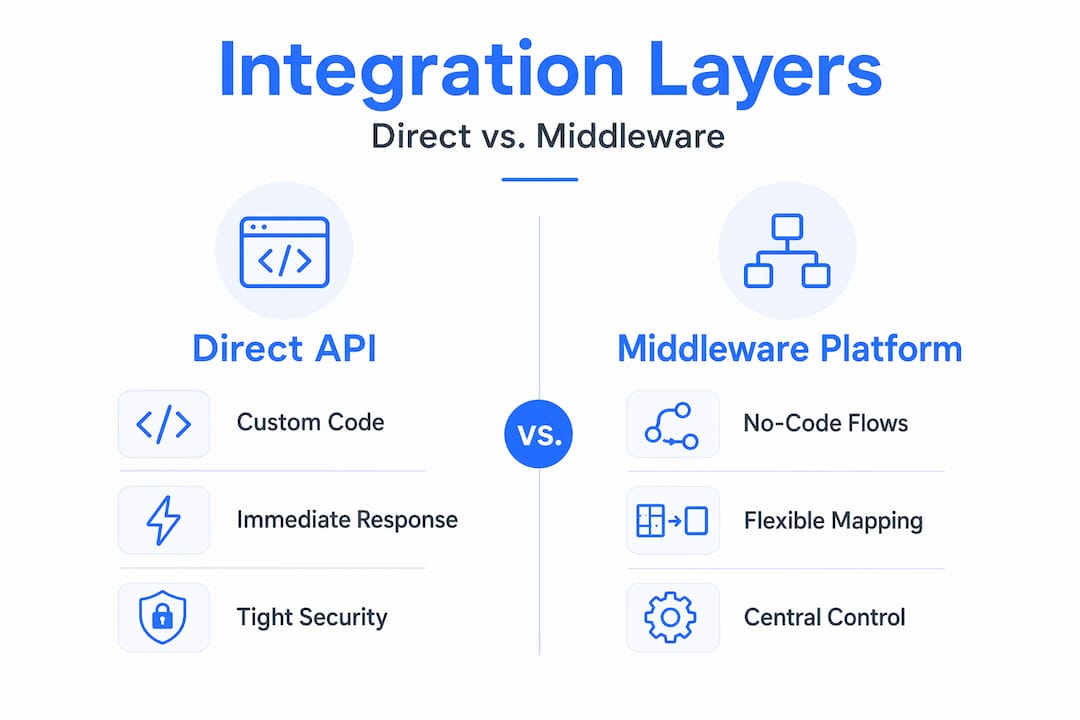
    Infographic comparing direct API to middleware integration

    Pro Tip: Before building any integration, create a one-page data flow diagram showing every system, every trigger, and every output. Teams that skip this step spend three times as long debugging misfired automations later.

    Integration patterns and architectural approaches

    With your planning done, you can choose the right architectural pattern. The wrong choice here is the most common source of integration failures.

    Embedding automation as a reusable layer

    The most durable approach is to treat document automation as a reusable embedded layer inside the systems where your teams already work, rather than a separate application they have to switch to. When automation runs programmatically within your CRM or ERP, adoption follows naturally because the user never leaves their existing interface.

    Coworkers collaborating on automation tools

    Understanding API execution models

    This is where most integrations get into trouble. Document automation APIs use three distinct execution patterns, and treating them interchangeably breaks workflows:

    1. Synchronous generation. The API call returns the finished document immediately. Use this for simple, fast document creation where the caller can wait a few seconds.

    2. Asynchronous processing with polling. You submit a job, receive a task ID, and poll a status endpoint until the document is ready. Use this for complex PDF operations, large batch jobs, or any processing that takes more than a few seconds.

    3. Webhook-driven events. The system calls back to your endpoint when an event completes, such as a signature being applied. Use this for e-signature workflows where completion time is unpredictable.

    The table below maps common enterprise use cases to the right execution model:

    Use case Execution model Why it fits
    Generate a quote from CRM data Synchronous Fast, single-record, caller waits
    Convert and compress large PDF batches Async with polling Processing time varies by file size
    Route contracts for e-signature Webhook callback Signer response time is unpredictable
    Trigger downstream ERP update on signing Webhook callback Event-driven, not time-driven

    A real-world example: SharePoint and Power Automate

    SharePoint Online supports structured document generation by turning Word templates into AI-powered forms. When a user submits the form, the document saves automatically to a library with all field values mapped. From there, a Power Automate flow picks up the document, routes it to DocuSign for signing, and writes the signed document back to the originating ERP record.

    This pattern works because each step has a clear handoff. The metadata fields on the SharePoint document carry signer names, email addresses, and record IDs so that the signed document maps back to the correct ERP record without any manual matching.

    Pro Tip: When designing flows that cross more than two systems, assign a unique correlation ID to each document at creation time and pass it through every API call. This makes debugging a failed workflow a matter of filtering logs, not guessing.

    Common integration pitfalls and how to avoid them

    Even well-planned integrations run into predictable problems. Knowing them in advance saves significant rework.

    • Assuming all API calls are synchronous. If your workflow calls a PDF processing API and expects an immediate response, it will time out under load. Always check the API documentation for execution model before building the flow.

    • Skipping idempotency. If a webhook fires twice due to a network retry, a naive integration creates two signed documents or triggers two ERP updates. Build idempotency keys into every write operation so duplicate events produce no effect.

    • Filename-based document matching. Relying on filenames to map a returned signed document to its source record is fragile. Use structured metadata fields like signer email and record ID instead. Filenames get changed; metadata fields do not.

    • Skipping parallel testing. Running new automation pipelines alongside existing RPA workflows before full cutover lets you compare outputs, catch field mapping errors, and identify cost drivers before they affect production.

    • Broad permission scopes for AI agents. If you are connecting document automation to AI agents, use constrained permission models. Model Context Protocol allows scoped document operations for AI-driven workflows, limiting what an agent can do to only the actions it genuinely needs.

    The most expensive integration mistakes are not technical failures. They are design failures: workflows built on assumptions about API behavior that nobody verified before go-live.

    Measuring success and maintaining reliable workflows

    Getting the integration running is step one. Keeping it reliable and improving it over time is the real work.

    Audit trails are the foundation. Capturing document lifecycle events including signer identity, timestamps, and status changes is required for GDPR compliance and gives you the traceability to diagnose any workflow issue after the fact. Store this data in your own systems alongside provider-generated logs so you retain portability if you ever change vendors.

    When you scale to thousands of documents per day, a few practices become critical:

    • Monitor queue depths and processing times, not just success or failure counts.

    • Set up alerts for documents stuck in pending states beyond a defined threshold.

    • Log every state transition explicitly so you can reconstruct the full lifecycle of any document on demand.

    • Review failed document events weekly and categorize them by root cause to spot systemic issues early.

    Continuous improvement comes from treating your document workflows like software. Collect user feedback from the teams submitting and approving documents. Track where delays occur. The analytics from an integrated document automation platform will surface patterns you cannot see when documents are moving through email threads.

    Pro Tip: Set a quarterly review cadence specifically for your document automation workflows. Pull the error logs, review processing times, and ask the teams using the system what still feels manual. The answer usually points to the next integration worth building.

    The efficiency gains from a properly connected system are substantial. Organizations that automate existing workflows across their document lifecycle consistently report faster cycle times, fewer data entry errors, and better visibility into where approvals are stalling. The key is measuring these outcomes from baseline so you can demonstrate the value of the integration investment.

    My take on integrating document automation in enterprise environments

    I have watched organizations spend months building document automation tools as standalone applications, only to see adoption stall because users had to leave their CRM or ERP to generate a document. The insight that changed how I think about this is simple: embedding automation inside systems where work happens removes the friction that kills adoption. The document gets created in context, and nobody has to remember to use a separate tool.

    The second thing I have learned is that API design quality matters more than feature lists. I have seen integrations built on well-documented, stable APIs that ran for three years without a maintenance call. I have also seen integrations built on underdocumented APIs that required constant patching. Before you commit to a document automation platform, test the API with real data from your systems. Check how it handles errors, what the retry behavior looks like, and whether the async patterns match what your workflows need.

    My strongest recommendation for anyone starting this work: do not try to automate everything at once. Pick one high-volume, high-friction document workflow, integrate it properly with full metadata tracking and audit logging, measure the improvement, and then scale. The teams that try to connect every system in a single project almost always end up with a fragile, partially working integration that nobody trusts. Start small, prove it works, and build from there.

    — Vivek

    See how Docupow handles the integration work for you

    If you have mapped your workflows and know what you need to connect, the next question is which platform makes that integration practical rather than painful.
    https://docupow.ai

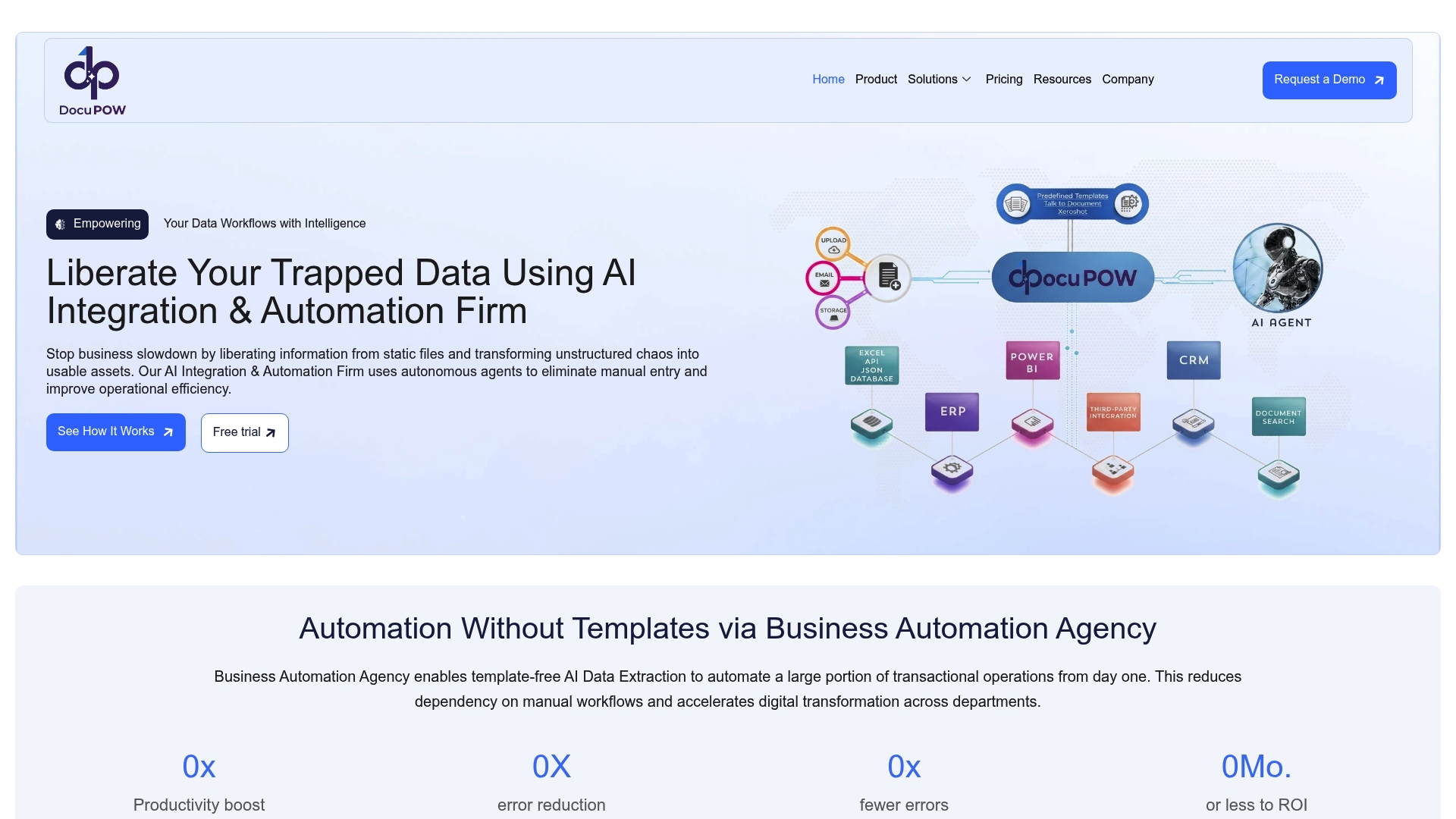
    Docupow is built API-first, which means you can embed it directly into your CRM, ERP, HR system, or custom application without rebuilding your existing processes around it. Pre-built connectors for Microsoft Power Automate and Zapier cover the most common enterprise workflow patterns out of the box. For teams in logistics or insurance, Docupow offers industry-specific workflow configurations that account for the document volumes and compliance requirements those environments demand. If your use case is more complex, the Docupow product supports full custom API integration with the autonomous AI agents that understand document context, not just field positions.

    FAQ

    What does it mean to connect document automation to existing systems?

    It means wiring your document generation, review, and signing workflows directly into the platforms your team already uses, such as your CRM, ERP, or SharePoint, so documents are created, routed, and stored automatically without manual steps between systems.

    What API execution model should I use for e-signature workflows?

    Use webhook callbacks for e-signature workflows. Since signer response time is unpredictable, webhook-driven events let the signing platform notify your system when the event completes rather than requiring your application to poll repeatedly.

    How do I prevent duplicate documents when integrating automation tools?

    Build idempotency keys into every write operation in your workflow. This way, if a webhook or API call fires more than once due to a network retry, the duplicate event has no effect and only one document is created or updated.

    What is the best way to track signed documents back to source records?

    Use structured metadata fields such as signer email and record ID rather than filename matching. Metadata-based tracking is reliable because those fields travel with the document through every system, while filenames are easily changed or duplicated.

    How do I keep AI agents secure when connecting them to document automation?

    Constrain what each AI agent can do using a scoped permission model. Model Context Protocol lets you define exactly which document operations an agent is allowed to perform, reducing the risk of unintended actions across your document workflows.


  • AI Workflow Automation Services: 2026 Enterprise Guide

    AI Workflow Automation Services: 2026 Enterprise Guide


    TL;DR:

    • AI workflow automation services use artificial intelligence to execute and manage business processes with minimal human intervention. They increase efficiency, reduce manual work, and provide scalable, secure governance frameworks for enterprises.

    AI workflow automation services are software systems that use artificial intelligence to execute, route, and manage business processes with minimal human intervention. The industry term for the broader category is intelligent process automation, which combines robotic process automation, machine learning, and agentic AI into a single operational layer. Enterprises adopting these services report measurable gains in speed, accuracy, and cost control across finance, HR, supply chain, and operations. Centralized governance models such as the Automation Center of Excellence set the standard for scaling these programs without creating security gaps. DocuPOW applies this same architecture to document-heavy workflows, freeing teams from manual data entry and giving decision-makers real-time visibility into their operations.


    What are AI workflow automation services and how do they work?

    AI workflow automation services combine three distinct technologies: rule-based automation for predictable tasks, machine learning for pattern recognition, and agentic AI for context-dependent decisions. Each layer handles a different level of process complexity. Rule-based automation handles invoice routing. Machine learning classifies incoming documents. Agentic AI decides what to do when a document does not match any known pattern.

    Hands typing on laptop in tech office

    Agentic AI uses intent-based design, meaning the system reads the full context of a request before acting. This is fundamentally different from a conditional script that checks one field and fires a response. The result is fewer dropped handoffs between systems and fewer exceptions that require human escalation.

    Integration is the backbone of any working automation program. Modern platforms connect to ERP systems, CRM platforms, and legacy databases through APIs, which means your existing tools do not need to be replaced. Enterprise API integration examples from 2026 show that most production deployments connect four or more core business systems in a single workflow.

    Infographic outlining AI workflow automation process steps

    Security and auditability are built into the architecture, not added later. Features like role-based access control, model version control, and full audit trails allow compliance teams to trace every automated decision back to its source. SOC 2 compliance is the baseline standard most enterprise buyers require before signing a contract.

    Key components every enterprise automation platform must include:

    • Agentic AI engine that reads context and makes decisions without rigid templates
    • API integration layer connecting ERP, CRM, and document management systems
    • Intelligent document processing for extracting structured data from unstructured files
    • Audit trail and version control for compliance and model governance
    • Multi-tenant governance supporting multiple business units under one security policy

    Pro Tip: Before evaluating any platform, ask vendors to demonstrate how their system handles a document it has never seen before. That single test reveals whether you are buying true agentic AI or a sophisticated template matcher.


    How do these services improve efficiency and reduce manual workload?

    The productivity case for intelligent workflow services is concrete and fast. Managed AI workflow automation deploys production-ready agents within weeks, reducing manual workflow touches by 30–50% and recovering 10–25 or more working hours weekly per team. That is not a long-term projection. Teams see those numbers within the first month of deployment.

    The gains show up differently across departments, but the pattern is consistent.

    • Finance teams eliminate manual invoice matching, three-way PO reconciliation, and exception coding
    • HR departments automate onboarding document collection, compliance checks, and benefits enrollment routing
    • Sales operations route contracts through approval chains without human coordination
    • Supply chain teams extract data from supplier documents and update inventory systems automatically

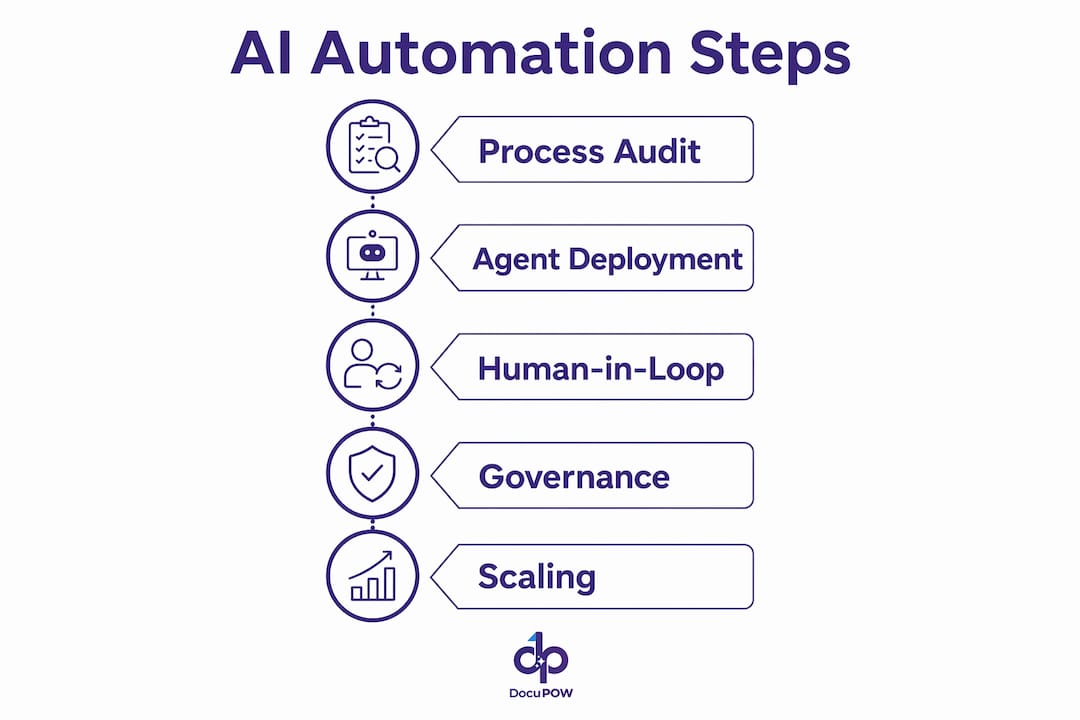
    Human-in-the-loop architecture is what makes these gains sustainable. Routing low-confidence tasks to human reviewers with the right context prevents errors from compounding downstream. The AI handles the high-volume, high-confidence work. Humans handle the exceptions that require judgment. This division of labor is what separates reliable automation from brittle automation.

    Automated AI business processes also reduce the cost of errors. When a human manually keys data from a PDF into an ERP system, the error rate is measurable and cumulative. Automated extraction with confidence scoring catches discrepancies before they reach the ledger. DocuPOW applies this model specifically to document workflows, using autonomous agents that understand document context rather than matching fields to a fixed template.


    What governance frameworks ensure scalable, secure automation?

    Governance is the part of AI workflow automation for enterprises that most teams underestimate until something breaks. The Automation Center of Excellence (CoE) is the organizational model that prevents that outcome. Enterprises with a centralized CoE achieve 60% faster time-to-value and 40% lower maintenance costs for automation projects. Those numbers reflect the compounding benefit of having one team own standards, tooling, and deployment practices.

    Without a CoE, enterprises fail to scale and face fragmented AI adoption that creates security and compliance failures. The failure mode is predictable: individual departments deploy their own agents, governance breaks down, and the organization ends up with shadow AI that bypasses security controls.

    Agent sprawl is the primary cause of AI automation failure. It happens when AI agents multiply without central oversight, each one operating under different rules, accessing different data, and logging activity in different places. The fix is not technical. It is organizational.

    A working governance framework includes four practices:

    1. Centralized agent registry listing every deployed agent, its owner, its data access scope, and its last audit date
    2. Role-based access control preventing any agent from accessing data outside its defined scope
    3. Model version control so every change to an agent’s logic is tracked and reversible
    4. Continuous monitoring dashboards showing agent performance, error rates, and escalation frequency in real time
    Governance element Purpose Risk if absent
    Agent registry Tracks all deployed agents Shadow AI, unaudited access
    Role-based access Limits data exposure Compliance violations
    Version control Tracks logic changes Untraceable errors
    Monitoring dashboards Flags performance issues Silent failures

    Pro Tip: Assign a named owner to every AI agent at deployment. Ownerless agents are the first ones to go unmonitored and the first ones to create compliance problems.


    How to plan and implement AI workflow automation successfully

    The most common implementation mistake is automating a broken process. Process mining and converting fragmented SOPs into explicit decision logic must happen before any AI agent touches a live workflow. If your current process has undocumented exceptions, workarounds, and tribal knowledge baked in, the AI will inherit all of it.

    Start with a process audit. Map every step, every decision point, and every exception path. Turn that map into explicit rules before selecting an automation model. This work is not glamorous, but it determines whether your deployment succeeds or fails.

    Not every process needs autonomous AI. Determining where rule-based automation ends and agentic reasoning begins is one of the most valuable decisions in your implementation plan. A vendor invoice with a fixed format and predictable fields does not need an agentic system. A complex supplier contract with variable clauses and conditional obligations does.

    Staged deployment is the safest path to scale. Run a pilot on one process, one team, and one data source. Measure error rates, escalation frequency, and time savings against your baseline. Use those results to refine the model before expanding. Modern agent management platforms cut development time for complex workflows by over 65%, which means the iteration cycle is fast enough to course-correct without major cost.

    Key steps for a successful rollout:

    • Audit first. Document every process step and exception before writing a single automation rule.
    • Classify by complexity. Separate rule-based tasks from those requiring contextual judgment.
    • Pilot on low-risk processes. Choose a workflow where errors are visible and recoverable.
    • Define escalation triggers. Set confidence thresholds that route uncertain decisions to human reviewers.
    • Integrate incrementally. Connect one system at a time to reduce disruption and isolate issues.

    Operational reporting workflows are a strong pilot candidate for most enterprises. They are high-frequency, data-intensive, and the output is easy to validate against existing reports.


    Key Takeaways

    AI workflow automation services deliver the fastest, most durable results when governance, process clarity, and agentic AI design work together from the start.

    Point Details
    Audit before automating Map every process step and exception path before deploying any AI agent.
    Match AI type to task complexity Use rule-based automation for predictable tasks and agentic AI for context-dependent decisions.
    Build a governance CoE A centralized Automation Center of Excellence cuts maintenance costs by 40% and speeds time-to-value by 60%.
    Design human-in-the-loop triggers Set confidence thresholds so low-certainty decisions route to human reviewers automatically.
    Prevent agent sprawl Maintain a central agent registry with named owners to stop shadow AI before it starts.

    Why most automation programs stall before they scale

    I have watched well-funded automation programs collapse under their own weight, and the cause is almost never the technology. The technology works. What fails is the assumption that deploying agents is the same as building a program.

    The teams that succeed treat automation as an operational discipline, not a one-time project. They assign owners. They set standards. They review agent performance the same way they review employee performance. The teams that fail treat it as an IT deployment and move on.

    The human-in-the-loop question is where I see the sharpest disagreement. Some leaders want full automation because they equate human review with inefficiency. That is the wrong frame. Designing escalation paths based on confidence thresholds is not a concession to the technology’s limits. It is how you build a system that gets smarter over time without creating liability.

    My honest advice: start with the governance structure before you buy a single license. Know who owns the agents, who audits them, and who has authority to shut one down. That clarity will save you more time and money than any feature comparison ever will. The AI agents in operational decisions conversation is maturing fast, and the organizations winning are the ones treating it as a management challenge, not a software challenge.

    — Sameer


    DocuPOW: purpose-built for document-heavy automation

    Enterprises that process high volumes of documents face a specific problem that general automation platforms do not fully solve. Invoices, contracts, purchase orders, and compliance forms contain data locked in unstructured formats that rule-based tools cannot reliably extract.

    https://docupow.ai

    DocuPOW addresses this directly. Its autonomous agents read document context without relying on fixed templates, which means new document formats do not require manual reconfiguration. Teams get document process automation benefits from day one, including real-time analytics, audit trails, and integration with existing ERP and CRM systems. For organizations ready to move from reactive data entry to proactive decision-making, the 2026 AI automation services guide outlines exactly where to start.


    FAQ

    What are AI workflow automation services?

    AI workflow automation services are software systems that use artificial intelligence to execute, route, and manage business processes with minimal human input. They combine rule-based automation, machine learning, and agentic AI to handle tasks across finance, HR, operations, and supply chain.

    How quickly can enterprises see results from AI process automation?

    Managed AI workflow automation services deploy production-ready agents within weeks, with teams recovering 10–25 or more working hours weekly after initial deployment.

    What is agent sprawl and why does it matter?

    Agent sprawl is the unmanaged proliferation of AI agents across an organization without central oversight. It creates security risks, compliance gaps, and operational inefficiencies that are difficult to reverse once established.

    Do all business processes need agentic AI?

    No. Rule-based automation handles predictable, structured tasks effectively. Agentic AI is best reserved for processes that require contextual judgment, variable inputs, or multi-step decision-making.

    What is an Automation Center of Excellence?

    An Automation Center of Excellence is a centralized team that owns governance standards, platform selection, and deployment practices for all AI automation across an enterprise. Organizations with a CoE achieve 60% faster time-to-value and 40% lower maintenance costs compared to decentralized approaches.

  • Top 3 Ai Based Ocr Solution Alternatives 2026

    Top 3 Ai Based Ocr Solution Alternatives 2026

    Onboarding and automating complex, high volume document workflows without extensive manual setup remains difficult for enterprise teams. Most AI based OCR solutions demand template creation, repeated model training, or offer limited integration with core ERP and CRM systems. This comparison lets enterprise teams pick an alternative that minimizes manual setup and fits their integration needs without a trial-and-error cycle.

    Table of Contents

    DocuPOW

    https://docupow.ai

    At a Glance

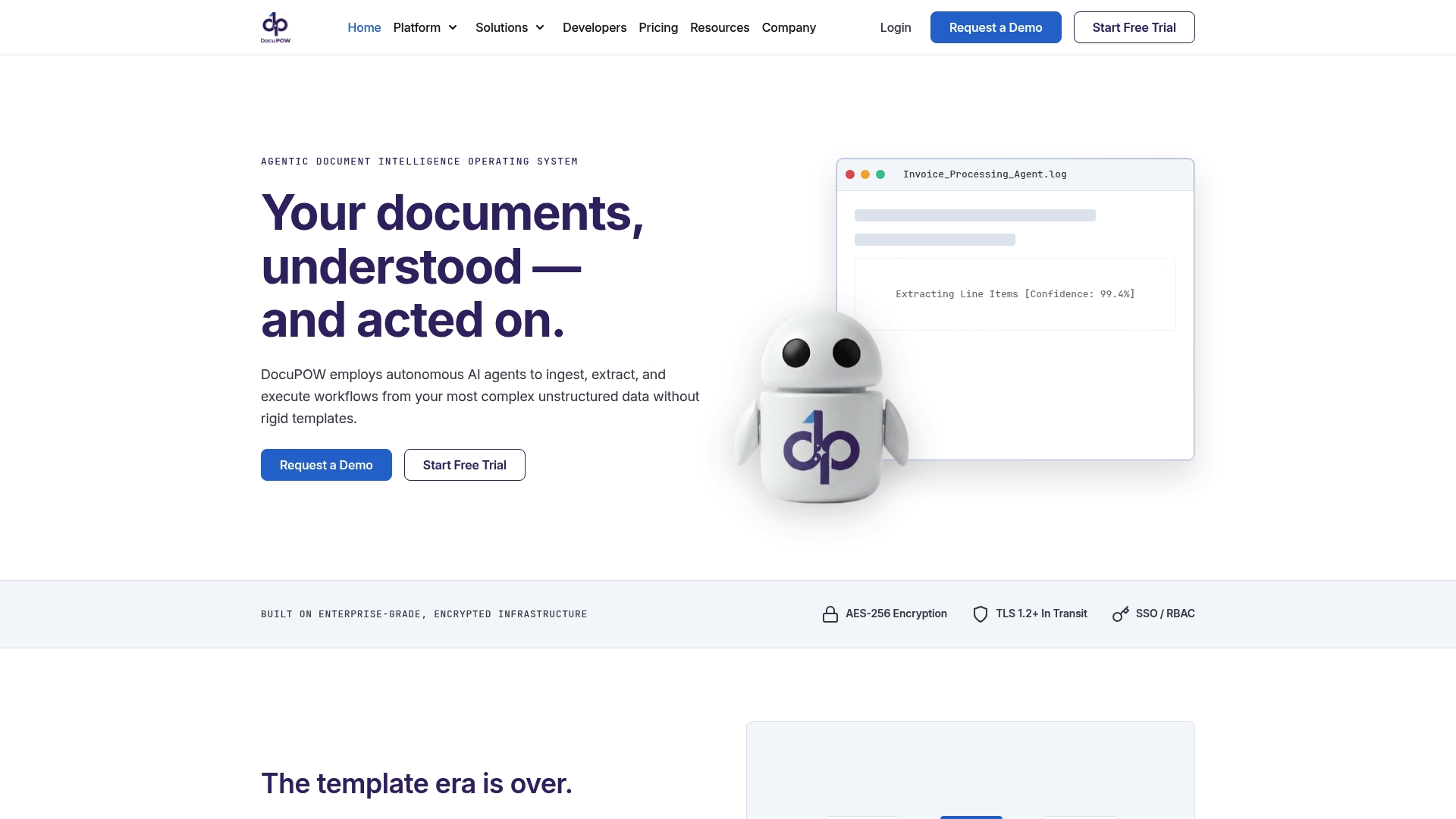
    DocuPOW reports it can extract 100+ fields from any new document type without training data. Autonomous agents read, structure, and execute workflows on complex unstructured files while removing template setup. The platform combines conversational querying, a visual workflow builder, and encrypted role based controls, targeting enterprise volume and predictive credit based pricing.

    Core Features

    DocuPOW performs Zeroshot extraction to identify fields without labeled examples and supports PDFs, images, DOCX, and XLSX. The Infinity AI assistant provides conversational access to extracted data and supports human review where needed. DocuPOW Flow offers a visual workflow builder for multi step automation, and the platform accepts ingestion via email, API, SFTP, and web upload while keeping data encrypted and governed by role based permissions.

    Key Differentiator

    The platform pairs template free extraction with visual process orchestration and a conversational assistant to move document understanding directly into executable workflows. That design lets teams automate approvals, validations, and downstream system calls without separate model training for each document type. The focus shifts from repeated training work to mapping business processes around document data.

    Pros

    No template requirement shortens onboarding for new document types and reduces manual configuration across departments. Granular confidence scores and source transparency let reviewers trace each extracted value back to the original document. That traceability eases audits and supports human in the loop validation. Built in process orchestration and the conversational assistant let teams route documents into approval paths and export validated data to ERPs. Encrypted storage and role based permissions protect access and record audit trails.

    Cons

    • The platform’s complexity may require vendor led training for optimal setup.

    Who It’s For

    Large enterprise teams that handle complex, high volume document workflows will get the most value from DocuPOW. Teams in finance, legal, healthcare, or supply chain that need template free extraction and automated end to end processes fit well. Smaller teams with limited integration resources may find the initial setup heavier than simpler tools.

    Unique Value Proposition

    Zeroshot extraction that needs no labeled training lets organizations onboard new document types without long labeling projects. Removing template creation reduces time to live for automated workflows and lowers upfront configuration cost. Predictive credit based pricing helps align costs with variable document volumes and unusual invoice flows.

    Real World Use Case

    An accounts payable team automates invoice extraction, validation, and approval using DocuPOW. The system routes exceptions for human review and posts validated entries to the ERP. That configuration lowers manual data entry and improves financial visibility across suppliers.

    Pricing

    Pricing starts at $99/month for the Starter plan when billed annually. A free trial runs for seven days. Higher volume and enterprise plans are custom priced and the vendor uses predictive credit based pricing for usage.

    Website: https://docupow.ai

    super.AI

    https://super.ai

    At a Glance

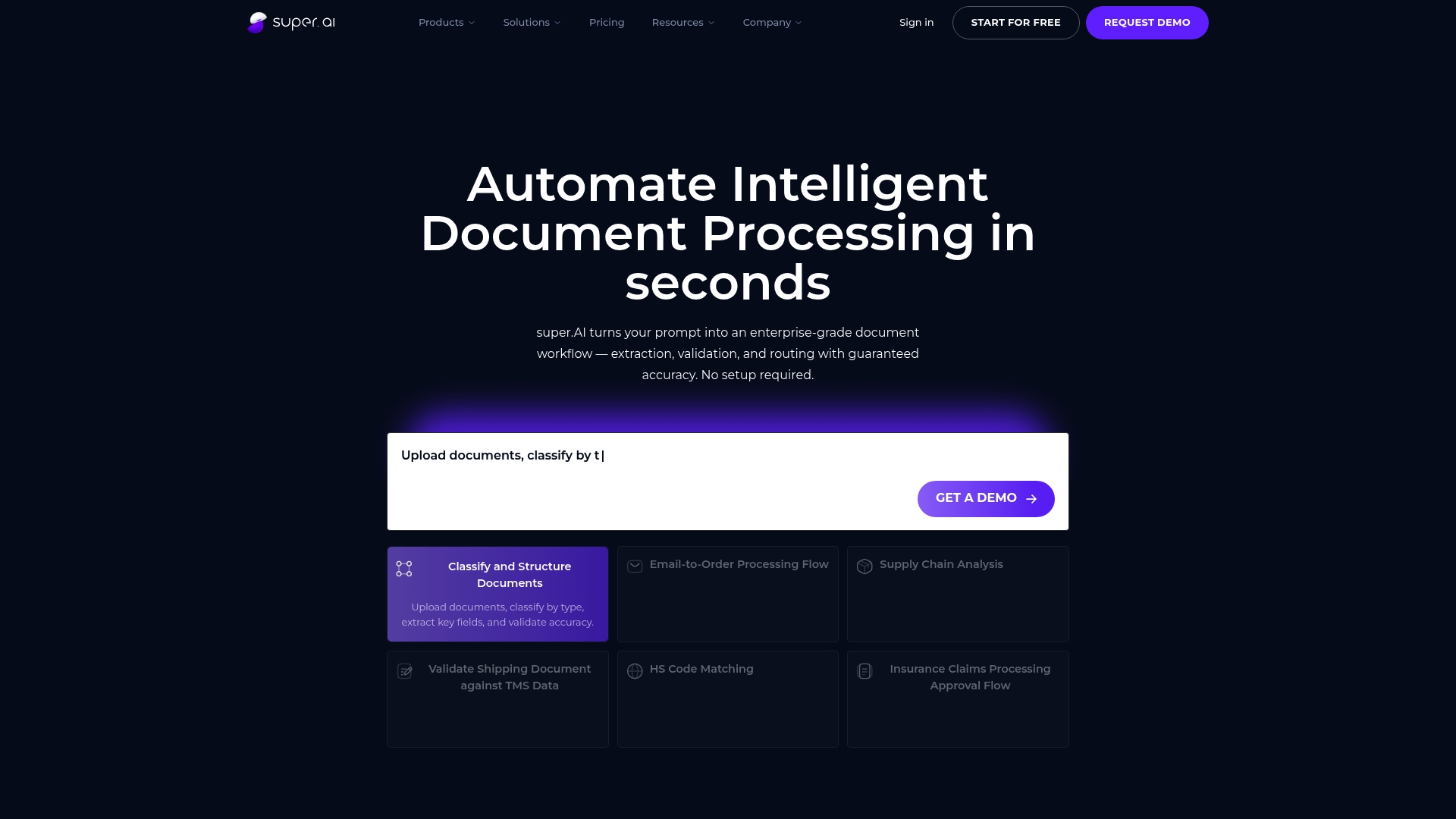
    The vendor advertises over 94% accuracy using top AI models and human review. That figure highlights the product focus on measurable extraction accuracy for invoices, customs forms, and shipping documents. The platform targets rapid deployment without large training data sets.

    Core Features

    super.AI classifies and structures documents via direct upload or email monitoring, then extracts and validates key fields. The Agentic Workflow Builder lets teams compose workflows with no code while pre built connectors link outputs to ERPs and CRMs. The platform also uses models from OpenAI, Google, and Anthropic alongside human review to raise confidence in results.

    Key Differentiator

    The company states guaranteed accuracy through integrated human review paired with enterprise grade AI models and fast rollout. That approach shifts validation into the platform instead of leaving it to downstream checks. For enterprises, the mix of model options plus human review is the main operational distinction.

    Pros

    Immediate value arrives with small setup effort and minimal onboarding, which helps teams start processing documents quickly. Human review raises final result confidence and acts as a backstop on complex document layouts. Pre built enterprise connectors simplify integration with existing ERPs and analytics platforms, while deployment choices range from self service to enterprise scale.

    Cons

    • Pricing transparency can be limited for large scale enterprise plans, which complicates budgeting for high volume use.
    • The solution depends on third party AI models, and those models may perform differently across niche document types.
    • Some advanced workflows and integrations require technical expertise and custom configuration.

    When It May Not Fit

    If your team lacks engineering resources for custom connectors, this product can demand extra support. Organizations with strict, fixed budgets for massive document volumes may find enterprise pricing complex. If you need an out of the box solution with no customization at all, this product may feel heavier than simpler capture tools.

    Notable Integrations

    super.AI connects to SalesForce, SAP, IBM, Oracle, Snowflake, Active Directory, Microsoft Dynamics, and Zapier. Those integrations cover core ERP, CRM, identity, and data warehousing needs for enterprise workflows.

    Who It’s For

    Medium to large enterprises and growing teams that require high volume, accurate document processing tied into core systems. Buyers who want configurable workflows, enterprise controls, and options for vendor managed or self service deployment will get the most value.

    Real World Use Case

    The vendor says Bureau Veritas reduced processing time by 75% per project after adopting super.AI for data capture and validation. That reduction sped invoice reconciliation and cut manual review cycles for logistics paperwork.

    Pricing

    A free tier exists for basic use, and Growth starts at $140/month for 100k credits. Custom enterprise plans are available with volume pricing and service level agreements for large deployments.

    Website: https://super.ai

    Docxster

    https://docxster.com

    At a Glance

    Docxster reports integration with more than 100 applications, covering ERP, CRM, and document management systems. The platform lets business teams visually link forms, document processing, validations, and approvals without code. It targets mid to large enterprises that must coordinate document work across operations, finance, legal, HR, and IT.

    Core Features

    Docxster provides a visual workflow builder that connects modules such as forms, document reading, validations, data tables, and approvals in a single system. The product automates reading and data extraction from unstructured documents, supports multiple languages and formats, and includes governance tools like audit trails and approvals. Role based workflows and exception handling let teams add human review where needed.

    Key Differentiator

    The platform’s defining trait is its ability to wire all modules visually, so teams configure complex workflows without programming. That visual linking covers data capture, decision rules, and document generation in one canvas. For organizations that need multi-team processes to operate inside a single system, this visual approach reduces handoffs.

    Pros

    No code workflow design hands control to business teams and reduces dependency on IT. Deep integration support with major enterprise systems lets Docxster sit inside existing stacks and move documents and data between ERP, CRM, and accounting tools. Multi language, template free document reading handles messy files and multi party workflows with approvals and exception handling. The platform also includes enterprise security features such as encryption and audit trails to support compliance.

    Cons

    • Some features are marked “Coming soon,” which means parts of the platform are not yet complete.
    • Complex workflows still require training for administrators and reviewers despite the visual builder.
    • Heavy dependence on integrations creates limitations when a needed system is not supported.

    When It May Not Fit

    Docxster is not a good match for small businesses that need a lightweight single use tool. Organizations expecting a fully finished feature set immediately may be disappointed by modules listed as coming soon. Teams that lack core enterprise systems or cannot invest in integration work will see limited value. Projects that require simple point solutions rather than multi step workflows should look elsewhere.

    Notable Integrations

    Integrations include Microsoft 365, Google Workspace, SAP, Salesforce, HubSpot, Zoho, QuickBooks, and Cargowise. Those connectors support document routing, data sync, and approval handoffs across common enterprise applications.

    Who It’s For

    Mid to large enterprise organizations that require complex, multi step document workflows across departments will benefit most. Teams in logistics, finance, real estate, and legal that coordinate many stakeholders and approvals will find the visual builder useful. IT teams that already manage ERP or CRM systems gain value from the platform’s integration focus.

    Real World Use Case

    A logistics company automates shipment documentation and customs clearance by routing scanned paperwork through Docxster workflows. The system extracts data from invoices and certificates, runs validations, and triggers approvals from compliance teams. That setup reduces manual handoffs and shortens clearance timelines.

    Pricing

    Pricing is not publicly listed. Docxster appears to use enterprise customized pricing based on deployment size and selected modules. Contact the vendor for a quote and implementation details.

    Website: https://docxster.com

    Comparison of alternatives

    Organizations seeking advanced solutions for intelligent document processing have multiple platform options tailored to distinct needs. Below, we analyze three prominent contenders: DocuPOW, super.AI, and Docxster, identifying their unique strengths and ideal use cases.

    Automated data extraction performance

    DocuPOW excels with zero-shot field extraction, enabling document understanding without the need for pre-trained templates or datasets. This contrasts with super.AI, which builds its accuracy on pre-integrated AI models along with a human validation layer for maximum result confidence. Domxster, while also proficient in data extraction, emphasizes the processing of workflows through its visually driven system, appealing to departments requiring substantial customization.

    Workflow design and customization

    Among these platforms, Docxster leads in providing a no-code, visually driven workflow designer, allowing organizations to comprehensively link document processes to approvals and validations across departments. Its integration support extends to over 100 applications. In comparison, DocuPOW supports a visual workflow builder tailored for pre-structured, enterprise-grade workflows but may require vendor-led training for full utilization, while super.AI offers pre-built connectors that prioritize rapid deployments.

    Best fit

    • Enterprises handling high-volume, template-free document integration find enormous value in DocuPOW’s zero-shot extraction.
    • Teams demanding confidence through human-reviewed AI processing can leverage super.AI for superior accuracy on intricate documents.
    • Inter-departmental coordination involving human validation through integrated workflows benefits from Docxster’s visual designer and vast software integrations.

    Our pick

    For organizations requiring the most from streamlined, template-free document processing, DocuPOW emerges as the recommended choice. Its zero-shot extraction reduces onboarding times, and its predictive pricing model ensures costs stay aligned with usage variability. However, teams prioritizing extensive workflow customization or AI model variety might find Docxster or super.AI better align with their objectives.

    Large enterprises seeking an advanced AI-driven OCR solution can compare these three platforms based on their capabilities and target applications.

    Product Core Feature Key Differentiator Best For Pricing Notable Limitation
    DocuPOW Zeroshot extraction for diverse formats Template-free workflow orchestration Large enterprises with complex document workflows Starts at $99/month May require training for initial setup
    super.AI Human review and top AI models Guaranteed accuracy with human validation Medium to large enterprises Starts at $140/month Complex enterprise pricing structure
    Docxster No-code visual workflow design Integration with 100+ enterprise systems Mid to large enterprises needing inter-departmental workflows Price not published Some features marked “Coming soon”

    Challenges in Choosing the Right Ai Based Ocr Solution for Your Enterprise

    Handling diverse document types and high-volume workflows without extensive training stands out as a key challenge for medium to large enterprises. Teams face hurdles like time-consuming template setup, limited integration options, and difficulties in routing documents through complex approval paths. These issues increase manual work and delay critical financial and operational decisions.

    DocuPOW tackles these pain points with its zero-shot extraction technology that requires no labeled training data. The platform’s autonomous agents read and process unstructured files, while its visual workflow builder and conversational AI assistant reduce configuration effort and speed up validations. Companies gain secure, role-based access with traceable audit trails to improve compliance and data accuracy.

    Gain deeper insights from the AI Archives, learn about practical applications in the DocuPow Archives, and see how DocuPOW reshapes document workflows at https://docupow.ai.

    https://docupow.ai

    Make your document processing more efficient with DocuPOW. Visit our site to see how you can automate invoice extraction, validations, and approvals without long training projects and reduce manual errors today.

    FAQ

    How does DocuPOW’s Zeroshot extraction feature work?

    DocuPOW uses Zeroshot extraction to identify fields from new document types without the need for labeled examples. This capability allows teams to extract over 100 fields from PDFs, images, DOCX, and XLSX files without lengthy preparation. Users can expect quick onboarding for various document types without the traditional setup hassle.

    What is the difference between DocuPOW and super.AI?

    super.AI guarantees over 94% accuracy through integrated human review alongside advanced AI models, making it effective for documents like invoices and customs forms. DocuPOW’s strength lies in its template-free extraction and visual process orchestration, which may be more suited for teams needing to automate complex workflows. Consider your team’s specific needs when selecting between the two platforms.

    Can I use DocuPOW for multi-step automation?

    DocuPOW offers a visual workflow builder called DocuPOW Flow, which supports multi-step automation of document-related processes. This feature simplifies workflows by allowing teams to automate tasks such as approvals and validations directly within the platform. Teams should expect a streamlined experience in managing complex document workflows.

    Does DocuPOW provide role-based permissions for document access?

    Yes, DocuPOW ensures data security through encrypted storage and role-based permissions. This allows organizations to control who can access and process sensitive documents, which is crucial for compliance and audit trails. Teams can confidently implement document solutions while maintaining strict access controls.

    What pricing options are available for DocuPOW?

    DocuPOW’s pricing starts at $99 per month for the Starter plan when billed annually. There is also a free trial available for seven days, allowing teams to evaluate the platform before committing to a subscription. Higher volume and enterprise plans are custom priced, aligning costs with usage needs.

  • Cloud Analytics Services: A 2026 Guide for Decision-Makers

    Cloud Analytics Services: A 2026 Guide for Decision-Makers


    TL;DR:

    • Cloud analytics services are cloud-hosted platforms that process data to provide scaled business insights and real-time analysis. Effective deployment depends on robust architecture, semantic layers, data governance, and cost discipline from the start. They are especially valuable for industries with high-volume, time-sensitive data like retail, finance, healthcare, and manufacturing.

    Cloud analytics services are defined as cloud-hosted platforms that ingest, store, transform, and serve data to produce business intelligence at scale. The industry term for this discipline is “cloud-based analytics,” though “cloud analytics services” is the phrase most decision-makers search when evaluating vendors and architectures. Organizations that adopt these platforms replace fixed server infrastructure with consumption-based models, gaining the ability to process fragmented data sources, run AI-driven anomaly detection, and deliver real-time insights across global teams. Data governance frameworks, FinOps cost disciplines, and semantic layers are the three pillars that separate successful deployments from expensive failures.

    1. What are the core architectural layers of cloud analytics services?

    Modern cloud analytics architectures are built around four core layers: ingestion, storage, transformation, and serving. Each layer has a distinct job, and weakness in any one of them creates downstream problems that no dashboard can fix.

    Team discussing cloud analytics architecture layers

    Ingestion is where raw data enters the system. Sources include streaming feeds, API pulls, and scheduled batch imports from ERP systems, CRMs, IoT sensors, and document workflows. The ingestion layer must handle both high-frequency event streams and large periodic file loads without dropping records or introducing latency that distorts time-sensitive analysis.

    Storage sits beneath ingestion and holds data in three zones: raw, curated, and aggregated. Raw zones preserve original records with full lineage. Curated zones hold cleaned, validated datasets ready for analysis. Aggregated zones store pre-computed summaries that power fast dashboard queries. Lineage preservation at the storage layer is what makes audit trails and compliance reporting possible.

    Transformation converts raw records into analysis-ready datasets. This layer handles schema standardization, field enrichment, deduplication, and data quality checks. Without a disciplined transformation layer, teams end up with five different definitions of “monthly revenue” across five different reports.

    Serving is the output layer. It delivers data through dashboards, REST APIs, SQL notebooks, and AI-assisted interfaces. The serving layer is where business teams actually interact with data, so its design determines whether analysts can self-serve or must queue requests with engineering.

    Layer Primary Function Common Tools and Patterns
    Ingestion Collect data from all sources Streaming, batch imports, API connectors
    Storage Preserve raw and curated data Data lakes, warehouses, lineage tracking
    Transformation Clean, enrich, and standardize ETL pipelines, schema validation, quality checks
    Serving Deliver insights to end users Dashboards, APIs, AI interfaces, notebooks

    2. What key features distinguish effective cloud analytics services in 2026?

    The most common failure in cloud analytics is lifting legacy BI tools to the cloud without changing the underlying architecture. Inconsistent metrics and conflicting dashboards result when teams skip the semantic layer. A semantic layer creates a single, governed definition for every business metric, so “conversion rate” means the same thing in the marketing dashboard as it does in the finance report.

    Governed self-service is the feature that makes a semantic layer operational. It lets analysts query data independently without breaking shared metric definitions. Without it, every new report risks introducing a new version of the truth.

    Integrated FinOps is the second non-negotiable feature. Cost monitoring must be integrated from the start, with workloads tagged by environment, team, and business owner. Without tagging, spend reports show total cloud costs but cannot tell you which team or product line generated them. That makes cost control impossible.

    AI capabilities now include anomaly detection, causal analysis, and plain-English explanations of business impacts. Cloud analytics platforms enable AI-driven insights that translate raw signals into decisions without requiring a data scientist to interpret every alert. This is the feature that moves analytics from reporting to decision support.

    Data classification supports compliance and privacy requirements by tagging fields as public, internal, confidential, regulated, or restricted. Data classification models tie access rules directly to sensitivity labels, so regulated fields are automatically protected without manual policy enforcement.

    Pro Tip: Build your semantic layer before you build your first dashboard. Retrofitting metric definitions after teams have already built reports on inconsistent data takes three times as long and creates organizational friction that slows adoption.

    3. What are the common challenges when deploying cloud analytics services?

    Deployment challenges in cloud data analysis services cluster around four recurring problems: data quality, integration complexity, compliance gaps, and processing architecture mismatches.

    Data quality and lineage management are the most common sources of project failure. When source systems use inconsistent formats, missing values, or duplicate records, the transformation layer cannot produce reliable outputs. The fix is to define quality rules at ingestion, not transformation, so bad data is flagged before it enters the storage layer.

    Security and compliance governance must be designed into the architecture from day one. Data governance is essential to manage privacy, reduce risk, and meet regulatory requirements. Organizations that treat governance as a post-launch task consistently face audit failures and data breach exposure.

    Streaming versus batch processing creates stability problems when teams try to synchronize everything in real time. Synchronous processing of all data streams is a recognized pitfall. Best practice reserves synchronous pipelines for user-critical paths and uses asynchronous pipelines for the majority of data movement. This prevents cascading failures during peak load.

    Data ownership gaps produce the same result as governance gaps: no one is accountable when a metric is wrong. Assigning clear owners to each data domain, and encoding those owners in the semantic layer, is the operational fix. AI workflow governance follows the same principle: ownership must be explicit before automation can be trusted.

    Pro Tip: Run a data lineage audit before you migrate any existing reports to a new cloud analytics platform. Knowing where each field originates, and how it has been transformed, prevents you from inheriting legacy data quality problems in your new architecture.

    4. Which industries benefit most from cloud analytics services?

    The primary value of cloud analytics has shifted toward domain intelligence: automated, contextualized insights that translate raw data into business decisions. This shift benefits specific industries more than others because their operations generate high-volume, time-sensitive data that manual analysis cannot keep pace with.

    Retail and logistics use real-time operational intelligence to monitor inventory levels, detect supply chain disruptions, and adjust pricing within minutes of a demand signal. A retailer processing point-of-sale data across thousands of locations needs a cloud analytics platform that can ingest, transform, and serve insights faster than a nightly batch job allows.

    Finance and marketing benefit from AI-assisted domain intelligence. Fraud detection, customer lifetime value modeling, and campaign attribution all require the kind of causal analysis that modern cloud platforms now deliver through automated investigation pipelines. These teams no longer need to wait for a data scientist to build a custom model for each question.

    Regulated industries including healthcare and financial services use cloud analytics for compliance-driven reporting. Data classification and governance are the features that make cloud analytics viable in these sectors. Platforms that cannot enforce field-level access controls and audit trails cannot meet HIPAA, SOX, or GDPR requirements.

    Manufacturing and construction use cloud analytics to integrate fragmented document workflows with operational data. When purchase orders, invoices, and delivery records live in separate systems, cloud analytics platforms that connect those sources give operations teams a single view of project cost and progress.

    5. How to evaluate and choose the best cloud analytics services for your organization

    The evaluation criteria that matter most are architectural fit, governance support, cost model transparency, and AI capability depth. Generic feature checklists miss the decisions that actually determine whether a platform succeeds at scale.

    Architectural fit means the platform must match your existing data sources and scale requirements. An organization running high-volume document workflows needs a platform with strong batch ingestion and lineage tracking. An organization running real-time operations needs low-latency streaming pipelines. Most enterprises need both, which is why hybrid architectural approaches that balance asynchronous bulk processing with synchronous critical paths are the most practical choice.

    Governance support is the criterion most teams underweight during evaluation. A platform that cannot enforce a semantic layer, assign data ownership, or classify fields by sensitivity will create governance debt that compounds over time. Evaluate governance features as rigorously as you evaluate query performance.

    Cost model transparency separates platforms that align spend with business value from those that generate surprise invoices. Pay-as-you-go pricing models replace fixed hardware costs with consumption-based operational spend. That flexibility is only useful if the platform provides workload-level cost attribution so you can see exactly what each team or product is spending.

    AI capability depth determines whether the platform delivers domain intelligence or just faster reporting. Evaluate whether the AI layer can detect anomalies, explain causality in plain language, and trigger automated investigations. Platforms that offer only visualization with a machine learning add-on are not the same as platforms with native AI-powered insight generation.

    Pro Tip: Request a cost attribution demo before signing any contract. Ask the vendor to show you how workload tagging works and what a monthly FinOps report looks like. If they cannot show you field-level cost breakdowns, the platform will not support real cost discipline.

    Evaluation Criterion What to Look For
    Architectural fit Supports both streaming and batch; matches your data source types
    Governance support Semantic layer, data ownership assignment, field-level classification
    Cost model transparency Workload tagging, consumption-based billing, FinOps reporting
    AI capability depth Native anomaly detection, causal analysis, plain-language explanations
    Integration flexibility API connectors, document workflow support, enterprise system compatibility

    Key Takeaways

    Successful cloud analytics adoption requires a governed, four-layer architecture with FinOps cost discipline and a semantic layer embedded from day one, not added after the first dashboard goes live.

    Point Details
    Architecture is the foundation Build ingestion, storage, transformation, and serving layers before adding AI or dashboards.
    Semantic layers prevent metric chaos Define every business metric once, centrally, to stop conflicting reports across teams.
    FinOps must start at launch Tag workloads by owner and environment from day one to align cloud spend with business value.
    Governance is not optional Data classification and ownership assignment protect compliance and build organizational trust in data.
    AI delivers domain intelligence Use platforms with native anomaly detection and causal analysis to move from reporting to decisions.

    Why most cloud analytics projects fail before they scale

    I have watched organizations invest heavily in cloud analytics platforms and still end up with the same problem they started with: nobody trusts the numbers. The root cause is almost always the same. Teams migrate their existing reports to a new cloud environment and call it modernization. They do not rebuild the architecture. They do not install a semantic layer. They do not assign data owners. They just move the mess to a faster server.

    Effective cloud analytics modernization is architectural, not just a tooling swap. The organizations that get this right treat the semantic layer and FinOps discipline as infrastructure, not features. They define metric ownership before they write the first query. They tag every workload before they run the first pipeline. That discipline feels slow at the start. It pays back in months, not years, because teams stop arguing about which dashboard is correct and start making decisions.

    The other pattern I see consistently is teams underestimating the cost of streaming everything in real time. Real-time data is genuinely valuable for operational decisions. But synchronizing every data source in real time is expensive and fragile. The teams that build the most reliable platforms use asynchronous pipelines for the majority of their data and reserve synchronous processing for the paths where latency actually changes a business outcome. That distinction, made early, saves significant infrastructure cost and prevents the cascading failures that kill confidence in a new platform.

    My honest recommendation: treat your first 90 days on a new cloud analytics platform as an architecture sprint, not a reporting sprint. Get the governance, ownership, and cost tagging right before you build a single dashboard for a business stakeholder.

    — Sameer

    How DocuPOW connects document intelligence to cloud analytics

    Organizations running cloud analytics at scale still face one persistent gap: data trapped in documents never reaches the analytics layer. Purchase orders, invoices, contracts, and delivery records sit in static files while the analytics platform waits for structured inputs it never receives.

    https://docupow.ai

    DocuPOW closes that gap with AI-powered autonomous agents that extract, classify, and route document data directly into cloud analytics workflows, without rigid templates or manual entry. For teams in real estate and construction, DocuPOW transforms document-heavy operations into governed, analytics-ready data streams. The result is faster financial visibility and decision-making grounded in complete data. Explore how DocuPOW’s AI workflow automation integrates with your cloud analytics architecture to deliver the domain intelligence your operations need in 2026.

    FAQ

    What are cloud analytics services?

    Cloud analytics services are cloud-hosted platforms that collect, store, process, and deliver data insights at scale. They replace on-premise BI infrastructure with consumption-based models that support real-time analysis, AI-driven insights, and governed self-service.

    What is a semantic layer in cloud analytics?

    A semantic layer is a centralized definition of every business metric used across an organization’s analytics platform. It prevents conflicting dashboard results by ensuring that every team queries the same definition of each metric.

    Why is FinOps important for cloud analytics?

    FinOps aligns cloud analytics spend with business value by tagging workloads to specific teams, environments, and products. Without workload tagging, cost reports show total spend but cannot identify which operations are driving it.

    How does AI improve cloud analytics for businesses?

    AI in cloud analytics detects anomalies, identifies causal relationships, and delivers plain-language explanations of business impacts. This moves analytics from passive reporting to automated decision support without requiring a data scientist for every investigation.

    What industries benefit most from cloud-based analytics solutions?

    Retail, logistics, finance, healthcare, manufacturing, and construction benefit most. These sectors generate high-volume, time-sensitive data from fragmented sources that cloud analytics platforms can integrate, govern, and analyze faster than manual methods allow.

  • What Is End-to-End Document Automation?

    What Is End-to-End Document Automation?

    Most business managers assume document automation means converting paper to PDF or generating contracts from templates. That framing misses the point entirely. What is end-to-end document automation, really? It’s the complete, connected process of ingesting a document, extracting its data, validating it against business rules, and pushing that data into the systems your organization actually runs on — without a human touching it at every step. This guide breaks down how it works, why it matters for compliance and efficiency, and where most implementations go wrong.

    Table of Contents

    Key takeaways

    Point Details
    More than document creation End-to-end automation covers the full lifecycle from ingestion to system integration, not just generating files.
    AI drives accuracy at scale Technologies like OCR, NLP, and ML work together to extract and classify data from structured and unstructured documents.
    Compliance is built in Automated audit trails, standardized templates, and validation rules reduce regulatory risk across departments.
    Exception handling is non-negotiable Human-in-the-loop review for low-confidence cases keeps automation reliable without sacrificing accuracy.
    Integration depth determines ROI How well automation connects to your ERP, CRM, and other systems separates high-value deployments from expensive experiments.

    How end-to-end document automation actually works

    The phrase “document automation” gets used loosely, so let’s be precise. End-to-end automation integrates multiple departments and systems into one connected process, not just a single task like e-signature or template population. The workflow follows what the industry calls Intelligent Document Processing, or IDP.

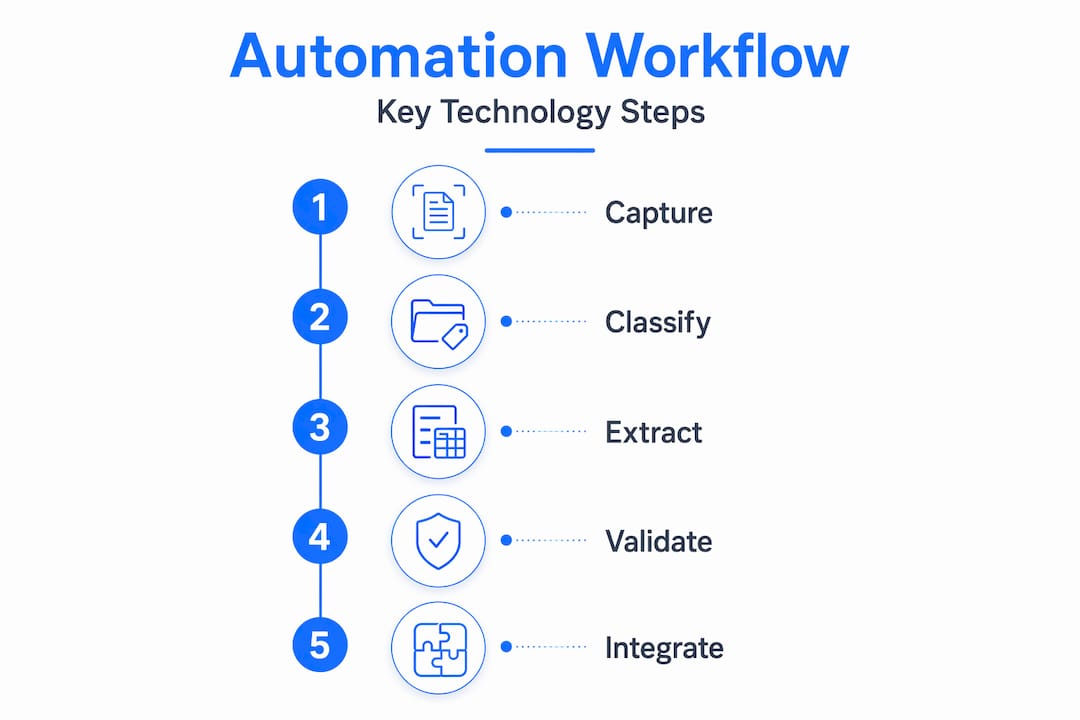
    Here’s how a mature pipeline moves from raw document to business action:

    1. Ingest. Documents arrive from any source: email attachments, scanned paper, uploaded files, or API feeds. The system accepts PDFs, images, Word files, and more without requiring a specific format.

    2. Classify. The system identifies what kind of document it’s dealing with. An invoice looks different from a purchase order or a compliance certificate. IDP uses AI, ML, NLP, and OCR to scan, categorize, and organize data from physical and digital sources.

    3. Extract. Relevant fields are pulled from the document. Vendor name, invoice total, contract dates, policy numbers. This is where template-free AI extraction separates modern systems from legacy approaches.

    4. Validate. Extracted data is checked against business rules. Does the invoice amount match the purchase order? Is the contract date within the approved window? Low-confidence extractions get flagged for human review.

    5. Integrate. Clean, validated data flows directly into downstream systems: your ERP, CRM, accounting platform, or compliance database. No manual re-entry. No copy-paste errors.

    The technology stack behind the workflow

    Combining OCR with AI-driven classification is what makes it possible to handle structured and unstructured documents at scale. OCR converts image-based text into machine-readable characters. NLP interprets context, so the system understands that “remit to” and “pay to” both refer to the payee field. ML models improve over time as they process more documents, reducing error rates without manual retraining.

    Infographic for automation workflow technology steps

    One distinction worth knowing: IDP is the AI-powered subset of document automation. Automated Document Processing (ADP) often refers to older, rules-based systems that rely on fixed templates. End-to-end automation at the enterprise level typically combines both, with AI handling the extraction and classification while business rules govern validation and routing.

    Pro Tip: Before evaluating any platform, map out every system your documents need to touch after processing. The integration layer, not the extraction engine, is where most projects stall.

    The real business benefits of document automation

    Analyst archiving folder, graph on laptop

    Speed is the benefit most managers cite first, and it’s real. Turnaround times drop from hours to minutes when validation and data entry are automated. But the more durable benefits are accuracy and compliance, and those deserve more attention than they usually get.

    Here’s what organizations consistently report after deploying complete document automation solutions:

    • Fewer errors entering downstream systems. Validated, standardized data flows mean your ERP or accounting platform receives clean inputs. Manual re-entry is where most data corruption happens.

    • Audit trails without extra work. Every document, extraction, validation decision, and exception review is logged automatically. When a regulator asks for documentation of your approval process, you pull a report instead of reconstructing a paper trail.

    • Compliance enforcement at the source. Document automation enforces approved templates and standardized clauses, reducing the risk that a contract goes out with outdated terms or a missing clause.

    • Labor reallocation, not just labor reduction. Automation reduces manual busywork, freeing staff to handle judgment-intensive tasks that actually require human thinking.

    • Cross-departmental consistency. Finance, legal, HR, and operations all working from the same validated data eliminates the version conflicts that slow decisions.

    The cost savings from reduced physical storage and manual processing are measurable, but the harder-to-quantify benefit is decision speed. When your procurement team can see validated invoice data in the ERP within minutes of receipt rather than days, purchasing decisions and cash flow management both improve.

    Implementation challenges you need to anticipate

    Here’s where most document automation projects underdeliver. The technology works. The integration and governance around it often don’t.

    • Legacy system integration is the hardest part. Most enterprises run ERP or CRM platforms that weren’t built with API-first connectivity in mind. Getting clean data into those systems requires custom connectors, field mapping, and ongoing maintenance.

    • Workflow orchestration is more complex than it looks. Enterprise-grade automation requires event-driven triggers, queues, workflow states, confidence scoring, and human-in-the-loop exception management to function reliably. A simple extraction tool doesn’t give you any of that.

    • Data quality depends on input quality. Blurry scans, inconsistent document formats, and missing fields all degrade extraction accuracy. Garbage in, garbage out still applies.

    • Template dependence limits scalability. Systems built on rigid templates break when a vendor sends a slightly different invoice layout. Template-free extraction using AI handles document variation without manual reconfiguration.

    • Change management is underestimated. Staff who’ve built workflows around manual review need training, clear exception protocols, and confidence that the system flags what it’s uncertain about.

    Pro Tip: Start with a single high-volume, high-pain document type, such as vendor invoices or new hire onboarding packets. Prove the ROI there before expanding. Trying to automate everything at once is how projects lose executive support.

    Business rules and exception handling are not optional add-ons. They’re what separate a proof-of-concept from production-grade automation. Any vendor that can’t clearly explain how their system handles low-confidence extractions should raise a flag.

    Where document automation delivers across industries

    The applications span every department that touches documents, which is every department.

    Finance and procurement

    Invoice processing is the most common starting point, and for good reason. The volume is high, the format variation is significant, and the cost of errors flows directly to the bottom line. Automation handles three-way matching between purchase orders, invoices, and receipts, then routes exceptions for human review before pushing approved data to the ERP. For supply chain operations, this means faster payment cycles and better supplier relationships.

    Document automation covers the full contract lifecycle, from drafting through approval routing, version tracking, and compliance enforcement. Legal teams using automation report fewer redline cycles and faster time-to-signature. The audit trail is built in, which matters during disputes or regulatory reviews.

    Insurance and financial services

    Insurance document workflows involve high document volumes, strict regulatory requirements, and significant variation in form types. Automation extracts policy data, validates coverage terms, and routes claims documents without manual sorting. For fintech and banking, the same approach applies to loan applications, KYC documents, and compliance filings.

    Manufacturing and logistics

    Global manufacturers deal with bills of lading, quality certificates, customs documents, and supplier invoices across multiple languages and formats. Manufacturing document automation connects these documents directly to ERP systems, giving operations teams real-time visibility into supply chain status. For logistics providers, automated processing of shipping documents reduces clearance delays and billing errors.

    The table below shows how automation maps to specific use cases across departments:

    Department Document type Automation benefit
    Finance Vendor invoices Three-way match, ERP integration, error reduction
    Legal Contracts Lifecycle tracking, clause enforcement, audit trail
    HR Onboarding packets Data extraction, system population, compliance logging
    Operations Purchase orders Approval routing, validation, procurement system sync
    Logistics Shipping documents Real-time status updates, billing accuracy, customs prep

    Emerging trends worth watching include AI orchestration layers that coordinate multiple specialized models for different document types, and zero-shot learning approaches that handle document types the system has never seen before without retraining.

    My take: most organizations are solving the wrong problem

    I’ve watched organizations spend months selecting a document automation platform and then spend years fighting their own implementation. The pattern is consistent. They focus on the extraction engine and ignore the orchestration layer. They buy a tool that produces clean data extractions and then discover there’s no reliable way to route exceptions, track workflow states, or integrate with the five systems that actually need that data.

    The other mistake I see constantly is treating automation as a cost-cutting exercise rather than a workflow transformation. When the goal is headcount reduction, the project gets scoped too narrowly. You automate one document type, save a few hours per week, and declare success. The real value comes when automation connects across departments, so a validated invoice automatically triggers a payment approval workflow, updates the vendor record in the CRM, and logs the transaction in the ERP without anyone touching it.

    Exception management is where I’d tell every decision-maker to spend disproportionate attention. How the system handles the 15% of documents that don’t process cleanly determines whether your team trusts it for the 85% that do. A system that silently fails on edge cases will erode confidence faster than any other factor.

    The organizations I’ve seen get genuine ROI from end-to-end document automation share one trait: they treat it as a strategic capability, not a one-time deployment. They tune models, refine business rules, and expand integration depth over time. That ongoing investment is what separates a tool from a competitive advantage.

    — Vivek

    See what Docupow does differently

    https://docupow.ai

    Docupow is built for organizations that need more than a template-based extraction tool. Its AI-powered agents understand document context without rigid templates, which means it handles the variation in real-world document volumes that breaks rule-based systems. From operations and workflow automation to industry-specific deployments in insurance, logistics, real estate, and construction, Docupow connects document data directly to the business systems your teams rely on. The platform includes human-in-the-loop review, real-time analytics, and confidence scoring built into the workflow. If your organization is ready to move from manual processing to a production-grade automation pipeline, explore what Docupow can do for your specific document types and systems.

    FAQ

    What is end-to-end document automation?

    End-to-end document automation is the complete process of ingesting, classifying, extracting, validating, and integrating document data into business systems without manual handling at each step. It covers the full lifecycle from document receipt to data appearing in your ERP, CRM, or compliance platform.

    How does document automation differ from just using templates?

    Template-based systems break when document formats change, requiring manual reconfiguration. Modern IDP systems use AI to extract data from diverse document types without predefined templates, making them far more scalable.

    What technologies power document automation?

    Document automation combines OCR for text recognition, NLP for contextual understanding, and ML models that improve accuracy over time. Workflow orchestration tools manage routing, exception handling, and system integration.

    What are the biggest benefits of document automation?

    The core benefits include faster processing cycles, fewer data entry errors, built-in audit trails for compliance, and labor reallocation from manual tasks to judgment-intensive work. Compliance is enforced automatically through standardized templates and validation rules.

    Why do document automation projects fail?

    Most failures trace back to underestimating integration complexity, skipping workflow orchestration, or treating exception handling as an afterthought. Reliable enterprise automation requires event-driven triggers, confidence scoring, and human-in-the-loop review to function at production scale.