TL;DR:
- AI integration services embed AI into business systems to automate data handling and decision-making processes. Successful projects use phased deployment, focus on robust validation controls, and prioritize vendor transparency on failure management. Proper knowledge transfer and governance are essential to prevent vendor lock-in and ensure operational resilience.
Artificial Intelligence Integration Services are defined as the process of embedding AI capabilities directly into existing business systems to automate, classify, and interpret data at scale. For document-heavy organizations, this is the difference between manual bottlenecks and real-time decision-making. Only 39% of technology leaders are confident their AI investments will yield positive financial returns. That gap exists because most teams focus on the technology itself rather than the integration quality behind it. Organizations with mature, AI-ready data capabilities achieve 65% better business outcomes. That number makes the case for getting integration right from the start, not as an afterthought.
What are Artificial Intelligence Integration Services?
Artificial Intelligence Integration Services connect AI models, including machine learning integration pipelines, natural language processing engines, and computer vision systems, to the workflows your teams already use. The industry term for this discipline is intelligent system integration, and it covers everything from API connections to full-scale AI deployment services that replace manual document handling. The goal is not to install a new tool. The goal is to make your existing systems smarter without rebuilding them from scratch.

For document workflows specifically, this means AI reads incoming files, extracts structured data, routes exceptions to human reviewers, and feeds clean records into your ERP or CRM. A manufacturer receiving hundreds of purchase orders daily does not need a bigger data entry team. They need an AI layer that reads each document, validates the data, and flags only the records that need a human decision. That is what mature AI integration solutions deliver.
How do you evaluate AI service providers?
Choosing the wrong AI service provider is expensive. Most teams make the mistake of evaluating vendors on team size, certifications, or the sophistication of their demo environment. Businesses most often fail by selecting partners based on buzzwords rather than production track record and a problem-first approach.
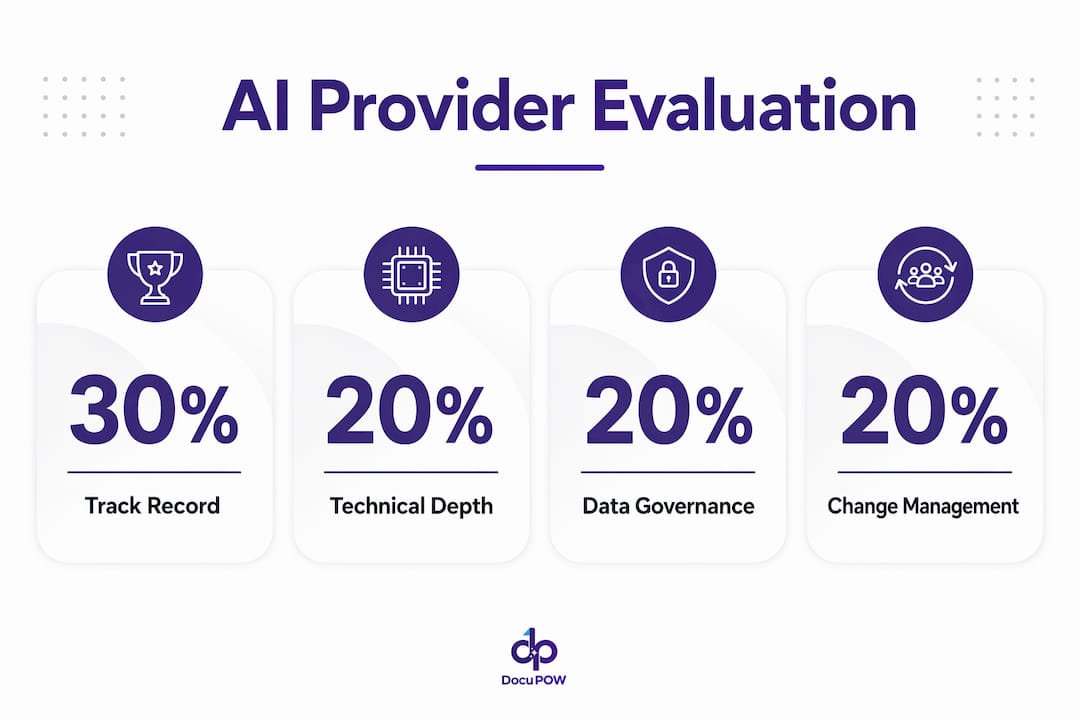
A structured evaluation framework assigns weight to four factors:
- Production track record (30%): Has the vendor deployed AI in production environments similar to yours? Ask for references from clients who went live, not just pilot customers. Any vendor scoring below 3 out of 5 on production maturity should be disqualified early.
- Technical depth (20%): Can the team explain their model selection rationale, data pipeline architecture, and failure handling without defaulting to marketing language?
- Data governance (20%): Does the vendor maintain audit trails, enforce access controls, and document data lineage? Governance is not optional for regulated industries.
- Change management (20%): Does the vendor have a plan for training your team, managing resistance, and measuring adoption after go-live?
Evaluation criteria weights place production track record at 30%, with technical depth, data governance, and change management each at 20%. That weighting reflects where real projects fail most often.
Pro Tip: Ask every vendor candidate one specific question: “Describe a production failure you experienced and how you resolved it.” Vendors who give a concrete, honest answer demonstrate the operational maturity you need. Vendors who deflect or describe only successes are a red flag.
What does a phased AI integration approach look like?
Successful AI integration does not happen in a single deployment sprint. Phased integrations with short proof-of-concept pilots lasting 4–8 weeks, followed by structured legacy system integration, reduce long-term dependency risks significantly. That timeline is not arbitrary. It gives your team enough data to validate model performance before committing to a full rollout.
A practical phased approach follows this sequence:
- Proof of concept (weeks 1–8): Run the AI model against a representative sample of your real documents. Measure extraction accuracy, exception rates, and processing speed. Set a minimum accuracy threshold before advancing.
- Legacy system integration (weeks 9–20): Connect the validated AI layer to your existing ERP, document management system, or workflow tool. Build the routing logic that sends exceptions to human reviewers.
- Parallel operation (weeks 21–28): Run AI and manual processes side by side. Compare outputs daily. This phase catches edge cases that the pilot missed.
- Full deployment and monitoring: Transition fully to AI-driven processing with live dashboards tracking accuracy, throughput, and error rates.
Knowledge transfer is the step most vendors skip. Your team needs architecture documentation, operational runbooks, training sessions, and full source code ownership before the vendor relationship ends. Without these deliverables, you trade one dependency for another. Comprehensive knowledge transfer is what separates a successful integration from a long-term vendor lock-in situation.
Pro Tip: Build a “day two” clause into your contract. This requires the vendor to provide a defined set of knowledge transfer deliverables, including runbooks and architecture diagrams, before final payment is released. It changes the incentive structure immediately.
What are the technical risks in AI document processing?
Document processing is not a single technical problem. Thoughtworks research identifies three distinct challenges: layout-aware text extraction, structural table parsing, and semantic interpretation. Each requires a different technical approach. Treating them as one problem leads to overengineered solutions that are fragile and expensive to maintain.
The most dangerous risk in document AI is silent failure. Silent failure occurs when incorrect data passes through the system without triggering any error alert. A misread invoice total or a misclassified vendor code propagates through your ERP undetected. By the time someone notices, the downstream damage to compliance records or financial reports is already done.
Validation and routing controls are the technical safeguards that prevent silent failure. These include:
- Confidence thresholds: The AI flags any extraction below a set confidence score for human review rather than auto-approving it.
- Schema validation: Every extracted record is checked against expected data types and value ranges before it enters your system.
- Human-in-the-loop routing: Low-confidence or anomalous documents go to a reviewer queue, not directly to your database.
- Audit trails: Every AI decision is logged with a timestamp, model version, and confidence score for traceability.
Validation and human-in-the-loop review are mandatory controls, not optional enhancements. Teams that treat them as phase-two features consistently experience data quality problems within the first 90 days of production.
Overengineering positional accuracy in layout extraction adds fragility without meaningful accuracy gains. A document AI system that breaks every time a vendor changes their invoice template is not production-ready. The better approach is training models on document intent rather than pixel-level position.
How does AI integration benefit document workflows across industries?
Mature AI integration solutions deliver measurable outcomes across manufacturing, real estate, construction, healthcare, and supply chain operations. Enterprises using mature AI integrations achieve improved automation in document workflows, which directly enhances decision-making speed and operational efficiency. The benefit is not theoretical. It shows up in processing time, error rates, and staff capacity.
Specific document types that AI integration handles effectively include purchase orders, invoices, bills of lading, compliance certificates, contracts, and inspection reports. Each of these documents contains structured and unstructured data that traditional rule-based systems handle poorly. AI models trained on real document variation handle them accurately at scale.
The business outcomes from AI-driven document automation include:
- Faster invoice approval cycles, reducing days payable outstanding
- Fewer manual data entry errors, which lowers rework costs and audit risk
- Real-time visibility into document status across the supply chain
- Compliance documentation that is complete, timestamped, and audit-ready without manual assembly
- Staff redeployment from data entry to higher-value analysis and decision-making
Operational agility is the outcome that surprises most teams. When your document processing runs on AI, you can absorb volume spikes, such as end-of-quarter purchase order surges, without adding headcount. That capacity flexibility has direct financial value. For real-world examples of AI document processing in manufacturing and logistics, the pattern is consistent: accuracy improves, cycle times drop, and teams shift from reactive firefighting to proactive planning.
Compliance is another underrated benefit. Regulated industries require complete audit trails for every document decision. AI systems with proper governance built in generate those trails automatically. Manual processes rarely do.
Key Takeaways
Successful AI integration for document workflows requires production-proven vendors, phased implementation, and mandatory validation controls to prevent silent failures and long-term operational dependencies.
| Point | Details |
|---|---|
| Evaluate on production track record | Weight vendor selection 30% on production maturity; disqualify any vendor below 3 out of 5. |
| Use a phased rollout | Run a 4–8 week proof of concept before committing to full legacy system integration. |
| Treat document processing as three problems | Layout extraction, table parsing, and interpretation each need a distinct technical approach. |
| Mandate validation controls | Confidence thresholds and human-in-the-loop routing are required to prevent silent data failures. |
| Require knowledge transfer deliverables | Architecture docs, runbooks, and source code ownership must be contractual, not optional. |
Why most AI integration projects underdeliver
I have reviewed enough AI integration projects to recognize the pattern early. The vendor presents a polished demo. The procurement team is impressed by the interface. The contract gets signed. Then, six months into production, the team discovers that the model was never tested on their actual document formats, the vendor has no rollback plan, and the knowledge transfer “deliverables” amount to a slide deck.
The teams that get this right share one habit: they evaluate vendors on how they handle failure, not how they describe success. Governed systems thinking means the vendor can show you their monitoring dashboards, explain their rollback procedure, and name the specific failure modes they have encountered in production. That level of transparency is rare. When you find it, it is worth paying for.
The other mistake I see repeatedly is treating knowledge transfer as a courtesy rather than a contractual obligation. Your team needs to own the system after the vendor leaves. If you cannot explain how the model works, retrain it on new document types, or diagnose a drop in accuracy, you are not running an AI integration. You are renting one. That distinction matters enormously when the vendor raises prices or exits the market.
Governance, monitoring, and rollback capabilities matter more than any individual feature. A system that can detect its own degradation and alert your team is worth more than one with a better extraction accuracy score on day one.
— Sameer
DocuPOW’s approach to document workflow AI
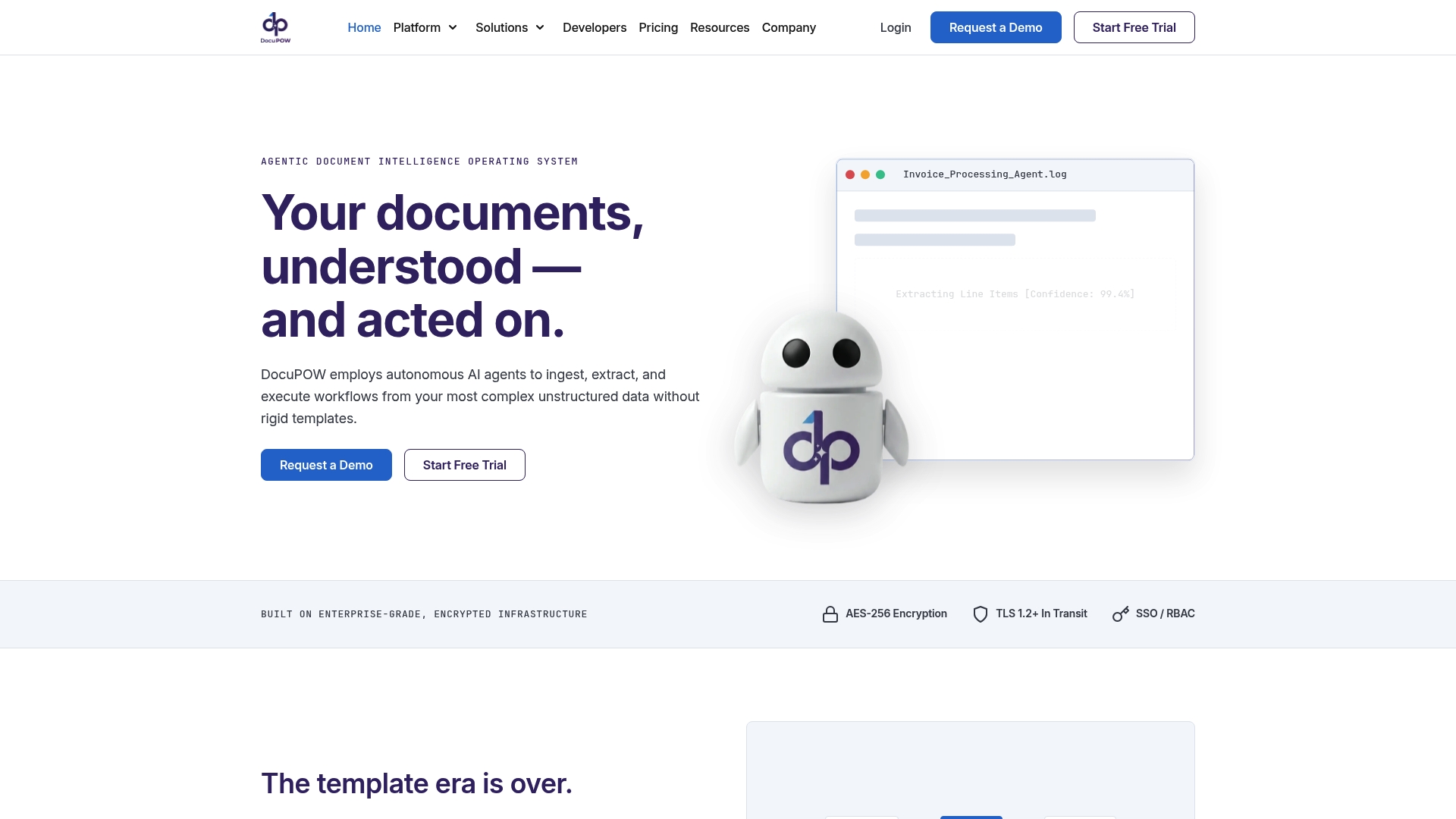
DocuPOW builds AI integration specifically for document-heavy operations, using autonomous agents that read documents in context rather than matching against fixed templates. That architecture handles the document variation that breaks rule-based systems.
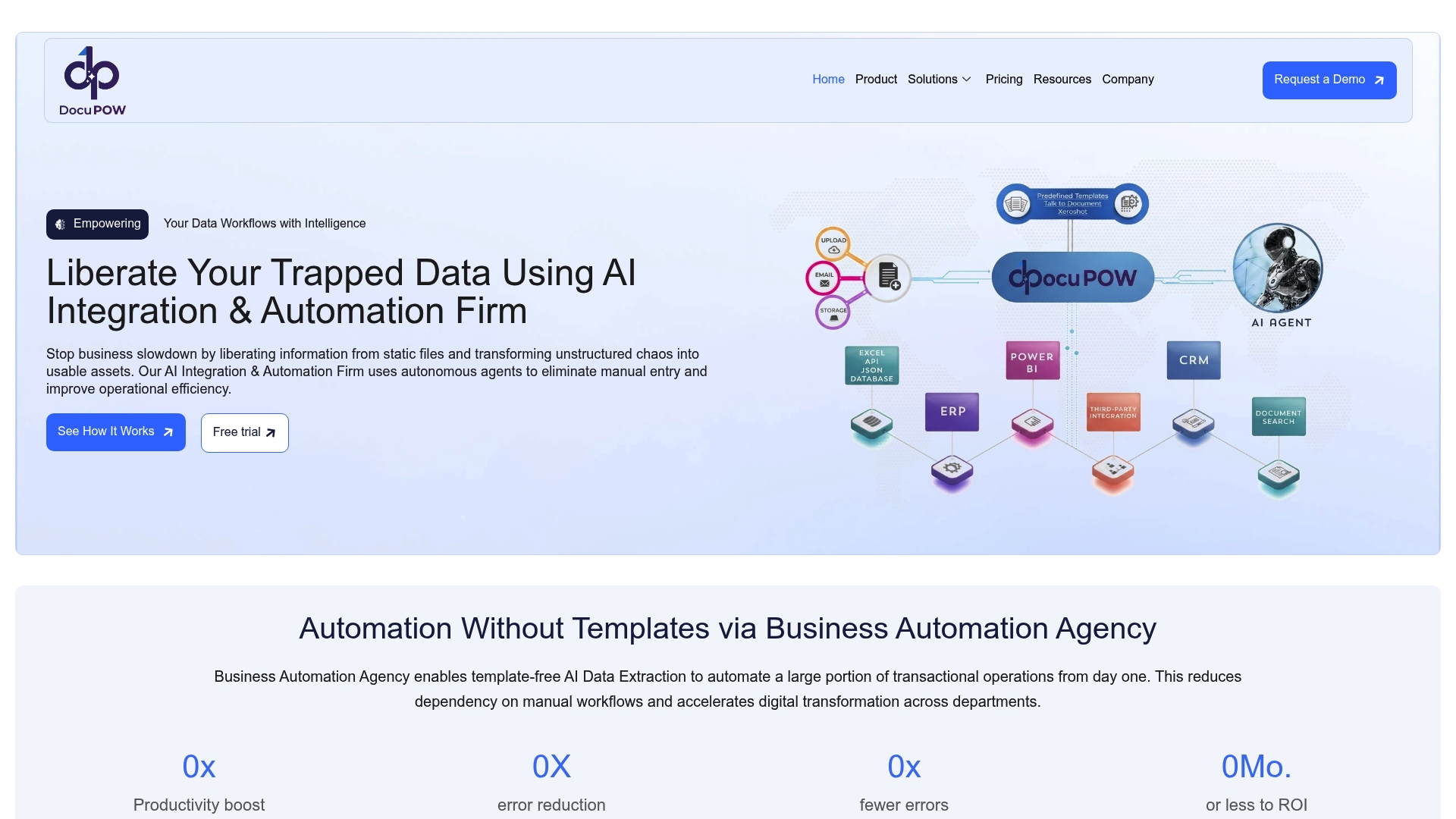
Teams working with DocuPOW get a phased implementation approach, starting with a proof-of-concept phase on their actual document types, followed by structured integration into existing ERP and workflow systems. The platform includes real-time analytics and confidence-scored extraction, so your team always knows where the AI is certain and where it needs human review. For organizations ready to move from manual document handling to AI-driven document workflows, DocuPOW provides the operational support and governance structure that production deployments require. You can also review high-volume document processing best practices to prepare your team before the first integration phase begins.
FAQ
What are Artificial Intelligence Integration Services?
Artificial Intelligence Integration Services embed AI models into existing business systems to automate data extraction, classification, and routing. For document workflows, this means AI reads incoming files and feeds structured data into your ERP or workflow tools without manual entry.
How long does an AI integration project take?
A proof-of-concept phase typically runs 4–8 weeks, followed by legacy system integration and parallel operation phases. Full production deployment for a document workflow integration commonly takes 6–9 months depending on system complexity.
What is silent failure in document AI?
Silent failure occurs when an AI system processes incorrect data without triggering an error alert, allowing bad records to propagate through downstream systems undetected. Confidence thresholds and human-in-the-loop routing controls are the primary safeguards against it.
How do I evaluate AI service providers for document processing?
Weight your evaluation 30% on production track record, 20% each on technical depth, data governance, and change management. Ask vendors to describe a specific production failure and how they resolved it before making any selection decision.
What knowledge transfer should I require from an AI integration vendor?
Require architecture documentation, operational runbooks, model training guides, and full source code ownership as contractual deliverables. These items should be tied to final payment to create the right incentive for the vendor to complete them properly.