Contract Management for Business Leaders: A Practical Guide
Unlock the full potential of your business with effective Contract Management. Discover how to prevent revenue loss and enhance outcomes.

Contract management is the end-to-end discipline of turning signed agreements into measurable business outcomes. According to the National Contract Management Association (NCMA), it covers overseeing contracts to confirm deliverables and deadlines are met and customer satisfaction is maintained. The single highest-priority action for any business leader is to map the current lifecycle, identify where contracts stall or go dark after signature, and close those gaps to protect revenue.
Why does this matter financially? Practitioners estimate that nearly 9.2% of contract value is lost when obligations go unmonitored. For a company with substantial annual contract spend, this loss can amount to a significant financial impact through missed milestones, auto-renewals on underperforming vendors, and overlooked price escalation clauses.
Quick diagnostic checklist — run this before anything else:
-
Do you have a single, searchable repository of all active contracts?
-
Can you name the owner responsible for each contract’s obligations?
-
Do you receive automated alerts at least 90 days before a renewal or expiration?
If you answered “no” to any of these, the sections below give you a structured path to fix them.
TL;DR: Contract management protects revenue and reduces risk. Start with a repository, assign owners, and automate renewal alerts.

Table of Contents
-
What does the contract management lifecycle actually look like?
-
What KPIs actually tell you whether your contracts are healthy?
-
What features should you require from contract management software?
-
How AI and agentic automation are changing contract management
-
DocuPOW addresses the contract management gaps that cost you most
What does the contract management lifecycle actually look like?
The seven-stage contract lifecycle model is the standard framework U.S. businesses use: Request & Intake, Authoring & Drafting, Negotiation & Redlining, Approval Workflow, Execution, Obligation Management, and Renewal or Termination. Stage clarity matters because you cannot fix a bottleneck you cannot see. Research consistently shows that negotiation and approval are the two slowest stages, and targeted automation at those points produces the fastest cycle-time gains.
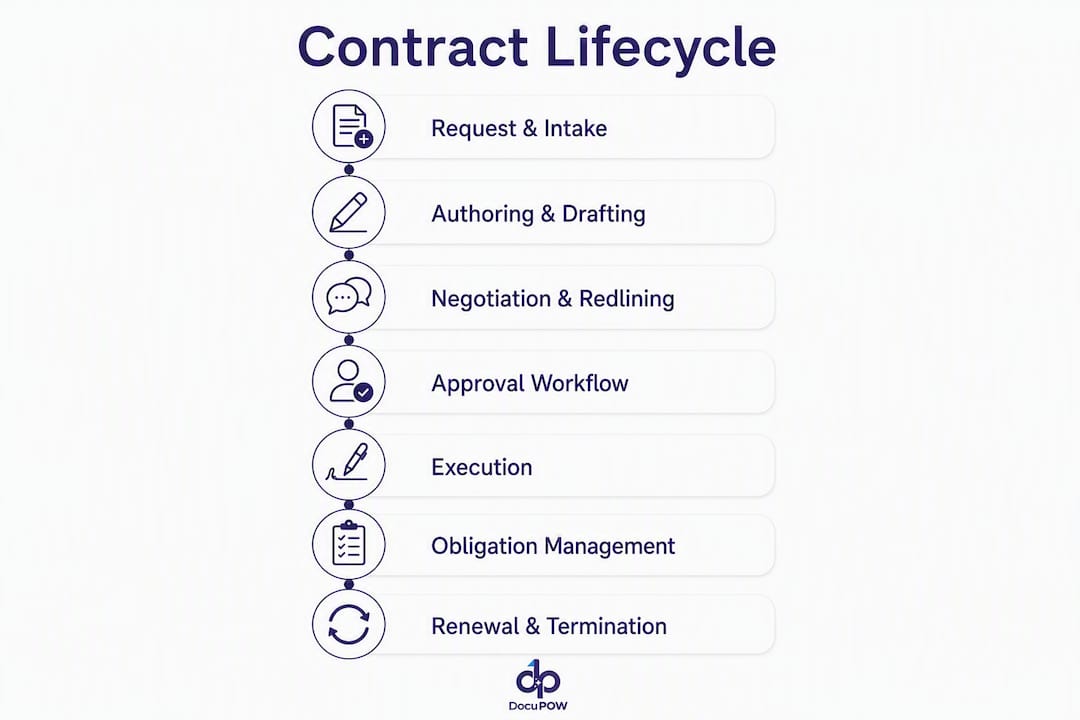
Stage 1: Request and intake
The contract request is where most lifecycle problems are seeded. Without a structured intake form, legal and procurement receive incomplete briefs and spend days chasing counterparties for basic information. The owner is typically the requesting business unit, with procurement or legal ops validating completeness. A well-designed intake captures contract type, counterparty, value, risk tier, and required delivery date before a single word is drafted.
Stage 2: Authoring and drafting
Legal or contract ops drafts from a pre-approved template and clause library. Standardized templates and clause libraries measurably reduce custom redlines and speed approval. The output of this stage is a clean first draft with tracked metadata: effective date, term, payment terms, and key obligations. Master Service Agreements (MSAs) typically take several business days to draft internally; vendor Statements of Work (SOWs) can proceed faster when templates are in place.
Stage 3: Negotiation and redlining
Both parties exchange redlines. This stage is where cycle time balloons without discipline. Collaborative redlining tools with version control and comment threading cut back-and-forth email chains. The owner is the commercial or legal lead; the output is a mutually agreed final draft.
Stage 4: Approval workflow
Approvals route to finance, legal, and executive sign-off depending on contract value and risk tier. Automated routing with defined service-level targets prevents contracts from sitting in inboxes for weeks. Designing faster approval workflows with clear escalation paths is one of the highest-ROI process improvements available to mid-market legal ops teams.
Stage 5: Execution
E-signature closes the loop. In the U.S., electronic signatures are legally valid under the federal Electronic Signatures in Global and National Commerce Act (ESIGN) and the Uniform Electronic Transactions Act (UETA), adopted across most states. Execution should also trigger automatic population of contract metadata into the repository and CRM/ERP systems.
Stage 6: Obligation management
Signing is the start of downstream management, not the finish line. This stage tracks every deliverable, payment milestone, SLA, and reporting requirement embedded in the contract. Missed obligations are the primary driver of that 9.2% value leakage. Owners here are contract managers and business unit leads, supported by automated alerts.
Stage 7: Renewal, amendment, and termination
Contracts that auto-renew without review lock organizations into underperforming terms. The renewal stage should trigger a formal performance review and, where relevant, a risk re-assessment. Scope changes, payment-term modifications, or ownership transfers should also trigger a formal risk re-assessment rather than leaving the original risk profile static.
Pro Tip: Design your intake form to capture the contract’s risk tier and required template at submission. A tiered intake that routes low-risk agreements to self-serve templates and high-risk agreements to legal review can cut average negotiation time by removing unnecessary legal involvement from routine contracts.
Who actually owns contract management in your organization?
Staffing contract responsibility is one of the most underestimated decisions in operations. The right model depends on contract complexity, volume, and the risk encoded in each agreement. Even a small company with a handful of high-value supplier agreements may need a formal contract owner, because the risk is material regardless of headcount.
Core roles and what they own
-
Contract manager/owner: Day-to-day lifecycle steward. Tracks obligations, manages amendments, owns the renewal calendar, and escalates risk. Requires clause literacy, negotiation skills, and proficiency with CLM tools.
-
Legal counsel: Drafts and reviews non-standard clauses, advises on regulatory exposure, and approves deviations from playbooks. Not a bottleneck when playbooks are well-designed.
-
Procurement: Leads supplier-side contracting, manages vendor performance, and owns spend compliance. Integrates contract data with purchase orders and invoices.
-
Commercial/sales owner: Owns customer-facing agreements. Responsible for ensuring contract terms align with what was sold and that revenue recognition triggers are captured.
-
Finance: Reviews payment terms, indemnification caps, and revenue recognition implications. Needs contract metadata in the ERP to close books accurately.
-
Legal ops/LegalOps: Designs and maintains the CLM system, clause library, templates, and approval playbooks. The operational backbone of a mature contract function.
Organizational models: which one fits your business?
Centralized center of excellence works best for large enterprises with high contract volume and significant regulatory exposure. One team owns all contracts, enforces standards, and maintains the system of record. The tradeoff is speed: business units sometimes feel the process is slow.
Federated model distributes contract ownership to business units, with legal and procurement providing standards and oversight. Faster for routine agreements, but consistency suffers without strong governance.
Hybrid/embedded model places contract managers inside business units while a central legal ops function owns the technology, templates, and playbooks. Most mid-market companies land here as they scale.
| Task | Primary Owner | Supporting Role |
|---|---|---|
| Intake and triage | Requesting BU / procurement ops | Legal ops |
| Drafting | Legal / contract manager | Commercial owner |
| Redlining | Legal | Commercial / finance |
| Approval routing | Legal ops | Finance, executive |
| Obligation tracking | Contract manager | Business unit lead |
| Renewal decision | Commercial / procurement | Finance, legal |
What KPIs actually tell you whether your contracts are healthy?
The core activities of contract management span the full lifecycle: intake, clause standardization, redline control, approval routing, e-signature execution, obligation management, audits, and amendments. Measuring them requires a small set of KPIs that are specific enough to drive action.

Key contract performance metrics
| KPI | Definition | Example Target |
|---|---|---|
| Contract cycle time | Days from request to executed signature | MSA: ≤20 days; SOW: ≤7 days |
| Renewal rate | % of expiring contracts actively reviewed and renewed or renegotiated | ≥90% |
| Obligation completion rate | % of tracked obligations met on time | — |
| Contract value leakage | Estimated % of contract value lost to missed milestones or auto-renewals | <3% |
| Compliance rate | % of contracts executed using approved templates and clauses | — |
Cycle time and compliance rate are the right KPIs to start with if your primary pain is sales cycle delays. Revenue leakage and obligation completion rate matter most if your problem is post-signature performance. Pick two metrics, baseline them, and measure monthly before adding more.
Compliance essentials
-
All executed contracts must carry a valid ESIGN/UETA-compliant e-signature with a timestamped audit trail.
-
SOX-relevant contracts (those affecting revenue recognition or material financial commitments) require an immutable audit trail with user actions and timestamps, as auditors expect this as a baseline.
-
Contract amendments must be version-controlled and linked to the original agreement in the repository.
-
Obligation alerts should fire at 90, 60, and 30 days before key deadlines.
Pro Tip: Before you build a full KPI dashboard, run a one-week manual audit of five recently expired contracts. Count how many renewed without a formal review, how many had untracked obligations, and how many were executed outside the approved template. That audit will tell you which two KPIs to prioritize.
What features should you require from contract management software?
The CLM software market has matured significantly. Buyers in 2026 should evaluate platforms against a specific feature checklist rather than relying on vendor demos alone. Gartner predicts that half of procurement contract management will be AI-enabled by 2027, which means the gap between AI-capable and legacy platforms is widening fast.
Feature categories to evaluate
-
Centralized repository with metadata: Full-text search, tagging by contract type, counterparty, value, expiration, and risk tier. Non-negotiable.
-
Authoring, templates, and clause library: Pre-approved templates with locked clauses and a fallback library for non-standard requests. Reduces legal review time on routine agreements.
-
Collaborative redlining: In-platform version control with comment threading, change tracking, and counterparty access. Eliminates email-chain redlines.
-
Approval workflow automation: Configurable routing rules based on contract value, type, and risk tier, with SLA enforcement and escalation paths. Agreement workflow automation at this layer is where most teams recover the most calendar time.
-
E-signature with ESIGN/UETA compliance: Native or integrated e-signature with a full audit trail.
-
Obligation and milestone tracking: Automated alerts, obligation registers linked to contract clauses, and dashboards showing completion status.
-
Analytics and dashboards: Cycle time trends, compliance rates, renewal calendars, and leakage estimates.
-
API integrations with ERP and CRM: Auto-population of contract data into Salesforce, SAP, Oracle, NetSuite, or equivalent systems. Integrating CLM with CRM and ERP enables auto-population of drafts and aligns contract metadata with financial reporting, which auditors require for SOX-relevant agreements.
-
Security and audit trail: Role-based access control, SOC 2 Type II certification, and immutable logs.
How AI changes the equation
AI-driven clause extraction reads executed contracts and populates obligation registers automatically, without manual data entry. Risk scoring flags non-standard clauses against a playbook baseline before a human reviewer touches the document. Auto-populated drafts pull counterparty data from CRM records and pre-fill standard fields, cutting drafting time on routine agreements from hours to minutes. The downstream effect: companies using modern CLM tools reduce cycle times by approximately 30% compared with manual processes.
For post-signature monitoring specifically, template-free AI extraction is more effective than template-based OCR. Legacy tools require a configured template for each document layout; agent-based systems understand document context and extract obligations from diverse formats, which is critical when managing portfolios with inconsistent layouts.
Pro Tip: During a vendor proof-of-concept, bring five of your messiest legacy contracts — inconsistent formatting, scanned PDFs, handwritten amendments. Run them through the AI extraction module and check whether the output obligation register is accurate without manual correction. That test reveals more than any polished demo.
How do you implement contract management in 90 days?
Good governance is the foundation. Before you configure software, define your intake form, build a clause library with at least three approved templates (MSA, NDA, SOW), and assign a single named owner for each major agreement type. Without those three elements, automation accelerates chaos rather than fixing it.
Quick wins to capture in the first two weeks
-
Centralize all signed contracts into a single folder structure or repository, even a shared drive, to establish a baseline inventory.
-
Identify the three contracts expiring soonest without a renewal decision and assign owners immediately.
-
Automate intake for one contract type (NDAs are the easiest starting point) using a web form that routes to a template and an approval workflow.
90-day pilot roadmap
-
Week 1–2: Audit existing contracts, build the repository structure, and define metadata schema (counterparty, type, value, expiration, owner).
-
Week 3–4: Configure templates and clause library for the two highest-volume contract types. Set up approval routing rules.
-
Week 5–6: Integrate the CLM with your CRM (Salesforce, HubSpot) and ERP (SAP, NetSuite, Oracle) to enable auto-population and financial alignment.
-
Week 7–8: Automate obligation alerts for all active contracts. Train contract owners and business unit leads on the new workflow.
-
Week 9–10: Measure baseline KPIs: cycle time, compliance rate, and obligation completion rate.
-
Week 11–12: Review pilot results, identify the next automation target, and present a business case for full rollout.
Timeline and cost considerations
For small and mid-size businesses, a basic CLM pilot can be live in 30–60 days using a cloud SaaS platform with pre-built templates. Enterprise implementations with deep ERP integration and custom workflow logic typically run 3–9 months. Cost drivers include the number of integrations, the size of the legacy contract portfolio requiring migration, and the level of AI configuration needed.
Change management essentials
-
Assign a named project sponsor at the VP level or above. Without executive sponsorship, adoption stalls.
-
Run a two-hour training session for each user group (legal, procurement, sales, finance) with role-specific workflows, not a generic platform walkthrough.
-
Communicate the “what’s in it for me” for each group: sales gets faster contract turnaround, finance gets cleaner revenue data, legal gets fewer emergency reviews.
-
Measure and share adoption metrics monthly for the first quarter. Teams that see their own cycle-time improvement sustain the behavior change.
How AI and agentic automation are changing contract management
AI and agentic automation make contract data usable in real time, shifting teams from reactive administration to proactive risk mitigation. That shift is not incremental. It changes the fundamental economics of post-signature management.
The specific capabilities that matter most:
-
Clause extraction: AI reads executed contracts and builds obligation registers automatically, without a pre-configured template for each document layout.
-
Risk scoring: Models flag non-standard clauses, unusual indemnification language, or missing standard protections against a playbook baseline, before a human reviewer opens the document.
-
Trigger-based re-assessment: When a scope change, payment-term modification, or ownership transfer occurs, the system flags the contract for re-assessment rather than leaving the original risk profile static.
-
Automated obligation alerts: Milestone and deadline alerts fire based on extracted contract dates, not manual calendar entries.
-
ERP/CRM integration: Contract data flows into financial systems automatically, giving finance real-time visibility into committed spend and revenue recognition triggers.
Consider a mid-size manufacturer managing 400 active supplier contracts across inconsistent PDF formats, scanned amendments, and legacy Word documents. Template-based OCR tools fail on roughly a third of those documents because the layouts do not match any configured template. An agent-based system with template-free extraction reads each document contextually, populates the obligation register, and flags 23 contracts with renewal dates inside 60 days that had no assigned owner. The team recovers those renewals before they auto-renew on unfavorable terms. That is the practical difference between reactive and proactive contract management.
The limits are real, though. AI extraction is not a substitute for legal judgment on high-stakes clauses. Indemnification caps, limitation of liability language, and jurisdiction-specific regulatory requirements still require a qualified attorney to review and approve. The right model is human-in-the-loop: AI handles extraction, classification, and alerting; humans make the final call on material risk decisions.
Key Takeaways
Effective contract management requires a structured lifecycle, assigned owners, measurable KPIs, and AI-assisted post-signature monitoring to protect contract value and reduce risk.
| Point | Details |
|---|---|
| Revenue leakage is quantifiable | Unmonitored obligations cost organizations an estimated 9.2% of contract value annually. |
| Seven stages, two bottlenecks | Negotiation and approval are the slowest stages; targeted automation there produces the fastest cycle-time gains. |
| Start with three KPIs | Cycle time, obligation completion rate, and compliance rate give you the clearest baseline before adding more metrics. |
| AI extraction changes post-signature | Template-free AI extraction populates obligation registers from any document format, enabling proactive renewal and milestone management. |
| DocuPOW for document automation | DocuPOW’s agent-based, template-free extraction and workflow orchestration directly addresses post-signature obligation tracking and cycle-time reduction. |
What teams actually get wrong about contract management
The most common failure pattern is not a technology gap. It is a process gap that technology then inherits. Teams migrate spreadsheet chaos into a CLM and wonder why the system does not fix the underlying problem.
Three failures show up repeatedly. First, no single owner for post-signature obligations. Contracts get signed, filed, and forgotten until a missed milestone surfaces as a financial problem. The fix is assigning a named owner at execution and linking that owner to automated alerts in the system. Second, passive renewals. Auto-renewal clauses are not inherently bad, but renewing without a performance review locks organizations into terms that no longer reflect market conditions or actual service quality. A 90-day renewal alert with a mandatory review step costs almost nothing to implement and recovers real money. Third, contract data that never reaches the ERP or CRM. Finance closes books without visibility into committed spend; sales quotes without knowing existing contract terms. Integrating contract metadata into financial and sales systems at execution is the single highest-leverage integration in a CLM rollout.
Fix those three things and you will see measurable reductions in revenue leakage and faster cycle times before you have fully deployed any new software. The technology accelerates the fix; it does not replace the discipline.
DocuPOW addresses the contract management gaps that cost you most
Most contract management pain concentrates in two places: getting accurate data out of executed contracts, and keeping that data current as obligations evolve. That is precisely where template-dependent tools fall short and where DocuPOW’s agent-based approach makes a concrete difference.
DocuPOW’s autonomous AI agents extract obligation data, key dates, and clause-level metadata from any contract format without requiring a pre-configured template for each document layout. That means your legacy portfolio, your scanned amendments, and your counterparty-generated agreements all feed the same obligation register automatically.
The practical outcomes for contract teams:
-
Faster intake-to-execution: Automated data extraction and workflow orchestration cut manual entry at every lifecycle stage, reducing cycle time from weeks to days on routine agreements.
-
Proactive obligation monitoring: Real-time alerts and dashboards surface renewal risks and missed milestones before they become financial losses, directly reducing the value leakage that manual processes allow.
-
ERP and CRM integration: DocuPOW connects contract data to your existing financial and sales systems via API, giving finance and procurement the visibility they need without a separate data entry step.
If your team is managing contracts across high-volume or complex document environments, see how DocuPOW handles document process automation for operations and request a demo to walk through your specific contract workflow.
Useful sources and further reading
-
What is Contract Management? — NCMA: The authoritative U.S. industry definition from the National Contract Management Association; the starting point for any formal contract management program.
-
Benefits of Contract Management — CIPS: The Chartered Institute of Procurement & Supply’s overview of why contract management matters and how it scales with business complexity.
-
Contract management — Wikipedia: A broad reference covering roles, organizational models, and the academic and practitioner literature on contract management.
-
How Contract Management Works In The USA For Businesses — Global Fin Info: Practical U.S.-focused lifecycle guide covering the seven-stage model, ESIGN/UETA compliance, and CLM ROI data.
-
Contract risk and management process — Risk Publishing: Quantifies revenue leakage from unmonitored contracts and explains the risk management process; useful for building the business case for CLM investment.
-
Contract risk assessment checklist — Risk Publishing: Covers trigger-based re-assessment best practices; essential reading for obligation management and post-signature monitoring.
-
Gartner: Half of Procurement Contract Management Will Be AI-Enabled by 2027: Gartner’s market forecast on AI adoption in CLM; useful for benchmarking technology investment decisions.
-
Contract Lifecycle Management Process — Precoro: Practical guide to CLM stages and best practices, with specific guidance on templates, clause libraries, and approval playbooks.
-
DocuPOW AI Workflow Automation Services Guide: DocuPOW’s enterprise-oriented guide on AI workflow automation, covering integration patterns and measurable ROI for contract-heavy operations.
FAQ
What is the meaning of contract management?
Contract management is the process of creating, executing, and monitoring agreements to confirm that all parties meet their obligations, deadlines, and performance standards. The NCMA defines it as overseeing contracts to maintain deliverables, deadlines, and customer satisfaction.
What are the five steps of contract management?
The full lifecycle has seven stages, but the five core steps are: drafting and authoring, negotiation and redlining, approval and execution, obligation tracking, and renewal or termination. Each step requires a named owner and defined outputs to prevent contracts from stalling or going dark after signature.
What are the 5 C’s of a contract?
The “5 C’s” is not a universally standardized framework in U.S. contract law or NCMA guidance; different practitioners define it differently. A common version covers Competent parties, Consideration, Consent, Capacity, and a lawful Cause or Object, but you should verify the specific version used by your legal counsel or training program.
What is a typical contract manager’s salary in the U.S.?
Salary ranges for contract managers vary by industry, company size, and location, and are not covered in the sources used for this article. For current U.S. compensation benchmarks, the NCMA and the Bureau of Labor Statistics publish regularly updated figures for contract management and procurement roles.
How does DocuPOW support contract management?
DocuPOW uses agent-based, template-free AI extraction to pull obligation data, key dates, and clause metadata from any contract format, then routes that data into obligation registers and integrates it with ERP and CRM systems. This directly addresses post-signature monitoring gaps and reduces the manual effort that drives cycle-time delays and revenue leakage.
Recommended
See DocuPOW on your documents.
Stop building templates. Start extracting data.