AI Workflow Automation Services: 2026 Enterprise Guide
<p>Discover how AI Workflow Automation Services boost efficiency, accuracy, and cost control in your enterprise. Explore key benefits for 2026.</p>


TL;DR:
- AI workflow automation services use artificial intelligence to execute and manage business processes with minimal human intervention. They increase efficiency, reduce manual work, and provide scalable, secure governance frameworks for enterprises.
AI workflow automation services are software systems that use artificial intelligence to execute, route, and manage business processes with minimal human intervention. The industry term for the broader category is intelligent process automation, which combines robotic process automation, machine learning, and agentic AI into a single operational layer. Enterprises adopting these services report measurable gains in speed, accuracy, and cost control across finance, HR, supply chain, and operations. Centralized governance models such as the Automation Center of Excellence set the standard for scaling these programs without creating security gaps. DocuPOW applies this same architecture to document-heavy workflows, freeing teams from manual data entry and giving decision-makers real-time visibility into their operations.
What are AI workflow automation services and how do they work?
AI workflow automation services combine three distinct technologies: rule-based automation for predictable tasks, machine learning for pattern recognition, and agentic AI for context-dependent decisions. Each layer handles a different level of process complexity. Rule-based automation handles invoice routing. Machine learning classifies incoming documents. Agentic AI decides what to do when a document does not match any known pattern.

Agentic AI uses intent-based design, meaning the system reads the full context of a request before acting. This is fundamentally different from a conditional script that checks one field and fires a response. The result is fewer dropped handoffs between systems and fewer exceptions that require human escalation.
Integration is the backbone of any working automation program. Modern platforms connect to ERP systems, CRM platforms, and legacy databases through APIs, which means your existing tools do not need to be replaced. Enterprise API integration examples from 2026 show that most production deployments connect four or more core business systems in a single workflow.
Security and auditability are built into the architecture, not added later. Features like role-based access control, model version control, and full audit trails allow compliance teams to trace every automated decision back to its source. SOC 2 compliance is the baseline standard most enterprise buyers require before signing a contract.
Key components every enterprise automation platform must include:
- Agentic AI engine that reads context and makes decisions without rigid templates
- API integration layer connecting ERP, CRM, and document management systems
- Intelligent document processing for extracting structured data from unstructured files
- Audit trail and version control for compliance and model governance
- Multi-tenant governance supporting multiple business units under one security policy
Pro Tip: Before evaluating any platform, ask vendors to demonstrate how their system handles a document it has never seen before. That single test reveals whether you are buying true agentic AI or a sophisticated template matcher.
How do these services improve efficiency and reduce manual workload?
The productivity case for intelligent workflow services is concrete and fast. Managed AI workflow automation deploys production-ready agents within weeks, reducing manual workflow touches by 30–50% and recovering 10–25 or more working hours weekly per team. That is not a long-term projection. Teams see those numbers within the first month of deployment.
The gains show up differently across departments, but the pattern is consistent.
- Finance teams eliminate manual invoice matching, three-way PO reconciliation, and exception coding
- HR departments automate onboarding document collection, compliance checks, and benefits enrollment routing
- Sales operations route contracts through approval chains without human coordination
- Supply chain teams extract data from supplier documents and update inventory systems automatically
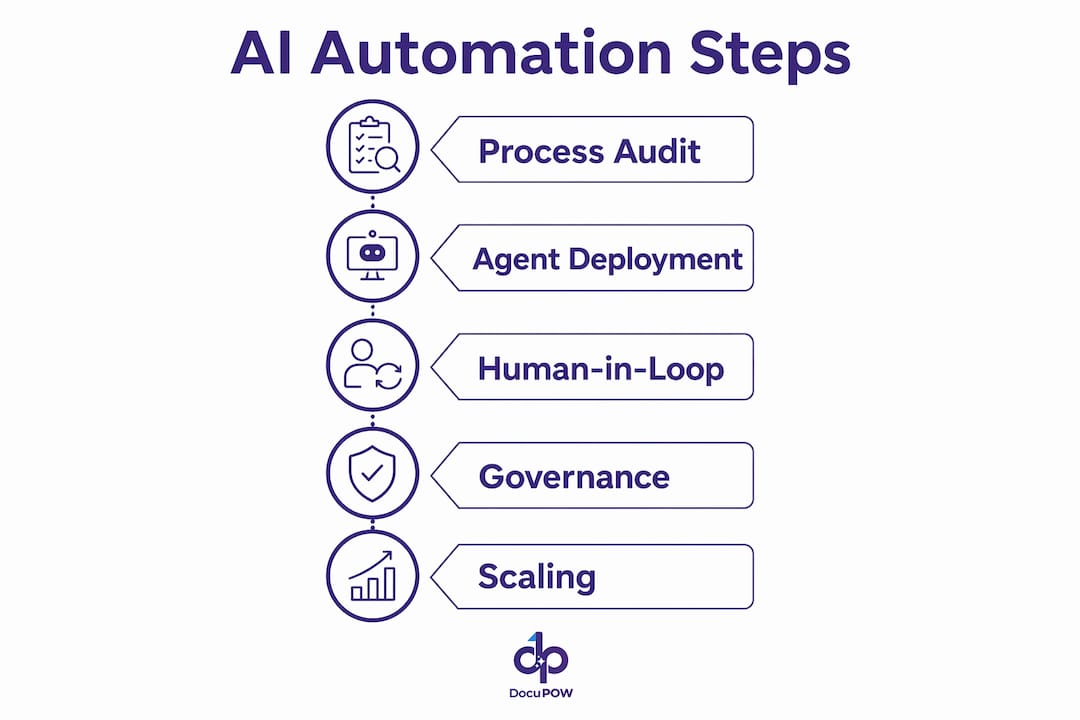
Human-in-the-loop architecture is what makes these gains sustainable. Routing low-confidence tasks to human reviewers with the right context prevents errors from compounding downstream. The AI handles the high-volume, high-confidence work. Humans handle the exceptions that require judgment. This division of labor is what separates reliable automation from brittle automation.
Automated AI business processes also reduce the cost of errors. When a human manually keys data from a PDF into an ERP system, the error rate is measurable and cumulative. Automated extraction with confidence scoring catches discrepancies before they reach the ledger. DocuPOW applies this model specifically to document workflows, using autonomous agents that understand document context rather than matching fields to a fixed template.
What governance frameworks ensure scalable, secure automation?
Governance is the part of AI workflow automation for enterprises that most teams underestimate until something breaks. The Automation Center of Excellence (CoE) is the organizational model that prevents that outcome. Enterprises with a centralized CoE achieve 60% faster time-to-value and 40% lower maintenance costs for automation projects. Those numbers reflect the compounding benefit of having one team own standards, tooling, and deployment practices.
Without a CoE, enterprises fail to scale and face fragmented AI adoption that creates security and compliance failures. The failure mode is predictable: individual departments deploy their own agents, governance breaks down, and the organization ends up with shadow AI that bypasses security controls.
Agent sprawl is the primary cause of AI automation failure. It happens when AI agents multiply without central oversight, each one operating under different rules, accessing different data, and logging activity in different places. The fix is not technical. It is organizational.
A working governance framework includes four practices:
- Centralized agent registry listing every deployed agent, its owner, its data access scope, and its last audit date
- Role-based access control preventing any agent from accessing data outside its defined scope
- Model version control so every change to an agent’s logic is tracked and reversible
- Continuous monitoring dashboards showing agent performance, error rates, and escalation frequency in real time
| Governance element | Purpose | Risk if absent |
|---|---|---|
| Agent registry | Tracks all deployed agents | Shadow AI, unaudited access |
| Role-based access | Limits data exposure | Compliance violations |
| Version control | Tracks logic changes | Untraceable errors |
| Monitoring dashboards | Flags performance issues | Silent failures |
Pro Tip: Assign a named owner to every AI agent at deployment. Ownerless agents are the first ones to go unmonitored and the first ones to create compliance problems.
How to plan and implement AI workflow automation successfully
The most common implementation mistake is automating a broken process. Process mining and converting fragmented SOPs into explicit decision logic must happen before any AI agent touches a live workflow. If your current process has undocumented exceptions, workarounds, and tribal knowledge baked in, the AI will inherit all of it.
Start with a process audit. Map every step, every decision point, and every exception path. Turn that map into explicit rules before selecting an automation model. This work is not glamorous, but it determines whether your deployment succeeds or fails.
Not every process needs autonomous AI. Determining where rule-based automation ends and agentic reasoning begins is one of the most valuable decisions in your implementation plan. A vendor invoice with a fixed format and predictable fields does not need an agentic system. A complex supplier contract with variable clauses and conditional obligations does.
Staged deployment is the safest path to scale. Run a pilot on one process, one team, and one data source. Measure error rates, escalation frequency, and time savings against your baseline. Use those results to refine the model before expanding. Modern agent management platforms cut development time for complex workflows by over 65%, which means the iteration cycle is fast enough to course-correct without major cost.
Key steps for a successful rollout:
- Audit first. Document every process step and exception before writing a single automation rule.
- Classify by complexity. Separate rule-based tasks from those requiring contextual judgment.
- Pilot on low-risk processes. Choose a workflow where errors are visible and recoverable.
- Define escalation triggers. Set confidence thresholds that route uncertain decisions to human reviewers.
- Integrate incrementally. Connect one system at a time to reduce disruption and isolate issues.
Operational reporting workflows are a strong pilot candidate for most enterprises. They are high-frequency, data-intensive, and the output is easy to validate against existing reports.
Key Takeaways
AI workflow automation services deliver the fastest, most durable results when governance, process clarity, and agentic AI design work together from the start.
| Point | Details |
|---|---|
| Audit before automating | Map every process step and exception path before deploying any AI agent. |
| Match AI type to task complexity | Use rule-based automation for predictable tasks and agentic AI for context-dependent decisions. |
| Build a governance CoE | A centralized Automation Center of Excellence cuts maintenance costs by 40% and speeds time-to-value by 60%. |
| Design human-in-the-loop triggers | Set confidence thresholds so low-certainty decisions route to human reviewers automatically. |
| Prevent agent sprawl | Maintain a central agent registry with named owners to stop shadow AI before it starts. |
Why most automation programs stall before they scale
I have watched well-funded automation programs collapse under their own weight, and the cause is almost never the technology. The technology works. What fails is the assumption that deploying agents is the same as building a program.
The teams that succeed treat automation as an operational discipline, not a one-time project. They assign owners. They set standards. They review agent performance the same way they review employee performance. The teams that fail treat it as an IT deployment and move on.
The human-in-the-loop question is where I see the sharpest disagreement. Some leaders want full automation because they equate human review with inefficiency. That is the wrong frame. Designing escalation paths based on confidence thresholds is not a concession to the technology’s limits. It is how you build a system that gets smarter over time without creating liability.
My honest advice: start with the governance structure before you buy a single license. Know who owns the agents, who audits them, and who has authority to shut one down. That clarity will save you more time and money than any feature comparison ever will. The AI agents in operational decisions conversation is maturing fast, and the organizations winning are the ones treating it as a management challenge, not a software challenge.
— Sameer
DocuPOW: purpose-built for document-heavy automation
Enterprises that process high volumes of documents face a specific problem that general automation platforms do not fully solve. Invoices, contracts, purchase orders, and compliance forms contain data locked in unstructured formats that rule-based tools cannot reliably extract.
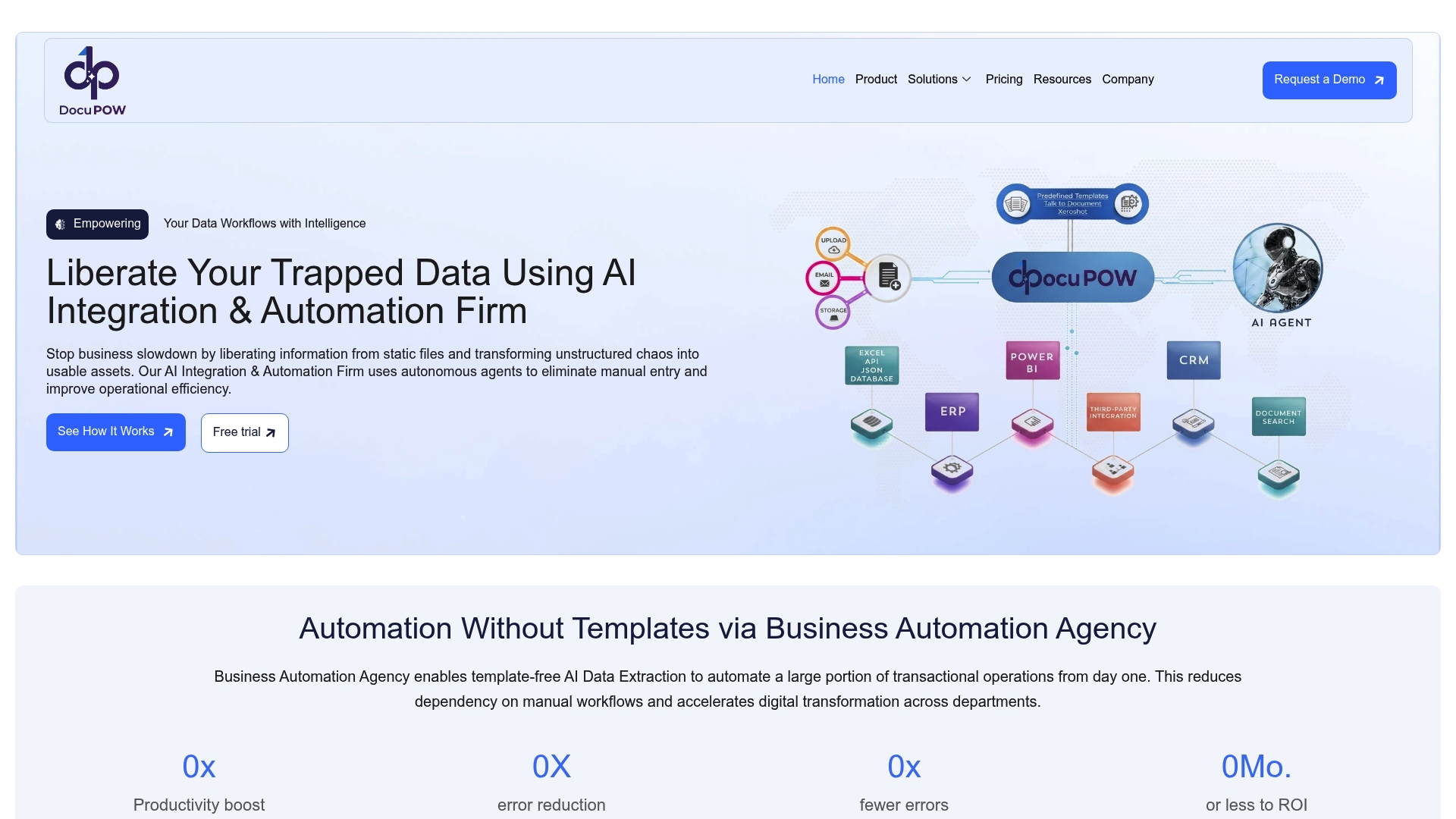
DocuPOW addresses this directly. Its autonomous agents read document context without relying on fixed templates, which means new document formats do not require manual reconfiguration. Teams get document process automation benefits from day one, including real-time analytics, audit trails, and integration with existing ERP and CRM systems. For organizations ready to move from reactive data entry to proactive decision-making, the 2026 AI automation services guide outlines exactly where to start.
FAQ
What are AI workflow automation services?
AI workflow automation services are software systems that use artificial intelligence to execute, route, and manage business processes with minimal human input. They combine rule-based automation, machine learning, and agentic AI to handle tasks across finance, HR, operations, and supply chain.
How quickly can enterprises see results from AI process automation?
Managed AI workflow automation services deploy production-ready agents within weeks, with teams recovering 10–25 or more working hours weekly after initial deployment.
What is agent sprawl and why does it matter?
Agent sprawl is the unmanaged proliferation of AI agents across an organization without central oversight. It creates security risks, compliance gaps, and operational inefficiencies that are difficult to reverse once established.
Do all business processes need agentic AI?
No. Rule-based automation handles predictable, structured tasks effectively. Agentic AI is best reserved for processes that require contextual judgment, variable inputs, or multi-step decision-making.
What is an Automation Center of Excellence?
An Automation Center of Excellence is a centralized team that owns governance standards, platform selection, and deployment practices for all AI automation across an enterprise. Organizations with a CoE achieve 60% faster time-to-value and 40% lower maintenance costs compared to decentralized approaches.
Recommended
See DocuPOW on your documents.
Stop building templates. Start extracting data.