Knowledge Management for Leaders: Practical Roadmap and AI Trends
Unlock the power of Knowledge Management to enhance onboarding, reduce mistakes, and accelerate decision-making in your organization.


Knowledge management (KM) is the structured practice of getting the right knowledge to the right people at the right time so they can make better decisions and perform more effectively. APQC defines it as a discipline that balances people, process, and technology to create, capture, organize, share, and apply organizational knowledge.
When KM works, leaders see three things happen quickly:
- Faster onboarding: New hires reach productivity in weeks rather than months because institutional knowledge is findable, not locked in someone’s head.
- Fewer repeated mistakes: Teams stop solving the same problems twice because after-action reviews and lessons learned are captured and surfaced at the right moment.
- Better decision speed: Leaders act on current, trusted information instead of hunting through inboxes and shared drives.
If you’re not sure where to start, a knowledge audit is the right first move. Map what you have, who owns it, and where the gaps are before you buy a single tool or write a single policy.
Table of Contents
- What does knowledge management actually cover?
- What types of knowledge does your organization actually hold?
- Which technologies actually solve KM problems in 2026?
- What strategic levers actually drive KM adoption?
- How do you measure whether KM is actually working?
- What kills KM programs, and how do you stop it?
- How do you run a knowledge audit?
- Key Takeaways
- The gap between KM strategy and where knowledge actually lives
- Document intelligence cuts the friction out of knowledge capture
- Useful sources for going deeper
- FAQ
- The case for treating KM as infrastructure, not initiative
What does knowledge management actually cover?
KM is not document storage, and it’s not an intranet project. The confusion costs organizations real money because they invest in platforms and get no behavior change.
APQC’s framework frames KM around three interdependent elements: people (who creates, shares, and uses knowledge), process (how knowledge moves through the organization), and technology (the tools that enable search, storage, and collaboration). Remove any one of those legs and the whole thing wobbles.
The core goals of KM are to reduce knowledge loss from turnover, accelerate learning across teams, cut the time people spend searching for information, and improve the consistency of decisions. Those are measurable outcomes, not aspirations.
| Dimension | Knowledge Management | Information Management | Content/Records Management |
|---|---|---|---|
| Primary goal | Get knowledge to people who need it to act | Organize and retrieve structured data | Manage documents for compliance and retention |
| Owner | KM lead, HR, L&D, business units | IT, data governance | Legal, compliance, records manager |
| Typical tools | Knowledge bases, wikis, enterprise search, AI assistants | Databases, MDM platforms, BI tools | ECM systems, DMS, archival platforms |
| Success measure | Reuse rate, decision speed, onboarding time | Data accuracy, retrieval time | Audit pass rate, retention compliance |
What KM is not:
- A one-time content migration project
- An IT infrastructure upgrade
- A SharePoint deployment with no governance
- A training library that nobody updates
- A search engine without curated, trusted content behind it
The most common mis-step is treating KM as an IT project. When IT owns it without a business sponsor, you get a platform with no adoption. When a business unit owns it without IT, you get a wiki with no integration. KM needs both, with a dedicated KM lead holding the accountability.
What types of knowledge does your organization actually hold?
Three types of knowledge exist in every organization, and each requires a different capture strategy.
Tacit knowledge is what people know but can’t easily write down: the troubleshooting heuristics a senior engineer uses, the negotiation instincts a seasoned sales rep has developed, the judgment calls a compliance officer makes under ambiguity. It lives in people’s heads and walks out the door when they leave.

Explicit knowledge is already documented: standard operating procedures, product specs, financial models, training manuals, regulatory filings. It’s the easiest to manage but often the hardest to keep current.
Implicit knowledge sits between the two. It’s knowledge that could be made explicit but hasn’t been yet — the informal routines embedded in how a team runs its weekly review, the unwritten rules about which escalation path actually works, the collective understanding of why a process is designed the way it is.
Workplace examples by type:
- Tacit: A field technician’s diagnostic sequence for equipment failure; a senior analyst’s pattern recognition for anomalous financial data; a project manager’s instinct for when a stakeholder is about to derail a timeline.
- Explicit: An onboarding checklist; a product pricing matrix; a vendor contract template; a regulatory compliance guide.
- Implicit: The team’s unwritten norm of always looping in legal before a client commitment; the informal review process that happens before anything goes to the VP; the shared understanding of which data source to trust when two systems disagree.
Capture techniques differ by type:
- Tacit: Structured interviews before retirement or role transitions, shadowing sessions with templated observation guides, after-action reviews that ask “what would you do differently?”
- Explicit: Document ingestion pipelines, version-controlled repositories, automated metadata tagging.
- Implicit: Process mapping workshops, retrospectives, community of practice discussions that surface undocumented norms.
Pro Tip: The most effective technique for eliciting tacit knowledge is paired shadowing with a structured capture template. Have a knowledge analyst shadow the expert for half a day, then immediately debrief using a fixed set of prompts: “What did you notice first? What would a newcomer miss? What rule of thumb are you applying?” That debrief, not the shadowing itself, is where the knowledge surfaces.
The Five Cs framework (Capture, Curate, Connect, Collaborate, Create) gives teams a simple vocabulary for talking about these activities without getting lost in academic taxonomy.
Which technologies actually solve KM problems in 2026?
Technology is an enabler, not the solution. Buy a platform before you have a content strategy and governance model, and you’ll have an expensive, empty repository within 18 months. That warning comes directly from APQC’s practitioner guidance, and it holds in 2026 as much as it ever did.
That said, the technology landscape has shifted meaningfully. Here’s how capability classes map to KM problems:
- Enterprise search: Solves findability. When people can’t find what they need, they recreate it or ask a colleague. A well-configured enterprise search layer with semantic capabilities reduces zero-result searches and surfaces the right asset at the right moment. Target fewer than 10% zero-result searches as a baseline KPI.
- Knowledge repositories and wikis: Solve storage and structure. Confluence, SharePoint, and purpose-built knowledge bases give teams a governed home for explicit knowledge. The risk is content decay — without ownership and review cadence, they become unreliable fast.
- Collaboration platforms: Solve connection and co-creation. Teams, Slack, and similar tools are where tacit knowledge often surfaces in conversation. The challenge is that conversational knowledge is ephemeral unless there’s a capture workflow attached.
- Knowledge graphs: Solve relationship discovery. A knowledge graph maps how concepts, people, documents, and decisions connect. For large enterprises with complex product lines or regulatory environments, graphs surface non-obvious relationships that flat search misses.
- Generative AI and semantic search: Solve synthesis and natural-language access. In 2026, 56% of organizations surveyed by Knoco International reported some AI introduction in their KM programs. Semantic search understands intent, not just keywords. Generative AI can draft summaries, answer questions from a curated corpus, and suggest related content. The governance risk is real: AI amplifies errors in bad content just as readily as it surfaces good content.
- Automated metadata and tagging: Solve curation bottlenecks. AI-assisted metadata enrichment, as recommended in the solution path framework, reduces the manual effort of tagging and classifying content at scale.
Evaluation checklist for selecting KM tools:
- Does it integrate with your existing ERP, CRM, and HRIS via API?
- Does it support your taxonomy and metadata schema, or does it impose its own?
- Who owns content governance in the platform — can non-technical users manage it?
- How does it handle access control and data residency for compliance?
- What AI safety controls exist — can you restrict AI responses to curated, verified content?
- Is there a human-in-the-loop review step before AI-generated content is published?
Pro Tip: Don’t pilot AI features on your full content corpus. Start with a single, well-governed domain — say, IT support or HR policy — where content is current, owned, and verified. Measure search success rate and user satisfaction before expanding. A clean pilot with 200 articles beats a messy rollout across 20,000.
For organizations managing unstructured data at scale, the metadata and extraction layer matters as much as the search interface.
What strategic levers actually drive KM adoption?
Five levers determine whether a KM program delivers measurable value or quietly fades after the launch event: leadership, governance, roles and ownership, incentives, and workflow integration.
Leadership is the non-negotiable one. Knoco International’s 2026 survey found that leadership support and embedding KM into routine work strongly correlate with reported program value. 56% of organizations reported some AI introduction in KM.
Governance elements to create:
- A content ownership policy that assigns every knowledge asset to a named individual or team
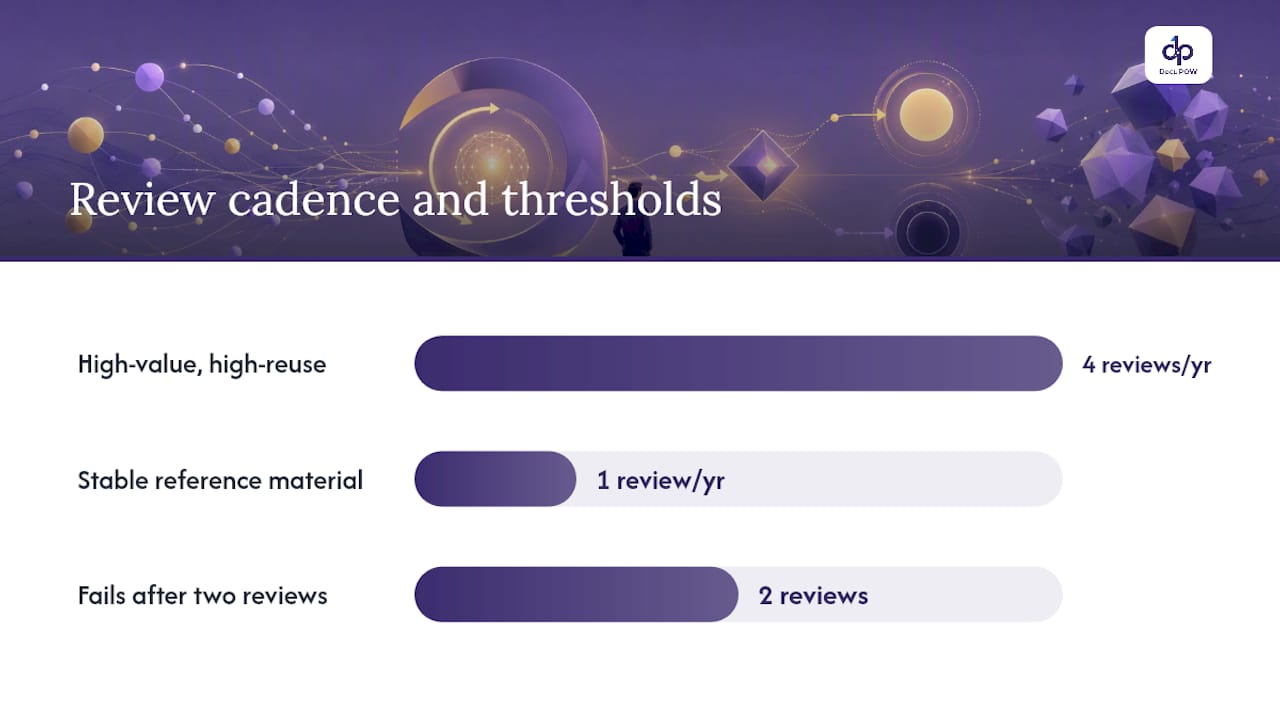
- A review cadence (quarterly for high-use content, annually for stable reference material)
- A metadata standard that all contributors follow, with a controlled vocabulary for key taxonomy fields
- An escalation path for disputed or outdated content
- A decommissioning process for content that fails its review
Incentives and role design: Contribution to the knowledge base should be visible and recognized. Some organizations tie KM contribution to performance reviews. Others use lightweight social recognition — a “most helpful article” callout in a team meeting. The mechanism matters less than the consistency. People share knowledge when sharing is safe, valued, and easy. When it’s treated as extra work on top of a full job, they don’t.
Workflow integration is where most programs fail quietly. If contributing to the knowledge base requires leaving the tool someone is already working in, most people won’t do it. The highest-adoption programs embed capture prompts directly into project close-out workflows, support ticket resolution, and sales CRM updates.
Legal and compliance considerations: KM governance must account for data privacy (GDPR, CCPA, and sector-specific regulations), intellectual property ownership of contributed content, and records retention obligations. Any knowledge asset containing personal data or proprietary third-party material needs access controls and a documented retention policy before it goes into a shared repository.
How do you measure whether KM is actually working?
Measurement should connect KM activity to business outcomes, not just platform activity. Page views and article counts tell you the system is being used; they don’t tell you whether it’s making the organization smarter.
Systematic reviews published in June 2026 confirm that KM has a positive but heterogeneous effect on organizational performance, with creation and sharing activities producing stronger results than passive storage. That finding has a direct measurement implication: track whether knowledge is being used, not just stored.
KPI categories and measurement approach:
| KPI | Why It Matters | How to Measure |
|---|---|---|
| Search success rate | Measures findability — the primary user experience | % of searches returning a clicked result; target <10% zero-result rate |
| Time-to-onboard | Connects KM to productivity ramp | Days from hire to first independent task completion; compare cohorts before/after KM |
| Repeat incident rate | Measures whether lessons learned are applied | % of support tickets matching a previously resolved issue type |
| Knowledge reuse rate | Shows whether content is being applied, not just stored | % of knowledge assets accessed at least once in 90 days |
| Content currency | Measures governance health | % of assets reviewed within their scheduled review window |
| Employee contribution rate | Measures cultural adoption | % of eligible contributors who submitted at least one asset per quarter |
A simple ROI example: If a team of 50 analysts each spends 30 minutes per day searching for information they can’t find, that’s 25 hours of lost productivity daily. If a well-governed KM program cuts that search time by 40%, the organization recovers 10 hours per day. At a fully loaded cost of $75 per hour, that’s $750 per day, or roughly $195,000 per year — from a single team. That calculation is conservative and directional, but it’s the kind of number that gets a KM budget approved.
Measurement cadence: Set baselines in the first 90 days of the pilot. Review KPIs monthly during the first year. Publish a quarterly KM health report to leadership. Adjust targets annually as the program matures.
What kills KM programs, and how do you stop it?
The most common showstoppers are content silos, poor metadata, outdated content, and low participation. Most of them are predictable, and most of them are preventable.
Red-flag checklist — watch for these early:
- No named owner on more than 20% of knowledge assets
- Search zero-result rate above 15% after 90 days of operation
- Fewer than 30% of eligible contributors have submitted anything in the past quarter
- Content review dates being missed consistently
- Leadership stops mentioning KM in team communications
- New employees report not using the knowledge base during onboarding
Mitigation matched to each red flag:
- No content owners: Run a content ownership sprint. Assign every asset to a team (not just a person) and make ownership visible in the repository. Ownerless content gets flagged for review or decommissioning.
- High zero-result rate: Conduct a taxonomy sprint. Interview the five most common user types, map their search language to your taxonomy, and add synonyms and redirects. Then audit the top 50 failed searches and create or surface the missing content.
- Low contribution: Simplify the submission process to three fields or fewer for a basic contribution. Add a capture prompt to existing workflows (ticket close, project retrospective, client debrief). Recognize contributors publicly.
- Missed review dates: Automate review reminders 30 days before the due date. Give content owners a one-click “still accurate” confirmation option so the bar for a quick review is low.
- Leadership disengagement: Schedule a quarterly KM health briefing for the executive sponsor. Present three metrics, one win, and one ask. Keep it to 15 minutes.
Change management for KM specifically: KM adoption fails when it’s positioned as a compliance requirement rather than a personal benefit. The most effective framing is “this makes your job easier” — not “this protects institutional knowledge.” Show new hires how the knowledge base saved them a week of ramp time. Show senior engineers how their documented expertise gets credited and reused. The productivity improvement strategies that work for general team performance apply here too: make the desired behavior the path of least resistance.
How do you run a knowledge audit?
A knowledge audit’s purpose is simple: discover what knowledge exists, who owns it, where the gaps are, and what’s at risk. It’s the foundation for every prioritization decision in a KM program.
Step-by-step audit checklist:
- Step 1 — Define scope: Choose one business domain (e.g., customer support, product development, finance operations). Don’t audit everything at once.
- Step 2 — Inventory data sources: List every place knowledge currently lives — shared drives, wikis, email threads, ticketing systems, people’s heads. Include informal sources.
- Step 3 — Identify stakeholders: Map the people who create, use, and depend on knowledge in this domain. Include both senior experts and frontline users.
- Step 4 — Sample and score: Pull a representative sample of 50–100 assets. Score each on four dimensions.
- Step 5 — Gap analysis: Compare what exists against what stakeholders say they need. Identify high-risk gaps (critical knowledge with no documentation and a single expert holder).
- Step 6 — Prioritize: Use scores to rank assets for capture, update, or decommission.
- Step 7 — Report and act: Present findings to the KM lead and domain owner with a 90-day action plan.
Scoring rubric (rate each asset 1–5 on each dimension):
- Value: How much does this knowledge affect decisions or performance if unavailable?
- Accuracy: Is the content current and verified by a subject matter expert?
- Currency: When was it last reviewed? Is it still relevant to current processes?
- Reuse potential: How many people or teams could benefit from this asset?
Assets scoring 16–20 are high-priority for preservation and promotion. Assets scoring below 8 are candidates for decommissioning or urgent update.
Retention and archival rules: High-value, high-reuse assets should be reviewed quarterly. Stable reference material (policies, standards) warrants annual review. Content that fails two consecutive reviews without an owner claiming it should be archived, not deleted — archived content can be restored if a future need emerges. Set a disposition path for each asset type: active, archive, or delete. Regulatory and compliance-related content follows its own retention schedule governed by legal requirements, not KM preference.
Key Takeaways
Effective knowledge management requires active creation and sharing, not just storage — organizations that treat KM as a living capability with clear ownership, governance, and AI-ready content quality consistently outperform those that treat it as a one-time platform deployment.
| Point | Details |
|---|---|
| Creation and sharing drive results | Systematic reviews confirm active KM activities outperform passive storage for organizational performance. |
| Governance before technology | Assign content owners, set review cadences, and define metadata standards before deploying AI or search tools. |
| Measure what matters | Track search success rate, time-to-onboard, and repeat incident rate — not just page views or article counts. |
| AI readiness requires content quality | Knoco International’s 2026 survey found that 56% of organizations have introduced AI into KM programs; success depends on trusted, governed content, not the platform. |
| DocuPOW accelerates capture and findability | DocuPOW’s template-free extraction and semantic search reduce the manual friction in KM capture and curation workflows. |
The gap between KM strategy and where knowledge actually lives
Most KM programs are designed around the knowledge people intend to share. The harder problem is the knowledge that’s trapped in documents, forms, contracts, and reports that nobody has time to read, tag, or summarize.
That gap is where KM initiatives stall. A team can have excellent governance, a clear taxonomy, and a well-designed knowledge base — and still find that 60% of the organization’s most valuable operational knowledge is sitting in PDFs, scanned forms, and email attachments that the search layer can’t surface because the content was never extracted or structured.
Document intelligence changes that equation. When an automated extraction layer can pull structured data and key insights from any document type without a rigid template, the capture stage of the KM lifecycle stops being a manual bottleneck. Semantic search on top of that extracted content means a compliance officer can ask a natural-language question and get an answer drawn from 10,000 contracts, not just the three they happened to save in the right folder.
Consider a practical example: a procurement team runs a supplier knowledge audit. Traditionally, that means someone manually reviewing hundreds of vendor contracts to extract payment terms, compliance clauses, and performance history. With document intelligence, that extraction happens automatically, the data is tagged and searchable, and the audit that used to take three weeks takes three days. The knowledge is now in the system, owned, and findable.
DocuPOW’s document intelligence platform is built for exactly this intersection of document processing and knowledge capture.
Document intelligence cuts the friction out of knowledge capture
The single biggest drag on KM programs isn’t culture or governance. It’s the sheer effort of getting knowledge out of documents and into a form that’s searchable, structured, and trustworthy. That’s the problem DocuPOW solves.
DocuPOW’s agent-based platform extracts data from any document type without templates, enriches it with metadata automatically, and makes it queryable through semantic search. For KM leaders, that means the capture and curation stages of the lifecycle stop requiring armies of manual reviewers. For IT and operations leaders, it means document workflow automation that connects directly to ERP, CRM, and HR systems through API.
The capabilities map directly to KM needs:
- Template-free extraction: Captures knowledge from contracts, reports, forms, and unstructured files without pre-configuration.
- AI-powered semantic search: Surfaces the right asset in response to a natural-language query, not just a keyword match.
- Human-in-the-loop audit review: Keeps a governance checkpoint in the workflow so AI-generated outputs are verified before they enter the knowledge base.
- Real-time analytics and predictive insights: Shows which knowledge assets are being used, which are stale, and where gaps are forming.
- ERP/CRM integration: Connects knowledge capture directly to the systems where work happens, so contribution doesn’t require leaving the workflow.
Buyer evaluation questions to ask any document intelligence vendor:
- Can the platform extract from all document types your organization uses, without custom templates for each?
- Does it support your existing metadata schema, or does it impose its own taxonomy?
- Is there a human review step before extracted content is published to the knowledge base?
- How does it handle data residency and access control for sensitive or regulated content?
- What does the integration path to your ERP or CRM look like, and how long does it take?
If you’re ready to see how AI workflow automation can accelerate your KM program, DocuPOW’s platform is worth a close look.
Useful sources for going deeper
These are the sources worth bookmarking, each for a specific purpose:
- Systematic reviews published in June 2026 (DOI record)
- Industry experts: KM as dynamic capability (MDPI article)
- What Is Knowledge Management? | APQC
- The State of Knowledge Management in 2026: Insights from Knoco International’s Global Survey – Knoco
- Solution Path for Knowledge Management
- Knowledge management: definition, best practices and examples
- Five stages of knowledge management – ResearchGate
- The Five Cs of KM. Originally published July 22, 2022 | by Stan Garfield | Medium
FAQ
What does knowledge management mean?
Knowledge management is the structured practice of creating, capturing, organizing, sharing, and applying organizational knowledge so the right people have the right information at the right time. APQC defines it as a discipline balancing people, process, and technology to improve decisions and performance.
What are the five stages of knowledge management?
The five stages are create, capture (or store), organize/curate, share (or disseminate), and apply (or use), followed by an evaluate stage in most practitioner models. Academic sources and practitioner frameworks align closely on this sequence, though naming varies.
What are the main types of knowledge in an organization?
The three core types are tacit knowledge (skills and judgment that are hard to document), explicit knowledge (documented procedures, policies, and data), and implicit knowledge (undocumented practices that could be made explicit). Each type requires a different capture and sharing strategy.
What are the Five Cs of knowledge management?
The Five Cs framework describes five KM activities: Capture, Curate, Connect, Collaborate, and Create. It’s a practitioner-friendly model for communicating KM responsibilities to teams without academic jargon.
How does AI change knowledge management in 2026?
Knoco International’s 2026 survey found that 56% of organizations have introduced AI into their KM programs, primarily through semantic search and automated tagging. AI accelerates findability and curation but requires high-quality, governed content to avoid amplifying errors.
The case for treating KM as infrastructure, not initiative
Here’s the view I keep coming back to after working through the 2026 research and practitioner data: most organizations are still treating knowledge management as a project with a launch date and a go-live celebration, when the evidence clearly shows it functions more like infrastructure. You don’t “complete” your network or your data warehouse. You operate it, maintain it, and improve it continuously.
The 2026 systematic reviews make this concrete. Creation and sharing activities drive performance gains. Passive storage doesn’t. That means the organizations getting real value from KM are the ones that have built ongoing habits — after-action reviews, communities of practice, embedded capture workflows — not the ones that did a big content migration and called it done.
The AI dimension adds urgency to this framing. With 56% of organizations now running some form of AI in their KM programs, the quality of your knowledge base is no longer just a governance concern. It’s a competitive variable. A well-governed, actively maintained knowledge base becomes a genuine AI asset. A neglected one becomes a liability the moment you point a language model at it.
The leaders who will get the most from KM in the next three years are the ones who stop asking “when will this be finished?” and start asking “how do we make this better every quarter?” That’s a different kind of commitment, and it requires a different kind of budget conversation. But the ROI math, even in conservative form, supports it.
Recommended
See DocuPOW on your documents.
Stop building templates. Start extracting data.