Make Intelligent Compliance Management Audit Ready With Governance
A governance-first playbook for intelligent compliance management: agentic patterns that classify, draft, and triage, audit-ready controls, and a 30–90...


Intelligent compliance management is the practice of embedding AI directly into compliance workflows so it recommends, drafts, and routes regulatory artifacts while a human still signs off on every decision. More than 83% of compliance leaders now report using AI in some form, and 84% say it made their departments more efficient, according to a Compliance Week and konaAI survey. What follows covers the actual capabilities behind that shift, the governance controls that keep it defensible, and a pilot checklist you can run in the next quarter.
TL;DR:
- Most vendors’ AI-driven compliance tools perform four core functions: horizon scanning, obligation extraction, structured classification, and real-time controls monitoring, embedded into existing workflows.
- ROI includes reductions in time per case and cost per case, with 84% of users reporting efficiency gains and 41% observing cost savings, though governance gaps remain a major challenge.
- Effective agent patterns include classify-and-route, draft artifact generation, deterministic remediations, and triage with human approval, all requiring disciplined design, validation, and continuous monitoring.
- Governance controls such as documented scope, detailed audit trails, model validation, and regular review are essential to meet regulator expectations and ensure compliance credibility.
- Successful pilots focus on high-volume, measurable tasks with ground-truth data, clear exit criteria, and early integration with existing systems, while data quality and oversight remain common pitfalls.
Table of Contents
- Core Capabilities of Intelligent Compliance Management
- What ROI Does Intelligent Compliance Management Actually Deliver?
- Which Agent Design Patterns Actually Work in Production?
- How Do You Govern AI Risk in Compliance Workflows?
- How Do You Start a Compliance AI Pilot?
- How DocuPOW Implements These Patterns in Practice
- What Data Protection Standards Apply to Compliance AI?
- How Does This Fit With ERP, GRC, and Document Management Systems?
- How Do You Handle Multi-Jurisdictional Compliance Requirements?
- How Do You Manage Organizational Adoption of These Tools?
- Where Has Intelligent Compliance Management Actually Worked?
- What Are the Real Limitations of AI in Compliance?
- Where Compliance Leaders Should Focus Next
- How DocuPOW Fits Into Your Compliance Roadmap
- Sources
- FAQ
Core Capabilities of Intelligent Compliance Management
Most vendors describe intelligent compliance management in abstractions. In practice, it comes down to four working capabilities that plug into workflows you already run.
Regulatory horizon scanning watches rule changes across agencies and jurisdictions, then extracts the specific obligations buried in dense text. Instead of a 40-page rule update landing in a shared inbox, the system produces a structured summary: which sections changed, which business units are affected, and what the deadline is.
Obligation extraction turns unstructured regulatory language into something a compliance system can act on. A new disclosure requirement becomes a tagged obligation with an owner, a due date, and a linked control, rather than a paragraph someone has to reread three times.
Classification with structured outputs is where the technical rigor matters most. A well-built agent doesn’t just guess; it returns a schema-validated object with a label, a confidence score, and a short reasoning string, like {"category": "AML_alert", "confidence": 0.91, "reasoning": "..."}. That structure is what lets a downstream system decide whether to auto-route the case or escalate it.
Continuous controls monitoring replaces the quarterly sample-check with real-time alerting. A transaction that breaches a threshold, or a vendor contract missing a required clause, gets flagged the moment it happens instead of during next month’s audit cycle.
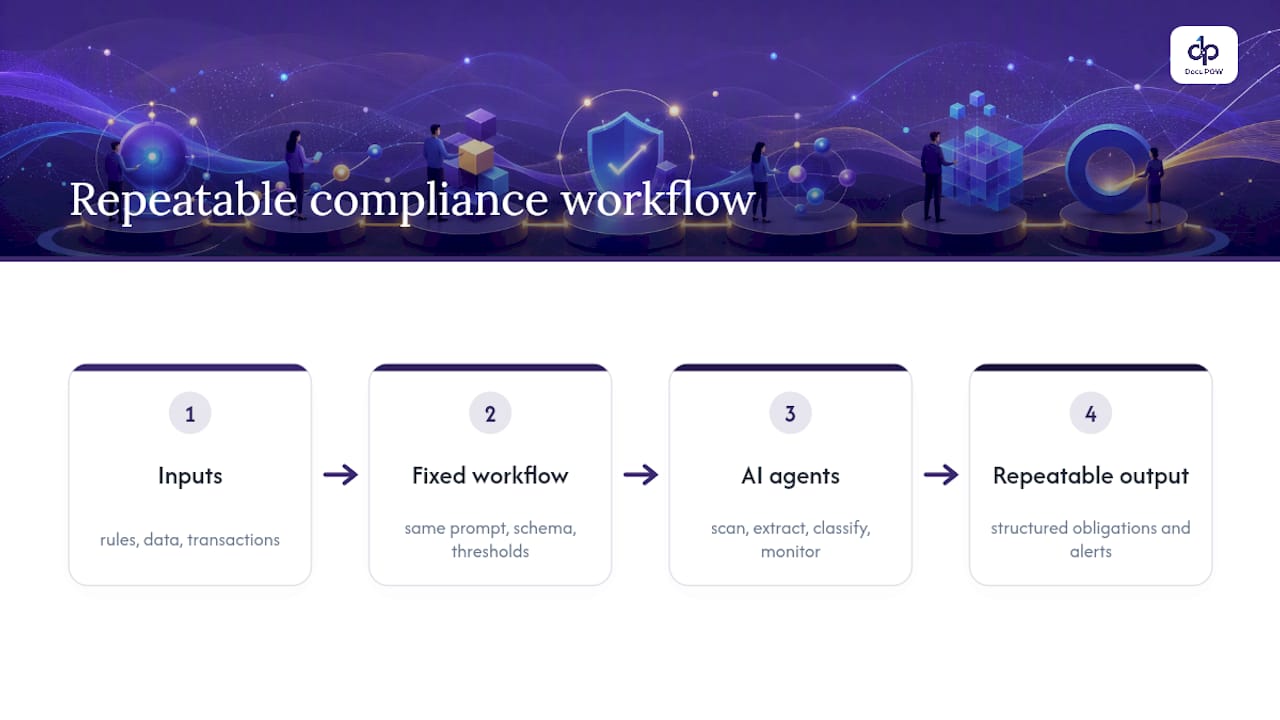
The common thread across all four is embedding AI into a defined process rather than handing analysts an open chat window. An open-ended prompt produces a different answer every time you ask it. A prompt wired into a fixed workflow, with the same inputs, schema, and thresholds every time, produces a repeatable one. That repeatability is what auditors and regulators actually want to see. As adoption grows, real-time data processing has become the backbone that makes continuous monitoring possible instead of theoretical.
What ROI Does Intelligent Compliance Management Actually Deliver?
Compliance leaders aren’t adopting AI for novelty. They’re adopting it because the numbers back it up.
Statistic Callout: Among compliance leaders using AI, 84% report improved departmental efficiency and 41% report direct cost savings, per the Compliance Week and konaAI survey. Separately, 53% of risk and compliance professionals are now using or piloting AI specifically to move from reactive to proactive compliance models.
Efficiency gains and cost savings are the headline, but they only mean something if you’re tracking the right operational metrics underneath them:
- Time per case: how long a review takes from intake to disposition, before and after automation.
- Human approval rate: the percentage of AI-generated recommendations a reviewer accepts without material edits.
- Cost per case: fully loaded cost, including reviewer time, not just software licensing.
- Coverage increase: how much more of your transaction or document volume you can now actually review.
None of this arrives automatically. The same survey data that shows high adoption also shows governance lagging behind it, meaning plenty of organizations are running AI without the controls to prove it’s working. Poor data quality, weak integration with legacy systems, and a shortage of staff who can supervise these tools are the three blockers that show up most often. Mitigating them starts with fixing data pipelines before scaling agent scope, not after.
Which Agent Design Patterns Actually Work in Production?
Compliance teams that get real ROI from AI tend to converge on the same handful of patterns, according to Purcell Analytics’ implementation guide. The four worth building around are:
- Classify-and-route. The agent categorizes an incoming case (a transaction, a document, a customer complaint) and routes it to the right queue based on confidence score. High-confidence, low-risk cases move automatically; anything below threshold goes to a human.
- Draft regulator-shaped artifacts. The agent produces the actual deliverable, like a SAR narrative, a policy citation, or a recommended remediation, in the format a regulator or reviewer expects. The reviewer edits and approves rather than starting from a blank page.
- Deterministic remediate-only. For narrowly scoped, low-ambiguity fixes (a missing field, a mismatched date), the agent applies a fixed correction with no judgment call involved. No approval loop needed because there’s no decision to make.
- Triage-and-approve. The agent surfaces a ranked list of what needs attention today, and a human approves or reprioritizes. This is the pattern most useful for teams still building trust in the system.
None of these hold up without design discipline underneath them. Deterministic pre-filters should catch the obvious cases before they ever reach the model. Every output needs schema validation, so a malformed response gets rejected rather than silently passed downstream. Prompt and model versions need to be logged with every single output, and reviewers need one-click accept or reject actions, not a five-step override process that nobody uses.
Pro Tip: *Track human approval rate as your single most important health metric.
Monitoring has to run continuously, not just at launch. That means drift detection on model outputs, and a scheduled cadence of ground-truth evaluation, where a sample of agent decisions gets checked against a known-correct answer set to catch quiet degradation before it becomes a finding.
How Do You Govern AI Risk in Compliance Workflows?
Governance is the part most teams underbuild, and it’s the part regulators care about most. Standards bodies and practitioners increasingly expect explainability and documented human oversight for any high-risk AI use, a point echoed in Thomson Reuters’ summary of practitioner sentiment. Four controls make that expectation concrete:
- Written scope documents that name exactly which actions an agent is permitted to take and which ones it is never allowed to take, reviewed and versioned like any other policy.
- Per-case audit trails capturing the prompt sent, the model ID and prompt version used, the full response returned, the reviewer’s identity, and the final decision, reconstructable months later if a regulator asks.
- Data protection and model validation, including periodic testing against fresh ground-truth sets to confirm the model still performs the way it did at launch.
- A quarterly review cadence where governance, not just IT, revisits scope, thresholds, and approval rates.
ISO’s governance and data management standards offer a useful frame for structuring these controls, particularly around retention and model risk documentation. None of this is optional overhead bolted onto a “real” AI project. It’s the difference between a pilot that survives its first regulatory exam and one that doesn’t. DocuPOW’s audit-readiness framework covers this same territory for teams building the underlying document workflows.
How Do You Start a Compliance AI Pilot?
Compliance leaders who succeed with a first pilot follow roughly the same sequence, and it rarely takes longer than 90 days to reach a go or no-go decision.
- Pick a narrow, high-volume, verifiable task. Invoice classification, KYC document review, or contract clause extraction all work because outcomes are measurable and volume is high enough to matter.
- Build a ground-truth evaluation set before touching production. You need a set of cases with known-correct answers to test against, not just a live-fire launch.
- Set your data readiness and reviewer UI first. Practitioners who’ve run these deployments at scale note that context layers and evaluation infrastructure matter more than which model you pick, according to lessons published in CDO Magazine. Get security approvals and integration checkpoints scheduled early since they’re usually the longest lead-time item.
- Define your exit criteria before you launch. Decide the approval-rate threshold and case volume that trigger scaling, and the thresholds that trigger a pause.
| Pilot stage | Primary gate | Owner |
|---|---|---|
| Task selection | Volume and measurability confirmed | Compliance lead |
| Evaluation build | Ground-truth set complete | Data/risk team |
| Production test | Approval rate stable above target | Reviewer team |
| Scale decision | Cost-per-case and coverage goals met | Compliance leadership |
How DocuPOW Implements These Patterns in Practice
An agent-based platform maps directly onto the patterns above. Autonomous agents extract data from documents without relying on rigid templates, which matters for compliance teams dealing with contracts, invoices, and disclosures that never arrive in a consistent format.
- Template-free extraction handles document variability the way a classify-and-route agent needs to, pulling structured fields from whatever format actually shows up.
- Multi-step workflow orchestration turns a document into a finished process, from intake through the review step, mirroring the draft-then-approve pattern compliance teams rely on.
- Human-in-the-loop review keeps a person making the final call on every extracted or routed item.
- Real-time analytics and predictive insights give compliance leaders the coverage and cost-per-case visibility that ROI tracking requires.
Specific customer case metrics and named implementations are best confirmed directly with DocuPOW, since figures vary by industry and document volume.
What Data Protection Standards Apply to Compliance AI?
Compliance AI touches some of the most sensitive data an organization holds: customer financial records, transaction histories, personally identifiable information, sometimes health data. That raises the stakes on every control decision.
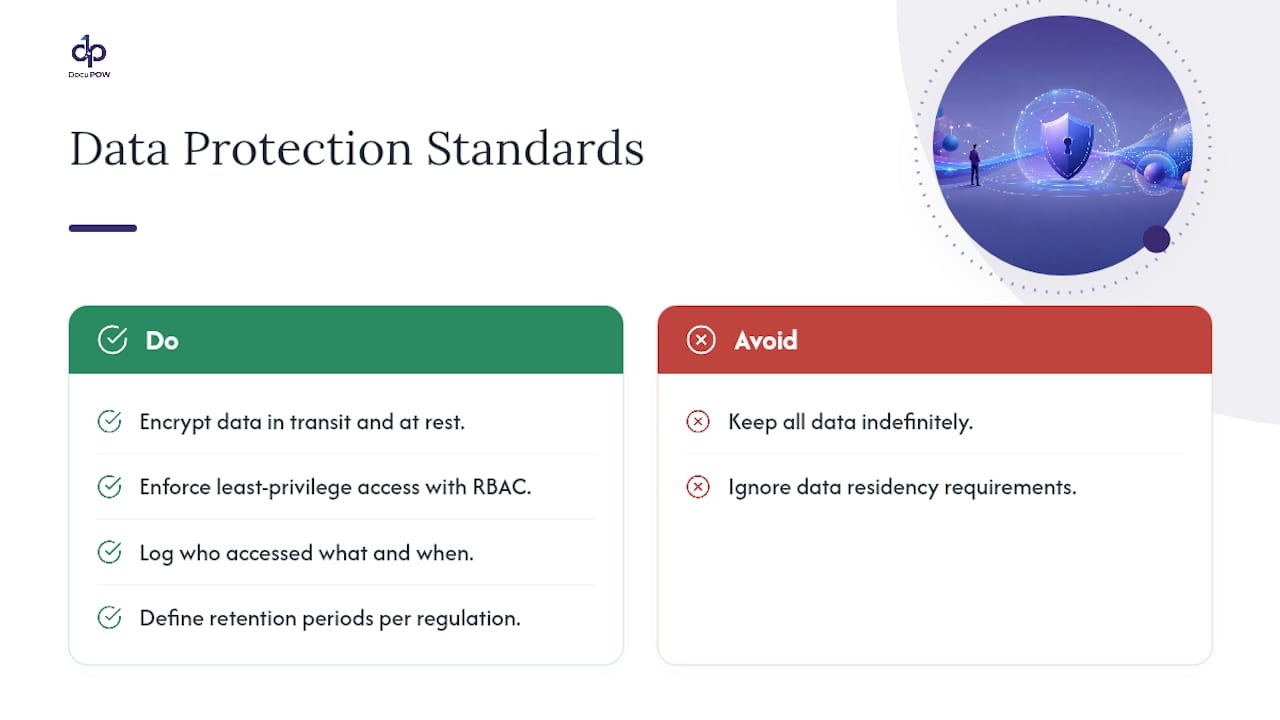
Encryption in transit and at rest is table stakes, not a differentiator. What actually separates a defensible deployment from a fragile one is access control granularity: does every person and every service account that touches compliance data have a documented, minimum-necessary reason to see it? Role-based access, paired with logging of who accessed what and when, gives you the evidence trail regulators expect if something goes wrong.
Data residency matters more than most teams initially plan for. If your compliance workflows touch customers across multiple jurisdictions, you need to know where the data physically sits and whether that location satisfies each jurisdiction’s requirements, not just your headquarters’ rules.
Model validation deserves the same rigor as data security. A model that was accurate at deployment can drift as inputs shift, whether through data changes, new regulatory language, or shifts in customer behavior. Periodic revalidation against a held-out evaluation set catches that drift before a regulator does. Retention policy is the other piece teams underweight: audit trail data, prompts, and model outputs need a defined retention period tied to your regulatory obligations, not an indefinite “keep everything” default that becomes its own liability.
How Does This Fit With ERP, GRC, and Document Management Systems?
Intelligent compliance management rarely runs as a standalone system. It sits between your document sources and the systems your compliance program already depends on: your GRC platform, your ERP, your document management repository.
The practical challenge is integration depth, not integration existence. A tool that can only read a PDF and hand back a static extract adds little value if your GRC platform still requires manual re-entry. The more useful pattern is API-level integration, where an agent’s output, a classified alert, an extracted obligation, a drafted narrative, writes directly into the case management or GRC workflow your team already uses, carrying its confidence score and audit metadata with it.
ERP integration matters most for teams whose compliance exposure runs through financial transactions: procurement, accounts payable, vendor onboarding. A platform that connects to ERP data natively can flag a compliance issue at the point a transaction is created, rather than during a retroactive audit weeks later. Document management integration matters for everything upstream of that: contracts, policies, disclosures, and the obligation extraction work described earlier depends on having clean access to that repository rather than a manual document dump.
DocuPOW’s platform architecture is built around this integration layer specifically, connecting extracted data to ERP and CRM systems via API rather than treating extraction as an isolated step.
How Do You Handle Multi-Jurisdictional Compliance Requirements?
Regulatory coverage is the area where AI’s promise and its actual limitations show up most clearly. A model trained on one jurisdiction’s regulatory language doesn’t automatically understand another’s, even when the underlying concept (anti-money laundering, data privacy, disclosure) looks similar on the surface.
The practical fix isn’t a single universal model. It’s building jurisdiction-specific context layers on top of a shared extraction and workflow engine, so the same platform can apply different obligation sets, different thresholds, and different regulator-shaped output formats depending on where a case originates. A SAR narrative built for one regulator’s expectations won’t satisfy another’s format requirements, and treating them as interchangeable is a common early mistake.
PwC’s guidance on this point is worth taking seriously: building virtual regulators, persona-driven simulators that pressure-test a compliance plan against how a specific regulator is likely to respond, before you ever submit anything for real, according to PwC’s risk and compliance research. That approach catches jurisdiction-specific gaps in a plan before they become actual regulatory friction.
Multi-jurisdictional coverage also means your governance scope documents need jurisdiction as a field, not an afterthought. What an agent is permitted to draft or auto-approve in one region may need a stricter human review threshold in another, depending on local regulatory maturity and enforcement posture.
How Do You Manage Organizational Adoption of These Tools?
The technology is rarely the reason a compliance AI rollout stalls. Adoption resistance usually comes from compliance analysts who’ve spent years building judgment they’re now asked to hand partially to a system they don’t yet trust.
The fix that works consistently is transparency about scope from day one: tell the team explicitly what the agent will and won’t decide, and where the human stays firmly in charge. A classify-and-route agent that surfaces its confidence score and reasoning alongside every recommendation gives reviewers something to evaluate rather than a black-box verdict to accept or reject blindly.
Training needs to cover more than “how to use the tool.” Reviewers need to understand what a falling approval rate means, what drift looks like, and when to escalate a pattern of disagreement with the system rather than just overriding case by case. Building that literacy across the team is what turns a pilot’s early skepticism into sustained use.
Change management also has a political dimension worth naming directly: whoever owns the human approval rate metric effectively owns the program’s credibility. Give that ownership to a compliance lead who has both the authority to pause a rollout and the technical fluency to read what the metric is actually telling them, not to an IT owner disconnected from the regulatory stakes.
Where Has Intelligent Compliance Management Actually Worked?
Financial services has moved fastest, largely because AML and KYC workflows are high-volume and rule-based enough to suit agentic patterns well. Transaction monitoring teams use classify-and-route agents to triage alerts, cutting the volume that reaches a human analyst while keeping every escalation auditable.
Healthcare compliance teams have applied similar patterns to claims review and disclosure tracking, where obligation extraction from constantly shifting payer and regulatory rules is a genuine bottleneck. Manufacturing and supply chain organizations, particularly those managing vendor compliance across many suppliers, have used document-extraction-driven workflows to catch missing certifications or expired contract clauses that used to slip through manual spot checks.
Insurance compliance teams have leaned on regulator-shaped artifact generation for filings that follow rigid, jurisdiction-specific formats, letting an agent produce a first draft that a compliance officer edits rather than building each filing from scratch.
The common pattern across every industry that’s made this work isn’t the specific use case. It’s narrow scope, measurable outcomes, and a human approval step that never disappears, even as the volume of cases going through it scales up.
What Are the Real Limitations of AI in Compliance?
AI in compliance is genuinely useful and genuinely limited, and pretending otherwise is how pilots fail.
The biggest limitation is context. A model can extract an obligation from regulatory text accurately and still miss the intent behind an unusual edge case that an experienced analyst would catch instantly. Agents are pattern matchers operating on the data and rules they’ve seen; a genuinely novel regulatory scenario, or a case that mixes signals in a way training data didn’t anticipate, can produce a confident, wrong answer.
Data quality is the second limitation, and it’s often the one that kills a pilot quietly rather than dramatically. An agent trained or evaluated against messy, inconsistent source documents will inherit that inconsistency in its outputs, and it usually takes weeks of falling approval rates before anyone traces the problem back to the data pipeline instead of the model.
Explainability has real limits too. Even with a reasoning string attached to every classification, a complex model’s actual decision process can be harder to fully reconstruct than a rule-based system’s ever was, which is exactly why the audit trail and human sign-off matter as much as they do.
And no governance framework eliminates the risk of overreliance. A team that starts trusting a high approval rate as permission to stop reviewing carefully has misread what the metric means. It measures whether the agent is useful, not whether oversight is still necessary.
Where Compliance Leaders Should Focus Next
Governance and evaluation need to be the baseline you build from, not a compliance checkbox added after a pilot already works. Teams that invest in data readiness and reviewer interfaces before expanding agent scope end up scaling faster, not slower, because they aren’t retrofitting controls under pressure. Engage regulators early, and treat human approval rate as the metric that tells you whether the whole program is actually healthy.
— Syed Naveed Abbas
How DocuPOW Fits Into Your Compliance Roadmap
If the checklist above sounds like the right sequence but building it from scratch feels like a multi-quarter project, that’s exactly the gap DocuPOW’s platform is built to close. Its agent-based extraction handles the document-to-structured-data step that most compliance teams try to bolt together with fragile templates and manual review, then hands the output into workflows with human-in-the-loop approval built in, not added on afterward.
Real-time analytics and predictive insights give you the coverage and cost-per-case visibility that ROI conversations require, without waiting months for a custom reporting build. For teams handling high transaction or document volume specifically, DocuPOW’s AI workflow automation services walk through how the extraction, orchestration, and review layers fit together for enterprise compliance use cases. Book a demo to see how your current document pipeline maps onto an agent-based workflow before you commit to a full build.
Sources
- AI-Compliance Survey — Compliance Week × konaAI
- Where AI helps power operational risk and compliance decisions — Moody’s
- AI Agents for Regulatory Compliance: An Implementation Guide — Purcell Analytics
FAQ
What Are the Three C’s of Compliance?
The three C’s most commonly cited are communication, culture, and controls. Effective compliance programs depend on clearly communicated policies, a culture that reinforces ethical behavior, and controls, increasingly AI-assisted, that catch violations before they escalate.
What Is the Best AI Tool for Regulatory Compliance?
There’s no single best tool across every industry, since needs vary by document type and regulatory scope. Agent-based platforms like DocuPOW that combine template-free document extraction with human-in-the-loop review tend to fit teams handling high volumes of varied compliance documentation.
Is Compliance a Stressful Job?
Compliance roles carry real pressure, driven by regulatory deadlines, personal liability concerns, and the volume of cases a small team often has to review. Intelligent compliance tools that automate triage and drafting reduce some of that load by cutting the manual case volume reaching each analyst.
What Are the Seven Pillars of Compliance?
Definitions vary across frameworks, but a commonly cited version includes written policies, a compliance officer, training, monitoring and auditing, reporting mechanisms, enforcement and discipline, and prompt response to detected issues. AI-driven monitoring and obligation extraction increasingly support the monitoring and reporting pillars specifically.
How Do I Know if My Compliance AI Pilot Is Working?
Track human approval rate as your primary signal. A rate holding steady above roughly 90%, alongside falling time-per-case and rising coverage, indicates the pilot is ready to scale.
Recommended
See DocuPOW on your documents.
Stop building templates. Start extracting data.