4 Pilot Metrics Leaders Must Track for AI Knowledge Management ROI
A governance-first enterprise guide that shows four pilot metrics to prove AI knowledge management works, plus checks for permission aware retrieval,...

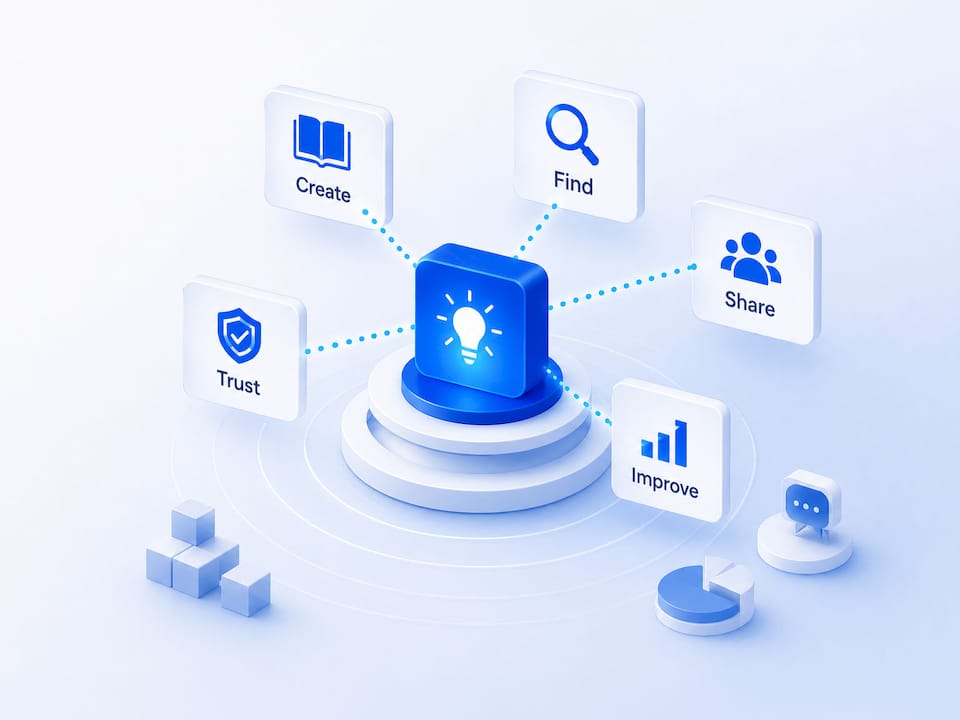
AI-powered knowledge management turns scattered documents into synthesized, role-aware answers instead of a pile of search results. The upside is real: faster decisions, hours of work recovered, and consistent answers across departments. None of it holds up without permission-aware retrieval and audit trails that a compliance team can actually verify. Skip that governance layer and the same technology that saves time becomes the fastest way to leak the wrong document to the wrong person.
TL;DR:
Permissions, audit logs, and redaction are essential safeguards to prevent AI-driven synthesis from leaking sensitive information to unauthorized users.
Most AI knowledge systems excel at content capture but often lack enforced permission controls and provenance tracking during retrieval.
High-volume functions like customer support, finance, and manufacturing see immediate ROI through faster answers, reduced ticket volume, and automated workflows.
Early pilot success depends on cleaning content, defining ownership, and establishing governance measures before full deployment.
Content hygiene practices, such as ROT detection and ownership assignment, are critical to long-term AI-KM effectiveness, surpassing model sophistication in importance.
Table of Contents
-
What Is AI-Powered Knowledge Management, and How Is It Different?
-
The DocuPOW Approach to Governance-First Knowledge Extraction
-
Why Most Knowledge Management Advice Gets the Order Backward
What Is AI-Powered Knowledge Management, and How Is It Different?
AI-powered knowledge management is the practice of using machine learning, natural language processing, and generative models to ingest an organization’s documents, conversations, and records, then answer questions directly instead of just pointing to files. That is the core shift. Traditional knowledge management software indexed documents and returned a ranked list; you still had to open five PDFs to find the clause you needed. Modern intelligent knowledge systems read those same PDFs, understand context, and hand back a synthesized answer with the sources attached.
That distinction changes what a buying decision actually protects against. A ranked-document search fails safely: if a user lacks permission to see a file, it just doesn’t show up in results. A synthesis engine can pull facts from ten documents a user was never cleared to read and blend them into one confident, plausible answer. TechTarget’s analysis of generative AI in enterprise KM makes this exact point: as knowledge platforms move from search to synthesis, permission-aware retrieval stops being a nice feature and becomes a prerequisite for safe deployment.
Most AI-driven knowledge systems organize their work around four lifecycle stages, which this article uses as its structure:
-
Capture — pulling structured and unstructured data out of documents, emails, tickets, and chat logs
-
Organize — tagging, linking, and structuring that data so it is searchable by meaning, not just keyword
-
Retrieve — surfacing the right answer to the right person, with the right permissions enforced
-
Apply — turning retrieved knowledge into summaries, decisions, and automated next steps
Core AI Technologies Powering Modern Knowledge Systems
Four technical layers do the actual work behind any credible AI knowledge base, and each solves a different problem.
Natural language processing handles the messy input: unstructured emails, scanned contracts, call transcripts, and free-text ticket fields that traditional databases choke on. Embeddings and vector search sit on top of that. Instead of matching keywords, embeddings convert text into numerical representations of meaning, so a query for “vacation policy” also surfaces a document titled “PTO guidelines” because the two phrases sit close together in semantic space. This is what powers real semantic search rather than the brittle keyword matching most legacy knowledge base software still relies on.

Generative models handle the last mile: summarizing a 40-page vendor contract into three bullet points, or drafting a synthesized answer that cites four internal sources. The benefit is speed. The risk is hallucination, where a model states something confident and wrong because it filled a gap with a plausible guess rather than a sourced fact. That risk is exactly why a 2026 systematic review across industries flags ethical and technological implementation barriers alongside the clear productivity gains, and recommends governance frameworks rather than unmonitored deployment.
Agentic automation is the newer layer, and it changes the operating model rather than just the interface:
-
Traditional software waits for a query; an autonomous agent can monitor a workflow, notice a stalled invoice, and act on it
-
Deployment choice matters: a privately hosted model keeps sensitive data inside your infrastructure, while a hosted API trades some control for lower setup cost
-
Model governance, meaning fine-tuning oversight, accuracy evaluation, and drift monitoring, keeps answer quality from degrading silently as source content changes
Pro Tip: Ask any vendor how often their model gets re-evaluated against a fixed test set of internal questions. “Continuously” without a specific cadence is usually marketing language, not a governance process.
How AI Works Across the Knowledge Management Lifecycle
Mapping AI capabilities to each lifecycle stage makes it much easier to compare vendors, because “AI-powered” means something different depending on which stage you’re evaluating.
-
Capture. Optical character recognition (OCR) pulls text off scanned pages, but template-free extraction goes further: it identifies entities like invoice numbers, vendor names, and line items without a pre-built template for every document layout. Entity linking then connects “Acme Corp” in a contract to the same entity in your CRM, so the system knows they’re the same customer.
-
Organize. Auto-tagging assigns metadata (department, sensitivity, document type) at ingestion instead of relying on someone remembering to do it manually. ROT detection, which stands for redundant, outdated, or trivial content, flags the three conflicting versions of a policy doc sitting in different folders. Knowledge graphs then map how entities relate to each other, which grounds later answers in verified connections instead of loose text similarity.
-
Retrieve. This is where permission-aware retrieval enforces access rules at query time, not just at storage time. Provenance tagging means every synthesized answer arrives with a visible trail back to its source documents, and contextual grounding keeps the model tethered to actual retrieved content rather than its general training data.
-
Apply. Summaries condense long documents into decision-ready briefs. Decision support surfaces relevant precedent, like similar past deals or prior support tickets, at the moment someone needs it. Agentic workflows take it one step further and trigger the next action, such as routing a flagged invoice to an approver, without a human having to notice the exception first.
The gap between vendors rarely shows up at capture. Most tools can extract text reasonably well. It shows up at retrieval, where permission enforcement and provenance either exist by design or get bolted on as an afterthought.
Key Platform Features and Procurement Requirements
Enterprise-grade intelligent knowledge management systems need to pass a specific checklist before they touch production data. Market analysis of the AI knowledge management space identifies permission-aware retrieval, tamper-evident audit trails, field-level redaction, and provable deletion as the procurement differentiators that separate platforms ready for regulated data from ones that aren’t.
-
Permission-aware retrieval (RBAC/ABAC). Role-based access control (RBAC) and attribute-based access control (ABAC) enforce who can see what at the moment of retrieval, not just at storage. A synthesized answer built from five documents needs to check permissions on all five, not just the top result.
-
Field-level redaction. Sensitive fields, like a salary figure buried inside an HR letter, need to be masked in an answer even when the surrounding document is visible to that user.
-
Tamper-evident audit logs and source provenance. Enterprise buyers increasingly want auditor-verifiable logs, meaning records a third-party auditor can independently confirm haven’t been altered, rather than logs only the vendor can vouch for.
-
Non-disruptive integration. A platform that requires a full data migration before it delivers value is a hard sell to any CIO. Integration through existing APIs into current ERP, CRM, and document stores should let a pilot start on live systems.
-
Active content-quality controls. ROT detection paired with owner-assigned review workflows keeps the knowledge base from decaying the moment nobody’s watching it, which is the single most common reason KM initiatives quietly stop delivering value after year one.
Benefits and Measurable ROI: What to Actually Expect
The business case for AI-powered knowledge management rests on four measurable outcomes, and each one should show up in a pilot’s numbers within weeks, not quarters.
Time recovery is the most immediate. Employees stop hunting across five systems for an answer that a synthesis engine can retrieve and cite in seconds. Support deflection follows close behind: when customers or internal staff get an accurate synthesized answer instead of opening a ticket, first-line ticket volume drops and human agents handle only the cases that genuinely need judgment. Faster onboarding comes from new hires querying the knowledge base directly instead of interrupting a senior colleague five times a day. Institutional knowledge retention matters most when someone leaves; a well-governed AI knowledge base captures the reasoning behind past decisions, not just the decisions themselves.
A 2026 systematic review across industries found consistent, cross-sector benefits in capture, retrieval, and personalization from AI-powered KM adoption, while cautioning that these gains only materialize when organizations address implementation and governance barriers directly rather than treating deployment as a plug-and-play rollout.
For a pilot, track these four metrics from day one:
-
Time-to-answer — how long it takes a user to get a correct, cited answer versus the old process
-
Search success rate — the percentage of queries that return a usable answer without escalation
-
Escalation rate — how often a query still needs a human expert despite the AI attempt
-
Net time saved — aggregated hours recovered per team per week, measured against a pre-pilot baseline
Implementation Roadmap and Governance Checklist
Most AI knowledge management failures trace back to sequencing, not technology. Governance and organizational readiness, not model capability, are the primary barriers to successful adoption, according to a review of AI-KM integration challenges. That single finding should reorder how most teams plan a rollout.
-
Pick a pilot team with repetitive, well-bounded queries. Support and sales teams are the classic starting point because their questions repeat constantly and the content is lower-risk than legal or HR data, which lets you build governance patterns before touching anything sensitive.
-
Audit content and clean up ROT before enabling synthesis. Feeding a generative model three conflicting versions of the same policy guarantees confident, wrong answers. Clean the source material first.
-
Assign content ownership and a review cadence. Every knowledge domain needs a named owner responsible for freshness, and a set schedule (monthly, quarterly) for reviewing what’s stale.
-
Build in human review gates. Sensitive or high-stakes answers, anything touching compliance, compensation, or legal exposure, should route through a human reviewer before it’s trusted as final.
-
Run the security checklist before go-live. Confirm permission models are enforced at retrieval, redaction works at the field level, deletion requests are provably completed, and audit logs are tamper-evident.
-
Set scale criteria and monitor continuously. Define the metrics (from the ROI section above) that justify expanding to a second team, and keep monitoring after launch rather than treating go-live as the finish line.
Pro Tip: Don’t pilot in legal or HR first, no matter how tempting the use case looks. Start where a wrong answer costs you an awkward Slack message, not a compliance investigation, then earn your way into sensitive domains once the governance model has actually been tested.
For teams building this out internally, DocuPOW’s knowledge management roadmap resource walks through the organizational change side in more depth, and a broader enterprise AI governance framework is worth reviewing before you finalize a security checklist.
Where AI Knowledge Management Delivers the Fastest ROI
Certain functions see payback almost immediately because their query volume is high and their content is relatively low-risk.
-
Customer support and contact centers. Deflecting repetitive tier-one questions to a synthesized, cited answer frees human agents for the calls that actually need empathy or judgment, and it’s the lowest-risk place to prove the model works before expanding scope.
-
Product and engineering teams. Centralizing decision history means a new engineer can query “why did we choose this architecture” and get the actual post-mortem instead of pinging three people who may not remember either.
-
Finance and operations. Automated document extraction from invoices, purchase orders, and contracts, paired with anomaly flagging that catches a duplicate payment or an out-of-policy line item, turns document processing from a manual bottleneck into a monitored workflow.
-
Manufacturing and supply chain. Document-to-action workflows connect a bill of lading or a quality report directly to the next step in the process, and exception handling routes anything unusual to a human before it becomes a shipment delay.
The DocuPOW Approach to Governance-First Knowledge Extraction
DocuPOW’s agentic, template-free extraction directly addresses the capture bottleneck most AI knowledge management projects hit first. Instead of building a rigid template for every invoice or contract layout a company handles, autonomous agents read documents contextually, which cuts ingestion friction for organizations juggling inconsistent formats across regions and vendors.
That capability maps to specific governance needs decision-makers should be checking for:
-
Provenance tracking that keeps every extracted data point traceable to its source document
-
Real-time analytics and predictive insights that turn extracted data into decision support instead of a static archive
-
API-based integration with ERP and CRM systems, so extraction feeds existing financial and operational systems without a disruptive migration
Global manufacturers with high-volume, inconsistent document flows are where this fit shows up most clearly, since template-free extraction removes the maintenance burden of rebuilding templates every time a supplier changes their invoice format. DocuPOW’s product documentation outlines the full extraction and workflow orchestration set for teams evaluating pilot scope.
Conclusion: Three Steps Before You Buy Anything
The governance-first case holds: AI-powered knowledge management pays off fastest when permission enforcement and auditability are designed in, not patched on later. Before signing anything, do three things: pick a low-risk pilot team, audit and clean your source content, and define your KPIs and ownership model in writing. Then ask every vendor the same three questions: How is retrieval permission enforced? Can an auditor independently verify your logs? What metrics do your pilots actually report?
Why Most Knowledge Management Advice Gets the Order Backward
Most vendor pitches lead with the model. They talk about summarization quality, response speed, how natural the generated answers sound. That’s the wrong starting point, and the research backs this up: organizational readiness and governance gaps, not model capability, are consistently cited as the primary barrier to AI-KM success. A brilliant model reading garbage, outdated, duplicated source content just produces confident garbage faster.
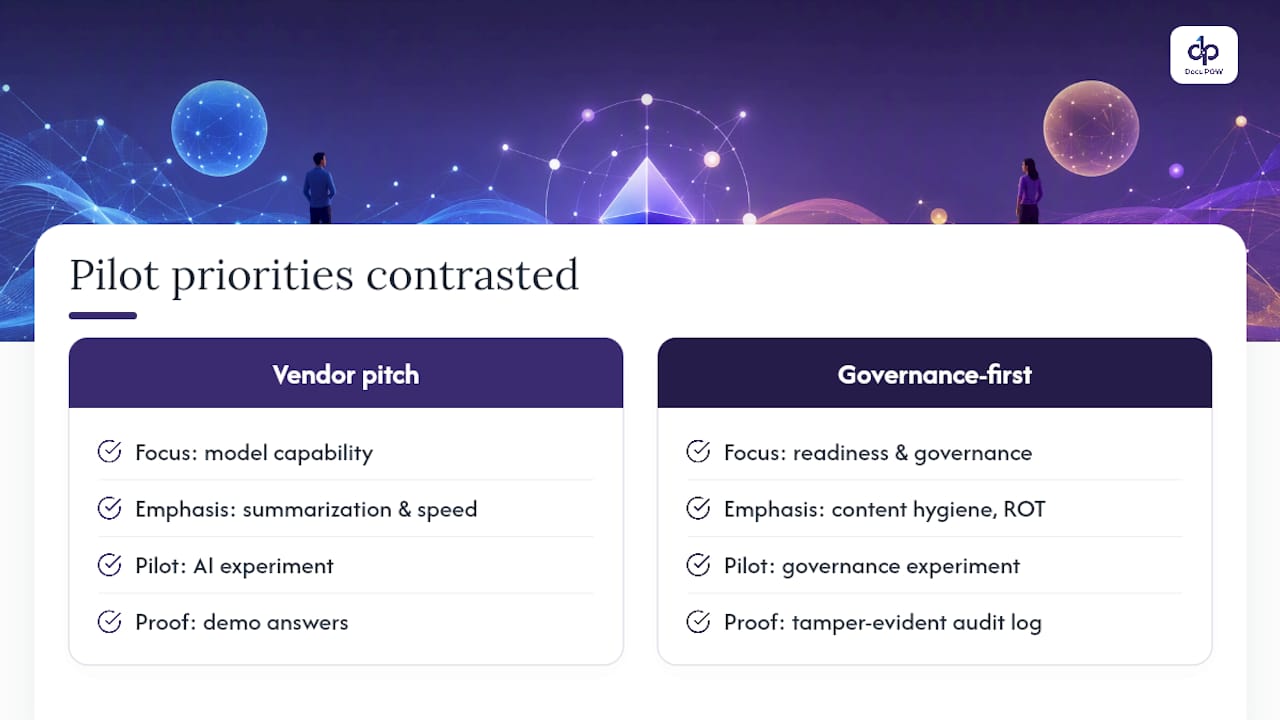
What gets underestimated is how much of this work is content hygiene, not AI sophistication. ROT detection and ownership assignment sound boring next to “generative synthesis,” but they determine whether your rollout works in month three or quietly stalls. The teams that succeed treat the pilot as a governance experiment with an AI component, not an AI experiment with governance bolted on.
If you take one thing from this, prioritize provable auditability over flashy demo answers. A model that gives a great answer in a sales demo and a vendor that can show you a tamper-evident log an outside auditor can verify are solving two different problems. Only one of them survives a compliance review.
— Syed Naveed Abbas
Put DocuPOW to Work on Your Document Backlog
If you’re weighing whether to build a governance-first knowledge system in-house or buy one, DocuPOW skips the months of template-building that most document automation projects get stuck on. Its agents read documents contextually, so a change in a vendor’s invoice layout doesn’t break your extraction pipeline the way a rigid, template-based tool would.
That matters most for teams drowning in inconsistent paperwork: finance departments reconciling invoices against purchase orders, operations teams processing shipment documents, or manufacturers handling supplier paperwork that never follows the same format twice. DocuPOW’s real-time analytics and predictive insights turn that extracted data into something you can act on immediately, rather than a static file sitting in a folder waiting for someone to notice a problem. Teams running high-volume document processing can see how the three-way matching workflow handles purchase orders, invoices, and receipts automatically, catching mismatches before they become a finance headache.
Start with a demo to see how DocuPOW handles your actual document formats, not a generic sample set, and get a clear read on where template-free extraction would save your team the most hours.
Sources
-
GenAI streamlines enterprise knowledge management process | TechTarget
-
AI Knowledge Management in 2026: State of the Market | Brain.AIVM
FAQ
How can AI be used in knowledge management?
AI handles document capture through OCR and entity extraction, organizes content through auto-tagging and knowledge graphs, retrieves answers through permission-aware semantic search, and applies knowledge through summaries and agentic workflows that act on what it finds.
What is the 30% rule in AI?
There’s no single, widely recognized “30% rule” specific to AI knowledge management; if you’ve seen the term elsewhere, it likely refers to a general productivity heuristic rather than a defined KM standard.
What are the best AI tools for knowledge management?
The strongest platforms combine permission-aware retrieval, tamper-evident audit logs, and template-free extraction rather than relying on rigid document templates. DocuPOW addresses the capture and extraction side of this stack with agentic, template-free processing built for high-volume enterprise document workflows.
Is AI good for knowledge management?
Yes, when governance is built in from the start. Cross-industry research confirms consistent benefits in capture, retrieval, and personalization, but the same research flags that skipping governance and content-quality controls is what causes AI-KM projects to underdeliver.
What’s the difference between traditional knowledge management and AI-powered knowledge management?
Traditional knowledge management software returns a ranked list of documents; AI-powered systems synthesize a direct answer from multiple sources and cite where it came from, which raises the stakes on permission enforcement at retrieval time.
Recommended
See DocuPOW on your documents.
Stop building templates. Start extracting data.