6–10 Week Pilot: Agentic Automated Policy Management for Enterprise
Enterprise checklist: run a 6–10 week automated policy management pilot using agentic, template free extraction and an LLM as judge to enforce policy as code.


Automated policy management uses agentic, template-free document extraction paired with an enforceable policy-as-code layer to turn policy text into machine-readable rules that drive fast, auditable decisions. If your organization processes recurring contracts, expense rules, or regulatory manuals with measurable workflows attached, a pilot is worth running now rather than later. One credible option for that pilot is a platform built specifically around this extraction-to-enforcement model rather than static templates.
TL;DR:
- Automating policy management relies on extracting unstructured policy text into enforceable, machine-readable rules, primarily for contracts, regulations, and vendor agreements.
- The process involves document normalization, context-aware extraction by large language models, and an iterative judgment system that refines rules before enforcement.
- Pilot success depends on narrowing scope, building quality datasets, setting clear evaluation criteria, and managing ambiguous policy language through document cleanup.
- Most pilot failures stem from overly broad scope and unaddressed policy ambiguity, highlighting the need for precise policies and measured confidence thresholds.
- Effective platforms support real-time enforcement, transparent decision logs, and seamless integration with existing systems, with pilot timelines typically lasting 6 to 10 weeks.
Table of Contents
- What Is Automated Policy Management, Exactly?
- How Does Automated Policy Management Work?
- What Are the Measurable Benefits of Automated Policy Management?
- How Do You Implement Automated Policy Management?
- What Do Deployment Pilots Actually Teach Teams?
- Where DocuPOW Fits Into Your Evaluation
- Sources
- FAQ
What Is Automated Policy Management, Exactly?
This isn’t policy portal software for publishing employee handbooks or tracking who clicked “acknowledge” on a code-of-conduct PDF. That’s a different product category entirely. Automated policy management, as covered here, is document-centric: it converts unstructured policy text (contracts, regulatory manuals, procurement terms, expense guidelines) into structured, enforceable rules that an agent-based system checks against incoming documents in real time.
The scope matters because vendors and buyers often talk past each other. Automated policy management, in this sense, covers:
- Contract clauses that trigger approval workflows or flag deviations from standard terms
- Regulatory manuals translated into pass/fail validation logic for compliance checks
- Expense and procurement rules applied automatically to incoming invoices or purchase requests
- Vendor agreements where terms need continuous monitoring against live transactions
The output looks different from a compliance dashboard. Expect typed rule units (discrete, machine-readable policy statements), pass/fail validation results tied to specific clauses, and audit logs that trace every automated decision back to its source document. If a vendor’s demo shows you a policy library with search and tagging but no extraction or enforcement engine underneath, you’re looking at the wrong category of tool.
How Does Automated Policy Management Work?
The pipeline starts with document normalization. Scanned contracts, PDFs, and legacy manuals get run through OCR and converted into structured Markdown or chunked text, canonicalizing formats so an extraction agent can work across inconsistent source documents without a preset template for each one.
From there, agentic large language models perform the extraction itself. Instead of matching fields against a fixed template, the agent reads context and intent, producing typed rule units or knowledge-graph nodes that represent each policy statement. This template-free approach is what separates modern platforms from the rules-engine software of a decade ago, and it’s why knowledge-graph-based extraction has gained traction: PoliGrapher’s research found this method identified 40% more collection statements than prior extraction approaches, at 97% precision.
Raw extraction alone isn’t trustworthy enough for enterprise decisions, though. That’s where LLM-as-a-judge verification comes in: a second model evaluates the extracted rules against multiple criteria, flags weak or ambiguous outputs, and triggers iterative repair before anything reaches production.
According to research on the De Jure extraction pattern, this judge-guided iteration produces monotonic quality improvements within three rounds at most, and downstream question-answering grounded in the refined rules was preferred over unrefined outputs in 73.8% of single-rule tests, climbing to 84% at broader retrieval depth.
Pro Tip: Ask any vendor exactly how many repair iterations their judge loop allows before a document escalates to a human. “Unlimited retries” sounds generous but usually means no real quality gate exists at all.
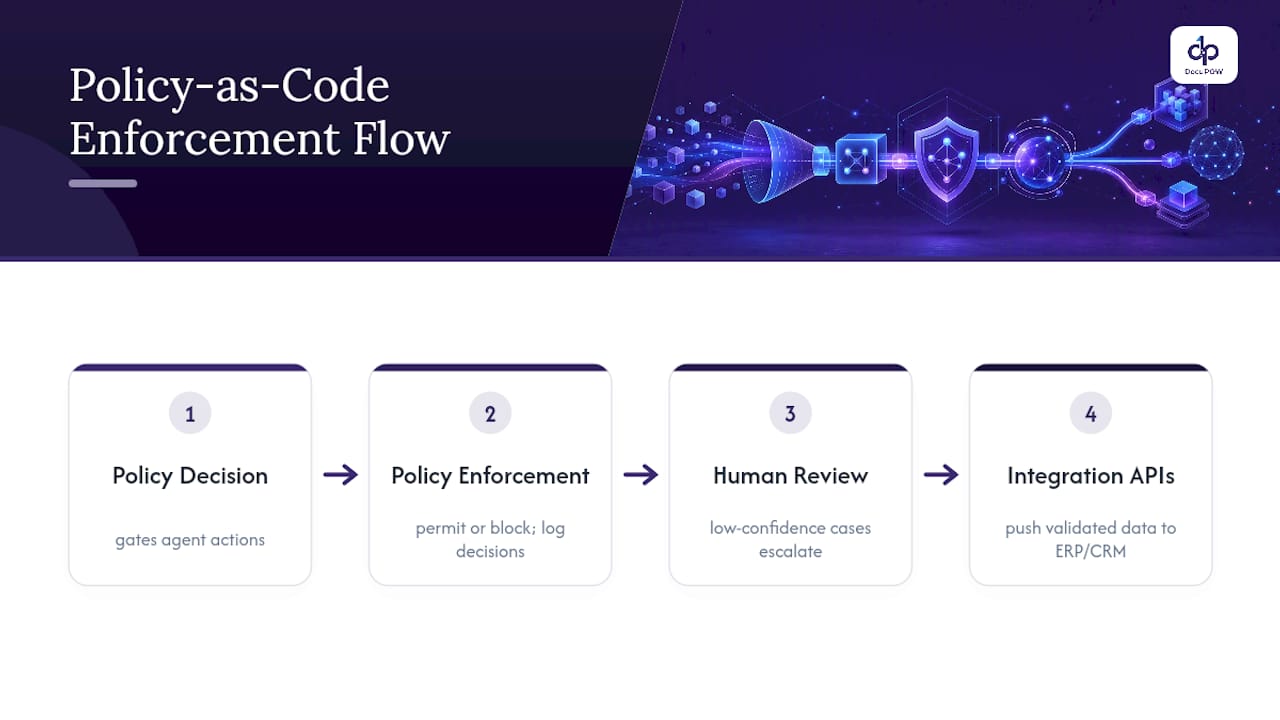
Once rules pass verification, a policy-as-code layer enforces them. This typically means a policy decision point (PDP) and policy enforcement point (PEP) architecture that gates agent actions in real time, similar to the guardrail model Kyndryl describes for regulated industries. Every decision gets logged. Human-in-the-loop checkpoints catch low-confidence cases, and integration APIs push validated data into your ERP, CRM, or workflow engine without a separate manual handoff.
What Are the Measurable Benefits of Automated Policy Management?
The business case comes down to fewer hours spent on manual review and faster time to decision, but the specific KPIs vary by function. Finance teams tracking invoice exceptions want reduced touch time per document. Procurement teams checking vendor terms against contract standards want fewer missed deviations. Compliance teams validating regulatory manuals want a defensible audit trail more than raw speed.
Vendor case notes in this space, including examples from GLIK’s policy automation templates, point to reductions in manual review effort approaching 70% for expense and invoice workflows in some deployments. Treat figures like that as directional rather than guaranteed. Every document mix, ambiguity level, and integration setup changes the outcome.
Function-level patterns worth tracking during a pilot:
- Finance: percentage of invoices auto-approved without human touch, average exception-handling time
- Procurement: number of vendor-term violations caught pre-payment versus post-payment
- Compliance: regulatory manual coverage percentage and time-to-flag for new rule changes
For reporting cadence, weekly reviews during the first 90 days catch drift early; monthly cadence works once confidence thresholds stabilize. Cost per document processed is the metric finance leaders ask for first, but pair it with an error-rate figure. A cheaper process that lets more bad decisions through isn’t actually cheaper.
How Do You Implement Automated Policy Management?
Moving from pilot to production follows a predictable sequence, and skipping steps is the most common way teams stall out.
- Define scope narrowly. Pick one document type and one policy class (say, expense reports against a single reimbursement policy) rather than trying to cover every contract type at once.
- Build a golden dataset. Assemble 50 to 100 representative documents, including edge cases and intentionally ambiguous language, so the system’s accuracy gets tested against real messiness, not clean samples.
- Set evaluation criteria upfront. Extraction fidelity, judge accuracy, auditability of the decision trail, integration readiness with existing systems, and security and compliance posture all need pass/fail thresholds before the pilot starts, not after.
- Run the pilot with a defined HITL budget. Decide in advance what percentage of documents route to human review versus automated pass, and set the confidence threshold that triggers escalation.
- Establish acceptance and rollback criteria. Know what “good enough to scale” looks like and what triggers a pause, before you’re staring at week six results trying to decide in real time.
A typical pilot runs 6 to 10 weeks for a single document type and policy class. Ambiguous source language is the biggest hidden cost here: research on policy ambiguity shows that vague or inconsistent policy text directly reduces automated extraction accuracy, so cleaning up the underlying policy documents often matters more than tuning the model.
Pro Tip: *Before you evaluate any vendor, write down your confidence threshold for auto-approval in numbers, not adjectives.
What Do Deployment Pilots Actually Teach Teams?
Most failed pilots share the same root cause: scope that’s too broad for the timeline allotted. Teams want to automate every contract type in the portfolio during a single quarter, and when the results come back mixed across document types, the whole initiative gets labeled a disappointment rather than a scoping error.
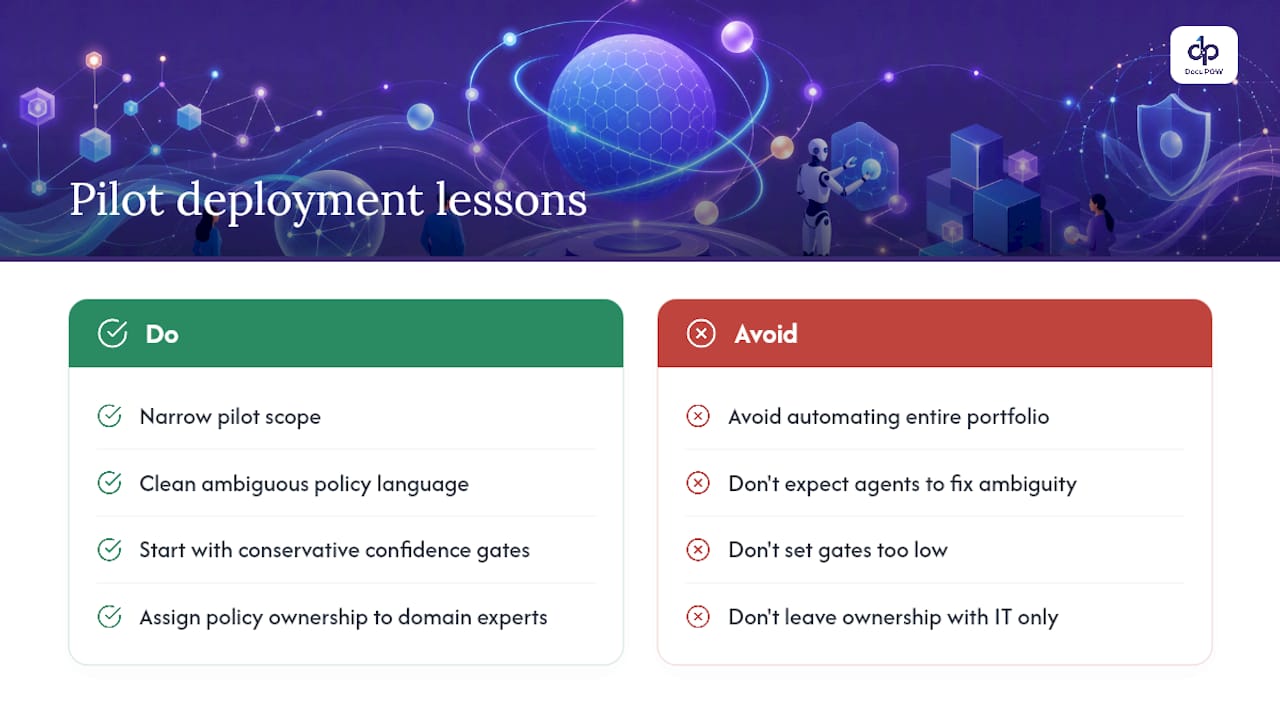
The second common trap is treating ambiguous policy language as the system’s problem to solve rather than the organization’s problem to fix. If your expense policy says “reasonable travel costs” without a number attached, no extraction agent will resolve that ambiguity consistently. Clean the policy before you automate it.
Confidence gates deserve more thought than most teams give them. Setting the threshold too low floods reviewers with false escalations; setting it too high lets bad decisions through silently. Start conservative, measure actual error rates against human review for the first month, then loosen the gate deliberately. Ownership should sit with whoever owns the underlying policy, not just IT. A compliance officer who understands the regulatory manual should sign off on rule accuracy, not just system uptime.
— Syed Naveed Abbas
Where DocuPOW Fits Into Your Evaluation
A platform built around the same extraction-to-enforcement model this article describes features template-free extraction that reads document context instead of matching fixed layouts, agentic enforcement tied to policy rules, and real-time analytics that give finance and compliance leaders visibility into decisions as they happen rather than after a quarterly audit.
For procurement teams building a pilot proposal, the checklist above translates directly into what to bring to a demo: a sample set of your actual policy documents (not sanitized examples), your target confidence threshold, and the KPIs your function cares about most, whether that’s exception-handling time in finance or vendor-term coverage in procurement. An audit trail and API integrations with existing ERP and CRM systems mean the pilot data doesn’t live in a silo. The platform page walks through how document intelligence and workflow orchestration connect, and the enterprise workflow automation guide covers broader orchestration patterns if your scope extends past a single policy class. If you’re weighing systems-integration partners for the rollout itself, firms like Autonomousfirm specialize in that kind of change management. Request a demo and bring your messiest document set. That’s the one that tells you whether the extraction actually holds up.
Sources
For readers who want to verify the technical claims vendors make, a few sources stand out: the De Jure paper on iterative LLM refinement, AWS’s Policy Discovery Module documentation, the open-source PolicyFlow project, and PoliGraph-er’s knowledge-graph research.
- De Jure: Iterative LLM Self-Refinement for Structured Extraction of Regulatory Rules
- PoliGraph-er: Knowledge graph extraction from privacy policies (USENIX/NDSS)
- GLIK policy automation templates and case notes
FAQ
What Makes Automated Policy Management “Agentic”?
Agentic means the extraction system reads document context and intent rather than matching fields against a fixed template, letting one agent handle varied document formats without per-type configuration.
Is Automated Policy Management the Same as HR Policy Software?
No. This category extracts and enforces rules from documents like contracts and regulatory manuals; it doesn’t publish or track employee acknowledgment of company handbooks.
How Long Does a Typical Pilot Take?
Most single-document-type pilots run 6 to 10 weeks, though ambiguous source policies can extend that timeline since unclear language reduces extraction accuracy.
What Confidence Threshold Should We Set for Auto-Approval?
There’s no universal number since it depends on document risk and volume, but most teams start conservative, measure error rates against human review for a month, then adjust.
Do platforms Support Integration With Existing ERP Systems?
Yes, some platforms provide APIs designed to connect extracted, validated policy data directly into existing ERP and CRM systems without a manual data transfer step.
Recommended
See DocuPOW on your documents.
Stop building templates. Start extracting data.