Data Analytics Consulting Firm: 2026 Selection Guide
Looking to hire a Data Analytics Consulting Firm? Discover how these experts transform your data into actionable insights for better business decisions.


TL;DR:
- A data analytics consulting firm transforms raw data into actionable insights that improve business results through scalable systems. These firms prioritize understanding business problems first and delivering production-ready AI embedded in daily workflows. Successful projects focus on organizational alignment and continuous analytics capabilities to produce measurable KPI improvements.
A data analytics consulting firm helps organizations transform raw data into decisions that drive measurable business results. These firms combine data engineering, applied AI, and business intelligence consulting to build systems that work in production, not just in presentations. Most businesses use less than 10% of their available data. That gap represents the core problem a qualified analytics strategy firm exists to close. The right partner does not just run reports. It builds a scalable data ecosystem that embeds insights directly into your operations, so your teams act on intelligence in real time rather than waiting for the next quarterly review.
What makes a data analytics consulting firm worth hiring?
The best firms follow a structured engagement model. Discovery-first engagements identify fragmented data sources, audit existing infrastructure, and produce a prioritized roadmap before any code is written. That sequence prevents the most expensive mistake in analytics projects: buying technology before defining the problem.

A business-first approach is the clearest differentiator between firms that deliver ROI and firms that deliver slide decks. Defining the business challenge first before selecting a technical method prevents costly misalignment. A supply chain team needs different models than a fraud detection team, and a firm that leads with tools rather than problems will build the wrong thing.
Look for firms that build production-ready systems. Models isolated in notebooks rarely deliver business value. The firms worth hiring operationalize AI by embedding it into daily workflows with proper MLOps, monitoring, and governance.
Track record matters. Ask for specific KPI improvements, not general success stories. Predictive modeling and operational analytics can improve forecast accuracy by 20–40% when implemented correctly. That is the standard to hold a firm accountable to.
- Structured engagement model with a defined discovery phase
- Business problem definition before technology selection
- Production-ready AI and data pipeline delivery
- MLOps, model governance, and ongoing monitoring
- Measurable KPI outcomes tied to specific deliverables
- Platform flexibility across cloud and on-premise environments
Pro Tip: Before your first call with any analytics consultancy, build a simple internal data inventory. List your key data sources, their formats, and who owns them. Firms that ask for this upfront are serious about delivery. Firms that skip it are selling a demo.
10 services top data analytics consulting firms provide
1. Discovery and data assessment
Every credible engagement starts here. The firm audits your existing data sources, identifies gaps, and maps the distance between your current state and your business goals. This phase typically runs 2–4 weeks and produces a prioritized list of opportunities ranked by business impact.
2. Data strategy and roadmap development
A roadmap translates business goals into a sequenced technical plan. It defines which data products to build first, which platforms to adopt, and how to measure progress. Without a roadmap, analytics projects drift and lose executive support.
3. Data engineering and pipeline development
Clean, reliable data pipelines are the foundation of every analytics system. Firms build ingestion, transformation, and storage layers that handle real-world data volume and variety. Automated data cleaning and feature engineering is critical here. Without it, models fail to deliver accurate predictions regardless of how sophisticated the algorithm is.
4. Advanced analytics and predictive modeling
This is where firms apply statistical modeling, machine learning, and forecasting to specific business problems. Examples include demand forecasting for manufacturers, churn prediction for subscription businesses, and credit risk scoring for financial services teams.
5. Operational analytics and embedded insights
Operational analytics means putting the right metric in front of the right person at the right moment. Embedding insights directly into workflows drives measurable outcomes. Traditional reports accessed once a week do not change behavior. Dashboards built into the tools your teams already use do.
6. Applied AI and machine learning deployment
Deployment is where most analytics projects fail. Top firms move models from development into production environments with proper API integration, version control, and fallback logic. This is the difference between a proof of concept and a system your business depends on. Firms with AI agents in operational decisions experience deliver this reliably.
7. Model validation, MLOps, and governance
A model that worked in january may fail by june if the underlying data distribution shifts. MLOps practices include automated retraining, drift detection, and audit trails. Governance frameworks define who can access model outputs and how decisions made by models are documented for compliance.
8. Self-service BI and dashboard development
Business intelligence consulting delivers tools that let non-technical teams answer their own questions. Platforms like Power BI, Tableau, and Looker are common choices. The firm’s job is not just to build dashboards but to design them so the right people can use them without a data analyst in the room.
9. Data monetization and product launch support
Some organizations can turn their data into a product sold to partners or customers. A data science consultancy helps identify those opportunities, build the data infrastructure to support them, and bring the product to market. This service is most relevant for firms with large proprietary datasets in logistics, healthcare, or financial services.
10. Ongoing support and analytics evolution
Analytics is not a one-time project. Markets change, business models evolve, and models degrade. Top firms offer retainer-based support that includes model monitoring, new use case development, and quarterly roadmap reviews. This ongoing relationship is what separates a vendor from a true analytics partner.
How to compare consulting firm capabilities
Not all analytics engagements are built the same. The table below outlines the key feature categories to evaluate when comparing firms, using generic capability tiers rather than vendor names.
| Feature | Entry-level firms | Mid-tier firms | Enterprise platforms |
|---|---|---|---|
| Engagement duration | Project-based, fixed scope | Phased delivery with reviews | Ongoing retainer with roadmap |
| Service scope | Single use case | End-to-end data strategy | Full ecosystem build and support |
| AI operationalization | Proof of concept only | Staging environment delivery | Full production with MLOps |
| Platform flexibility | Single cloud vendor | Multi-cloud capable | Vendor-agnostic architecture |
| Scalability | Limited to current data volume | Designed for 2x–5x growth | Built for enterprise-scale expansion |
The most common pitfall is choosing a firm based on a compelling demo built on clean sample data. Your production data is messier, more fragmented, and harder to work with. Ask every firm how they handle data quality issues before modeling begins. Integrated end-to-end models that combine data strategy, platform modernization, and AI operationalization consistently outperform point solutions.
Prioritize platform flexibility if your organization uses multiple cloud providers or plans to migrate. Firms locked into a single vendor ecosystem will create technical debt that costs more to unwind than the original project.
Pro Tip: Request a sample MLOps architecture diagram from any firm you are seriously considering. If they cannot produce one, their production delivery track record is likely thin.
Matching your business situation to the right consulting engagement
The right engagement type depends on your organization’s size, data maturity, and the specific problem you need to solve.
- Startups and early-stage companies: Focus on data strategy and a single high-value use case. Avoid building a full data warehouse before you have product-market fit. A packaged framework with a 90-day delivery cycle fits this stage well.
- Mid-market companies: These organizations typically have data scattered across multiple systems with no unified view. The priority is data engineering and a self-service BI layer so department heads can access their own metrics. Bespoke approaches work better here than rigid packaged frameworks.
- Large enterprises: The challenge shifts to governance, MLOps, and scaling models across business units. Structured 90-day success frameworks that transform raw data into AI-ready insights are a proven starting point, but enterprise engagements require longer roadmaps and dedicated change management.
- Supply chain and manufacturing: Demand forecasting, supplier risk scoring, and inventory optimization are the highest-ROI use cases. Prioritize firms with operational analytics experience in physical goods industries.
- Financial services: Fraud detection, credit risk, and regulatory reporting require model governance and explainability. Choose a firm with documented compliance frameworks.
- Data monetization priority: If your goal is to sell data or data-derived products, select a firm with a dedicated data product practice, not just a modeling team.
The choice between packaged frameworks and bespoke builds comes down to speed versus fit. Packaged frameworks deliver faster results but may not address your specific operational context. Bespoke approaches take longer but produce systems that match your actual workflows. For most mid-market organizations, a hybrid works best: a packaged discovery phase followed by a custom build.
Key Takeaways
The most effective data analytics consulting engagements combine a business-first problem definition, production-ready AI delivery, and embedded operational analytics to produce measurable KPI improvements.
| Point | Details |
|---|---|
| Start with discovery | Firms that audit data sources first prevent costly misalignment before any build begins. |
| Demand production readiness | Models must move from notebooks into live workflows with MLOps and governance in place. |
| Match engagement to maturity | Startups need focused use cases; enterprises need governance and cross-unit scaling. |
| Embed insights operationally | Analytics embedded in daily tools drives decisions; periodic reports rarely change behavior. |
| Measure forecast accuracy gains | Predictive modeling can improve forecast accuracy by 20–40% when implemented correctly. |
The uncomfortable truth about analytics consulting in 2026
The analytics consulting industry has a production problem. I have watched organizations spend six figures on data science projects that never left a Jupyter notebook. The consultants delivered technically sound models. The business never used them. The gap was not technical. It was organizational.
The firms that consistently deliver results treat stakeholder alignment as a core deliverable, not an afterthought. They run working sessions with the operations team, the finance team, and the IT team before writing a single line of code. They ask who will use this output and what decision it will change. That question, asked early and answered honestly, separates projects that matter from projects that impress in a boardroom and disappear six months later.
The next wave of analytics consulting will be defined by agentic AI. Autonomous agents that monitor data pipelines, flag anomalies, and trigger workflows without human intervention are moving from experimental to production-ready. The firms building these systems today are the ones worth partnering with for the next five years. Do not hire a firm to run yesterday’s analytics. Hire one that is already building what 2027 requires.
View your consulting partner as a long-term infrastructure investment, not a project vendor. The organizations that treat analytics as a continuous capability rather than a one-time initiative consistently outperform those that do not.
— Sameer
How DocuPOW fits into your analytics consulting strategy
Data analytics consulting produces better results when the underlying data is clean, complete, and accessible. DocuPOW addresses the layer most consulting firms cannot fix: the documents. Invoices, purchase orders, contracts, and operational records locked in PDFs and scanned files are invisible to analytics systems until they are extracted and structured.
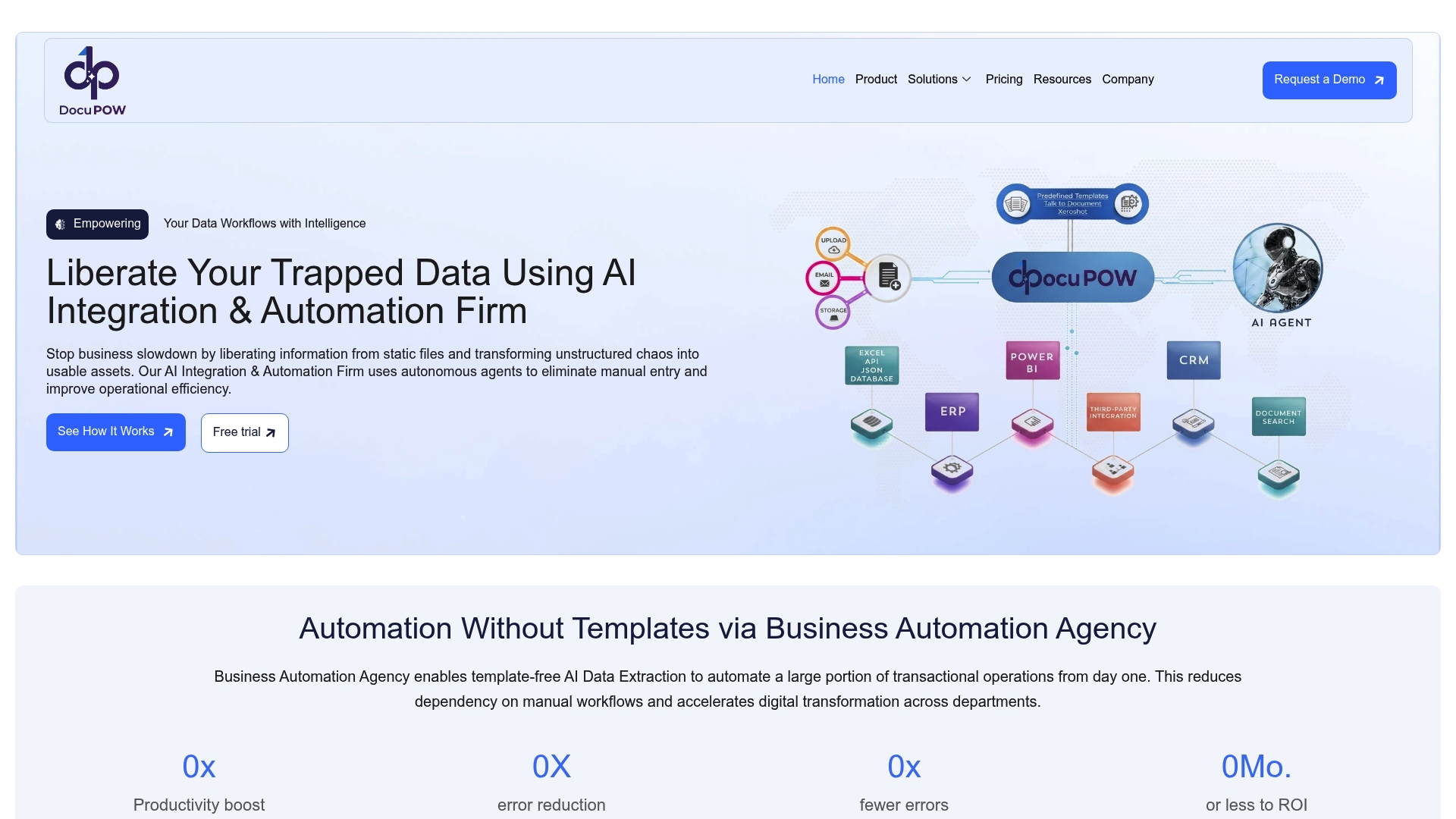
DocuPOW uses autonomous AI agents to extract data from documents without rigid templates, feeding cleaner inputs into your analytics pipelines from day one. Teams that automate document workflow processes reduce the data preparation burden that consumes analyst time and delays model deployment. For organizations managing high volumes of operational documents, DocuPOW’s AI automation services connect directly to the data infrastructure your consulting firm is building.
FAQ
What does a data analytics consulting firm actually do?
A data analytics consulting firm audits your data, builds a strategy roadmap, and delivers production-ready analytics systems including predictive models, dashboards, and embedded AI. The goal is measurable improvement in decision speed and operational efficiency.
How long does a typical analytics consulting engagement take?
Engagement length varies by scope. Discovery phases typically run 2–4 weeks. Full data ecosystem builds for mid-market organizations commonly take 3–6 months. Enterprise programs with MLOps and governance layers run longer.
What is the difference between data analytics consulting and business intelligence consulting?
Business intelligence consulting focuses on reporting and dashboards that describe what happened. Data analytics consulting includes predictive modeling and applied AI that forecasts what will happen and recommends what to do next.
How do I know if a consulting firm can deliver production-ready AI?
Ask for an MLOps architecture example and a case study showing a model moved from development to a live production environment. Firms that cannot provide both are unlikely to deliver beyond a proof of concept.
Why do most analytics projects fail to deliver ROI?
The most common cause is building models that never integrate with operational workflows. Models isolated from daily systems rarely deliver business value. ROI requires embedding outputs into the tools and processes your teams use every day.
Recommended
See DocuPOW on your documents.
Stop building templates. Start extracting data.