Document Security: The 2026 Guide for Organizations
Learn essential strategies for Document Security in 2026. Protect your organization from breaches and ensure compliance with regulations.


What is document security, and why does it matter?
Document security is the practice of protecting physical and digital documents from unauthorized access, tampering, theft, and misuse across their entire lifecycle. That lifecycle runs from the moment a document is created through storage, transmission, use, and final destruction. Getting any stage wrong creates exposure.
The stakes are concrete. A misfiled contract, an unencrypted email attachment, or a shared drive with open permissions can each trigger a data breach, a regulatory penalty, or a lawsuit. The FTC Safeguards Rule requires organizations to protect customer information through documented, tested security programs. HIPAA mandates equivalent protections for health data. ISO 22388:2023 sets the bar for physical document security. These are not optional frameworks.
Three reasons drive most organizations to prioritize document protection:
- Confidentiality: Sensitive data, whether financial records, personnel files, or client contracts, must stay visible only to those with a legitimate need.
- Compliance: Regulations carry real penalties for failures. Undocumented controls can be treated as seriously as an actual breach.
- Risk mitigation: Proactive protection costs far less than breach response, litigation, and reputational repair.
Secure document management is not a single tool or policy. It is a coordinated system of controls spanning people, processes, and technology.
The five pillars of document security
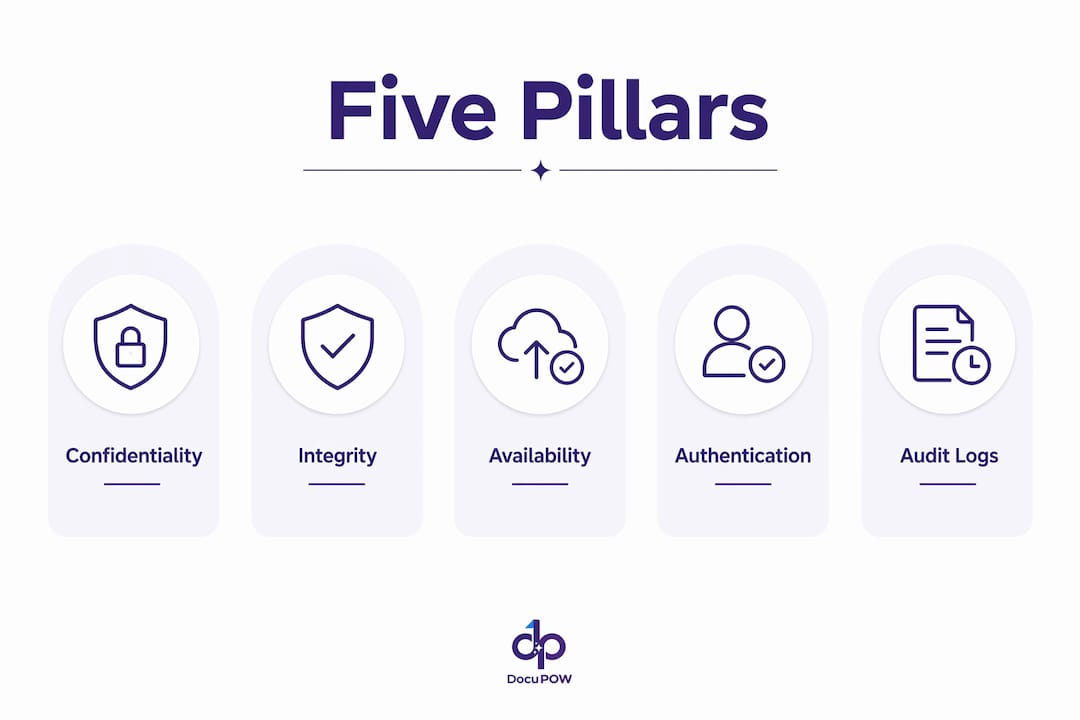
Document security rests on five pillars drawn from information assurance: confidentiality, integrity, availability, authentication, and nonrepudiation. Together, they cover every phase of a document’s life.
- Confidentiality means only authorized people can read a document. Encryption is the primary technical control here. A file encrypted with AES-256 at rest and TLS in transit stays unreadable even if intercepted.
- Integrity means the document has not been altered without authorization. Cryptographic hashing and digital signatures detect tampering. Under the HIPAA Security Rule, regulated entities must implement electronic measures to confirm that health data has not been improperly altered or destroyed.
- Availability means authorized users can access what they need, when they need it. Redundant storage, backup schedules, and disaster recovery plans keep documents accessible without sacrificing control.
- Authentication confirms that the person requesting access is who they claim to be. Multi-factor authentication (MFA) is the current baseline standard under both the FTC Safeguards Rule and NIST guidance.
- Nonrepudiation ensures that a party cannot later deny creating, sending, or receiving a document. Audit trails and automatic logging are decisive here, providing timestamped proof of every action for compliance audits and legal proceedings.
No single pillar is sufficient on its own. An organization with strong encryption but no audit logs can prove confidentiality but not accountability.
What threats put your documents at risk?
Threats to confidential information security come from both outside and inside the organization. Knowing the attack surface is the first step toward defending it.

External threats include phishing attacks that trick employees into surrendering credentials, malware that exfiltrates files silently, and direct hacking attempts targeting document management systems. Physical theft of laptops, USB drives, or printed files remains a persistent risk, particularly in industries that handle paper-heavy workflows.
Insider threats are often underestimated. A disgruntled employee downloading client records before resignation, or a well-meaning staff member emailing a contract to a personal account for convenience, both create real exposure. The distinction between malicious and accidental insider risk matters for response planning, but both require the same preventive controls.
Human error is the most common root cause of document breaches. Misdirected emails, misconfigured sharing permissions, and failure to shred sensitive printouts all fall into this category. Training reduces frequency; monitoring catches what training misses.
Improper disposal is a specific and often overlooked risk. Documents discarded without shredding or secure digital deletion can be recovered. The FTC’s privacy and security guidance explicitly requires documented disposal procedures for both physical and digital records.
The legal and financial consequences of these threats are not abstract. Regulatory fines, civil litigation, and the cost of breach notification and remediation add up quickly. Organizations that treat document protection as a cost center rather than a risk control tend to discover the real cost the hard way.
Best practices for implementing document security
Effective implementation requires controls at every layer: technical, physical, and administrative. The FTC’s information security program requirements provide a useful checklist that applies well beyond financial institutions.
- Role-based access control (RBAC): Limit document access to what each role genuinely needs. A billing clerk does not need access to HR files. Least-privilege access reduces the blast radius of any single compromised account.
- Multi-factor authentication: The FTC Safeguards Rule requires MFA for any individual accessing an information system unless an equivalent control is approved in writing. NIST SP 800-63B provides detailed technical requirements for authentication assurance levels.
- Encryption: Encrypt all sensitive documents at rest and in transit. For digital transmission, TLS is the standard. For stored files, AES-256 is widely adopted. Where encryption is technically infeasible, the FTC requires documented compensating controls reviewed by a qualified security officer.
- Physical document controls: Locked filing cabinets, clean-desk policies, visitor access logs, and secure print release (where documents only print when the authorized user is physically present at the printer) all reduce physical exposure. ISO 22388:2023 guides risk assessment and security feature selection for physical documents.
- Secure disposal: Shred paper documents using cross-cut or micro-cut shredders. For digital files, use certified data wiping or degaussing. The FTC requires disposal procedures to be documented and periodically reviewed.
- Zero Trust architecture: NIST SP 800-207 defines Zero Trust as a model that continuously evaluates user and device security posture on every access request, rejecting the assumption that anything inside the network perimeter is trustworthy. Applied to documents, this means every access attempt is verified, not just the initial login.
- Continuous monitoring: Log all access to sensitive documents. Automated alerts for anomalous behavior, such as a user downloading hundreds of files at 2 AM, catch threats that periodic reviews miss.
- Regular risk assessments: Assess threats, evaluate existing controls, and document findings. The FTC Safeguards Rule requires these assessments to be written and periodically repeated as the threat environment changes.
Pro Tip: When deploying RBAC, audit existing permissions before adding new ones. Most organizations discover that access has drifted far beyond what roles actually require, often because permissions were granted for a project and never revoked.
Document security policies and compliance standards
Policy without enforcement is theater. The organizations that fare best in regulatory audits are those that treat documentation of their security program as seriously as the controls themselves. Failure to document can be treated as critically as a security breach from a legal perspective.
FTC Safeguards Rule (16 CFR Part 314) applies to financial institutions and requires a written information security program covering risk assessment, access controls, encryption, secure disposal, monitoring, and service provider oversight. The rule mandates a designated Qualified Individual responsible for the program, and requires that program to be evaluated and adjusted in response to testing results and operational changes.
HIPAA Security Rule requires administrative, physical, and technical safeguards for electronic protected health information. HIPAA’s access control requirements mandate that only authorized persons can access ePHI, with audit controls to record and examine system activity. Documentation must be retained for six years from creation or last effective date.
ISO 22388:2023 addresses physical document security specifically, guiding organizations through risk assessment, document classification, and the introduction of security features for documents that validate transactions or prove compliance.
NIST frameworks provide the technical backbone for most American organizations. NIST SP 800-171 Rev. 3 covers protection of Controlled Unclassified Information in nonfederal systems. The NIST Cybersecurity Framework 2.0 offers a broader risk management structure applicable across industries.
Service provider management is a compliance requirement that organizations frequently underestimate. Both the FTC Safeguards Rule and HIPAA require that contracts with third-party vendors include explicit security obligations. A vendor handling your documents inherits your compliance obligations by contract.
For organizations tracking how audit trails support ISO 27001 compliance, the connection between logging practices and regulatory defensibility is direct: a well-maintained audit trail is often the difference between passing an audit and failing one.
How should you train employees on document security?
Technical controls fail when people bypass them, and people bypass them when they do not understand why the controls exist. Employee training is the connective tissue between policy and practice.

Effective training programs cover three areas. First, recognition: employees need to identify phishing emails, suspicious file requests, and social engineering attempts. Second, procedure: staff must know exactly how to handle sensitive documents, from creation to disposal, including what to do when they receive a misdirected file or discover a potential breach. Third, accountability: employees who understand that access logs exist and that anomalous behavior triggers alerts tend to follow procedures more consistently.
Training should not be a one-time onboarding event. Quarterly refreshers, simulated phishing exercises, and role-specific training for employees who handle particularly sensitive documents all improve retention. The FTC Safeguards Rule explicitly lists employee training and management as a required component of the risk assessment process.
One underused approach is scenario-based training. Walking an employee through a realistic situation, such as receiving an email that appears to be from a colleague asking for a contract to be forwarded, is more effective than a slide deck about phishing. The scenario forces a decision, and the debrief explains why the correct choice matters.
How to conduct a document security risk assessment
A risk assessment is not a checkbox. It is the foundation on which every other security decision rests. The FTC Safeguards Rule requires written risk assessments that identify threats, evaluate existing safeguards, and describe how identified risks will be mitigated or accepted.
A practical assessment follows these steps:
- Inventory your documents. Catalog what sensitive documents exist, where they are stored (physical and digital), who can access them, and how they move through the organization.
- Identify threats. For each document category, list realistic threats: unauthorized access, accidental disclosure, theft, ransomware, improper disposal.
- Evaluate existing controls. Assess whether current safeguards adequately address each threat. Document gaps explicitly.
- Assign risk ratings. Prioritize by likelihood and potential impact. A gap in access controls for payroll data ranks higher than a gap in controls for public marketing materials.
- Define remediation actions. For each gap, specify the control to be implemented, the owner, and the deadline.
- Document everything. The written record is what regulators review. An undocumented control is, from a compliance standpoint, a missing control.
- Schedule reassessment. Threats evolve. The FTC requires periodic reassessment; HIPAA requires evaluation whenever the security environment changes. Annual reassessment is a reasonable baseline for most organizations, with triggered reviews after incidents or major operational changes.
Ongoing monitoring bridges the gap between formal assessments. Automated log review, user behavior analytics, and periodic penetration testing catch threats that a point-in-time assessment cannot anticipate.
What to do when a document security breach occurs
Speed and structure are what separate a manageable incident from a catastrophic one. Organizations without a documented incident response plan tend to improvise under pressure, and improvisation during a breach compounds the damage.
A document-specific incident response plan should include:
Immediate containment. Isolate the affected system or document repository. Revoke access credentials for any account suspected of compromise. If physical documents are involved, secure the area and restrict further access.
Assessment. Determine what documents were accessed, by whom, and for how long. Identify whether the breach involved regulated data (ePHI, customer financial information, personally identifiable information) because that determination drives notification obligations.
Notification. HIPAA requires breach notification to affected individuals and the Department of Health and Human Services within 60 days of discovery for breaches affecting 500 or more individuals. The FTC and state breach notification laws impose their own timelines. Legal counsel should be involved from the moment regulated data is confirmed as compromised.
Remediation. Close the vulnerability that enabled the breach. Update access controls, patch software, retrain staff, or revise procedures as the root cause analysis dictates.
Documentation. Record every action taken, every decision made, and every finding from the investigation. This documentation serves two purposes: it guides future prevention, and it demonstrates to regulators that the organization responded appropriately. Regulatory audits following a breach focus heavily on the quality of the incident record.
Post-incident review. Within 30 days of resolution, conduct a formal review. What failed? What worked? Update the risk assessment and security program accordingly. Security is an ongoing process that must adapt to new threats, not a fixed state achieved once and maintained passively.
DocuPOW’s AI-driven document intelligence platform is built with security at its core, giving organizations the controls they need to protect sensitive data while eliminating the manual bottlenecks that create exposure. Whether you’re managing high-volume document workflows or need tighter access governance across your operations, DocuPOW’s document automation gives your team the visibility and control to stay compliant and move fast.

Key Takeaways
Effective document security requires coordinated controls across people, processes, and technology, grounded in written policies and tested against real threats throughout the document lifecycle.
| Point | Details |
|---|---|
| Five pillars framework | Confidentiality, integrity, availability, authentication, and nonrepudiation cover every stage of a document’s lifecycle. |
| Compliance is documented | Undocumented controls can be treated as seriously as a breach under FTC and HIPAA standards. |
| Zero Trust for access | NIST SP 800-207 requires continuous verification of user and device posture on every document access request. |
| Training closes the gap | Scenario-based, role-specific training reduces the human error that technical controls alone cannot prevent. |
| Reassess regularly | Risk assessments must be written, periodically repeated, and updated after incidents or major operational changes. |
FAQ
What is the meaning of document security?
Document security is the practice of protecting physical and digital documents from unauthorized access, tampering, theft, and misuse across their entire lifecycle, from creation through secure destruction.
What are the four types of information security?
Information security is typically organized around administrative, physical, technical, and operational safeguards. Together, these categories cover policy, physical access, technology controls, and day-to-day procedures for handling sensitive information.
What are the four types of security?
Security programs generally address physical security (protecting facilities and physical documents), network security (protecting digital infrastructure), information security (protecting data and documents), and operational security (protecting processes and procedures from exploitation).
How do I secure my documents?
Start with role-based access controls and multi-factor authentication, encrypt files at rest and in transit, implement secure disposal procedures for both paper and digital records, and conduct a written risk assessment to identify and close gaps. Train employees on procedures and monitor access logs continuously.
What compliance standards govern document security in the United States?
The primary frameworks are the FTC Safeguards Rule (16 CFR Part 314), the HIPAA Security Rule for health data, and NIST publications including SP 800-171 and the Cybersecurity Framework 2.0. ISO 22388:2023 applies specifically to physical document security.
Recommended
See DocuPOW on your documents.
Stop building templates. Start extracting data.