Productivity Improvement Strategies for Teams in 2026
Discover proven Productivity Improvement strategies for teams in 2026. Boost efficiency and reduce costs with system-level changes.


TL;DR:
Productivity improvement involves applying strategies and tools to increase efficiency and reduce waste in workflows.
Successful methods require systemic change, precise measurement of key metrics, and consistent framework application.
Productivity improvement is the systematic application of strategies and tools to increase work efficiency and output while reducing waste and delays. For professionals and teams, this means more than working harder. It means working within systems that eliminate friction, protect focus, and measure what actually matters. Structured productivity methods can achieve 15–30% operational cost reduction and 40–60% cycle time improvement within 8–16 weeks. That kind of result does not come from individual productivity hacks. It comes from coordinated, system-level change.
How can productivity improvement be measured effectively?
Measurement is where most teams go wrong first. They pick one number, usually output volume, and optimize for it. The problem is that single-metric approaches invite gaming the system. A sales rep who closes 50 deals with a 40% refund rate is not productive. A developer who ships 20 features with a 60% bug rate is not productive either.
The metrics that matter most fall into five categories:
-
Output volume: Units produced, tasks completed, or transactions processed per period
-
Cycle time: How long a process takes from start to finish
-
Quality rate: Defect rate, rework percentage, or error frequency
-
Focus time: Hours spent on high-value, uninterrupted work
-
Utilization rate: Percentage of available capacity actually applied to productive work
Presence-based measures, like hours logged or meetings attended, tell you almost nothing about real output. They reward visibility over results. Teams that track these five categories together get a far more accurate picture of where efficiency breaks down.
Pro Tip: Run a two-week audit before changing anything. Track output, cycle time, and error rate simultaneously. You will almost always find that the bottleneck is not where managers assumed it was.
A balanced scorecard approach blends quantitative data (cycle time, defect rate) with qualitative signals (team feedback, process friction reports). This combination catches problems that numbers alone miss, like a process that looks fast on paper but burns out the people running it.
What are the most effective frameworks to boost productivity?
The right framework depends on the type of work, not on what is trending. Teams that chase every new methodology end up with more process overhead than productivity gain. The goal is to pick one primary framework, apply it consistently, and layer in tools only after the system is working.
| Framework | Best for | Core mechanism |
|---|---|---|
| OKRs | Goal alignment across teams | Quarterly objectives with measurable key results |
| Kanban | Continuous flow work | Visual board limiting work in progress |
| Scrum | Project-based delivery | Two-week sprints with defined ceremonies |
| Getting Things Done (GTD) | Individual knowledge workers | Capture, clarify, organize, reflect, engage |
| Time blocking | Deep work protection | Calendar-based scheduling of focus periods |
OKRs work best when teams need to align effort across departments. Kanban suits operations teams handling ongoing requests, like IT support or document processing. Scrum fits product and engineering teams building in defined cycles. GTD and time blocking are individual techniques that complement any team framework.
Scaling individual productivity hacks without team coordination causes friction. A developer using GTD while their team runs unstructured sprints creates misaligned handoffs. The individual gains disappear in the coordination gaps. Standardized workflows and clear role ownership are what convert individual effort into team-level output.
Pro Tip: Before adopting a new framework, map your current workflow for two weeks. You will likely find that the problem is not the framework. It is undefined ownership at specific handoff points.
Standardized workflows also reduce onboarding time significantly. When every step has a defined owner and a documented process, new team members reach full productivity faster. That is a compounding gain that most teams undercount.
How does technology and AI enhance productivity while avoiding common pitfalls?
Technology does not fix broken processes. It accelerates them, including the broken parts. Teams must map, mine, and understand current performance deeply before applying automation. Skipping this step is the most common and most expensive mistake in productivity technology projects.
Process mining should come first. This means analyzing actual workflow data, not the idealized version in the process documentation, to find where delays, rework, and exceptions cluster. Once the real bottlenecks are visible, automation targets become obvious.
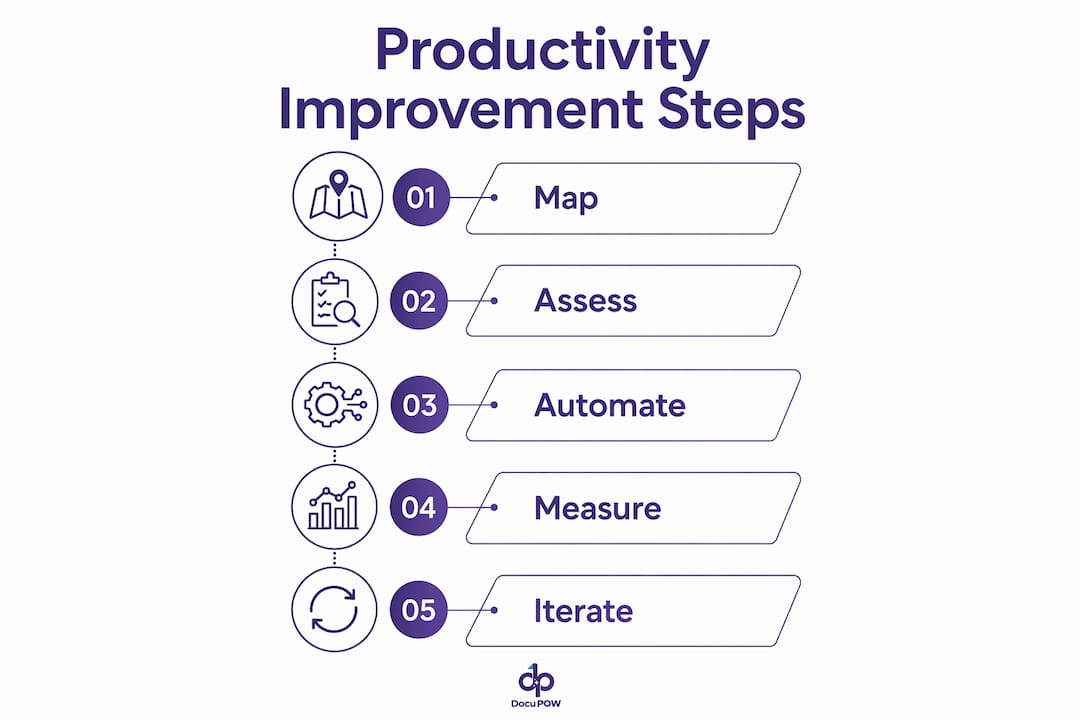
Here is the sequence that works:
-
Map actual workflows. Document what really happens, including exceptions, workarounds, and shadow processes. These unofficial workarounds often reveal the highest-leverage improvement opportunities.
-
Identify bottlenecks. Use process mining tools to find where cycle time inflates and errors concentrate.
-
Redesign before automating. Fix the process logic first. Automating a flawed process just produces flawed results faster.
-
Apply AI to the redesigned process. AI mapping tools can reduce documentation and analysis time by up to 90%. That frees teams to focus on higher-value decisions.
-
Deploy agentic AI for dynamic workflows. AI agents manage complex multi-step workflows dynamically, adapting in real time when conditions change. This improves both speed and resilience.
The payoff from this sequence is significant. Eliminating non-value-adding steps and automating reduces cycle time by 30–50% and errors by over 70%. That is not a marginal gain. It is a structural shift in how much a team can accomplish with the same headcount.
DocuPOW applies exactly this model. Its autonomous agents understand document context without relying on rigid templates, which means they adapt when document formats change. Teams processing high volumes of invoices, purchase orders, or contracts see the biggest gains because those workflows combine high frequency with high error risk.
What practical steps can teams take to implement sustainable productivity improvements?
Sustainable improvement requires more than a good launch. Most initiatives lose momentum within weeks because ownership is unclear and measurement stops after the first review. Ownership assigned to every workflow step is essential. Without it, accountability drifts and the process reverts to its old state.
The steps that produce lasting results:
-
Document actual workflows, not ideal ones. Documenting exceptions and shadow processes reveals the real bottlenecks that management-approved process maps miss entirely.
-
Assign a named owner to every step. Ownership is not a team. It is a specific person responsible for that step’s performance and improvement.
-
Protect focus time aggressively. Employees lose an average of 32 workdays annually due to context switching between applications. Reducing that number through calendar discipline and tool consolidation is one of the fastest ways to increase work output.
-
Reduce context switching. Consolidate tools, batch similar tasks, and set communication windows. Focus time is the most valuable skill for modern knowledge workers, and it requires deliberate protection.
-
Review metrics weekly, not quarterly. Weekly reviews catch drift early. Quarterly reviews catch it after the damage is done.
The continuous improvement culture matters as much as the initial process redesign. Teams that treat their workflows as permanent tend to calcify. Teams that treat them as living systems, subject to regular review and adjustment, compound their gains over time.
Key Takeaways
Sustainable productivity improvement requires system-level coordination, accurate measurement, and technology applied only after workflows are fully understood and redesigned.
| Point | Details |
|---|---|
| Measure with balance | Track output, cycle time, quality, focus time, and utilization together, never just one metric. |
| Choose one framework | Pick OKRs, Kanban, Scrum, GTD, or time blocking based on your work type, then apply it consistently. |
| Diagnose before automating | Map and mine actual workflows, including exceptions, before applying any automation or AI. |
| Assign clear ownership | Every workflow step needs a named owner or improvement initiatives stall within weeks. |
| Protect focus time | Context switching costs teams up to 32 workdays per employee per year. Reduce it deliberately. |
The uncomfortable truth about productivity I keep seeing teams ignore
Most productivity initiatives fail not because the framework was wrong or the technology was immature. They fail because nobody dealt honestly with the human side of the change.
I have watched teams adopt OKRs, Kanban, and AI automation tools in sequence, each time with genuine enthusiasm, and still end up back where they started six months later. The pattern is always the same. The process gets redesigned. The tools get deployed. The ownership chart gets drawn. Then the first difficult conversation arrives, someone’s workflow changes in a way they did not expect, and the path of least resistance is to quietly revert.
Human resistance to change is the main barrier in process redesign. That is not a soft observation. It is the most reliable predictor of whether an improvement initiative survives contact with reality.
What actually works is treating the change management as a first-class deliverable, not an afterthought. That means explaining the “why” before the “what,” involving the people closest to the work in the redesign, and giving them real authority to flag when the new process is not working. It also means protecting deep work blocks even when the calendar pressure is intense. Technology can handle more of the routine cognitive load than most teams realize. The job of leadership is to create the conditions where people can do the work that only humans can do.
The teams I have seen sustain real productivity gains share one trait. They are honest about what is actually happening in their workflows, not what the process documentation says should be happening.
— Sameer
How DocuPOW accelerates productivity gains for operations teams
Teams that have done the hard work of mapping their workflows and identifying bottlenecks often hit the same wall: document-heavy processes that resist automation because every file looks slightly different. That is exactly the problem DocuPOW was built to solve.
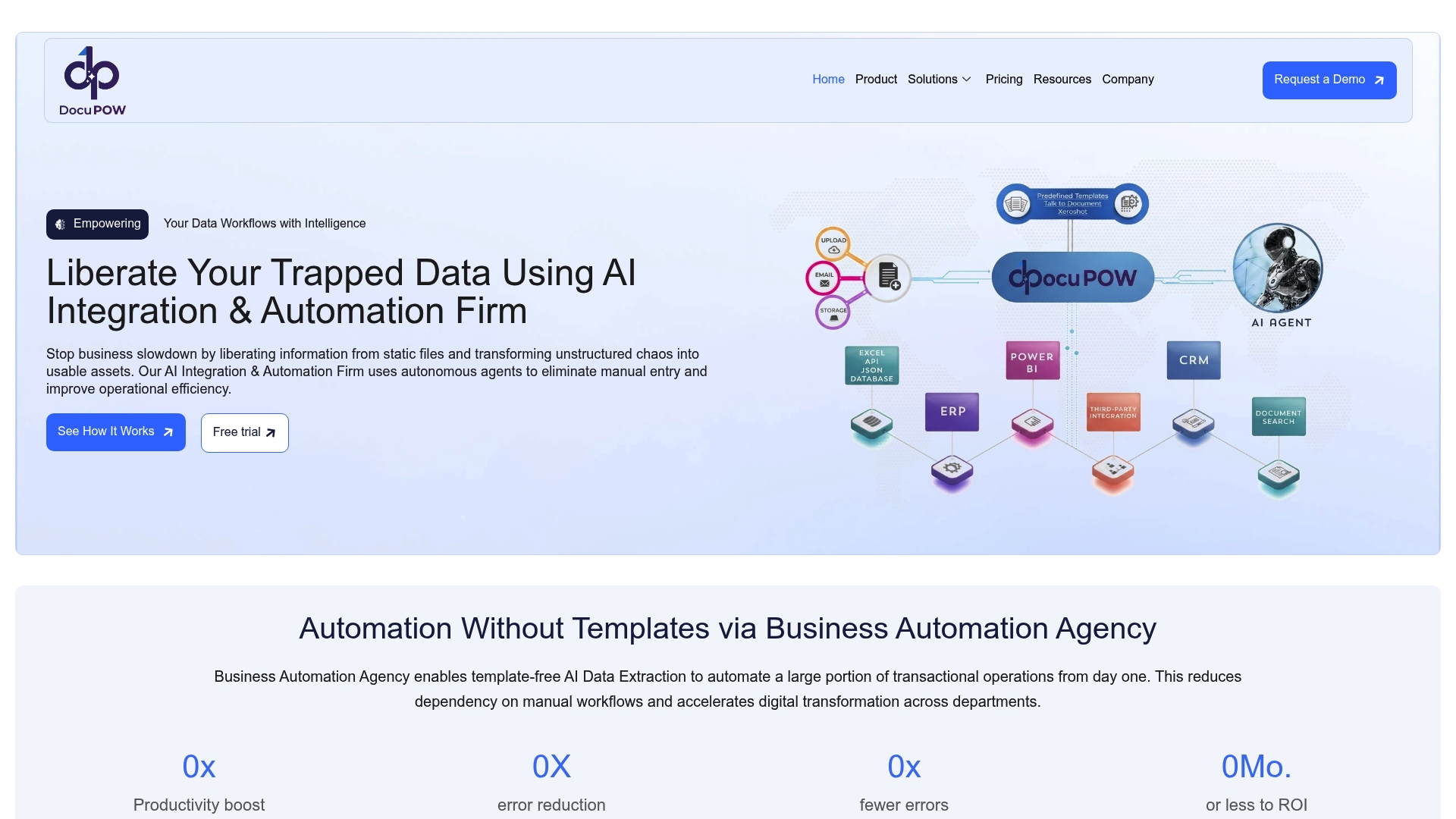
DocuPOW’s AI agents extract data from invoices, contracts, and operational documents without templates, adapting to format variations automatically. For teams running high-volume document workflows, this translates directly into the cycle time reductions and error rate improvements that structured productivity methods promise. The AI workflow automation guide covers how enterprise teams are applying these capabilities in 2026. For teams specifically focused on document process automation benefits, DocuPOW’s platform connects document intelligence with operational reporting in a single system.
FAQ
What is productivity improvement in a business context?
Productivity improvement is the systematic process of increasing work output and efficiency while reducing waste, delays, and errors. It applies to individuals, teams, and entire organizations through frameworks, measurement, and process redesign.
How long does it take to see results from productivity improvement initiatives?
Structured methods can deliver 40–60% cycle time improvement within 8–16 weeks when workflows are properly diagnosed and ownership is clearly assigned before implementation begins.
What is the biggest mistake teams make when trying to improve productivity?
The most common mistake is applying technology or new frameworks before mapping actual workflows. Automating a broken process accelerates the problems rather than fixing them.
Why does focus time matter so much for productivity?
Context switching between applications costs employees an average of 32 workdays per year. Protecting large, uninterrupted blocks of time for high-value work is the single fastest way to increase meaningful output.
How do OKRs differ from Kanban for team productivity?
OKRs align teams around quarterly goals with measurable outcomes, making them best for cross-functional coordination. Kanban manages continuous flow work through visual boards that limit work in progress, making it better suited for operations and support teams.
Recommended
See DocuPOW on your documents.
Stop building templates. Start extracting data.