Business Operations Modernization: A Leader’s Playbook
Unlock the full potential of your company with effective business operations modernization, focusing on talent, processes, and data quality.


Business operations modernization succeeds when process redesign, data quality, and operating-model changes move together, not when a company buys new software and hopes the rest follows. The technology matters far less than the sequence you introduce it in. Get the order wrong and even a well-funded initiative stalls before it delivers a single dollar of measurable value.
TL;DR:
Successful modernization requires balancing talent, processes, and technology, with most organizations overinvesting in tools while neglecting people and workflows.
Sequencing is critical; teams must first stabilize processes, then standardize them, before scaling automation to avoid amplifying dysfunction.
Data foundations such as clean schemas and governance are essential before deploying AI or automation tools to ensure accuracy and reliability.
Operating-model changes must accompany technology adoption, with clear roles, outcome-based responsibilities, and deliberate upskilling to prevent underdelivered results.
Document automation tools like DocuPOW can effectively address trapped data issues, streamlining data extraction, reconciliation, and facilitating broader modernization objectives.
Table of Contents
What Does Business Operations Modernization Actually Cover?
Modernization is not an IT migration. Swapping an old ERP for a new one, or moving servers to the cloud, changes infrastructure but leaves the underlying work unchanged if nobody touches the process or the people running it. Real modernization redesigns how work gets done, using better data and smarter tools to change outcomes, not just interfaces.
Accenture’s research on enterprise reinvention frames this as three interdependent pillars, and it’s a useful lens for any leader scoping a program:
-
Talent: the skills, incentives, and decision rights people need to work differently
-
Methods & Processes: the end-to-end workflows, standards, and governance that define how work flows
-
Assets & Platforms: the technology, data, and infrastructure that support the other two
Accenture’s analysis found that reinvention-ready companies balance all three. Most organizations over-invest in the third pillar and neglect the first two, which is exactly why PwC found that 85% of operations and supply chain leaders feel ahead of competitors on digital transformation, yet 89% say their tech investments haven’t delivered the results they expected.
What Steps Should Leaders Take First?
Before any tool selection or vendor conversation, get the program architecture right. A modernization initiative without a value target and clear ownership drifts into a technology procurement exercise.
-
Set a measurable value ambition. Define the specific metric (cycle time, cost per transaction, error rate) and the target before scoping any solution.
-
Align business and technology leadership on shared goals, then assign a single end-to-end process owner accountable for outcomes, not just a system.
-
Prioritize by risk-to-value ratio. Pick a wedge pilot: high visibility, contained blast radius, fast enough to show results within a quarter.
-
Build in governance and funding cadence from day one, so the program survives budget cycles instead of dying at the annual review.
-
Embed change management as a workstream, not an afterthought bolted on before go-live.
Pro Tip: Write the success metric on a single page before you talk to a single vendor. If you can’t state the target number in one sentence, you’re not ready to prioritize technology yet.
Which Technology and Data Foundations Matter Most?
Cloud platforms and AI tools get the attention, but data foundations decide whether either one works. Canonical schemas, master data cleanup, and clear governance rules have to exist before automation or AI agents touch a process, because dirty inputs just produce faster errors.
An integration-first approach beats a rip-and-replace mentality. API-led connections and an adaptive integration fabric let you modernize incrementally instead of betting the whole operation on one migration weekend.
Where does agentic AI fit? Not as a layer on top of a broken workflow. BCG’s research on agentic transformation found that deployments redesigning the end-to-end process around AI agents deliver far larger productivity and cost gains than automating isolated tasks inside an unchanged workflow.
-
Redesign the process for agents, not around them
-
Build observability so you can see what an agent decided and why
-
Set audit trails and security controls before scaling agent access to sensitive data
Deloitte’s research adds a warning worth sitting with: AI agents increasingly blur functional boundaries, which means your data governance has to span departments, not just systems.
How Should the Operating Model and Roles Change?
Technology investment without operating-model change is the single most common reason modernization underdelivers. McKinsey’s research on operating-model transformation found that programs fail specifically when tech and data changes get pursued separately from organizational redesign. Coordinate them, or don’t bother starting.
Practical shifts that make a measurable difference:
-
Design roles around outcomes: a named process owner accountable for a KPI, not a department accountable for a task
-
Build cross-functional teams with a regular funding and review cadence, similar to quarterly business reviews or product increment planning
-
Upskill talent deliberately, and tie incentives to the outcomes the modernization program targets, not to legacy activity metrics
None of this happens automatically. A new platform doesn’t reassign decision rights. Leaders do that, and the reassignment usually generates more resistance than the software rollout itself.
Why Does Sequencing Determine Success or Failure?
The order matters more than almost any other decision in the program: stabilize, then standardize, then scale. Automating an unstable process just makes the dysfunction faster and harder to unwind.
-
Stabilize first. Run a Pareto analysis of escalations and defects to find the 20% of causes driving 80% of the pain, then fix those before touching automation.
-
Standardize the fixed process. A documented approach to transformation failures recommends requiring 60 days of demonstrated stability before a process moves into automation scope.
-
Reconstruct workarounds deliberately. Workarounds exist because the formal process failed someone; before automating around them, decide whether to eliminate the root cause or formalize the workaround as the new standard.
-
Scale only after standardization holds under real operating conditions, not just in a pilot environment.
Pro Tip: If your team can’t describe the “happy path” of a process in under two minutes without contradicting each other, it isn’t stable enough to automate yet.
What Does a 6 to 12 Month Modernization Roadmap Look Like?
A pragmatic roadmap front-loads discovery and treats the first pilot as a controlled experiment, not a full rollout.
-
Discovery (weeks 1 to 4): Run process mining, data profiling, and an escalation analysis to identify where value and risk concentrate.
-
Prioritization: Score candidate processes on impact times risk times ease of implementation. Pick the highest-scoring wedge, not the flashiest one.
-
Pilot design (weeks 5 to 10): Set baseline metrics before you change anything, define governance and control checkpoints, and write explicit success criteria in advance.
-
Pilot execution and review (weeks 10 to 16): Compare results against baseline. Don’t declare victory on anecdote; use the numbers you defined at the start.
-
Scale criteria and BAU handoff (months 4 to 12): Define the threshold a pilot must clear before expanding, and hand the stabilized process to business-as-usual ownership with documented standards intact.
Momentum matters here. A pilot that takes 18 months to show results loses its executive sponsor long before it proves anything.
How Do You Measure ROI on Modernization?
Three categories of metrics keep a program honest and keep sponsors funding it.
-
Operational KPIs: cycle time, error rate, and throughput, tracked weekly during the pilot phase and monthly after scale
-
Financial KPIs: cost per transaction, cash flow impact, and working capital improvements, reported against the baseline set before the pilot started
-
AI and automation guardrails: exception rates, extraction or decision accuracy, and model drift monitoring, so agentic systems don’t quietly degrade without anyone noticing
Skip the guardrail metrics and you’ll find out about a problem from a customer complaint instead of a dashboard.
How Does Document Automation Solve the Trapped-Data Problem?
Trapped data is one of the most common blockers behind a slow financial close, manual reconciliation, and decision-making that runs on stale numbers. Most invoices, purchase orders, and contracts still arrive as static files, and legacy extraction tools depend on rigid templates that break the moment a vendor changes their layout.
DocuPOW approaches this differently, using autonomous agents that understand document context instead of matching against a fixed template. That distinction matters for finance and operations teams processing documents from hundreds of different vendors or subcontractors.
-
Template-free extraction pulls structured data from any document type without pre-built templates
-
Agentic workflow orchestration routes documents through multi-step approval and reconciliation processes automatically
-
Real-time analytics and predictive insights shift teams from reacting to close-period surprises to spotting issues earlier
-
Native ERP and CRM integration means extracted data lands where finance and operations teams already work
Organizations tackling this well align closely with what BCG found about agentic redesign: cost and productivity gains come from rebuilding the process, not bolting AI onto the old one. Faster close cycles and fewer manual touchpoints follow from that redesign, not from the software alone.
What Counts as True Modernization vs. a Simple Upgrade?
The clearest test: does the change alter how a decision gets made, or just how fast a screen loads? A finance team that migrates its ERP to the cloud but still exports data to spreadsheets for reconciliation hasn’t modernized its operations. It has modernized its hosting bill.
True business operations modernization redesigns the process, the data structure behind it, and the roles that own it, together. It typically touches four connected layers:
-
Process modernization: reworking the sequence of steps, approvals, and handoffs to remove redundant work
-
Data modernization: establishing clean, shared, canonical data instead of siloed spreadsheets and disconnected systems
-
Technology modernization: adopting cloud infrastructure, automation, and AI tools that fit the redesigned process
-
Organizational modernization: reassigning decision rights and accountability so the new process actually sticks
EY’s research on operations transformation found that integrating standard work processes, performance monitoring, and human-AI collaboration into one coherent management system produces measurable productivity gains, well beyond what any single technology upgrade delivers on its own. That’s the difference between modernization and an upgrade: one changes a tool, the other changes how the organization operates.
What Leaders Consistently Get Wrong
The checklist is simple to write and hard to execute: align on a specific outcome, fund the program properly, pilot on a contained process, measure against a real baseline, then scale. Most programs fail not because the checklist is unclear but because leaders skip steps under pressure to show progress.
Scope creep is the quiet killer. A pilot scoped around one invoice type expands to “all vendor documents” within six weeks because a stakeholder wants visibility, and suddenly nobody can isolate what worked. Watch for it, and say no more often than feels comfortable.

The politics deserve more attention than most playbooks give them. Workarounds exist because someone, somewhere, built a shortcut around a broken process, and that person often has more institutional authority than the org chart suggests. Replacing their workaround without acknowledging why it existed guarantees resistance.
Modernization is not a project with an end date. It’s a capability an organization either builds or doesn’t.
— Syed Naveed Abbas
Where DocuPOW Fits in Your Modernization Plan
If trapped document data is slowing your close, your reconciliation, or your reporting, that’s a specific, solvable problem, and it’s the one DocuPOW was built to solve. Instead of forcing your team to maintain rigid templates that break every time a vendor changes an invoice format, DocuPOW’s autonomous agents read documents the way a person would: by context, not by fixed layout.
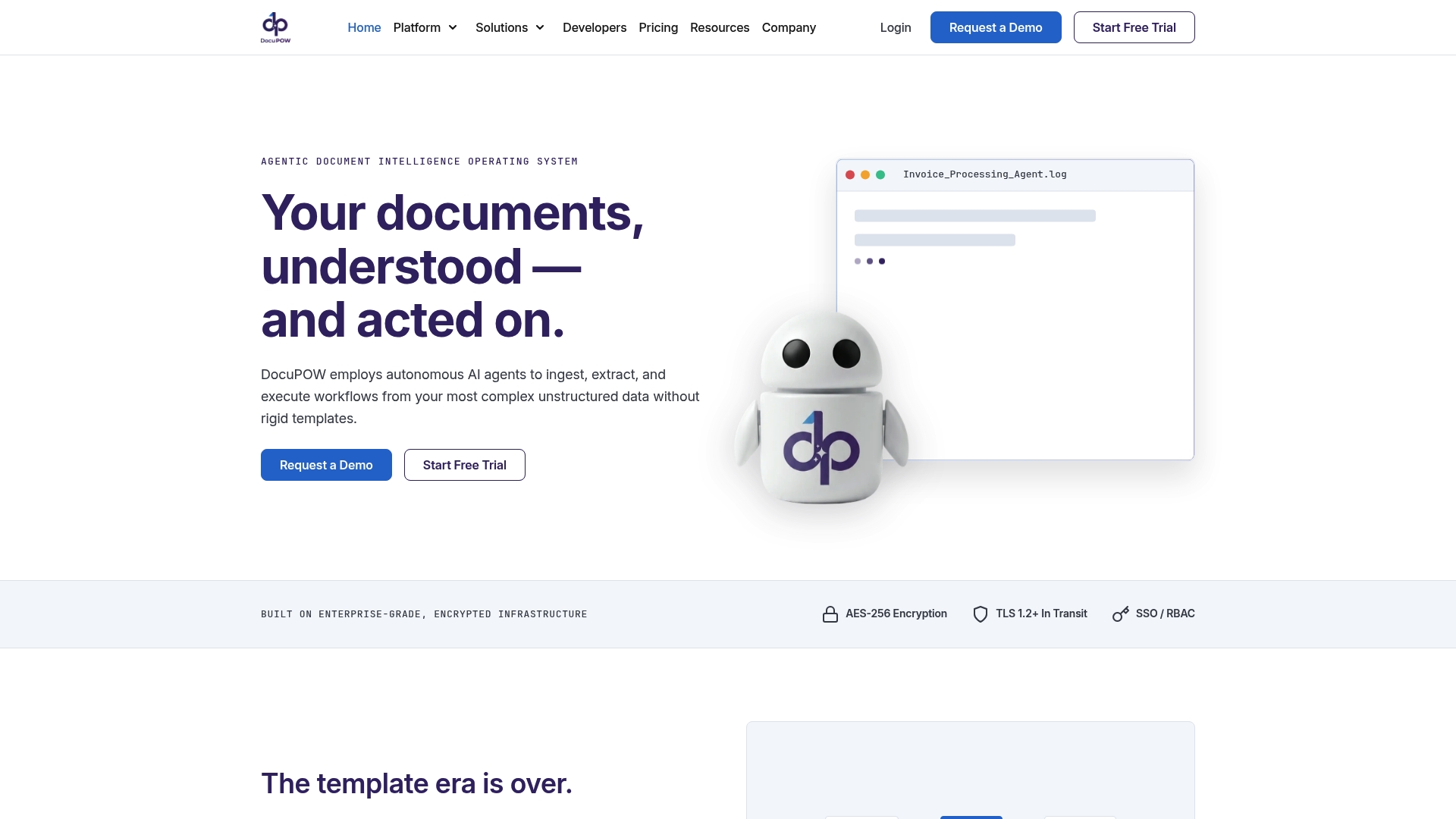
That maps directly onto the priorities this article covers: clean data foundations, agentic workflows designed around the process instead of bolted onto it, and integrations that push extracted data straight into your ERP or CRM without a manual handoff. Finance, procurement, and operations teams use it to cut manual entry, speed up reconciliation, and get real-time analytics instead of end-of-month surprises.
The practical next step is a pilot on one high-volume document type. Explore DocuPOW’s platform or start with the high-volume document processing best practices guide to scope where a contained pilot would deliver the fastest measurable win.
Sources
The PwC 2026 Digital Trends in Operations Survey backs the data-quality gap driving underperformance. BCG’s agentic transformation research supports the redesign-first approach to AI. McKinsey’s operating-model analysis and Tekkr’s overview of AI’s operational role offer additional grounding on execution.
FAQ
How Can Business Operations Be Improved?
Improvement starts with stabilizing the process before automating it, then standardizing the fixed version, and only then scaling technology across the organization. Programs that skip stabilization tend to automate existing dysfunction instead of fixing it.
What Are the Latest Trends in Business Operations Modernization?
Agentic AI is the dominant trend, with BCG’s research showing that redesigning entire processes around AI agents delivers far larger gains than automating individual tasks. Data governance and integration-first architecture are close behind, since agents need clean, connected data to work reliably.
What Are the Four Types of Business Operations Modernization?
A useful way to break it down is process modernization, data modernization, technology modernization, and organizational modernization. All four need to move together, since fixing one layer without the others rarely produces a lasting result.
What Business Function Sees the Highest Success Rate From Modernization?
What the data does show is that programs balancing talent, process, and technology, rather than leaning on any single lever, consistently outperform ones that treat modernization as a pure technology upgrade.
Can Document Automation Tools Like DocuPOW Support Broader Modernization Goals?
Yes. Template-free extraction and agentic workflow orchestration directly address the trapped-data and manual-reconciliation bottlenecks that commonly block faster financial close and reliable decision-making across finance and operations teams.
Recommended
See DocuPOW on your documents.
Stop building templates. Start extracting data.