Enterprise Automation Services: 2026 Business Guide
Explore how Enterprise Automation Services can transform workflows. Discover key technologies like RPA and AI that boost efficiency and ROI.


TL;DR:
- Enterprise automation services use RPA, AI, and low-code platforms to replace manual workflows across departments. They enable rapid deployment, improve operational efficiency, and require strategic governance for successful scaling. Organizations need a phased approach, a Center of Excellence, and proper documentation to avoid compliance issues and achieve long-term growth.
Enterprise automation services are defined as technology-driven frameworks that integrate robotic process automation (RPA), AI, and low-code platforms to replace manual workflows with governed, repeatable digital processes. The industry term “business process automation” covers the same ground, but enterprise automation services specifically addresses cross-departmental deployment at scale. Modern platforms can deploy workflows in days, not months, delivering measurable ROI across finance, HR, and supply chain. DocuPOW represents the next step in this evolution, applying autonomous AI agents to extract and act on data trapped inside documents without rigid templates. For any organization serious about enterprise digital transformation, understanding the full technology stack and deployment options is the starting point.
What are the primary enterprise automation services technologies?
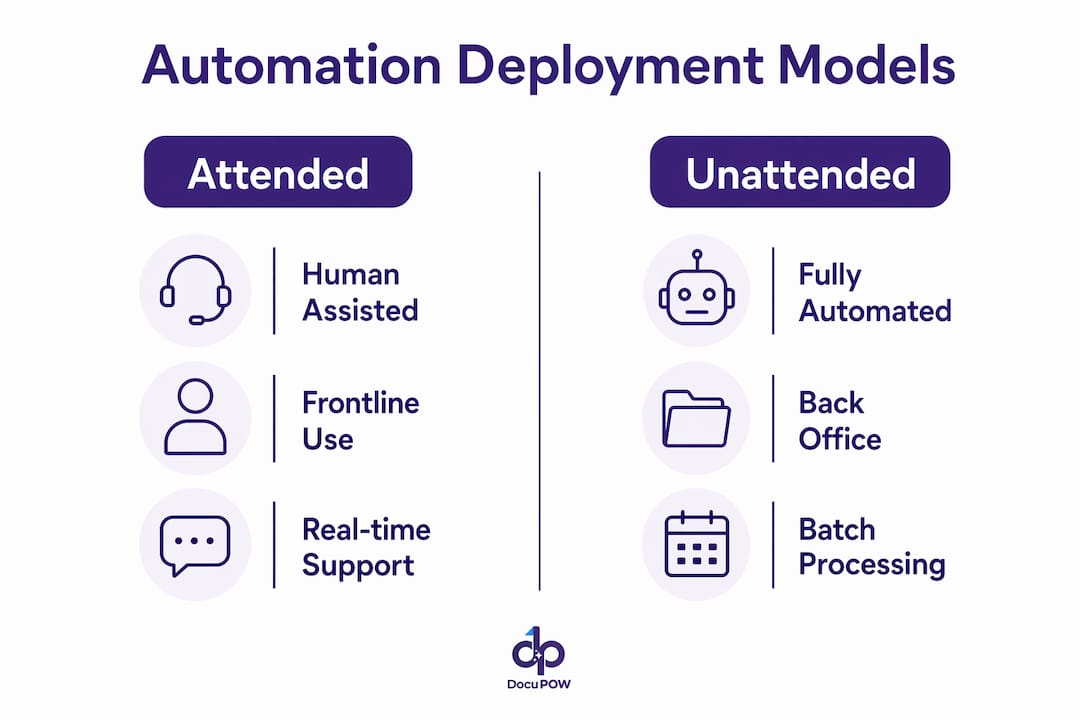
The technology stack behind modern automation has expanded well beyond basic RPA. Three primary deployment models now address varying operational demands: attended, unattended, and hybrid automation. Each model serves a different operational context, and choosing the wrong one wastes budget and creates friction.

| Deployment model | How it works | Best use case |
|---|---|---|
| Attended automation | Bot runs alongside a human, triggered by user action | Customer service, real-time data lookup |
| Unattended automation | Bot runs independently on a schedule or event trigger | Invoice processing, payroll, batch reporting |
| Hybrid automation | Combines attended and unattended bots in one workflow | Complex approvals requiring human sign-off |
Beyond deployment models, the technology categories themselves have grown more sophisticated. Hyperautomation integrates Generative AI, Intelligent Document Processing (IDP), and Agentic Process Automation (APA) to handle tasks that once required human judgment. That shift matters because rule-based RPA alone cannot read an unstructured contract or interpret a supplier email. Combining RPA with AI gives organizations both execution speed and cognitive decision-making in a single workflow.
RPA executes repetitive UI tasks while AI provides the cognitive layer on top. The strongest automation programs use both integrated together, not as separate tools. DocuPOW’s approach reflects this directly: its autonomous agents understand document context rather than following fixed extraction templates, which means they handle variation the way a trained analyst would.
Pro Tip: Map each department’s workflows before selecting a deployment model. Finance typically benefits from unattended batch processing, while HR onboarding often needs hybrid models that keep a human in the loop for compliance sign-offs.
How do workflow automation solutions accelerate operational efficiency?
The business case for workflow automation solutions is grounded in speed and cost reduction. No-code and low-code platforms shifted implementation timelines from months to days for core business process deployments as of Q2 2026. That compression means organizations can test, iterate, and scale automation without waiting for long IT development cycles.
The operational gains show up most clearly in three areas:
- Finance: Automated invoice matching, payment reconciliation, and financial reporting reduce manual data entry errors and close books faster. DocuPOW’s financial data extraction capabilities give finance teams real-time visibility into payables and receivables without manual re-keying.
- HR: Onboarding workflows, benefits enrollment, and compliance documentation can run on automated triggers. A new hire’s paperwork moves through approvals without anyone chasing signatures.
- Supply chain: Purchase order processing, shipment tracking updates, and vendor invoice reconciliation are high-volume, repetitive tasks that automation handles faster and with fewer errors than manual teams.
The cumulative effect across these functions is significant. Organizations that automate document-heavy back-office processes free up staff for analysis and decision-making rather than data entry. That reallocation of human effort is where the real productivity gain lives.
Pro Tip: Build a governance framework before you scale. Unmanaged automation workflows, sometimes called “shadow automation,” create technical debt that surfaces as compliance failures during audits. Document every automated process from day one.
What strategic considerations enable successful automation scaling?
Scaling automation from a single department to an enterprise-wide capability requires more than adding more bots. Most organizations fail to scale because they treat automation as a collection of individual tools rather than a strategic infrastructure. The following steps address the most common failure points.
- Establish a Center of Excellence (CoE). A dedicated CoE governs automation standards, manages security, and maintains a reusable component library. Without a CoE, automation programs fragment into disconnected projects that cannot share assets or enforce compliance policies.
- Separate RPA from AI responsibilities. RPA handles task execution: clicking, copying, pasting, and form-filling at scale. AI handles cognitive decisions: classifying documents, interpreting unstructured text, and flagging anomalies. Conflating the two leads to over-engineering simple tasks or under-powering complex ones.
- Audit shadow automation regularly. No-code tools make it easy for business teams to build their own workflows without IT oversight. Those undocumented workflows become liabilities when they break or face a compliance audit. A quarterly shadow automation review catches problems before they escalate.
- Manage technical debt proactively. Every automation added without documentation or version control adds to the debt load. Assign ownership to each automated process and require change-log updates whenever a workflow is modified.
- Align automation goals with business outcomes. Automation projects that start with a technology choice rather than a business problem tend to stall. Define the metric you want to move, such as invoice processing time or error rate, before selecting a platform.
The CoE model also provides the governance layer needed for security and regulatory compliance. In regulated industries like healthcare, financial services, and manufacturing, an ungoverned automation program is a liability, not an asset.
How can businesses implement and integrate automation services today?
Practical implementation follows a phased approach that reduces risk and builds internal confidence. Jumping straight to enterprise-wide deployment without a pilot phase is the most common and most expensive mistake organizations make.
- Phase 1: Pilot. Select one high-volume, well-documented process. Invoice processing or employee onboarding both work well. Run the automation in parallel with the manual process for four to six weeks to validate accuracy and catch edge cases.
- Phase 2: Small-scale deployment. Expand to three to five related processes within the same department. This phase tests your governance framework and builds the team’s ability to manage automated workflows.
- Phase 3: Cross-functional scaling. Use the lessons from Phase 2 to extend automation across departments. At this stage, unified orchestration that connects people, systems, and AI under a single control plane becomes critical.
Platform selection matters at every phase. Platforms that integrate with ERP, CRM, and core business systems reduce the custom integration work required at each expansion step. DocuPOW’s AI workflow automation connects directly with existing operational systems, so document data flows into the right system of record without manual handoffs.
Intent-based design is an emerging capability worth evaluating during platform selection. It lets business users describe a problem in plain language and receive an automated solution blueprint, which reduces the gap between what IT builds and what operations actually needs. That alignment shortens deployment cycles and improves adoption rates.
Governance does not stop at deployment. SLA-driven monitoring tracks whether automated processes are meeting performance targets. When a workflow degrades, the monitoring system alerts the CoE before the problem affects downstream operations. Build monitoring into the deployment plan from the start, not as an afterthought.
Key takeaways
Enterprise automation services deliver the most value when organizations treat them as a governed infrastructure rather than a collection of individual tools.
| Point | Details |
|---|---|
| Choose the right deployment model | Match attended, unattended, or hybrid automation to each department’s specific workflow needs. |
| Combine RPA with AI | RPA handles task execution; AI handles cognitive decisions. Both together outperform either alone. |
| Build a CoE early | A Center of Excellence governs standards, security, and reusability before scaling enterprise-wide. |
| Prevent shadow automation | Document every automated workflow from day one to avoid compliance failures during audits. |
| Phase your implementation | Pilot one process, validate results, then expand. Skipping the pilot phase is the costliest mistake. |
Why I think most automation programs stall before they scale
After watching dozens of organizations go through automation initiatives, the pattern is consistent. The pilot succeeds. The team celebrates. Then the program quietly stalls at three to five automations and never reaches enterprise scale. The reason is almost never the technology.
The real obstacle is organizational. Teams build automations without a CoE, without documentation standards, and without a clear owner for each workflow. Six months later, a process breaks during an audit and nobody knows who built it or how it works. That single incident kills executive confidence and freezes the entire program.
Intent-based design addresses part of this problem by making automation more accessible to business users. But accessibility without governance makes the shadow automation problem worse, not better. The organizations that scale successfully treat their automation program the way they treat their ERP: as infrastructure that requires ownership, version control, and a support model.
The other shift I have seen work is reframing automation as a data strategy, not just a process efficiency play. When you automate document processing with a platform like DocuPOW, you are not just removing manual steps. You are creating a structured data feed that powers analytics, forecasting, and decision-making. That framing gets CFO and COO buy-in far faster than a cost-reduction pitch alone.
Automation is not a project with an end date. It is a capability that compounds over time. The organizations that treat it that way are the ones still expanding their programs three years in.
— Sameer
DocuPOW’s approach to enterprise automation
Businesses that are ready to move beyond basic workflow tools need a platform built for document-heavy operations at scale.
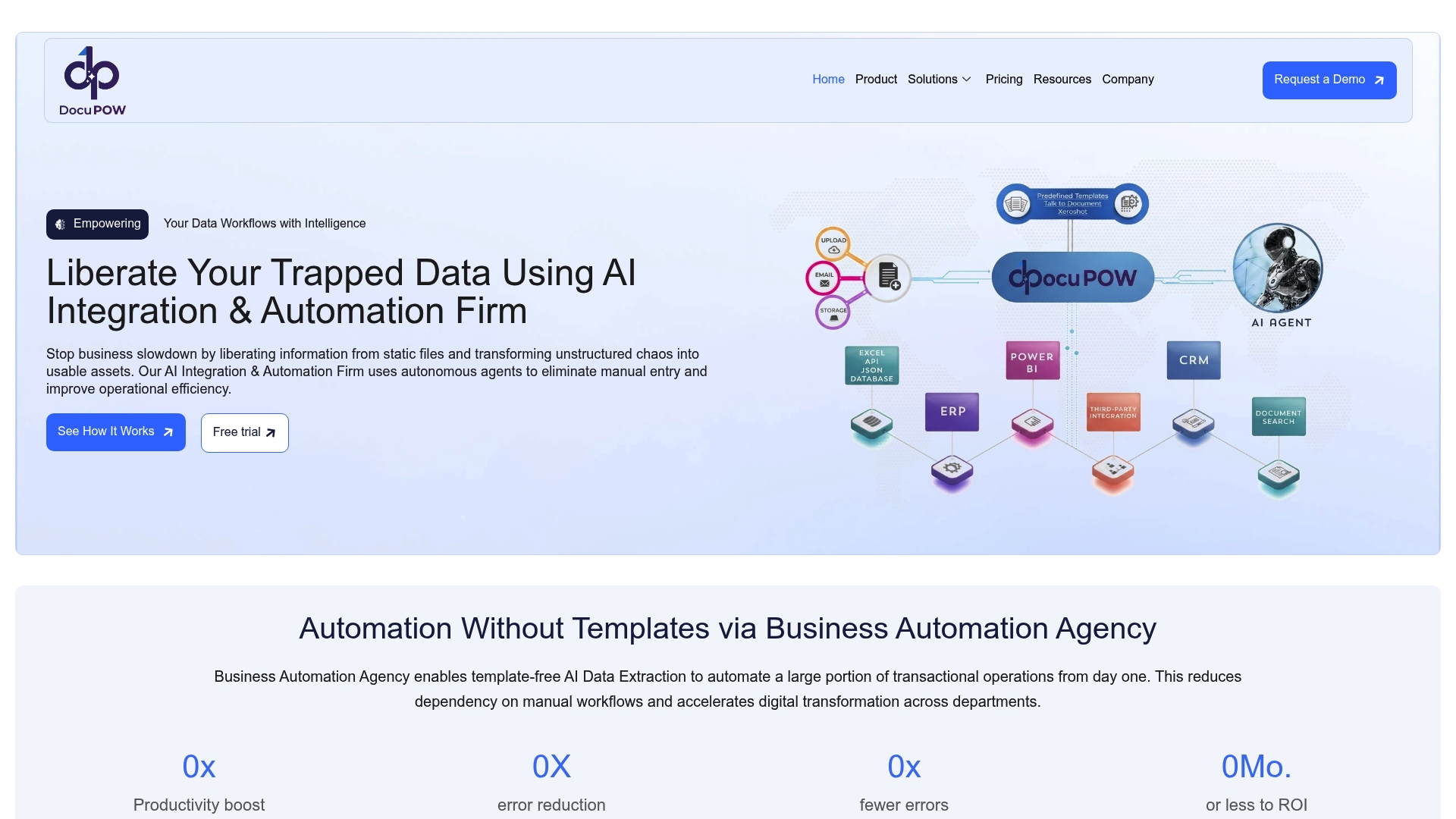
DocuPOW applies autonomous AI agents to intelligent document processing, extracting structured data from invoices, contracts, purchase orders, and reports without fixed templates. That means the system handles variation across document formats the way a trained analyst would, without manual reconfiguration. For global manufacturers and operations teams, DocuPOW delivers real-time analytics and predictive insights that shift teams from reactive data entry to proactive decision-making. Explore the full DocuPOW automation platform to see how it fits your operational environment.
FAQ
What are enterprise automation services?
Enterprise automation services are technology frameworks that use RPA, AI, and low-code platforms to replace manual business processes with governed, repeatable digital workflows across multiple departments.
How does RPA differ from AI in automation?
RPA executes repetitive, rule-based UI tasks like data entry and form-filling. AI provides cognitive decision-making for tasks like document classification and anomaly detection. The most effective automation programs combine both.
What is a Center of Excellence in automation?
A Center of Excellence is a dedicated internal team that governs automation standards, manages security, and maintains reusable workflow components to support enterprise-wide scaling.
How long does it take to deploy enterprise automation?
Modern no-code and low-code platforms can deploy core business process automations in days rather than months, though full enterprise-wide scaling follows a phased approach over several months.
What is shadow automation and why does it matter?
Shadow automation refers to undocumented workflows built by business teams outside IT oversight. These workflows create compliance and technical debt risks that surface during audits or when a process breaks unexpectedly.
Recommended
See DocuPOW on your documents.
Stop building templates. Start extracting data.