Intelligent Data Extraction Services: 2026 Business Guide
Discover how Intelligent Data Extraction Services transform unstructured data into actionable insights for businesses in 2026. Streamline your operations!


TL;DR:
- Intelligent Data Extraction Services use AI to convert unstructured documents into structured, validated data. They outperform basic OCR and web scraping by understanding document context, handling layout variation, and connecting directly to enterprise systems. Implementing hybrid models with schema validation and phased deployment ensures reliable, scalable automation for high-volume workflows.
Intelligent Data Extraction Services (IDS) are the industry term for AI-powered systems that convert unstructured documents into structured, machine-readable data using technologies like natural language processing (NLP), optical character recognition (OCR), machine learning, and computer vision. Unlike basic OCR or manual data entry, these services understand document context, validate extracted fields against business rules, and feed clean data directly into enterprise workflows. DocuPOW builds on this foundation with autonomous agents that process documents without rigid templates. For organizations drowning in invoices, contracts, and forms, automated data extraction is no longer optional. It is the operational baseline for competing in 2026.
What are Intelligent Data Extraction Services?
Intelligent Data Extraction Services go far beyond reading text off a page. OCR alone reads text but lacks the context awareness and validation capabilities found in full Intelligent Document Processing (IDP). That distinction matters enormously in practice. A purchase order contains vendor names, line items, totals, and tax codes. OCR captures the characters. IDS understands which field is which, cross-checks the math, and flags discrepancies before the data reaches your ERP system.

The core value is turning trapped, unstructured information into structured, actionable data at scale. Think of a global manufacturer receiving thousands of supplier invoices monthly in different formats, languages, and layouts. Manual entry is slow, error-prone, and expensive. Intelligent data retrieval automates that entire pipeline, from document ingestion to validated database entry, without a human touching each record.
DocuPOW represents this category well. Its autonomous agents read document context and extract fields without relying on pre-built templates, which means a new supplier format does not require a developer to build a new extraction rule. That template-free approach is what separates modern intelligent document processing from legacy systems.
How do Intelligent Data Extraction Services differ from traditional OCR and data scraping?
The confusion between IDS, OCR, and data scraping services is common and costly. Each technology solves a different problem at a different level of sophistication.
Traditional OCR converts scanned images into text strings. It does not know that “NET 30” is a payment term or that “$4,500.00” belongs to a subtotal field. It produces a flat text output and stops there. Basic web scraping services go one step further by pulling structured data from HTML pages, but they break the moment a website changes its layout or adds bot detection.
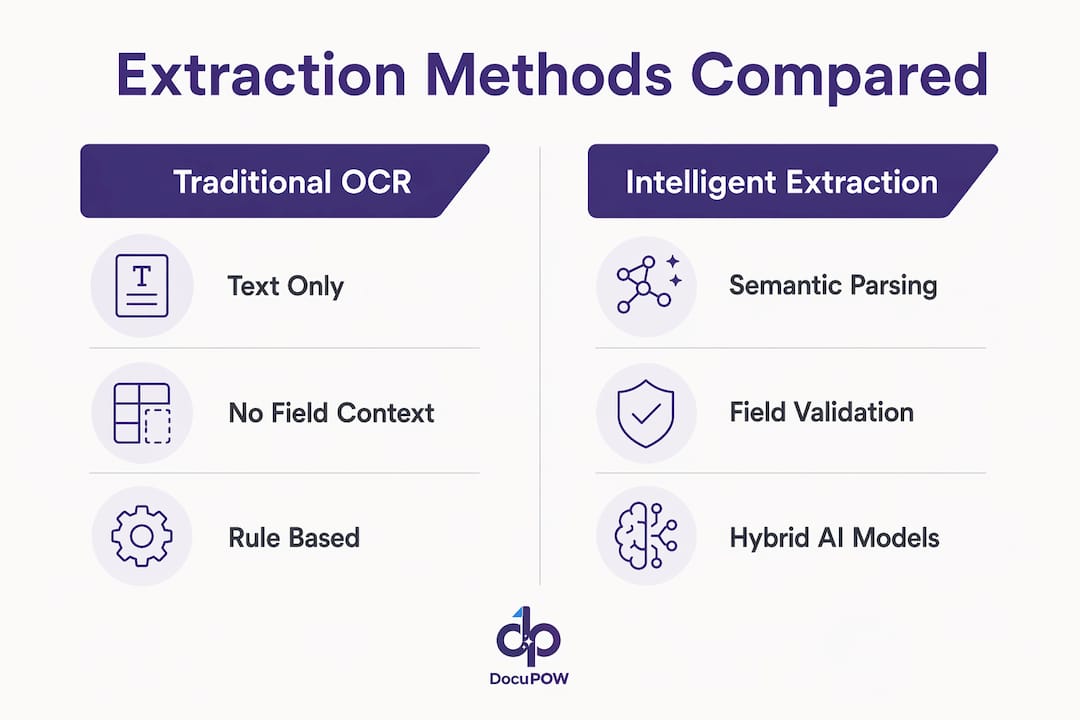
Intelligent Data Extraction Services operate at a higher level entirely. They parse document structure, infer field semantics, validate outputs against defined schemas, and adapt to format variations without manual reconfiguration.
| Capability | Traditional OCR | Basic data scraping | Intelligent Data Extraction |
|---|---|---|---|
| Reads text from images | Yes | No | Yes |
| Understands field context | No | Partial | Yes |
| Validates against business rules | No | No | Yes |
| Handles layout variation | No | No | Yes |
| Processes tables and handwriting | Limited | No | Yes |
| Integrates with ERP/CRM | Manual | Manual | Automated |
Pro Tip: If your current system requires a developer to update extraction rules every time a supplier changes their invoice layout, you are using a template-based tool, not true IDS. The cost of that maintenance compounds fast across hundreds of document types.
What are the core technologies used in Intelligent Data Extraction Services?
Modern extraction services combine several AI disciplines into a single pipeline. No single technology handles every document type well on its own.
- Natural Language Processing (NLP): Identifies entities, relationships, and intent within text. NLP is what allows a system to recognize “Invoice Date: March 15, 2026” as a date field rather than a generic string.
- Machine learning models: Trained on large document datasets, these models classify document types, locate field boundaries, and improve accuracy over time with feedback loops.
- Computer vision: Processes the visual layout of a document, including column alignment, table structures, and spatial relationships between elements.
- Multimodal AI: Modern document intelligence decomposes documents into searchable features including text, tables, charts, and annotations. This enables semantic search across decades of archived files, not just keyword matching.
The most reliable production systems use hybrid architectures. Hybrid extraction models combine deterministic parsing for layout detection with AI semantic understanding for field inference, achieving accuracy up to 90.7%. That outperforms pure cloud AI solutions on complex, variable document types.
Schema validation is the final layer that most teams underestimate. Strict JSON and Pydantic schema definitions enable automated validation and programmatic error handling before any data reaches a database. Without schema enforcement, extraction errors propagate silently into downstream systems and corrupt reporting.
Pro Tip: Avoid fully end-to-end “black box” AI models for critical financial or legal documents. Hybrid pipelines that use deterministic parsing for layout and large language models for semantic inference give you accuracy, cost control, and auditability in one architecture.
How can businesses implement Intelligent Data Extraction Services effectively?
Deployment speed is faster than most teams expect. Initial extraction workflows can be operational within one hour when connecting AI-based extraction services to cloud databases. That speed is real, but it applies to simple, well-structured documents. Scaling to complex, variable formats takes more deliberate planning.
A phased rollout is the proven path. Starting with a single high-frequency, low-variance document type builds trust in the AI model and the human review workflow before you add complexity. For most manufacturers, that means starting with a standard purchase order or remittance advice, not a multi-page contract.
Follow these steps for a reliable implementation:
- Identify your highest-volume document type. Pick the document your team processes most often with the least format variation. This is your pilot.
- Define your extraction schema. List every field you need, its data type, and its validation rule. A vendor ID must be numeric. A date must follow ISO 8601. Write these rules before you configure anything.
- Connect to your target system. Map extracted fields to your ERP, CRM, or database columns. Test with a sample batch of 50–100 real documents before going live.
- Build a human-in-the-loop review queue. Flag low-confidence extractions for human review. Use those corrections to retrain the model. Accuracy improves with each reviewed batch.
- Address infrastructure before scaling. Infrastructure bottlenecks including proxy management, anti-bot bypass, and dynamic content rendering cause more production failures than the AI models themselves. Solve these before expanding document volume.
- Expand to adjacent document types. Once your pilot document type runs at acceptable accuracy, apply the same schema-driven approach to the next highest-volume type.
Pro Tip: Build automated retry logic into your extraction pipeline from day one. When a document fails schema validation, the system should automatically re-attempt extraction with adjusted parameters before routing to human review. This single step cuts manual review queues significantly.
What are the key benefits and challenges of using Intelligent Data Extraction Services?
The business case for automated data extraction is direct. Speed, accuracy, and cost savings all improve simultaneously when you replace manual entry with AI-driven extraction.
Core benefits:
- Speed: Extraction that takes a human 10 minutes per document runs in seconds at scale.
- Accuracy: Hybrid models achieve up to 90.7% accuracy on complex documents, and accuracy improves with feedback loops.
- Cost reduction: Eliminating manual data entry reduces labor costs and the downstream cost of correcting entry errors.
- Data completeness: AI extraction captures fields that manual processes routinely miss, including embedded tables, footnotes, and secondary line items.
- Scalability: Volume spikes, like month-end invoice surges, do not require hiring temporary staff.
The challenges are real and worth planning for:
- Data variability: Documents from different vendors, regions, or time periods vary in layout, language, and quality. No model handles every variation perfectly out of the box.
- Model hallucination: AI models can invent plausible-sounding field values when confidence is low. Schema validation and human review catch most of these errors, but they require deliberate design.
- Infrastructure complexity: Proxy rotation, anti-bot measures, and dynamic rendering are infrastructure problems that block scaling more often than model accuracy does.
| Performance area | Manual processing | Intelligent Data Extraction |
|---|---|---|
| Processing speed | Minutes per document | Seconds per document |
| Accuracy on structured docs | Variable, human error-prone | Up to 90.7% with hybrid models |
| Scalability | Limited by headcount | Scales with compute |
| Error detection | Post-entry audit | Real-time schema validation |
| Integration | Manual export/import | Direct ERP/CRM connection |
The organizations that get the most value from smart data processing are those that treat it as a workflow redesign, not just a software purchase. The technology works. The implementation discipline is what determines the outcome.
Key takeaways
Intelligent Data Extraction Services deliver reliable, scalable document automation when built on hybrid AI architectures, strict schema validation, and phased deployment starting with high-frequency document types.
| Point | Details |
|---|---|
| IDS goes beyond OCR | Intelligent extraction understands field context and validates data; OCR only reads text. |
| Hybrid models outperform pure AI | Combining deterministic parsing with AI semantics achieves up to 90.7% accuracy on complex documents. |
| Schema validation is non-negotiable | JSON/Pydantic schemas catch extraction errors before they reach your database. |
| Start narrow, then scale | Begin with one high-frequency document type to build model trust before expanding. |
| Infrastructure limits scale | Proxy management and dynamic rendering cause more production failures than AI model quality. |
Why schema-first thinking changes everything in data extraction
Most teams I see evaluate extraction services by asking “how accurate is the AI?” That is the wrong first question. The right question is “how does the system handle errors when the AI is wrong?”
Every AI model produces incorrect outputs sometimes. The difference between a production-grade extraction system and a prototype is what happens at that moment. Systems built on strict schema definitions catch errors immediately, trigger automated retries, and route failures to human review with full context. Systems built on vague natural language prompts pass errors downstream silently.
I have watched organizations spend months chasing data quality problems in their ERP systems, only to trace the root cause back to an extraction pipeline with no validation layer. The AI was performing fine. The missing schema was the problem.
The second thing I would push back on is the instinct to automate everything at once. Phased rollouts feel slow, but they build the organizational trust that makes full automation sustainable. A team that has seen the system handle 10,000 purchase orders correctly will approve the next phase quickly. A team burned by a bad batch on day one will resist automation for years.
Multimodal understanding is the capability that will separate leading platforms from the rest over the next three years. Text extraction is largely a solved problem for clean, structured documents. The hard work is in tables, handwritten annotations, embedded images, and mixed-format files. Platforms that handle all of those in a single pipeline, without routing to separate specialized models, will win on both accuracy and operational simplicity.
For any business leader evaluating document automation solutions right now: ask vendors to show you their error handling, not just their accuracy numbers. The accuracy demo is easy to stage. The error handling is where real systems are built.
— Sameer
DocuPOW’s approach to enterprise-ready document extraction
Organizations that have moved past the pilot stage know that extraction accuracy is only part of the equation. The other part is what happens when documents arrive in unexpected formats, at unexpected volumes, at month-end.
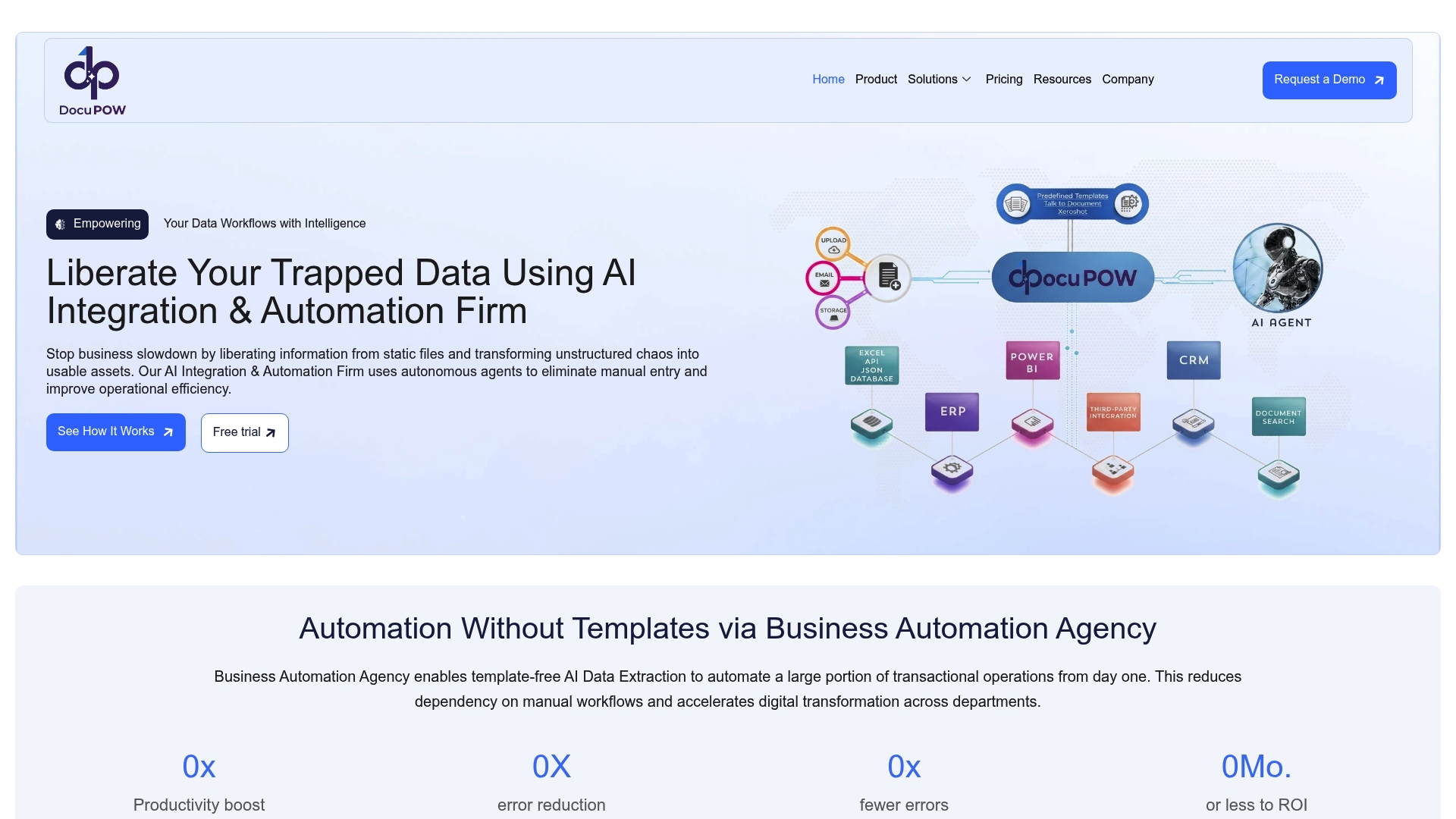
DocuPOW addresses both sides. Its autonomous agents extract data from any document format without templates, validate outputs against defined schemas in real time, and connect directly to ERP and CRM systems. For teams managing high-volume document workflows, DocuPOW’s platform handles volume spikes without manual intervention. The intelligent data extraction solutions built into DocuPOW cover supply chain, manufacturing, construction, and back-office operations. If your team is still manually keying data from documents, that is the problem DocuPOW is built to solve.
FAQ
What is the difference between OCR and Intelligent Data Extraction?
OCR converts scanned images into raw text without understanding field context or validating data. Intelligent Data Extraction uses NLP, machine learning, and schema validation to identify, classify, and verify each extracted field against business rules.
How long does it take to deploy an AI data extraction workflow?
Initial extraction workflows can be operational within one hour for simple, structured document types connected to cloud databases. Complex, variable document types require additional schema definition and testing time.
What accuracy can businesses expect from intelligent data extraction?
Hybrid extraction models that combine deterministic layout parsing with AI semantic understanding achieve accuracy up to 90.7% on complex documents. Accuracy improves further with human-in-the-loop feedback loops over time.
Why do intelligent extraction systems fail in production?
Infrastructure issues including proxy management, anti-bot bypass, and dynamic content rendering cause more production failures than AI model quality. Addressing infrastructure before scaling is the most effective way to prevent pipeline failures.
What document types can Intelligent Data Extraction Services handle?
Modern IDS platforms process invoices, purchase orders, contracts, forms, and mixed-format files including tables, handwritten annotations, and embedded images. Multimodal extraction decomposes documents into text, table, chart, and annotation features for full semantic retrieval.
Recommended
See DocuPOW on your documents.
Stop building templates. Start extracting data.