Document Intelligence: The 2026 Enterprise Guide
Discover how Document Intelligence transforms enterprise operations. Learn about AI's impact on data processing, accuracy, and efficiency.


TL;DR:
- Document intelligence uses AI to classify, extract, and validate data from documents at scale, improving efficiency. It combines NLP, ML, and computer vision to understand document meaning, not just text. Organizations see significant reductions in processing time and high accuracy, transforming enterprise data management.
Document intelligence is defined as the AI-powered process of classifying, extracting, and validating data from structured and unstructured documents at scale. It goes far beyond optical character recognition (OCR) by combining natural language processing (NLP), machine learning (ML), and computer vision to understand what a document means, not just what it says. Organizations processing invoices, contracts, purchase orders, or compliance forms now treat document intelligence as a core operational capability. Companies implementing these systems report processing time reductions of 60–70% and extraction accuracy up to 99%. Those numbers represent a fundamental shift in how enterprises manage information.
What is document intelligence and how does it work?
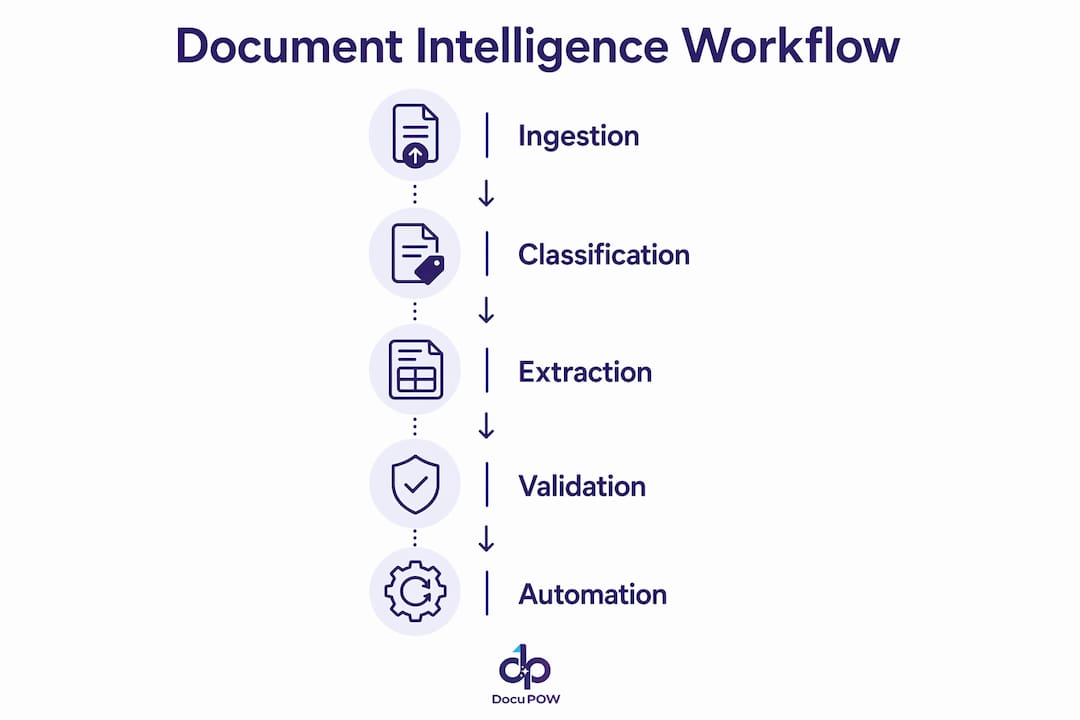
Document intelligence is the technical discipline behind intelligent document processing (IDP). IDP is the recognized industry term for the full pipeline: ingestion, classification, extraction, validation, and integration. The two terms are used interchangeably in enterprise contexts, but IDP is the more precise label when describing the end-to-end system.
The pipeline begins at ingestion. Documents arrive from email, scanners, APIs, web portals, and enterprise resource planning (ERP) systems in formats including PDF, TIFF, DOCX, and XML. The system classifies each document by type, such as invoice, bill of lading, or insurance claim, before any data extraction begins. Classification accuracy at this stage determines everything downstream.
Extraction is where the technology diverges most sharply from legacy approaches. Traditional OCR reads pixels and returns text strings with no understanding of context. Template-based systems map fields to fixed coordinates on a page, which breaks the moment a vendor changes their invoice layout. Schema-driven AI extraction defines fields in plain language, allowing the model to generalize across new formats without retraining. That adaptability is the core advantage over rigid template systems.
Validation is the stage most teams underestimate. Business-rule checks and cross-document consistency catch errors that perfect extraction still misses. A correctly extracted invoice total that does not match the purchase order is a production failure. Validation layers prevent that failure before data reaches your ERP or finance system.
| Capability | OCR only | RPA with templates | AI-native IDP |
|---|---|---|---|
| Handles varied layouts | No | No | Yes |
| Understands document context | No | No | Yes |
| Requires retraining for new formats | N/A | Yes | No |
| Validates against business rules | No | Limited | Yes |
| Supports human-in-the-loop review | No | Manual only | Built-in |
Pro Tip: Run a document variety audit before selecting a processing approach. If your document types vary by vendor, region, or version, schema-driven AI extraction will outperform any template-based system within the first month.
What are the best practices for implementing document intelligence?
The single most reliable implementation strategy is to start narrow. Pick one high-volume, well-defined document type, invoices being the most common, and build your first production pipeline around it. Narrowly scoped IDP pilots on high-volume documents improve ROI and reduce deployment risk. Once that pipeline runs reliably, expanding to contracts or shipping documents becomes a configuration exercise rather than a full rebuild.
Human-in-the-loop design is a feature, not a fallback. Routing low-confidence outputs for human review rather than forcing full automation is what makes enterprise-grade IDP reliable. The goal is not to eliminate human judgment. The goal is to direct human attention only where it adds value. Staff who previously entered data manually shift to reviewing edge cases, correcting exceptions, and improving the model over time.
Integration depth determines long-term value. An IDP system that extracts data accurately but dumps it into a spreadsheet creates a new bottleneck. The extracted, validated data must flow directly into your ERP, CRM, or finance platform. That integration layer is where automated information management delivers its full return.
Common pitfalls to avoid:
- Skipping the document audit. Teams that deploy without cataloging their actual document variety discover edge cases in production, not in testing.
- Treating change management as optional. Redefining roles for manual data entry staff toward exception handling and governance is commonly underestimated and frequently causes adoption failure.
- Setting accuracy expectations too high at launch. A 95% straight-through processing rate on day one is a strong result. Continuous feedback loops from human reviews improve that figure over weeks, not days.
- Ignoring audit trail requirements. Every extraction decision should be traceable for compliance purposes. Build logging into the pipeline from the start.
- Underestimating volume thresholds. Document intelligence becomes cost-effective at roughly 1,000 documents per month for a given document type. Below that threshold, manual processes often cost less.
Pro Tip: Map your exception routing before go-live. Define which document types go to which reviewer, what the escalation path looks like, and how corrections feed back into the model. Teams that skip this step spend their first month firefighting.
What ROI and business benefits can organizations expect?
The financial case for document intelligence is well established. Companies implementing IDP report an average ROI of 200–300% within the first year. That return comes from three sources: labor cost reduction, error elimination, and cycle time compression.
Accounts payable provides the clearest example. Manual invoice processing typically takes 19.5 days from receipt to payment approval. AI-powered processing compresses that to 3.2 days. Faster cycle times mean fewer late payment penalties, more early payment discounts captured, and better cash flow visibility.
“The organizations seeing the highest returns from document intelligence are not the ones with the most documents. They are the ones with the clearest process definitions and the strongest integration between their IDP pipeline and their core business systems.”
Compliance and risk reduction add a benefit that does not always appear in ROI calculations. Every manually processed document carries human error risk. Automated validation against business rules and regulatory requirements reduces that risk systematically. For industries like insurance, financial services, and healthcare, that reduction in compliance exposure has direct dollar value.
| Department | Primary document types | Key benefit |
|---|---|---|
| Finance | Invoices, purchase orders | Faster cycle times, fewer errors |
| HR | Onboarding forms, contracts | Reduced processing time, compliance |
| Insurance | Claims, policies | Faster adjudication, fraud detection |
| Legal | Contracts, NDAs | Faster review, obligation tracking |
| Logistics | Bills of lading, customs forms | Real-time shipment visibility |
The volume threshold matters for planning. Below 1,000 monthly documents of a given type, model building and maintenance costs can exceed the savings from automation. Organizations should prioritize document types that clear that threshold before expanding scope. For high-volume document processing, the economics improve sharply as volume grows.
How is document intelligence evolving with AI-native technology?
The 2026 market standard has shifted decisively toward AI-native, model-based IDP. Vision-language models read documents as a human would, combining layout understanding with text comprehension. A model that understands a table is a table, regardless of its position on the page, outperforms any coordinate-based template system on varied document formats.
Large language models (LLMs) can interpret new document types without retraining, which is a genuine capability leap. The trade-off is cost. LLM-based extraction runs at higher per-document cost than classical OCR or fine-tuned ML models. The right architecture depends on document complexity and volume. Financial, legal, and compliance documents with dense contextual requirements justify the LLM cost. High-volume, standardized documents like purchase orders often do not.

Agentic AI represents the next capability layer. Rather than executing a fixed extraction pipeline, agentic systems make decisions autonomously: routing documents, requesting missing information, triggering downstream workflows, and escalating exceptions. Human governance remains essential, but the human role shifts from processing to oversight.
Key trends shaping enterprise document intelligence through 2026 and beyond:
- Multimodal models that process text, tables, images, and handwriting within a single document in one pass.
- Agentic workflows that connect document extraction to downstream business processes without manual handoffs.
- Compliance-by-design architectures that embed audit trails, data lineage, and regulatory validation into the extraction pipeline.
- Hybrid model stacks that route simple documents to fast, low-cost models and complex documents to LLMs, balancing accuracy and cost.
- Continuous learning loops where human corrections automatically improve model performance over time.
The shift to template-free extraction is not a future trend. It is the current baseline for any enterprise-grade IDP deployment in 2026.
Key Takeaways
Document intelligence delivers its highest ROI when organizations combine AI-native extraction, business-rule validation, and human-in-the-loop governance within a tightly integrated enterprise workflow.
| Point | Details |
|---|---|
| Start narrow, then scale | Pilot on one high-volume document type like invoices before expanding to other categories. |
| Validation matters as much as extraction | Business-rule checks and cross-document consistency prevent production failures that accurate extraction alone cannot catch. |
| Human-in-the-loop is a design feature | Routing low-confidence outputs for review improves reliability and builds model accuracy over time. |
| ROI requires volume | Document intelligence becomes cost-effective at roughly 1,000 documents per month per document type. |
| AI-native models outperform templates | Schema-driven and vision-language models generalize across new document formats without retraining. |
Why I think most organizations are still thinking about this wrong
Most teams I talk to frame document intelligence as a cost-cutting project. They calculate labor hours saved, divide by salary cost, and present a payback period. That framing is not wrong, but it misses the larger opportunity.
The real value is not in replacing data entry. It is in what becomes possible when data arrives in your systems in hours instead of days. A finance team that knows its payables position in real time makes different decisions than one waiting for end-of-week batch processing. A logistics operation that sees customs document exceptions the moment they occur resolves them before they delay shipments.
I have seen organizations deploy technically sound IDP systems and still fail to capture that value. The reason is almost always integration depth. The extraction pipeline works, but the data lands in a staging table that someone checks twice a day. The bottleneck just moved.
The organizations that get this right treat document intelligence as an enterprise information automation initiative, not a document scanning project. They map the downstream decisions that depend on document data and build the integration backward from those decisions. That approach changes the scope, the success metrics, and the organizational buy-in.
Change management is the other underestimated factor. The staff who previously entered data are not eliminated. They become the people who catch what the model misses and teach it to do better. That repositioning requires deliberate communication and role design. Teams that skip it face resistance that slows adoption more than any technical challenge.
— Sameer
DocuPOW: Purpose-Built for Enterprise Document Workflows
Organizations processing high volumes of invoices, contracts, shipping documents, or compliance forms need more than a generic automation tool. DocuPOW’s AI-powered platform uses autonomous agents that understand document context without relying on rigid templates, extracting data accurately across varied formats from day one.
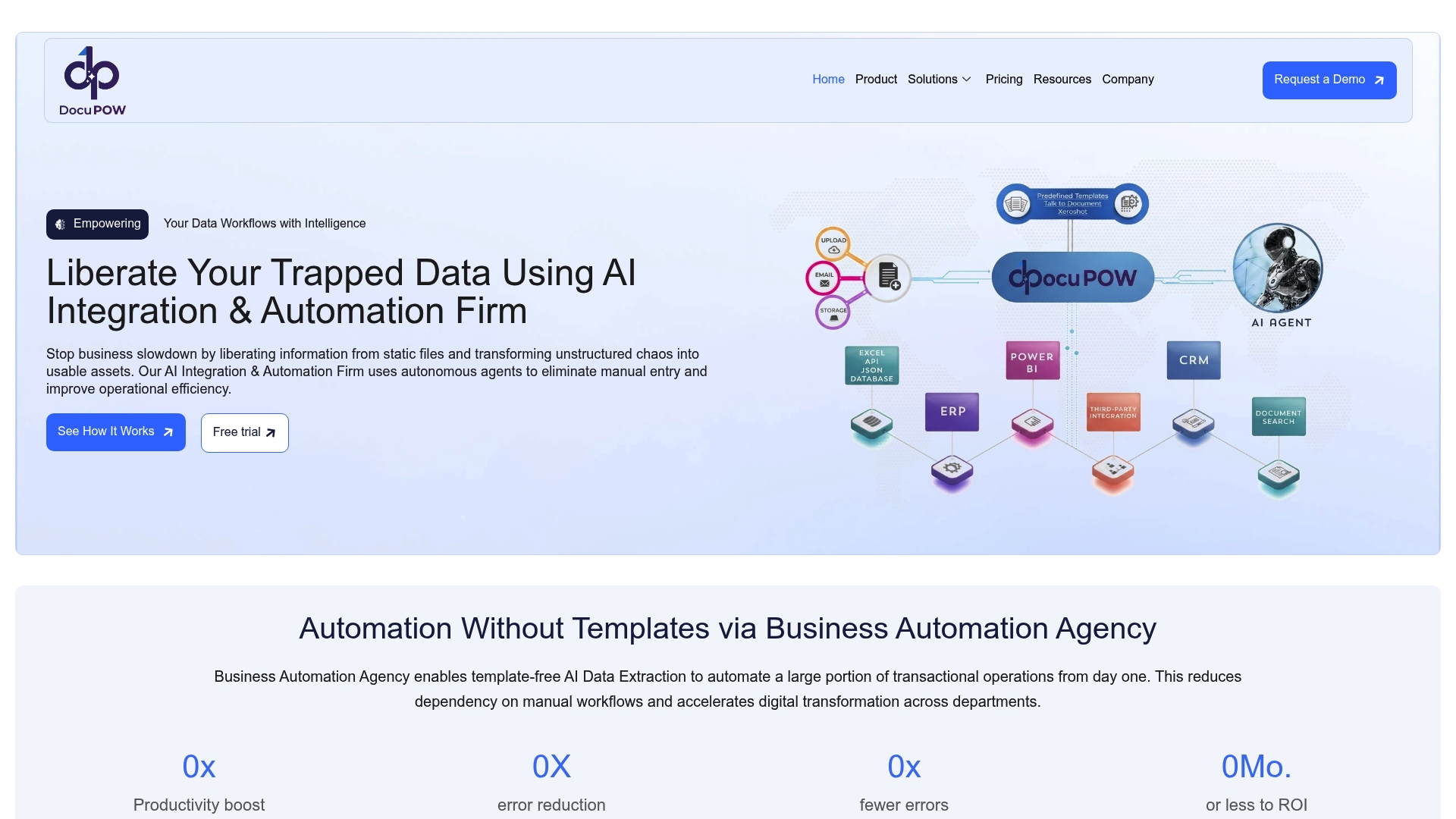
DocuPOW connects directly to ERP, CRM, and finance systems, so extracted data reaches the teams and tools that need it without manual handoffs. The platform’s real-time analytics give operations and finance teams the visibility to act on document data as it arrives. For teams ready to move from reactive processing to proactive decision-making, the AI workflow automation guide covers the full implementation path. Organizations in construction, real estate, and high-volume manufacturing can review industry-specific document automation solutions built for their workflows.
FAQ
What is document intelligence in simple terms?
Document intelligence is the use of AI to automatically read, classify, and extract data from documents like invoices, contracts, and forms. It replaces manual data entry with accurate, automated processing that feeds directly into business systems.
How accurate is AI document extraction?
AI-native document intelligence systems achieve extraction accuracy up to 99% on well-defined document types. Accuracy depends on document variety, model quality, and the strength of the validation layer applied after extraction.
When does document intelligence become cost-effective?
Document intelligence becomes cost-effective for organizations processing at least 1,000 documents per month of a given type. Below that volume, model building and maintenance costs can exceed the savings from automation.
What is the difference between OCR and document intelligence?
OCR converts document images into text strings with no understanding of meaning or context. Document intelligence uses NLP, ML, and vision-language models to classify documents, extract structured data, and validate it against business rules.
How long does it take to see ROI from document intelligence?
Companies implementing IDP report 200–300% ROI within the first year, driven by processing time reductions of 60–70% and near-elimination of manual data entry errors.
Recommended
See DocuPOW on your documents.
Stop building templates. Start extracting data.