Enterprise Legal Teams: Cut Time 37% with Smart Contract Intelligence
See how smart contract intelligence delivers measurable ROI. Learn why template-free, agentic extraction prevents data-readiness failures and speeds legal...

Smart Contract Intelligence is AI that reads, extracts, and structures obligations, dates, clauses, and risk from traditional contracts, not blockchain code. Applied at scale, it turns filing cabinets of PDFs into a searchable dataset that flags renewal deadlines, surfaces noncompliant clauses, and stops revenue leakage before it happens. For legal, procurement, finance, and compliance leaders, the payoff is fewer missed obligations and faster, better-informed decisions across the entire contract portfolio.
TL;DR:
- Contract intelligence platforms must handle inconsistent formats, scanned images, and legacy documents without pre-mapped templates for effective extraction.
- Prioritize platforms that offer clause-level traceability, configurability to match your negotiation playbook, and robust API integrations with existing systems.
- Most enterprise AI contract projects stall due to fragmented data storage; centralizing contracts and defining clear governance are essential before scaling.
- Pilot strategies should focus on high-impact contract categories like supplier agreements or real estate leases to demonstrate measurable ROI quickly.
- When evaluating platforms, ensure they provide explainable results, support human review, and deliver accurate, source-linked information critical for audits or negotiations.
Table of Contents
- Core Capabilities Enterprise Teams Should Expect From Contract Intelligence
- Business Value and ROI: What KPIs Actually Move the Needle
- Implementation Checklist: Avoiding the Data-Readiness Trap
- How to Evaluate a Contract Intelligence Platform Without Getting Burned
- Why Template-Free, Agentic Extraction Changes the Calculus
- Ready to See What Your Contracts Are Actually Telling You
- Sources
- FAQ
Core Capabilities Enterprise Teams Should Expect From Contract Intelligence
Most contract portfolios are a mess of PDFs, scanned images, and Word documents signed across a decade of mergers, vendor changes, and legal counsel turnover. A serious contract intelligence platform has to read all of it, not just the clean digital files.
The baseline starts with optical character recognition and natural language processing strong enough to parse scanned images and inconsistent formatting. From there, the platform should extract clauses and metadata without requiring you to pre-map every document type. That template-free, zero-shot capability matters enormously once you factor in how many contract formats a typical enterprise actually holds, often numbering in the hundreds across departments and acquired entities.
Beyond extraction, look for these capabilities:
- Obligation tagging and key date detection that flags renewals, termination windows, and payment triggers automatically
- Semantic search that returns answers with a citation to the exact clause and page, not a black-box summary
- Portfolio analytics showing clause frequency, risk heatmaps, and compliance scoring across the whole document set
- Agentic workflows that route contracts for review, suggest redlines, and trigger downstream actions when a deadline or breach condition hits
- API-level integration with ERP, CRM, and e-signature systems so extracted data flows into the systems your finance and sales teams already use
KPMG’s analysis of AI-driven contract lifecycle management frames this shift plainly: contracts stop being static records and become a queryable dataset that surfaces risk and opportunity on its own, rather than waiting for someone to go looking.
Pro Tip: When you evaluate a platform’s search function, ask it a question you already know the answer to. If it cannot point you to the exact clause and page that generated the response, the output is not something you can rely on in an audit or a negotiation.
Business Value and ROI: What KPIs Actually Move the Needle
The business case for contract intelligence rests on a handful of measurable KPIs: cycle time reduction, legal hours saved, cost avoidance on outside counsel, and dollars recovered from entitlements you were already owed but never claimed.
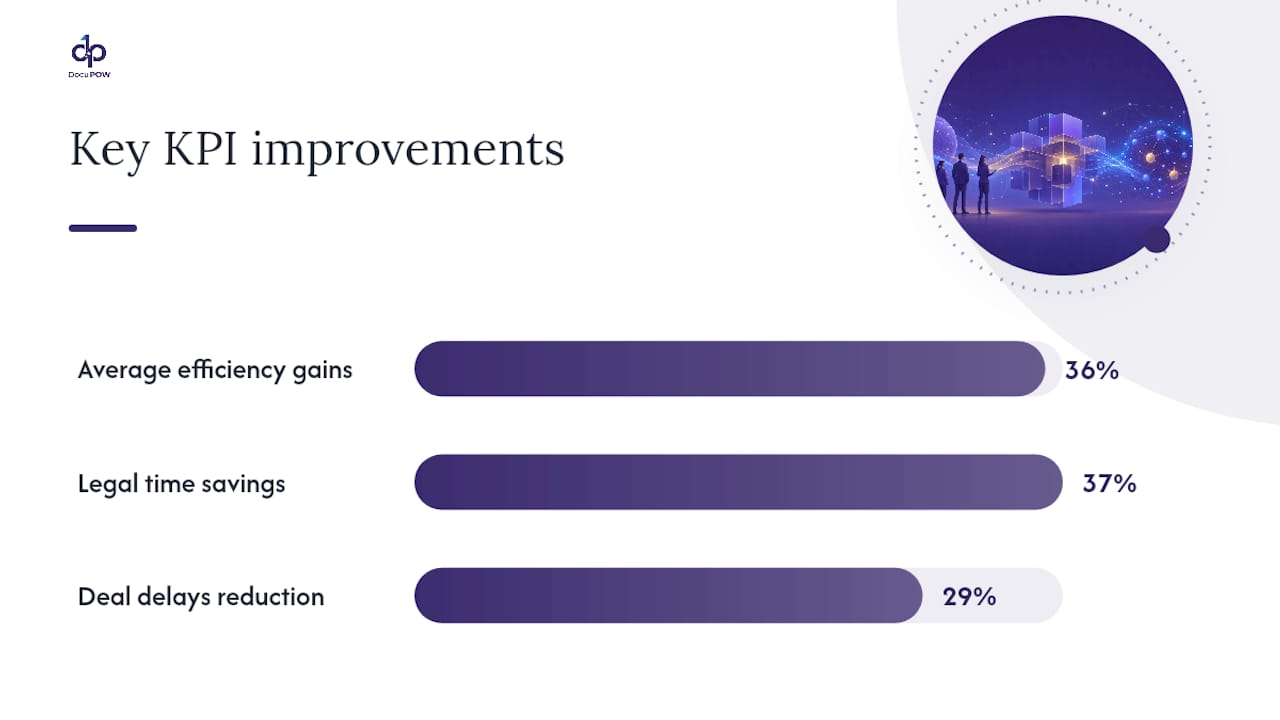
Deloitte’s 2026 survey on AI contract lifecycle management found average efficiency gains of about 36% across agreement workflows, with legal teams reporting roughly 37% time savings and a 29% reduction in deal delays. Those numbers hold up because the biggest wins rarely come from new contracts. The most valuable ROI often comes from existing contracts, where AI can surface missed rebates, unclaimed volume discounts, or auto-renewal clauses that were not tracked.
Real value capture tends to show up in a few recurring patterns:
- Renewal leakage prevention, catching auto-renew clauses before the notice window closes
- Claims and rebate validation against supplier or licensing agreements
- Faster negotiation cycles because redline history and fallback positions are instantly retrievable
If you are building a business case, measure time-to-value on a single pilot cohort rather than the whole portfolio at once. KPMG’s guidance points to high-impact pilot categories like payor contracts, IT and licensing agreements, real estate leases, and supplier contracts, where financial impact is easy to isolate and report to leadership.
Implementation Checklist: Avoiding the Data-Readiness Trap
Most AI contract projects that stall do not fail because the model is bad. They fail because the underlying data was never ready for AI in the first place. Fragmented storage across shared drives, email attachments, and departmental silos routinely blocks enterprise AI from delivering consistent results, according to BriefGlance’s analysis of stalled enterprise AI projects. Fix the data problem before you scale anything.
Work through implementation in this order:
- Centralize your contract repository. Pull agreements out of scattered drives and inboxes into one system-of-record before running large-scale extraction.
- Build and maintain your playbooks. Document preferred positions, acceptable fallback language, and escalation triggers so AI outputs reflect actual negotiation logic, not generic defaults.
- Set governance thresholds. Decide which clause types require human sign-off, which can auto-approve, and how audit trails get logged for every AI-assisted decision.
- Lock down access and encryption. Role-based access control, encryption in transit and at rest, and tenant segregation are non-negotiable in regulated industries, per KPMG’s security guidance.
- Map your integrations early. Identify which ERP, CRM, or procurement systems need to receive extracted data automatically, and which events (a missed renewal, a breach flag) should trigger downstream action.
- Pilot on one cohort, then scale. Pick a single contract category, validate accuracy against a manual sample, gate expansion on hitting your KPI targets, and only then roll out portfolio-wide.
Pro Tip: Treat your playbook as a living document, not a one-time setup task. Scale LLP’s research on institutional knowledge in AI contract review found that outdated fallback positions are one of the most common reasons AI-assisted reviews drift away from what legal actually wants.
For teams building out a phased rollout, DocuPOW’s guidance on agentic contract lifecycle management walks through pilot structuring in more detail.
How to Evaluate a Contract Intelligence Platform Without Getting Burned
Skip the feature checklist and focus on five things that actually predict whether a platform will hold up at scale.
- Traceability. Every extracted answer should link back to the source clause and page. If a vendor cannot show you clause lineage, treat that as disqualifying, not a minor gap.
- Configurability. Can you load your own playbooks, fallback language, and escalation rules, or does the system force a generic negotiation logic onto every contract?
- Interoperability. Confirm API depth and whether the platform supports event-driven triggers into your ERP or CRM, not just a one-way data export.
- Explainable operations. Ask how human review integrates into the workflow, and whether the audit trail would survive scrutiny from a compliance officer or outside auditor.
- Total cost. Licensing is only one line item. Factor in implementation, data migration, integration builds, and the change management effort of getting legal and procurement teams to trust the outputs.
Watch for platforms that rely on generic large language model outputs without structured, traceable extraction. Brightleaf’s research on general-purpose AI in legal workflows found these tools often produce coherent-sounding but incomplete results at scale, exactly the kind of gap that surfaces in an audit, not a demo.
Why Template-Free, Agentic Extraction Changes the Calculus
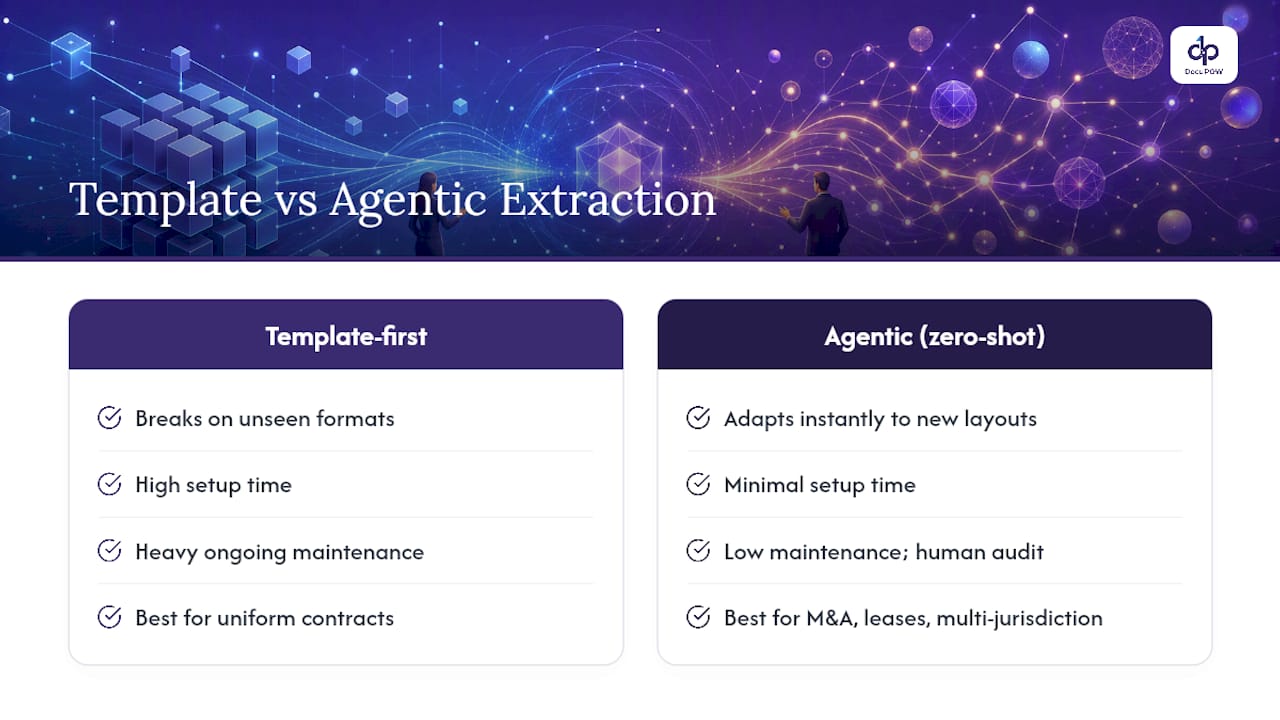
Template-first extraction tools break the moment a contract format they have not seen before shows up, which happens constantly across mergers, regional vendors, and legacy agreements. An agentic, zero-shot extraction approach is built to adapt to unseen layouts instantly, cutting the setup and maintenance burden that template-dependent systems carry.
Paired with human-in-the-loop auditing, this approach fits template-heavy portfolios especially well: supplier agreements inherited through acquisitions, real estate leases with wildly different formats, or multi-jurisdiction vendor contracts where no two documents look alike. That is where rigid, template-based systems tend to lose the most time.
— Syed Naveed Abbas
Ready to See What Your Contracts Are Actually Telling You
DocuPOW is built for exactly the data-readiness problem this article just walked through: template-free, agentic extraction that adapts to unseen contract layouts instead of breaking every time a new format shows up.
If your portfolio spans acquired entities, regional vendors, or a decade of inconsistent templates, that adaptability is the difference between a pilot that stalls and one that scales. This extraction can be paired with human-in-the-loop review, real-time analytics, and API-level integration into ERP and CRM systems, so extracted obligations and key dates reach the teams that need to act on them. For a related use case on intelligent intake and process orchestration, Segua is worth a look.
Before you book a demo, pull together a sample of your messiest contracts (the scanned ones, the inconsistent formats, the ones nobody wants to touch), your top three KPIs, and a list of the systems you need extracted data to reach. Then check the pricing page for the Starter, Professional, and Enterprise tiers, or start with a focused pilot through DocuPOW’s 90 day agentic AI accessibility program to see results on a single contract cohort before committing further.
Sources
- AI Contract Lifecycle Management: The 2026 Survey on Trends & ROI | Deloitte US
- AI revolution contract lifecycle management | KPMG (2026)
- Briefglance
- AI Contract Review and Institutional Knowledge | Scale LLP
- AI Contract Analysis: Why General-Purpose AI Falls Short for Legal Teams – Brightleaf Solutions, Inc.
FAQ
What Is Smart Contract Intelligence in Plain Terms?
It is AI applied to traditional contracts (leases, vendor agreements, licensing deals) that extracts obligations, key dates, and clauses so legal and procurement teams can query their portfolio instead of manually rereading it. It has nothing to do with blockchain-based smart contracts.
How Long Does It Take to See ROI From Contract AI?
Time-to-value depends on the pilot cohort, but organizations that centralize their data first and pilot on a single contract category, like supplier agreements or real estate leases, tend to see measurable gains fastest. Deloitte’s 2026 survey reports average efficiency gains of about 36% and legal time savings near 37% among organizations using AI contract lifecycle management.
Why Do Enterprise AI Contract Projects Fail?
The most common cause is data readiness, not the AI model itself. Fragmented contract storage across drives, emails, and departmental silos prevents consistent extraction, a failure point BriefGlance’s research identifies as a leading cause of stalled enterprise AI initiatives.
What Should I Bring to a Contract Intelligence Demo?
Bring a sample of your most inconsistent contracts, your top KPIs (cycle time, cost avoidance, renewal tracking), and a list of the ERP or CRM systems that need to receive extracted data. This lets the vendor show real accuracy on your actual documents rather than a clean demo file.
How Much Does DocuPOW Cost?
DocuPOW offers a Starter plan at $99 per month and a Professional plan at $499 per month, with Enterprise pricing available on request based on scope and volume.
Recommended
See DocuPOW on your documents.
Stop building templates. Start extracting data.