Standards First Document Audit Trails for Compliance Teams: NIST, SEC
Standards First guide for compliance teams to build document audit trails aligned to NIST, SEC, and NARA with a 10 Step checklist.


A document audit trail is a chronological, tamper-evident record of every action taken on a file, built so a reader can reconstruct exactly who did what, when, where, and why. Organizations rely on it for three jobs: proving compliance to regulators, supporting security investigations, and diagnosing operational breakdowns. Bodies like NIST, the SEC, and NARA all treat this reconstructive ability as the real test of whether a log qualifies as an audit trail at all.
TL;DR:
- A comprehensive audit trail must log all actions affecting a document, including views, edits, approvals, signatures, sharing, permission changes, and deletion attempts.
- Timestamps need to be synchronized to an authoritative source, and logs must include specific fields such as actor identity, event type, object ID, outcome, and source context to ensure reliability.
- Protecting log integrity with cryptographic hashing, append-only storage, and regular reconstruction tests is essential, especially as document volume and system complexity grow.
- Logs should be centralized, searchable, and exportable in structured formats like JSON or XML to support regulatory compliance and facilitate quick evidence retrieval.
- Continuous monitoring, retention mapping, and regular review are necessary to prevent gaps, ensure adherence to legal standards, and maintain usable, defensible audit records.
Table of Contents
- Definition and Scope: Audit Trail Versus Version History
- Why Document Audit Trails Matter for Different Stakeholders
- Core Components: Fields and Integrity Controls Every Audit Record Needs
- Design and Operations: The Audit-Trail Lifecycle and Implementation Checklist
- Regulatory and Records-Management Considerations
- Common Challenges and Mitigation at Scale
- Concrete Examples and Use Cases
- Prioritized Checklist and Recommended Controls
- Standardized Formats and Protocols for Audit Trail Data Exchange
- Legal Considerations and Admissibility in Court or Regulatory Proceedings
- What Teams Consistently Get Wrong About Audit Trails
- How DocuPOW Helps Deliver Compliance-Ready Audit Trails
- Sources
- FAQ
Definition and Scope: Audit Trail Versus Version History
NIST’s definition frames an audit trail as a record sufficient to reconstruct and examine the sequence of activities around a security-relevant operation. For a document, that means capturing every lifecycle event, not just the moments someone hit save.
A defensible trail typically logs:
- Creation and initial upload of the document
- Every view or access, including by whom
- Edits, with the specific fields or content changed
- Approvals and rejections in a workflow
- Digital signatures and signing events
- Sharing, exports, and downloads
- Permission or access-level changes
- Deletion attempts, successful or not
- Administrative actions, such as retention overrides
This is where people often confuse two different things. Version history shows you the states a document passed through: draft one, draft two, final. An audit trail shows you the actions that produced those states, along with actions that leave no version at all, like a permission change or a failed deletion attempt. A file can have a clean version history and a dangerously incomplete audit trail if viewing, sharing, and access events were never captured.
Scope decisions follow from risk, not convenience. A signed contract or a financial record usually needs full-event logging, while an internal draft memo might only need creation and edit tracking. The right approach maps record classes to retention obligations first, then decides how granular the logging needs to be for each class. Teams building this out often start with a document lifecycle management framework to make those scoping calls consistently.
Why Document Audit Trails Matter for Different Stakeholders
The value of an audit trail changes depending on who is asking the question. An external auditor wants proof that a control operated as designed. An incident responder wants to know how an unauthorized change happened and who else might be affected. A process owner wants to know why an invoice sat unapproved for two weeks.
Each group gets something different from the same record:
- Compliance teams use trails to produce defensible evidence during audits or regulatory examinations
- Security teams use trails to trace unauthorized access, scope a breach, and support incident response
- Operations teams use trails to find bottlenecks, like approvals stuck with one reviewer
- Legal teams use trails to establish timelines when a dispute or investigation requires it
NIST’s SP 800-92 guidance recommends designing logs for two audiences at once, investigators and process owners, so the same record serves forensic detail and operational visibility. That dual purpose is what separates a useful audit trail from a log nobody reads until something breaks.
The stakes show up clearly during an audit. A trail that can reconstruct exactly when a contract was approved and by whom turns a multi-day evidence hunt into a quick export. Without it, the same request can stall an entire audit cycle while someone manually reassembles email threads and file timestamps.
Core Components: Fields and Integrity Controls Every Audit Record Needs
A record that omits the wrong field can be technically present and still useless in a dispute. NIST’s control set in SP 800-53 lays out what a well-formed audit event needs to contain and how it should be protected.
At minimum, each entry should capture:
- Timestamp, synchronized to an authoritative time source, not a local device clock
- Actor identity, tied to an authenticated user or system account, never a shared login
- Event type, described specifically rather than as a generic “modified”
- Object identifier, pointing to the exact document, version, or field affected
- Outcome, recording success, failure, or a denied attempt
- Source context, such as IP address, device, or originating system
Integrity controls matter as much as the fields themselves. Cryptographic hashing lets you verify a log has not been altered after the fact. Append-only storage prevents entries from being edited or deleted once written. Where write-once-read-many storage is impractical, an audit-trail alternative that can reliably recreate original records serves the same evidentiary purpose, an approach the SEC has explicitly recognized for regulated recordkeeping.
Time synchronization deserves its own attention. If systems across a workflow drift out of sync by even a few minutes, event sequencing becomes unreliable exactly when you need it most, during a dispute over which action happened first. NIST’s AU-8 control specifically addresses synchronized timestamps for this reason.
Indexing and searchability round out the design. A trail that exists but can’t be queried by document ID, actor, or date range fails the same test as one with missing fields: it can’t answer a question fast enough to matter.
Pro Tip: Store a cryptographic hash of each log entry alongside the entry itself, so any tampering attempt changes the hash and flags itself automatically.
Design and Operations: The Audit-Trail Lifecycle and Implementation Checklist
Building an audit trail is not a one-time setup. It’s an operational lifecycle that has to keep working as document volume and system count grow. NIST’s SP 800-53 and SP 800-92 guidance treats logging as a full cycle: generation, transmission, storage, access, analysis, and disposal.
- Define auditable events for each record class based on risk and regulatory exposure.
- Capture and normalize events across every system that touches the document, using a consistent field structure.
- Synchronize timestamps to a shared, authoritative time source across all logging systems.
- Centralize logs into a searchable store rather than leaving them scattered across applications.
- Protect the store with hashing, append-only writes, or an equivalent audit-trail alternative.
- Restrict administrative access to logging systems, and log the administrators’ own actions too.
- Review and correlate logs on a schedule, not only after an incident triggers a look.
- Test reconstruction by picking a real document and confirming you can rebuild its full history end to end.
- Map retention requirements by record class, so logs aren’t destroyed before their legal or regulatory window closes.
- Confirm export readiness so a regulator or auditor request can be answered in a usable format quickly.
Two steps deserve extra weight. Testing reconstruction is the only way to know your trail actually works, rather than assuming it does because logging is turned on. Pick a document with a complex history, an approval chain, a permission change, an export, and try to rebuild the sequence from the logs alone. If you can’t, you’ve found the gap before an auditor does.
Monitoring logging failures matters just as much as capturing events in the first place. A system that silently stops logging creates a gap that looks, to an outside reviewer, indistinguishable from evidence tampering. Capacity planning belongs in the same conversation: as document volume grows, log volume grows faster, and a store that worked at one scale can become slow or unsearchable at another. Teams working through this often lean on a structured compliance documentation approach to keep the checklist consistent across departments.
Regulatory and Records-Management Considerations
Three sources of guidance shape what a defensible audit trail has to look like, and each answers a different question.
- NIST’s SP 800-53 controls define what to log and how to protect it, covering event selection, record content, timestamp synchronization, log protection, retention, and disposal.
- The SEC’s audit-trail alternative under Rule 17a-4 lets broker-dealers preserve records electronically without write-once-read-many storage, provided the system maintains a complete, time-stamped audit trail that can recreate an original record if it’s modified or deleted. The amendments took effect January 3, 2023, with a compliance deadline in 2023 for firms electing the alternative.
- NARA’s metadata guidance requires that permanent federal electronic records carry documentation adequate to identify, service, and interpret them, with metadata preserved through any migration until the destination system is confirmed reliable.
The common thread across all three is that format matters less than evidentiary reliability. The SEC’s rule is explicitly technology-neutral: it cares whether a system can prove authenticity and recreate a record, not which vendor built it. NARA’s guidance similarly focuses on whether metadata survives a transfer, not which file format carries it. For retention and exportability, this means building logs that can be pulled into a machine-readable format on demand, since a regulator’s request rarely waits for a custom export job to be built from scratch.
Common Challenges and Mitigation at Scale
Audit trails tend to work fine in a pilot and break down at scale. Volume is the first problem: high-frequency systems can generate more log data than a team can store affordably or search quickly, forcing hard choices about what to sample versus capture in full.
Timestamp drift is a quieter but more damaging issue. When systems across a workflow aren’t synchronized to the same time source, event sequences become unreliable right when a dispute needs them most.
Cross-system correlation adds another layer of difficulty. A single document might touch a content management system, an e-signature platform, and an ERP system, each logging events in its own format, making it hard to assemble one coherent timeline.
- High volume: prioritize logging for high-risk record classes rather than logging everything at maximum detail
- Clock drift: synchronize all systems to one authoritative time source
- Fragmented logs: normalize event formats before centralizing them
- Administrative gaps: log admin actions with the same rigor as user actions, including failed deletion attempts
Pro Tip: Run a quarterly reconstruction test on a randomly chosen document rather than waiting for an audit to reveal a correlation gap.
Concrete Examples and Use Cases
A contract dispute is the clearest illustration. If a vendor claims a clause was changed after signing, a complete audit trail can show the exact edit, the actor, the timestamp, and the signature event that followed, settling the question without relying on memory or email threads.
Accounts payable teams face a similar scenario when an invoice payment is questioned. The trail shows who approved it, whether the amount was edited after initial entry, and when it moved through each approval step, which is often the fastest way to close out an internal dispute.
E-signature workflows depend on the same principle. A signed document’s trail should show the signer’s identity verification, the exact document version presented, and the completion timestamp, since courts and regulators increasingly expect that level of detail as standard practice.
- Contracts: reconstruct edits and approvals to resolve disputed clauses
- Invoices: trace approval chains and edits to resolve payment disputes
- E-signatures: verify signer identity and document version at signing
Sector expectations differ too. Financial firms operate under SEC-style recreation requirements, while public archives under NARA guidance focus more on long-term metadata survival through system migrations than on rapid dispute resolution.
Prioritized Checklist and Recommended Controls
Teams under time pressure need a short list they can start acting on today, not a full audit program to design from scratch.
- Define auditable events per record class before anything else.
- Synchronize clocks across every system that touches a document.
- Hash log entries to make tampering self-evident.
- Centralize logs into one searchable store.
- Restrict and log administrative access separately from user access.
- Test reconstruction on a real document with a complex history.
- Map retention periods to each record class’s regulatory obligation.
- Confirm logs can be exported in a usable format on request.
- Set up monitoring and alerts for logging failures.
- Review logs and alerts on a recurring schedule, not only reactively.
One of the most time-consuming parts of this checklist in practice is steps one and six: defining events and proving reconstruction works, especially for organizations extracting data from documents that arrive in inconsistent formats. Agentic, template-free extraction can shorten that work because it captures structured event data from documents without requiring a rigid template for every layout, and a human-in-the-loop audit review step gives compliance teams a documented checkpoint rather than a black-box process.
Escalate to legal or records management when a reconstruction test fails on a record tied to active litigation, an open regulatory inquiry, or a permanent-record retention obligation. At that point, the cost of a gap is no longer theoretical.
Standardized Formats and Protocols for Audit Trail Data Exchange
Audit trails only prove their value when they can move between systems without losing meaning, and that’s where format choice matters. Structured, machine-readable formats like JSON and XML remain the common baseline for exchanging audit records between platforms, since both can carry nested event data and are widely supported by log management tools.
Common log standards like Syslog handle the transport side, routing event data from distributed systems into a central store in near real time. Where documents move between organizations, such as a contract shared with an outside counterparty, the receiving system needs enough embedded metadata to interpret the trail independently, not just a human-readable export.
NARA’s metadata guidance is instructive here even outside government archives: metadata can be embedded directly in a file or maintained separately, but it has to survive migration to a new system, and it has to remain interpretable once the original creating system is gone. That principle applies just as much to a company migrating from one document platform to another. A trail exported in a proprietary format that only the original vendor’s software can read fails the same test a paper record would fail if the only person who could interpret it retired.
The practical takeaway for teams choosing tools is to prioritize export formats over vendor promises. If a platform can’t produce a structured, portable export of its audit data on request, that’s a gap worth flagging before, not after, a regulator or new system migration exposes it.
Legal Considerations and Admissibility in Court or Regulatory Proceedings
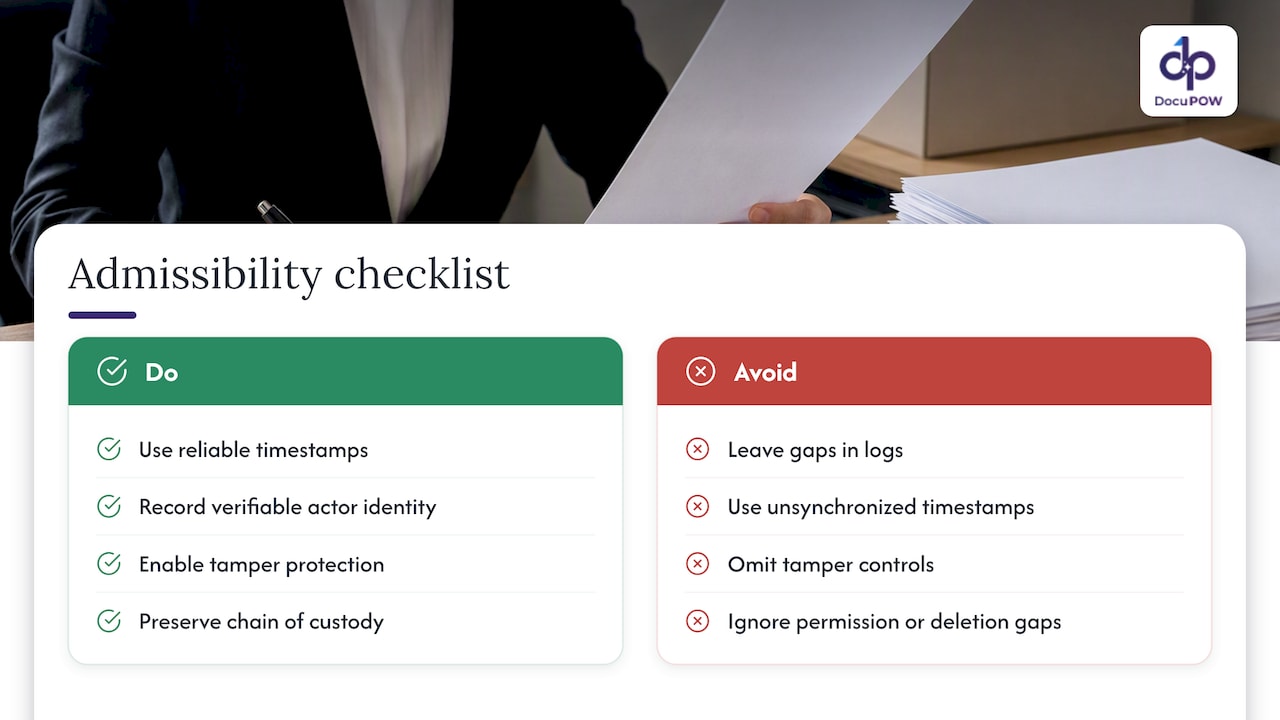
An audit trail’s value in a legal or regulatory proceeding depends on the same qualities that make it useful internally: reliable timestamps, verifiable actor identity, and evidence that the record has not been altered after the fact. A log with gaps, unsynchronized timestamps, or no tamper protection invites the argument that it can’t be trusted, regardless of what it appears to show.
The SEC’s audit-trail alternative illustrates the underlying legal logic well. Rather than mandating a specific storage technology, it requires that a system be able to recreate an original record if it’s modified or deleted, treating recreation capability as the real evidentiary standard. That framing extends beyond broker-dealers: any organization trying to establish that a document trail is trustworthy in a dispute needs to show the same thing, that the record could be independently verified or reconstructed, not just displayed.
Chain of custody matters here too. A document’s audit trail is strongest as evidence when it shows an unbroken sequence of custody and action, with no unexplained gaps between who touched the file and when. A missing entry, especially around a deletion attempt or a permission change, can undercut the credibility of an otherwise solid record.
None of this substitutes for legal advice specific to a given proceeding or jurisdiction. Organizations facing active litigation or a regulatory inquiry involving document evidence should involve legal counsel and records management early, since the standards for admissibility can vary by court, agency, and record type.
What Teams Consistently Get Wrong About Audit Trails
Most organizations treat audit trails as a compliance checkbox rather than an operational asset, and that mindset shows up the moment something goes wrong. The teams that struggle most in an audit or investigation are usually the ones that logged plenty of data but never tested whether they could reconstruct anything from it.
My view, after looking at how these systems fail, is that reconstruction capability and exportability deserve more attention than event volume. A trail with fewer fields that you can reliably rebuild and export beats a sprawling log nobody has ever pulled a real timeline from. Metadata and provenance should be treated as part of the record itself, not an afterthought bolted on for archivists. And a periodic proof-of-reconstruction exercise, run before an auditor asks for one, is worth more than any additional logging feature a vendor tries to sell you.
— Syed Naveed Abbas
How DocuPOW Helps Deliver Compliance-Ready Audit Trails
Every checklist item above gets harder when documents arrive in inconsistent formats that require manual setup for every new layout. Template-free, agentic extraction can read document context directly, so audit-relevant fields can be captured without a maintenance backlog when new document types show up. A human-in-the-loop review step can provide compliance teams a documented checkpoint for the kind of reconstruction test this guide recommends, with exportable evidence that supports retention and export readiness.
If reconstruction speed and audit prep time are the priority, check current plans and pricing or request a demo to see the audit review workflow on your own documents.
Sources
- audit trail – Glossary | CSRC
- Final Rule: Electronic Recordkeeping Requirements for Broker-Dealers
- NARA — Metadata guidance for permanent electronic records
FAQ
What Does an Audit Trail Check For?
An audit trail checks for the sequence of actions taken on a document or system, including who performed each action, when it happened, what changed, and whether the action succeeded or failed. It exists to let a reviewer reconstruct that sequence later, which is why NIST’s definition centers on reconstructive sufficiency rather than a simple activity list.
Can You Give Me an Example of an Audit Trail?
A signed contract’s audit trail might show its creation date, an editor’s change to a payment clause, a reviewer’s approval, and the final e-signature event, each with a timestamp and actor identity attached. That sequence lets someone later confirm exactly what happened and in what order, without relying on memory or separate email records.
Can We Delete an Audit Trail?
Generally, no, not while the underlying record remains subject to a retention or regulatory obligation. Deleting or altering a trail undermines its evidentiary value and can itself become an audit finding, which is why integrity controls like append-only storage exist to prevent it.
Is an Audit Trail Mandatory?
Whether an audit trail is legally mandatory depends on the industry and record type. Regulated sectors like broker-dealer recordkeeping have explicit requirements, such as the SEC’s audit-trail alternative under Rule 17a-4, while other organizations adopt audit trails voluntarily for security and operational reasons even without a specific mandate.
Recommended
See DocuPOW on your documents.
Stop building templates. Start extracting data.