Due Diligence Automation for Manufacturers: 2026 Guide
Discover how Due Diligence Automation transforms manufacturing. Enhance speed, accuracy, and scalability while managing supplier risks effectively.


What is due diligence automation and why does it matter for manufacturers?
Due diligence automation applies AI to replace manual document review, supplier data collection, and risk scoring with continuous, structured workflows. For global manufacturers juggling thousands of suppliers across multiple jurisdictions, that shift is not incremental. It is the difference between catching a supplier’s financial distress early and reacting only after costly expedited freight bills impact your operations.
The core benefits for manufacturing operations:
- Speed: AI-driven risk assessment cuts evaluation time significantly compared to traditional manual methods.
- Accuracy: Automated extraction eliminates transcription errors from PDFs, scanned certificates, and multilingual filings.
- Continuous monitoring: Systems track financial stability, regulatory compliance, and operational metrics around the clock, not just at quarterly review cycles.
- Scalability: Manual monitoring by a team of analysts can only cover a limited number of suppliers. Automation extends coverage to many more without adding headcount.
- Audit readiness: Every data point links back to its source document, giving you a defensible trail for regulators and stakeholders.
- Compliance coverage: Automated systems handle ESG reporting requirements, sanctions screening, and evolving regulatory frameworks simultaneously.
DocuPOW is built specifically for this problem. Its autonomous AI agents extract contextual data from unstructured manufacturing documents without relying on rigid templates, giving manufacturers real-time visibility into supplier and operational risk.
Table of Contents
- How AI and document data extraction reshape the due diligence process
- Balancing AI automation with human expertise in manufacturing workflows
- How DocuPOW’s AI platform improves manufacturing due diligence
- Strategic advice for implementing due diligence automation
- Integration challenges and best practices for manufacturing environments
- Data security and compliance in automated due diligence systems
- DocuPOW gives manufacturers a faster path to defensible due diligence
- Key Takeaways
- FAQ
How AI and document data extraction reshape the due diligence process
AI brings three capabilities to manufacturing due diligence that manual processes simply cannot replicate at scale: pattern recognition, predictive risk scoring, and anomaly detection.

Machine learning models trained on supplier data recognize combinations of signals that precede failures. A drop in payment timeliness, a spike in workforce turnover mentions in news filings, and a shift in ESG disclosure language can collectively flag a supplier months before a formal default. Natural language processing reads those signals from PDFs, scanned compliance certificates, financial records, and supplier disclosures simultaneously, transforming unstructured content into structured, auditable data.
Automated due diligence platforms continuously monitor supplier risk factors including financial stability, operational metrics, and regulatory compliance, using predictive scoring to surface problems before they escalate. Anomaly detection catches inconsistencies that manual reviewers miss at volume: a supplier whose emissions data contradicts its stated production capacity, or a compliance certificate whose date does not align with the audit period it covers.
- Extract data from technical reports, financial filings, compliance certificates, and supplier questionnaires automatically.
- Classify and structure thousands of unstructured documents in near real time.
- Flag illogical declaration combinations and policy inconsistencies before they pass through review.
- Generate complete audit trails linking every response back to its source document.
- Reduce due diligence questionnaire completion from extended periods to much shorter timelines.
Pro Tip: Clean your supplier master data before deploying any AI model. Improving master data quality before scoring begins is critical to earning analyst trust and minimizing false positives. That cleanup earned analyst trust. A model built on stale records produces false positives that kill adoption within weeks.
Balancing AI automation with human expertise in manufacturing workflows
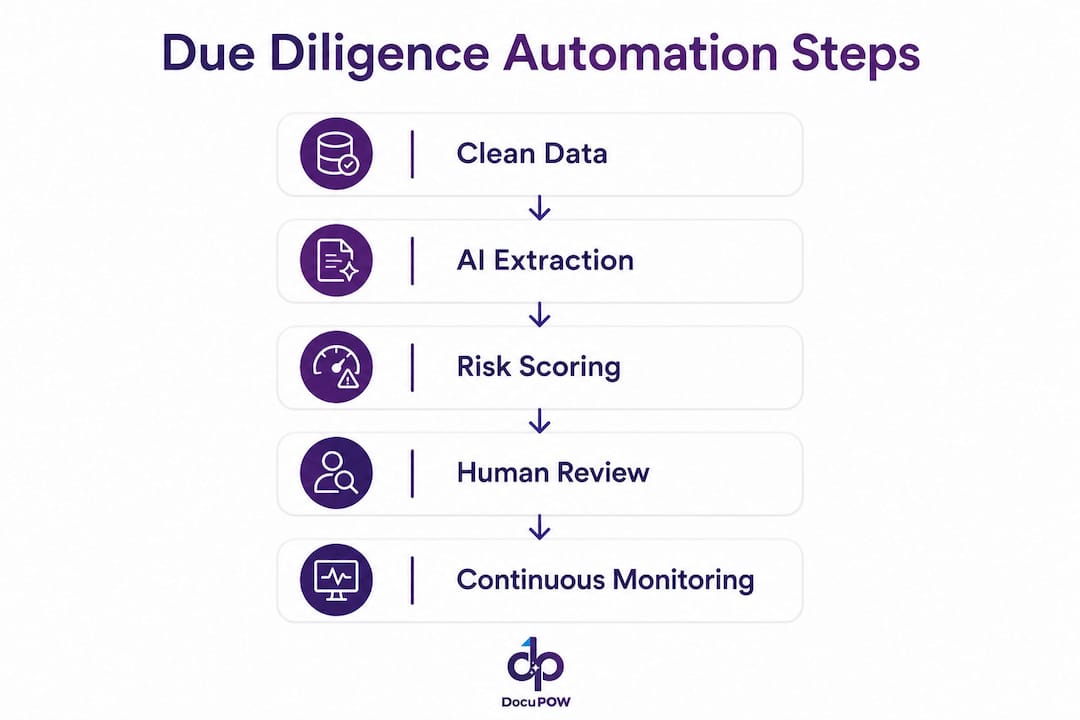
AI does not replace your procurement analysts. It changes what they spend their time on.
By pre-processing large volumes of supplier data, AI enables prioritization at scale. Routine submissions get handled automatically. Exceptions, high-risk flags, and complex geopolitical exposures get routed to the humans who can actually interpret context and make judgment calls. That reallocation is where the real productivity gain lives.
Integrating automation with machine PLCs takes this further for technical due diligence. Direct PLC data access bypasses manual maintenance logs entirely, giving you a live, unvarnished view of equipment health rather than a spreadsheet someone filled in last quarter. That live data feeds directly into risk models, improving the accuracy of technical assessments during acquisitions or supplier audits.
Key collaboration strategies that work in practice:
- Map AI output to existing risk playbooks so analysts receive findings in a format they already trust.
- Build role-based escalation rules that route flagged cases to the right reviewer automatically.
- Maintain a human feedback loop to correct false positives and retrain models over time.
- Use transparent risk scoring with visible data quality metrics so analysts understand why a supplier was flagged.
- Reserve human review for low-data jurisdictions where AI confidence is explicitly lower.
How DocuPOW’s AI platform improves manufacturing due diligence
DocuPOW’s autonomous agents understand document context without needing predefined templates. That matters in manufacturing, where documents arrive in dozens of formats across multiple languages and regulatory regimes.
DocuPOW’s platform automates data extraction from technical reports, compliance certificates, financial records, and operational filings, reducing manual entry and the errors that come with it. Real-time analytics and predictive insights let teams move from reactive firefighting to proactive risk management, spotting supplier stress signals before they become operational crises.
The traceability layer is what makes the output defensible. Every extracted data point links back to its source document, satisfying audit committee requirements and meeting investment-grade standards for regulatory compliance.
| Metric | Before Automation | After Automation |
|---|---|---|
| Analyst time per supplier review significantly decreases after automation. | ||
| Supplier base under active monitoring expands substantially with automation. | ||
| Master data staleness is greatly reduced through diligent data cleaning before applying AI models. | ||
| Risk coverage expands considerably beyond baseline levels with automation. |
74% reduction in analyst time per supplier review — with recovered hours reallocated to second-source qualification and contract renegotiation, generating $4.8M in annualized cost reductions.
Strategic advice for implementing due diligence automation
The manufacturers who get the most from automation treat it as a phased build, not a one-time deployment.
Start with master data. Clean and deduplicate your supplier records before any model touches them. Then define your risk dimensions explicitly: financial distress, geopolitical exposure, single-source concentration, ESG event risk, delivery performance. Name the framework. Giving procurement leadership a labeled, documented methodology produces a defensible artifact they can present to audit committees.
Layer AI capabilities progressively. Early-stage automation handles document classification and data extraction. Later stages add predictive scoring, anomaly detection, and LLM-powered query interfaces that let analysts ask plain-language questions and get ranked, cited results.
Strategic recommendations for decision-makers:
- Prioritize data quality over model sophistication in the first phase.
- Build escalation rules and risk playbooks before going live.
- Customize automation tools to your specific supplier geography and document types.
- Monitor false-positive rates actively and set realistic targets (under 35% is achievable within four months).
- Plan for AI workflow integration with existing ERP and procurement systems from day one.
Integration challenges and best practices for manufacturing environments
The hardest part of implementing due diligence automation is not the AI. It is connecting the AI to your existing systems without inheriting their problems.
Legacy ERP data, inconsistent supplier master records, and siloed document repositories all create friction. The practical fix is a phased approach: scope your risk dimensions first, clean your data second, and build scoring models third. Rushing to deploy a model on dirty data produces the false positives that destroy analyst trust and stall adoption.
For AI readiness in manufacturing contexts, the organizational side matters as much as the technical side. Assign internal owners for model retraining, false-positive feedback loops, and playbook updates. Without that ownership, models drift and analysts stop trusting the output. API integration with procurement platforms and ERP systems should be scoped early so automation outputs flow directly into existing workflows rather than creating a parallel reporting layer.
Data security and compliance in automated due diligence systems
Automated due diligence systems handle sensitive supplier financials, compliance records, and operational data. That concentration of sensitive information requires enterprise-grade security architecture.
Role-based access controls limit who can view which supplier records. Encryption at rest and in transit protects documents moving through extraction pipelines. Audit trails, already built into well-designed due diligence platforms, double as security logs showing who accessed what and when. For manufacturers operating across the EU, UK, and US, compliance frameworks including GDPR, the UK Modern Slavery Act, and evolving supply chain due diligence directives require that automated reporting systems produce traceable, auditable outputs. AI-powered platforms that aggregate supplier assessments and generate consistent audit trails meet that bar more reliably than manual processes, which vary by analyst and review cycle.
DocuPOW gives manufacturers a faster path to defensible due diligence
Manual due diligence at global manufacturing scale is a losing proposition. The document volumes are too high, the supplier geographies too diverse, and the regulatory requirements too fast-moving for spreadsheet-driven review to keep pace.
DocuPOW’s autonomous AI agents extract, structure, and analyze supplier and operational data from any document format, without templates, without manual re-entry, and with full traceability back to source files. Manufacturers get real-time risk visibility, predictive analytics, and audit-ready outputs that hold up to regulatory scrutiny. The document process automation DocuPOW delivers translates directly into faster supplier onboarding, fewer line stoppages, and procurement teams focused on strategic decisions rather than data wrangling. See what DocuPOW’s platform can do for your manufacturing due diligence workflows at docupow.ai.
Key Takeaways
AI-powered due diligence automation cuts analyst time per supplier review by 74% while expanding active risk coverage across entire supplier bases, making it the most practical path to defensible, scalable oversight for global manufacturers.
| Point | Details |
|---|---|
| Speed and scale | Automated risk assessment cuts evaluation time significantly compared to traditional manual methods. |
| Data quality first | Reducing master data staleness from 14% to under 2% is the non-negotiable foundation before any model goes live. |
| Human-AI balance | AI surfaces exceptions and prioritizes cases; human analysts retain judgment on complex and low-data situations. |
| Traceability | Every extracted data point links to its source document, satisfying audit committee and regulatory requirements. |
| DocuPOW | DocuPOW’s template-free autonomous agents extract and structure manufacturing documents for real-time risk visibility and audit-ready due diligence outputs. |
FAQ
What is due diligence automation?
Due diligence automation uses AI and machine learning to replace manual supplier data collection, document review, and risk scoring with continuous, structured workflows. It enables manufacturers to monitor thousands of suppliers in real time rather than relying on periodic manual audits.
How much time can automation save in supplier reviews?
Leading manufacturers have achieved a 74% reduction in analyst time per supplier review by automating risk assessments and data processing at scale.
Does automation replace human analysts in due diligence?
No. AI strengthens governance by handling volume-intensive tasks and surfacing high-risk cases, while human analysts retain responsibility for interpretation, escalation, and final decisions.
How does DocuPOW support manufacturing due diligence?
DocuPOW’s autonomous AI agents extract contextual data from unstructured manufacturing documents without rigid templates, delivering real-time analytics, predictive risk insights, and full traceability to source files for audit-ready compliance.
What is the biggest implementation risk for due diligence automation?
Deploying AI models on stale or inaccurate supplier master data. Cleaning and deduplicating records before scoring begins is what determines whether analysts trust the output or reject it within weeks.
Recommended
See DocuPOW on your documents.
Stop building templates. Start extracting data.