Legal Document Analysis for Enterprise Teams in 2026
Discover how AI transforms Legal Document Analysis for enterprise teams. Automate repetitive tasks and empower lawyers to focus on important judgments.


TL;DR:
- AI automates the extraction, classification, validation, and summarization of legal documents, reducing drafting time significantly.
- It enhances operational capacity by allowing small teams to handle larger volumes with improved consistency and traceability.
What is legal document analysis, and how does AI change it?
Legal document analysis is the process of extracting, classifying, validating, and summarizing key information from contracts, policies, filings, and other legal papers. Traditionally, that work fell entirely on attorneys reading line by line. AI changes the equation by automating the repetitive parts, leaving lawyers to focus on judgment calls rather than page counts.
The core functions AI handles today include:
- Extraction: Pulling specific clauses, dates, parties, and obligations from unstructured text
- Classification: Identifying document type (NDA, MSA, DPA, regulatory filing) to route it correctly
- Validation: Checking extracted data against internal standards or playbooks
- Summarization: Producing plain-English overviews for business stakeholders
According to Thomson Reuters, AI automation lets lawyers generate first drafts up to 72% faster than manual drafting. Lawyers without automation spend up to 56% of their time on drafting alone. Enterprise document review now spans a wide taxonomy: NDAs, commercial agreements, data processing addenda, employment contracts, board materials, regulatory letters, and vendor security questionnaires. A platform that handles only two or three of those document types leaves real gaps in a legal team’s week.
What technical challenges should you expect with AI legal document analysis?
Deploying AI for legal document review is not plug-and-play. A 2026 systematic review ranked data quality as the top technical challenge in legal AI adoption, ahead of security and complexity. Poor data quality directly undermines the reliability of any automated analysis.
The main barriers enterprise teams encounter:
- Data quality: Duplicate files, scanned images without OCR, and fragmented storage across shared drives and email inboxes make it nearly impossible for AI to build an accurate picture of a commercial relationship
- Context window limits: When an LLM operates near its maximum context capacity, accuracy degrades and hallucinations increase, which is why long contracts require staged, multi-pass pipelines rather than a single prompt
- Hallucinations: An AI might confidently state a termination clause requires 90 days’ notice when the actual requirement is 30 days. That kind of error carries real financial and legal risk
- Legal interpretation complexity: Tasks like distinguishing ratio decidendi from obiter dicta, or resolving conflicts between a master agreement and its amendments, require reasoning that goes well beyond standard NLP
- Security and integration: Privileged material carries confidentiality obligations that disqualify many cloud-only tools, and a platform that does not connect to existing document management systems adds steps rather than removing them
Pro Tip: Break long document analysis into discrete pipeline stages: classify first, then map evidence, then extract field by field. This approach bounds hallucination risk because the extraction model only sees the passages already identified as relevant, not the entire document.
How much do enterprises actually gain from AI-driven document review?
The efficiency gains are measurable and arrive faster than most legal teams expect. The 72% reduction in drafting time cited by Thomson Reuters is the headline number—lawyers without automation spend up to 56% of their time on drafting alone—but the operational impact runs deeper than speed.
AI enables small legal teams to absorb volume spikes that would otherwise require new hires. A real example: with AI-assisted review, a lean in-house team handled a 30% spike in contract volume without expanding headcount or compromising accuracy. That kind of throughput flexibility is what makes AI a structural change rather than a productivity tweak.
Standardization is the other major gain. When every agreement runs through the same playbook, junior associates and interns apply the same criteria as senior counsel. Risk flags do not depend on who happened to review a document on a given afternoon. For enterprises managing multiple brands or business units, that consistency is difficult to achieve any other way. Freed from repetitive review, legal teams shift toward business counseling, deal structuring, and proactive risk management.
Which AI technologies actually work for complex legal interpretation?
Standard NLP gets you part of the way there. For the harder problems in legal document analysis, you need more.

Large language models augmented with legal-specific prompting and playbooks handle routine review well. A precise prompt specifying indemnification caps, uncapped IP indemnification, and audit rights without notice returns output a lawyer can act on immediately. A vague prompt returns vague output. The discipline of prompt engineering is underestimated by most enterprise teams starting out.
For genuinely complex legal reasoning, neuro-symbolic AI and multi-agent systems address what LLMs alone cannot. These architectures integrate symbolic reasoning into probabilistic models, allowing the system to enforce legal hierarchies, manage conflicting provisions, and apply burden-of-proof rules correctly. That matters when you are analyzing a 100-page subscription agreement with five amendment layers.
Multi-stage pipelines are the practical implementation of these principles:
| Pipeline stage | Function | Why it matters |
|---|---|---|
| Parse | Convert PDF to addressable text with layout preserved | Enables accurate clause-level retrieval |
| Classify | Identify document type and apply correct schema | Misclassification cascades through every later stage |
| Evidence map | Locate source passages for each expected field | Bounds hallucination to mapped evidence only |
| Extract | Run LLM on each field with its evidence pointers | Produces typed, structured data with provenance |
| Validate | Cross-field consistency checks | Flags errors without rejecting the whole document |
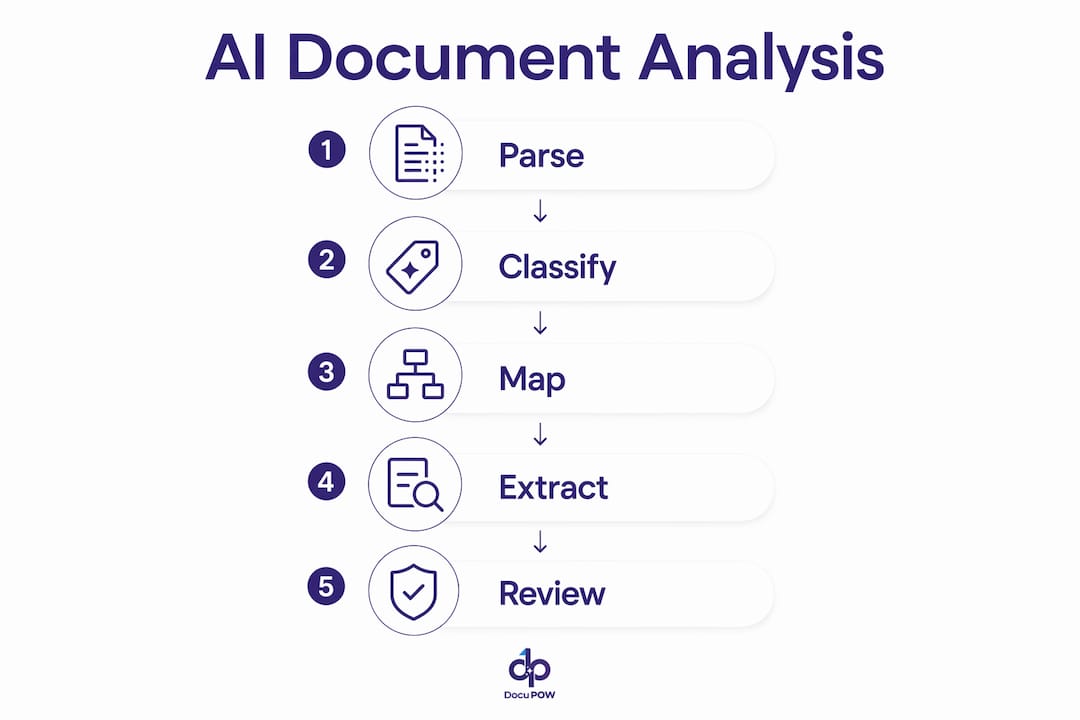
Character-level citation ties every AI output back to the exact passage in the source document. Platforms that paraphrase without source pointers force lawyers to re-read the document to verify every claim, which eliminates the time savings the AI was supposed to deliver. Traceability is not a nice feature. It is the condition under which a legal team can actually trust the output.
DocuPOW’s AI integration applies these principles through autonomous agents that understand document context without relying on rigid templates, a practical implementation of the multi-stage, context-aware approach described above.
How DocuPOW handles legal document processing in practice
DocuPOW’s approach starts where most platforms fall short: it does not require pre-built templates to extract data from a document. Its autonomous agents read context directly, which means a novel contract structure does not break the extraction workflow.
Key platform capabilities:
- Template-free extraction: Agents interpret document context rather than matching fields to fixed positions
- Real-time analytics: Legal teams see document status, risk flags, and extraction results as they happen, not in batch reports
- Predictive insights: The platform shifts teams from reactive review to proactive risk identification before issues escalate
- Workflow integration: DocuPOW connects with existing enterprise IT infrastructure, including global manufacturers’ operational systems
- Financial visibility: Extracted data feeds directly into financial reporting, reducing the lag between contract execution and business decision-making
DocuPOW’s real-time analytics and predictive capabilities reduce errors and costs by giving teams the information they need before a problem surfaces. The platform is recognized among the Top 3 Best Automated Document Processing Services in 2026, a distinction that reflects both technical capability and enterprise deployment track record.
For teams managing high volumes of contracts across multiple business units, the combination of template-free extraction and predictive analytics represents a meaningful shift in how legal operations run day to day.
How should legal teams manage the transition to AI document analysis?
Technology adoption in legal is slower than in most enterprise functions, and for good reason. The stakes of a missed clause or a misread obligation are high. A structured change management approach reduces that risk considerably.
Start with a workflow audit before selecting a modern way to manage contracts platform. Map how documents move from receipt to review today, where bottlenecks occur, and which document types consume the most attorney time. That map tells you where AI delivers the fastest return and where human oversight remains non-negotiable.
Training needs to cover two distinct audiences. Attorneys need to understand AI limitations, particularly hallucination risk and the importance of verifying citations against source documents. Non-legal business users who interact with contract outputs need enough context to recognize when a summary requires attorney review rather than direct action. Both groups benefit from AI workflow guidance that is specific to their role rather than generic platform training.
Governance matters as much as training. Establish clear policies on which document types AI can process autonomously, which require attorney sign-off, and how AI outputs are stored and audited. The American Bar Association’s guidelines on AI in legal practice provide a useful framework for firms building these policies. Pilot on lower-stakes document types first, measure accuracy against known outputs, and expand scope as confidence builds. Teams that treat AI adoption as an architectural decision rather than a software purchase tend to see faster and more durable results.
DocuPOW turns legal document complexity into a competitive advantage
Legal teams processing high volumes of contracts, filings, and policies face a real operational problem: the document load grows faster than headcount can. DocuPOW addresses that directly by automating document workflows without requiring your team to build or maintain extraction templates.
Where other approaches require clean, structured input to function reliably, DocuPOW’s autonomous agents handle the messy reality of enterprise document repositories: varied formats, complex clause structures, and multi-document hierarchies. The result is faster extraction, fewer manual corrections, and financial data that reaches decision-makers in hours rather than days. For global manufacturers and multi-entity enterprises managing contract volume across business units, that speed translates directly into better cash flow visibility and fewer compliance gaps. Explore how DocuPOW’s AI automation services fit your document processing workflow, or see the platform applied to high-volume processing at enterprise scale.
Key Takeaways
AI-powered legal document analysis cuts drafting time by up to 72% (lawyers without automation spend up to 56% of their time on drafting) and lets lean teams absorb volume spikes without adding headcount, but only when data quality, pipeline design, and governance are treated as prerequisites, not afterthoughts.
| Point | Details |
|---|---|
| Data quality is the foundation | Poor data quality ranked first among technical challenges in a 2026 systematic review, undermining even well-designed AI systems. |
| 72% faster drafting | Thomson Reuters data shows AI automation reduces first-draft time by up to 72% compared to manual creation, with lawyers without automation spending up to 56% of their time on drafting alone. |
| Volume without headcount | AI-assisted review enabled one legal team to handle a 30% contract volume spike without expanding staff. |
| Multi-stage pipelines reduce errors | Separating classification, evidence mapping, and extraction bounds hallucination risk and improves output traceability. |
| DocuPOW | Recognized among the Top 3 Best Automated Document Processing Services in 2026, DocuPOW uses template-free autonomous agents for enterprise legal document workflows. |
FAQ
What does legal document analysis actually cover?
Legal document analysis covers extraction, classification, validation, and summarization across the full range of enterprise documents: NDAs, commercial agreements, data processing addenda, employment contracts, board materials, regulatory filings, and vendor questionnaires.
Why does data quality matter so much for AI legal review?
A 2026 systematic review ranked data quality as the top technical challenge in legal AI adoption. Duplicates, unreadable scans, and fragmented storage cause AI to analyze irrelevant or outdated documents, producing unreliable outputs.
How do multi-stage pipelines reduce AI hallucinations in contract review?
By separating classification, evidence mapping, and field extraction into discrete steps, the extraction model only processes passages already identified as relevant. This bounds hallucination risk because the AI cannot generate claims from unspecified parts of the document.
What AI techniques handle complex legal interpretation beyond basic NLP?
Neuro-symbolic AI and multi-agent systems integrate symbolic reasoning into probabilistic models, enabling the system to enforce legal hierarchies, resolve conflicting provisions, and handle tasks like distinguishing binding legal holdings from non-binding commentary.
How does DocuPOW differ from template-based document processing tools?
DocuPOW uses autonomous agents that read document context directly, without requiring pre-built templates. This means varied contract structures and novel document formats do not break the extraction workflow, which is a common failure point for template-dependent platforms.
Recommended
See DocuPOW on your documents.
Stop building templates. Start extracting data.