Document Knowledge Graph: 5 Checks for Hybrid GraphRAG
Build a document knowledge graph with hybrid NLP and LLM extraction. Get practical checkpoints for GraphRAG, quality metrics, provenance, and production.


A document knowledge graph is a traceable graph of entities, relations, and provenance extracted from a document corpus, built to support GraphRAG-style multi-hop retrieval. The most practical production pattern is a hybrid pipeline: deterministic NLP extraction for scale, paired with limited LLM verification and schema induction for coverage, so you get structured, auditable retrieval without the full cost of LLM-only extraction.
TL;DR:
- Set chunk sizes at 800 to 1,200 tokens with 50 to 100 tokens of overlap, preserving page and layout metadata for tables, forms, and figures.
- Route only chunks with low parser confidence, dense jargon, or implicit relations to an LLM; deterministic parsing handles routine extraction at scale.
- Cluster entity mentions by embedding similarity, start with a merge threshold between 0.85 and 0.92, then tune it against a labeled sample.
- Attach confidence scores and source spans to every edge, and enforce source document access controls on graph neighborhoods and provenance records.
- RAKG reported 95.91% accuracy on MINE versus 89.71% for a GraphRAG baseline, but validate extraction and downstream question answering on your own documents.
Table of Contents
- Why document knowledge graphs matter for GraphRAG retrieval
- LLM-first, NLP-first, or hybrid: choosing a construction approach
- Building the pipeline: chunking, extraction, consolidation, and indexing
- A minimal developer checklist for prototyping a document knowledge graph
- Measuring quality: metrics, benchmarks, and what the numbers mean for production
- How DocuPOW fits as the extraction and provenance layer
- Connecting a document knowledge graph to your existing systems
- Scaling a document knowledge graph across large, mixed document collections
- Keeping a document knowledge graph secure in corporate environments
- Production pragmatism versus research prototypes
- Get a working extraction and provenance layer running with DocuPOW
- FAQ
- Sources
Why document knowledge graphs matter for GraphRAG retrieval
A vector index answers “what sounds similar to this query.” A knowledge graph answers “what connects to this entity, and through how many steps.” That distinction matters for any question that spans multiple documents or requires reasoning across relationships rather than semantic proximity alone.
GraphRAG formalizes this with several retrieval modes built on top of an extracted entity graph and community summaries: global search for corpus-wide themes, local search for entity-centered questions, DRIFT for a blend of the two, and basic search as a vector-only fallback. Each mode draws on the same underlying graph, just at different scopes.
The practical benefits show up quickly once a document set grows past a handful of files:
- Multi-hop reasoning: a graph lets you answer “which vendors supply parts affected by the recall mentioned in contract X” without the model guessing at an implicit chain.
- Auditability: every edge can carry a pointer back to the sentence or paragraph it came from, so an answer is checkable.
- Community summaries: clustering related entities produces corpus-level summaries that a pure vector store cannot generate on its own.
- Structured queries: once relations are typed, you can run graph queries (shortest path, neighborhood expansion) instead of relying only on similarity search.
Legal discovery, technical documentation spanning multiple product versions, and multi-document research synthesis are the cases where a document knowledge graph clearly outperforms plain retrieval. A single contract clause rarely matters in isolation; what matters is how it connects to obligations defined three documents away; that is exactly the query pattern a graph is built to serve.
LLM-first, NLP-first, or hybrid: choosing a construction approach
The decision that shapes everything downstream is how you extract entities and relations in the first place. Three approaches dominate current practice, and each has a different cost and accuracy profile.
LLM-first extraction prompts a large language model to read chunks and emit entities and relations directly, often with function calling or structured output schemas. It handles ambiguous phrasing and implicit relations well, and it adapts to new domains without retraining. The tradeoffs are real: hallucinated relations, inconsistent entity naming across calls, and a compute bill that scales linearly with document volume. For a corpus in the millions of pages, that cost becomes the binding constraint.
NLP or dependency-parser-first extraction uses tools like SpaCy, spaCy’s dependency parser, or custom rule-based extractors to identify entities and syntactic relations deterministically. It is fast, reproducible, and cheap to run at scale, and it produces identical output for identical input, which matters for auditing. The ceiling is lower on relations that depend on context the parser cannot see, like coreference across paragraphs or implied causality.
Hybrid pipelines run deterministic extraction first, then route a smaller fraction of chunks, typically the ones with low parser confidence or ambiguous entity boundaries, through an LLM for verification and schema induction. Engineering reports on enterprise GraphRAG deployments describe dependency-based pipelines reaching roughly 94% of LLM-generated knowledge graph quality while cutting compute and indexing cost substantially, which is the core argument for hybrid designs in production.
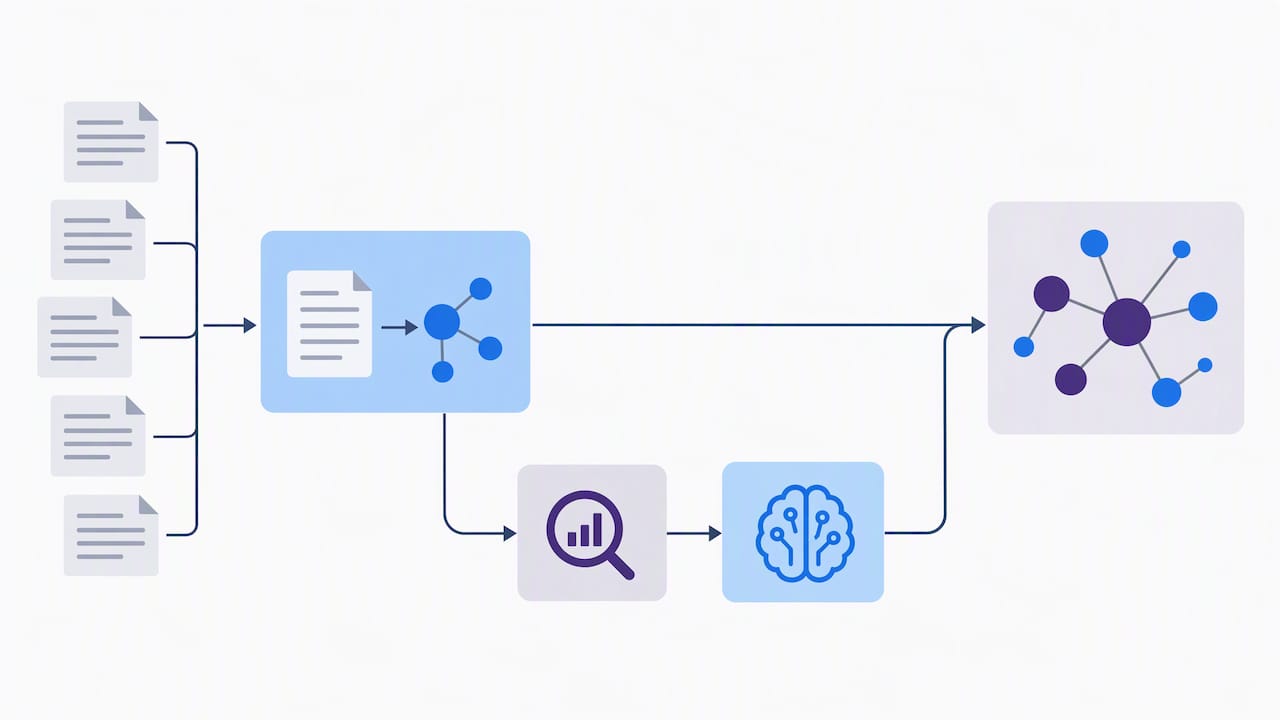
Statistic: Hybrid dependency-parser plus LLM-verification pipelines reach near-LLM extraction accuracy at a fraction of the indexing cost, a meaningful gap when a corpus runs into the millions of pages.
Mapped against the dimensions that matter for a production decision:
| Approach | Cost/compute | Scalability | Traceability | Multi-doc performance |
|---|---|---|---|---|
| LLM-first | High, scales with volume | Limited by API throughput and budget | Depends on prompt discipline | Strong on nuanced relations |
| NLP/dependency-first | Low, fixed per document | High, parallelizes easily | High, deterministic output | Weaker on implicit, cross-sentence relations |
| Hybrid | Moderate, LLM used selectively | High, LLM calls bounded | High, with explicit verification step | Strong, combines both strengths |
For most production teams, hybrid wins on the combination of cost and traceability, which is why it shows up repeatedly in recent systems work rather than as a theoretical compromise.
Building the pipeline: chunking, extraction, consolidation, and indexing
A document knowledge graph pipeline has five stages, and the engineering decisions at each stage determine whether the graph is usable at scale or collapses into noise.
- Chunking. Split documents into passages of roughly 800 to 1,200 tokens with 50 to 100 tokens of overlap, so entities and relations spanning a chunk boundary are not lost. For documents with tables, forms, or figures, preserve layout metadata, page numbers and bounding boxes, rather than flattening to plain text, since that metadata becomes the provenance anchor later.
- Extraction. Run named entity recognition and relation extraction per chunk. SpaCy or a custom extractor handles the bulk of mentions and syntactic relations; route chunks with low parser confidence, dense jargon, or likely implicit relations to an LLM prompt using function calls that return a fixed schema (entity, relation, evidence span).
- Consolidation. Different chunks will mention the same entity with different surface forms. Embed entity mentions, cluster by cosine similarity, and merge clusters above a chosen threshold, often somewhere in the 0.85 to 0.92 range depending on domain vocabulary density. TRACE-KG describes this pattern explicitly: embedding and clustering for canonicalization, followed by constrained LLM-guided resolution for cases the clustering leaves ambiguous, producing a schema that is induced from the data rather than defined upfront.
- Materialization and storage. Store the graph structure, nodes, typed edges, and community assignments, in a graph database or an in-memory graph structure for smaller corpora. Store dense embeddings in a vector database for semantic lookup. Each edge should carry a confidence score and a provenance pointer back to the originating chunk and span; this is the reification pattern that practitioner guidance on provenance recommends for anything that will face human review later.
- Indexing and retrieval heuristics. Combine a one-hop traversal from the query’s matched entities with a vector-based re-ranking pass on candidate subgraphs. This hybrid retrieval, graph structure for reach, vector similarity for relevance ranking, tends to outperform either method alone on multi-document questions.
Pro Tip: Keep a compact graph skeleton for one-hop traversal and a lightweight bipartite text-keyword graph alongside it; this dual-index pattern keeps global queries affordable without sacrificing local precision, an approach described in hybrid indexing research.
Schema choice runs through all five stages. An ontology-driven schema, defined before extraction, gives you consistent entity types and faster downstream queries, but it breaks on document sets that do not fit the ontology cleanly. A schema-free or induced-schema approach, letting the schema emerge from clustering and LLM-assisted resolution, adapts better to heterogeneous collections at the cost of some upfront unpredictability. Most production systems converge on induced schema with a small set of fixed top-level types (person, organization, date, monetary amount) and open-ended relation types that get consolidated during the clustering step.
A minimal developer checklist for prototyping a document knowledge graph
The fastest path to a working prototype follows a straight line: ingest, parse layout, chunk, extract, consolidate, index, query. Each step maps to a small, swappable component, which matters because you will want to replace pieces as you learn what your document set actually looks like.
A minimal generic stack looks like this:
- Tokenizer and encoder: any sentence-transformer or OpenAI-compatible embedding model for chunk and entity embeddings.
- Extractor: SpaCy for dependency parsing and baseline NER, with a custom extractor or LLM function-calling step for relations the parser misses.
- Vector store: a dedicated vector database for embedding lookup, separate from the graph store.
- Graph store: a graph database for production, or an in-memory adjacency structure (a Python dict of nodes and edges works for prototypes under a few thousand documents).
- Verification layer: an LLM call gated to low-confidence extractions only, not the full corpus.
Concrete thresholds worth starting from: chunk size of 800 to 1,200 tokens, overlap of 50 to 100 tokens, embedding dimension matched to whatever model you pick (384 or 768 dimensions cover most open-source sentence encoders), and an entity-merge similarity threshold starting around 0.88, tuned against a small labeled sample before you scale up.
Operationally, three habits save significant rework later:
- Batch and stream. Process documents in batches for the initial backfill, then switch to incremental, streaming indexing for new documents so the graph never needs a full rebuild.
- Sample for QA. Pull a random sample of extracted triples each week and have a human reviewer check them against the source span; this catches drift in extraction quality before it compounds.
- Version your schema. Even an induced schema changes as new document types arrive, so track schema versions alongside the graph data to avoid silent incompatibilities.
Pro Tip: Start with a single document type and a few hundred files. Measure extraction precision by hand before scaling the pipeline to the full corpus; thresholds tuned on a small sample rarely transfer cleanly to a messier, larger one without adjustment.
Measuring quality: metrics, benchmarks, and what the numbers mean for production
A document knowledge graph is only as useful as its measurable accuracy, and three axes matter: node and edge precision and recall against a labeled sample, topology coverage (does the graph capture the relations a human reader would expect), and downstream task performance, usually measured as QA accuracy or mean reciprocal rank on retrieval tasks built from the graph.
Statistic: RAKG reports 95.91% accuracy on the MINE dataset, compared with 89.71% for a GraphRAG baseline, a gap of roughly 6.2 percentage points that suggests retrieval-informed, LLM-augmented construction can meaningfully improve knowledge graph construction accuracy over a purely graph-extraction baseline.
That result is encouraging, but it comes from a specific benchmark and construction method, so treat it as evidence that the approach is promising rather than a guarantee that it transfers unchanged to your document set. A few things to check before trusting an academic figure in production:
- Confirm the evaluation task matches your use case. Accuracy on a QA benchmark does not automatically mean the underlying graph is complete or well-typed.
- Run sample-based human verification on your own extracted triples rather than assuming a published number applies.
- Use downstream QA metrics as a gate, not just construction-time precision, since a graph can look clean structurally and still fail to answer real questions well.
- Check provenance coverage separately: a graph can score well on accuracy while still missing evidence spans that a reviewer would need to trust the output.
How DocuPOW fits as the extraction and provenance layer
We built our platform as a template-free, agentic extraction layer that reads unfamiliar document layouts without a rigid schema, which maps directly onto the extraction and consolidation stages a document knowledge graph pipeline needs. Our human-in-the-loop auditing gives you the verification step that hybrid pipelines rely on, and API access lets you push incremental updates into a graph as new documents arrive rather than rebuilding from scratch. Real-time analytics and predictive insights sit on top of the same extracted data, which is useful once the graph is feeding more than retrieval.
Connecting a document knowledge graph to your existing systems
A document knowledge graph rarely stands alone. The practical integration points are an ERP or CRM feeding structured records that the graph should reconcile against, a vector database already in use for other retrieval tasks, and whatever orchestration layer runs your LLM calls today.
The cleanest integration pattern treats the graph as an additional index alongside your existing data layer rather than a replacement for it. Entity resolution against ERP master data, for instance, lets you match a “Supplier A” mentioned in a contract to the exact vendor record in your procurement system, turning a document-only insight into something a finance or operations team can act on directly. API-based incremental updates matter here: a graph that only refreshes on a nightly batch job will lag behind a live ERP feed, so streaming updates as documents arrive keeps the two systems aligned.
For teams already running a GraphRAG-style retrieval layer, the graph becomes the connective tissue between unstructured document content and structured business systems, which is the integration case most enterprise deployments are actually solving for. Our knowledge discovery resources and enterprise knowledge base guidance go deeper on how extracted document data flows into these downstream systems.
Scaling a document knowledge graph across large, mixed document collections
Scale breaks a document knowledge graph in predictable ways. Entity resolution gets harder as vocabulary diversity grows across document types, a scanned invoice and a legal brief describe entities very differently. Indexing cost grows with graph size, and a naive one-hop traversal over a graph with millions of nodes becomes slow without a compact skeleton index.
The practical fixes map to each failure point:
- Heterogeneous formats: separate extraction pipelines per document type (scanned forms, structured PDFs, plain text) that converge on a common entity schema downstream, rather than one extractor forced to handle everything.
- Entity resolution at scale: tiered merging, cheap embedding-based clustering first, LLM-based disambiguation only for the ambiguous remainder, keeps cost bounded as volume grows.
- Indexing cost: a dual-index pattern, a compact graph skeleton for traversal plus a lightweight bipartite text-keyword graph for broader coverage, keeps global queries affordable even as the full graph grows large.
- Incremental growth: streaming updates with periodic consolidation passes avoid the need for full graph rebuilds as new documents arrive continuously.
Heterogeneity is less a single problem than a compounding one: each new document type adds vocabulary the schema has not seen, which is exactly why an induced-schema approach tends to age better than a fixed ontology once a collection grows past a handful of document types.
Keeping a document knowledge graph secure in corporate environments
A document knowledge graph often contains more sensitive detail than the documents it was built from, because relations between entities can expose connections that no single source document states outright. That makes access control and data handling a first-class design concern, not an afterthought.
Encryption at rest and in transit for both the graph store and the vector store is the baseline. Beyond that, access control should operate at the subgraph level where possible, so a user querying the graph only retrieves neighborhoods tied to documents they are already permitted to see, mirroring the access rules of the source document management system rather than granting blanket graph access.
Provenance data, the evidence spans and source pointers attached to each edge, needs the same access controls as the source documents themselves, since a reification record effectively repeats the sensitive content it points to. For regulated industries, audit logging on graph queries matters as much as logging on document access, since a well-constructed graph can let a user infer information they were never granted direct access to by combining permitted fragments.
Our document lifecycle governance guidance covers the broader governance patterns that apply equally to a knowledge graph built from the same document set.
Production pragmatism versus research prototypes
Most document knowledge graph research optimizes for benchmark accuracy on a fixed dataset. Production engineering optimizes for something different: predictable cost, auditable output, and graceful degradation when extraction gets something wrong. Those goals pull in different directions, which is why a paper’s reported accuracy rarely survives contact with a messy, growing document set.
Choose hybrid extraction by default, reserve LLM-first for small, high-value document sets where cost is not the constraint, and roll out incrementally with human review sampling and SEO guidance before trusting the graph for anything consequential. Measure downstream QA performance, not just construction-time precision, because that is the number that tells you whether the graph is actually useful.
— Syed Naveed Abbas
Get a working extraction and provenance layer running with DocuPOW
If the pipeline above sounds right but the extraction and consolidation stages are the part you would rather not build from scratch, that is the layer we focus on. Our agentic, template-free extraction reads document layouts without a predefined schema, so new document types do not require new extraction rules before they can feed your graph.
What this looks like in practice:
- Template-free extraction adapts to unseen layouts without manual setup for each new document type.
- Human-in-the-loop auditing gives you the verification checkpoint a hybrid pipeline needs before data reaches your graph.
- API access for incremental updates keeps a live graph in sync with new documents as they arrive, rather than waiting on batch rebuilds.
- Conversational querying with source citations gives you a provenance trail that lines up with the reification practices a production graph needs.
Our Starter plan runs $99 per month, and Professional runs $499 per month; Enterprise pricing is available on request through the same page. Check current plan details and trial options to see which tier fits the document volume you are working with.
FAQ
What is a document knowledge graph used for?
A document knowledge graph structures entities, relations, and their source evidence extracted from a document corpus, so retrieval systems can answer multi-hop questions that span several documents rather than relying on similarity search alone. It is the structural backbone behind GraphRAG-style retrieval, supporting local, global, and hybrid query modes.
How do you build a knowledge graph from documents?
The core pipeline chunks documents, extracts entities and relations with NLP tools or LLM prompts, consolidates duplicate mentions through embedding clustering, and materializes the result into a graph database with provenance attached to each edge. A hybrid approach, deterministic extraction paired with selective LLM verification, tends to balance cost and accuracy better than either method alone, according to engineering reports on enterprise GraphRAG deployments.
Is LLM-based extraction more accurate than NLP-based extraction?
LLM-based extraction handles ambiguous and implicit relations better, but dependency-parser pipelines can reach roughly 94% of LLM-generated knowledge graph quality at a fraction of the compute and indexing cost. For most production use, a hybrid pipeline captures most of the accuracy gain without the full cost of LLM-only extraction.
What is the RAKG benchmark result and why does it matter?
RAKG reported 95.91% accuracy on the MINE dataset, compared with 89.71% for a GraphRAG baseline, suggesting that retrieval-informed, LLM-augmented construction can improve knowledge graph accuracy over a standard graph-extraction baseline. The result comes from one benchmark and construction method, so production teams should still validate against their own document set before assuming the improvement transfers directly.
Can DocuPOW feed an existing GraphRAG pipeline?
Our platform extracts structured data from documents without requiring a predefined template, and our API supports incremental updates, which fits the extraction and provenance layer a GraphRAG pipeline needs upstream of graph construction. Pricing starts at $99 per month for the Starter plan, with Professional at $499 per month.
Recommended
See DocuPOW on your documents.
Stop building templates. Start extracting data.