FedRAMP Document Processing: What Applies and How to Vet
What FedRAMP means for document processing: when authorization is required, which controls and records matter, and how to check a service before it touches federal files.


FedRAMP document processing means running federal information (invoices, contracts, forms, case files) through a cloud service that has been assessed under the Federal Risk and Authorization Management Program. If a cloud service creates, collects, processes, stores or maintains federal information on behalf of an agency, FedRAMP generally applies. The practical task for finance, procurement, legal, IT and compliance teams is to confirm the scope, confirm the specific offering is certified, and then prove that the document workflow around it (access, logging, integrations, human review) behaves the way the paperwork says. This guide walks through each step, and shows where DocuPOW’s approach to template-free extraction, audit review and secure integration fits that work.
TL;DR
- FedRAMP applies to cloud services that handle federal information on behalf of an agency, and each agency decides applicability based on its own use case and risk.
- Certification attaches to a named cloud service offering, so you verify the exact product and version, not the vendor’s brand.
- The 2026 Consolidated Rules rename authorization to certification and use classes B, C and D in place of Low, Moderate and High, with initial certification expected from January 1, 2027.
- Controls come from NIST SP 800-53 Rev 5, and logging, access control and every API connection to your document workflow need to be documented, not just promised.
- A document platform with human-in-the-loop review, schema validation and API integration gives your auditors the evidence trail that FedRAMP-style oversight asks for.
Table of Contents
- What FedRAMP document processing covers
- The 2026 changes in plain terms
- What a certification package contains
- How to check a service before it touches federal documents
- FIPS and FedRAMP are not the same thing
- Where the document workflow itself decides the outcome
- A worked example: supplier invoices on a federal contract
- Perspective
- Pricing and getting started
- FAQ
- Sources
What FedRAMP document processing covers
FedRAMP is the federal program that standardizes security assessment and continuous monitoring for cloud services used by agencies. Document processing is squarely inside its reach when the service reads, extracts, indexes or searches documents that belong to an agency.
FedRAMP’s own scope guidance gives a clear example: when an agency uses a shared cloud service to index and search internal repositories holding non-public federal information such as documents, emails and databases, the service is collecting, processing and maintaining that information on the agency’s behalf, so FedRAMP authorization is required. The governing policy, OMB memo M-24-15, says agencies must apply FedRAMP when acquiring cloud services that create, collect, process, store or maintain federal information, unless the service meets specific exclusion criteria. Each agency determines applicability from its own implementation, use case and risk profile.
The same guidance lists what falls outside: widely available services that provide commercially available information without collecting federal information, with document and address verification services named as examples where FedRAMP does not apply. The dividing line is whose data is being processed, not whether the word “document” appears in the product description.
Who needs it in practice
Federal agencies are the buyers who require it. Agency policies can be strict: the Department of Energy’s January 2025 response to M-24-15 states that under DOE Order 205.1D, all cloud services used by DOE organizations need a FedRAMP Authorization to Operate, and using a non-approved product is a policy variance that needs documented justification and sign-off from the authorizing official.
For contractors, integrators and suppliers who handle agency paperwork, the effect is the same: the agency will ask which cloud services touch its documents and whether each one is covered. Finance and procurement teams that process purchase orders, invoices and vendor records for federal work, legal teams reviewing contracts, and healthcare or insurance organizations serving federal programs should settle this question before a document workflow goes live.
The 2026 changes in plain terms
FedRAMP’s rules changed in 2026, so older guides can mislead. The official launch of the FedRAMP Consolidated Rules for 2026 is recorded as June 24, 2026. Two changes matter most to a document workflow.
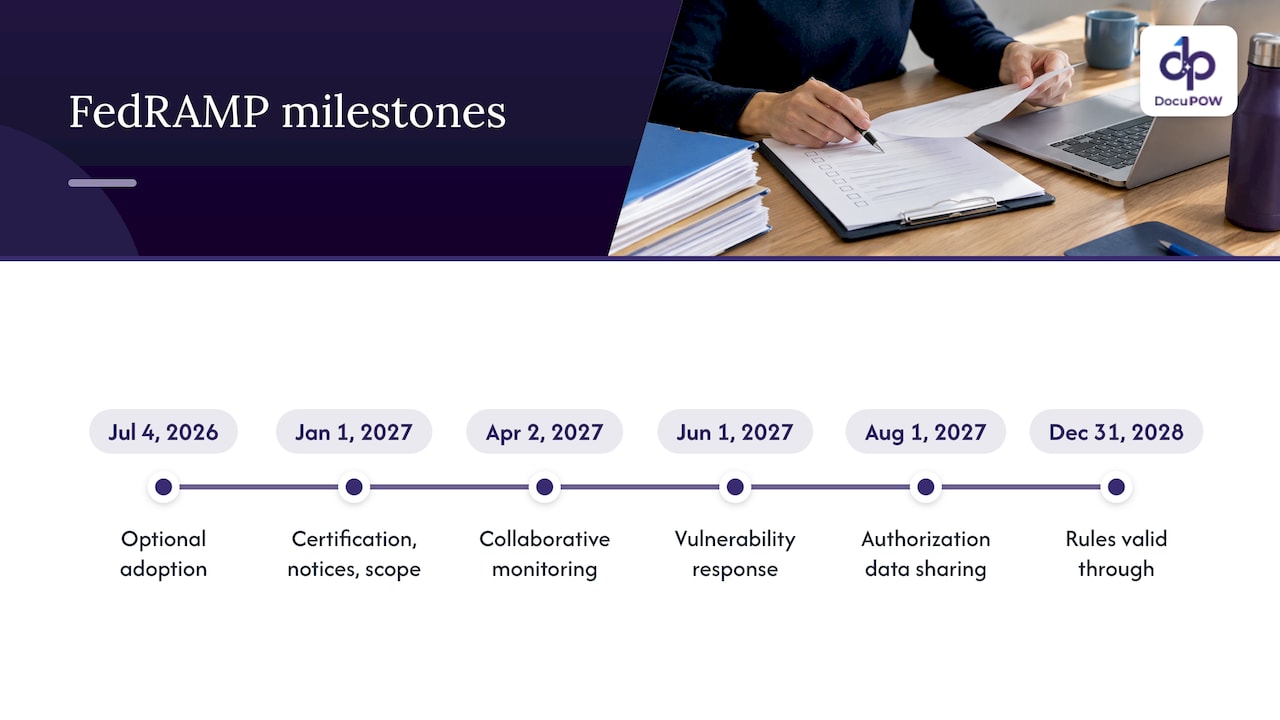
New vocabulary. “Authorization” is now “Certification,” and impact levels are replaced by classes. Under the Rev5 track, Class B corresponds to Low, Class C to Moderate and Class D to High. The reference timeline on FedRAMP’s Rev5 Class B certification page shows optional adoption allowed from July 4, 2026, and initial certification plus ongoing certification expected from January 1, 2027, with a grace period that ends on the first independent assessment started after that date.
Machine-readable evidence. Providers must supply information as JSON documents valid against FedRAMP’s schemas, intended for consumption by FedRAMP and agency governance, risk and compliance tools. According to FedRAMP’s RFC-0024 outcome, comprehensive machine-readable authorization data is required only for Class D, while Classes B and C provide some machine-readable data, mostly semi-structured text. The same notice lists 2027 milestones, including Significant Change Notifications and Minimum Assessment Scope from January 1, Collaborative Continuous Monitoring from April 2, Vulnerability Detection and Response from June 1 and Authorization Data Sharing from August 1, and says the 2026 rules are valid through December 31, 2028.
Schedules like these can shift, so confirm the current dates on fedramp.gov before you plan a rollout around them.
What a certification package contains
Before you evaluate a document platform you should know what its package is supposed to hold. Per the FedRAMP CSP Authorization Playbook (November 2025), the package includes:
| Document | What it tells you |
|---|---|
| System Security Plan (SSP) | The security blueprint: the authorization boundary and the controls protecting confidentiality, integrity and availability of federal data. Appendices A through Q |
| Security Assessment Plan (SAP) | How the independent assessor will test the controls. Appendices A through D |
| Security Assessment Report (SAR) | What the assessor found. Appendices A through F |
| Plan of Action and Milestones (POA&M) | Open findings and the dates for closing them |
| Agency ATO | The signed federal agency authorization to operate |
The controls come from NIST SP 800-53 Revision 5, grouped into families such as Access Control, Configuration Management, Incident Response, Risk Assessment and System and Information Integrity. For a document pipeline, two families deserve the most attention. Access control (AC-01 through AC-22) decides who and what can open a file. Audit and accountability (AU-02 through AU-12) covers event logging, retention of audit records and protection of audit information, which the 2026 Consolidated Rules require Rev5 Class B providers to address in their Security Decision Record.
Here is the point most guides skip. FedRAMP’s control guidance stresses that controls are not a static checklist: each one must connect to real system behavior, with repeatable processes, assigned responsibilities, current evidence and a way to detect when the implementation drifts from the certified system. A document workflow is exactly where drift happens, because new document types, new vendors and new integrations arrive constantly.
How to check a service before it touches federal documents
FedRAMP’s agency guidance gives a sequence you can follow. Here it is, applied to a document-processing purchase.
Step 1: Confirm the use is in scope
Write down which documents the service will see and whose they are. If they include non-public federal information, assume FedRAMP applies and let the agency make the final determination. FedRAMP’s scope page lists questions to ask, including whether the service will integrate with enterprise security services such as identity and access management, SIEM, single sign-on or secure access service edge, and whether multiple agencies or third parties will use it.
Step 2: Verify the exact offering
Certification belongs to a named cloud service offering, not a company. When the FedRAMP program office confirms that an offering meets requirements and approves it for the Marketplace, the offering is considered authorized. That status is not an endorsement: it establishes that the security posture has been assessed and is presumptively adequate for federal use. A vendor’s commercial product and its certified government offering can be different things, so match the product name, version and deployment to the Marketplace listing.
Step 3: Read the package for your use
Agencies are told to review the provider’s certification package: certification type and class, inherited controls, provider responsibilities, secure configuration guidance and ongoing certification data. Then they document their own use in their own system authorization instead of copying the provider’s package. The SSP should focus on what the agency implements, configures, operates or inherits.
Step 4: Account for every integration
This is where document workflows get tangled. Extraction feeds an ERP, the ERP feeds a payment system, a search layer feeds a chatbot. FedRAMP’s boundary guidance says all interconnections, APIs and external services that could transmit federal data and metadata must be disclosed to the authorizing official, including the extent to which federal information can be affected. Metadata counts too: both data describing tenant activity and information in logs, audit trails and vulnerability reports must be accounted for, protected and documented.
Build an integration inventory with one row per connection: source system, destination, data fields moved, authentication method, log location. It is tedious by hand, and it is the document an authorizing official will ask to see first.
Step 5: Configure, then keep monitoring
Agencies should configure the service securely, covering identity, logging, monitoring, data protection, incident response, records and privacy, then review ongoing certification reports, vulnerability information and quarterly reviews at intervals that fit the system’s risk. Certification is a starting point, and the evidence has to keep coming.
FIPS and FedRAMP are not the same thing
The question comes up constantly. FedRAMP is a program for assessing and monitoring cloud services. FIPS publications are federal standards that the program uses as inputs. In particular, providers determine the security categorization of data using the FIPS 199 categorization template (SSP Appendix K) together with NIST SP 800-60. That categorization sets the baseline. One assessor’s guide puts the base control counts at 156 for Low, 323 for Moderate and 410 for High, built around confidentiality, integrity and availability. A FIPS-validated component inside a product does not make the product FedRAMP certified, and a certified product still has to be configured correctly by you.
Where the document workflow itself decides the outcome
A certification covers the cloud environment. Whether your invoices, contracts and forms move through it safely depends on the workflow you build on top, and that is where most internal findings arise.
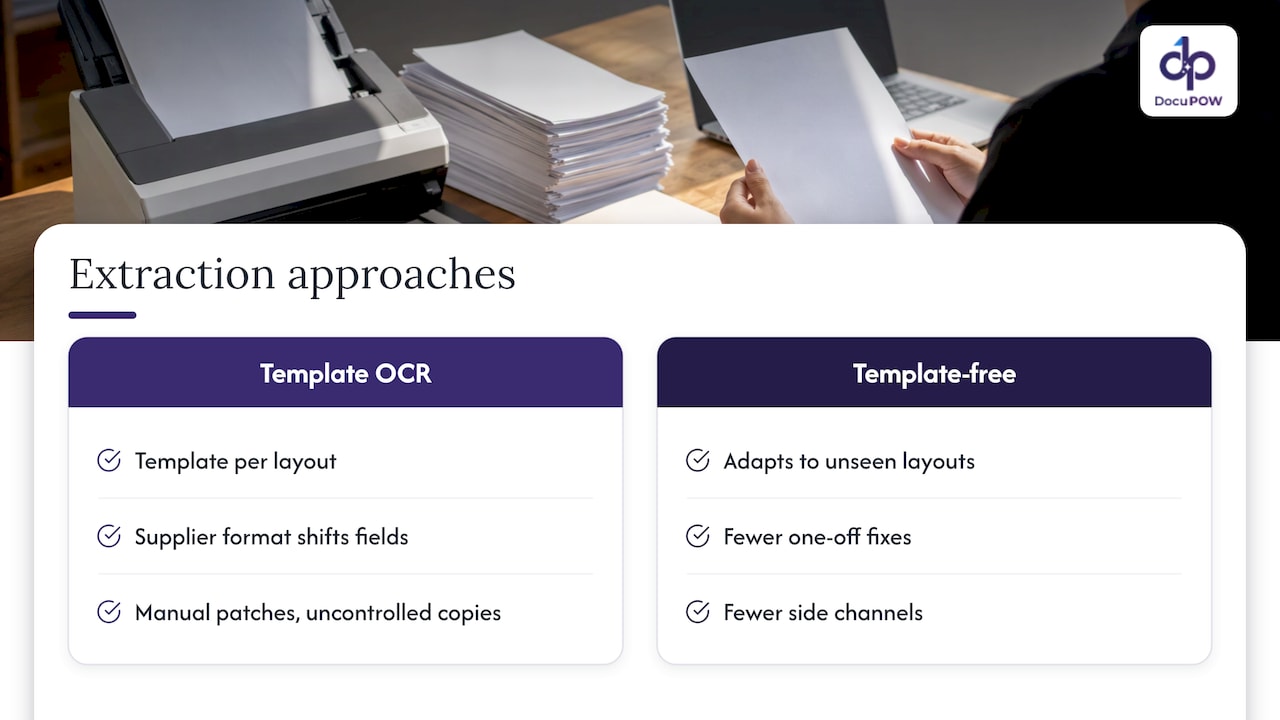
Template-based extraction breaks quietly. Older OCR setups depend on a template per layout. When a supplier changes its invoice format, fields shift or vanish, and someone patches it by hand, often with an uncontrolled copy of the file. DocuPOW’s extraction is template-free: it is designed to adapt to document layouts it has not seen before, which means fewer one-off fixes and fewer side channels where documents leak out of the controlled path. You can see how it works on the zero-shot extraction page.
Validation belongs before the database. DocuPOW enforces strict schema validation, so a value that does not fit the expected structure is stopped before it reaches a core system. For audit purposes that is a control with observable behavior, which fits FedRAMP’s insistence on controls tied to real system behavior.
Human review needs a record. Human-in-the-loop audit review lets a person approve or correct uncertain extractions, and the review step gives you a documented point of accountability. Our guide to document exception handling shows how to route, review and resolve those cases.
Integrations need a clean boundary. DocuPOW connects to ERP and CRM systems through an API and offers developer tools, so the connection list for your boundary inventory is one you design deliberately rather than discover later. Platform details are on the platform page.
Controls should map to a framework you can name. Our resource on NIST-aligned controls for secure AI processing covers seven controls compliance teams can use to organize their evidence, and our security overview describes the bank-grade encryption and cloud-native architecture behind the platform. For a broader view, see the document security guide.
Evidence for contracts and data protection
A document platform processes your data under an agreement, and the agreement should match your control environment. For the contract side, this overview of vendor DPA requirements lays out what a data processing agreement should cover and the evidence a provider prepares for an assessment.
A worked example: supplier invoices on a federal contract
Imagine a contractor’s accounting team processing 2,000 supplier invoices a month for a federally funded program. Invoices arrive as PDFs in dozens of layouts. The team’s checklist might look like this:
- Classify the data: invoices tied to the program may carry non-public federal information, so the agency’s applicability decision comes first.
- Name the offering that will read the files and confirm its Marketplace listing and class.
- List every connection: email intake, extraction, ERP posting, approval workflow, archive.
- Define who reviews low-confidence extractions and where that review is logged.
- Set a quarterly check of the provider’s ongoing certification information.
Steps 3 and 4 are where a template-free, agent-based platform with built-in review saves the most manual effort, because there is one pipeline to describe instead of a patchwork of scripts, templates and spreadsheets.
Perspective
We see FedRAMP as a discipline for tracing every document from intake to database, and that is also how we build. A scanner that reads a page is the easy part. The hard part is knowing, for every field that lands in a core system, where it came from, who or what checked it and what happened when it did not fit.
That is why DocuPOW pairs template-free extraction with schema validation and human-in-the-loop audit review, and why we describe conversational document querying with transparent source citations: an answer that points back to its source page is an answer an auditor can follow.
Teams that treat compliance as a document of record stored in a binder fall behind the moment a new supplier format arrives. Teams that tie each control to system behavior keep pace. We built our platform for the second kind of team.
Syed Naveed Abbas
Pricing and getting started
DocuPOW is a subscription platform. The Starter plan is $99 per month and the Professional plan is $499 per month, and Enterprise pricing is arranged with us. Additional credits are available on Starter and Professional. Teams with integration and compliance requirements can review the plans on the pricing page and see how the platform handles extraction, orchestration and review in one place.
If your documents come from procurement, finance, legal or operations queues, the operations solutions page shows how multi-step workflows are put together.
FAQ
Who needs FedRAMP authorization?
Federal agencies must apply FedRAMP when they acquire cloud services that handle federal information on their behalf, unless an exclusion applies. Vendors and contractors feel the requirement through agency purchasing. Each agency decides applicability from its own use case and risk profile.
Is FIPS the same as FedRAMP?
No. FedRAMP is the program that assesses and monitors cloud services, while FIPS publications are federal standards it draws on. FIPS 199, for example, is used to categorize data, and that categorization determines the control baseline.
Does FedRAMP certify a company or a product?
A named cloud service offering. A vendor can have more than one product, and only the certified offering is covered. Check the listing against the exact service and version you plan to use.
What changed in 2026?
The Consolidated Rules for 2026 launched on June 24, 2026. They rename authorization to certification, use Classes B, C and D in place of Low, Moderate and High, and call for machine-readable evidence. Initial certification is expected from January 1, 2027, so confirm current schedules on fedramp.gov.
Sources
- FedRAMP RFC-0010 Scope Interpretation Technical Assistance
- DOE Response to OMB M-24-15, January 2025
- FedRAMP Rev5 Class B certification reference
- FedRAMP Certification, Consolidated Rules for 2026
- Initial Outcome from RFC-0024 Rev5 Machine-Readable Packages
- FedRAMP CSP Authorization Playbook
- Rev5 Control Guidance, Consolidated Rules for 2026
- Using a FedRAMP Certified Cloud Service
- Scope of FedRAMP, Consolidated Rules for 2026
- The FedRAMP Authorization Process
- FedRAMP Authorization Boundary Guidance
- Rev5 Agency Authorization
- What to Expect From a FedRAMP Moderate Assessment
Recommended
See DocuPOW on your documents.
Stop building templates. Start extracting data.