Real-Time Financial Visibility: How to Get It Right
Real-time financial visibility depends on how fast documents become trusted data. Learn what to connect, what to track, and how to close the gaps.


Real-time financial visibility means you can answer the questions that matter, such as how much cash you have, what is owed and what is coming, from data that is current, not from last month’s close. Most guides start with dashboards and bank feeds. The harder gap is upstream: invoices, purchase orders, contracts and remittances arrive as PDFs, scans and emails, and a number cannot be live until someone or something has turned those pages into validated data. That is the layer DocuPOW is built for, with template-free extraction that feeds your ERP directly.
TL;DR
- Visibility is not faster reporting. Reporting tells you what happened; visibility tells you what is happening and what is likely next.
- Dashboards only show what has been posted. Invoices waiting in approval, unmatched receipts and unread contracts are invisible until their documents become data.
- In the FIS Cash Management Report, U.S. finance teams spend an average of 17.3 hours a week gathering, reconciling or validating cash data.
- The fix is fewer disconnected systems and less manual work: automated capture, validation, ERP integration and clear data definitions.
- Start with one document flow, such as accounts payable, prove it, then expand.
Table of Contents
- What real-time financial visibility actually means
- Why dashboards go stale: the document gap
- What it costs when visibility lags
- What needs to be connected
- Which numbers to watch in real time
- A practical path to a live view
- Data quality, security and access
- Start with one flow on DocuPOW
- FAQ
- Sources
What real-time financial visibility actually means
The phrase gets used loosely, so it helps to separate three ideas.
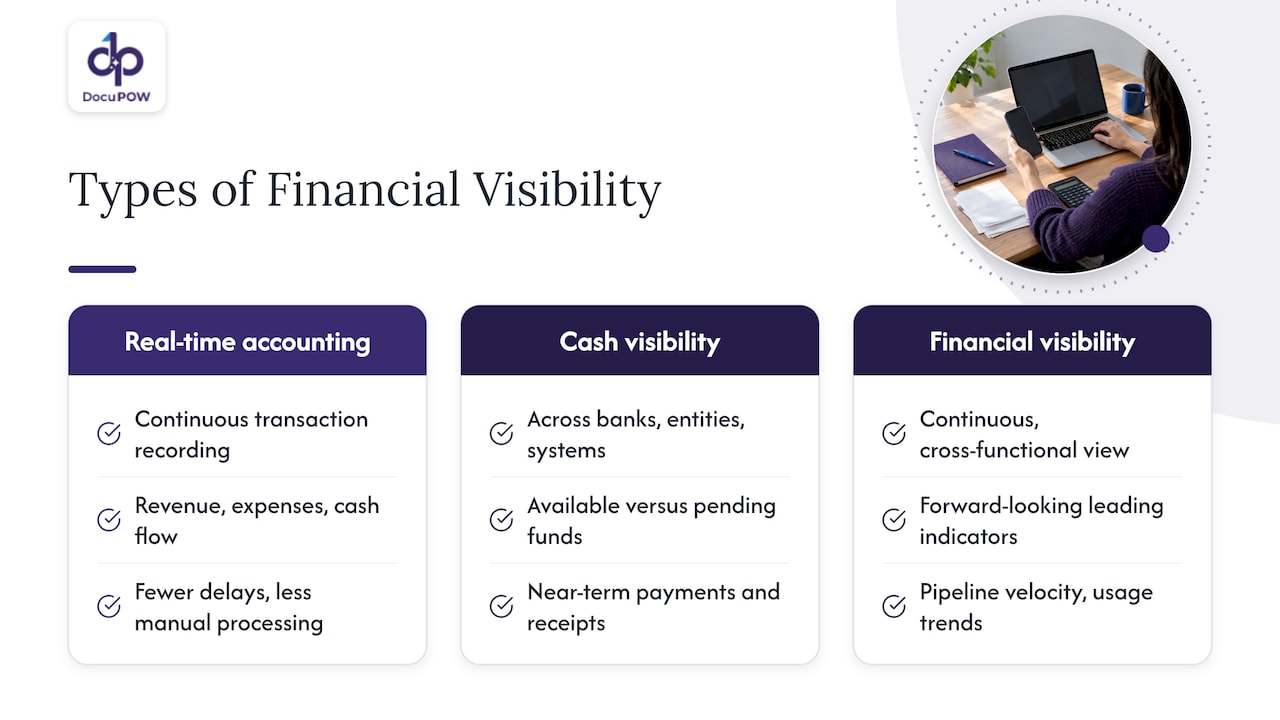
Real-time accounting is the continuous recording of transactions as they happen. Sage describes it as giving near-instant visibility into revenue, expenses and cash flow. It does not mean every number is final every second. It means the system stays updated with fewer delays and less manual processing.
Cash visibility is narrower. Stripe defines it as a real-time view of cash positions across every bank account, legal entity and financial system. It has two parts: the current position (available versus pending funds) and near-term movement, such as scheduled payouts, customer payments, payroll, vendor bills and tax payments.
Financial visibility is the broadest. PIF draws the line this way: reporting is finance-owned, period-based and backward-looking, while visibility is continuous, cross-functional and forward-looking, built on leading indicators like pipeline velocity and usage trends. The cost of confusing the two is decision latency: you get an accurate answer after the decision has been made.
That is also why “real-time financial reporting” is a slightly misleading goal. A report is a snapshot. What you want is a live view that you can trust, and that depends on what feeds it.
Why dashboards go stale: the document gap
A dashboard built on general ledger extracts can only show posted transactions. Finaisse’s Kris Subramanian points out that unapplied receipts, invoices stuck in approval, unexplained intercompany differences and unbooked disputes are operational state that lives outside the reporting layer.
Most of that operational state starts life as a document:
- A vendor invoice that arrives by email and waits in an inbox.
- A purchase order or delivery receipt that has to be matched to it.
- A customer remittance advice that explains which invoices a payment covers.
- A contract amendment that changes payment terms.
Until each of these is read, checked and keyed into a system, your liabilities are understated, your forecast is blind to upcoming payments and your cash position is incomplete. The delay is not in the dashboard. It is in the typing.
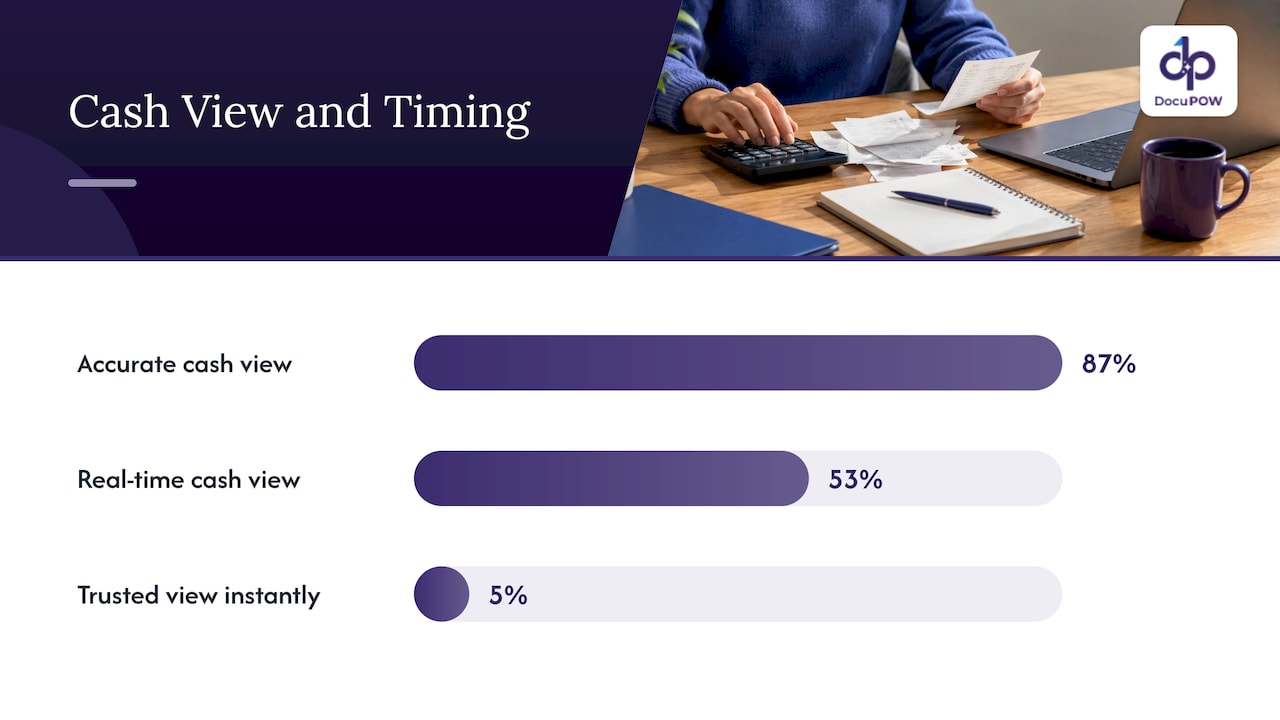
The numbers support this. The FIS Cash Management Report finds that in the U.S., 87% of finance leaders report having an accurate view of cash, but only 53% can produce one in real time. Teams spend an average of 17.3 hours per week gathering, reconciling or validating cash data, and only 5% can produce a trusted view instantly. Confidence in the view and the ability to produce it quickly are two different things, and the hours are mostly spent on the manual work between a document and a record.
What it costs when visibility lags
Numeric warns that poor cash flow visibility raises the likelihood of overdrafts, covenant breaches, late payments and emergency borrowing. The direct costs are fees and unfavorable terms, and there is added legal and audit risk, since regulators, lenders and auditors expect timely, well-supported representations of cash and liquidity.
Forecasting suffers in a quieter way. Stripe notes that a 13-week cash forecast that counts pending payouts as available is wrong on the first day, and the error compounds each week. The same logic applies to documents: a forecast that does not know about the invoices sitting in someone’s queue starts from a wrong baseline.
When visibility is good, Stripe lists the payoffs: better liquidity management through sweeps or cash pooling, forecasts that start from accurate opening balances, a faster month-end close, and decisions like whether an early-payment discount is worth the hit to your cash buffer.
What needs to be connected
A live view is an integration problem before it is an analytics problem. A treasury best-practices guide describes a cash position as built from several feeds: prior-day balances downloaded from banks, intraday bank reporting via API, SWIFT or ETL, expected payables and receivables pulled directly from the ERP through dynamic APIs, and open treasury transactions.
In practice, you are connecting four kinds of data:
| Data | Where it starts | What makes it late |
|---|---|---|
| Bank balances and transactions | Bank portals, BAI2 and camt.053/camt.052 files | Different balance definitions at different banks |
| Payables | Vendor invoices, POs, receipts | Manual keying, approval queues |
| Receivables | Customer invoices, remittances | Unapplied cash, missing remittance detail |
| Commitments | Contracts, payroll runs, tax notices | Terms buried in documents nobody has read into the system |
Two details deserve attention. First, Stripe notes that ledger, available and collected balances do not mean the same thing at every bank, so definitions matter. Second, KPMG says a consistent finance taxonomy across the enterprise is the backbone of scalable analytics: “cash on hand” must mean the same thing in every ERP and treasury system. The same applies to documents. If one vendor’s invoice calls a field “amount due” and another calls it “balance,” your system needs them normalized before they land in the ledger.
Which numbers to watch in real time
Do not try to watch everything. Practical cash visibility, according to Numeric’s guide, ties together bank balances, open AR, scheduled AP, payroll runs, tax payments, credit facilities and major recurring items into one always-on view, usually across same-day, 7 to 30 day and 13-week rolling horizons.
Agicap suggests a similar shortlist:
- Net cash and net debt, reconciled by group, entity and currency.
- Cash runway and liquidity headroom against covenant limits.
- Working capital measures: days sales outstanding (DSO, how long customers take to pay), days payable outstanding (DPO, how long you take to pay vendors), aging reports and collection efficacy.
Build reports that flex by audience. Treasury4’s Chris Blow advises letting analysts self-serve detail while the CFO sees only the three or four metrics that matter, and using cash flow data rather than only accounting close data so leadership sees liquidity before the books are final.
Notice that several of these metrics, AP scheduling, aging, covenant headroom, are driven directly by documents: invoices, statements and loan agreements.
A practical path to a live view
The steps below move from the bottom of the stack, where delays begin, to the top.
1. Pick the document flow with the most lag
For most finance teams this is accounts payable: invoices arrive in varied layouts, wait for coding and approval, and only then reach the ledger. Measure how many days pass between an invoice arriving and being visible in your system. That gap is your visibility lag.
Manual collation is the usual culprit. A guide to automating invoice processing walks through why moving from typing to automated capture is the first operational change a small finance team can make.
2. Capture data without templates
Template-based OCR needs a configured template per vendor layout, so every new supplier is a setup project and every layout change breaks something. Our platform uses template-free, zero-shot extraction designed to adapt to unseen document layouts, which keeps setup and maintenance low. You can see how that works on our zero-shot extraction page. For finance teams, the practical effect is that a new vendor’s invoice does not wait for someone to build a template.
3. Validate before posting
Speed without accuracy only moves errors into the ledger faster. DocuPOW enforces strict schema validation, and exceptions can be routed to a person through human-in-the-loop audit review, so a doubtful total or a missing PO number is resolved before it becomes a posted transaction. Our guide on document exception handling shows how to route, review and resolve them, and data normalization from documents covers the definitions problem described above.
4. Push straight into the ERP
The treasury guidance above calls for payables and receivables sourced directly from the ERP through APIs. DocuPOW integrates with ERP and CRM systems via API and is designed to execute transactional data streams directly into core databases, so a captured invoice becomes a record without re-keying. Our ERP document integration guide explains how to connect documents to your ERP, and the accounts payable flow shows the process end to end.
5. Report from operational state, not just closed periods
Once documents reach the system within hours, your cash forecast can count approved-but-unpaid invoices and open commitments rather than waiting for the close. Our article on automating operational reporting workflows covers the reporting side.
6. Review forecast against actuals on a rhythm
Agicap recommends daily reconciliation, a monthly forecast-versus-actual review, version-controlled models with granular user permissions, and governance shared among treasury, FP&A, controllers and operations. KPMG adds that you should roll out predictive forecasting by business unit or geography first, then scale.
Data quality, security and access
Live data raises the stakes on governance, because more people see it sooner. Deloitte’s 2026 U.S. treasury report advises prioritizing data governance and data quality over complex AI models, with data quality metrics identified and monitored. U.S. Bank’s Patel puts it plainly: you cannot create strong real-time visibility without data integrity and data integration.
For documents, that means three habits:
- Know the source of every number. Conversational document querying in DocuPOW returns transparent source citations, so a figure can be traced to the page it came from.
- Control who sees what. Financial documents contain bank details and personal data. DocuPOW runs on encrypted, cloud-native infrastructure with bank-grade encryption.
- Keep an audit trail. Human-in-the-loop review gives auditors a record of who confirmed what, which matters because lenders and auditors expect well-supported representations of cash.
Technology alone will not change much. KPMG stresses that advanced tools will not fix an outdated operating model: teams need to redefine workflows so staff spend less time collating and more time analyzing, with training to support the shift.
Our view: visibility starts at the page
Finance teams often come to us after buying a dashboard that still shows old numbers. The dashboard was fine. The data feeding it was late, because the documents behind the numbers were still waiting to be read.
We built DocuPOW on the idea that a document system should behave like a human expert: read the page, understand what it means, check it against your rules and hand the result to the system of record. Template-free extraction means a new supplier does not mean a new project. Schema validation and human-in-the-loop review mean speed does not cost accuracy. API integration means the result lands in your ERP, not in a spreadsheet someone has to re-key.
Compressing the close does not create visibility. Reducing the time between a document arriving and a validated record existing does. That is the structural change worth making first, and it is one a single team can start with one document flow.
Syed Naveed Abbas
Start with one flow on DocuPOW
If your visibility lag begins with invoices, receipts and contracts, DocuPOW covers the path from capture to ERP: template-free extraction, validation, human-in-the-loop review, real-time analytics and AI-powered semantic search across your documents. Plans are published on our pricing page: Starter is $99 per month and Professional is $499 per month, and Enterprise is priced on request. Explore the product overview to see how the pieces fit.
For a closer look at how accounting teams use it, see our invoice data capture solution.
FAQ
What is the difference between real-time financial reporting and real-time financial visibility?
Reporting summarizes closed periods and is optimized for accuracy. Visibility is continuous and forward-looking, optimized for decisions. Reporting can be sped up, but a faster report is still a backward look unless the underlying data, including pending invoices and commitments, is current.
Does real-time mean every number is final?
No. As Sage explains, real-time accounting keeps the system updated with fewer delays and less manual processing, but not every figure is final every second. Use the live view for decisions and the close for the official record.
How can a business improve its financial visibility quickly?
Reduce disconnected systems and manual work. Stripe lists centralized reporting, real-time bank feeds, forecasting tools, automated reconciliation and a defined account hierarchy. On the document side, automating capture and validation of invoices and other financial documents removes the largest delay between an event and a record.
Which metrics should I watch first?
Start with cash position by account and entity, near-term inflows and outflows from open receivables and payables, and working capital measures like DSO and DPO. Keep the executive view to the three or four numbers that drive decisions.
Sources
- What Is Real-Time Accounting? | Sage Advice US
- Cash Visibility: A Guide | Stripe
- Financial reporting is not the same as visibility | PIF
- Real-time financial visibility | Finaisse
- FIS Cash Management Report
- Cash Flow Visibility: A Practical Guide | Numeric
- Cash and treasury best practices
- Predictive Cash Forecasting and Visibility | KPMG
- Cash Flow Forecast Guide 2026 | Agicap
- Data Fluency & Reporting in Treasury | Treasury4
- The transformative potential of AI in treasury | Deloitte
- How Liquidity Visibility Drives Business Growth | U.S. Bank
- How to Automate Invoice Processing | TechMate
Recommended
See DocuPOW on your documents.
Stop building templates. Start extracting data.