The Role of AI in Manufacturing Documents in 2026
<p>Discover the role of AI in manufacturing documents by 2026. Transform error-prone processes into precise, automated workflows for compliance and efficiency.</p>


The role of AI in manufacturing documents is to convert manual, error-prone paperwork into automated, auditable, and accurate workflows that scale across global operations. Intelligent document processing (IDP), the recognized industry term for this technology, combines computer vision, natural language processing (NLP), and agentic AI to ingest, classify, extract, and validate documents with 95%+ extraction accuracy. For manufacturing professionals managing inspection reports, certificates of conformance, work orders, and supplier invoices, this shift is not theoretical. It is operational, measurable, and already delivering compliance advantages that manual processes cannot match.
How does AI-enabled intelligent document processing work in manufacturing?
AI-enabled IDP processes manufacturing documents by layering multiple AI techniques into a single workflow rather than applying one algorithm to every document type. Computer vision reads scanned forms, handwritten inspection sheets, and mixed-format PDFs. NLP interprets the meaning of extracted text, maps it to data fields, and flags anomalies. Agentic AI platforms then route the structured output to downstream systems such as ERP, PLM, or quality management software without human intervention.
The document types IDP handles in manufacturing are wide-ranging:
- Purchase orders and supplier invoices validated against approved vendor databases
- Inspection reports and non-conformance records classified by product line or facility
- Certificates of calibration and training records matched to regulatory requirements
- Work orders and maintenance logs routed to the correct production team
- Bills of materials cross-referenced against engineering change orders
The workflow typically follows a defined sequence. Raw documents enter a pre-processing layer that separates text, handwriting, and diagrams before any AI model touches the content. Confidence scoring then assigns a reliability rating to each extracted field. High-confidence outputs route automatically; low-confidence fields escalate to a human reviewer. This architecture is what allows automation of 70-80% of manual document tasks while keeping human judgment in the loop for edge cases.
Contextual learning improves classification over time. When a reviewer corrects a misclassified document, the model updates its understanding of that document type. Over weeks, the system recognizes facility-specific formats, supplier-specific layouts, and regulatory-specific terminology without requiring template reconfiguration.

Pro Tip: Start IDP deployment on a single, high-volume document type, such as supplier invoices or calibration certificates, before expanding. A focused pilot generates measurable ROI data and exposes pre-processing gaps before they affect critical compliance records.
What is AI’s impact on compliance and audit readiness?
Compliance documentation in manufacturing is where AI delivers its most deterministic value. AI document control produces binary outputs: either a clause complies with the referenced standard or it does not. This removes the interpretive ambiguity that auditors and quality managers spend hours resolving manually.
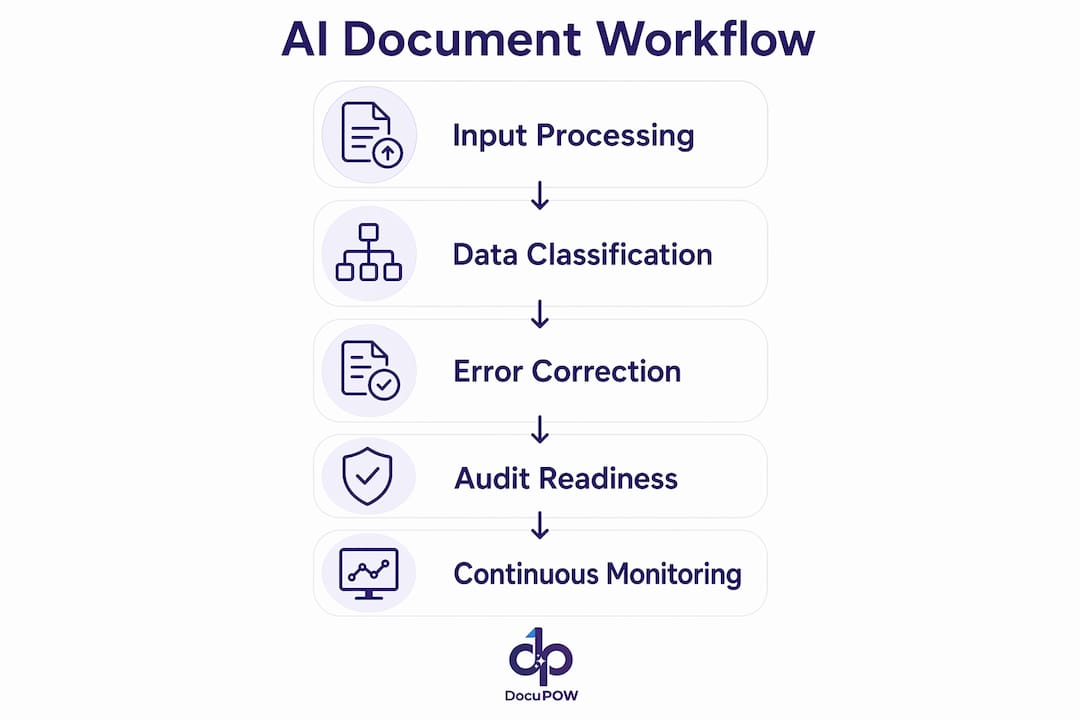
AI-driven compliance systems accomplish the following in sequence:
- Capture and classify incoming compliance documents, including SOPs, HACCP plans, calibration records, and training logs, by regulatory category and revision status.
- Validate procedural usage by cross-referencing active document versions against approved master lists, flagging any outdated procedures still in circulation.
- Monitor continuously by scanning for expiration dates on certifications, training completions, and equipment calibration cycles, then escalating alerts when validations fail.
- Generate audit-ready evidence files organized by regulatory requirement, with clear chains of custody showing who approved each document and when.
“Implementation cycles for AI document control are measured in weeks, not months, and the ROI is visible directly in audit outcomes.” — Quality Digest
The practical impact on audit preparation is significant. Digital structured records replace physical binders, and a query replaces a manual binder pull during an FDA or ISO inspection. Audit nonconformances drop because version control is enforced automatically rather than relying on staff to pull the correct revision. For food manufacturers, pharmaceutical producers, and automotive suppliers operating under strict regulatory frameworks, this capability alone justifies the investment in AI-driven document processes.
AI compliance automation also generates continuous monitoring dashboards that give quality managers real-time visibility into document status across multiple facilities. A calibration certificate expiring in 14 days triggers an alert today, not after the auditor finds it.
What are the risks in AI-driven document workflows?
AI-driven document workflows carry real risks that manufacturing teams must address before full deployment. The most underreported risk is silent content corruption. Frontier large language models corrupt approximately 25% of original document content during prolonged delegated workflows, and this degradation increases with document length and the presence of distracting files. Adding agentic tools does not prevent this problem because it is inherent to transformer architectures.
The table below maps the primary risk categories against their causes and mitigations:
| Risk | Cause | Mitigation |
|---|---|---|
| Silent content corruption | LLM processing of long documents | Separate retrieval from editing; use human diffs |
| Extraction hallucinations | Messy or mixed-format input documents | Pre-processing layer before AI ingestion |
| Misclassification errors | Insufficient training data for document type | Confidence scoring with human escalation |
| Governance failures | No audit trail on AI-generated outputs | NIST AI RMF-aligned policy controls |
| Version control drift | AI editing approved documents without approval | Lock editing behind human approval workflows |
Messy input documents are the second major failure point. A scanned form with handwritten annotations, embedded diagrams, and faded text will produce unreliable extractions if fed directly to an AI model. Document pre-processing that separates text, handwriting, and diagrams before ingestion reduces errors and prevents AI from hallucinating critical fields such as part numbers, lot codes, or approval signatures.
Pro Tip: Treat every document entering your AI workflow as potentially corrupted at the source. Build a pre-processing validation layer that normalizes format, resolution, and structure before any extraction model runs. This single step prevents the majority of downstream accuracy failures.
Human-in-the-loop verification is not optional in manufacturing contexts. When an AI system edits a controlled document, a qualified reviewer must compare the original and the modified version using a diff tool before the change is committed. Digitizing without this governance layer creates a compliance liability, not an advantage.
What are the best practices for implementing AI in manufacturing document management?
Successful AI adoption in manufacturing document management follows a governance-first architecture rather than a technology-first one. Aligning with the NIST AI Risk Management Framework means applying its four functions: Govern, Map, Measure, and Manage. This translates to defining acceptable use policies for AI document editing, mapping which document types carry the highest risk, measuring extraction accuracy against ground truth, and managing exceptions through escalation workflows.
The following practices separate successful implementations from failed pilots:
- Build a governed intake layer. Every document entering the AI system passes through pre-processing, confidence scoring, and source citation before any downstream action. Raw, unvalidated documents never reach production workflows.
- Integrate AI with existing PLM and CCMS platforms. Structured content architectures that merge PLM and CCMS enable AI to retrieve accurate manufacturing document information in real time. Machine-readable content organized by topics and metadata relationships is what makes conversational AI retrieval reliable.
- Connect AI to BPM and RPA systems. Workflow automation tools handle the routing, approval, and archiving steps that follow extraction. This end-to-end connection is what produces the 70-80% reduction in manual work.
- Separate retrieval from editing. Retrieval using vector embeddings is low-risk and appropriate for AI automation. Editing controlled documents requires human approval and a documented diff before any change is committed.
- Measure ROI against compliance outcomes. Track audit nonconformances, document retrieval time, and manual processing hours before and after deployment. These metrics communicate value to operations leadership and justify expansion.
Implementation cycles for AI document control run in weeks when the scope is focused. A phased approach, starting with one document type and one facility, generates the evidence base needed to scale confidently. Avoid the common mistake of deploying AI across all document types simultaneously before governance policies are tested. AI implementation mistakes at the governance layer are far more expensive to fix than delayed rollouts.
Key takeaways
AI in manufacturing document management delivers measurable compliance, accuracy, and efficiency gains only when governance, pre-processing, and human verification are built into the workflow from the start.
| Point | Details |
|---|---|
| IDP accuracy benchmark | AI-enabled IDP achieves 95%+ extraction accuracy when pre-processing layers are in place. |
| Compliance automation value | AI generates audit-ready evidence files and continuous compliance alerts, reducing nonconformances. |
| Silent corruption risk | LLMs corrupt roughly 25% of content in long delegated workflows; separate retrieval from editing. |
| Governance alignment | Align AI document workflows with the NIST AI Risk Management Framework before scaling. |
| Phased implementation | Start with one high-volume document type to validate accuracy and governance before expanding. |
Why most manufacturing teams underestimate the pre-processing problem
I have watched manufacturing teams invest heavily in AI document platforms and then spend the first six months troubleshooting extraction failures that had nothing to do with the AI model itself. The documents were the problem. Scanned PDFs with mixed handwriting, embedded schematics, and inconsistent field layouts will defeat even a well-trained model if they enter the pipeline raw.
The instinct is to blame the AI vendor and demand a better model. The actual fix is almost always upstream: clean the input before the model ever sees it. Pre-processing is unglamorous work, but it is the single highest-leverage investment in any manufacturing document automation program.
I am also skeptical of teams that skip human-in-the-loop verification because it feels like it defeats the purpose of automation. It does not. Automation handles volume; human review handles risk. In a regulated manufacturing environment, a single corrupted controlled document can trigger a recall, a warning letter, or a failed audit. The cost of that outcome dwarfs the cost of a reviewer spending 30 seconds approving a diff.
What I find genuinely exciting about 2026 is that agentic AI platforms are now capable of continuous compliance monitoring at a scale no human team can match. Expiring certifications, outdated SOPs, and missing training records surface automatically before an auditor finds them. That is a real operational advantage, and it is available today to any manufacturer willing to build the governance layer first.
Start with structured digital records. Build the pre-processing layer. Align with NIST AI RMF. Then automate in phases. The teams that follow this sequence are the ones reporting measurable audit improvements within a quarter.
— Sameer
How DocuPOW supports manufacturing document automation
DocuPOW is built specifically for the document complexity that manufacturing operations generate every day. Its autonomous agents understand document context without relying on rigid templates, which means inspection reports, certificates, and supplier invoices are processed accurately even when formats vary across facilities or suppliers.
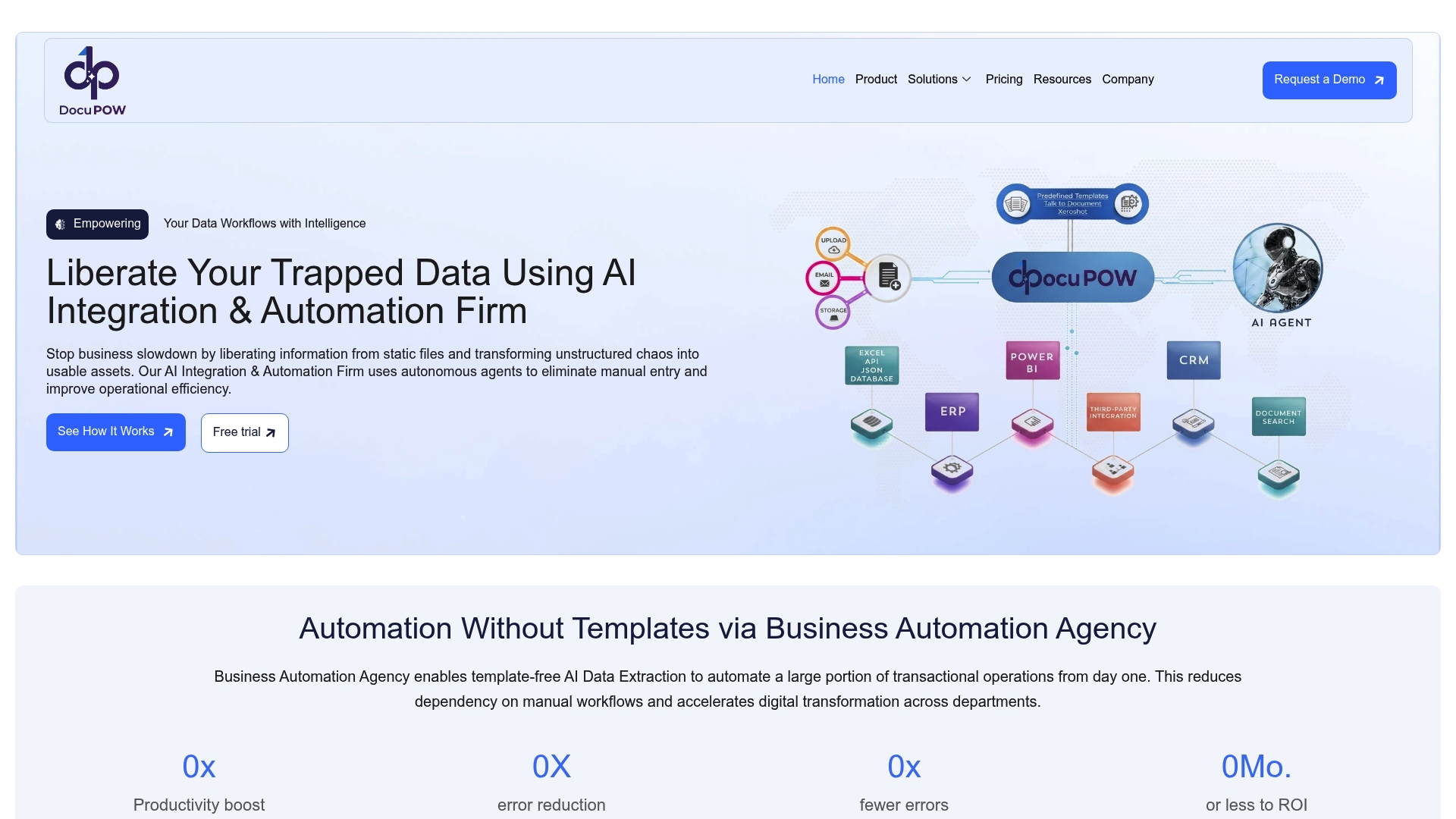
For manufacturing teams focused on compliance and audit readiness, DocuPOW’s manufacturing document automation platform delivers real-time extraction, confidence scoring, and continuous compliance monitoring in a single governed workflow. Pre-processing, human escalation, and audit trail generation are built in, not bolted on. If you are evaluating how to reduce manual processing time and improve audit outcomes, explore DocuPOW’s document process automation benefits to see where your operations can gain the most ground.
FAQ
What is intelligent document processing in manufacturing?
Intelligent document processing (IDP) is the AI-driven method for ingesting, classifying, extracting, and routing manufacturing documents using computer vision and NLP. It processes thousands of documents automatically and outputs structured data for ERP, PLM, and quality management systems.
How does AI improve compliance documentation?
AI captures, classifies, and validates compliance documents continuously, generating audit-ready evidence files and escalating alerts when certifications expire or procedures fall out of compliance. This replaces manual binder reviews with real-time monitoring.
What is the biggest risk of using AI for manufacturing documents?
The most significant risk is silent content corruption. Frontier LLMs corrupt roughly 25% of original document content during long delegated workflows, which makes separating document retrieval from editing, and requiring human approval for edits, a non-negotiable governance requirement.
How long does AI document control implementation take?
Implementation cycles for focused AI document control deployments are measured in weeks, not months, particularly when scoped to a single document type or facility before scaling.
What governance framework should manufacturers use for AI documents?
The NIST AI Risk Management Framework provides the most applicable structure, covering Govern, Map, Measure, and Manage functions that align directly with the audit trail and policy compliance requirements of manufacturing document workflows.
Recommended
See DocuPOW on your documents.
Stop building templates. Start extracting data.