Contract Review Automation: Finance & Ops Playbook
<p>Discover how Contract Review Automation transforms procurement. Cut review time, reduce errors, and sync data seamlessly with your ERP.</p>

Contract review automation uses AI to extract clauses, obligations, and key dates from supplier contracts, then syncs that data directly to ERP systems like SAP S/4HANA, Oracle Manufacturing Cloud, and NetSuite, cutting manual review time significantly while substantially reducing procurement error rates. If you run procurement, accounts payable, or plant finance for a global manufacturer, this is the capability that turns your contract repository from a legal archive into a live operational feed.
What it delivers in practice:
-
Time savings: PO processing time reduces notably
-
Error reduction: Extraction error rates fall from ~12% to 1.8%
-
Continuous alerts: Renewal dates, price escalators, and volume minimums trigger proactive notifications before obligations are missed
-
ERP sync: Extracted terms map directly to BOMs, work orders, and production calendars
Stat: Procurement teams that deploy contract intelligence significantly reduce the time spent on document review, freeing capacity for strategic sourcing and renegotiation.
Pro Tip: Before you run a single extraction, confirm your contracts are digitally accessible. Scanned PDFs locked in shared drives are the single biggest delay in any pilot.
Table of Contents
-
Why does contract review automation matter for manufacturing?
-
What core capabilities must a contract automation system have?
-
How do you implement contract automation in a manufacturing environment?
-
How should you select an enterprise contract automation vendor?
-
What pitfalls should you avoid when automating contract review?
-
How does DocuPOW address manufacturing finance and ops requirements?
-
How should you train finance and operations teams on contract automation tools?
-
What data privacy and security practices apply to contract data in automated systems?
-
How do you integrate contract automation with legacy ERP systems?
-
DocuPOW cuts contract processing time without the complexity
Why does contract review automation matter for manufacturing?
Deloitte estimates that businesses lose a noticeable percentage of contract value by not managing contracts efficiently, leading to significant financial losses for manufacturers with large annual supplier spend through missed discounts, uncaptured escalators, and auto-renewed terms nobody intended to keep.
The operational stakes are just as real. A missed force majeure clause, an expired quality certification flow-down, or a price escalator that triggers mid-production run can disrupt your supply chain faster than any demand shock. Manual review simply cannot keep pace with hundreds of active MSAs, OEM agreements, and distribution contracts renewing on staggered cycles.
Continuous obligation tracking is where most teams underestimate the value. Extracting data once at contract signature is essential. Even more valuable is an alert system that notifies teams in advance of renewals, volume shortfalls, and pricing tier changes to manage financial impacts proactively.
Cross-functional stakeholders who care about this:
-
Plant controllers: Cash-flow visibility tied to actual contract terms, not budget assumptions
-
Procurement leads: Faster PO creation, fewer exceptions, stronger renegotiation leverage
-
AP teams: Three-way match accuracy and early-pay discount capture
-
Engineering/quality: Regulatory flow-downs (ISO 9001, RoHS, ITAR) surfaced before production begins
Pro Tip: Scope your first pilot around one contract type with high volume and predictable structure, like standard vendor MSAs. You will build a reusable playbook and prove ROI without touching complex bespoke agreements.
What core capabilities must a contract automation system have?
Manufacturing-specific extraction maps numerous distinct data points per contract and ties them to plant-floor context. A general-purpose document reader is not enough. Here is what the feature checklist should include:
-
Clause and obligation extraction: Pricing tiers, escalation triggers, renewal windows, warranty terms, MSA/amendment reconciliation
-
Regulatory clause detection: ISO 9001, RoHS, REACH, ITAR, and EPA compliance flow-downs flagged before production runs
-
Date and obligation monitoring: Continuous alerts for every dated commitment, not just signature-date archiving
-
Context-aware ERP mapping: Part numbers, BOM cross-references, and production calendar alignment via LLM-orchestrated automation
-
Three-way match orchestration: PO, invoice, and receipt reconciliation with exception routing
-
Confidence scores and audit trail: Every extracted field carries a confidence score; every human override is logged
| Extraction Element | Expected Output |
|---|---|
| Pricing tiers and escalators | Structured table with trigger conditions and effective dates |
| Renewal and expiration dates | Calendar alerts with configurable lead times |
| Regulatory compliance clauses | Pass/flag status against current regulatory checklist |
| Liability caps and indemnity | Clause text plus deviation flag against playbook |
| Part numbers and BOM references | Mapped to ERP item master for downstream PO generation |
| Volume commitments and minimums | Running tracker against actual purchase history |
How do you implement contract automation in a manufacturing environment?
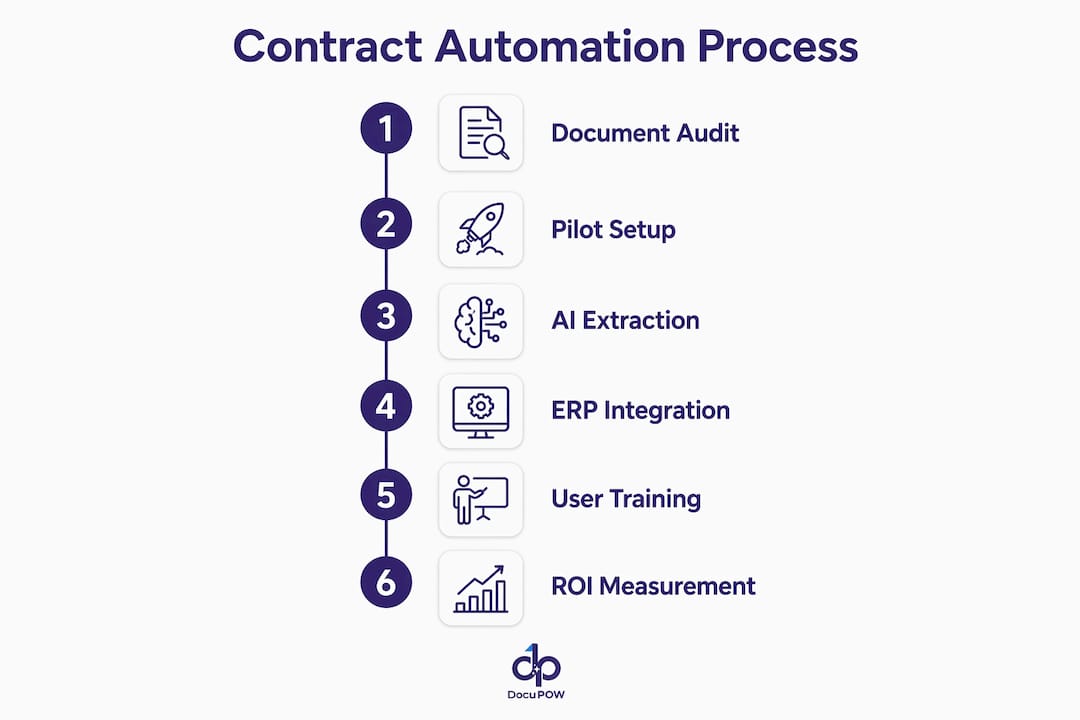
A mid-market manufacturer typically runs several weeks from discovery to pilot cutover. Here is the cadence:
-
Weeks 1–3: Document audit and ERP assessment. Inventory all active contracts by type and volume. Confirm digital accessibility. Map ERP fields (SAP, Oracle, NetSuite) that need to receive extracted data. Treat this step as a formal audit: you will surface expired renewals, inconsistent indemnity language, and hidden liabilities that nobody knew existed.
-
Weeks 4–8: Model training and integration. Feed the AI with representative contract samples. Build ERP connectors. Define confidence thresholds for auto-routing versus human review. Establish approval hierarchies and exception rules.
-
Weeks 9–12: Pilot, refine, and deploy. Run extractions against a live contract cohort. Validate outputs against a human-reviewed sample. Measure error rates, cycle time, and exception frequency. Adjust thresholds before scaling.
Required inputs before you start: digital contract files, ERP system access with field-mapping documentation, sample POs and BOMs, and documented approval thresholds by contract value.
Change management is not optional. Procurement and finance teams need to understand what the system decides automatically versus what it escalates. Engineering needs to know how regulatory clause alerts reach them.

Pro Tip: Treat data migration as a formal audit, not a file transfer. The migration phase is your best opportunity to find hidden liabilities, expired renewals, and inconsistent indemnity language before they become production problems.
How should you select an enterprise contract automation vendor?
Demand evidence, not demos. Here is the decision matrix for manufacturing use cases:
| Dimension | What to Request as Proof |
|---|---|
| Extraction accuracy | Pilot results on your contract types; before/after error rates |
| ERP integration depth | Pre-built connectors for SAP/Oracle/NetSuite; API documentation |
| Continuous obligation tracking | Alert configuration options; SLA for model refresh |
| Throughput and scalability | Documents processed per hour; batch processing limits |
| Security and compliance | SOC 2 Type II report; encryption in transit and at rest; data residency options |
| Implementation timeline | Week-by-week project plan; dedicated engineering resources |
| Pricing model | Per-document, per-seat, or enterprise license; overage terms |
Red flags to walk away from:
-
No audit trail on extracted fields or human overrides
-
No native ERP mapping (promises API access instead of pre-built connectors)
-
Opaque pricing with no pilot-phase cost clarity
-
No confidence scoring on extracted data
-
Inability to demonstrate regulatory clause detection for ISO, RoHS, or ITAR
For AI automation services evaluation, weight extraction accuracy and ERP integration depth most heavily. A system that extracts accurately but cannot push data to your ERP creates a new manual step, not fewer.
What pitfalls should you avoid when automating contract review?
The most expensive mistake is automating a broken process. Finance leaders consistently note that automation executes existing workflows exactly as defined, including their flaws. Map and fix your approval and exception rules before you turn the system on.
Governance controls that prevent the common failures:
-
Process mapping first: Document every approval step, exception path, and escalation rule before configuring the system
-
Confidence thresholds: Set a minimum score below which the system routes to human review, not auto-approval
-
Human-in-the-loop gates: High-risk clauses (liability caps, indemnity, regulatory flow-downs) require mandatory human sign-off regardless of confidence score
-
SLA for model refresh: Schedule quarterly reviews of extraction accuracy against new contract samples
-
Role-based access controls: Limit who can override extracted fields and log every change
Pro Tip: Preserve human decision rights explicitly in your governance policy. Define which clause types always require human review, and document that list before go-live. It prevents scope creep and protects you in disputes.
How do you measure success and prove ROI?
Establish a baseline before the pilot starts. Without pre-automation numbers, you cannot prove the value that justifies scaling.
| KPI | Baseline Measurement | Target | Frequency |
|---|---|---|---|
| Contract cycle time | Days from receipt to approval | Aim to significantly reduce | Weekly during pilot |
| PO time-to-create | Hours from contract term to PO | Under 1 day | Weekly |
| Extraction error rate | % of fields requiring manual correction | Target low error rates | Per batch |
| Auto-routed orders | % of POs requiring no human intervention | Target a high proportion | Monthly |
| Early-pay discounts captured | $ value of discounts realized | Track against available | Monthly |
| Compliance events avoided | Regulatory clause flags acted on pre-production | All flagged items | Per contract |
Stat: AI contract intelligence cuts manual processing time by over 80% and reduces error rates from ~12% to under 2% in manufacturing procurement workflows.
Expected timeline to measurable ROI: most teams see meaningful cycle-time reduction within the 9–12 week pilot window. Full-scale ROI, including contract leakage recovery and compliance event avoidance, typically materializes in months 4–6 post-deployment.
How does DocuPOW address manufacturing finance and ops requirements?
DocuPOW’s template-free extraction approach means it reads contract context rather than matching fields to a fixed schema. That matters in manufacturing, where MSAs, amendments, and OEM agreements rarely follow a uniform structure.
Feature-to-requirement mapping:
-
Template-free AI extraction: Handles non-standard supplier agreements without retraining for each new format
-
LLM orchestration layer: Maps extracted terms to ERP item masters, BOMs, and production calendars
-
Three-way match automation: Reconciles PO, invoice, and receipt data with exception routing built in
-
Real-time obligation alerts: Proactive notifications for renewals, escalators, and volume commitments
-
Audit trail and confidence scoring: Every extracted field is logged with its confidence score and any human override
| Dimension | DocuPOW Capability | Evidence |
|---|---|---|
| Extraction accuracy | Template-free, context-aware LLM extraction | No rigid schema dependency |
| ERP integration | Connectors for SAP, Oracle, NetSuite | Procurement solution page |
| Three-way match | PO-Invoice-Receipt orchestration | Dedicated flow documentation |
| Continuous tracking | Real-time alerts on dated obligations | Platform feature |
| Security controls | SOC 2-level access controls, audit trail | Platform architecture |
| Implementation support | Structured pilot methodology | 9–12 week deployment cadence |
Pro Tip: Start your DocuPOW pilot with one high-volume contract type and two ERP fields. Measure extraction accuracy and cycle time for four weeks before expanding scope. Narrow pilots produce the clearest ROI evidence for budget approval.
How should you train finance and operations teams on contract automation tools?
Training fails when it is treated as a one-time event. The teams who sustain adoption treat it as an ongoing competency, not a go-live checkbox.
Procurement staff need to understand what the system extracts automatically, what it escalates, and how to interpret confidence scores. A two-hour session on extraction logic and exception handling is more valuable than a full-day platform walkthrough. Finance teams need to connect extracted contract terms to their forecasting models. The practical skill is knowing how to query obligation alerts and translate them into cash-flow adjustments.
Engineering and quality teams have a narrower but critical need: understanding how regulatory clause flags reach them and what action is expected. A clear escalation path, documented before go-live, prevents flags from sitting unresolved in a queue.
Role-specific training tracks work better than company-wide sessions. Build a short playbook for each function: what they see, what they decide, and what they escalate. Pair that with a 30-day post-go-live check-in to catch gaps before they become habits.
What data privacy and security practices apply to contract data in automated systems?
Contract data carries some of the most sensitive commercial information a manufacturer holds: pricing, liability exposure, supplier relationships, and regulatory obligations. The security architecture around automated systems needs to reflect that.
KPMG’s CLM guidance specifies role-based access controls, least-privilege principles, single sign-on, and encryption in transit and at rest as foundational requirements. Data residency controls matter for manufacturers with cross-border supplier relationships subject to GDPR or state-level privacy laws.
Specific practices for manufacturing contract data:
-
Tenant or departmental segregation for multi-plant environments
-
Field-level redaction for commercially sensitive terms during review routing
-
End-to-end audit trail covering clause lineage, version history, and approval activity
-
Legal-hold policies that extend to automated repositories and backups
-
Human-in-the-loop review for high-risk clauses, with confidence thresholds that prevent auto-approval of sensitive terms
SOC 2 Type II certification is the minimum bar for any vendor handling contract data. ISO 27001 adds a useful layer for manufacturers with international operations.
What do real manufacturing implementations look like?
The pattern that repeats across successful deployments: start narrow, prove the number, then scale.
One mid-market industrial components manufacturer ran a 12-week pilot on 200 standard vendor MSAs. Before automation, the procurement team spent roughly 60% of its time on document review. After the pilot, that figure dropped to around 15%, consistent with reported outcomes showing manual processing time cut by over 80%. The team redirected that capacity to supplier renegotiations, recovering pricing concessions that more than offset the platform cost.
A second pattern involves AP automation integration. Manufacturers who connect contract extraction directly to their AP workflows capture early-pay discounts that were previously invisible because the payment terms lived in a PDF nobody checked. Three-way match automation catches invoice discrepancies against contract terms before payment runs, not after.
The common thread: the ROI case is clearest when you measure a specific, pre-defined metric before and after. Teams that skip baseline measurement struggle to secure budget for the next phase.
How do you integrate contract automation with legacy ERP systems?
Legacy ERP environments are where most manufacturing automation projects stall. SAP ECC, older Oracle E-Business Suite instances, and on-premise Epicor deployments often lack the API surface that modern contract automation platforms expect.
Pre-built ERP connectors reduce mapping errors and accelerate implementation significantly. When native connectors are not available, robotic process automation (RPA) bridges the gap until a native integration is feasible. That is a workable short-term solution, but it adds a maintenance dependency.
Practical integration approach for legacy environments:
-
Field mapping documentation first: Before any connector work, document exactly which ERP fields need to receive extracted contract data and what format each field expects
-
Middleware layer: Use an integration platform (MuleSoft, Dell Boomi, or similar) to translate between the contract automation API and the ERP’s data model
-
Incremental rollout: Connect one ERP module at a time, starting with the procurement or purchasing module before touching finance or production planning
-
Data validation gates: Build a validation step that checks extracted data against ERP master data before writing, catching mismatches before they propagate
The engineering effort concentrates in the integration layer, not the extraction engine. Budget accordingly, and require vendors to show reference ERP connectors during the selection process, not just API documentation.
Key Takeaways
Contract review automation delivers measurable ROI for manufacturing finance and ops teams when deployed with clear KPIs, a structured pilot, and ERP integration built in from the start.
| Point | Details |
|---|---|
| Start with a narrow pilot | Focus on one high-volume contract type; measure cycle time and error rate before expanding. |
| Baseline before you automate | Capture pre-automation metrics or you cannot prove the value that justifies scaling. |
| Continuous tracking beats one-time extraction | Set alerts for renewals, escalators, and volume commitments to prevent contract leakage. |
| ERP integration is the critical path | Pre-built connectors for SAP, Oracle, or NetSuite determine whether extracted data reaches operations or stays in a silo. |
| DocuPOW for manufacturing pilots | DocuPOW’s template-free extraction and three-way match automation map directly to manufacturing procurement requirements. |
The part most teams get wrong about contract automation
Most articles on this topic focus on the extraction accuracy number. That is the wrong thing to optimize first.
The teams that get the most out of contract automation are the ones who spent two weeks before go-live fixing their approval workflows. Not configuring the software. Fixing the process. Because the software will execute whatever you tell it to, including the workarounds your procurement team built three years ago when the ERP was upgraded and nobody updated the approval matrix.
The second thing teams consistently underestimate is the obligation tracking piece. Extraction at signature is easy to demo and easy to measure. Continuous monitoring of 400 active contracts, each with its own renewal window, escalation trigger, and volume commitment, is where the real financial exposure lives. A system that extracts well but does not alert proactively is a better filing cabinet, not a risk management tool.
The change management reality: the internal objection you will hear most often is “the AI will make mistakes.” It will, occasionally. The answer is not to defend the AI. The answer is to show the error rate comparison: 1.8% versus 12%. Then ask which error rate the team is currently comfortable defending to the CFO.
Sustaining adoption after the pilot comes down to one thing: make sure the people using the system can see, in their daily workflow, that it is saving them time. If the benefit is invisible to the end user, adoption stalls regardless of what the KPI dashboard shows.
DocuPOW cuts contract processing time without the complexity
Manufacturing finance and ops teams running hundreds of supplier agreements need extraction that works on real-world contracts, not sanitized demos. DocuPOW’s autonomous agents read contract context without rigid templates, map extracted terms directly to your ERP, and fire real-time alerts before a renewal or escalator catches your team off guard.
The practical wins for manufacturing teams: template-free extraction handles non-standard MSAs and amendments, three-way match automation catches invoice discrepancies before payment runs, and obligation alerts keep procurement and finance aligned on what is actually owed and when. For teams ready to move from pilot to production, the enterprise workflow automation guide covers integration patterns and governance controls in detail. Start with a focused pilot on your highest-volume contract type and measure extraction accuracy and cycle time over four weeks. That is enough to build the internal ROI case for full deployment.
FAQ
What is contract review automation?
Contract review automation uses AI to extract clauses, obligations, and key dates from contracts and route that data to ERP and procurement systems, replacing manual document reading with structured, auditable data flows.
How long does a manufacturing contract automation pilot take?
A mid-market manufacturer typically runs 9–12 weeks from document audit to pilot cutover, with ERP integration consuming the most engineering time in weeks 4–8.
What error rate can I expect after deploying AI contract extraction?
Reported outcomes from manufacturing deployments show extraction error rates dropping from approximately 12% to 1.8%, with PO processing time falling from 3–4 days to under one day.
How does DocuPOW handle non-standard supplier agreements?
DocuPOW uses template-free, context-aware extraction, so it reads contract language directly rather than matching fields to a fixed schema, making it effective on MSAs, amendments, and OEM agreements that do not follow a uniform structure.
What security certifications should a contract automation vendor have?
SOC 2 Type II is the minimum standard for vendors handling contract data. Look for role-based access controls, encryption in transit and at rest, data residency options, and a full audit trail covering every extracted field and human override.
Recommended
See DocuPOW on your documents.
Stop building templates. Start extracting data.