Unstructured Data Management Service: 2026 Guide
Discover how an Unstructured Data Management Service can enhance visibility, compliance, and security for your organization by managing valuable data.


TL;DR:
- Unstructured data management involves systems that discover and classify data like emails, images, and documents, which comprise most enterprise data. Most organizations lack full visibility into their unstructured data, increasing risks of security breaches, compliance failures, and AI project failures. Effective governance requires continuous, automated processes and clear ownership to adapt to evolving regulations and AI needs.
Unstructured data management service is defined as the systematic set of processes and technologies that organizations use to discover, classify, govern, and extract value from data that doesn’t fit neatly into rows and columns. Emails, contracts, PDFs, images, audio files, and chat logs all fall into this category. They make up the vast majority of enterprise data, yet 56% of organizations report only partial visibility into where that data actually lives. That blind spot creates real exposure: compliance failures under GDPR and HIPAA, security breaches, and AI projects that collapse before they deliver results.
What challenges does unstructured data management service solve?
The most immediate problem is visibility. When your team can’t see where sensitive data sits, you can’t protect it or govern it. Partial data visibility affects 56% of enterprises, meaning more than half of all organizations are making compliance and security decisions with incomplete information. That’s not a technology gap. It’s a governance gap.
Unmanaged unstructured data creates four distinct categories of business risk:
-
Security exposure: Files with sensitive personal or financial data sit in shared drives with overly broad access permissions, violating the Principle of Least Privilege.
-
Compliance failures: Privacy laws like GDPR and HIPAA require documented records retention and deletion schedules. Without them, audits become crises.
-
Storage cost bloat: Organizations pay to store and back up data they no longer need, including files past their legal retention date.
-
AI project failure: Approximately 60% of AI pilot projects fail because the unstructured data feeding those models is ungoverned, stale, or mislabeled.
“The core barrier to effective unstructured data governance is not a lack of tools. It is a lack of integration, automation, and clear ownership across environments. Organizations that treat governance as a one-time project rather than a continuous workflow consistently fall short.”
That last point deserves attention. AI failure rates tied to data readiness are not a technical problem you can solve by buying another platform. They reflect a foundational decision about whether governance is a priority or an afterthought.
How do modern frameworks enable effective unstructured data services?
The old approach was to catalog everything. That approach stalls. A complete catalog of all files overwhelms governance teams and produces diminishing returns. The modern alternative is continuous, automated discovery combined with targeted classification based on business impact.
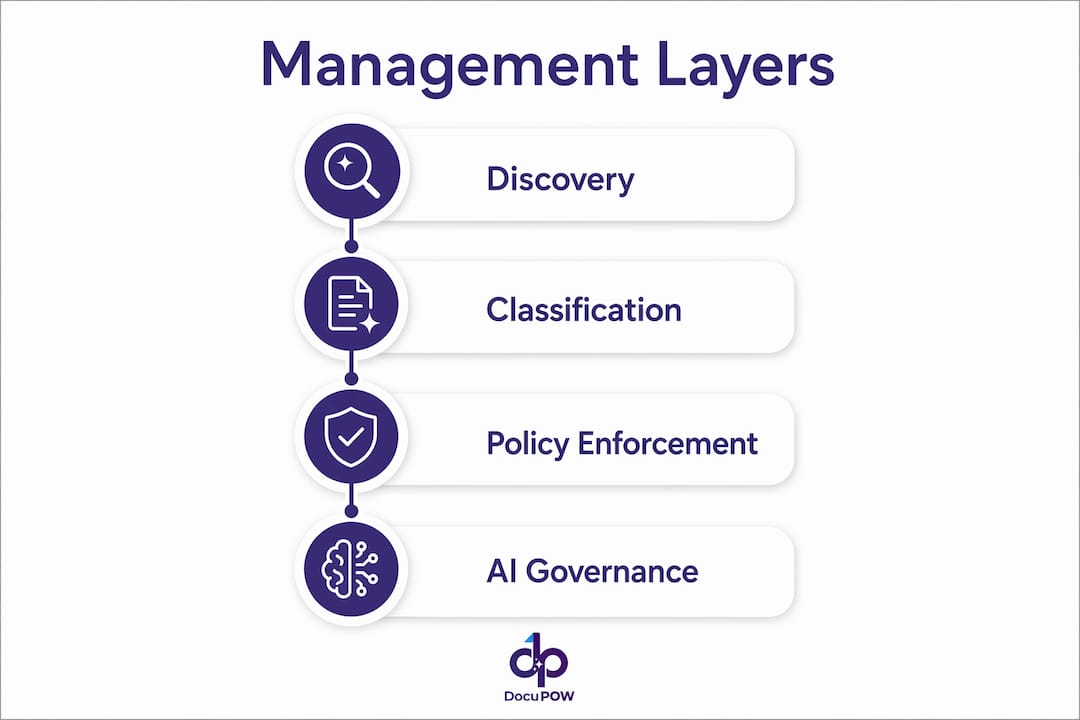
A well-designed unstructured data service operates across three layers.
Discovery and classification
Automated tools scan on-premises file servers, cloud storage buckets, SharePoint libraries, and email archives continuously, not just during annual audits. They apply metadata tags based on content sensitivity, data type, and regulatory category. Unified sensitivity models and data lineage tracking are foundational to managing hybrid environments where data moves between cloud and on-premises systems regularly.

Policy enforcement
Classification without enforcement is just labeling. Effective unstructured data processing requires automated policy execution: access controls that restrict who can read or edit sensitive files, retention schedules that trigger archiving or deletion at defined dates, and defensible deletion workflows. Automated retention policies that enforce deletion after legal or business expiry reduce storage costs and legal exposure more effectively than indefinite archiving.
AI governance integration
Modern data governance services must account for AI agents that read and act on unstructured files. Every file an AI agent touches needs traceable lineage so you can audit what the model consumed, when, and why. Integrated unstructured data governance improves AI output trustworthiness and satisfies regulatory requirements like Article 12 source traceability under emerging AI compliance frameworks.
Pro Tip: When evaluating data management solutions, ask vendors specifically how their platform handles AI agent lineage. If they can’t show you a file-to-agent audit trail, their governance story is incomplete.
The fragmentation problem is also worth naming directly. 32% of enterprises use 11 or more tools to manage unstructured data, and 12% use more than 21. That level of fragmentation makes consistent policy enforcement nearly impossible. A unified platform that applies a single sensitivity model across all environments is not a luxury. It’s the only way to govern at scale.
| Capability | Entry-level approach | Enterprise-grade approach |
|---|---|---|
| Discovery | Manual scans, scheduled quarterly | Continuous automated scanning across all environments |
| Classification | File type only | Content-aware, sensitivity-based metadata tagging |
| Policy enforcement | Manual access reviews | Automated Principle of Least Privilege with audit logs |
| Retention | Ad hoc deletion | Defensible deletion triggered by legal/business expiry |
| AI governance | None | File-to-agent lineage tracing with compliance reporting |
How to implement unstructured data management services effectively
The most effective implementation follows a phased approach. Trying to govern everything at once produces paralysis. A 90-day governance playbook moves organizations from reactive storage to proactive governance in three structured phases.
-
Days 1–30: Map your repositories. Identify every location where unstructured data lives, including shadow IT storage, personal drives, and legacy archives. Run an automated discovery scan and produce a risk-ranked inventory. Flag repositories with sensitive data and no access controls as immediate priorities.
-
Days 31–60: Audit access and classify high-risk data. Apply sensitivity classification to your highest-risk repositories first. Conduct access reviews and remove permissions that violate the Principle of Least Privilege. Assign data owners to each repository. Clearly defined data owners are necessary to complement technology. Without stewardship, automated tools generate exceptions that nobody resolves.
-
Days 61–90: Enforce policies and establish monitoring. Activate retention schedules, automated deletion workflows, and access alerts. Set KPIs for risk reduction, storage cost savings, and compliance audit readiness. Connect your governance layer to any AI systems that consume unstructured files, and establish lineage tracking from day one.
Pro Tip: Don’t start with your largest data repository. Start with the one that feeds your most critical AI workflow or carries the highest regulatory risk. Early wins in high-impact areas build the organizational support you need to scale governance across the enterprise.
Governance is not a project with an end date. Governance policies require ongoing iteration as regulations change and AI use cases expand. Build a quarterly review cycle into your operating model from the start. Assign domain accountability so that each business unit owns the data it generates, rather than pushing all responsibility to a central IT team.
Measuring outcomes matters as much as the implementation itself. Track three KPIs from the beginning: the percentage of repositories with full sensitivity classification, the volume of data deleted under defensible deletion policies, and the time required to produce a compliance audit report. These three metrics tell you whether your unstructured data analysis is producing real governance or just documentation.
How does unstructured data management future-proof your organization?
AI regulation is moving faster than most organizations expect. Emerging frameworks already require organizations to demonstrate that AI outputs are traceable to specific source documents. That requirement makes AI data governance a compliance obligation, not just a best practice. Organizations that can’t show which files trained or informed an AI decision face regulatory exposure that grows with every new AI deployment.
The future-proofing case for strong unstructured data services rests on four realities:
-
AI accuracy degrades with stale data. Models trained on outdated or mislabeled unstructured files produce unreliable outputs. Continuous governance keeps training data current and correctly labeled.
-
Regulatory scope is expanding. GDPR and HIPAA already impose data management obligations. AI-specific regulations are adding source traceability and sensitive data handling requirements on top of those.
-
Cold storage must stay accessible. Cold storage solutions must allow user access without manual rehydration delays. Governance strategies that archive data into inaccessible silos create operational bottlenecks when that data is needed for audits or AI training.
-
Governance enables agility. Organizations with clean, classified, well-governed unstructured data can deploy new AI agents faster because the data foundation is already in place.
Connecting your unstructured data governance layer to a document automation platform accelerates all of these outcomes. When documents are processed, classified, and routed automatically, governance becomes part of the workflow rather than a separate overhead function. That integration is where AI integration for document workflows produces the most measurable return.
Key Takeaways
Effective unstructured data management requires continuous governance, not periodic audits, and that governance must extend to every AI system consuming your files.
| Point | Details |
|---|---|
| Visibility is the first problem | 56% of enterprises lack full visibility into unstructured data, creating security and compliance exposure. |
| AI projects depend on governance | 60% of AI pilots fail due to ungoverned unstructured data feeding the models. |
| Phased implementation works | A 90-day playbook moves organizations from reactive storage to active governance with measurable KPIs. |
| Ownership is non-negotiable | Automated tools require dedicated data owners to resolve exceptions and maintain metadata quality. |
| Governance must be continuous | Regulations and AI use cases evolve constantly, requiring quarterly policy reviews and living workflows. |
Where most organizations get unstructured data governance wrong
I’ve watched organizations invest in classification tools and then wonder why their governance program stalled six months later. The technology was fine. The problem was that nobody owned the exceptions.
Automated classification gets you 80% of the way there. The remaining 20% requires human judgment: files that don’t fit clean categories, access requests that need context, retention decisions that depend on legal input. When those exceptions pile up with no assigned owner, the backlog grows and confidence in the entire program erodes. The fix is not a better algorithm. It’s assigning a named person to each data domain before you turn on the automation.
The other mistake I see consistently is treating governance as a data team problem. Unstructured data governance touches legal, finance, operations, HR, and every business unit that generates documents. When the data team owns it alone, they lack the authority to enforce policies across those domains. The most successful programs I’ve seen treat governance as a cross-functional operating model with executive sponsorship, not a technical project managed by IT.
Start with the data that matters most. Prioritizing AI agent lineage over a complete catalog is the pragmatic path to scalable governance. You will never finish cataloging everything. You can finish governing the data that drives your most critical decisions.
— Sameer
DocuPOW: built for the unstructured data challenge
Managing unstructured data at scale requires more than a governance policy. It requires a platform that extracts, classifies, and routes document data automatically, without rigid templates or manual entry.
DocuPOW uses autonomous AI agents that understand document context, pulling structured data from contracts, invoices, reports, and operational files across your entire document ecosystem. The result is improved compliance readiness, lower storage costs, and AI models that run on clean, current data. For organizations in manufacturing, construction, or finance, DocuPOW’s document processing capabilities show exactly how this works in practice across real operational environments. See how DocuPOW’s intelligent document processing fits your governance and automation goals.
FAQ
What is an unstructured data management service?
An unstructured data management service is a set of technologies and processes that discover, classify, govern, and extract value from data stored in non-database formats such as documents, emails, and images. It addresses security, compliance, and AI readiness challenges that structured data tools cannot solve.
Why do 60% of AI projects fail due to unstructured data?
AI models trained on ungoverned, stale, or mislabeled unstructured data produce unreliable outputs. Without classification, lineage tracking, and access controls on source files, AI systems lack the data quality needed to perform accurately.
How long does it take to implement unstructured data governance?
A phased 90-day playbook can move an organization from reactive storage to active governance, covering repository mapping, access audits, policy enforcement, and continuous monitoring within that window.
What is defensible deletion and why does it matter?
Defensible deletion is an automated policy that purges data after its legal or business retention period expires. It reduces storage costs and legal exposure compared to retaining all data indefinitely, and it demonstrates regulatory compliance during audits.
How does data governance affect compliance with GDPR and HIPAA?
GDPR and HIPAA both require documented retention schedules, access controls, and the ability to locate and delete specific personal data on request. Without a functioning unstructured data governance program, meeting these requirements during an audit is operationally impossible.
Recommended
See DocuPOW on your documents.
Stop building templates. Start extracting data.