Phased Agentic Rollout for Legal Teams: AI-Powered CLM
Practical rollout for legal and procurement teams: pilot one workflow, use template-free extraction, and enable agentic automation with governance and...


AI-powered contract lifecycle management automates extraction, surfaces risk and obligation insight, and triggers event-driven actions across drafting, negotiation, and renewal. The payoff is faster cycle time, fewer missed obligations, and an audit trail regulators and auditors can actually follow. Start smaller than you think: pilot one high-impact workflow, like renewal management or vendor onboarding, before touching anything else.
TL;DR:
- High-quality, organized contract repositories are crucial, as AI-CLM’s ROI depends more on metadata and governance than on the AI model itself.
- Running a pilot with a known-answer dataset on a single workflow, such as renewals, and monitoring extraction accuracy and adoption, can validate AI’s effectiveness before scaling.
- Extracting clauses and metadata in under a minute and ensuring source-linked answers are essential features when evaluating AI-CLM tools.
- Governance controls like data access segmentation, source traceability, and human review gates need to be implemented before expanding AI-CLM deployment.
- Phased implementation starting with repository cleanup, controlled pilots, and gradual integration with enterprise systems minimizes risks and maximizes AI-CLM benefits.
Table of Contents
- What Is AI-Powered Contract Lifecycle Management?
- How Can AI Be Used in Contract Management?
- What ROI Should You Expect From AI Contract Automation?
- What Risks and Governance Controls Should You Plan For?
- How Do You Roll Out AI-CLM in Phases?
- What Features Should You Evaluate When Choosing an AI-CLM Tool?
- How Does AI-CLM Integrate With ERP and Enterprise Systems?
- When Should You Pilot AI-Powered CLM?
- What Deployments Actually Teach You About AI-CLM
- How DocuPOW Supports Your AI-CLM Rollout
- Sources
- FAQ
What Is AI-Powered Contract Lifecycle Management?
AI-powered contract lifecycle management, often shortened to AI-CLM, isn’t one feature. It’s four layers of capability stacked on top of each other, and vendors rarely sit at the same layer for every function they advertise.
The bottom layer is extraction and search: pulling metadata, clauses, and dates out of PDFs and scanned files, then letting you query that repository in plain English. Next comes the copilot layer, where AI answers questions about specific contracts with citations back to the source text. Above that sits drafting assistance, where the system suggests language or flags a clause that violates your playbook. At the top is agentic automation, where the system takes multi-step action, like assembling a renewal packet and routing it for approval, without a person clicking through every screen.
Foundation models and generative AI pushed the top two tiers from demo-ware into production over the past two years, largely because GenAI made it usable at suggesting contract language and procurement-tailored insight generation rather than just pattern-matching keywords.
- Extraction/search: find every contract with a specific indemnification clause in under a minute
- Copilots: ask “what’s our termination notice period with this vendor?” and get a sourced answer
- Drafting assistance: flag a nonstandard limitation-of-liability clause against your playbook
- Agentic actions: auto-generate a renewal brief 90 days out and route it to the contract owner
How Can AI Be Used in Contract Management?
Most legal and procurement teams start with the tasks that eat the most billable or administrative hours, then work upward toward automation. The order matters. Trying to run agentic workflows before your extraction is trustworthy just moves errors downstream faster.
- Metadata extraction and clause classification. AI tags parties, effective dates, renewal terms, and clause types, then attaches a confidence score so reviewers know which fields need a second look.
- Natural-language Q&A and search. Ask a question in plain English and get an answer with a link back to the exact paragraph in the source document, not a black-box summary.
- Drafting assistance and playbook-driven redlines. The system compares incoming contract language against your approved fallback positions and marks deviations automatically.
- Obligation discovery and post-signature alerts. AI-CLM tools surface deliverables, payment triggers, and renewal deadlines buried in section 14 of a 40-page agreement, then set alerts.
- Agentic workflows with human gates. A renewal brief gets assembled and routed to the contract owner for sign-off; nothing executes without a person confirming it.
Pro Tip: Run every new AI-CLM capability against a “known-answer” sample first, meaning a batch of contracts where you already know the correct clause, date, or obligation. If the tool can’t match your known answers, don’t trust it on the unknown ones.
What ROI Should You Expect From AI Contract Automation?
The gains are real but uneven, and they depend heavily on what your repository looks like before you turn AI loose on it. Teams that digitize and clean up their contracts first see faster payback than teams that point AI at a messy shared drive and hope.
Reported gains cluster around three areas: shorter review cycles, fewer missed renewal deadlines, and a meaningful drop in manual review hours as AI flags deviations and speeds processing across the contract lifecycle. None of that happens automatically. It happens when extraction accuracy is high enough that reviewers trust the output instead of re-checking everything by hand.
The gap that actually determines ROI: AI-CLM performance depends more on repository quality and metadata governance than on the sophistication of the AI model itself. A well-organized repository with clean metadata will outperform a flashier AI layered on top of chaos.
Track these KPIs from day one of a pilot:
- Cycle time from contract request to fully executed signature
- Extraction accuracy against your known-answer sample
- Obligation coverage: what percentage of deliverables and deadlines the system correctly surfaces
- User adoption: how often legal and procurement actually use the tool versus reverting to manual review
What Risks and Governance Controls Should You Plan For?
Every AI-CLM rollout runs into the same governance questions, and getting ahead of them before a pilot beats fixing them after a vendor is embedded in your workflow. EY frames this as three specific questions organizations should ask before integrating generative AI into contract management: what data trains the model, who can see the outputs, and how decisions get audited.
Build these controls in before you scale past a pilot:
- Data sensitivity and access control. Segment contract data by permission level so an AI answer never surfaces a clause a requester isn’t cleared to see.
- Explainability and source-tracing. Every AI-generated answer should link back to the exact contract and paragraph it came from, not just a paraphrased summary.
- Human-in-the-loop gating. Route any AI-flagged risk or unusual clause to a human reviewer before it triggers a downstream action.
- Operational monitoring and audits. Schedule regular spot-checks against known answers, and ask vendors directly what happens when their model updates or changes behavior.
Agentic features are the newest and least consistent layer across the market. Vendors range widely in production readiness, so treat agentic claims with structured skepticism and verify autonomous behaviors against a known-answer set before letting any agent act without review.
How Do You Roll Out AI-CLM in Phases?
A staged rollout beats a big-bang deployment almost every time, because it lets you catch extraction errors and governance gaps while the blast radius is still small. PwC frames this as three phases: digitize and prepare, integrate and learn, then full orchestration. Here’s how that plays out on the ground.
- Digitize and prepare the repository. Run OCR on scanned contracts, deduplicate versions, and identify which agreements follow standard templates versus custom language. This is unglamorous work, and skipping it is the single biggest reason pilots underperform.
- Run a controlled pilot with known-answer samples. Pick one workflow, renewal review is a common starting point, and validate AI output against a review queue before trusting any field it extracts.
- Integrate with ERP, CRM, and procure-to-pay systems. Once extraction accuracy holds up, connect contract data to downstream systems through APIs and webhooks so renewal dates and obligations trigger automatically instead of living in a spreadsheet.
- Enable agentic flows behind guardrails. Turn on multi-step automation only for well-understood workflows, and monitor cycle time, accuracy, and escalation rates continuously.
Pro Tip: Pick a workflow with a visible, undeniable deadline, like a contract renewing in 60 days, for your first pilot. Building a known-answer sample around a real deadline forces the pilot to prove itself instead of drifting.
DocuPOW’s template-free extraction approach fits directly into phase one and two: because it doesn’t rely on rigid document templates, it cuts the manual mapping work that normally slows down repository preparation.
What Features Should You Evaluate When Choosing an AI-CLM Tool?
Vendor demos tend to look impressive and reveal little about production reliability. Push past the demo script with a checklist built around what actually breaks in practice.
- Extraction accuracy and confidence scoring. Ask how the system flags low-confidence fields for review rather than silently guessing.
- Playbooks and redline enforcement. Confirm the tool compares incoming language against your fallback positions, not just a generic clause library.
- Audit trails and permission-aware search. Every answer should be source-linked and respect the same access controls your document repository already enforces, since source-linked answers preserve verifiability far better than a standalone chatbot.
- Integration depth. Ask specifically about API access, connector or MCP support, webhook triggers, and where data physically resides.
- Commercial model. Understand whether AI features are bundled, priced per seat, or gated behind feature flags that add cost later.
Read the contract intelligence buyer’s guide for a deeper walkthrough of how to structure vendor evaluation criteria.
How Does AI-CLM Integrate With ERP and Enterprise Systems?
Treat your contract repository as the single source of truth, and insist that every AI-generated answer link back to it. That single rule prevents the most common failure mode: an AI summary that drifts from what the actual contract says.
Connector and MCP ecosystems raise a real question worth asking directly: what data gets exposed to external copilots, and how are live queries secured? Don’t accept a vague answer here.
- Favor event-driven automation (webhooks) for time-sensitive triggers like renewal alerts, and scheduled batch analysis for lower-urgency reporting.
- Secure every API endpoint with the same access controls that govern your underlying repository, not a looser standard.
- Test agentic behaviors in a staging environment against known-answer samples before any agent touches production data.
DocuPOW’s AI workflow automation architecture is built around this pattern: source-linked outputs, API-driven handoffs, and staged testing before agentic actions go live.
When Should You Pilot AI-Powered CLM?
Pilot renewals or vendor onboarding first. Three steps: pick that workflow, build a known-answer dataset, and define governance rules before switch-on. Judge success by extraction accuracy against known answers, measurable cycle-time reduction, and whether the contract owner actually adopts the tool instead of working around it.
What Deployments Actually Teach You About AI-CLM
The pilots that stall almost never fail because of the AI model. They fail because nobody assigned a repository owner, or the underlying document set was too disorganized for any extraction engine to work against reliably.
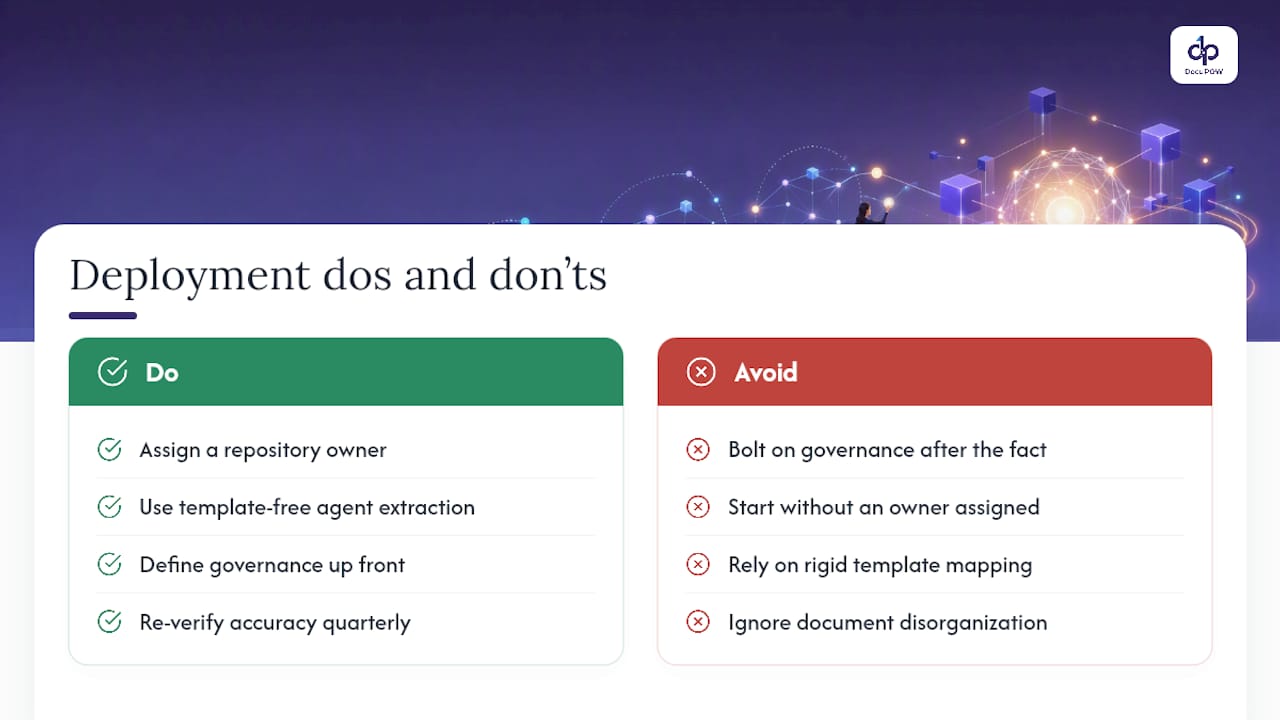
Template-free extraction changes that calculus. Instead of mapping every contract type to a rigid field structure before you start, an agent-based approach reads context directly from each document, which cuts the manual setup work that usually eats the first month of any pilot.
The teams that get this right treat governance as a design decision, not an afterthought bolted on after a vendor complains about a security review. Decide who owns escalation, what “confidence enough to trust” means for your business, and how you’ll re-verify accuracy every quarter, before you scale past a single workflow.
— Syed Naveed Abbas
How DocuPOW Supports Your AI-CLM Rollout
DocuPOW aligns directly with the phased rollout legal and procurement teams actually need: template-free extraction for phase one repository cleanup, agent-based workflow orchestration for phase three integration, and real-time analytics that carry you into phase four monitoring. Unlike tools that need every contract type pre-mapped to a template, DocuPOW’s agents read context directly from the document itself, which is exactly the manual work that slows most pilots down.
When you request a demo, bring a known-answer sample from your own contract set and ask for an integration test against your ERP or procurement stack alongside a walkthrough of DocuPOW’s security controls. That’s the fastest way to know if it holds up before you commit budget. Explore the template-free extraction platform or check DocuPOW’s enterprise automation services to scope a pilot around your highest-volume contract workflow.
Sources
- How AI enhances contract lifecycle management
- Transforming contract management with generative AI | EY – US
- Contract lifecycle management with AI: PwC
FAQ
How Can AI Be Used in Contract Management?
AI extracts metadata and clauses, answers natural-language questions with source links, flags playbook deviations during drafting, tracks obligations, and, at the most advanced tier, executes multi-step renewal or onboarding workflows behind human review gates.
What Is the Best AI Contract Management Software?
The right choice depends on your repository’s condition and integration needs rather than any single “best” answer; platforms like DocuPOW that use template-free extraction reduce setup work for organizations without standardized contract templates.
Will Contract Management Be Replaced by AI?
No. AI automates extraction, drafting suggestions, and routine review, but human oversight remains necessary for final approvals and exception handling, which shifts legal roles toward governance rather than eliminating them.
What Are the Five Stages of Contract Lifecycle Management?
The stages are typically request and initiation, drafting and negotiation, review and approval, execution and signature, and post-signature management including obligation tracking and renewal.
How Long Does an AI-CLM Pilot Usually Take?
A focused pilot on a single workflow, like renewal management, with a known-answer validation set typically takes a few weeks to a few months depending on repository readiness, not a full year-long rollout.
Recommended
See DocuPOW on your documents.
Stop building templates. Start extracting data.