Contract Data Extraction: Weeks to Hours, With Buyer Checks
Contract data extraction can turn weeks of manual review into hours. Compare OCR and AI methods, human checks, audit trails, and vendor privacy controls.


Contract data extraction uses AI to turn clause text, dates, and party names buried in contract files into structured fields that feed CLM, ERP, and CRM systems. It cuts weeks of manual review down to hours, and the practical approach now favored by most teams combines automated extraction with human review on the fields that carry the most risk.
TL;DR:
- Define a field taxonomy and risk tiers before vendor demos, then label a representative test set that includes your oldest, messiest scanned contracts.
- Verify party names, auto renewal clauses, and payment obligations manually before extracted values enter downstream systems, where errors can trigger billing mistakes or unwanted renewals.
- Measure precision, recall, and F1 for each field, then route low confidence results for review and record the approver, timestamp, source, and model version.
- Confirm vendor data use in writing, including whether customer contracts train models, and negotiate subprocessors, export formats, deletion timelines, and exit assistance before signing.
- Use template based extraction only for standardized layouts; varied contracts favor template free methods, while scanned files first need OCR and messy examples in a pilot.
Table of Contents
- What to Extract From Contracts: Fields, Clauses, and Priority Items
- How Modern Extraction Methods Work: OCR, NLP, and Agentic Approaches
- Implementation Checklist: Moving From Pilot to Production
- Accuracy, Validation, and Governance: Metrics, Test Sets, and Audit Trails
- Vendor Evaluation: Privacy, Subprocessors, and Exit Rights
- DocuPOW’s Approach: Agentic, Template-Free Extraction in Practice
- What the Research Gets Right, and What It Misses
- See How Template-Free Extraction Fits Your Contract Workflow
- FAQ
- Sources
What to Extract From Contracts: Fields, Clauses, and Priority Items
Not every data point in a contract matters equally, so the first task is deciding what to pull and in what order. Most extraction programs start with core metadata: contracting parties, effective date, expiration date, signature date, and a unique contract identifier. These fields populate dashboards and trigger renewal alerts, so they are usually the first targets.
Beyond metadata, certain clauses carry outsized operational and legal weight:
- Renewal and auto-renewal terms, which determine whether a contract rolls over without action
- Termination notice periods, which set the window for exiting an agreement
- Payment terms, including amounts, schedules, and penalties for late payment
- Indemnities and liability caps, which define financial exposure
- Confidentiality obligations and governing law, which shape dispute resolution
Party names, auto-renewal clauses, and payment obligations deserve immediate human verification before any downstream system treats them as fact. A misread party name or missed renewal date can cascade into a billing error or a contract that renews when nobody intended it to.
How Modern Extraction Methods Work: OCR, NLP, and Agentic Approaches
Extraction starts with getting readable text out of the document. Scanned contracts need optical character recognition (OCR) to convert images into machine-readable text, while digital-born PDFs and Word files can often be parsed directly, preserving more structure and accuracy from the start.
Once text is available, the extraction model itself can take a few forms:
- Prebuilt models trained on common contract types, ready to use with little setup
- Custom-trained or fine-tuned models, built on labeled examples from your own contract library
- Template-based extraction, which relies on fixed layouts and breaks when a new format appears
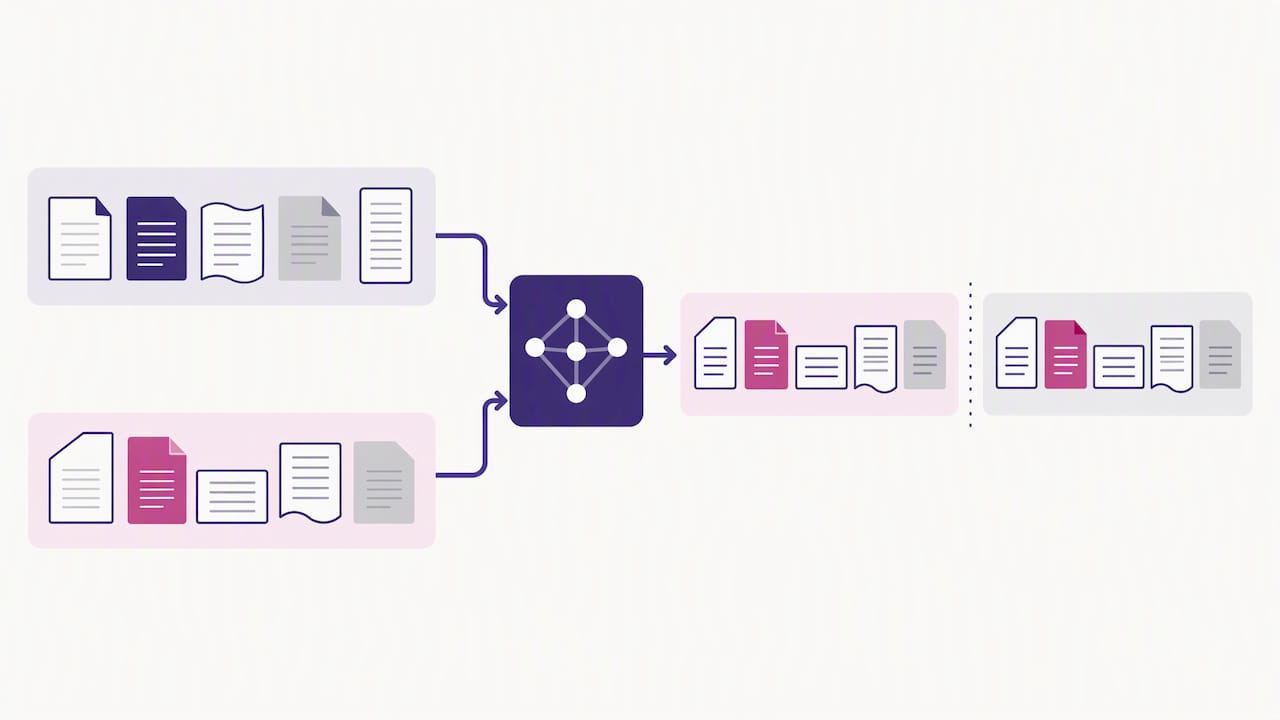
- Template-free or agentic extraction, which reads context and clause meaning rather than fixed positions, adapting to layouts it has never seen
Research on contract datasets shows that larger, expert-labeled corpora materially improve how well these models generalize, which is why labeling effort during a pilot pays off later (CUAD). Hybrid systems that combine machine learning with rule-based post-processing and layout analysis have reported strong results on scanned contract extraction tasks (OCRMiner research).
Once fields are extracted, they need a canonical format, typically JSON or CSV, mapped to the field names your CLM or ERP expects.
Pro Tip: Run a small batch of your messiest, oldest scanned contracts through any tool you evaluate before trusting it on clean digital files.
Implementation Checklist: Moving From Pilot to Production
A pilot that skips steps tends to stall at the review stage, so it helps to follow a sequence rather than jumping straight to a vendor demo.
- Inventory your contract documents and classify them by format: scanned, native PDF, or Word, then sample a representative set across contract types.
- Define a field taxonomy covering the metadata and clauses you need, and label a test set against that taxonomy.
- Run a pilot: choose a prebuilt or custom-trained model, set acceptance criteria for accuracy before expanding scope.
- Build human-in-the-loop gates for high-risk fields like auto-renewals and payment terms, capturing who approved each one and when.
- Integrate extracted outputs into CLM, ERP, or CRM systems with explicit field mapping and defined error handling for mismatches.
- Set up ongoing monitoring: track field-level accuracy, watch for model drift, and schedule periodic revalidation against fresh samples.
The GAO notes that AI can help analyze contract data and match terms at scale. However, outputs need to stay traceable to source documents, and human review remains necessary because of the risk of automation bias in AI-assisted contracting tasks.
Statistic Callout: Representative, documented test sets are central to demonstrating that an extraction model generalizes beyond its training data, according to NIST’s AI Risk Management Framework. Skipping this step is one of the most common reasons pilots look good in a demo but underperform in production.
Accuracy, Validation, and Governance: Metrics, Test Sets, and Audit Trails
Trusting extracted data in production means measuring it the same way you would measure any other business-critical system. Field-level precision, recall, and F1 scores tell you how often a model gets a given field right, and setting confidence thresholds per field lets you route uncertain extractions to a human reviewer automatically rather than guessing.
NIST’s framework recommends pairing these computational metrics with documented, representative test sets and human-AI teaming rather than relying on accuracy numbers alone (NIST AI RMF). In practice, that means:
- Testing against a sample that reflects your actual contract mix, not just clean examples
- Logging a named reviewer’s approval on high-risk fields, timestamped and linked to the source document
- Keeping audit logs of which model version produced which extraction
- Maintaining data lineage so any downstream figure can be traced back to its source clause
Named-reviewer provenance matters because it prevents automation bias, the tendency to accept a model’s output simply because it was produced by a system rather than a person. Documented test methodology and version history also make it far easier to answer an auditor’s questions later.
Vendor Evaluation: Privacy, Subprocessors, and Exit Rights
Choosing a contract extraction vendor is as much a procurement and legal exercise as a technical one. The FTC’s 2024 guidance makes clear that companies offering AI services cannot use customer data to train models without clear, conspicuous notice and affirmative express consent, and that disclosures hidden behind hyperlinks or fine print do not satisfy that bar. Confirm in writing how a vendor handles your contract data before you sign.
Beyond data-use commitments, a thorough evaluation checks for:
- Disclosure of subprocessors, cloud hosts, and underlying model providers, with notice before any change
- Clear exit rights, including data export formats, deletion timelines, and transition assistance
- Contractual audit rights and service-level agreements tied to accuracy, not just uptime
- Enforceable restrictions on how extracted data can be used or shared
A structured vendor checklist built around these domains, including security posture and procurement controls, mirrors guidance used in legal-sector AI evaluations (AI Product Evaluation Checklist). For teams building out a broader vendor security review, a practical guide to assessing supplier risk is a useful companion to this checklist (vendor risk guide).
Pro Tip: Ask for exit terms in writing before you sign, not after you decide to leave. Switching costs tend to surface only once a vendor relationship is already deep.
DocuPOW’s Approach: Agentic, Template-Free Extraction in Practice
We built our extraction engine around agentic, template-free processing, meaning it reads the context of a contract rather than matching it against a fixed layout. That removes the setup and maintenance burden that comes with template-based tools, since a new contract format does not require retraining before it can be processed.
Enterprise teams have reported significant reductions in processing time, which we attribute to skipping the template-matching step entirely. Our conversational querying feature lets reviewers ask a document questions directly and get answers with source citations, which keeps extracted data auditable as it flows into analytics and downstream systems.
What the Research Gets Right, and What It Misses
The volume of guidance on contract data extraction tends to overweight model selection and underweight governance design. Picking between a prebuilt model and a custom-trained one matters less than most vendor pitches suggest, because both approaches fail the same way when nobody defines what “accurate enough” means for a given field before the pilot starts.
The conventional advice to “test accuracy and compare vendors” is incomplete without a parallel track on exit rights and data use commitments, since a model that performs well but locks your contract data into a proprietary format has just traded one risk for another. Teams that treat vendor evaluation and accuracy testing as a single, combined checklist tend to avoid both traps at once.
If there is one place to start, it is defining your field taxonomy and risk tiers before evaluating any tool. A vendor demo looks convincing on any contract; it is your own messiest, oldest documents that reveal whether an approach actually holds up.
— Syed Naveed Abbas
See How Template-Free Extraction Fits Your Contract Workflow
The checklist above only works if the underlying extraction adapts to your actual contract mix instead of forcing you to rebuild templates every time a new format shows up. That is the gap our agentic, template-free approach closes: we extract from any document layout without the setup cycle that template-based tools require, while keeping human-in-the-loop review on the fields that need it.
If this matches a gap in how your team currently handles contracts, our pricing page lays out the Starter, Professional, and Enterprise plans, and our platform overview walks through how the extraction and integration pieces connect end to end.
FAQ
What is an example of data extraction?
A common example is pulling the renewal date, payment terms, and contracting parties out of a signed PDF and turning them into structured fields a spreadsheet or database can use. Contract data extraction applies this same process specifically to legal agreements, converting clause language into fields that feed CLM or ERP systems.
Can ChatGPT analyze a contract?
General-purpose language models can summarize or answer questions about a contract’s text, but they are not purpose-built for structured field extraction at scale or for the audit trails that enterprise workflows require. Purpose-built extraction tools add field-level confidence scoring, provenance tracking, and system integrations that a general chat interface does not provide by default.
What does contract data mean?
Contract data refers to the structured information embedded in an agreement, including party names, dates, payment terms, and clauses like termination or indemnification. Once extracted, this data can populate dashboards, trigger alerts, and feed reporting across procurement, legal, and finance systems.
What is the best tool for data extraction?
The right tool depends on your document mix: template-based tools work for highly standardized forms, while template-free, agentic extraction tends to perform better across varied or unfamiliar contract layouts without retraining. We use the agentic, template-free approach specifically to handle that variability while keeping human review in the loop for high-risk fields.
Sources
- AI Companies: Uphold Your Privacy and Confidentiality Commitments | Federal Trade Commission
- Artificial Intelligence: Uses and Risks for Small Business Contracting and Innovation Research | GAO
- NIST AI Risk Management Framework (AI RMF) | NIST
- CUAD: An Expert-Annotated NLP Dataset for Legal Contract Review
Recommended
See DocuPOW on your documents.
Stop building templates. Start extracting data.