Compliance Teams: 7 NIST Aligned Controls for Secure AI Processing
Actionable controls to secure AI document pipelines for compliance teams. See seven baseline controls, a pipeline checklist, and how they map to the NIST...


Secure AI document processing requires seven baseline controls: validated ingestion, redaction or tokenization before any model sees the data, permission-aware retrieval, envelope encryption backed by a proper key management system, least-privilege access, tamper-evident audit logging, and documented testing and evaluation (TEVV). Compliance teams should operationalize all seven using the NIST AI Risk Management Framework’s four functions, Govern, Map, Measure, and Manage, rather than treating security as a one-time review. Platforms like DocuPOW build several of these controls into the extraction layer itself.
TL;DR:
- Ensuring secure AI document processing requires all seven baseline controls to be operational at each pipeline stage, including validation, redaction, encryption, and audit logging.
- Derivative data like embeddings and logs can leak sensitive information if redaction and permission checks are not applied consistently throughout preprocessing, inference, and retrieval.
- Implementing strict access controls during ingestion and tagging each data chunk with permissions automatically enforces confidentiality during retrieval, especially when integrated with envelope encryption.
- Regular testing and evaluation, such as accuracy benchmarks, redaction validation, and drift monitoring, are essential for maintaining security and compliance over time.
- Starting with low-risk document types and gradually scaling up controls, combined with continuous governance review, reduces exposure before handling highly sensitive data.
Table of Contents
- Why Sensitive Document AI Pipelines Carry Different Risks
- A Stage-by-Stage Controls Checklist for Document AI Pipelines
- Secure Architecture Patterns That Make RAG Safe for Sensitive Documents
- Mapping Document AI Governance to the NIST AI RMF
- Testing, Validation, and Continuous Assurance for Document AI
- A 90-Day Playbook for Deploying a Secure Document AI Pipeline
- How DocuPOW Approaches Secure Document Processing
- How DocuPOW Fits Into a Secure Document Pipeline
- Standards and Resources Worth Reading Next
- Sources
- FAQ
Why Sensitive Document AI Pipelines Carry Different Risks
Traditional document security assumes a file sits somewhere and access is either granted or denied. AI pipelines break that assumption because every processing step generates a new copy of the data in a different form. OCR output, vector embeddings, model logs, and even the model’s own responses all inherit the sensitivity of the source document, whether anyone intended that or not.

That derivative data is where most exposure actually lives. A redacted PDF can still leak the redacted text through its OCR layer or its embedding vectors if nobody thought to apply the same rule twice.
Threats specific to this pipeline shape include:
- Prompt injection, where malicious text embedded in a document instructs the model to ignore its guardrails or exfiltrate other users’ data.
- Model exfiltration, where an attacker queries an inference endpoint repeatedly to reconstruct training or context data.
- Data poisoning, where corrupted documents skew extraction accuracy or plant triggers for later exploitation.
- Telemetry leaks, where debug logs or monitoring dashboards capture raw text that was supposed to stay redacted.
- Malformed or embedded content, such as macros or hidden layers in scanned files that exploit parser vulnerabilities.
Trust boundaries in these systems typically fall at four points: the preprocessing step where files first get parsed, the inference endpoint where a model reads content, any external model call that leaves your infrastructure, and the logging layer that records what happened. Security-by-design principles for OCR treat confidentiality and accountability as core requirements at each of those boundaries, not bolted-on extras.
A Stage-by-Stage Controls Checklist for Document AI Pipelines
Mapping controls to each stage of the pipeline gives engineering and compliance teams a shared checklist instead of a vague mandate to “secure the AI.” Here is the sequence, in the order data actually flows.
- Ingest. Validate file types, scan for malware, and route uploads through an intake zone that quarantines anything unrecognized before it touches a parser.
- OCR and preprocessing. Canonicalize formats, apply deterministic redaction and tokenization rules, and run this step on ephemeral workers that don’t persist intermediate files.
- Inference. Favor private or VPC-hosted models over public APIs where possible, use scoped tokens and mutual TLS for every call, and back your key management with a hardware security module. If you use an external model, insist on a no-data-retention clause in the contract.
- Retrieval and RAG. Tag chunks with access control lists at the moment of ingest, gate retrieval so a query only returns chunks the requester is actually permitted to see, redact sensitive spans before anything reaches a prompt, and require citations so every answer traces back to an auditable source.
- Storage and retention. Keep separate retention schedules for raw scans, extracted text, embeddings, and metadata. Bind deletion timers at the moment of intake so nothing lingers by default.
- Logging and audit. Redact or tokenize log content, write logs to tamper-evident storage, and record who accessed what, when, and for what stated purpose.
- Operational controls. Enforce least-privilege role-based access, rotate keys on a fixed schedule, run inference on ephemeral compute where feasible, and keep an incident response plan specific to AI pipeline failures.
Permission-aware retrieval deserves special weight here. Secure RAG system design treats access control lists as something you can only attach reliably at ingest, since reconstructing who was allowed to see a chunk after it has been embedded and stripped of context is nearly impossible.
Pro Tip: Run regular permission drift tests: periodically pick a sample of documents whose access rules changed after ingestion, then confirm your retrieval layer actually reflects the new permissions instead of the ones baked in at indexing time.
Secure Architecture Patterns That Make RAG Safe for Sensitive Documents
Envelope encryption is the backbone of any document AI system handling regulated data. A data encryption key wraps the document content, and a separate key encryption key, held in a key management system, wraps that key in turn. Inference jobs decrypt only what they need for the duration of the call, which keeps cleartext exposure to a narrow window instead of a standing risk.
Chunking strategy matters just as much as encryption. When you split a document into pieces for embedding, attach the source document’s access control list to every chunk at that same moment. Permissions that travel with the vector, rather than living in a separate table someone has to remember to check, are what make permission-aware retrieval actually enforceable later.
A retrieval gateway sits between the user’s query and the vector store, and it should enforce the intersection of relevance and permission, not relevance alone. A few practices define this pattern:
- Redact sensitive spans from retrieved chunks before they ever enter a prompt.
- Delimit retrieved content clearly from system instructions so injected text inside a document can’t masquerade as a command.
- Log the exact chunks returned for every query, tied to the requester’s identity.
The OWASP catalog of generative AI risks lists prompt injection as one of the most common attack vectors against exactly this kind of retrieval layer, which is why delimiting retrieved content is not optional polish.
Deployment choice shapes how much of this you control directly. On-premises or VPC-hosted models give you full visibility into where data lives, at the cost of more infrastructure to manage. Contractually constrained external models can match that privacy bar on paper, through no-retention and no-training clauses, but you’re trusting a vendor’s implementation rather than verifying it yourself.
Mapping Document AI Governance to the NIST AI RMF
The NIST AI RMF gives compliance teams four functions to organize governance work around, and each one maps to concrete deliverables rather than abstract principle.
Govern means writing the policy that says who owns AI risk decisions, maintaining a model inventory, and setting documentation standards before any pipeline goes live. Map means scoping intended use for each document class, cataloging what data types flow through the system, and binding purpose to classification so a contract document and a medical record don’t get treated identically. Measure means running TEVV processes on a defined schedule, testing for both privacy leakage and bias, and tracking security and resilience metrics over time, not just at launch. Manage means having a risk treatment plan, an incident response procedure specific to AI failures, and a rollback path if a model version starts misbehaving in production.
The NIST AI RMF Playbook recommends specific artifacts that turn these functions into something an auditor can actually review:
- Model cards documenting training data sources and known limitations.
- Impact assessments scoped to each document class and use case.
- TEVV reports showing test methodology and results, not just pass/fail summaries.
- Audit playbooks that walk a reviewer through how to verify a control is functioning.
NIST frames this as continuous and cross-cutting rather than a single approval gate, and that framing matters. A pipeline that passed governance review in January can drift out of compliance by June if nobody re-checks it.
Testing, Validation, and Continuous Assurance for Document AI
TEVV, test, evaluation, verification, and validation, is where most document AI projects either earn trust or lose it. The NIST AI 100-1 Core document treats security and resilience testing as core measurement activities, not afterthoughts bolted on before launch.
- Pre-deployment benchmarking. Run accuracy benchmarks against a held-out dataset, quantify uncertainty in extraction confidence scores, and get an independent reviewer, not the team that built the pipeline, to sign off.
- Redaction and exfiltration testing. Feed synthetic PII through the pipeline and measure recall and precision on what gets caught, then run known prompt injection payloads against the retrieval layer to see what leaks.
- Adversarial parser testing. Fuzz document parsers with malformed files, since a crashed or misbehaving parser is often the first crack an attacker finds.
- Drift monitoring. Watch for query pattern anomalies, shifts in output entropy that might signal model degradation, and access pattern alerts that flag unusual retrieval behavior.
Pro Tip: Schedule redaction testing on the same cadence as your key rotation policy. Both drift silently, and pairing the reminders means neither gets forgotten.
Treat re-testing as a calendar item, not a response to an incident. Audit readiness improves dramatically when TEVV reports already exist rather than getting assembled the week before a review.
A 90-Day Playbook for Deploying a Secure Document AI Pipeline
Rolling out secure AI document processing in phases lets you catch problems on low-risk data before they touch anything regulated.
- Phase 0 (weeks 1 to 2): Scope and threat model. Identify stakeholders across security, legal, and the business unit, inventory your document types, build a threat model for the pipeline, and assemble a synthetic pilot dataset that mimics sensitive data without using any real records.
- Phase 1 (weeks 3 to 5): Secure ingestion. Implement intake validation, malware scanning, and OCR with redaction and tokenization hooks built in from the start.
- Phase 2 (weeks 6 to 9): Permission-aware retrieval. Deploy the RAG gateway with access control list tagging at ingest and redaction-before-prompt enforced on every query.
- Phase 3 (weeks 10 to 12): Instrumentation. Turn on TEVV testing, drift monitoring, and tamper-evident logging, and bind retention policies so deletion timers start automatically.
- Phase 4 (ongoing): Governance operationalization. Produce the model cards, impact assessments, and audit playbooks the NIST AI RMF calls for, then schedule recurring revalidation.
Start with your lowest-risk document classes, invoices without personal data, public filings, internal memos, and hold your highest-risk categories back until Phase 2 controls are live and tested.
| Phase | Weeks | Primary deliverable |
|---|---|---|
| Phase 0 | 1 to 2 | Threat model and synthetic pilot dataset |
| Phase 1 | 3 to 5 | Secure ingestion with redaction hooks |
| Phase 2 | 6 to 9 | Permission-aware RAG gateway live |
| Phase 3 | 10 to 12 | TEVV, monitoring, and audit logging instrumented |
| Phase 4 | Ongoing | Governance artifacts and recurring audits |
How DocuPOW Approaches Secure Document Processing
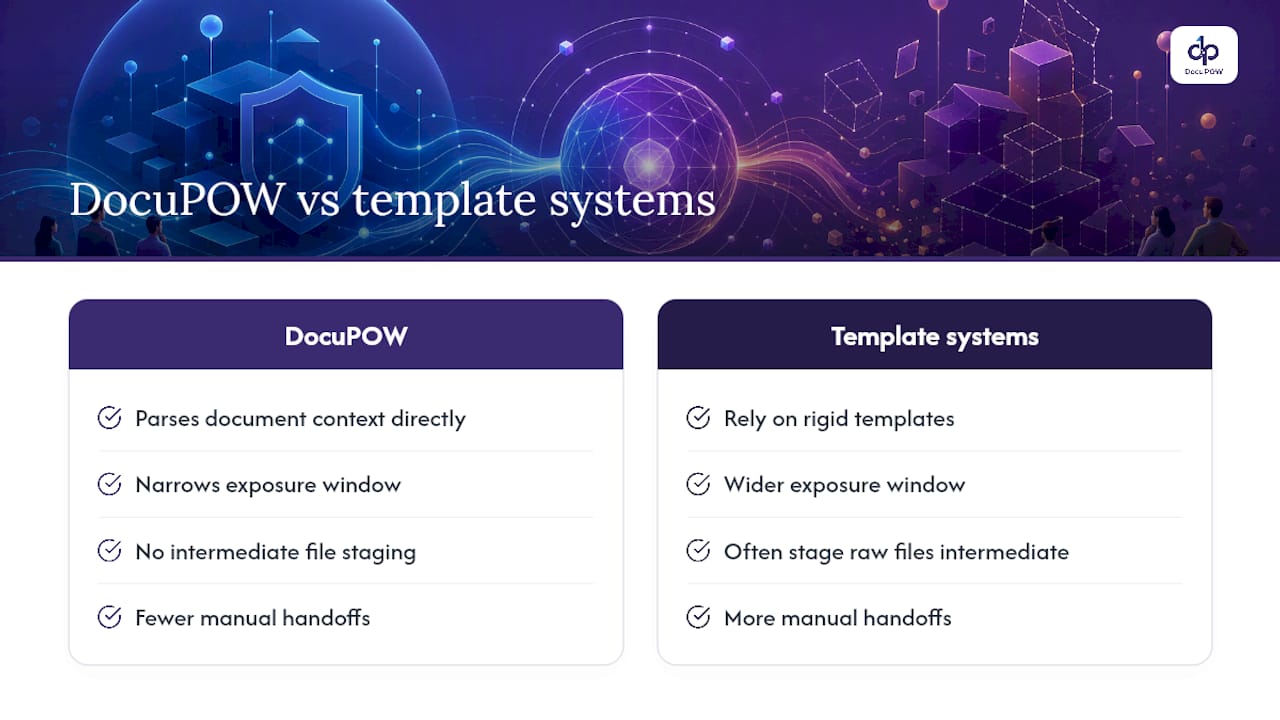
DocuPOW’s autonomous agents parse document context directly instead of relying on rigid templates, which narrows the exposure window inherent in template-based extraction tools that often require staging raw files in intermediate formats. Fewer manual handoffs mean fewer places sensitive data can sit unmonitored.
Real-time analytics built into the platform give compliance teams continuous visibility into extraction activity, rather than the periodic spot-checks that template-based systems typically depend on. That visibility matters more than most teams expect once a pipeline is running dozens of document classes simultaneously, because problems tend to surface in the gaps between scheduled reviews.
How DocuPOW Fits Into a Secure Document Pipeline
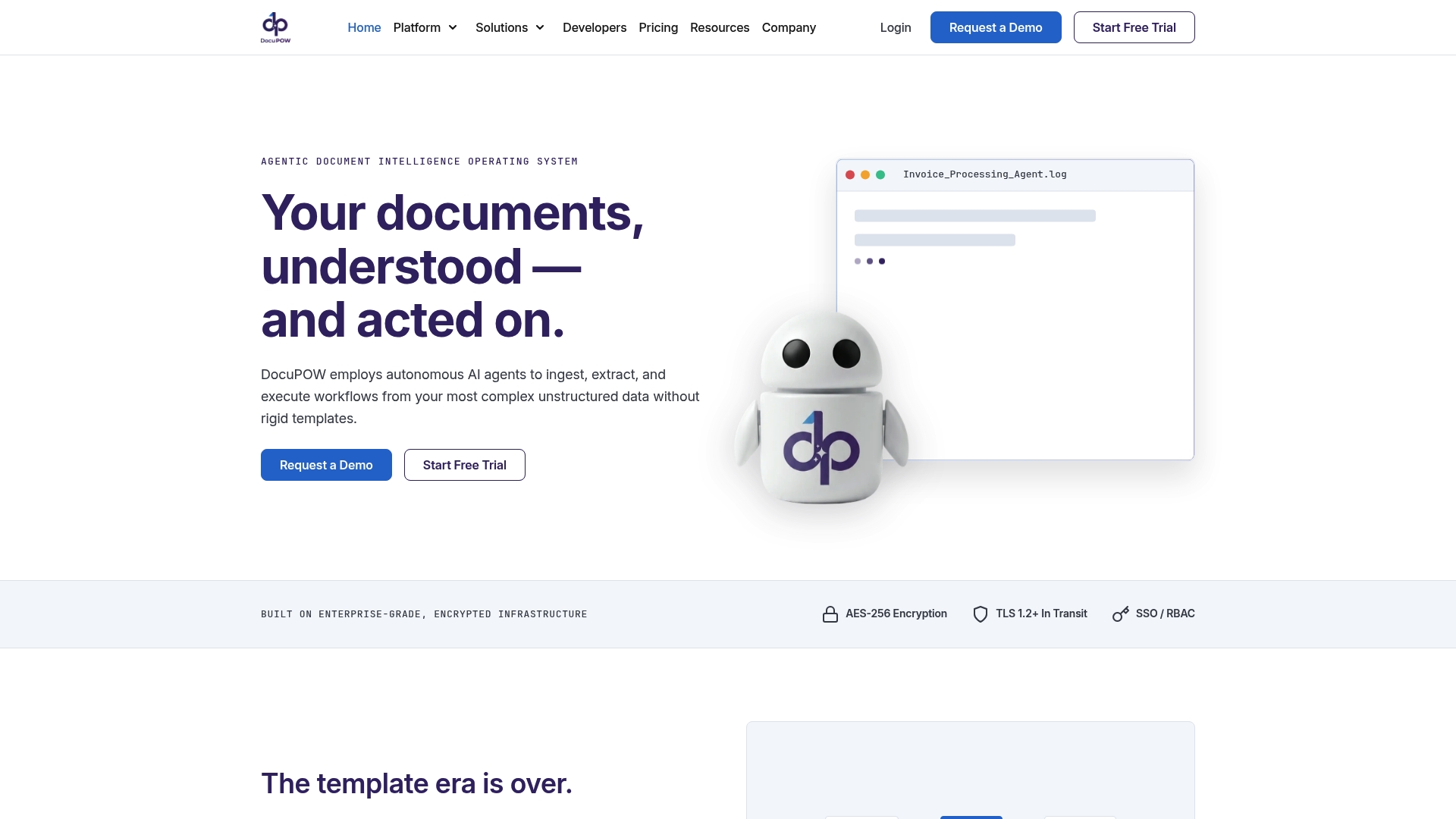
Building every control in this guide from scratch, ingestion validation, permission-aware retrieval, tamper-evident logging, TEVV instrumentation, takes most teams months of engineering time before a single production document gets processed. DocuPOW compresses that timeline by handling template-free extraction and multi-step workflow orchestration with enterprise security controls already built into the platform, so your team spends its cycles on governance and validation instead of infrastructure.
The platform’s document processing case studies show how manufacturers and other enterprises have applied agent-based extraction to high-volume document workflows without rebuilding their security stack from zero. If your team is scoping a pilot, start with a synthetic dataset that mirrors your sensitive document classes, request a security brief covering DocuPOW’s encryption and access control implementation, and schedule a demo to see how the permission model maps to your existing role structure.
Standards and Resources Worth Reading Next
Start with the NIST AI RMF and its companion playbook, the National Archives’ CUI guidance for handling controlled unclassified information, and OCR security-by-design principles for parser hardening. Partners like gamgi’s transparency framework offer useful models for audit documentation as well.
Sources
- AI Risk Management Framework | NIST
- AI RMF resources (playbook) — NIST AIRC
- Artificial Intelligence Risk Management Framework: Core (NIST AI 100-1)
- Ocr
FAQ
How Can AI Be Used for Document Processing?
AI extracts structured data from unstructured documents through OCR combined with context-aware models that identify fields, relationships, and meaning without relying on rigid templates. Secure implementations pair this extraction with redaction, tokenization, and permission-aware retrieval so sensitive fields never reach a model or a log unprotected.
What Is the Difference Between IDP and OCR?
OCR converts images of text into machine-readable characters, while intelligent document processing (IDP) goes further by using AI to understand document structure, context, and meaning to extract usable data. IDP typically includes OCR as one component within a larger pipeline that also validates, classifies, and routes extracted information.
Is There Such a Thing as Secure AI?
AI systems can be made secure through layered controls, envelope encryption, permission-aware access, tamper-evident logging, and TEVV, but security is a continuous practice rather than a fixed state, per the NIST AI RMF’s emphasis on lifecycle risk management. No AI deployment is permanently secure without ongoing testing and monitoring.
What Is the Best AI for Processing Documents Securely?
The best choice depends on your document volume, sensitivity, and existing infrastructure, but platforms built with permission-aware retrieval, encryption, and audit logging as core features rather than add-ons hold a clear advantage. DocuPOW’s agent-based approach builds several of these controls into the extraction layer itself, which reduces the custom engineering work compliance teams would otherwise need to build separately.
How Do You Secure AI-Processed Documents Against Prompt Injection?
Delimit retrieved content clearly from system instructions, redact sensitive spans before they reach a prompt, and enforce permission-aware retrieval so injected instructions in one document can’t surface another user’s data. The OWASP GenAI risk catalog recommends treating every retrieved chunk as untrusted input until it passes these checks.
Recommended
See DocuPOW on your documents.
Stop building templates. Start extracting data.