Author: Naveed Abbas

  • AI Agent Development Company: 2026 Evaluation Guide

    AI Agent Development Company: 2026 Evaluation Guide


    TL;DR:

    • The best AI agent development companies deliver production-ready systems with deep API integration, transparency, and monitoring. They design scalable workflows, avoid vendor lock-in, and conduct thorough scoping phases like Agent Design Sprints to prevent costly failures. Choosing a partner requires verifying live deployments, open architecture, and ongoing support to ensure reliable, maintainable solutions.

    An AI agent development company builds autonomous software agents that observe environments, make decisions, take actions, and improve workflows without constant human input. Unlike a basic chatbot, a production AI agent integrates with live systems, manages state across multi-step tasks, and escalates to humans when it hits the edge of its defined autonomy. Choosing the right AI agent development company requires evaluating production experience, integration depth, and systems engineering discipline. This guide covers the key capabilities, frameworks, pricing, and selection criteria that business leaders need to make a confident decision in 2026.

    1. What capabilities distinguish a top-tier AI agent development company?

    The best AI agent development firms deliver more than a working demo. They build agents that hold up in production, under real data, real edge cases, and real compliance requirements.

    Hands pointing at laptop in monitoring discussion

    Tool use architecture and API integration depth separate production builders from prototype shops. A capable firm designs agents that call external APIs, query databases, and retrieve documents in a coordinated sequence. This API integration depth is what makes an agent genuinely useful rather than a glorified search box.

    Planning and reasoning transparency is non-negotiable for regulated industries. Production AI agents log decision reasoning chains to provide full traceability for audit and compliance needs. That means every action the agent takes is traceable, which matters enormously in finance, healthcare, and manufacturing.

    Human escalation mechanisms define the boundary between automation and risk. AI agents require human escalation pathways for situations beyond their defined autonomy boundaries. A firm that skips this design step is building an agent that will eventually make a costly unsupervised mistake.

    Production monitoring and drift detection keep agents reliable after launch. Models degrade as data patterns shift, and a firm without observability tooling will leave you managing failures reactively.

    Multi-agent orchestration and state management matter for complex workflows. Coordinating multiple specialized agents, each handling a distinct task, requires architectural discipline that only experienced firms possess.

    Pro Tip: Ask any prospective firm to show you a production monitoring dashboard from a live client deployment. If they cannot, they are selling you a prototype capability, not a production one.

    2. What are the main AI agent development frameworks?

    Framework choice shapes everything from how an agent reasons to how easy it is to maintain. Multi-agent orchestration frameworks differ significantly: LangGraph handles stateful workflows, LangChain supports general-purpose agents, and AutoGen coordinates multi-agent systems.

    Framework Architecture Best use case Key limitation
    LangChain Chain-based General agents, RAG pipelines Limited native state management
    LangGraph Graph-based Stateful, multi-step workflows Steeper learning curve
    AutoGen Multi-agent coordination Parallel agent collaboration Higher orchestration complexity
    Custom frameworks Proprietary Highly specialized workflows Vendor lock-in risk

    The choice between open-source and proprietary frameworks carries real business consequences. Vendor lock-in is a critical risk, and best practices include using open-source frameworks with client ownership of prompt logic and orchestration code. That means if you ever switch vendors, you keep your intellectual property and your architecture.

    For most enterprise document automation workflows, LangGraph is the strongest choice because it natively handles the conditional branching and state persistence that document processing requires. AutoGen fits scenarios where parallel agents need to collaborate, such as a research agent feeding outputs to a summarization agent. LangChain works well for simpler retrieval-augmented generation tasks where state management is minimal.

    The right firm will recommend a framework based on your workflow complexity, not on what they already know. A firm that defaults to one framework for every client is optimizing for their own efficiency, not yours.

    3. What does a typical AI agent development project cost and how long does it take?

    Enterprise-grade AI agent projects are not cheap or fast. Production cutover typically takes 4–14 weeks and costs about $47,000 per single agent engagement. That figure reflects the real engineering effort involved, not a sales estimate.

    Pricing breaks down by project phase and complexity:

    Phase Typical cost Timeframe
    Agent Design Sprint $3,500–$5,000 5–7 days
    Discovery and scoping $5,000–$15,000 1–2 weeks
    Simple agent build $15,000–$50,000 3–6 weeks
    Complex agent build $50,000–$150,000 6–12 weeks
    Multi-agent system $100,000–$500,000 10–20 weeks
    Ongoing support $2,000–$10,000/month Continuous

    The most underestimated cost driver is integration engineering. Most engineering effort focuses on integration plumbing, including APIs and databases, taking 2–4 weeks. That is often more time than the AI modeling itself. Teams that budget only for the model miss the bulk of the real work.

    Industry best practice avoids direct-to-production deployment. Standard practice includes two weeks of shadow mode where the agent runs alongside humans for review before operating autonomously. That shadow period is not optional overhead. It is the difference between a controlled rollout and a production incident.

    Pro Tip: Never skip the Agent Design Sprint. A $3,500–$5,000 sprint that produces a technical specification prevents the ambiguity that causes six-figure project failures.

    4. How to evaluate and choose the right AI agent development partner

    Choosing among AI agent development companies requires more than reviewing a portfolio. You need evidence of production deployments, not polished demos.

    Start with these questions in your first vendor conversation:

    1. Can you show a live production deployment with monitoring dashboards?
    2. Who owns the prompt logic, orchestration code, and agent architecture after delivery?
    3. How do you handle tool call failures, API timeouts, and unexpected data formats?
    4. What does your human escalation design look like for edge cases?
    5. How do you detect and respond to model drift after launch?

    Red flags are easy to spot if you know what to look for. A vendor that cannot describe their failure mode planning in specific terms is not ready for production work. A vendor that retains ownership of your orchestration code is building dependency, not capability.

    Vendors that prioritize workflow scoping with detailed definitions of users, triggers, and data before writing a single line of code consistently deliver better ROI and operational reliability. Skipping this step is the single most common cause of AI agent project failures.

    The Agent Design Sprint is the clearest signal of a mature vendor. It costs $3,500–$5,000 and produces an implementable technical specification. Any firm that wants to jump straight to development without a scoping phase is optimizing for billing hours, not your outcome.

    Post-launch support is where most vendors fall short. Ignoring post-launch monitoring leads to costly failures. Continuous tuning is not optional for agents in production. Confirm that your contract includes monitoring, retraining triggers, and a defined escalation path for production issues.

    Knowledge transfer is the final test. A good partner leaves your team able to maintain, extend, and audit the agent without calling them for every change. If a vendor resists documenting their architecture, they are building a dependency, not a solution.

    Key takeaways

    The most effective AI agent development partner combines production-proven integration depth, open-source architecture, and a systems engineering approach to deliver agents that hold up in real business environments.

    Point Details
    Prioritize production proof Ask for live monitoring dashboards, not demos, before signing any contract.
    Budget for integration work API and database plumbing takes 2–4 weeks and drives most project costs.
    Start with a Design Sprint A $3,500–$5,000 sprint produces the technical spec that prevents costly failures.
    Demand open-source architecture Client ownership of prompt logic and orchestration code prevents vendor lock-in.
    Plan for post-launch monitoring Continuous tuning and drift detection are required for agents to stay reliable in production.

    What I’ve learned from watching AI agent projects succeed and fail

    I’ve watched organizations spend six figures on AI agent projects that never made it to production. The pattern is almost always the same. A vendor sells a compelling demo, skips the scoping phase, and delivers something that works perfectly on clean sample data and breaks immediately on the messy, inconsistent documents that real businesses actually use.

    The uncomfortable truth is that 40% of failure modes emerge during scenario stress testing against real-world noisy data. That number should change how you evaluate vendors. It means the majority of production failures are predictable and preventable, but only if the vendor runs rigorous stress tests before deployment.

    The firms that consistently deliver treat AI agent projects as systems engineering challenges, not software features. They think about infrastructure, governance, and observability from day one. They design for failure before they design for success.

    My strongest advice: insist on an Agent Design Sprint before any development begins. The specification it produces is not just a planning document. It is the clearest signal you will get about whether a vendor actually understands your workflow or is just pattern-matching to their last project.

    Open architecture is not a technical preference. It is a business requirement. The moment you accept proprietary orchestration code you cannot read or own, you have handed a vendor permanent leverage over your operations. That is a risk no operations leader should accept.

    — Sameer

    DocuPOW’s approach to AI-driven document automation
    https://docupow.ai

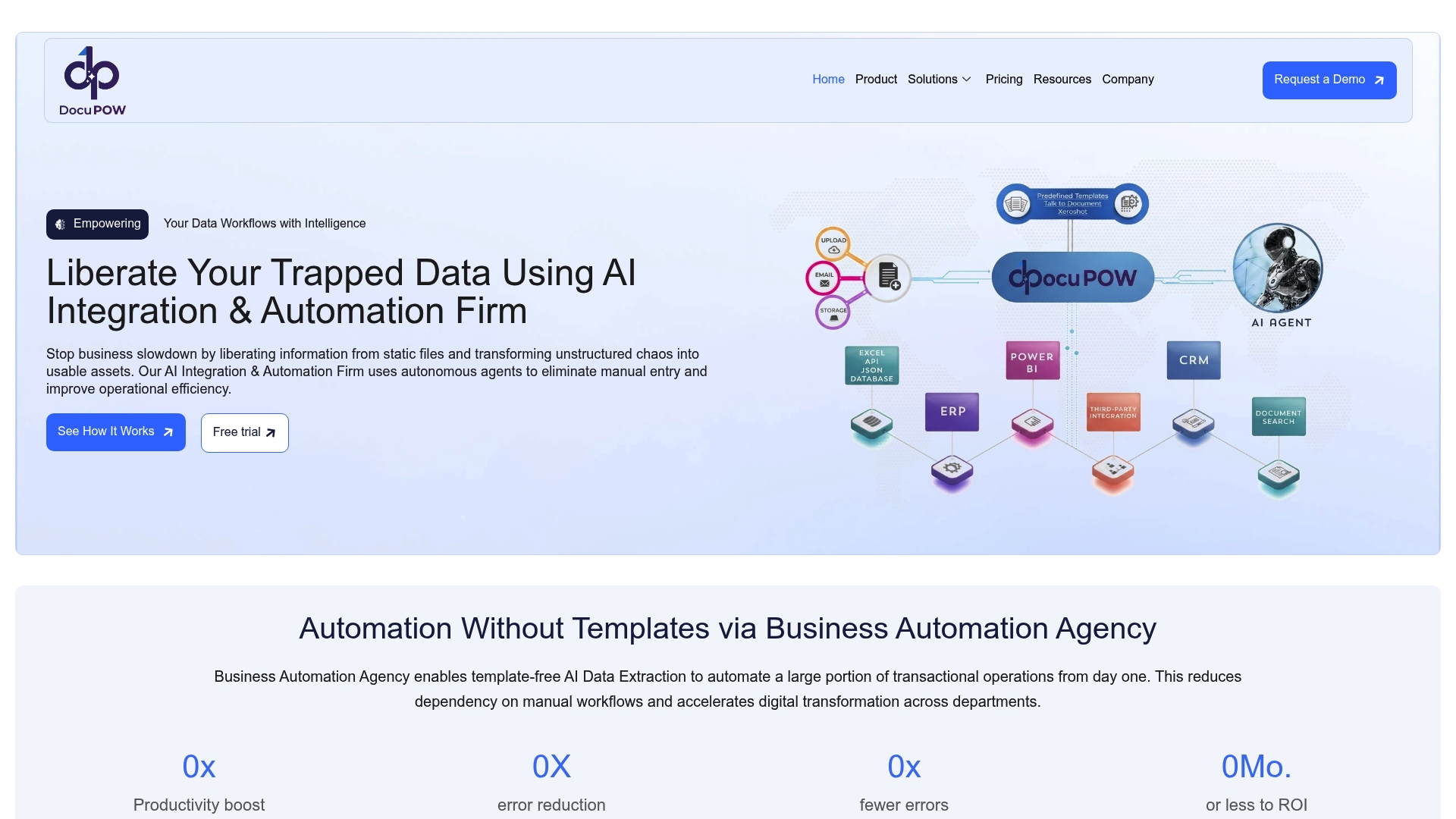
    DocuPOW applies the same production-first principles covered in this guide to document automation for enterprise teams. Its autonomous agents extract data from unstructured documents without rigid templates, integrate directly with existing business systems, and provide real-time analytics that shift teams from reactive to proactive decision-making. For operations leaders dealing with high document volumes, DocuPOW’s AI workflow automation services cover the full stack: integration engineering, agent orchestration, monitoring, and continuous improvement. Teams in real estate, construction, and back-office operations can also explore purpose-built solutions for document process automation that reduce manual entry and improve financial visibility at scale.

    FAQ

    What does an AI agent development company actually build?

    An AI agent development company builds autonomous software agents that connect to business systems, execute multi-step tasks, and make decisions without constant human oversight. These agents differ from chatbots because they take actions, not just generate responses.

    How long does it take to build a production AI agent?

    Enterprise AI agent projects typically take 4–14 weeks from kickoff to production cutover, with integration engineering alone requiring 2–4 weeks. Complex or multi-agent systems take longer.

    What is an Agent Design Sprint?

    An Agent Design Sprint is a 5–7 day scoping engagement that produces a detailed technical specification for an AI agent project. It costs $3,500–$5,000 and is the most reliable way to prevent scope failures before development begins.

    How do I avoid vendor lock-in with an AI agent partner?

    Require that all prompt logic, orchestration code, and agent architecture be delivered to you as client-owned assets. Insist on open-source frameworks like LangChain, LangGraph, or AutoGen rather than proprietary platforms.

    What should AI agent development services cost in 2026?

    Pricing ranges from $15,000–$50,000 for simple agents to $100,000–$500,000 for multi-agent systems, with ongoing support running $2,000–$10,000 per month. Discovery and scoping add $5,000–$15,000 before development begins.


  • AI Agents for Small Businesses: 2026 Practical Guide

    AI Agents for Small Businesses: 2026 Practical Guide


    TL;DR:

    • AI agents automate multi-step workflows for small businesses, increasing efficiency in document processing and customer service. They require careful deployment, supervision, and clean processes to deliver measurable ROI and minimize operational risk. Success depends on accurate data, human oversight, and phased implementation with clear performance tracking.

    AI agents for small businesses are specialized software programs that automate repetitive, rule-based tasks without requiring human input for each step. Unlike basic chatbots that handle a single exchange, AI agents complete multi-step workflows end to end, from extracting invoice data to routing approvals. The industry term for this category is “agentic AI,” and it covers everything from document processing to customer query triage. On no-code platforms, deployment takes 1.5 to 3 hours, with measurable ROI appearing within 30–60 days. Structured document workflows reach accuracy rates of 95–99%, making them one of the fastest wins available to small business owners today.

    1. What are the top AI agent types for small businesses?

    The ten categories below cover the most practical applications for small business operations. Each one targets a specific workflow where manual effort is high and the rules are clear enough for automation to succeed.

    1. Automated document processing agents These agents extract data from invoices, receipts, purchase orders, and forms. They push that data directly into accounting or ERP systems, cutting manual entry time significantly. Businesses processing high volumes of structured documents see the fastest returns here.

    2. Customer query triage and reply drafting agents These agents read incoming customer messages, classify them by topic and urgency, and draft replies for human review. They function as automated customer service tools that reduce response time without removing the human from the final send decision.

    3. AI scheduling and calendar management assistants These virtual assistants for SMEs handle meeting requests, check availability, send confirmations, and reschedule conflicts. They work well for service businesses where appointment volume is high and scheduling errors are costly.

    Man managing schedule with AI assistant at coworking space

    4. Inventory monitoring and exception flagging agents These agents watch stock levels against defined thresholds and alert the right person when action is needed. They do not place orders autonomously unless explicitly configured to do so, which keeps human judgment in the loop for purchasing decisions.

    5. Research and knowledge management assistants These agents search internal documents, databases, or the web and return structured summaries. They save hours of manual research for small teams that need competitive intelligence or regulatory updates.

    6. Sales lead and CRM data automation agents These agents pull contact data from emails, forms, and web sources, then populate CRM records automatically. They reduce the data entry burden that causes CRM adoption to fail in small businesses.

    7. Email classification and prioritization bots These agents sort incoming email by category, urgency, and sender type. They surface the messages that need immediate attention and archive the rest, cutting inbox management time for owners who handle their own communications.

    8. Meeting follow-up and action item summarizers These agents process meeting transcripts and extract decisions, owners, and deadlines. Agentic AI workflows commonly include meeting follow-ups as one of the first successful pilots for small teams.

    9. Content drafting helpers for marketing or client communication These agents generate first drafts of newsletters, social posts, or client update emails based on a brief or template. A human editor still reviews and approves, but the blank-page problem disappears.

    10. Workflow coordination agents connecting multiple tools These agents act as connectors, triggering actions across platforms when a condition is met. For example, when a signed contract lands in a shared folder, the agent creates a project record, notifies the team, and logs the event.

    Pro Tip: Start with one agent in one workflow. Owners who try to automate five processes at once typically see none of them succeed in the first 60 days.

    2. What features define effective AI agents for small business workflows?

    Choosing the right AI solution for your small business comes down to six criteria. The tool itself matters less than whether it fits your existing processes and data quality.

    Accuracy on structured documents

    Structured document automation delivers 95–99% accuracy on invoices, receipts, and standard forms. That number drops sharply when documents contain unstructured text, handwriting, or judgment calls. Know which document types you are automating before you commit to a platform.

    Ease of deployment

    No-code and low-code platforms let non-technical owners configure agents without writing code. The best platforms offer pre-built connectors for common tools like QuickBooks, Salesforce, and Gmail. If setup requires a developer, the total cost of ownership rises faster than most small business budgets allow.

    Integration with existing tools

    An AI agent that cannot connect to your CRM, accounting software, or email creates more work, not less. Prioritize platforms with native integrations over those requiring custom API work. Check the integration list before signing any contract.

    Human review gates

    Human-in-the-loop controls reduce operational risk and build trust in AI outputs during early adoption. Configure agents to draft or flag, not to act autonomously, until you have at least two weeks of clean performance data. This is especially critical for financial approvals and customer-facing communications.

    Logging and audit trails

    Effective AI agent rollouts include audit trails that log triggers, proposed actions, approval decisions, and error reasons. These logs are your safety net when something goes wrong and your evidence when something goes right.

    Clean processes before automation

    Clean, documented business processes matter more than the AI tool choice for successful automation. If your current invoice approval process has three people doing it differently, the agent will inherit that inconsistency. Fix the process first, then automate it.

    Pro Tip: Before evaluating any platform, write down the exact steps a human takes to complete the task you want to automate. If you cannot write it down clearly, the agent cannot follow it reliably.

    3. How to implement AI agents safely and measure ROI

    A staged rollout protects your business from costly mistakes and gives you the data to justify scaling. Follow this sequence.

    Step 1: Identify the right starting task

    Target repetitive, rules-based tasks with minimal judgment required. Invoice data extraction, appointment confirmations, and email sorting are strong starting points. Avoid automating tasks that require context, negotiation, or relationship management in the first phase.

    Step 2: Measure baseline performance

    Baseline measurement before automation is the step most small businesses skip, and it is the one that undermines ROI justification later. Time the task manually. Count errors and rework instances. Record cycle time from start to finish. These numbers become your benchmark.

    Step 3: Run a supervised pilot

    Deploy the agent in draft or read-only mode for at least one to two weeks. Have a team member review every output before it triggers any downstream action. This phase reveals edge cases your process documentation missed.

    “The most effective AI adoption balances helpful automation with cautious pilot testing and human oversight to avoid costly errors. Rushing past the pilot phase is the single most common reason small business AI projects fail to deliver lasting value.”

    Step 4: Track the right metrics

    Measure time saved per task, error rate before and after, and cycle time reduction. AI agents reduce time on repetitive tasks by up to 40% in structured workflows. If your pilot does not show improvement within 30 days, the problem is usually data quality or process inconsistency, not the agent itself.

    Step 5: Assign governance roles

    Name one person as the AI tool owner for each agent. That person reviews logs, handles exceptions, and decides when to expand the agent’s permissions. Without a named owner, accountability dissolves and errors go unaddressed.

    Step 6: Scale only on confirmed data

    Expand the agent’s scope only after the pilot data confirms consistent improvement. Scaling a flawed process faster is the most expensive mistake in AI implementation.

    4. Situational recommendations: matching AI agents to your business

    Not every AI tool for entrepreneurs fits every business. The right choice depends on your document volume, task type, and technical resources.

    Business Profile Best AI Agent Type Priority Metric
    Invoice-heavy (300+ docs/month) Document processing agent Accuracy rate, cycle time
    Customer-service heavy Query triage and reply drafting Response time, resolution rate
    Service business (appointments) Scheduling assistant No-show rate, booking errors
    Limited technical resources Built-in platform AI features Setup time, support quality
    Multi-tool workflow coordination Workflow connector agent Integration depth, error logging

    For businesses processing over 300 documents monthly, structured document AI offers the fastest ROI. The volume justifies the setup time and the accuracy gains compound quickly. Businesses below that threshold often get better results from built-in AI features inside tools they already pay for, such as accounting software with receipt scanning or email platforms with smart sorting.

    Businesses with limited technical resources should prioritize platforms with native AI features before building custom solutions. The AI automation services guide covers evaluation criteria for platforms suited to small business document workflows.

    A few warnings apply regardless of business type:

    • Never automate judgment-heavy tasks without a human review gate in place.

    • Avoid platforms that cannot export your data if you switch vendors.

    • Do not let a vendor’s demo data substitute for a test on your actual documents.

    Budget-conscious owners can adopt incrementally. Start with one free or low-cost agent, prove the ROI, then use those savings to fund the next implementation. This approach keeps risk low and builds internal confidence in AI tools over time.

    Key takeaways

    AI agents deliver the most value for small businesses when deployed on structured, rules-based tasks with clean data, supervised pilots, and named human owners accountable for each workflow.

    Point Details
    Start with structured tasks Invoice extraction and email sorting deliver the fastest, most measurable ROI.
    Measure before you automate Record baseline task time and error rates before deploying any agent.
    Use human-in-the-loop controls Run agents in draft mode for at least one to two weeks before granting autonomous action.
    Audit trails are non-negotiable Logs of triggers, actions, and decisions protect you legally and operationally.
    Clean processes beat better tools Fix inconsistent workflows before automating them or the agent inherits the problem.

    What I have learned about AI agents after watching small businesses adopt them

    The loudest promise in AI right now is full automation. I want to push back on that directly. Targeting 100% touchless processing is a mistake for most small businesses. The realistic ceiling for structured document workflows sits closer to 80–89%, and pushing past that produces diminishing returns while increasing the risk of undetected errors.

    The businesses I have seen succeed with AI agents share one trait: they treated the pilot phase as a learning exercise, not a proof of concept to be rushed through. They measured baseline performance, ran supervised tests, and only expanded after the data confirmed improvement. The ones that failed skipped the baseline measurement entirely and then could not explain why the agent was not delivering value.

    The other pattern worth naming: AI agents amplify whatever data and process quality you already have. If your invoice data is inconsistent, the agent will extract inconsistent data faster. That is not a technology problem. It is a process problem that no tool can fix on its own.

    My honest recommendation is to treat AI as a productivity multiplier for your existing team, not a replacement for human judgment. The owners who get the most out of these tools are the ones who stay curious, stay skeptical, and keep a human in the loop until the data earns their trust.

    — Sameer

    DocuPOW’s approach to document automation for small businesses

    Small businesses that process high volumes of invoices, contracts, or operational forms need accuracy they can rely on. DocuPOW delivers 95–99% accuracy on structured documents without requiring rigid templates, because its autonomous agents understand document context rather than matching fixed fields.

    https://docupow.ai

    DocuPOW connects to your existing accounting, CRM, and operations tools, so there is no rip-and-replace required. Built-in governance features keep a human in the loop for approval-required actions, and full audit trails log every extraction and decision. Whether you work in real estate document workflows, construction operations, or general back-office processing, DocuPOW’s intelligent document automation platform is built to deliver measurable results from day one.

    FAQ

    What is an AI agent, and how does it differ from a chatbot?

    An AI agent completes multi-step workflows end to end, while a chatbot typically handles a single exchange and stops. Agents can extract data, route approvals, update records, and trigger follow-up actions without human input at each step.

    How long does it take to deploy an AI agent for a small business?

    On no-code platforms, deployment typically takes 1.5 to 3 hours. Measurable ROI appears within 30–60 days when the agent is applied to a structured, rules-based task with clean input data.

    What accuracy can small businesses expect from document processing agents?

    Structured document automation, covering invoices, receipts, and standard forms, achieves 95–99% accuracy. Accuracy drops for unstructured or judgment-heavy documents, which require human review gates.

    How can AI help small businesses without adding operational risk?

    Deploying agents in read-only or draft-only mode with human approval before autonomous action is the most effective risk control. Audit trails that log every trigger and decision provide accountability and support safe scaling.

    What tasks should small businesses avoid automating?

    Tasks requiring negotiation, relationship context, or subjective judgment should not be fully automated. Automating only rule-based and auditable tasks reduces risk and aligns with regulatory guidance on responsible AI use in business.

  • Data Analytics Consulting Firm: 2026 Selection Guide

    Data Analytics Consulting Firm: 2026 Selection Guide


    TL;DR:

    • A data analytics consulting firm transforms raw data into actionable insights that improve business results through scalable systems. These firms prioritize understanding business problems first and delivering production-ready AI embedded in daily workflows. Successful projects focus on organizational alignment and continuous analytics capabilities to produce measurable KPI improvements.

    A data analytics consulting firm helps organizations transform raw data into decisions that drive measurable business results. These firms combine data engineering, applied AI, and business intelligence consulting to build systems that work in production, not just in presentations. Most businesses use less than 10% of their available data. That gap represents the core problem a qualified analytics strategy firm exists to close. The right partner does not just run reports. It builds a scalable data ecosystem that embeds insights directly into your operations, so your teams act on intelligence in real time rather than waiting for the next quarterly review.

    What makes a data analytics consulting firm worth hiring?

    The best firms follow a structured engagement model. Discovery-first engagements identify fragmented data sources, audit existing infrastructure, and produce a prioritized roadmap before any code is written. That sequence prevents the most expensive mistake in analytics projects: buying technology before defining the problem.

    Team discussing data flow diagram in office

    A business-first approach is the clearest differentiator between firms that deliver ROI and firms that deliver slide decks. Defining the business challenge first before selecting a technical method prevents costly misalignment. A supply chain team needs different models than a fraud detection team, and a firm that leads with tools rather than problems will build the wrong thing.

    Look for firms that build production-ready systems. Models isolated in notebooks rarely deliver business value. The firms worth hiring operationalize AI by embedding it into daily workflows with proper MLOps, monitoring, and governance.

    Track record matters. Ask for specific KPI improvements, not general success stories. Predictive modeling and operational analytics can improve forecast accuracy by 20–40% when implemented correctly. That is the standard to hold a firm accountable to.

    • Structured engagement model with a defined discovery phase
    • Business problem definition before technology selection
    • Production-ready AI and data pipeline delivery
    • MLOps, model governance, and ongoing monitoring
    • Measurable KPI outcomes tied to specific deliverables
    • Platform flexibility across cloud and on-premise environments

    Pro Tip: Before your first call with any analytics consultancy, build a simple internal data inventory. List your key data sources, their formats, and who owns them. Firms that ask for this upfront are serious about delivery. Firms that skip it are selling a demo.

    10 services top data analytics consulting firms provide

    1. Discovery and data assessment

    Every credible engagement starts here. The firm audits your existing data sources, identifies gaps, and maps the distance between your current state and your business goals. This phase typically runs 2–4 weeks and produces a prioritized list of opportunities ranked by business impact.

    2. Data strategy and roadmap development

    A roadmap translates business goals into a sequenced technical plan. It defines which data products to build first, which platforms to adopt, and how to measure progress. Without a roadmap, analytics projects drift and lose executive support.

    3. Data engineering and pipeline development

    Clean, reliable data pipelines are the foundation of every analytics system. Firms build ingestion, transformation, and storage layers that handle real-world data volume and variety. Automated data cleaning and feature engineering is critical here. Without it, models fail to deliver accurate predictions regardless of how sophisticated the algorithm is.

    4. Advanced analytics and predictive modeling

    This is where firms apply statistical modeling, machine learning, and forecasting to specific business problems. Examples include demand forecasting for manufacturers, churn prediction for subscription businesses, and credit risk scoring for financial services teams.

    5. Operational analytics and embedded insights

    Operational analytics means putting the right metric in front of the right person at the right moment. Embedding insights directly into workflows drives measurable outcomes. Traditional reports accessed once a week do not change behavior. Dashboards built into the tools your teams already use do.

    6. Applied AI and machine learning deployment

    Deployment is where most analytics projects fail. Top firms move models from development into production environments with proper API integration, version control, and fallback logic. This is the difference between a proof of concept and a system your business depends on. Firms with AI agents in operational decisions experience deliver this reliably.

    7. Model validation, MLOps, and governance

    A model that worked in january may fail by june if the underlying data distribution shifts. MLOps practices include automated retraining, drift detection, and audit trails. Governance frameworks define who can access model outputs and how decisions made by models are documented for compliance.

    8. Self-service BI and dashboard development

    Business intelligence consulting delivers tools that let non-technical teams answer their own questions. Platforms like Power BI, Tableau, and Looker are common choices. The firm’s job is not just to build dashboards but to design them so the right people can use them without a data analyst in the room.

    9. Data monetization and product launch support

    Some organizations can turn their data into a product sold to partners or customers. A data science consultancy helps identify those opportunities, build the data infrastructure to support them, and bring the product to market. This service is most relevant for firms with large proprietary datasets in logistics, healthcare, or financial services.

    10. Ongoing support and analytics evolution

    Analytics is not a one-time project. Markets change, business models evolve, and models degrade. Top firms offer retainer-based support that includes model monitoring, new use case development, and quarterly roadmap reviews. This ongoing relationship is what separates a vendor from a true analytics partner.

    How to compare consulting firm capabilities

    Not all analytics engagements are built the same. The table below outlines the key feature categories to evaluate when comparing firms, using generic capability tiers rather than vendor names.

    Feature Entry-level firms Mid-tier firms Enterprise platforms
    Engagement duration Project-based, fixed scope Phased delivery with reviews Ongoing retainer with roadmap
    Service scope Single use case End-to-end data strategy Full ecosystem build and support
    AI operationalization Proof of concept only Staging environment delivery Full production with MLOps
    Platform flexibility Single cloud vendor Multi-cloud capable Vendor-agnostic architecture
    Scalability Limited to current data volume Designed for 2x–5x growth Built for enterprise-scale expansion

    The most common pitfall is choosing a firm based on a compelling demo built on clean sample data. Your production data is messier, more fragmented, and harder to work with. Ask every firm how they handle data quality issues before modeling begins. Integrated end-to-end models that combine data strategy, platform modernization, and AI operationalization consistently outperform point solutions.

    Prioritize platform flexibility if your organization uses multiple cloud providers or plans to migrate. Firms locked into a single vendor ecosystem will create technical debt that costs more to unwind than the original project.

    Pro Tip: Request a sample MLOps architecture diagram from any firm you are seriously considering. If they cannot produce one, their production delivery track record is likely thin.

    Matching your business situation to the right consulting engagement

    The right engagement type depends on your organization’s size, data maturity, and the specific problem you need to solve.

    • Startups and early-stage companies: Focus on data strategy and a single high-value use case. Avoid building a full data warehouse before you have product-market fit. A packaged framework with a 90-day delivery cycle fits this stage well.
    • Mid-market companies: These organizations typically have data scattered across multiple systems with no unified view. The priority is data engineering and a self-service BI layer so department heads can access their own metrics. Bespoke approaches work better here than rigid packaged frameworks.
    • Large enterprises: The challenge shifts to governance, MLOps, and scaling models across business units. Structured 90-day success frameworks that transform raw data into AI-ready insights are a proven starting point, but enterprise engagements require longer roadmaps and dedicated change management.
    • Supply chain and manufacturing: Demand forecasting, supplier risk scoring, and inventory optimization are the highest-ROI use cases. Prioritize firms with operational analytics experience in physical goods industries.
    • Financial services: Fraud detection, credit risk, and regulatory reporting require model governance and explainability. Choose a firm with documented compliance frameworks.
    • Data monetization priority: If your goal is to sell data or data-derived products, select a firm with a dedicated data product practice, not just a modeling team.

    The choice between packaged frameworks and bespoke builds comes down to speed versus fit. Packaged frameworks deliver faster results but may not address your specific operational context. Bespoke approaches take longer but produce systems that match your actual workflows. For most mid-market organizations, a hybrid works best: a packaged discovery phase followed by a custom build.

    Key Takeaways

    The most effective data analytics consulting engagements combine a business-first problem definition, production-ready AI delivery, and embedded operational analytics to produce measurable KPI improvements.

    Point Details
    Start with discovery Firms that audit data sources first prevent costly misalignment before any build begins.
    Demand production readiness Models must move from notebooks into live workflows with MLOps and governance in place.
    Match engagement to maturity Startups need focused use cases; enterprises need governance and cross-unit scaling.
    Embed insights operationally Analytics embedded in daily tools drives decisions; periodic reports rarely change behavior.
    Measure forecast accuracy gains Predictive modeling can improve forecast accuracy by 20–40% when implemented correctly.

    The uncomfortable truth about analytics consulting in 2026

    The analytics consulting industry has a production problem. I have watched organizations spend six figures on data science projects that never left a Jupyter notebook. The consultants delivered technically sound models. The business never used them. The gap was not technical. It was organizational.

    The firms that consistently deliver results treat stakeholder alignment as a core deliverable, not an afterthought. They run working sessions with the operations team, the finance team, and the IT team before writing a single line of code. They ask who will use this output and what decision it will change. That question, asked early and answered honestly, separates projects that matter from projects that impress in a boardroom and disappear six months later.

    The next wave of analytics consulting will be defined by agentic AI. Autonomous agents that monitor data pipelines, flag anomalies, and trigger workflows without human intervention are moving from experimental to production-ready. The firms building these systems today are the ones worth partnering with for the next five years. Do not hire a firm to run yesterday’s analytics. Hire one that is already building what 2027 requires.

    View your consulting partner as a long-term infrastructure investment, not a project vendor. The organizations that treat analytics as a continuous capability rather than a one-time initiative consistently outperform those that do not.

    — Sameer

    How DocuPOW fits into your analytics consulting strategy

    Data analytics consulting produces better results when the underlying data is clean, complete, and accessible. DocuPOW addresses the layer most consulting firms cannot fix: the documents. Invoices, purchase orders, contracts, and operational records locked in PDFs and scanned files are invisible to analytics systems until they are extracted and structured.

    https://docupow.ai

    DocuPOW uses autonomous AI agents to extract data from documents without rigid templates, feeding cleaner inputs into your analytics pipelines from day one. Teams that automate document workflow processes reduce the data preparation burden that consumes analyst time and delays model deployment. For organizations managing high volumes of operational documents, DocuPOW’s AI automation services connect directly to the data infrastructure your consulting firm is building.

    FAQ

    What does a data analytics consulting firm actually do?

    A data analytics consulting firm audits your data, builds a strategy roadmap, and delivers production-ready analytics systems including predictive models, dashboards, and embedded AI. The goal is measurable improvement in decision speed and operational efficiency.

    How long does a typical analytics consulting engagement take?

    Engagement length varies by scope. Discovery phases typically run 2–4 weeks. Full data ecosystem builds for mid-market organizations commonly take 3–6 months. Enterprise programs with MLOps and governance layers run longer.

    What is the difference between data analytics consulting and business intelligence consulting?

    Business intelligence consulting focuses on reporting and dashboards that describe what happened. Data analytics consulting includes predictive modeling and applied AI that forecasts what will happen and recommends what to do next.

    How do I know if a consulting firm can deliver production-ready AI?

    Ask for an MLOps architecture example and a case study showing a model moved from development to a live production environment. Firms that cannot provide both are unlikely to deliver beyond a proof of concept.

    Why do most analytics projects fail to deliver ROI?

    The most common cause is building models that never integrate with operational workflows. Models isolated from daily systems rarely deliver business value. ROI requires embedding outputs into the tools and processes your teams use every day.

  • Intelligent Data Extraction Services: 2026 Business Guide

    Intelligent Data Extraction Services: 2026 Business Guide


    TL;DR:

    • Intelligent Data Extraction Services use AI to convert unstructured documents into structured, validated data. They outperform basic OCR and web scraping by understanding document context, handling layout variation, and connecting directly to enterprise systems. Implementing hybrid models with schema validation and phased deployment ensures reliable, scalable automation for high-volume workflows.

    Intelligent Data Extraction Services (IDS) are the industry term for AI-powered systems that convert unstructured documents into structured, machine-readable data using technologies like natural language processing (NLP), optical character recognition (OCR), machine learning, and computer vision. Unlike basic OCR or manual data entry, these services understand document context, validate extracted fields against business rules, and feed clean data directly into enterprise workflows. DocuPOW builds on this foundation with autonomous agents that process documents without rigid templates. For organizations drowning in invoices, contracts, and forms, automated data extraction is no longer optional. It is the operational baseline for competing in 2026.

    What are Intelligent Data Extraction Services?

    Intelligent Data Extraction Services go far beyond reading text off a page. OCR alone reads text but lacks the context awareness and validation capabilities found in full Intelligent Document Processing (IDP). That distinction matters enormously in practice. A purchase order contains vendor names, line items, totals, and tax codes. OCR captures the characters. IDS understands which field is which, cross-checks the math, and flags discrepancies before the data reaches your ERP system.

    Side profile IT specialist reviewing data printouts

    The core value is turning trapped, unstructured information into structured, actionable data at scale. Think of a global manufacturer receiving thousands of supplier invoices monthly in different formats, languages, and layouts. Manual entry is slow, error-prone, and expensive. Intelligent data retrieval automates that entire pipeline, from document ingestion to validated database entry, without a human touching each record.

    DocuPOW represents this category well. Its autonomous agents read document context and extract fields without relying on pre-built templates, which means a new supplier format does not require a developer to build a new extraction rule. That template-free approach is what separates modern intelligent document processing from legacy systems.

    How do Intelligent Data Extraction Services differ from traditional OCR and data scraping?

    The confusion between IDS, OCR, and data scraping services is common and costly. Each technology solves a different problem at a different level of sophistication.

    Traditional OCR converts scanned images into text strings. It does not know that “NET 30” is a payment term or that “$4,500.00” belongs to a subtotal field. It produces a flat text output and stops there. Basic web scraping services go one step further by pulling structured data from HTML pages, but they break the moment a website changes its layout or adds bot detection.

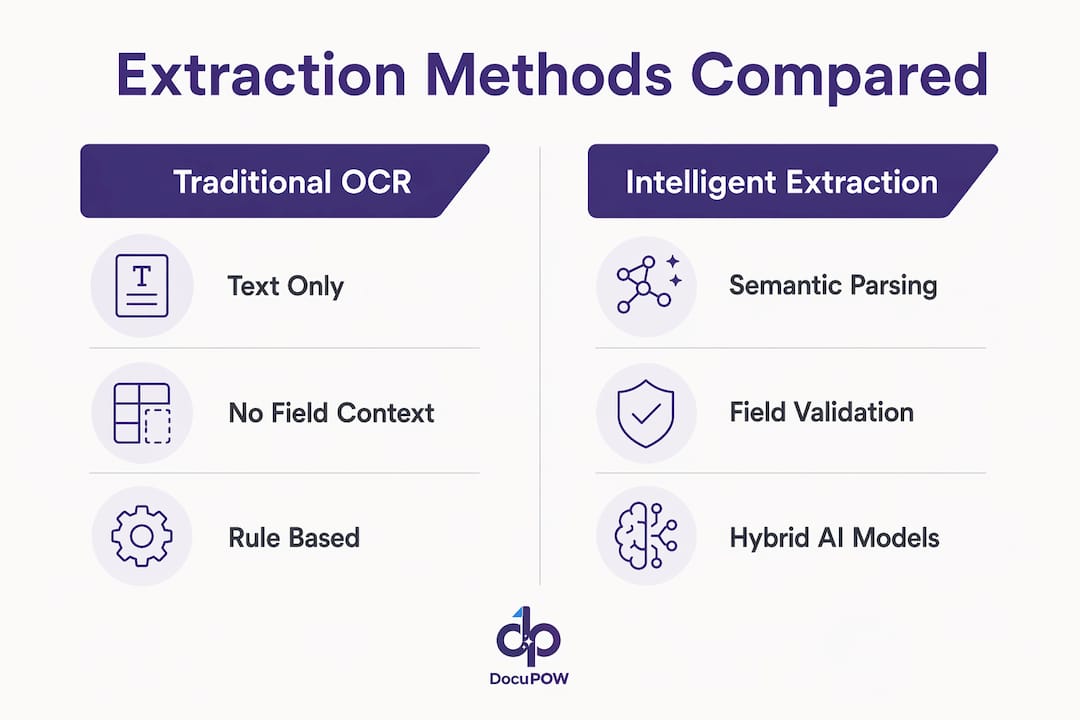
    Infographic comparing IDS and traditional OCR methods

    Intelligent Data Extraction Services operate at a higher level entirely. They parse document structure, infer field semantics, validate outputs against defined schemas, and adapt to format variations without manual reconfiguration.

    Capability Traditional OCR Basic data scraping Intelligent Data Extraction
    Reads text from images Yes No Yes
    Understands field context No Partial Yes
    Validates against business rules No No Yes
    Handles layout variation No No Yes
    Processes tables and handwriting Limited No Yes
    Integrates with ERP/CRM Manual Manual Automated

    Pro Tip: If your current system requires a developer to update extraction rules every time a supplier changes their invoice layout, you are using a template-based tool, not true IDS. The cost of that maintenance compounds fast across hundreds of document types.

    What are the core technologies used in Intelligent Data Extraction Services?

    Modern extraction services combine several AI disciplines into a single pipeline. No single technology handles every document type well on its own.

    • Natural Language Processing (NLP): Identifies entities, relationships, and intent within text. NLP is what allows a system to recognize “Invoice Date: March 15, 2026” as a date field rather than a generic string.
    • Machine learning models: Trained on large document datasets, these models classify document types, locate field boundaries, and improve accuracy over time with feedback loops.
    • Computer vision: Processes the visual layout of a document, including column alignment, table structures, and spatial relationships between elements.
    • Multimodal AI: Modern document intelligence decomposes documents into searchable features including text, tables, charts, and annotations. This enables semantic search across decades of archived files, not just keyword matching.

    The most reliable production systems use hybrid architectures. Hybrid extraction models combine deterministic parsing for layout detection with AI semantic understanding for field inference, achieving accuracy up to 90.7%. That outperforms pure cloud AI solutions on complex, variable document types.

    Schema validation is the final layer that most teams underestimate. Strict JSON and Pydantic schema definitions enable automated validation and programmatic error handling before any data reaches a database. Without schema enforcement, extraction errors propagate silently into downstream systems and corrupt reporting.

    Pro Tip: Avoid fully end-to-end “black box” AI models for critical financial or legal documents. Hybrid pipelines that use deterministic parsing for layout and large language models for semantic inference give you accuracy, cost control, and auditability in one architecture.

    How can businesses implement Intelligent Data Extraction Services effectively?

    Deployment speed is faster than most teams expect. Initial extraction workflows can be operational within one hour when connecting AI-based extraction services to cloud databases. That speed is real, but it applies to simple, well-structured documents. Scaling to complex, variable formats takes more deliberate planning.

    A phased rollout is the proven path. Starting with a single high-frequency, low-variance document type builds trust in the AI model and the human review workflow before you add complexity. For most manufacturers, that means starting with a standard purchase order or remittance advice, not a multi-page contract.

    Follow these steps for a reliable implementation:

    1. Identify your highest-volume document type. Pick the document your team processes most often with the least format variation. This is your pilot.
    2. Define your extraction schema. List every field you need, its data type, and its validation rule. A vendor ID must be numeric. A date must follow ISO 8601. Write these rules before you configure anything.
    3. Connect to your target system. Map extracted fields to your ERP, CRM, or database columns. Test with a sample batch of 50–100 real documents before going live.
    4. Build a human-in-the-loop review queue. Flag low-confidence extractions for human review. Use those corrections to retrain the model. Accuracy improves with each reviewed batch.
    5. Address infrastructure before scaling. Infrastructure bottlenecks including proxy management, anti-bot bypass, and dynamic content rendering cause more production failures than the AI models themselves. Solve these before expanding document volume.
    6. Expand to adjacent document types. Once your pilot document type runs at acceptable accuracy, apply the same schema-driven approach to the next highest-volume type.

    Pro Tip: Build automated retry logic into your extraction pipeline from day one. When a document fails schema validation, the system should automatically re-attempt extraction with adjusted parameters before routing to human review. This single step cuts manual review queues significantly.

    What are the key benefits and challenges of using Intelligent Data Extraction Services?

    The business case for automated data extraction is direct. Speed, accuracy, and cost savings all improve simultaneously when you replace manual entry with AI-driven extraction.

    Core benefits:

    • Speed: Extraction that takes a human 10 minutes per document runs in seconds at scale.
    • Accuracy: Hybrid models achieve up to 90.7% accuracy on complex documents, and accuracy improves with feedback loops.
    • Cost reduction: Eliminating manual data entry reduces labor costs and the downstream cost of correcting entry errors.
    • Data completeness: AI extraction captures fields that manual processes routinely miss, including embedded tables, footnotes, and secondary line items.
    • Scalability: Volume spikes, like month-end invoice surges, do not require hiring temporary staff.

    The challenges are real and worth planning for:

    • Data variability: Documents from different vendors, regions, or time periods vary in layout, language, and quality. No model handles every variation perfectly out of the box.
    • Model hallucination: AI models can invent plausible-sounding field values when confidence is low. Schema validation and human review catch most of these errors, but they require deliberate design.
    • Infrastructure complexity: Proxy rotation, anti-bot measures, and dynamic rendering are infrastructure problems that block scaling more often than model accuracy does.
    Performance area Manual processing Intelligent Data Extraction
    Processing speed Minutes per document Seconds per document
    Accuracy on structured docs Variable, human error-prone Up to 90.7% with hybrid models
    Scalability Limited by headcount Scales with compute
    Error detection Post-entry audit Real-time schema validation
    Integration Manual export/import Direct ERP/CRM connection

    The organizations that get the most value from smart data processing are those that treat it as a workflow redesign, not just a software purchase. The technology works. The implementation discipline is what determines the outcome.

    Key takeaways

    Intelligent Data Extraction Services deliver reliable, scalable document automation when built on hybrid AI architectures, strict schema validation, and phased deployment starting with high-frequency document types.

    Point Details
    IDS goes beyond OCR Intelligent extraction understands field context and validates data; OCR only reads text.
    Hybrid models outperform pure AI Combining deterministic parsing with AI semantics achieves up to 90.7% accuracy on complex documents.
    Schema validation is non-negotiable JSON/Pydantic schemas catch extraction errors before they reach your database.
    Start narrow, then scale Begin with one high-frequency document type to build model trust before expanding.
    Infrastructure limits scale Proxy management and dynamic rendering cause more production failures than AI model quality.

    Why schema-first thinking changes everything in data extraction

    Most teams I see evaluate extraction services by asking “how accurate is the AI?” That is the wrong first question. The right question is “how does the system handle errors when the AI is wrong?”

    Every AI model produces incorrect outputs sometimes. The difference between a production-grade extraction system and a prototype is what happens at that moment. Systems built on strict schema definitions catch errors immediately, trigger automated retries, and route failures to human review with full context. Systems built on vague natural language prompts pass errors downstream silently.

    I have watched organizations spend months chasing data quality problems in their ERP systems, only to trace the root cause back to an extraction pipeline with no validation layer. The AI was performing fine. The missing schema was the problem.

    The second thing I would push back on is the instinct to automate everything at once. Phased rollouts feel slow, but they build the organizational trust that makes full automation sustainable. A team that has seen the system handle 10,000 purchase orders correctly will approve the next phase quickly. A team burned by a bad batch on day one will resist automation for years.

    Multimodal understanding is the capability that will separate leading platforms from the rest over the next three years. Text extraction is largely a solved problem for clean, structured documents. The hard work is in tables, handwritten annotations, embedded images, and mixed-format files. Platforms that handle all of those in a single pipeline, without routing to separate specialized models, will win on both accuracy and operational simplicity.

    For any business leader evaluating document automation solutions right now: ask vendors to show you their error handling, not just their accuracy numbers. The accuracy demo is easy to stage. The error handling is where real systems are built.

    — Sameer

    DocuPOW’s approach to enterprise-ready document extraction

    Organizations that have moved past the pilot stage know that extraction accuracy is only part of the equation. The other part is what happens when documents arrive in unexpected formats, at unexpected volumes, at month-end.

    https://docupow.ai

    DocuPOW addresses both sides. Its autonomous agents extract data from any document format without templates, validate outputs against defined schemas in real time, and connect directly to ERP and CRM systems. For teams managing high-volume document workflows, DocuPOW’s platform handles volume spikes without manual intervention. The intelligent data extraction solutions built into DocuPOW cover supply chain, manufacturing, construction, and back-office operations. If your team is still manually keying data from documents, that is the problem DocuPOW is built to solve.

    FAQ

    What is the difference between OCR and Intelligent Data Extraction?

    OCR converts scanned images into raw text without understanding field context or validating data. Intelligent Data Extraction uses NLP, machine learning, and schema validation to identify, classify, and verify each extracted field against business rules.

    How long does it take to deploy an AI data extraction workflow?

    Initial extraction workflows can be operational within one hour for simple, structured document types connected to cloud databases. Complex, variable document types require additional schema definition and testing time.

    What accuracy can businesses expect from intelligent data extraction?

    Hybrid extraction models that combine deterministic layout parsing with AI semantic understanding achieve accuracy up to 90.7% on complex documents. Accuracy improves further with human-in-the-loop feedback loops over time.

    Why do intelligent extraction systems fail in production?

    Infrastructure issues including proxy management, anti-bot bypass, and dynamic content rendering cause more production failures than AI model quality. Addressing infrastructure before scaling is the most effective way to prevent pipeline failures.

    What document types can Intelligent Data Extraction Services handle?

    Modern IDS platforms process invoices, purchase orders, contracts, forms, and mixed-format files including tables, handwritten annotations, and embedded images. Multimodal extraction decomposes documents into text, table, chart, and annotation features for full semantic retrieval.

  • AI Data Extraction for Business Professionals: 2026 Guide

    AI Data Extraction for Business Professionals: 2026 Guide


    TL;DR:

    • AI data extraction automates the retrieval of structured information from unstructured documents using schema-driven methods. It outperforms traditional template-based approaches by offering higher accuracy, faster processing speeds, and preservation of document layout across diverse formats. These benefits improve efficiency in industries like finance, healthcare, and real estate by enabling scalable, high-quality data automation.

    AI data extraction is the process of using artificial intelligence to pull structured information from unstructured documents automatically. The industry term for this broader discipline is intelligent document processing (IDP), and AI data extraction is its core function. Modern systems combine natural language processing (NLP), machine learning, and schema-driven processing to convert PDFs, invoices, contracts, and images into clean, usable data. DocuPOW applies this approach through autonomous agents that read document context rather than matching fixed templates. For business professionals managing high document volumes, the difference between template-based and AI-driven extraction is the difference between a brittle process and one that scales.

    How does AI data extraction work?

    AI data extraction operates through a pipeline of coordinated technologies. The process starts with document ingestion, where the system accepts files across formats. Then OCR (optical character recognition) converts scanned images into machine-readable text. NLP models interpret meaning, and a schema layer defines exactly which fields to extract.

    Hands loading documents into scanner for data extraction

    The most significant shift in recent years is the move from template-based extraction to declarative schema definitions. Declarative schemas let business professionals specify the fields they need using a JSON structure, without any prior training data or template configuration. The AI reads the schema, locates the relevant data in the document, and returns structured output. This means you can point the system at a new document type on Monday and have clean data by Tuesday, with no model retraining required.

    Modern extraction pipelines also handle format diversity at scale. Advanced AI extraction can process over 100 document formats, including PDFs, DOCX files, spreadsheets, images, and websites, through a single API call. That breadth matters for operations teams dealing with supplier invoices, scanned receipts, and web-sourced data all in the same workflow.

    Key components in a production-grade AI extraction pipeline include:

    • OCR layer: Converts scanned pages and images into text while preserving spatial layout
    • NLP engine: Interprets field labels, sentence structure, and contextual meaning
    • Schema definition: Declares target fields in JSON format without model retraining
    • Confidence scoring: Assigns a reliability score to each extracted field
    • Citation metadata: Records the source location of each extracted value for audit trails

    Pro Tip: Always review per-field confidence scores before sending extracted data downstream. A field with a low confidence score signals ambiguity in the source document, not a system failure. Flag those fields for human review rather than letting errors propagate into your ERP or CRM.

    What performance benchmarks does AI extraction offer vs. traditional methods?

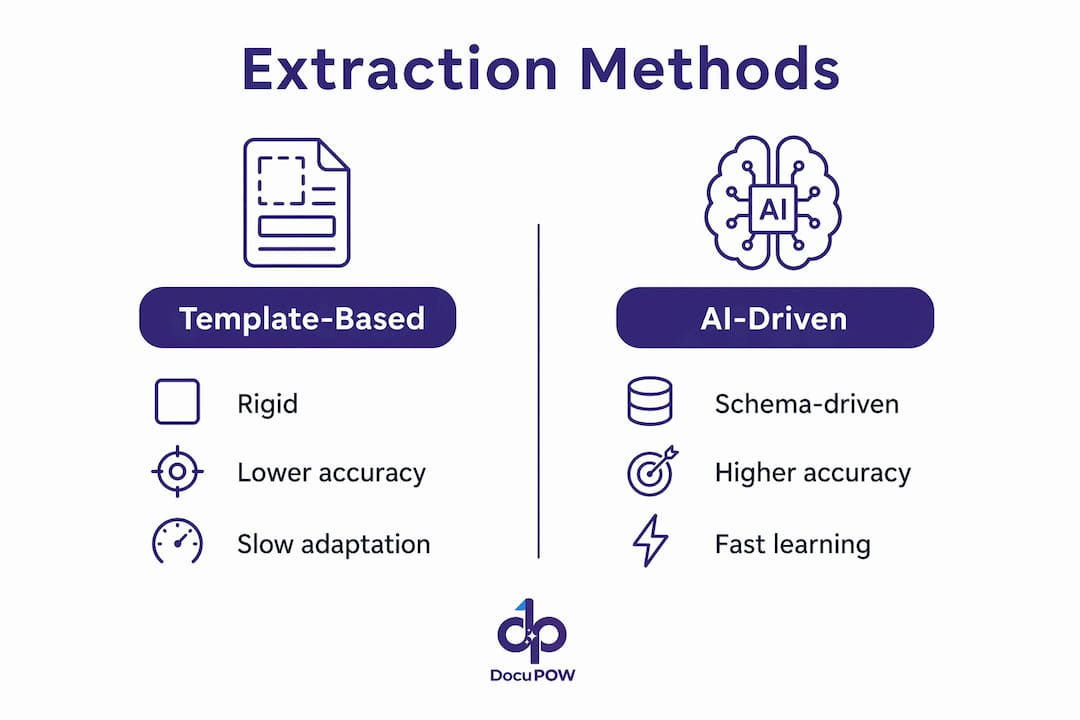
    Infographic comparing AI and template-based extraction methods

    The accuracy gap between template-based and AI-driven extraction is measurable and significant. Template-based extraction typically suffers a 12–28 point F1 score drop when processing new document formats. F1 score measures the balance between precision and recall, so a 20-point drop means roughly one in five extracted values is wrong or missing. That error rate is unacceptable at scale.

    LLM-based intelligent extraction methods drop only 2–6 F1 points when encountering new formats. That gap closes because the model understands language and context rather than relying on fixed field positions. A supplier invoice from a new vendor no longer breaks the extraction job.

    Speed is the second dimension where modern AI extraction separates itself. Specialized extraction engines with Rust cores achieve processing speeds 15–40 times faster than equivalent open-source libraries across common formats like PDF, DOCX, and XLSX. Faster throughput means finance teams can close books faster and operations teams can process inbound shipment documents in near real time.

    Spatial fidelity is a less-discussed but critical factor. Modern extraction engines preserve table structures and document layout, which are essential for accurate downstream analysis. Older flattening techniques collapse tables into unstructured text, destroying the row-column relationships that give the data meaning.

    Dimension Template-based extraction LLM-based AI extraction
    F1 score drop on new formats 12–28 points 2–6 points
    Processing speed Baseline 15–40x faster (Rust-core engines)
    New document type setup Manual template rebuild Schema definition only
    Table and layout preservation Often lost Maintained (spatial fidelity)
    Retraining required Yes, per new format No

    What are the real-world applications of AI data extraction?

    Intelligent document processing platforms extend well beyond simple text extraction. IDP platforms connect extracted data directly to business process automation, linking field values to workflows for tasks like policy administration, claim resolution, and purchase order matching. The data does not just get extracted. It gets routed, validated, and acted on.

    The industries seeing the clearest returns include:

    • Finance and accounting: Automated retrieval from invoices, bank statements, and expense receipts feeds directly into ERP systems, cutting manual entry and accelerating month-end close. Teams using automated financial data extraction report fewer reconciliation errors and faster audit cycles.
    • Healthcare: Medical forms, prior authorization documents, and clinical records contain dense, variable data. AI extraction pulls structured fields from these documents and routes them to patient management systems without manual transcription.
    • Real estate: Lease agreements, title documents, and property disclosures contain dozens of critical fields. Real estate document workflows benefit from AI extraction that reads variable clause structures rather than fixed field positions.
    • Manufacturing and supply chain: Bills of lading, quality certificates, and supplier invoices arrive in hundreds of formats. Automated extraction in manufacturing reduces receiving errors and speeds up supplier payment cycles.
    • Insurance: IDP accelerates claim resolution and supports early fraud detection by automating extraction from FNOLs, medical records, and supporting documents.

    Document types that benefit most from AI-driven automated data retrieval include invoices, contracts, purchase orders, shipping manifests, medical intake forms, research papers, and regulatory filings. The common thread is high volume combined with structural variability. When no two documents look exactly alike, template-based tools fail and AI-driven tools thrive.

    Pro Tip: Start your IDP rollout with the document type that causes the most downstream errors in your current process. Fixing one high-impact extraction point delivers faster ROI than spreading effort across every document type at once.

    How can businesses implement AI data extraction effectively?

    The starting point for any implementation is schema design. Define the fields your business needs from each document type in a structured format. JSON schema definitions steer the AI toward exactly the right fields without requiring custom model training. This approach cuts setup time from weeks to hours for most document types.

    A practical implementation follows these steps:

    1. Audit your document inventory. List every document type entering your workflows, their formats, and the fields your teams extract manually today.
    2. Define schemas per document type. Write JSON schemas specifying field names, data types, and any validation rules. Start with your highest-volume document type.
    3. Connect via API. Most production-grade AI extraction platforms expose a REST API. Send documents to the endpoint and receive structured JSON in return.
    4. Validate with confidence scores. Set a confidence threshold for each field. Route low-confidence extractions to a human review queue rather than passing them downstream automatically.
    5. Integrate with downstream systems. Map extracted fields to your ERP, CRM, or workflow platform. Use the citation metadata to maintain a full audit trail from source document to database record.
    6. Monitor and refine. Track field-level accuracy over time. When accuracy drops on a specific field, review the source documents for structural changes and update the schema accordingly.

    Common challenges include OCR quality on low-resolution scans and document variability across vendors. For OCR issues, pre-processing steps like image deskewing and contrast normalization improve text quality before extraction begins. For variability, schema-driven AI extraction handles the differences automatically because it reads meaning rather than position.

    DocuPOW’s platform applies this schema-driven approach through autonomous agents, making it well-suited for back-office automation scenarios where document formats change frequently and manual setup time is a bottleneck.

    Key Takeaways

    AI data extraction delivers the greatest value when schema-driven methods replace rigid templates, enabling accurate, high-speed processing across variable document formats at scale.

    Point Details
    Schema-driven extraction wins JSON schemas extract target fields without model retraining, cutting setup from weeks to hours.
    Accuracy gap is measurable LLM-based tools drop only 2–6 F1 points on new formats versus 12–28 points for template-based systems.
    Speed advantage is real Rust-core extraction engines process documents 15–40 times faster than standard open-source libraries.
    Confidence scores are mandatory Per-field confidence scores identify ambiguous extractions before errors reach downstream systems.
    Industry applications are broad Finance, healthcare, real estate, manufacturing, and insurance all benefit from AI-driven automated data retrieval.

    Why I think most businesses are still thinking about this the wrong way

    The conversation I hear most often goes like this: a team evaluates AI extraction tools, picks one based on a demo with clean sample documents, and then hits a wall three months later when real-world documents break the system. The problem is not the tool. The problem is that teams treat document extraction as a one-time configuration project rather than an ongoing data quality discipline.

    The shift to declarative schemas changes this dynamic fundamentally. When your extraction logic lives in a JSON schema rather than a hand-built template, updating it takes minutes. That means your extraction system can evolve as fast as your document landscape does. I have seen operations teams cut their document exception rate by focusing obsessively on schema maintenance rather than chasing a perfect initial setup.

    The other thing most articles skip is the importance of spatial fidelity. A lot of teams evaluate extraction tools by testing on simple text fields and miss the fact that their most valuable data lives inside tables. A tool that flattens a financial statement into unstructured text has destroyed the data before you even start analyzing it. Always test with your most complex document type, not your simplest.

    My practical advice: pick a platform that exposes confidence scores at the field level, supports schema updates without retraining, and preserves document layout. Those three criteria eliminate most of the failure modes I have seen in production deployments. Vendor selection based on demo performance on clean documents is the single most common mistake in this space.

    — Sameer

    DocuPOW’s AI-powered platform for document extraction

    DocuPOW is an intelligent document automation platform built on schema-driven AI extraction and autonomous agents that read document context rather than matching templates.

    https://docupow.ai

    Teams across manufacturing, real estate, supply chain, and finance use DocuPOW to process high volumes of variable documents with accuracy that template-based tools cannot match. The platform supports high-volume document workflows with real-time analytics and full audit trails from source document to structured output. For teams managing property documents, DocuPOW’s real estate extraction solutions handle lease agreements, title documents, and disclosures without manual field mapping. Visit DocuPOW to see how the platform fits your document processing needs.

    FAQ

    What is AI data extraction?

    AI data extraction is the automated process of pulling structured fields from unstructured documents using NLP, machine learning, and schema-driven processing. It replaces manual data entry with accurate, high-speed retrieval across formats like PDFs, images, and DOCX files.

    How does AI extraction differ from traditional OCR?

    Traditional OCR converts images to text but does not interpret meaning or structure. AI extraction adds NLP and schema logic on top of OCR output, identifying specific fields and their values regardless of where they appear in the document.

    What is an F1 score in the context of data extraction?

    An F1 score measures the balance between precision and recall in extraction accuracy. Template-based tools drop 12–28 F1 points on new document formats, while LLM-based tools drop only 2–6 points, making AI methods significantly more reliable across variable documents.

    Do AI extraction tools require training data for new document types?

    Schema-driven AI extraction requires no training data for new document types. Defining a JSON schema with the target fields is sufficient for the system to extract accurately from documents it has never seen before.

    What industries benefit most from intelligent data extraction?

    Finance, healthcare, real estate, manufacturing, insurance, and supply chain operations all benefit from intelligent data extraction. Any industry processing high volumes of variable documents, such as invoices, contracts, or medical forms, sees measurable gains in speed and accuracy.

  • Top 3 Best Automated Document Processing Services 2026

    Managing large volumes of varied documents takes too much manual work for operations, finance, and procurement teams. Template based systems require constant rule mapping and force manual setup for every new document type. This comparison covers extraction method, compliance, and workflow integration so teams can select a service that fits their volume and regulatory needs.

    Table of Contents

    DocuPOW

    https://docupow.ai

    At a Glance

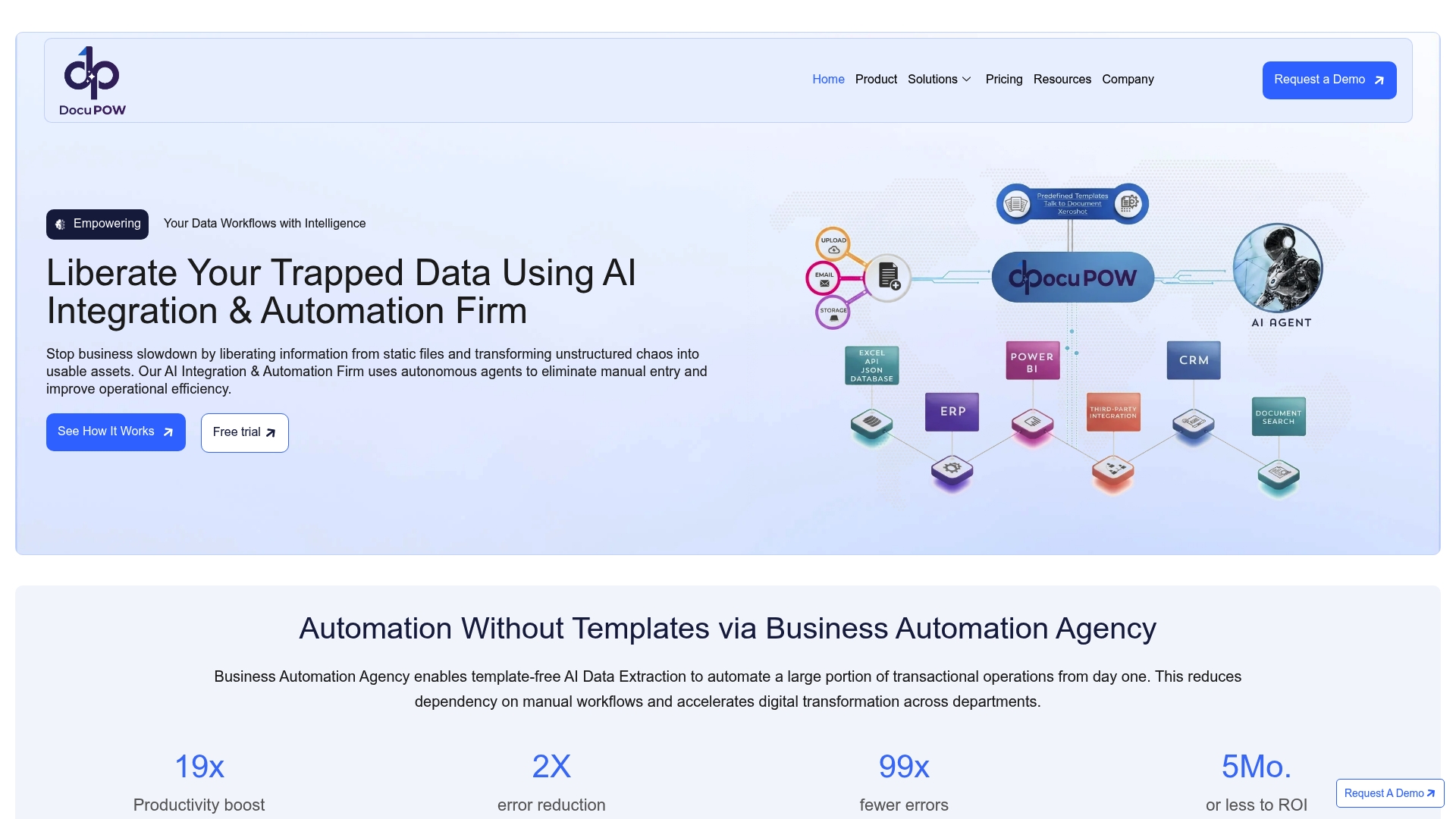
    ZeroShot learning lets DocuPOW extract data from new document types without templates or prior training. The system handles handwritten notes and unstructured files while learning to improve extraction accuracy over time. Large manufacturers use its output for near real time spend analytics and faster procurement decisions.

    Core Features

    DocuPOW uses ZeroShot learning to pull fields from invoices, contracts, and forms with no manual mapping. It includes document search, visual bounding boxes for verification, and a user friendly interface for review and correction. The product follows an API first model so you can connect AI agents, ERP and CRM systems, Power BI, and Power Automate for downstream workflows and analytics.

    Key Differentiator

    The standout capability is the platform’s ZeroShot approach that removes the need for templates. That reduces upfront setup for new document types and shortens time to value for large volume workloads. Teams that process diverse document formats will spend less time building extraction rules and more time acting on the extracted data.

    Pros

    DocuPOW improves accuracy through continuous learning, which means extraction quality rises as the system sees more examples. It accepts complex, unstructured, and handwritten documents that break traditional template based tools. The API first design and explicit support for ERP, CRM, Power BI, and Power Automate make it practical for enterprise automation and reporting. Real time analytics and a conversational interface let finance and operations teams query document data without building reports.

    Cons

    • Complexity in initial setup and integration for highly specialized legacy systems.

    Notable Integrations

    • ERP systems for posting and reconciliation.
    • CRM systems for linkages to sales and contract records.
    • Power BI for operational dashboards and spend analytics.
    • Power Automate for workflow orchestration.
    • APIs for custom system integration and AI agent workflows.

    Who It’s For

    Large enterprises that process high volumes of varied documents and require template free automation. Procurement, finance, and legal teams that need faster access to accurate document data will benefit. Organizations planning multi system integrations and centralized analytics will see the most value.

    Unique Value Proposition

    Autonomous agents that understand document context let DocuPOW translate documents into actionable data without extensive manual mapping. That capability reduces manual entry work and improves financial visibility for procurement and operations teams. With real time analytics and predictive insights, teams can shift from reactive fixes to earlier interventions that reduce late fees and process exceptions.

    Real World Use Case

    A global manufacturer replaced manual document sorting with DocuPOW driven extraction. The company gained real time spend analytics, cut late payment penalties, and sped decision making across procurement and operations. The result came from combining template free extraction, system integration, and live analytics.

    Pricing

    Pricing follows a tier based model with per page rates. Typical public rates range from $0.15 to $0.25 per page, and the vendor offers custom enterprise options for high volume contracts and bespoke integrations. Detailed quotes require direct engagement with the vendor.

    Website: https://docupow.ai

    Docparser

    https://docparser.com

    At a Glance

    The Starter plan begins at $39 per month and includes 100 parsing credits. Docparser extracts data from Word, PDF, image files, and spreadsheets using OCR, pattern recognition, and anchor keywords. That mix targets teams that need high volume, rule driven extraction for predictable document formats.

    Core Features

    Docparser reads Word, PDF, CSV, XLS, TXT, XML, and image files and applies OCR for scanned documents. The platform offers a visual rules’ builder that needs no code, table and repetition recognition, and image preprocessing for cleaner extraction. Outputs include Excel, CSV, JSON, XML, and Webhooks API for real-time delivery to other systems.

    Key Differentiator

    The product centers on a no code visual rules builder with advanced pattern recognition and multi layout support for documents that change layout often. That approach favors teams who can define rules and templates rather than teams that need autonomous context aware agents. Compared with DocuPOW, Docparser serves buyers who prefer explicit rule mapping over agent driven interpretation.

    Pros

    Docparser handles high volumes while supporting many file types, which extends automation beyond invoices to contracts and catalogs. The visual rule editor and pre-built templates let non developers build extraction logic and test results quickly. Integrations with Google Sheets, Zapier, Power Automate, Microsoft Excel OneDrive, and Salesforce CRM allow parsed data to flow into accounting, ERP, and CRM pipelines.

    Cons

    • Creating complex rules has a learning curve for teams new to document mapping.

    • Workflows with many steps or highly complex rules can show occasional performance slowdowns.

    • Lower tier plans have limited retained data policies, so long term storage requires external systems.

    • PDF mapping can feel restrictive when documents deviate widely from expected templates.

    When It May Not Fit

    Docparser is the wrong choice if you need autonomous, context aware extraction that adapts without explicit rules. It also may not fit teams that require long term document retention on entry level plans. Buyers without staff able to build and maintain rules may hit productivity limits quickly.

    Notable Integrations

    • Google Sheets

    • Zapier

    • Power Automate

    • Microsoft Excel/OneDrive

    • Salesforce CRM

    Who It’s For

    Small to large enterprises that need automated data extraction from invoices, purchase orders, bank statements, contracts, and HR forms. Best fit for operations, finance, and logistics teams that can invest in rule building and maintain templates. Also suitable for service providers that process predictable document sets.

    Real World Use Case

    A logistics company configures Docparser to read delivery notes and shipping orders, extract line items, and push records into inventory and shipment tracking systems. That setup reduces manual entry and updates tracking systems in near real time.

    Pricing

    Monthly subscription plans start at $39 per month for the Starter plan with 100 parsing credits. Higher tiers and custom enterprise pricing are available for larger volumes and advanced retention needs.

    Website: https://docparser.com

    Parashift AI

    https://parashift.ai

    At a Glance

    Parashift AI reports over 90% straight-through processing for high volume document flows. The vendor states compliance with EU data sovereignty requirements and alignment with the EU AI Act and DORA regulations. The platform combines proprietary models and third party support to target regulated European environments.

    Core Features

    Parashift AI delivers intelligent document processing with automated document separation and segregation, AI document classification, and AI data extraction. It exposes an agentic document extraction OCR API for programmatic access and supports trainable, enterprise models alongside third party models. Deployment can run in private cloud or on premise to keep data under customer control.

    Key Differentiator

    The product uses a tri model strategy that pairs proprietary vision language models, Swarm Learning, and third party model support. That mix aims to keep model training and inference within an EU native infrastructure while allowing hybrid model selection. That compliance claim and the tri model approach serve as the primary technical distinction.

    Pros

    Parashift AI supports strict European compliance and data sovereignty, which matters for banks and insurers that keep data inside EU borders. The platform reports the high straight through processing figure above, and that accuracy claim suggests material reduction in manual review for common document types. Deployment options for private cloud and on premise give IT teams direct control over data and operations.

    Cons

    • Integration can be complex and may require specialized technical expertise, according to third party reviews.

    • Pricing is not fully transparent and requires tailored quotes to get exact costs.

    • Smaller organizations may face a learning curve to exploit advanced AI model features and Swarm Learning.

    When It May Not Fit

    If you lack internal AI or integration expertise, deployment in private cloud or on premise will likely demand outside help. Organizations with minimal regulatory constraints and simple invoice flows may find the platform more than they need. Firms that require clear list pricing up front will need to budget for a quote based procurement process.

    Notable Integrations

    Parashift AI connects to established ECM and workflow tools. Notable integrations include:

    • d.velop
    • JobRouter
    • M-Files

    Who It’s For

    Mid to large European enterprises in regulated sectors will get the most from Parashift AI. Ideal buyers operate in banking, healthcare, logistics, or insurance and need strict EU data control. Teams that must combine vendor models with locally trained models will find the architecture useful.

    Real World Use Case

    A European bank used the platform to reach the straight through processing rate cited above for incoming invoices and KYC documents. The deployment ran in a private cloud to preserve EU data sovereignty and meet regulatory workflows. That setup reduced manual verification steps while keeping audit trails under bank control.

    Pricing

    Parashift AI uses a tier based cloud subscription model where costs decrease as volumes scale. Exact pricing requires a tailored quote from the vendor. Expect volume based discounts and scope based estimates for private cloud or on premise deployments.

    Website: https://parashift.ai

    Comparison of alternatives

    Selecting an automated document processing service depends on critical considerations such as data compliance, adaptability, and cost-effectiveness.

    Versatility and adaptability

    DocuPOW’s ZeroShot learning technology stands as a defining advantage, enabling the platform to extract data from unstructured and handwritten documents without relying on predefined templates. This capability makes it a flexible option for enterprises managing diverse document types, reducing setup time significantly. On the other hand, Docparser utilizes a rule-based extraction approach that excels in predictable document flows, favoring smaller businesses and teams with stable workflows over dynamic variability, but limited in adapting to document structure changes.

    Regulatory suitability

    Parashift AI is noted for its high compliance with strict European data regulations, including EU AI Act and DORA standards, and supports private cloud and on-premise deployment. This makes it a prime candidate for sectors like finance and healthcare where legal and sovereignty requirements must be adhered to rigorously. While DocuPOW addresses large enterprise needs effectively, it does not exclusively focus on meeting stringent geographical compliance mandates as enforced within the EU, giving Parashift AI a distinct edge in regulated environments.

    Best fit

    • Large Enterprises with High Document Variability: DocuPOW’s ZeroShot learning excels for teams capturing data from diverse and unpredictable file types, driving significant efficiency.
    • Teams Relying on Rule-Based Systems: Docparser offers rule-driven extraction tailored to consistent document layouts and straightforward workflows.
    • Regulated Industries: Parashift AI ensures strict compliance within the European Union with its privacy measures and extensive model support.

    Our pick

    DocuPOW is the recommended choice for its ZeroShot learning capabilities, bypassing the need for templates and facilitating handling of unstructured and handwritten documents. For users requiring flexible, context-aware automation in scalable enterprise settings, DocuPOW delivers operational agility. However, firms in strictly regulated industries or those heavily reliant on predefined rules might benefit more from considering Parashift AI or Docparser, respectively.

    Automated document processing services offer efficiency enhancements for enterprises handling diverse file formats. Below is a comparison of leading solutions highlighting key features and considerations.

    Product Key Feature Best For Pricing Limitation
    DocuPOW ZeroShot learning for template-free extraction Large enterprises with diverse document needs $0.15–$0.25 per page Complex integration with specialized legacy systems
    Docparser Visual no-code rules builder Teams needing high-volume structured parsing Starting at $39/month Complex rules have a learning curve
    Parashift AI EU-regulated compliance and private cloud options European companies in regulated sectors Price not published Requires expertise for integrations

    How Can Large Enterprises Handle Diverse Document Workloads Efficiently?

    DocuPOW solves the problem of processing high volumes of varied documents without relying on rigid templates. Many teams struggle with manual entry and slow turnaround, especially procurement, finance, and legal groups that need fast access to accurate data. DocuPOW uses AI-powered autonomous agents that understand document context, reducing manual mapping and increasing operational accuracy.

    Organizations gain benefits such as real-time analytics and predictive insights that enhance decision making and cut costs. Learn more about how DocuPOW liberates trapped data and supports multi-system integration at DocuPOW.

    https://docupow.ai

    Empower your teams to move from reactive tasks to proactive strategies. Visit DocuPOW and import your documents to see your extracted data ready for actionable analytics in moments.

    FAQ

    What is unique about DocuPOW’s data extraction capability?

    DocuPOW uses ZeroShot learning to extract data without needing templates. This capability allows it to handle handwritten notes and unstructured files effectively, improving extraction accuracy over time. Organizations looking for efficient document processing should consider DocuPOW for its rapid adaptability to new document types.

    How does DocuPOW compare to Docparser in terms of rule definition?

    Docparser features a no-code visual rules builder that allows teams to define precise extraction rules for various document types. In contrast, DocuPOW’s ZeroShot approach eliminates the need for such rules, making it ideal for organizations that handle diverse document formats. Choose DocuPOW for a faster setup when working with varied documents, while Docparser may suit those needing strict rule definitions.

    Can DocuPOW integrate with other enterprise systems?

    Yes, DocuPOW follows an API-first model, enabling connections with AI agents, ERP, and CRM systems, as well as Power BI and Power Automate. This integration capability makes it practical for enterprise automation and reporting, ensuring teams can leverage document data effectively across their workflows.

    What are the pricing options for DocuPOW?

    DocuPOW has a tier-based pricing model with rates ranging from $0.15 to $0.25 per page. Organizations processing high volumes of documents may find custom enterprise pricing options beneficial for better rates and features tailored to their needs.

    How does the learning capability of DocuPOW provide value?

    DocuPOW improves extraction quality through continuous learning, meaning accuracy increases as the system encounters more document examples. This advancing accuracy enhances the efficiency of procurement and operations teams by reducing manual review and enabling faster decision making.

  • Enterprise Automation Services: 2026 Business Guide

    Enterprise Automation Services: 2026 Business Guide


    TL;DR:

    • Enterprise automation services use RPA, AI, and low-code platforms to replace manual workflows across departments. They enable rapid deployment, improve operational efficiency, and require strategic governance for successful scaling. Organizations need a phased approach, a Center of Excellence, and proper documentation to avoid compliance issues and achieve long-term growth.

    Enterprise automation services are defined as technology-driven frameworks that integrate robotic process automation (RPA), AI, and low-code platforms to replace manual workflows with governed, repeatable digital processes. The industry term “business process automation” covers the same ground, but enterprise automation services specifically addresses cross-departmental deployment at scale. Modern platforms can deploy workflows in days, not months, delivering measurable ROI across finance, HR, and supply chain. DocuPOW represents the next step in this evolution, applying autonomous AI agents to extract and act on data trapped inside documents without rigid templates. For any organization serious about enterprise digital transformation, understanding the full technology stack and deployment options is the starting point.

    What are the primary enterprise automation services technologies?

    Infographic comparing attended and unattended automation models

    The technology stack behind modern automation has expanded well beyond basic RPA. Three primary deployment models now address varying operational demands: attended, unattended, and hybrid automation. Each model serves a different operational context, and choosing the wrong one wastes budget and creates friction.

    Team collaborating on automation technologies roadmap

    Deployment model How it works Best use case
    Attended automation Bot runs alongside a human, triggered by user action Customer service, real-time data lookup
    Unattended automation Bot runs independently on a schedule or event trigger Invoice processing, payroll, batch reporting
    Hybrid automation Combines attended and unattended bots in one workflow Complex approvals requiring human sign-off

    Beyond deployment models, the technology categories themselves have grown more sophisticated. Hyperautomation integrates Generative AI, Intelligent Document Processing (IDP), and Agentic Process Automation (APA) to handle tasks that once required human judgment. That shift matters because rule-based RPA alone cannot read an unstructured contract or interpret a supplier email. Combining RPA with AI gives organizations both execution speed and cognitive decision-making in a single workflow.

    RPA executes repetitive UI tasks while AI provides the cognitive layer on top. The strongest automation programs use both integrated together, not as separate tools. DocuPOW’s approach reflects this directly: its autonomous agents understand document context rather than following fixed extraction templates, which means they handle variation the way a trained analyst would.

    Pro Tip: Map each department’s workflows before selecting a deployment model. Finance typically benefits from unattended batch processing, while HR onboarding often needs hybrid models that keep a human in the loop for compliance sign-offs.

    How do workflow automation solutions accelerate operational efficiency?

    The business case for workflow automation solutions is grounded in speed and cost reduction. No-code and low-code platforms shifted implementation timelines from months to days for core business process deployments as of Q2 2026. That compression means organizations can test, iterate, and scale automation without waiting for long IT development cycles.

    The operational gains show up most clearly in three areas:

    • Finance: Automated invoice matching, payment reconciliation, and financial reporting reduce manual data entry errors and close books faster. DocuPOW’s financial data extraction capabilities give finance teams real-time visibility into payables and receivables without manual re-keying.
    • HR: Onboarding workflows, benefits enrollment, and compliance documentation can run on automated triggers. A new hire’s paperwork moves through approvals without anyone chasing signatures.
    • Supply chain: Purchase order processing, shipment tracking updates, and vendor invoice reconciliation are high-volume, repetitive tasks that automation handles faster and with fewer errors than manual teams.

    The cumulative effect across these functions is significant. Organizations that automate document-heavy back-office processes free up staff for analysis and decision-making rather than data entry. That reallocation of human effort is where the real productivity gain lives.

    Pro Tip: Build a governance framework before you scale. Unmanaged automation workflows, sometimes called “shadow automation,” create technical debt that surfaces as compliance failures during audits. Document every automated process from day one.

    What strategic considerations enable successful automation scaling?

    Scaling automation from a single department to an enterprise-wide capability requires more than adding more bots. Most organizations fail to scale because they treat automation as a collection of individual tools rather than a strategic infrastructure. The following steps address the most common failure points.

    1. Establish a Center of Excellence (CoE). A dedicated CoE governs automation standards, manages security, and maintains a reusable component library. Without a CoE, automation programs fragment into disconnected projects that cannot share assets or enforce compliance policies.
    2. Separate RPA from AI responsibilities. RPA handles task execution: clicking, copying, pasting, and form-filling at scale. AI handles cognitive decisions: classifying documents, interpreting unstructured text, and flagging anomalies. Conflating the two leads to over-engineering simple tasks or under-powering complex ones.
    3. Audit shadow automation regularly. No-code tools make it easy for business teams to build their own workflows without IT oversight. Those undocumented workflows become liabilities when they break or face a compliance audit. A quarterly shadow automation review catches problems before they escalate.
    4. Manage technical debt proactively. Every automation added without documentation or version control adds to the debt load. Assign ownership to each automated process and require change-log updates whenever a workflow is modified.
    5. Align automation goals with business outcomes. Automation projects that start with a technology choice rather than a business problem tend to stall. Define the metric you want to move, such as invoice processing time or error rate, before selecting a platform.

    The CoE model also provides the governance layer needed for security and regulatory compliance. In regulated industries like healthcare, financial services, and manufacturing, an ungoverned automation program is a liability, not an asset.

    How can businesses implement and integrate automation services today?

    Practical implementation follows a phased approach that reduces risk and builds internal confidence. Jumping straight to enterprise-wide deployment without a pilot phase is the most common and most expensive mistake organizations make.

    • Phase 1: Pilot. Select one high-volume, well-documented process. Invoice processing or employee onboarding both work well. Run the automation in parallel with the manual process for four to six weeks to validate accuracy and catch edge cases.
    • Phase 2: Small-scale deployment. Expand to three to five related processes within the same department. This phase tests your governance framework and builds the team’s ability to manage automated workflows.
    • Phase 3: Cross-functional scaling. Use the lessons from Phase 2 to extend automation across departments. At this stage, unified orchestration that connects people, systems, and AI under a single control plane becomes critical.

    Platform selection matters at every phase. Platforms that integrate with ERP, CRM, and core business systems reduce the custom integration work required at each expansion step. DocuPOW’s AI workflow automation connects directly with existing operational systems, so document data flows into the right system of record without manual handoffs.

    Intent-based design is an emerging capability worth evaluating during platform selection. It lets business users describe a problem in plain language and receive an automated solution blueprint, which reduces the gap between what IT builds and what operations actually needs. That alignment shortens deployment cycles and improves adoption rates.

    Governance does not stop at deployment. SLA-driven monitoring tracks whether automated processes are meeting performance targets. When a workflow degrades, the monitoring system alerts the CoE before the problem affects downstream operations. Build monitoring into the deployment plan from the start, not as an afterthought.

    Key takeaways

    Enterprise automation services deliver the most value when organizations treat them as a governed infrastructure rather than a collection of individual tools.

    Point Details
    Choose the right deployment model Match attended, unattended, or hybrid automation to each department’s specific workflow needs.
    Combine RPA with AI RPA handles task execution; AI handles cognitive decisions. Both together outperform either alone.
    Build a CoE early A Center of Excellence governs standards, security, and reusability before scaling enterprise-wide.
    Prevent shadow automation Document every automated workflow from day one to avoid compliance failures during audits.
    Phase your implementation Pilot one process, validate results, then expand. Skipping the pilot phase is the costliest mistake.

    Why I think most automation programs stall before they scale

    After watching dozens of organizations go through automation initiatives, the pattern is consistent. The pilot succeeds. The team celebrates. Then the program quietly stalls at three to five automations and never reaches enterprise scale. The reason is almost never the technology.

    The real obstacle is organizational. Teams build automations without a CoE, without documentation standards, and without a clear owner for each workflow. Six months later, a process breaks during an audit and nobody knows who built it or how it works. That single incident kills executive confidence and freezes the entire program.

    Intent-based design addresses part of this problem by making automation more accessible to business users. But accessibility without governance makes the shadow automation problem worse, not better. The organizations that scale successfully treat their automation program the way they treat their ERP: as infrastructure that requires ownership, version control, and a support model.

    The other shift I have seen work is reframing automation as a data strategy, not just a process efficiency play. When you automate document processing with a platform like DocuPOW, you are not just removing manual steps. You are creating a structured data feed that powers analytics, forecasting, and decision-making. That framing gets CFO and COO buy-in far faster than a cost-reduction pitch alone.

    Automation is not a project with an end date. It is a capability that compounds over time. The organizations that treat it that way are the ones still expanding their programs three years in.

    — Sameer

    DocuPOW’s approach to enterprise automation

    Businesses that are ready to move beyond basic workflow tools need a platform built for document-heavy operations at scale.

    https://docupow.ai

    DocuPOW applies autonomous AI agents to intelligent document processing, extracting structured data from invoices, contracts, purchase orders, and reports without fixed templates. That means the system handles variation across document formats the way a trained analyst would, without manual reconfiguration. For global manufacturers and operations teams, DocuPOW delivers real-time analytics and predictive insights that shift teams from reactive data entry to proactive decision-making. Explore the full DocuPOW automation platform to see how it fits your operational environment.

    FAQ

    What are enterprise automation services?

    Enterprise automation services are technology frameworks that use RPA, AI, and low-code platforms to replace manual business processes with governed, repeatable digital workflows across multiple departments.

    How does RPA differ from AI in automation?

    RPA executes repetitive, rule-based UI tasks like data entry and form-filling. AI provides cognitive decision-making for tasks like document classification and anomaly detection. The most effective automation programs combine both.

    What is a Center of Excellence in automation?

    A Center of Excellence is a dedicated internal team that governs automation standards, manages security, and maintains reusable workflow components to support enterprise-wide scaling.

    How long does it take to deploy enterprise automation?

    Modern no-code and low-code platforms can deploy core business process automations in days rather than months, though full enterprise-wide scaling follows a phased approach over several months.

    What is shadow automation and why does it matter?

    Shadow automation refers to undocumented workflows built by business teams outside IT oversight. These workflows create compliance and technical debt risks that surface during audits or when a process breaks unexpectedly.

  • Business Automation Agency: Top 10 Picks for 2026

    Business Automation Agency: Top 10 Picks for 2026


    TL;DR:

    • A business automation agency designs workflows that focus on revenue-impacting processes and delivers quick results. The best agencies map workflows, recommend platform-agnostic solutions, and provide ongoing support to ensure automation success. Choosing the right partner involves evaluating their experience, process focus, and ability to demonstrate return on investment.

    A business automation agency is a specialized firm that designs, builds, and deploys automated workflows to replace manual processes across sales, operations, finance, and document management. The right agency does more than install software. It maps your revenue-critical processes, calculates ROI before a single tool goes live, and delivers working automations in weeks, not months. Businesses save an average of 114 hours per employee annually through AI automation, and 77% of small businesses now use at least one AI tool. Choosing the wrong partner wastes both. This guide names the top 10 agencies, compares them side by side, and tells you exactly how to pick the right one for your operation.

    What criteria define the best business automation agencies in 2026?

    The best agencies focus on workflows that directly affect revenue before touching back-office tasks. Lead follow-up automation alone can recover 40–60% of lost potential revenue. That single metric separates agencies that drive growth from those that just reduce paperwork.

    Strong agencies share five defining traits:

    • Revenue-first workflow focus. They target lead management, invoice processing, and client onboarding before expense reports or HR forms.
    • Process mapping before tool selection. They document your current workflow, identify bottlenecks, and calculate the cost of manual work before recommending any platform.
    • Platform-agnostic recommendations. Agencies that provide platform-agnostic advice add the most value because they match tools to your needs, not their preferred vendor relationships.
    • Rapid delivery timelines. A 4–6 week implementation window for core automations is the current industry standard. Longer timelines signal over-engineering.
    • Ongoing optimization. Post-launch support and performance reviews are non-negotiable. Automations degrade as business processes change.

    Pro Tip: Ask every agency candidate to show you a sample ROI calculation from a past client engagement. Agencies that cannot produce one are guessing at your return.

    Top 10 business automation agencies and what sets them apart

    The market for automation consulting services has grown significantly. These ten agencies represent the strongest options across different business sizes, industries, and automation needs.

    1. DocuPOW

    DocuPOW specializes in AI-powered document workflow automation for organizations handling high volumes of complex documents. Its autonomous agents extract data from unstructured files without rigid templates, which eliminates the manual rekeying that slows finance and operations teams. Global manufacturers use DocuPOW to gain real-time financial visibility and cut processing errors. The platform includes predictive analytics that shift teams from reactive to proactive decision-making.

    Man reviewing document automation workflow at laptop

    2. USTech Automations

    USTech Automations focuses on small business automation with a complete playbook approach. The agency maps every revenue-generating workflow before recommending tools, and it publishes detailed ROI benchmarks for common automations like CRM follow-up sequences and invoice routing. Implementation timelines average 4–6 weeks for core workflow builds. Their strength is translating complex automation logic into plain-language process maps that non-technical owners can manage.

    3. Rippling

    Rippling delivers unified platform automation that combines HR, IT, and payroll into a single data model. Unified platform automation provides more powerful workflow automation than piecemeal tools because all data lives in one place. When an employee is hired, Rippling automatically provisions software access, runs payroll setup, and routes compliance documents without manual handoffs. This makes Rippling the strongest choice for businesses where HR and IT workflows create the biggest operational drag.

    4. Automaziot

    Automaziot structures its engagements around a six-stage consulting process: discovery, audit, strategy, roadmap, implementation, and ongoing optimization. The agency offers a free initial consultation, which lets you test their process mapping skills before any financial commitment. Automaziot handles both strategy-only engagements and full builds, depending on your internal technical resources. Their audit stage is particularly thorough, scoring every automation opportunity on time saved, error reduction, and business impact.

    5. MakeAutomation

    MakeAutomation scores automation opportunities on three dimensions: time saved, error reduction, and business impact. Effective agencies prioritize high-impact workflows using exactly this kind of structured scoring. The agency specializes in custom integrations between CRMs, ERPs, and document management systems. Their consulting-only service model works well for businesses that have internal developers but need expert workflow strategy.

    6. Aplos AI

    Aplos AI focuses on operational efficiency automations with measurable outcomes. Automated appointment reminders cut no-show rates by 30–50%, and Aplos AI builds this type of high-impact, low-complexity automation as entry points for larger engagements. The agency targets service businesses where scheduling, client communication, and billing create the most manual work. Pricing is project-based, and most initial automations deploy within three weeks.

    7. BizTech Automation Consulting

    BizTech Automation Consulting follows the SBA-aligned principle that successful automation starts with operational pain points, not technology selection. The agency runs pilot projects before full rollout, which verifies ROI with real data before you commit to a larger build. This approach reduces implementation risk significantly. BizTech works primarily with SMBs in manufacturing, healthcare, and professional services.

    8. Automation agency for workflow automation (no-code specialists)

    Several agencies now specialize in no-code workflow automation using platforms like Zapier, Make (formerly Integromat), and n8n. These agencies serve non-technical business owners who need automations built and maintained without custom code. Typical projects include automated lead routing, email sequence triggers, and document generation from form submissions. Project costs run lower than custom-code agencies, and delivery timelines are often under two weeks for standard workflows.

    9. Digital transformation services agencies

    Larger digital transformation services firms offer automation as part of broader technology overhauls. These agencies suit enterprises that need automation integrated with legacy ERP systems, compliance frameworks, and multi-department workflows. Engagements typically run 3–6 months and include change management support. The tradeoff is higher cost and longer timelines compared to specialist automation agencies.

    10. Industry-specific automation specialists

    Vertical-focused agencies build automations for specific industries such as real estate, construction, and healthcare. DocuPOW, for example, offers dedicated real estate automation solutions that handle contract processing, compliance document routing, and data extraction from property files. Industry specialists deliver faster results because they start with pre-built workflow templates for common processes in your sector. The limitation is narrower scope if your needs span multiple industries.

    Comparing top agencies across key features

    The table below maps the most relevant decision criteria across agency types.

    Agency / Type Core Specialty Implementation Time Service Model Best For
    DocuPOW AI document workflows, data extraction 2–4 weeks Full build + platform Manufacturers, finance, compliance teams
    USTech Automations Revenue workflow automation 4–6 weeks Consulting + build SMBs prioritizing sales and revenue ops
    Rippling HR, IT, payroll unification Varies by module Platform + consulting Growing teams with HR/IT complexity
    Automaziot Six-stage consulting process 4–8 weeks Strategy or full build Businesses needing structured audit first
    MakeAutomation CRM and ERP integrations 3–6 weeks Consulting-only option Businesses with internal developers
    Aplos AI Service business operations 2–3 weeks Full build Scheduling-heavy service businesses
    BizTech SMB process automation 4–6 weeks Pilot-first build Manufacturing, healthcare, professional services
    No-code specialists Zapier/Make/n8n workflows 1–2 weeks Full build Non-technical owners, tight budgets
    Digital transformation firms Enterprise-wide automation 3–6 months Full transformation Enterprises with legacy systems
    Industry specialists Vertical-specific workflows 2–4 weeks Full build Real estate, construction, healthcare

    Startups and small businesses get the fastest ROI from no-code specialists or agencies like Aplos AI and USTech Automations. Enterprises with document-heavy compliance requirements get more value from DocuPOW or digital transformation firms. Consulting and implementation are distinct services, so you can hire for strategy only if your team can handle the build.

    How to choose the right agency for your needs

    Start by identifying which workflows cost you the most in manual time or lost revenue. Small businesses with systematic workflow automation grow revenue 2.1 times faster than those without it. That growth comes from automating the right processes first, not all processes at once.

    Use this checklist before signing with any agency:

    • Map your top three revenue-impacting workflows. These are the processes where delays or errors directly cost you money or customers.
    • Assess your internal technical capability. If you have developers, a consulting-only engagement may be enough. If you do not, you need a full-build agency.
    • Demand pricing transparency upfront. Vague “custom pricing” without a clear project scope is a red flag.
    • Request a free discovery or ROI audit call. Most reputable agencies offer one. Use it to test their process mapping skills and see if they ask the right questions.
    • Ask about post-launch optimization. Automations that run without review degrade over time. Confirm the agency includes ongoing support or a clear handoff plan.

    Pro Tip: Run a pilot project on one workflow before committing to a full engagement. Real pilot data beats any agency’s projected ROI estimate.

    The most critical step in successful automation is focusing on operational challenges rather than technology. Agencies that lead with tool recommendations before understanding your workflows are selling products, not solving problems.

    Key takeaways

    A business automation agency delivers the fastest ROI when it targets revenue-generating workflows first, uses platform-agnostic recommendations, and validates results through pilot projects before full deployment.

    Point Details
    Revenue workflows first Automate lead follow-up and invoice processing before back-office tasks for faster returns.
    Pilot before full rollout Test one workflow with real data to verify ROI before committing to a full agency engagement.
    Match agency type to your size Startups benefit from no-code specialists; enterprises need full-build or transformation firms.
    Demand process mapping Any agency that skips workflow mapping and jumps to tool selection is not worth hiring.
    Ongoing optimization matters Automations degrade as processes change; confirm post-launch support before signing.

    Why I think most businesses automate in the wrong order

    The most common mistake I see is businesses hiring an automation agency to fix their expense reporting or HR onboarding first. Those are real pain points, but they are not where the money is. The fastest returns come from automating the workflows that touch revenue directly: lead follow-up, quote generation, invoice processing, and contract routing.

    I have watched companies spend months building beautiful back-office automations and then wonder why their revenue numbers did not move. The answer is always the same. They optimized processes that were invisible to customers and prospects. Meanwhile, leads were sitting in a CRM for three days waiting for a human to send a follow-up email.

    The agencies that deliver the best outcomes are the ones that ask “where are you losing money?” before they ask “what tools do you use?” That question changes the entire engagement. It shifts the focus from technology to business outcomes, which is where automation ROI actually lives.

    My advice: take the free discovery call that most reputable agencies offer, and use it to test whether the agency asks about your revenue workflows or your software stack. The answer tells you everything about how they think. Agencies that lead with document process automation benefits tied to financial outcomes are the ones worth hiring in 2026.

    — Sameer

    DocuPOW brings AI-powered document automation to your operations

    Document workflows sit at the center of most operational bottlenecks, from purchase orders stuck in email to compliance documents that require manual review before approval. DocuPOW addresses this directly with AI agents that extract data from any document type without templates, routing information to the right system in real time.

    https://docupow.ai

    DocuPOW works alongside your existing agency relationships or as a standalone platform for document-heavy operations. Its back-office automation capabilities cover everything from financial data extraction to compliance document processing. Teams in manufacturing, real estate, and construction use DocuPOW to cut processing time and reduce errors without rebuilding their existing systems. Visit DocuPOW’s operations platform to see how document automation fits your workflow.

    FAQ

    What does a business automation agency actually do?

    A business automation agency maps your existing workflows, identifies high-impact automation opportunities, and builds or configures automated systems to replace manual tasks. Engagements range from strategy-only consulting to full implementation and ongoing support.

    How long does it take to see ROI from automation?

    Most agencies deliver initial automations within 4–6 weeks, and revenue-focused workflows like lead follow-up typically show measurable ROI within the first month of operation.

    What is the difference between automation consulting and full implementation?

    Consulting covers strategy, process mapping, and tool recommendations. Full implementation means the agency builds and deploys the automations. Businesses can hire for strategy only, build only, or both depending on their internal resources.

    Which workflows should a small business automate first?

    Lead follow-up automation has the highest revenue impact for small businesses, as missing follow-up accounts for 40–60% of lost potential revenue. Start there before automating back-office processes.

    How do I evaluate whether an agency is worth hiring?

    Ask for a sample ROI calculation from a past engagement, request a free discovery call, and confirm they map your workflows before recommending tools. Agencies that lead with technology recommendations before understanding your processes prioritize their vendor relationships over your results.

  • AI Automation Services: A 2026 Business Guide

    AI Automation Services: A 2026 Business Guide

    AI automation services are the practice of deploying artificial intelligence to replace manual, rule-based business tasks with intelligent, self-managing workflows. The industry term for this discipline is intelligent automation, which combines machine learning, natural language processing, and process orchestration into a single operational layer. Businesses that adopt these services report measurable gains in speed, accuracy, and cost control. Providers like Winder.AI and AI Adoption Agency have built entire service models around delivering these gains at production scale. Whether your team processes invoices, reviews contracts, or handles customer support tickets, AI-driven automation removes the bottleneck of human repetition and replaces it with consistent, auditable output.

    What are AI automation services and how do they work?

    AI automation services use artificial intelligence to identify, execute, and monitor tasks that previously required human input. Unlike traditional rule-based automation, which breaks when inputs vary, AI-powered automation services adapt to context. A system trained on invoice formats, for example, can extract line items from a document it has never seen before, without a template.

    The core architecture typically includes a data ingestion layer, an AI processing engine, and an output connector that feeds results into your existing tools. Integrating AI into existing platforms reduces friction and focuses human effort on exceptions rather than routine processing. This means your team spends less time on data entry and more time on decisions that require judgment.

    Close-up of AI automation architecture whiteboard

    Teams across industries apply this model to a wide range of tasks. Automating customer service tickets, sales leads, invoice processing, and HR onboarding demonstrates how broadly these services apply across departments. The underlying principle is the same in every case: AI handles the volume, humans handle the edge cases.

    How do AI automation services improve document processing?

    Document processing is where AI automation delivers the clearest, fastest return. Manual data entry from invoices, contracts, purchase orders, and compliance forms is slow, error-prone, and expensive. AI process automation replaces that cycle with continuous, accurate extraction.

    Tasks that benefit most from AI workflow automation include:

    • Invoice processing: Extracting vendor names, line items, totals, and payment terms without manual keying
    • Contract review: Flagging non-standard clauses, missing signatures, and expiration dates automatically
    • Data entry from forms: Pulling structured data from PDFs, scanned documents, and emails into CRM or ERP systems
    • Customer support triage: Classifying and routing tickets based on content and urgency
    • HR onboarding documents: Verifying completeness and populating employee records

    Professional AI automation services improve KPIs by 30–90% through structured deployment. That range reflects the difference between automating a single task and rebuilding an entire workflow end to end.

    Reliability is built into production-grade deployments through human-in-the-loop checkpoints, audit logs, and exception queues. These controls mean a flagged document gets routed to a human reviewer rather than silently failing. For regulated industries, this governance layer is not optional.

    Infographic showing key AI automation impact statistics

    Pro Tip: Map your current error rate and processing time before you deploy anything. Without a baseline, you cannot measure whether the automation is actually working.

    Managed AI automation services vs. no-code DIY tools

    The most common mistake teams make is treating no-code platforms as equivalent to managed AI automation services. They are not the same product.

    Feature No-code tools (e.g., Zapier, Make) Managed AI automation services
    Governance None by default Audit logs, versioned prompts, SLAs
    Reliability Fragile; breaks on input changes Hardened infrastructure with error handling
    Compliance support Minimal Maps to frameworks like NIST AI RMF
    Maintenance Self-managed Named engineers, ongoing operations
    Best for Simple, low-risk tasks Complex, regulated, high-volume workflows

    Low-trust no-code tools lack governance and break in production. That is a serious risk when the process involves financial data, customer records, or compliance documentation. A broken Zapier chain that silently drops invoice data costs far more to fix than the subscription saved.

    Managed services from providers like Winder.AI follow a structured engagement model. Managed providers maintain and operate automations post-build, offering SLAs, exception handling, and named engineers. That ongoing relationship is what separates a production system from a prototype.

    For teams in regulated environments, production-grade AI automation with full governance is the only responsible path. Versioned prompts, audit trails, and risk framework alignment are not features you add later. They must be built in from the start.

    Pro Tip: Ask any vendor to show you their audit log and exception handling process before signing a contract. If they cannot demonstrate both, the system is not production-ready.

    How to choose and implement AI automation services effectively

    Choosing the right AI automation service starts before you talk to any vendor. The selection process is a scoping exercise, not a shopping trip.

    1. Audit your current workflows. Identify which tasks consume the most time, generate the most errors, or create the most downstream rework. These are your automation candidates.
    2. Quantify the cost. Measure hours spent, error rates, and cycle times. Discovery sprints and pre-commitment audits prevent automating broken processes and quantify ROI before any build begins.
    3. Prioritize by impact, not complexity. The highest-volume, most repetitive task is usually the best starting point, not the most technically interesting one.
    4. Choose a phased engagement model. AI automation services typically follow Discovery (2–3 weeks), Build (6–10 weeks), and ongoing Run phases. Pricing for focused workflows runs approximately $5,000–$8,000 for Discovery, $15,000–$40,000 for Build, and $2,000–$6,000 per month for Run.
    5. Plan for integration. Your automation must connect to the tools your team already uses, whether that is Salesforce, Slack, an ERP, or a document management system. Isolated automations create new silos.
    6. Build in monitoring from day one. Human-in-the-loop operations and continuous performance reporting prevent the failures that come from “set and forget” deployments.

    The most expensive automation mistakes happen before code is written. Wrong scoping, poor task sequencing, and chasing flashy AI demos instead of measurable cost or cycle time reduction are the three most common causes of failed projects.

    Pro Tip: Treat your first automation as a proof of concept with a defined success metric. If it does not hit the target within 90 days, stop and reassess before scaling.

    What AI automation platforms and services are available in 2026?

    The market for AI automation agency services has matured significantly. Teams now have options across the full spectrum from self-serve platforms to fully managed engagements.

    • Winder.AI offers managed AI business automation with named engineers, SLAs, and production-grade infrastructure for enterprise teams.
    • AI Adoption Agency provides structured Discovery, Build, and Run engagements with entry-level packages starting at $249–$899 and enterprise engagements starting at $100,000.
    • Arahi.ai focuses on rapid deployment, with 200+ pre-built templates and 1,500+ integrations configurable in plain English without engineering resources.
    Provider Best for Deployment speed Governance
    Winder.AI Enterprise, regulated industries 6–10 weeks Full SLA, audit logs
    AI Adoption Agency Mid-market, structured ROI focus 2–8 weeks Versioned prompts, compliance
    Arahi.ai SMB, rapid prototyping 1 day to weeks Template-based

    For document-intensive workflows, DocuPOW’s AI document automation platform adds a layer of contextual intelligence that goes beyond standard template matching. Its autonomous agents extract data from documents they have never seen before, which is critical for teams dealing with variable formats across suppliers or clients.

    Businesses save over 20 hours per week by outsourcing manual repetitive tasks to managed services. That figure compounds quickly across a team of ten or twenty people.

    What business outcomes do AI automation services deliver?

    The outcomes from machine learning automation are consistent across industries: less manual work, fewer errors, and faster cycle times. The degree of improvement depends on how well the process was scoped and how mature the underlying data is.

    “Effective AI automation rebuilds workflows by integrating AI into existing tools, handling background tasks and leaving humans to focus on exceptions.” — Winder.AI

    Teams that automate invoice processing and data entry typically see error rates drop sharply within the first quarter. The reason is straightforward: AI does not misread a field because it is tired or distracted. It applies the same logic to the ten-thousandth document as it did to the first.

    Operational efficiency gains of 30% or more are common in document-heavy back-office functions. That efficiency translates directly into cost reduction, faster financial close cycles, and better visibility into operational data. For global manufacturers and construction firms, where document volume is high and errors carry real financial consequences, the ROI case is clear.

    Scalability is the less-discussed benefit. A manual process that handles 500 invoices per month cannot handle 5,000 without hiring more staff. An automated system scales with volume at near-zero marginal cost.

    Key Takeaways

    Production-grade AI automation services deliver measurable operational gains when scoped correctly, governed properly, and maintained continuously.

    Point Details
    Audit before automating Map error rates and cycle times before any build to establish a measurable baseline.
    Managed beats DIY for complex tasks No-code tools lack governance; managed services include audit logs, SLAs, and named engineers.
    Phased engagement reduces risk Discovery, Build, and Run phases keep costs controlled and ROI visible at each stage.
    Document processing is the fastest win Invoice extraction, contract review, and data entry deliver the clearest and fastest returns.
    Ongoing monitoring is non-negotiable Human-in-the-loop checkpoints and continuous reporting prevent silent failures post-deployment.

    Why most AI automation projects fail before they start

    The pattern I see most often is teams that buy a platform before they understand their process. They sign up for a managed service, hand over a workflow description, and expect the vendor to figure out the rest. That almost never works.

    The real work of AI automation is process archaeology. You have to dig into what actually happens, not what the process map says should happen. Those two things are almost always different. The gaps between them are where automation breaks.

    I have watched organizations spend $50,000 on a Build phase only to discover the underlying data was inconsistent, the approval logic was undocumented, and the “simple” task they wanted to automate had seventeen edge cases nobody had written down. A proper Discovery sprint would have surfaced all of that in two weeks for a fraction of the cost.

    The other mistake I see is treating automation as a one-time project. The best-performing teams I have worked with treat their automations as products. They have owners, they have metrics, and they have a review cycle. When a model drifts or a document format changes, someone is responsible for catching it. That discipline is what separates a system that runs for three years from one that quietly fails after six months.

    If you are evaluating AI automation agency services right now, ask the vendor one question: “Who owns this after go-live?” The answer will tell you everything about whether they are selling you a product or a project.

    — Sameer

    DocuPOW’s approach to AI-driven document automation

    Teams that process high volumes of documents across variable formats need more than a workflow tool. They need a system that understands context.

    https://docupow.ai

    DocuPOW applies autonomous AI agents to extract data from invoices, contracts, purchase orders, and compliance documents without relying on fixed templates. For industries like real estate and construction, where document formats vary by client and project, that flexibility is the difference between a working system and a constant maintenance burden. DocuPOW connects directly to existing back-office tools and delivers real-time analytics so teams can act on data the same day it arrives. Teams looking to move from manual processing to fully automated back-office operations can see how DocuPOW handles production-scale document intelligence.

    FAQ

    What are AI automation services?

    AI automation services use artificial intelligence to replace manual, repetitive business tasks with intelligent, self-managing workflows. They differ from traditional automation by adapting to variable inputs rather than breaking when conditions change.

    How long does it take to deploy AI automation?

    Deployment timelines range from a single day for template-based platforms to 8 weeks for full production builds. A structured engagement typically includes a 2–3 week Discovery phase before any build begins.

    What is the difference between managed AI automation and no-code tools?

    Managed AI automation services include governance, audit logs, SLAs, and named engineers who maintain the system post-launch. No-code tools like Zapier or Make lack these controls and are not suitable for regulated or high-risk workflows.

    How much do AI automation services cost?

    Entry-level packages start at $249–$899, while full Discovery, Build, and Run engagements for focused workflows typically range from $25,000 to $90,000. Enterprise engagements start at $100,000.

    What processes should businesses automate first?

    Start with the highest-volume, most repetitive tasks that generate measurable errors or delays. Invoice processing, data entry, and customer support triage consistently deliver the fastest and most measurable returns.

  • How to Automate Operational Reporting Workflows

    How to Automate Operational Reporting Workflows

    Automating operational reporting workflows is the practice of using software, APIs, and AI to replace manual data gathering, formatting, and report distribution with scheduled, self-running pipelines. Teams that implement this correctly reduce report creation from 15 hours per week to under 5 minutes end-to-end. The tools making this possible include workflow platforms like n8n, AI narrative engines like the Claude API, and distribution integrations with Slack and Gmail. For business analysts and operations managers, the payoff is not just speed. It is consistent, accurate data delivered to the right people without anyone touching a spreadsheet.

    What tools and prerequisites do you need to automate operational reporting workflows?

    The first requirement is documentation. You cannot automate what you have not mapped. Before touching any tool, write down every step your team takes to produce a report: where the data comes from, who pulls it, how it gets formatted, and where it goes. This step alone exposes redundancies and broken handoffs that would otherwise get baked into your automation.

    The second requirement is a stable data layer. Effective reporting automation uses a canonical data warehouse that unifies sources like your CRM, ERP, billing system, and product analytics under a single schema. Without this, your automated reports will surface conflicting numbers. Tools like dbt handle the transformation layer, turning raw database tables into clean, tested metrics your reports can trust.

    Hands typing on laptop in data-focused workspace

    With those foundations in place, you can select your toolset. The table below maps the core components to their roles:

    Tool category Example tools Role in the pipeline
    Workflow automation n8n, Zapier Schedules triggers and connects services
    Data transformation dbt, Fivetran Cleans and unifies raw data
    AI narrative generation Claude API, OpenAI API Converts metrics into plain-language summaries
    Report rendering Puppeteer, Pandoc Generates PDF or HTML output
    Distribution Slack API, Gmail API Delivers reports to recipients automatically

    Key prerequisites before you build:

    • Define your metrics clearly. Agree on how revenue, churn, or utilization are calculated before automating.
    • Establish data cutoff policies. Decide when data is “final” for each reporting period.
    • Assign ownership. Each data source needs a named owner who handles quality issues.
    • Test your data pipeline independently. Automation should not be the first place you discover data errors.

    Pro Tip: Start with one report that already works well manually. Automate it first, validate the output against your manual version for two weeks, then expand. This builds confidence and catches edge cases early.

    Step-by-step process to automate your reporting workflow

    A working automation pipeline follows a clear sequence. Each step hands off to the next, and each one has a specific tool doing a specific job.

    1. Schedule the trigger. Use a cron job inside n8n or a similar platform to fire the pipeline at a set time, such as every Monday at 6 a.m. This replaces the analyst who previously remembered to run the report.

    2. Extract the data. The workflow calls your data warehouse via API or SQL query. If you use dbt, your models are already tested and ready. The pipeline pulls only the metrics defined in your canonical layer.

    3. Transform and validate. Run lightweight checks inside the workflow: are row counts within expected ranges? Are any key metrics null? If a check fails, the pipeline sends an alert to Slack instead of distributing a broken report.

    4. Generate the narrative. Pass the validated metrics to the Claude API or a comparable AI model. Provide a structured prompt that specifies the report format, the audience, and the tone. The model returns a plain-language summary that explains what the numbers mean.

    5. Render the report. Use Puppeteer or Pandoc to convert the AI output and raw data into a formatted PDF or HTML document. This step handles branding, tables, and charts.

    6. Distribute automatically. The final step sends the rendered report to a Slack channel, an email list via Gmail API, or a shared dashboard. No human intervention is needed.

    Step Action Tool
    1. Trigger Schedule pipeline run n8n cron job
    2. Extract Pull metrics from warehouse SQL query or API
    3. Validate Check data quality n8n conditional logic
    4. Narrate Generate plain-language summary Claude API
    5. Render Format into PDF or HTML Puppeteer, Pandoc
    6. Distribute Send to Slack, email, dashboard Slack API, Gmail API

    Pro Tip: Build your validation step before your narrative step. An AI model given bad data will produce a confident, well-written summary of incorrect numbers. Catching errors before the narrative stage saves you from distributing misinformation.

    Infographic illustrating steps to automate reporting workflow

    How do you troubleshoot common obstacles in reporting automation?

    The most common cause of automation failure is automating a broken process. Most automation failures occur when teams skip documentation and stabilization, then wonder why their pipeline accelerates errors instead of eliminating them. If your manual report regularly contains data disputes, your automated version will produce those disputes faster and at scale.

    The second major obstacle is metric inconsistency. When different systems define “active users” or “monthly revenue” differently, automated reports surface contradictions that erode trust. A canonical data layer solves this, but only if it is governed. Governed feedback loops that centralize business rule definitions let you propagate changes across all reports instantly, replacing the chaos of disconnected spreadsheet updates.

    Common pitfalls and how to address them:

    • Undocumented edge cases. Month-end adjustments, refunds, and manual corrections often live only in someone’s memory. Document them before automating.
    • Fragile API connections. External data sources change their schemas. Build error handling that alerts your team when a source feed breaks.
    • No feedback mechanism. Report recipients notice errors that builders miss. Create a simple channel, such as a Slack thread or a form, where readers can flag issues.
    • Big-bang rollouts. Phased improvements prioritized by stabilizing inputs first, then automating reconciliations, then adding compliance controls, consistently outperform total overhauls.

    “Treating reporting automation purely as a technology project causes failures. Deep understanding of workflows and phased deployment is the difference between a pipeline that runs and one that gets trusted.”

    The teams that succeed treat automation as a process redesign project that happens to use software. The technology is the easy part.

    How does AI enhance operational report automation beyond dashboards?

    Traditional dashboards are reactive. They show you what happened after you log in and look. AI-driven insights agents proactively detect outliers, perform root-cause analysis, and generate plain-language incident summaries, cutting problem investigation time from days to minutes. That shift from reactive to proactive is the real efficiency gain in modern reporting workflow optimization.

    The specific capabilities AI adds to a reporting pipeline include:

    • Anomaly detection. The system flags when a metric deviates from its expected range, without waiting for an analyst to notice.
    • Root-cause analysis. When revenue drops, the AI cross-references related metrics, such as traffic, conversion rate, and refunds, to identify the likely cause.
    • Plain-language summaries. Operators read narrative summaries more than charts. Automated narrative generation converts data tables into sentences that non-technical stakeholders can act on immediately.
    • Proactive alerts. Instead of a weekly report, the system sends a message when something requires attention, regardless of the schedule.

    AI-driven reporting workflows save organizations 2 to 6 hours per week per employee by replacing manual data gathering and formatting. Across a team of ten analysts, that is up to 60 hours recovered every week. The role of AI agents in operational decisions is expanding precisely because the time savings compound at the team level, not just the individual level.

    The integration path is straightforward. Your n8n workflow calls the AI model after the data validation step. The model receives structured JSON with your metrics and returns a narrative block. That block gets inserted into your report template before rendering. No separate AI platform is required.

    Key takeaways

    Automating operational reporting workflows requires stable data, documented processes, and a phased rollout before any pipeline goes live.

    Point Details
    Document before automating Map every manual step and data source before writing a single line of automation logic.
    Build a canonical data layer Unify CRM, ERP, and billing data under one schema to prevent metric conflicts across reports.
    Validate data before narrating Run quality checks before passing metrics to an AI model to avoid distributing confident errors.
    Use phased rollouts Automate one working report first, validate it, then expand to avoid compounding broken processes.
    Add AI narrative generation Plain-language summaries drive faster decisions than charts alone, especially for non-technical stakeholders.

    Why I think most teams automate in the wrong order

    The standard advice is to pick a tool and start building. I have watched that approach fail repeatedly. Teams spend weeks configuring n8n workflows before they have agreed on what “monthly recurring revenue” means across their CRM and billing system. The pipeline runs perfectly and delivers wrong numbers on schedule.

    The teams that get this right spend the first two weeks doing nothing but mapping. They draw the actual workflow, not the calendar. They find the analyst who manually adjusts the export every quarter-end and document exactly what she changes and why. That knowledge becomes the business rule that goes into the governance layer.

    The second thing I would push back on is the instinct to automate everything at once. Phased deployment is not a compromise. It is the correct engineering approach. You stabilize inputs, automate one reconciliation, validate it for a month, then move to the next. Each phase builds trust with the stakeholders who receive the reports.

    The future of this work is not better dashboards. It is AI agents that monitor your operations continuously and surface the one thing that needs your attention today. That shift requires the same foundation: clean data, documented rules, and a pipeline you trust. Build the foundation first. The AI layer is straightforward once the data is reliable.

    — Sameer

    How DocuPOW fits into your automation pipeline

    Operational report automation depends on clean data extraction from the documents feeding your systems. Purchase orders, invoices, and operational records locked in PDFs or scanned files create gaps in your data layer before automation even begins.

    https://docupow.ai

    DocuPOW uses autonomous AI agents to extract data from documents without rigid templates, feeding your canonical data warehouse with accurate, structured records. For business analysts and operations managers, that means the data entering your reporting pipeline is clean from the source. Explore the document process automation benefits DocuPOW delivers for operations teams, or see how agentic AI back-office automation closes the gap between document intake and automated reporting.

    FAQ

    What is operational reporting workflow automation?

    Operational reporting workflow automation is the use of software, APIs, and AI to replace manual data collection, formatting, and report distribution with scheduled pipelines. Tools like n8n, dbt, and the Claude API handle each stage without human intervention.

    How much time can automation save on reporting?

    Automation can reduce report creation from 15 hours per week to under 5 minutes per pipeline run. At the team level, AI-driven workflows save 2 to 6 hours per employee per week.

    What should I do before automating my reports?

    Document every manual step, stabilize your data inputs, and define your metrics clearly before building any automation. Automating an undocumented or broken process accelerates errors rather than eliminating them.

    Do I need a data warehouse to automate reporting?

    A canonical data warehouse is the most reliable foundation for automated reporting. It unifies data from your CRM, ERP, and billing systems under a single schema, preventing metric conflicts that undermine report accuracy.

    What role does AI play in automated reporting?

    AI generates plain-language narrative summaries, detects anomalies, and performs root-cause analysis automatically. These capabilities shift reporting from reactive dashboards to proactive alerts that reach the right people before problems escalate.